
- Home
- »
- Power Generation & Storage
- »
-
Micro Combined Heat And Power Market Size Report, 2033GVR Report cover

Micro Combined Heat And Power Market (2026 - 2033)
Size, Share & Trends Analysis Report By Product (Engine-based, Fuel Cell-based), By Application (Commercial, Residential), By Region (North America, Europe, Asia Pacific, Latin America, Middle East & Africa), And Segment Forecasts
Market Size, 2025
$5.1BMarket Estimate, 2026
$5.7BMarket Forecast, 2033
$10.4BCAGR, 2026–2033
9.1%Micro Combined Heat And Power Market Summary
The global micro combined heat and power market size was valued at USD 5.1 billion in 2025 and is projected to grow from USD 5.7 billion in 2026 to USD 10.4 billion by 2033, at a CAGR of 9.1% from 2026 to 2033. Asia Pacific market dominated, with a revenue share of 42.4% in 2025. This growth is attributed to the growing awareness and concerns about climate change and carbon emissions, increasing consumers' and governments' inclination towards cleaner energy solutions.
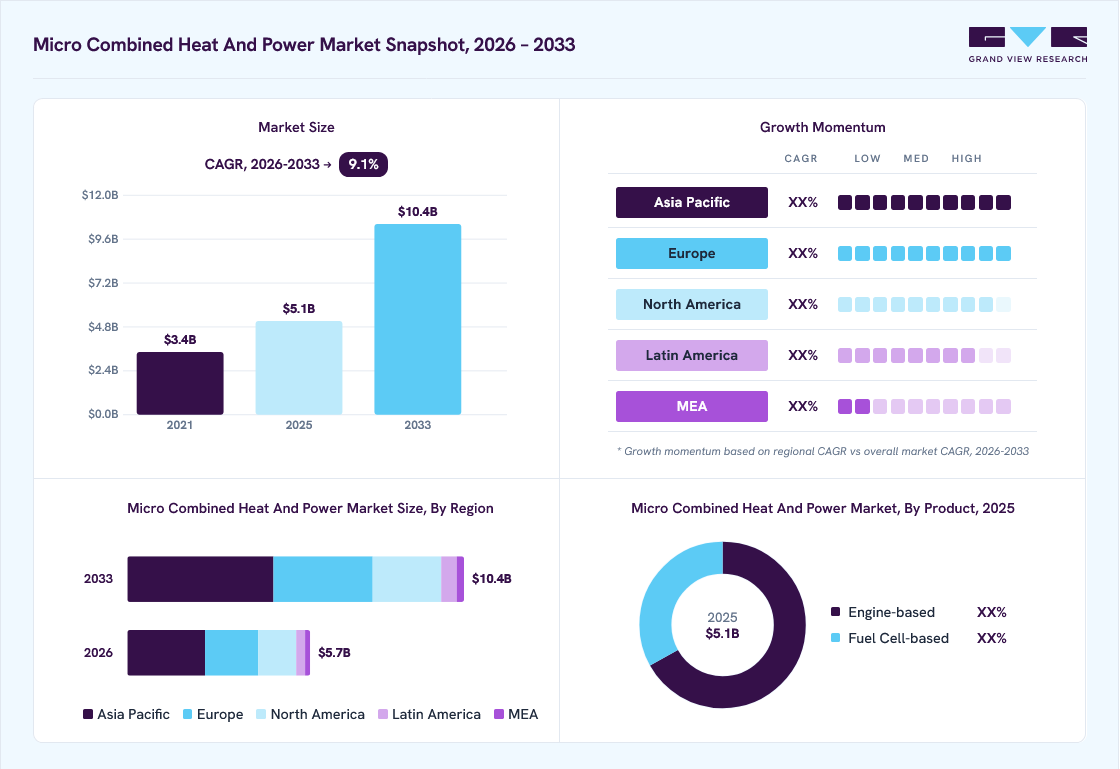 Source: Grand View Research, IR Documents, Primary Interviews, Paid DatabasesTo learn more about this report,
 Download Free Sample Report
Key Market Trends & Insights
- By product: Engine-based segment led the market with the largest revenue share of 66.8% in 2025.
- By application: Residential segment led the market with the largest revenue share of 58.6% in 2025.
Regional Highlights
- Largest regional market: Asia Pacific (42.4% revenue share, 2025)
- By country: China held the largest market share in 2025.
Market Size & Forecast
- Market size in 2025: USD 5.1 Billion
- Estimated market size in 2026: USD 5.7 Billion
- Projected market size by 2033: USD 10.4 Billion
- CAGR (2026-2033): 9.1%
GVR research-powered AIAsk Prism AI about the micro combined heat and power marketGet cited answers from GVR research on market growth, segments, regulations and forecasts.Start with✓ Source-linked answers ✓ Market-specific context ✓ Traceable figuresExplore Prism AI ↗Micro combined heat and power (MCHP) systems, particularly those running on natural gas or biofuels, offer lower carbon emissions than grid electricity and traditional heating systems, aligning with government strategies.
These systems are highly efficient compared to traditional separate heat and power generation methods. Therefore, increasingly stringent energy efficiency regulations and targets across the globe have driven the adoption of MCHP systems over the years. Furthermore, MCHP systems can significantly reduce consumer energy costs by utilizing waste heat from power generation for heating purposes. This economic advantage is a major driver for the product's residential and small business sectors. Moreover, this product provides a decentralized energy solution, reducing dependency on centralized power grids and enhancing energy security, particularly in remote or rural areas.
 To learn more about this report, Download Free Sample Report
Advances in microturbine, sterling engines, and fuel cell technologies are making micro combined heat and power systems more reliable, efficient, and affordable. These technological improvements are expanding the feasibility and attractiveness of MCHP solutions, thereby fueling the product adoption in regions.
Local building codes, zoning regulations, and environmental permits may complicate and delay the installation of MCHP systems, adding to their costs and timelines. Furthermore, installing these systems requires expertise and careful integration with existing heating and electrical systems, which can pose a barrier for adoption among consumers and businesses with less knowledge and expertise.
Rapid urbanization, especially in developing regions, presents opportunities for micro-combined heat and power system manufacturers and service providers to cater to new residential and commercial developments seeking sustainable energy solutions. Furthermore, subsidies, tax credits, and grants offered by governments to promote energy efficiency and renewable energy adoption can significantly reduce the financial barriers associated with MCHP system installation.
Market Dynamics
The micro combined heat and power (Micro CHP) market is experiencing robust growth, driven by increasing demand for energy-efficient distributed power generation, rising electricity prices, and stringent carbon emission reduction targets. Governments across Europe, Asia-Pacific, and North America are promoting decentralized energy systems through financial incentives, energy efficiency regulations, and net-zero emission policies. Advancements in fuel cell technology, hydrogen-ready CHP systems, and smart energy management solutions are further enhancing system performance and expanding deployment across residential and commercial sectors. Additionally, growing investments in resilient energy infrastructure and increasing adoption of on-site power generation are supporting long-term market growth.
The increasing demand for decentralized power generation and improved energy efficiency is a major driver of the micro combined heat and power (Micro CHP) market. Unlike conventional systems that generate electricity and heat separately, Micro CHP systems produce both simultaneously from a single fuel source, significantly improving fuel utilization and reducing energy losses. With rising electricity prices, growing concerns over grid reliability, and the need to lower operational energy costs, residential homeowners, commercial buildings, hospitals, hotels, and educational institutions are increasingly adopting Micro CHP systems to achieve reliable on-site power generation and efficient heating.
In addition, governments across Europe, North America, and the Asia-Pacific are implementing stringent energy efficiency regulations and offering financial incentives, tax credits, and subsidy programs to encourage the deployment of distributed energy technologies. The growing emphasis on reducing greenhouse gas emissions, improving energy security, and supporting net-zero building initiatives is accelerating the installation of Micro CHP systems. Continuous technological advancements, including high-efficiency fuel cells, hydrogen-ready CHP units, and intelligent energy management systems, are further enhancing system performance, reducing operating costs, and expanding the range of residential and commercial applications.
Despite their long-term operational savings, Micro CHP systems require relatively high upfront investments for equipment, installation, and integration with existing heating infrastructure. Fuel cell-based systems, while offering superior efficiency and lower emissions, remain significantly more expensive than conventional heating systems. Economic viability also depends on local electricity prices, natural gas availability, policy incentives, and annual operating hours. In regions with low electricity costs or limited government support, longer payback periods continue to restrain wider market adoption.
The global transition toward low-carbon energy systems presents significant growth opportunities for the Micro CHP market. Manufacturers are increasingly developing hydrogen-compatible Micro CHP units capable of operating on natural gas-hydrogen blends and, ultimately, pure hydrogen as hydrogen infrastructure expands. Rapid advancements in solid oxide fuel cells (SOFC) and proton exchange membrane fuel cells (PEMFC) are improving electrical efficiency, reducing emissions, and extending system lifespans.
Market Concentration & Characteristics
The Micro CHP market is experiencing steady innovation, particularly in fuel cell technologies that offer higher efficiency and near-zero emissions. Advancements in hydrogen-compatible systems and integration with solar PV and battery storage are shaping next-generation solutions. Manufacturers are also enhancing remote monitoring, modularity, and automation features. Smart grid compatibility and real-time energy optimization are emerging priorities. These innovations improve grid resilience and sustainability. While not disruptive, innovation is technically intensive and value-driven.
 To learn more about this report, Download Free Sample Report
Regulatory frameworks strongly influence the Micro CHP market through decarbonization mandates, clean energy subsidies, and building energy codes. Governments in Europe, Japan, and parts of North America offer tax credits, rebates, and feed-in tariffs for high-efficiency, low-emission systems. Net-zero targets and emissions caps are prompting adoption in residential and commercial sectors.
Analyst Perspective
The global micro combined heat and power (Micro CHP) market is gaining momentum as demand for decentralized, energy-efficient power generation continues to rise. Growing adoption of fuel cell technologies, supportive decarbonization policies, and increasing integration of hydrogen-ready systems are accelerating market growth, while advancements in smart energy management and distributed generation are strengthening the long-term outlook. Additionally, rising investments in resilient building infrastructure and the modernization of residential and commercial heating systems are further expanding the adoption of Micro CHP solutions worldwide.
Product Insights
By product, the engine-based segment led the market with the largest revenue share of 66.8% in 2025. The market is segmented into engine-based and fuel cell-based MCHP systems. The Engine-based segment led the market with the largest revenue share of 68.8% in 2024. Engine-based micro combined heat and power (MCHP) systems dominated due to their reliability, efficiency, and cost-effectiveness, particularly those utilizing natural gas. These systems are widely adopted in residential and commercial applications, contributing to their substantial market share. Their ability to provide both heat and electricity from a single energy source makes them a preferred choice for a wide range of end-users.
The fuel cell-based segment is expected to witness a robust CAGR of 16.3% over the forecast period. Fuel cells offer higher electrical efficiency than traditional combustion engines, with negligible emissions of pollutants. They operate silently, making them suitable for residential and urban environments without noise concerns. Furthermore, fuel cells generally have longer maintenance intervals and lower maintenance requirements than engines, reducing operational downtime and costs.
Application Insights
By application, the residential segment led the market with the largest revenue share of 58.6% in 2025. Many residential units are adopting MCHP systems in order to save cost. By generating electricity on-site and utilizing waste heat for space heating and hot water, homeowners can significantly reduce energy bills. Furthermore, these systems offer homeowners a degree of energy independence by reducing reliance on the grid.
 To learn more about this report, Download Free Sample Report
Commercial MCHP systems are larger and more powerful compared to residential systems, designed to meet the energy needs of small to medium-sized commercial buildings, hotels, hospitals, and other facilities. Commercial facilities have high energy demands, making MCHP systems an attractive option for reducing electricity and heating costs, especially in buildings with constant heating and cooling needs. Furthermore, to fulfill corporate sustainability goals and regulatory pressures related to use of cleaner energy technologies like MCHP systems, which can reduce carbon footprints compared to conventional energy sources is further expected to fuel its demand.
Regional Insights
The micro combined heat and power (MCHP) market in North America is expected to grow at a significant CAGR over the forecast period, on account of fluctuating energy costs and the desire for energy cost stability, driving interest in MCHP systems for residential and commercial applications. In addition, policies promoting renewable energy integration and carbon reduction initiatives support the deployment of these systems, which can utilize renewable fuels or hydrogen.
U.S. Micro Combined Heat And Power Market Trends
The U.S. Micro Combined Heat and Power (MCHP) market is expected to develop significantly during the forecast period. Growth is triggered by mounting federal and state-level incentives to boost clean and efficient energy technologies. Increasing energy prices and demand for trustworthy on-site power generation motivate adoption in residential and commercial segments.
Europe Micro Combined Heat And Power Market Trends
Europe's micro combined heat and power (MCHP) market held a considerable share in 2025. Stringent energy efficiency mandates and carbon reduction targets set by the European Union drive demand for efficient technologies like MCHP systems. Furthermore, favorable policy frameworks and financial incentives, such as feed-in tariffs and subsidies, encourage the deployment of combined heat and power technologies, therebyfueling product adoption in the region.
Asia Pacific Micro Combined Heat And Power Market Trends
Asia Pacific dominated the micro combined heat and power market with the largest revenue share of 42.4% in 2025. Rapid urbanization and industrialization in countries like China, India, and Southeast Asian nations have led to increased demand for electricity and heating. Furthermore, many countries in the Asia Pacific face severe air pollution issues, driving policies supporting the use of cleaner energy technologies such as MCHP systems, which can use cleaner fuels or operate more efficiently than conventional power plants.
 To learn more about this report, Download Free Sample Report
Key Micro Combined Heat And Power Company Insights
The Micro Combined Heat and Power (MCHP) market is fragmented and has multiple players operating in different segments. Over the last few years, there has been a significant rise in product innovation and market growth, fueled by circular economy goals, improvements in material and technological advancements, and increasing consumer demand for energy-efficient, sustainable products.
-
Axiom Energy Group, LLC manufactures microCHP, marathon engine, custom remote power, and vapor recovery systems. It operates a 70,000 sq. ft. manufacturing facility. Its microCHP offers various features and benefits, such as affordability, reduced carbon emissions, and a long-lasting engine.
-
Yanmar Holdings Co., Ltd was established in 1912. Its business areas include agriculture, marine, energy systems, compact equipment, industrial, commercial, and component businesses. The company offers various products and services under the above-mentioned business categories
Key Micro Combined Heat And Power Companies:
The following key companies have been profiled for this study on the micro combined heat and power market.
-
Viessmann Group
-
Axiom Energy Group, LLC.
-
EC Power A/S
-
Yanmar Holdings Co. Ltd.
-
Vaillant Group
-
SOLIDpower Group
-
Remeha
-
2G Energy Inc.
-
ATCO Ltd
-
Enginuity Power Systems
Competitive Benchmarking
Category
Operating Strategies
Competitive Edge
Weakness
Established Players (Aisin Corporation, BDR Thermea Group (Remeha), Bosch Home Comfort Group, Honda Motor Co., Ltd., Mitsubishi Heavy Industries, Ltd., Viessmann Group, Yanmar Holdings Co., Ltd.)
- Enhance Micro CHP portfolios through continuous innovation in engine-based and fuel cell-based technologies.
- Expand market presence by strengthening distribution channels, service capabilities, and strategic partnerships.
- Increase investment in hydrogen-ready systems and intelligent energy management platforms for future growth.
- Benefit from recognized brands supported by extensive manufacturing capabilities and global sales networks.
- Maintain diversified product portfolios serving residential, commercial, and distributed energy applications worldwide.
- Leverage strong financial resources and technical expertise to sustain long-term competitive positioning.
- Face substantial investment requirements for product development, manufacturing, and technology upgrades.
- Depend on favorable government incentives and regulatory frameworks to support market expansion.
- Encounter increasing competition from alternative low-carbon heating and distributed energy technologies.
Emerging & Regional Players (2G Energy AG, Ceres Power plc, EC Power A/S)
- Focus on specialized high-efficiency CHP technologies tailored to residential and commercial applications.
- Expand commercialization through technology licensing, strategic collaborations, and regional market partnerships.
- Develop advanced hydrogen-compatible systems and digital monitoring solutions to strengthen product offerings.
- Possess specialized technological expertise in advanced CHP systems with high operating efficiency.
- Demonstrate greater flexibility in product innovation and faster adoption of emerging technologies.
- Capitalize on niche market opportunities through customized solutions and focused business strategies.
- Operate with relatively smaller production capacity and narrower global distribution networks.
- Rely heavily on partnerships and project-based deployments to accelerate commercial expansion.
- Remain more exposed to technology adoption risks and changing government support programs.
Recent Developments
-
In May 2025, Enginuity Power Systems launched the E|200, a 200kW Combined Heat and Power (CHP) system certified to UL2200 standards and designed to emit significantly below EPA thresholds.
-
In May 2025, Axiom Energy Group, LLC. entered into a strategic partnership with Global Clean Energy Inc. to launch a new Cogeneration Division.
Micro Combined Heat & Power Market Report Scope
Report Attribute
Details
Market definition
The micro combined heat and power (micro-CHP) market includes revenues from the sales of engine-based and fuel cell-based micro-CHP systems used for commercial and residential applications, excluding installation, maintenance, fuel, and service revenues.
Market size in 2025
USD 5.1 billion
Estimated market size in 2026
USD 5.7 billion
Projected market size by 2033
USD 10.4 billion
Growth rate
CAGR of 9.1% from 2026 to 2033
Base year for estimation
2025
Historical data
2021 - 2024
Forecast period
2026 - 2033
Quantitative units
Revenue in USD million and CAGR from 2026 to 2033
Report coverage
Revenue forecast, company ranking, competitive landscape, growth factors, and trends
Segments covered
Product, application, region
Regional scope
North America; Europe; Asia Pacific; Latin America; Middle East & Africa
Country scope
U.S.; Canada; Mexico; UK; Germany; France; Italy; Spain; China; India; Japan; South Korea; Brazil; Argentina
Key companies profiled
Aisin Corporation; BDR Thermea Group (Remeha); Bosch Home Comfort Group; Ceres Power plc; EC Power A/S; Honda Motor Co., Ltd.; Mitsubishi Heavy Industries, Ltd.; Viessmann Group; Yanmar Holdings Co., Ltd.; 2G Energy AG
Customization scope
Free report customization (equivalent up to 8 analysts' working days) with purchase addition or alteration to country, regional & segment scope.
Pricing and purchase options
Avail customized purchase options to meet your exact research needs. Explore purchase options
Global Micro Combined Heat And Power Market Report Segmentation
This report forecasts revenue growth at regional & country levels and provides an analysis of the industry trends in each of the segments from 2021 to 2033. For this study, Grand View Research has segmented the global micro combined heat and power market report based on product, application, and region:
 To learn more about this report, Download Free Sample Report
-
Product Outlook (Revenue, USD Million, 2021 - 2033)
-
Engine-based
-
Fuel Cell-based
-
-
Application Outlook (Revenue, USD Million, 2021 - 2033)
-
Commercial
-
Residential
-
-
Regional Outlook (Revenue, USD Million, 2021 - 2033)
-
North America
-
U.S.
-
Canada
-
Mexico
-
-
Europe
-
Germany
-
UK
-
France
-
Italy
-
Spain
-
-
Asia Pacific
-
China
-
Japan
-
India
-
South Korea
-
-
Central & South America
-
Brazil
-
Argentina
-
-
Middle East & Africa
-
Research Methodology
The micro combined heat and power market figures in this report are based on a proven research process that combines executive interviews with secondary research from proprietary databases, company filings, and recognized regulatory and institutional sources. Market size is built through value-chain sizing—reconciling supply-side and demand-side estimates—and triangulated with bottom-up and top-down approaches. Every estimate passes multiple levels of expert validation before publication, with each micro combined heat and power segment quantified using the revenue-capture definitions in the table below.
Segment Definition
Product
Revenue Capture Definition
Engine-based
This segment includes revenue generated from the sale, installation, and servicing of engine-based micro combined heat and power (Micro CHP) systems, primarily powered by natural gas or LPG. These systems simultaneously generate electricity and useful heat for residential and small commercial applications, with revenue captured from equipment sales, installation, maintenance, and aftermarket services.
Fuel Cell-based
This segment comprises revenue generated from the sale, installation, and maintenance of fuel cell-based Micro CHP systems that produce electricity and heat through electrochemical conversion of fuels such as natural gas or hydrogen. Revenue is derived from system sales, integration services, software and control systems, replacement components, and long-term service contracts.
Application
Revenue Capture Definition
Commercial
This segment covers revenue generated from the deployment of Micro CHP systems across commercial facilities, including hotels, hospitals, educational institutions, offices, retail buildings, and small industrial establishments. Revenue includes equipment sales, engineering, installation, commissioning, maintenance, and energy management services.
Residential
This segment includes revenue generated from the installation and operation of Micro CHP systems in single-family and multi-family residential buildings for combined electricity generation and space and water heating. Revenue is captured through system sales, installation, replacement parts, maintenance services, and long-term service agreements.
Estimation Model
Layer Name
Key Question
Description
Energy Demand & Distributed Generation Layer
What constitutes the demand base for Micro CHP systems?
Assess electricity and thermal energy demand across residential and commercial buildings, natural gas availability, heating requirements, distributed energy adoption, and government energy efficiency initiatives. Evaluate building stock, urbanization, energy costs, carbon reduction policies, and demand for reliable on-site power generation that drive Micro CHP adoption.
Technology Adoption & System Deployment Layer
How is demand generated across Micro CHP technologies?
Analyze the deployment of engine-based and fuel cell-based Micro CHP systems across residential and commercial applications. Assess government incentive programs, replacement of conventional boilers, adoption of fuel cell technologies, hydrogen-ready systems, smart energy management integration, and regional installation trends influencing market expansion.
Capital Investment & Installation Spending Analysis Layer
How are investments distributed across the Micro CHP value chain?
Evaluate capital expenditure on Micro CHP equipment, installation, engineering, commissioning, fuel cell stacks, engines, control systems, maintenance, and digital energy management solutions. Assess investment patterns by technology, application, capacity range, model, and geographic region to determine spending across the value chain.
Pricing & Market Value Assessment Layer
What is the revenue potential of the market?
Assess pricing trends for engine-based and fuel cell-based Micro CHP systems, installation services, operation and maintenance contracts, replacement components, and energy management software across major regions. Evaluate the impact of system capacity, technology type, fuel source, installation complexity, government incentives, and component costs on revenue generation. This layer establishes the overall market value across products, applications, and geographies while ensuring consistency with distributed energy demand, energy efficiency investments, and technology adoption trends.
Delivered Customizations
This report has been delivered with the following In-depth customizations
Client Request
Customization Delivered
Value Adds
Technology Benchmarking & Performance Analysis
Assessed engine-based and fuel cell-based Micro CHP technologies based on electrical efficiency, thermal efficiency, fuel flexibility, emissions, operating costs, system lifespan, and application suitability across residential and commercial sectors.
Supported technology selection, enabled competitive benchmarking, and identified the most suitable solutions for different end-use applications.
Hydrogen-Ready & Fuel Cell Opportunity Assessment
Analyzed the adoption potential of hydrogen-compatible Micro CHP systems, advancements in fuel cell technologies, smart energy management integration, and future commercialization opportunities across key markets.
Enabled prioritization of emerging technology investments, identified long-term growth opportunities, and strengthened strategic positioning in the evolving low-carbon energy landscape.
Policy Incentives & Regional Adoption Assessment
Evaluated government incentives, subsidy programs, feed-in tariffs, carbon reduction policies, energy efficiency regulations, and regional deployment trends influencing Micro CHP adoption across major countries.
Enabled identification of high-growth regional markets, supported market entry strategies, and assessed the impact of policy frameworks on future demand.
Frequently Asked Questions About This Report
Europe is anticipated to register the second fastest CAGR of 9.4% over the forecast period.
Engine-based segment led the market with the largest revenue share of 66.8% in 2025.
The micro combined heat and power market is expected to grow at a CAGR of 9.1% from 2026 to 2033, reaching USD 10.4 billion by 2033.
The key factor driving the growth of the global micro combined heat and power market is the increasing demand for energy-efficient, decentralized power generation solutions that simultaneously reduce energy costs and carbon emissions.
Residential segment led the market with the largest revenue share of 58.6% in 2025.
Asia Pacific market dominated, with a revenue share of 42.4% in 2025.
The key players operating in the micro combined heat and power market are Aisin Corporation; BDR Thermea Group (Remeha); Bosch Home Comfort Group; Ceres Power plc; EC Power A/S; Honda Motor Co., Ltd.; Mitsubishi Heavy Industries, Ltd.; Viessmann Group; Yanmar Holdings Co., Ltd.; 2G Energy AG, among others.
The micro combined heat and power market size was valued at USD 5.1 billion in 2025 and is estimated at USD 5.7 billion in 2026.
About the Author(s)
Power Generation & Storage Research Team
Energy & Power · Power Generation & StorageThis report was authored by the power generation & storage research team at Grand View Research - comprising two research analysts, one senior research analyst, and one industry expert - with specialized expertise in the power generation & storage segment of the energy & power industry. All findings are based on proprietary energy & power databases, executive interviews, and regulatory analysis, subject to internal peer review prior to publication.
Last Updated:
Speak to Analyst

Customize this report to your needs - add regions, segments, or data points, with 20% free customization.
Or view our licence options:


ISO 9001:2015 & 27001:2022 Certified
We are GDPR and CCPA compliant! Your transaction & personal information is safe and secure. For more details, please read our privacy policy.


