
- Home
- »
- Next Generation Technologies
- »
-
Microbolometer Market Size And Share Report, 2026-2033GVR Report cover

Microbolometer Market (2026 - 2033)
Size, Share & Trends Analysis Report By Resolution, By Material (Vanadium Oxide, Amorphous Silicon), By Application (Aerospace and Defense, Automotive, Security & Surveillance, Healthcare), By Region, And Segment Forecasts
Market Size, 2025
$524.9MMarket Estimate, 2026
$557.2MMarket Forecast, 2033
$898.1MCAGR, 2026–2033
7.1%Microbolometer Market Summary
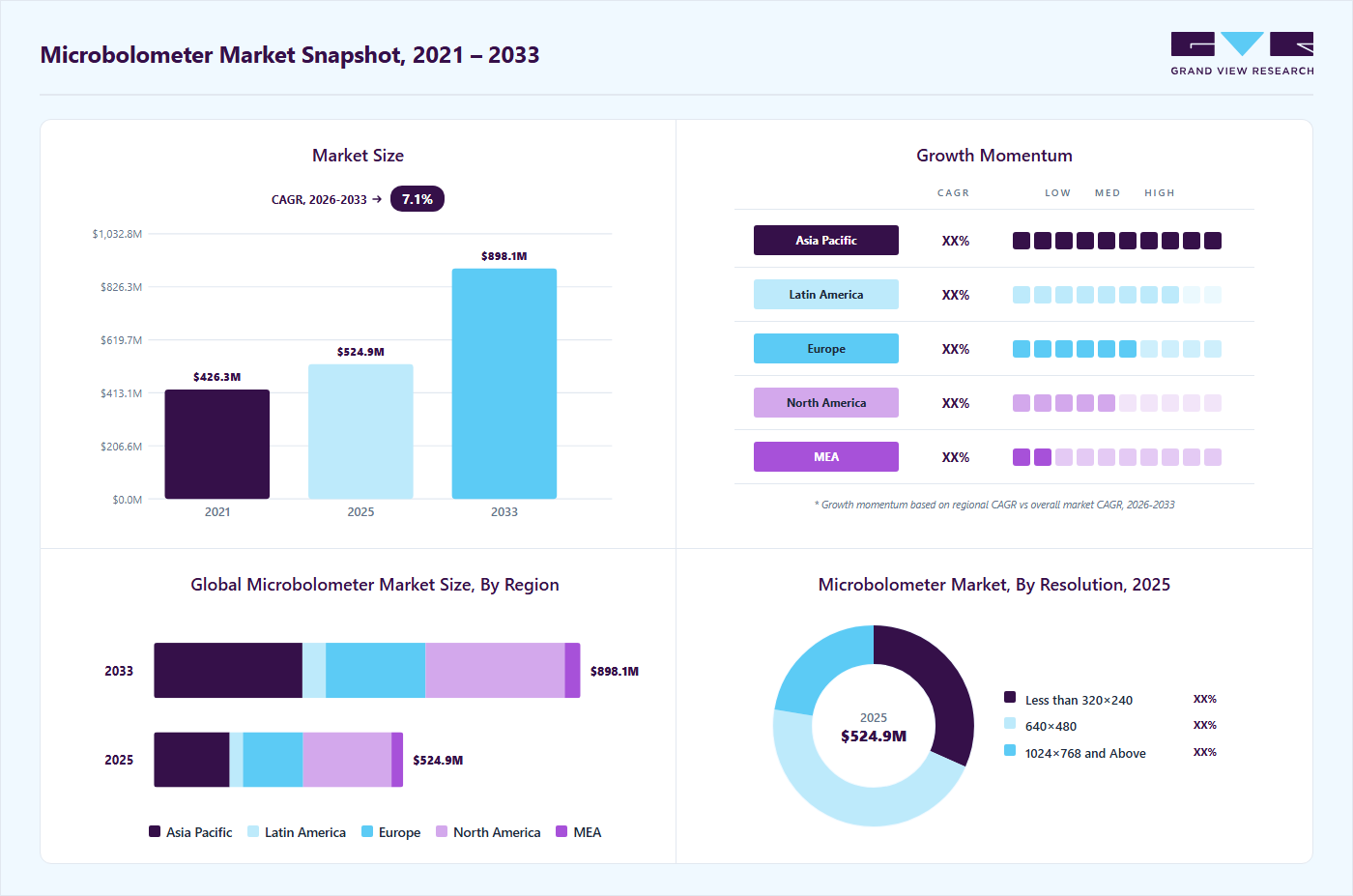
The global microbolometer market size was valued at USD 524.9 million in 2025 and is projected to grow from USD 557.2 million in 2026 to USD 898.1 million by 2033, at a CAGR of 7.1% from 2026 to 2033. The North America held the largest share of 35.4% of the global market in 2025. This market expansion is driven by the increasing adoption of uncooled infrared imaging technologies across defense, automotive, and industrial applications, the growing integration of thermal sensing capabilities into smart devices and autonomous systems, and the rising demand for cost-effective, high-performance thermal cameras to enhance safety, monitoring, and predictive maintenance operations.
 Source: Grand View Research, IR Documents, Primary Interviews, Paid DatabasesTo learn more about this report,
 Download Free Sample Report
 Key Market Trends & Insights
- By resolution: 640×480 segment held the largest market share of 45.9% in 2025.
- By material: Vanadium oxide segment accounted for the largest share in 2025.
- By application: Aerospace and defense segment accounted for the largest market revenue share in 2025.
Regional Highlights
- Largest regional market: North America (35.4% revenue share, 2025)
- Fastest-growing regional market: Asia Pacific (highest CAGR of 8.0%, 2026-2033)
- By country: The U.S. held the largest market share in North America in 2025.
Market Size & Forecast
- Market size in 2025: USD 524.9 Million
- Estimated market size in 2026: USD 557.2 Million
- Projected market size by 2033: USD 898.1 Million
- CAGR (2026-2033): 7.1%
Three ways to get this report
Buy it, customize it, or ask a question.Ask an Analyst
A direct answer, usually in 1 working day
- AccessReport author, directly
- Reply timeWithin 1 working day
- No sales callDirect answer only
- FormatEmail reply
- CostFree, no cost
Get the Full Report
What the study covers
- FormatsPDF · Excel · Dashboard
- Timeline2026–2033 annual, 2025 base
- Coverage20+ countries, 5 regions
- Companies10+ key players profiled
Customize the Report
20% free customization
- IncludeCountries, segments, points
- TailorTo your product definition
- ExtendDeeper competitor detail
- OrA fully bespoke study
- Turnaround5–10 working days
The growth of the microbolometer industry is driven by the convergence of advanced infrared sensing technologies, miniaturization, and intelligent imaging systems that enhance thermal detection capabilities. The adoption of compact, uncooled microbolometer sensors is accelerating as defense forces, automotive manufacturers, and industrial operators seek reliable, low-power thermal imaging solutions. Advanced image processing algorithms, AI-enabled analytics, and integration with IoT and smart monitoring platforms enable real-time thermal diagnostics, predictive maintenance, and automated threat detection, reducing operational risks and improving system performance in the microbolometer industry.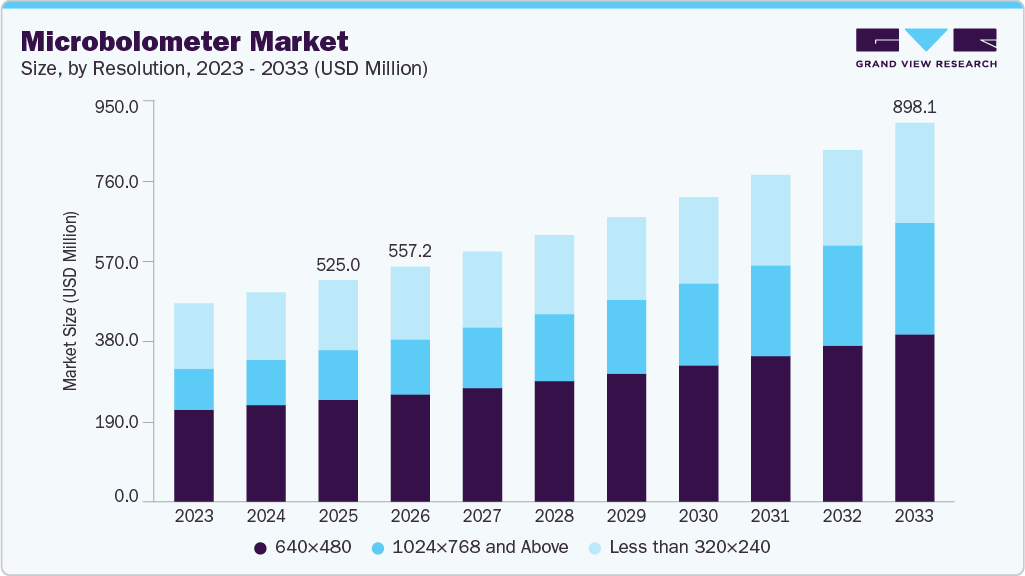 To learn more about this report, Download Free Sample Report
 The rapid advancement of high-resolution uncooled infrared sensor technologies and wafer-level packaging techniques is significantly transforming thermal imaging capabilities by enabling smaller, lighter, and more energy-efficient microbolometer modules. These innovations leverage improved pixel sensitivity and noise-reduction mechanisms to deliver clearer thermal images in compact form factors, enabling deployment across handheld devices, drones, and portable inspection systems. The integration of advanced semiconductor manufacturing processes further supports scalable production and cost optimization, allowing manufacturers to expand adoption across industrial, security, and consumer applications.
Furthermore, the market is witnessing growing momentum toward the integration of microbolometers into automotive safety and autonomous driving platforms designed to enhance perception in low-visibility conditions. Vehicle manufacturers are increasingly incorporating thermal imaging sensors into advanced driver assistance systems (ADAS) to improve pedestrian detection, animal recognition, and night-time hazard identification. This shift toward enhanced vehicle safety and sensor fusion technologies is enabling automakers to strengthen collision avoidance capabilities while meeting evolving regulatory and consumer safety expectations in next-generation mobility ecosystems.
Moreover, the expansion of smart infrastructure, industrial automation, and energy management initiatives is driving demand for thermal monitoring solutions. Industrial operators are increasingly investing in microbolometer-based thermal cameras to monitor electrical systems, mechanical equipment, and building performance in real time, enabling early fault detection and reduced maintenance downtime. This growing emphasis on asset reliability and energy optimization is strengthening the role of advanced thermal sensing technologies across manufacturing plants, utilities, and commercial facilities.
In addition, the rising deployment of thermal imaging technologies in healthcare diagnostics, public safety, and environmental monitoring is reshaping application opportunities across the microbolometer industry. Hospitals, emergency responders, and municipal authorities are increasingly adopting non-contact temperature screening, search-and-rescue imaging, and wildfire detection systems powered by microbolometer sensors to improve response accuracy and operational readiness. This transition toward mission-critical thermal intelligence solutions and system integration positions microbolometer manufacturers to meet the evolving demands of safety, healthcare, and environmental resilience programs.
Resolution Insights
The 640×480 segment led the market with the largest revenue share of 45.9% in 2025, driven by its optimal balance between image clarity, processing efficiency, and cost-effectiveness. Industries and public safety agencies are prioritizing investments in mid-resolution thermal cameras that deliver reliable performance for routine inspection and firefighting operations. The continued expansion of predictive maintenance programs in manufacturing facilities, utilities, and commercial infrastructure further reinforces the segment’s leading position, as organizations increasingly deploy standardized thermal imaging solutions capable of delivering accurate diagnostics in the market.
The 1024×768 and above segment is expected to witness at the fastest CAGR of 10.6% from 2026 to 2033. The rising demand for ultra-high-resolution thermal imaging in defense surveillance, autonomous vehicles, and advanced research applications is driving the segment's growth. Governments and technology developers are increasingly deploying high-definition infrared sensors capable of detecting smaller temperature variations and providing enhanced situational awareness. The growing focus on precision targeting, long-range monitoring, and AI-enabled image analytics is expected to support expansion in the high-resolution segment of the microbolometer industry.
Material Insights
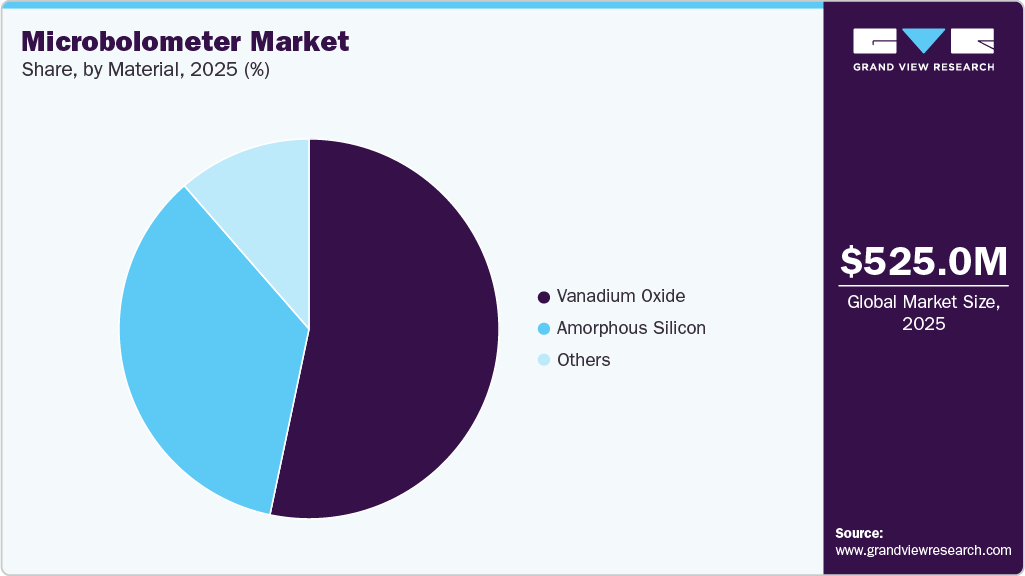
The vanadium oxide segment led the market with the largest revenue share of 53.3% in 2025, driven by its superior thermal sensitivity and stability, which make it highly suitable for mission-critical thermal imaging applications. Defense agencies are increasingly investing in high-performance infrared sensors capable of delivering accurate temperature detection and reliable performance. The expansion of border surveillance programs, critical infrastructure protection initiatives, and advanced industrial automation systems is encouraging manufacturers to adopt vanadium oxide-based microbolometer to ensure consistent detection accuracy in the global market.
 To learn more about this report, Download Free Sample Report
 The amorphous silicon segment is expected to witness at a significant CAGR from 2026 to 2033, owing to its compatibility with standard semiconductor fabrication processes and ability to support high-volume production at competitive costs. The rapid expansion of smart home ecosystems, wearable thermal sensors, and next-generation driver assistance systems is accelerating the adoption of amorphous silicon technology, enabling broader commercialization of compact and energy-efficient thermal imaging solutions across emerging digital and connected device environments.
Application Insights
The aerospace and defense segment accounted for the largest revenue share in 2025, driven by the increasing deployment of advanced thermal imaging systems for border surveillance, battlefield awareness, and unmanned aerial vehicle (UAV) operations. Governments and defense agencies are prioritizing investments in next-generation infrared sensing technologies to enhance night-time detection, target tracking, and reconnaissance capabilities. The expansion of military modernization programs and space-based monitoring missions is encouraging defense organizations to integrate high-performance microbolometer sensors into aircraft systems to ensure operational readiness and mission reliability.
The automotive segment is expected to witness at the fastest CAGR from 2026 to 2033. This growth is driven by the rising integration of thermal imaging technologies into advanced driver assistance systems (ADAS) and autonomous vehicle platforms. Automotive manufacturers are increasingly adopting compact microbolometer modules to support pedestrian detection, night vision enhancement, and collision avoidance in low-visibility conditions. The growing focus on vehicle safety regulations, smart mobility solutions, and sensor fusion technologies is accelerating the adoption of thermal imaging sensors in the microbolometer industry.
Regional Insights
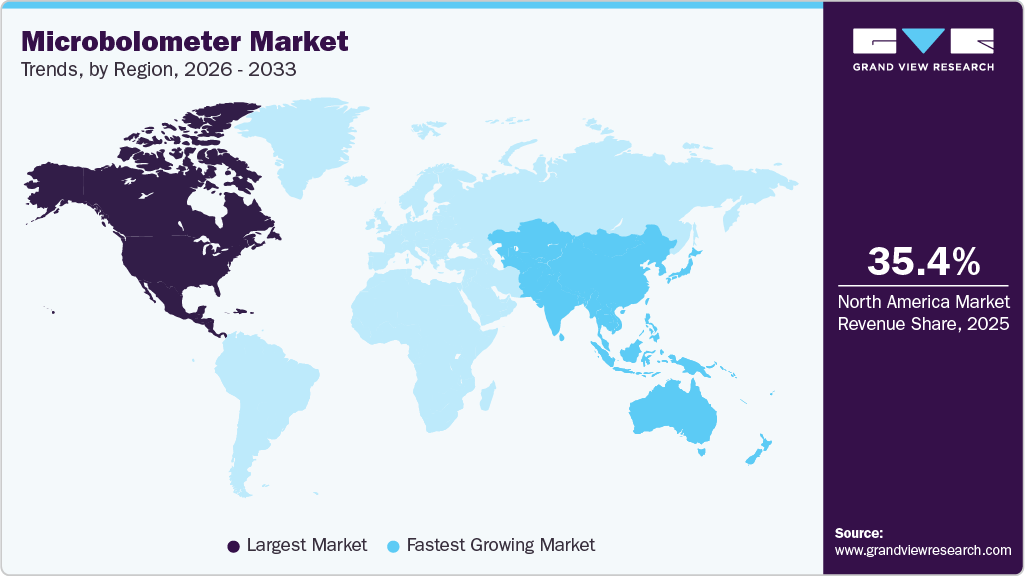
North America dominated the global microbolometer market with the largest revenue share of 35.4% in 2025, driven by the strong presence of advanced defense and aerospace programs, along with the increasing deployment of thermal imaging technologies in homeland security and border surveillance operations. The region is witnessing robust adoption of high-performance infrared sensors for military modernization, critical infrastructure protection, and industrial monitoring applications. The expansion of smart manufacturing initiatives and the rising demand for predictive maintenance solutions across utilities and energy sectors are further strengthening market growth.
 To learn more about this report, Download Free Sample Report
 U.S. Microbolometer Market Trends
The microbolometer market in the U.S. accounted for the largest market revenue share in North America in 2025, fueled by increasing investments in next-generation thermal imaging systems, including AI-enabled surveillance cameras and advanced driver assistance systems (ADAS). The rising focus on enhancing situational awareness in defense operations and improving safety standards in automotive and industrial environments is encouraging the deployment of high-resolution thermal sensors. The expansion of domestic semiconductor manufacturing capabilities and the growing role of technology companies in infrared imaging innovation are contributing to sustained market growth in the country.
Europe Microbolometer Market Trends
The microbolometer market in Europe is expected to grow at a significant CAGR of 6% from 2026 to 2033. The market growth is driven by the increasing adoption of energy efficiency and sustainability initiatives across industrial and commercial infrastructure. The region is experiencing a surge in demand for compact, low-power thermal imaging modules for automation, smart city surveillance, and environmental monitoring applications. The integration of advanced imaging analytics and sensor fusion technologies is supporting improved operational safety in this industry.
The UK microbolometer market held a significant share in Europe in 2025, driven by the rising implementation of intelligent public safety and security frameworks supported by advanced thermal imaging systems. Increasing collaboration between research institutions and technology providers is fostering innovation in compact infrared sensors and portable thermal cameras. The growing focus on strengthening national security infrastructure and emergency response capabilities is indirectly boosting demand for the microbolometer industry.
The microbolometer market in Germany is fueled by the increasing focus on Industry 4.0 adoption within manufacturing and industrial automation environments and the deployment of high-precision thermal monitoring equipment. The country is witnessing a rising demand for infrared-based inspection systems that enable early fault detection in machinery and production lines. A strong emphasis on engineering excellence and industrial digitalization is driving the development of highly reliable, durable, and technologically advanced thermal sensing solutions.
Asia Pacific Microbolometer Market Trends
The microbolometer market in the Asia-Pacific is expected to grow at the fastest CAGR of 8% over the forecast period, driven by the rapid expansion of consumer electronics manufacturing and the increasing integration of thermal imaging sensors into smartphones, drones, and smart home devices. The region is experiencing rising adoption of cost-effective uncooled infrared technologies, enabling broader deployment across security, industrial inspection, and healthcare screening applications. The growing penetration of smart city infrastructure and surveillance networks is enhancing demand for advanced thermal imaging solutions across emerging economies in the market.
The Japan microbolometer market is gaining traction owing to the increasing adoption of robotics, precision electronics, and advanced sensing technologies in industrial automation and public safety systems. The country is focusing on integrating compact, high-sensitivity thermal imaging modules into automated inspection equipment and disaster monitoring systems. The growing emphasis on disaster preparedness and infrastructure resilience is driving investments in reliable, high-performance microbolometer solutions.
The microbolometer market in China is rapidly expanding. China's market is driven by the increasing localization of infrared sensor manufacturing and the rapid development of technologically advanced domestic semiconductor suppliers. The country is witnessing strong growth in smart surveillance and defense modernization programs that incorporate AI-powered thermal imaging systems. The expansion of large-scale industrial facilities and critical infrastructure projects is accelerating demand for high-volume and cost-efficient microbolometer technologies across the country.
Key Microbolometer Company Insights
Some of the key players operating in the market are Teledyne Technologies Inc. and Lynred, among others.
-
Teledyne Technologies Inc. is a global provider of advanced infrared sensing and thermal imaging solutions, offering a broad portfolio of uncooled microbolometer detectors and thermal camera cores widely used across defense, industrial inspection, and security applications. The company’s strong technological capabilities, extensive product ecosystem, and integration of advanced sensor technologies following the acquisition of FLIR have strengthened its position as one of the most dominant players in the global industry, enabling large-scale deployment of high-performance thermal imaging systems across military and commercial sectors.
-
Lynred is a global supplier of infrared detectors and microbolometer technologies, delivering high-sensitivity thermal imaging sensors for aerospace, defense, industrial automation, and automotive applications. The company’s continuous investments in next-generation infrared technologies, including compact pixel architectures and advanced detector manufacturing, along with its leadership position in Europe’s infrared sensor ecosystem, make it one of the most influential and technologically advanced companies in the microbolometer industry.
Guide Sensmart Tech Co., Ltd. and Zhejiang Dali Technology Co., Ltd. are some of the emerging market participants in the microbolometer industry.
-
Guide Sensmart Tech Co., Ltd. is rapidly expanding as an emerging player in the microbolometer industry by developing cost-effective thermal imaging cameras and infrared sensor modules designed for industrial inspection, public safety, and commercial surveillance applications. The company’s focus on expanding manufacturing capacity, improving sensor affordability, and targeting high-growth markets such as smart infrastructure and security systems is strengthening its competitive position and enabling broader adoption of microbolometer-based imaging technologies across developing regions.
-
Zhejiang Dali Technology Co., Ltd. is emerging as a significant regional manufacturer of thermal imaging systems and uncooled infrared detectors, supplying microbolometer-based solutions for defense, industrial monitoring, and firefighting applications. The company’s increasing focus on domestic technology development, expansion of infrared product portfolios, and growing participation in government and infrastructure projects are positioning it as one of the growing companies in the global market.
Key Microbolometer Companies:
The following key companies have been profiled for this study on the microbolometer market.
- Teledyne Technologies Inc.
- Lynred
- BAE Systems
- RTX Corporation
- L3Harris Technologies, Inc.
- NEC Corporation
- Zhejiang Dali Technology Co., Ltd.
- Leonardo DRS Inc.
- Guide Sensmart Tech Co., Ltd.
- Hamamatsu Photonics K.K.
Recent Developments
-
In February 2026, Teledyne Technologies Inc. Incorporated introduced the Lepton XDS dual-sensor thermal module designed for compact drones and industrial inspection systems. The launch highlighted advanced multispectral imaging capabilities combining thermal and visible sensors to improve detection accuracy and enable lightweight integration into autonomous platforms, strengthening the company’s leadership in compact microbolometer solutions.
-
In January 2026, Lynred unveiled the YOCTO1024 uncooled microbolometer featuring an 8.5-micrometer pixel pitch and XGA resolution for high-performance thermal imaging applications. The product demonstrated improved detection, recognition, and identification performance, marking a technological milestone in compact, high-resolution infrared sensing systems for defense and industrial markets.
-
In November 2025, BAE Systems collaborated with international defense agencies to integrate advanced thermal imaging sensors into next-generation surveillance and targeting platforms. The partnership emphasized enhanced situational awareness and operational readiness through the deployment of high-performance microbolometer-based imaging technologies.
Microbolometer Market Report Scope
Report Attribute
Details
Market size in 2025
USD 524.9 million
Estimated market size in 2026
USD 557.2 million
Projected market size by 2033
USD 898.1 million
Growth rate
CAGR of 7.1% from 2026 to 2033
Base year for estimation
2025
Historical data
2021 - 2024
Forecast period
2026 - 2033
Quantitative units
Revenue in USD million/billion, and CAGR from 2026 to 2033
Report Product
Revenue forecast, company ranking, competitive landscape, growth factors, and trends
Segments covered
Resolution, material, application, region
Region scope
North America; Europe; Asia Pacific; Latin America; Middle East & Africa
Country scope
U.S.; Canada; Mexico; UK; Germany; France; China; Japan; India; South Korea; Australia; Brazil; UAE; Saudi Arabia; South Africa
Key companies profiled
Teledyne Technologies Inc.; Lynred; BAE Systems; RTX Corporation; L3Harris Technologies, Inc.; NEC Corporation; Zhejiang Dali Technology Co., Ltd.; Leonardo DRS Inc.; Guide Sensmart Tech Co., Ltd.; Hamamatsu Photonics K.K.
Customization scope
Free report customization (equivalent to up to 8 analyst’s working days) with purchase. Addition or alteration to country, regional & segment scope.
Pricing and purchase options
Avail customized purchase options to meet you exact research needs. Explore purchase options
Global Microbolometer Market Report Segmentation
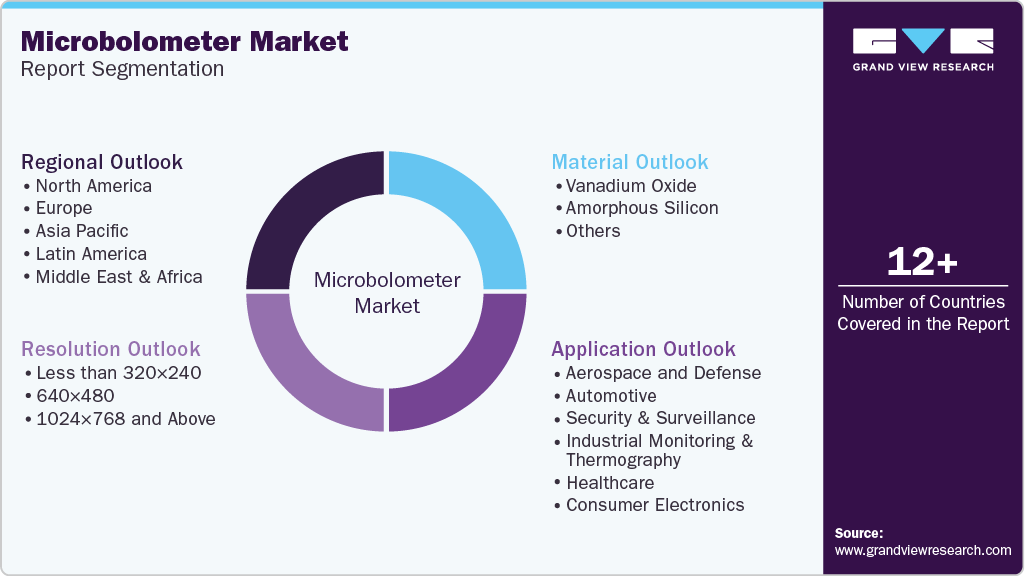
This report forecasts revenue growth at global, regional, and country levels and provides an analysis of the latest technological trends in each of the sub-segments from 2021 to 2033. For this study, Grand View Research has segmented the global microbolometer market report based on resolution, material, application, and region:
 To learn more about this report, Download Free Sample Report
 -
Resolution Outlook (Revenue, USD Million, 2021 - 2033)
-
Less than 320×240
-
640×480
-
1024×768 and Above
-
-
Material Outlook (Revenue, USD Million, 2021 - 2033)
-
Vanadium Oxide
-
Amorphous Silicon
-
Others
-
-
Application Outlook (Revenue, USD Million, 2021 - 2033)
-
Aerospace and Defense
-
Automotive
-
Security & Surveillance
-
Industrial Monitoring & Thermography
-
Healthcare
-
Consumer Electronics
-
Others
-
-
Regional Outlook (Revenue, USD Million, 2021 - 2033)
-
North America
-
U.S.
-
Canada
-
Mexico
-
-
Europe
-
UK
-
Germany
-
France
-
-
Asia Pacific
-
China
-
Japan
-
India
-
South Korea
-
Australia
-
-
Latin America
-
Brazil
-
-
Middle East and Africa (MEA)
-
UAE
-
Saudi Arabia
-
South Africa
-
-
Frequently Asked Questions About This Report
The global microbolometer market size was estimated at USD 525.0 million in 2025 and is expected to reach USD 557.2 million in 2026.
The global microbolometer market is expected to grow at a compound annual growth rate of 7.1% from 2026 to 2033 to reach USD 898.1 million by 2033.
The 640×480 segment accounted for the largest market share of over 45% in 2025, driven by its optimal balance between image clarity, processing efficiency, and cost-effectiveness. Industries and public safety agencies are prioritizing investments in mid-resolution thermal cameras that deliver reliable performance for routine inspection and firefighting operations. The continued expansion of predictive maintenance programs in manufacturing facilities, utilities, and commercial infrastructure further reinforces the segment’s leading position, as organizations increasingly deploy standardized thermal imaging solutions capable of delivering accurate diagnostics in the market.
Some of the key players operating in the microbolometer market include Teledyne Technologies Inc., Lynred, BAE Systems, RTX Corporation, L3Harris Technologies, Inc., NEC Corporation, Zhejiang Dali Technology Co.,Ltd., Leonardo DRS Inc., Guide Sensmart Tech Co., Ltd., Hamamatsu Photonics K.K.
The microbolometer market is driven by the increasing adoption of uncooled infrared imaging technologies across defense, automotive, and industrial applications, the growing integration of thermal sensing capabilities into smart devices and autonomous systems, and the rising demand for cost-effective, high-performance thermal cameras to enhance safety, monitoring, and predictive maintenance operations.
Asia Pacific is the fastest-growing region over the forecast period, with a CAGR of 8.0% from 2026 to 2033.
The vanadium oxide segment held the largest revenue share of 53.3% in 2025.
The aerospace and defense segment accounted for the largest revenue share in 2025, while the automotive segment is expected to grow at the fastest CAGR.
North America dominated the global microbolometer market with a revenue share of 35.4% in 2025.
About the Author(s)
Next Generation Technologies Research Team
Technology · Next Generation TechnologiesThis report was authored by the next generation technologies research team at Grand View Research - comprising two research analysts, one senior research analyst, and one industry expert - with specialized expertise in the next generation technologies segment of the technology industry. All findings are based on proprietary technology databases, executive interviews, and regulatory analysis, subject to internal peer review prior to publication.
Last Updated:
Speak to Analyst

Customize this report to your needs - add regions, segments, or data points, with 20% free customization.
Or view our licence options:


ISO 9001:2015 & 27001:2022 Certified
We are GDPR and CCPA compliant! Your transaction & personal information is safe and secure. For more details, please read our privacy policy.


