
- Home
- »
- Medical Devices
- »
-
Middle East & Africa Continuous Glucose Monitoring Devices Market 2031GVR Report cover
![Middle East & Africa Continuous Glucose Monitoring Devices Market Size, Share & Trends Report]()
Middle East & Africa Continuous Glucose Monitoring Devices Market (2025 - 2033) Size, Share & Trends Analysis Report By Type (Appliers, Accessories), By Connectivity, By Indication, By End Use, By Region, And Segment Forecasts
- Report ID: GVR-4-68040-642-9
- Number of Report Pages: 175
- Format: PDF
- Historical Range: 2025 - 2033
- Forecast Period: 2025 - 2033
- Industry: Healthcare
- Report Summary
- Table of Contents
- Segmentation
- Methodology
- Download FREE Sample
-
 Download Sample Report
Market Size & Trends
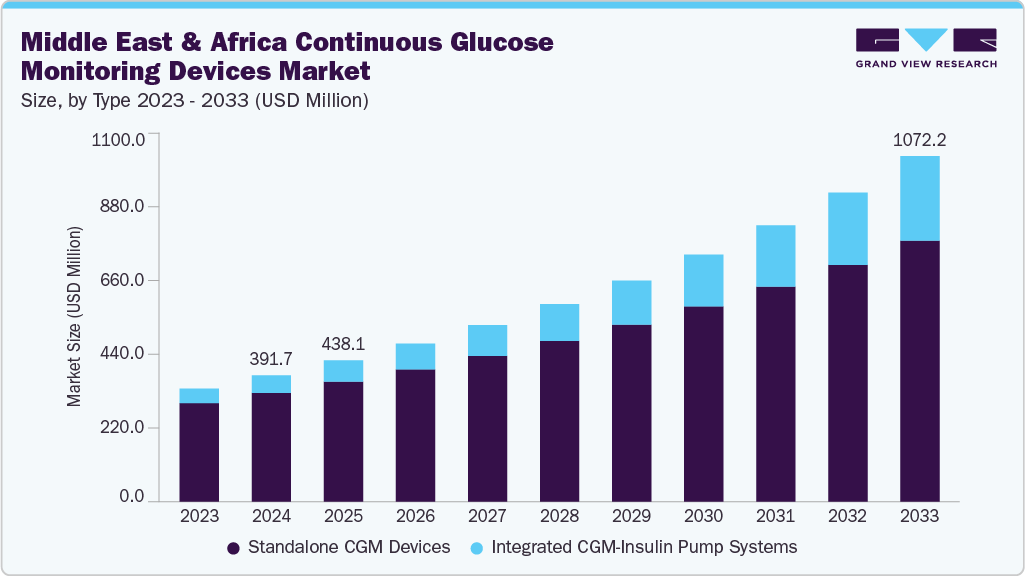
The Middle East & Africa continuous glucose monitoring devices market size was estimated at USD 391.7 million in 2024 and is expected to grow at a CAGR of 11.8% from 2025 to 2033 to reach a value of USD 1,072.2 million in 2033. This growth is fueled by the alarming rise in diabetes cases across the region. In the Middle East and North Africa (MENA), the number of adults aged 20–79 with diabetes increased from 17 million in 2000 to 84.7 million in 2024 and is expected to reach 162.6 million by 2050. MENA has the world’s highest regional prevalence at 17.6% and a projected 92% surge in cases.
In support of increasing access to continuous glucose monitoring (CGM) technologies, the Foundation for Innovative New Diagnostics (FIND) launched the “Access to CGMs for Equity in Diabetes Management” (ACCEDE) initiative, seeking proposals from CGM manufacturers not yet commercialized in Kenya and South Africa. As of early 2023, only about 10% of the 55,000 people living with type 1 diabetes in these countries were using CGMs. Furthermore, rising insulin use among type 2 diabetes patients-estimated at 18% in Kenya and up to 45% in South Africa’s private sector-presents a significant opportunity for CGM expansion.
FIND’s strategy aims to double CGM usage in Kenya and South Africa by 2025 and extend reach to an estimated regional market of 213,000 type 1 and 21.5 million type 2 diabetes patients across Eastern and Southern Africa. The project emphasizes affordability, training, and evidence generation to ensure scalable and sustainable CGM adoption. CGM devices provide continuous, real-time glucose data, supporting better glycemic control and reducing the need for invasive fingersticks. However, their effectiveness depends heavily on proper patient training and healthcare provider support.
Safety concerns linked to CGM misuse, particularly from insufficient training, have been highlighted in recent evaluations. A cross-sectional study in Saudi Arabia showed that 40% of users operated CGMs without adequate guidance. Additionally, over half of CGM-related adverse event reports between 2019 and 2021 were attributed to user error rather than device failure, reinforcing the need for structured training programs.
The UAE’s annual diabetes conferences further highlight the region’s commitment to advancing diabetes care. The 2024 event, co-hosted by the Imperial College London Diabetes Centre and HealthPlus, drew over 400 professionals and emphasized CGM innovations and practical applications. It fostered dialogue on new management strategies, from low-calorie diets to artificial pancreases, reinforcing the role of CGMs in modern diabetes treatment.
In H2 2024, the World Diabetes Foundation (WDF) approved seven ambitious projects focused on expanding non-communicable disease (NCD) prevention and primary care across Africa, the Middle East, North Africa, and South-East Asia. These initiatives are significantly contributing to the growth of the continuous glucose monitoring (CGM) devices market by enhancing healthcare infrastructure and expanding access to diabetes care. Here is the table summarizing the WDF-funded projects signed in H2 2024,
Country
Project Code
Project Description
South Africa
WDF24-1933
Aims to enhance national and provincial diabetes response by closing gaps in awareness, diagnosis, care, and management.
Palestine (West Bank)
WDF24-1935
Focuses on strengthening the national health system’s capacity for comprehensive diabetes care, building on outcomes from earlier program phases.
Zambia
WDF24-1936
Targets improved diabetes care for 75,000 people in the Kalulushi District through better services and infrastructure.
Burundi
WDF24-1934
Seeking to implement a national diabetes prevention and management program.
Liberia
WDF24-1937
Expands on prior efforts to integrate diabetes and hypertension services into secondary and tertiary healthcare facilities.
Mozambique
WDF23-1925
Builds on earlier WDF support to integrate diabetes and hypertension care at the primary healthcare level as part of a broader national NCD response.
The newly funded projects aim to reinforce national healthcare systems, improve diagnostic and monitoring capabilities, and establish functional referral mechanisms. A major goal is to embed diabetes and hypertension care into various levels of healthcare, ensuring long-term sustainability. Key components include the distribution of standardized equipment, comprehensive training for healthcare professionals, and structured patient education programs that empower self-management and form peer support networks.
Projects in countries like South Africa, Palestine, Zambia, Burundi, Liberia, and Mozambique reflect this regional momentum. By building on prior successes and working closely with governments and communities, these initiatives are fostering a stronger framework for diabetes detection and treatment, thereby accelerating the adoption of CGM technology across underserved regions.
Market Concentration & Characteristics
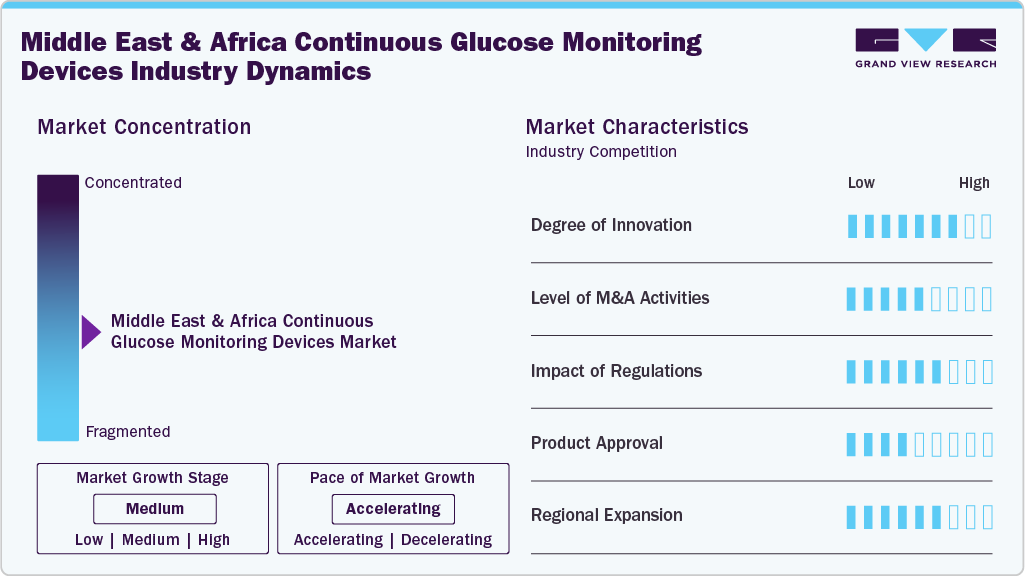
The Middle East & Africa CGM devices market is characterized by moderate industry concentration, with key players such as Abbott, Medtronic, and Dexcom leading due to their technological edge and extensive distribution networks. The market is witnessing increased adoption driven by the region's high diabetes prevalence (17.6% in MENA) and efforts to improve disease management. Public-private partnerships and international funding are boosting infrastructure and accessibility. While urban centers are primary adopters, rural expansion remains a growth frontier. Local manufacturing is limited, with most devices imported. The market is also influenced by growing awareness, digital health integration, and health policy reforms.
The Middle East & Africa continuous glucose monitoring (CGM) devices industry is experiencing a steady wave of innovation, particularly to meet the needs of people with type 1 diabetes (T1D). CGMs offer a less invasive alternative to traditional finger-prick testing, typically using microneedle-based sensors that measure glucose in interstitial fluid (ISF). However, a shift toward non-invasive technologies is underway. Although current non-invasive CGMs face challenges in accuracy compared to their minimally invasive counterparts, significant advancements are expected within the next two to three years.
A notable breakthrough occurred in 2023 when Nemaura Medical’s sugarBEAT, a non-invasive wearable glucose sensor, received approval from the Saudi Food and Drug Authority (SFDA). This development could benefit approximately 4.27 million Saudi adults living with diabetes, nearly 17.7% of the adult population.
Beyond accuracy improvements, innovations are also focused on device miniaturization and expanding consumer access via over-the-counter availability. Leading global players like Dexcom, Abbott, Medtronic, and Senseonics dominate the market with microneedle CGMs. At the same time, in the Gulf Cooperation Council (GCC) region, Abbott, Medtronic, Dexcom, and Roche maintain a strong presence.
New non-invasive glucose sensing technologies-such as radiofrequency and optical sensing-are being developed by companies like Know Labs and LifePlus. At present, these non-invasive devices typically have a Mean Absolute Relative Difference (MARD) above 10%, but performance is expected to improve with time.
As non-invasive CGMs become more accurate and accessible, their use is anticipated to expand significantly beyond T1D to include the larger population with type 2 diabetes (T2D), enhancing overall diabetes management in the region. This innovation wave signals a pivotal transition toward more comfortable, user-friendly, and scalable CGM solutions in the Middle East & Africa.
Mergers and acquisitions in the MEA continuous glucose monitoring (CGM) devices industry are witnessing a steady rise, driven by growing diabetes prevalence and demand for innovative technologies. Regional healthcare investment is accelerating, with companies seeking strategic collaborations and acquisitions to expand local manufacturing and distribution capabilities. While most M&A activities have centered around biologics and insulin analogues, partnerships involving CGM technologies are gradually emerging, especially as governments prioritize digital health solutions. This steady M&A momentum reflects the region’s push to strengthen healthcare infrastructure and improve access to advanced diabetes monitoring solutions across the public and private sectors.
Regulations play a crucial role in shaping the Middle East & Africa CGM devices industry across Saudi Arabia, South Africa, the UAE, and Kuwait. These countries enforce stringent regulatory standards to ensure device safety and accuracy. For instance, the Saudi Food and Drug Authority (SFDA) recently approved non-invasive CGMs, boosting market access. In South Africa, regulatory compliance under SAHPRA is essential for local distribution. The UAE and Kuwait align with international standards, expediting approvals for innovative CGMs. While strict regulations may delay entry, they enhance trust, quality, and adoption, supporting the region’s growing demand for advanced diabetes management and digital health technologies.
In the Middle East & Africa continuous glucose monitoring (CGM) devices market, product substitutes include traditional blood glucose meters, flash glucose monitoring systems, and emerging non-invasive wearables. Finger-prick glucometers remain widely used due to affordability and familiarity, especially in low-resource settings. Flash systems like Abbott’s FreeStyle Libre offer intermittent reading without continuous tracking. Additionally, advancements in smartwatches and biosensing wearables with glucose monitoring capabilities present potential substitutes. However, these alternatives often lack real-time data, trend analysis, or the accuracy levels of CGMs. Despite competition, CGMs remain superior for continuous insights and better glycemic control, particularly for patients with type 1 and insulin-dependent type 2 diabetes.
Dexcom is accelerating its regional expansion in the continuous glucose monitoring (CGM) market with the launch of its real-time CGM system, Dexcom ONE+, in Spain, Belgium, and Poland. A rollout in the Netherlands followed in mid-February 2024. The company has also announced plans to introduce Dexcom ONE+ in the Middle East, Africa, and additional European countries in the near future, signaling an aggressive push into global markets.
Dexcom ONE+ features a water-resistant sensor, a transmitter for real-time glucose data transmission, and a smartphone-compatible app. It allows users and up to ten others to monitor blood glucose levels remotely, enhancing patient engagement and care coordination. The device is customizable and can be worn on the abdomen, upper arms, or upper buttocks (for children aged 2–17). With its ‘delay first high’ alert feature, Dexcom ONE+ reduces alert fatigue and encourages better compliance. These innovations not only support Dexcom’s global market penetration but also cater to diverse user needs across different age groups and geographies. The company’s strategic move positions it strongly in Europe, the Middle East, and Africa (EMEA), contributing to greater accessibility of advanced diabetes care technologies and reinforcing its leadership in the CGM industry.
Type Insights
The standalone CGM devices accounted for the largest revenue share of 86.1% in 2024 due to their widespread adoption and ease of use. These devices offer real-time glucose monitoring without frequent calibrations or the need for complex integration with insulin delivery systems. Their accuracy, portability, and ability to transmit data to smartphones make them highly favored by both patients and healthcare providers. Furthermore, standalone CGMs are more accessible and cost-effective than integrated systems, contributing to broader usage across emerging markets. Increased awareness, technological advancements, and strong support from healthcare programs have further driven their dominance in the CGM market.
The integrated CGM-insulin pump systems segment is expected to witness the fastest CAGR of 18.8% due to rising demand for automated and personalized diabetes management solutions. These systems offer real-time glucose monitoring alongside precise insulin delivery, reducing manual intervention and enhancing glycemic control. Technological advancements, such as hybrid closed loops and artificial pancreas systems, are driving adoption among type 1 diabetes patients. Growing awareness of improved health outcomes, reduced hypoglycemia risks, and convenience also supports market expansion.
Connectivity Insights
The Bluetooth connectivity segment accounted for the largest revenue share of 58.3% in 2024 due to its widespread integration in continuous glucose monitoring (CGM) devices, enabling seamless data transmission to smartphones and smartwatches. This real-time data access enhances diabetes management by providing users and caregivers with timely glucose readings and alerts. Bluetooth technology also supports app-based analytics, personalized insights, and remote monitoring, which are highly valued in-home care and telemedicine.
The Near Field Communication (NFC) segment is expected to witness the fastest CAGR of 16.2% due to its convenience, security, and increasing integration in wearable glucose monitoring devices. NFC enables quick, contactless data transfer between CGM sensors and smartphones or compatible readers without pairing, making it ideal for tech-savvy users and healthcare providers. Its simplicity and low power consumption enhance usability, especially in pediatric and elderly populations. As smartphone penetration rises in emerging markets and healthcare shifts toward digital solutions, NFC-enabled CGM devices are gaining traction, driving rapid adoption and market expansion across diverse demographics and regions.
Indication Insights
Type 2 Diabetes (T2DM) accounted for the largest revenue share of 56.4% in 2024 and is expected to witness the fastest growth due to its alarming prevalence across the Middle East. Approximately 46 million people in the region are affected. T2DM rates have surged over the past 20 years, ranging from 2.6% to 21.9% across nations. Kuwait (21.9%), the UAE (21.6%), and Saudi Arabia (21.4%) report the highest prevalence. In Saudi Arabia, around 18% of the general population is at moderate to high risk of developing T2DM. These figures highlight the urgent need for effective monitoring solutions, such as CGMs.
The Type 1 Diabetes (T1DM) segment also held a significant market share owing to the growing adoption of continuous glucose monitoring (CGM) systems among patients requiring intensive insulin therapy. T1DM patients benefit significantly from CGMs as these devices provide real-time glucose data, helping to avoid hypoglycemic events and manage blood sugar fluctuations. Increased awareness, rising diagnosis rates, and supportive reimbursement policies across parts of the Middle East and Africa have further fueled adoption. Additionally, innovations in CGM technology, including improved accuracy and user-friendly designs, have made these devices more accessible and attractive to individuals managing Type 1 Diabetes daily.
End Use Insights
Homecare/personal use accounted for the largest revenue share of 51.0% in 2024 and is expected to witness the fastest growth due to growing patient preference for convenient and self-managed diabetes care. Continuous glucose monitoring (CGM) devices enable real-time glucose tracking without frequent hospital visits, supporting better glycemic control. The rise in smartphone-based applications, increased awareness, and user-friendly wearable sensors have accelerated adoption in home settings. Moreover, the growing elderly population, prevalence of type 2 diabetes, and healthcare cost pressures have pushed demand for remote monitoring solutions.
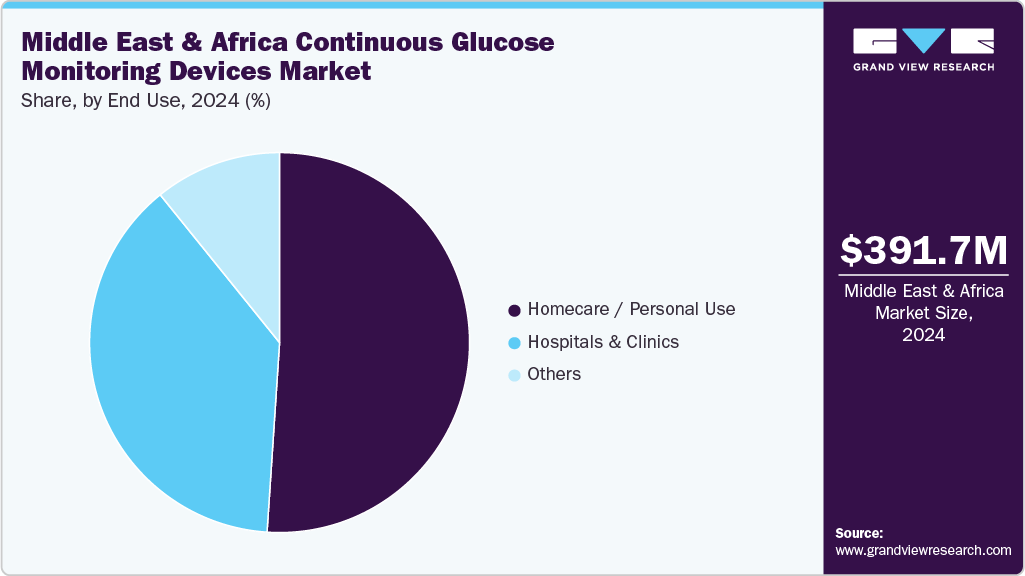
Hospitals and clinics also held a significant share of the Middle East & Africa continuous glucose monitoring (CGM) devices market in 2024 due to the growing adoption of CGM devices for in-patient diabetes management and acute care. These healthcare settings provide professional monitoring, ensuring accurate diagnosis and treatment adjustments for patients with unstable glucose levels. Increased investments in healthcare infrastructure across the Middle East and Africa. Additionally, hospitals play a key role in educating newly diagnosed patients on CGM usage. Integration with electronic health records (EHRs) and multi-patient monitoring platforms also boosts clinical efficiency and patient outcomes.
Country Insights
Saudi Arabia’s continuous glucose monitoring market is witnessing strong growth, driven by the country’s high diabetes prevalence-23.1% among adults, equating to over 5.3 million cases in 2024. As one of the highest diabetes burdens, Saudi Arabia’s investments in digital health and CGM-integrated insulin therapies are propelling regional market leadership.
The South Africa continuous glucose monitoring devices market is growing due to the rising prevalence of type 2 diabetes, driven by unhealthy diets, high sugar intake, obesity, and sedentary lifestyles. Type 2 diabetes accounts for 90% of cases, mostly affecting overweight adults. Around 4.2 million South Africans-approximately one in nine adults-live with diabetes. This surge in cases is prompting greater demand for CGM technologies to improve real-time glucose management. Increased health awareness, advancements in wearable tech, and broader access to mobile health tools are supporting market expansion, especially as CGM adoption extends across both urban and underserved regions.
The continuous glucose monitoring devices market in the UAE is expected to grow during the forecast period. In the UAE, CGM devices like Dexcom G7 and FreeStyle Libre are widely accessible through pharmacies, online platforms, and specialized clinics such as GluCare.Health. These systems help monitor glucose levels in real time and come with accessories like sensor patches. GluCare.Health is a key provider, offering competitive pricing for Dexcom G7, with a one-month supply priced at 780 AED, including three 10-day sensors. Prices may vary across the GCC due to differences in distribution, regulations, and market dynamics. The increasing availability and affordability of these devices support better diabetes management and are driving growth in the UAE’s CGM devices market.
The Kuwait continuous glucose monitoring devices market is witnessing strong growth, driven by the rising prevalence of type 2 diabetes, changing lifestyles, and increased awareness of real-time diabetes management. Technological adoption is high, with advanced CGM systems like Dexcom and FreeStyle Libre gaining popularity. Growing demand for minimally invasive monitoring, coupled with government efforts and initiatives by local health authorities, is boosting access to these devices.
Key Middle East & Africa Continuous Glucose Monitoring Devices Company Insights
The growth of the Middle East & Africa continuous glucose monitoring (CGM) devices market is propelled by leading players such as Abbott Laboratories; Medtronic plc; Dexcom, Inc.; and Roche. These companies are leveraging technological innovations to expand their footprint in the region. Their strategies focus on developing user-friendly, reliable CGM systems tailored to local healthcare needs. Emphasis is placed on improving access through regional partnerships, regulatory approvals, and educational initiatives. Additionally, efforts to integrate CGM devices into national diabetes management programs and increasing awareness of real-time glucose monitoring are fostering greater adoption across MEA.
Key Middle East & Africa Continuous Glucose Monitoring Devices Companies:
- Dexcom, Inc.
- Abbott Laboratories
- Medtronic plc
- Senseonics Holdings, Inc.
- F. Hoffmann-La Roche (Roche Diabetes Care)
- Ypsomed AG
- GlySens Incorporated
- Novo Nordisk A/S
- Ascensia Diabetes Care
- Diabetes Cloud (Aidex) and Meiqi (emerging startups)
Recent Developments
-
In July 2024, GluCare.Health in Dubai became the first UAE clinic to offer the Dexcom G7 CGM system. The device features real-time glucose tracking, improved Bluetooth connectivity, a 60% smaller size, and high accuracy. Its all-in-one sensor design makes it more affordable and ideal for managing diabetes in Dubai’s fast-paced lifestyle.
-
In March 2023, Dexcom launched its G7 Continuous Glucose Monitoring system in South Africa, marking its first major African rollout. The G7 offers faster warmup, no fingersticks, and enhanced accuracy. Partnering with VitalAire Diabetes, Dexcom aims to expand access and improve diabetes care for users aged two and older across the region.
Middle East & Africa Continuous Glucose Monitoring Devices Market Report Scope
Report Attribute
Details
Market size value in 2025
USD 438.1 million
Revenue forecast in 2033
USD 1,072.2 million
Growth rate
CAGR of 11.8% from 2025 to 2033
Actual data
2021 - 2024
Forecast period
2025 - 2033
Quantitative units
Revenue in USD million/billion and CAGR from 2025 to 2033
Report coverage
Revenue forecast, company ranking, competitive landscape, growth factors, and trends
Segments covered
Type, connectivity, indication, end use, region
Regional scope
Middle East & Africa
Country scope
South Africa; Saudi Arabia; UAE; Kuwait
Key companies profiled
Dexcom, Inc.; Abbott Laboratories; Medtronic plc; Senseonics Holdings, Inc.; F. Hoffmann-La Roche (Roche Diabetes Care); Ypsomed AG; GlySens Incorporated; Novo Nordisk A/S; Ascensia Diabetes Care; Diabetes Cloud (Aidex) and Meiqi (emerging startups)
Customization scope
Free report customization (equivalent to 8 analysts working days) with purchase. Addition or alteration to segment scope.
Pricing and purchase options
Avail customized purchase options to meet your exact research needs. Explore purchase options
Middle East & Africa Continuous Glucose Monitoring Devices Market Report Segmentation
This report forecasts revenue growth at the regional and country levels and analyzes the latest industry trends in each of the sub-segments from 2021 to 2033. For this study, Grand View Research has segmented the Middle East & Africa continuous glucose monitoring devices market report based on type, connectivity, indication, end use, and region:
-
Type Outlook (Revenue, USD Million, 2021 - 2033)
-
Standalone CGM Devices
-
Integrated CGM-Insulin Pump Systems
-
-
Connectivity Outlook (Revenue, USD Million, 2021 - 2033)
- Bluetooth
- 4G/Cellular
- NFC (Near Field Communication)
-
Indication Outlook (Revenue, USD Million, 2021 - 2033)
-
Type 1 Diabetes
-
Type 2 Diabetes
-
-
End Use Outlook (Revenue, USD Million, 2021 - 2033)
-
Hospitals & Clinics
-
Homecare / Personal Use
-
Other
-
-
Regional Outlook (Revenue, USD Million, 2021 - 2033)
-
Middle East & Africa
-
South Africa
-
Saudi Arabia
-
UAE
-
Kuwait
-
Rest of Middle East & Africa
-
-
Frequently Asked Questions About This Report
b. The Middle East & Africa continuous glucose monitoring devices market size was valued at USD 391.7 million in 2024 and is expected to reach USD 438.1 million in 2025.
b. The Middle East & Africa continuous glucose monitoring devices market is expected to grow at a compound annual growth rate of 11.8% from 2025-2033 to reach USD 1,072.2 million in 2033.
b. The Standalone CGM Devices dominated the type segment with a market share of 86.1% in 2024. This can be attributed to its widespread adoption and ease of use. These devices offer real-time glucose monitoring without frequent calibrations or the need for complex integration with insulin delivery systems.
b. Key market players are Dexcom, Inc., Abbott Laboratories, Medtronic plc, Senseonics Holdings, Inc., F. Hoffmann-La Roche (Roche Diabetes Care), Ypsomed AG, GlySens Incorporated, Novo Nordisk A/S, Ascensia Diabetes Care, Diabetes Cloud (Aidex) and Meiqi (emerging startups)
b. Key factors driving the Middle East & Africa CGM devices market include the rising prevalence of diabetes, increasing awareness and early diagnosis initiatives, and growing adoption of digital health technologies.


Share this report with your colleague or friend.
Need a Tailored Report?
Customize this report to your needs — add regions, segments, or data points, with 20% free customization.


ISO 9001:2015 & 27001:2022 Certified
We are GDPR and CCPA compliant! Your transaction & personal information is safe and secure. For more details, please read our privacy policy.
Trusted market insights - try a free sample
See how our reports are structured and why industry leaders rely on Grand View Research. Get a free sample or ask us to tailor this report to your needs.













