Middle East Ashwagandha Supplements Market Summary
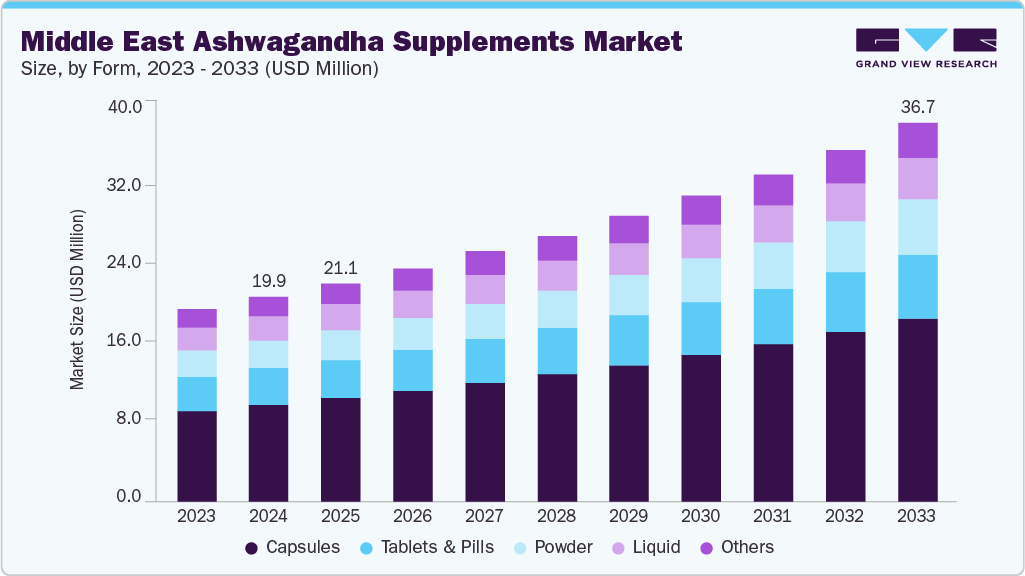
The Middle East ashwagandha supplements market size was estimated at USD 19.9 million in 2024 and is anticipated to reach USD 36.7 million by 2033, growing at a CAGR of 7.1% from 2025 to 2033. This can be attributed to rising adoption of herbal supplements, consumer demand for natural remedies for sleep, stress, immunity, and overall wellness and expanding distribution channels in the region.
Key Market Trends & Insights
- By form, ashwagandha capsule supplements led the market and accounted for a share of 47.37% in 2024.
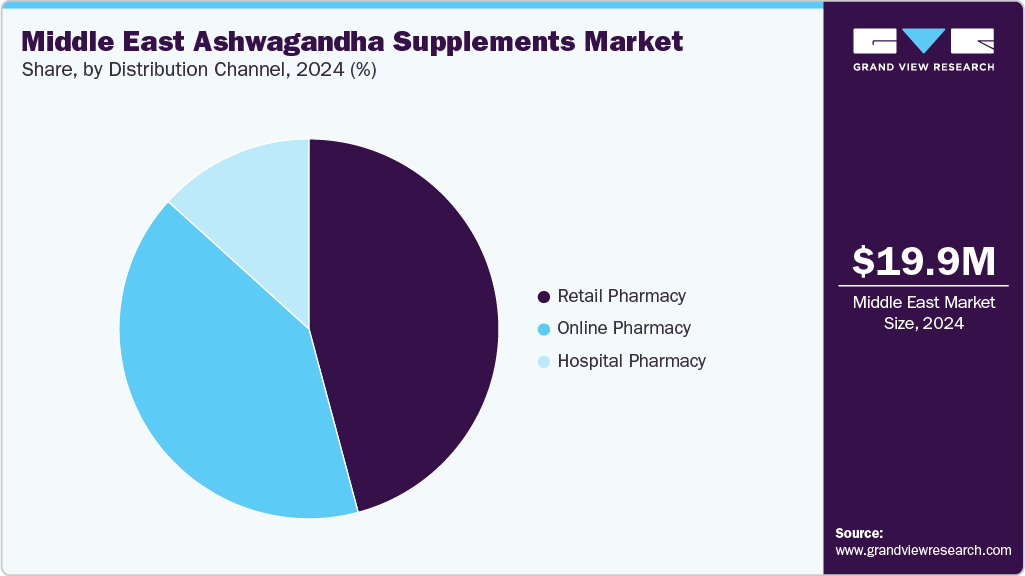
- By distribution channel, the sale of ashwagandha supplements through retail pharmacy held the highest market share of 45.83% in 2024.
- By country, Saudi Arabia held a market share of 36.51% in 2024.
Market Size & Forecast
- 2024 Market Size: USD 19.9 Million
- 2033 Projected Market Size: USD 36.7 Million
- CAGR (2025-2033): 7.1%
In the Middle East, the ashwagandha market price has been progressively increasing as demand rises for herbal and wellness supplements. Dependence on imports, limited local production, and growing health awareness are driving higher prices, while traditional forms remain comparatively affordable.
The ashwagandha supplements market in the Middle East is growing as more consumers turn to natural and herbal remedies for stress management, sleep support, and overall wellness. The long-standing tradition of using herbal medicine in the region has helped boost acceptance of adaptogenic herbs such as ashwagandha, aligning with the increasing focus on preventive and holistic health.
Economic growth is playing a major role in expanding the ashwagandha market in the Middle East. In countries such as the UAE, Saudi Arabia, and Qatar, higher disposable incomes and rapid urbanization are making wellness and premium herbal products more accessible to a wider audience. Consumers are increasingly opting for capsules, powders, and functional blends from brands such as Goli Nutrition, NOW Foods, and Gaia Herbs, often willing to pay extra for reliable and effective products, which has encouraged companies to launch region-specific and innovative offerings.
Better distribution channels are also helping the market grow. Online retailers such as iHerb Middle East, e-commerce sites such as Amazon.ae, and retail stores including Boots UAE have made ashwagandha supplements easier to access, even though local production is limited and imports dominate. Along with rising awareness about herbal wellness, these factors support the steady growth of the ashwagandha market across the Middle East.
Consumer Insights
The Middle East ashwagandha supplements market shows a significant gender imbalance, with men being 60% of users and women around 40%. This indicates that men are more likely to buy ashwagandha, possibly driven by interests in physical performance, stress relief, or energy support.
Looking at age distribution, the 25-44 group is the largest segment, followed by those over 45, while the 18-24 group remains smaller. This suggests that working-age and middle-aged adults are the primary users, seeking stress management, increased energy, or overall wellness to cope with busy lifestyles. Younger consumers might be more focused on other forms of supplements.
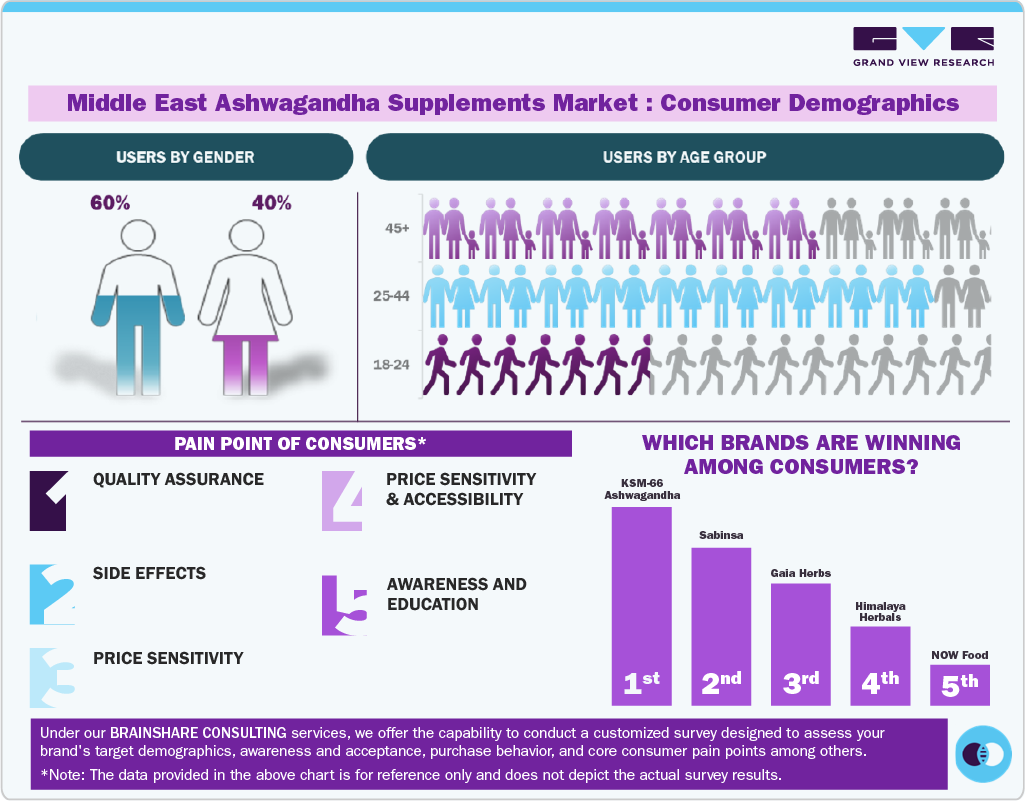
Consumers in the region face several pain points. Concerns about product quality and potential side effects are common, highlighting the demand for safe, standardized, and reliable products. Price sensitivity and accessibility also play a role, as affordability and availability in urban and semi-urban areas influence purchasing decisions. In addition, limited awareness about the benefits of ashwagandha points to an opportunity for brands to invest in educational campaigns to build trust and encourage adoption.
In terms of brand preferences, KSM-66 Ashwagandha leads, followed by Sabinsa and Gaia Herbs, while Himalaya Herbals and NOW Foods hold smaller shares. This ranking underscores the importance of internationally recognized, clinically backed brands and strong distribution networks.
Form Insights
The capsules segment accounted for a revenue share of 47.37% in 2024. This can be attributed to the fact that capsules are widely recognized, easy to consume, and most convenient for users across all ages. Working professionals and middle-aged users often prefer capsules for their simplicity and consistent dosing, making them the most popular choice despite the growing availability of other formats.
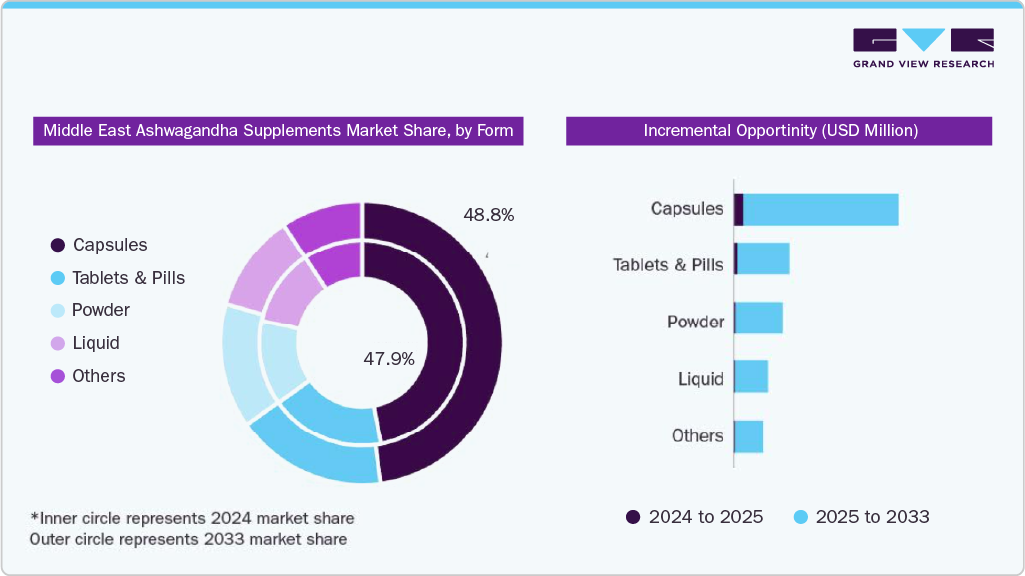
The powder segment is anticipated to witness a growth rate of 7.9% from 2025 to 2033, as the younger consumers are increasingly seeking ways to mix and integrate supplements into their shakes, smoothies, and functional drinks. The versatility of powder ashwagandha supplements, along with rising trends of fitness-oriented lifestyles, is driving the market growth compared to traditional formats. Products such as Organic India Ashwagandha powder, Himalaya Ashwagandha powder, and KSM-66 Ashwagandha powder are gaining traction among young users.
Distribution Channel Insights
The retail pharmacy segment accounted for a revenue share of 45.83% in 2024, owing to consumer trust in established offline pharmacies and their presence in urban areas. A majority of buyers still prefer purchasing ashwagandha in person for reassurance regarding packaging, quality, and guidance from staff, which supports strong sales through this channel. Chains such as Boots UAE, Seif Pharmacies in Saudi Arabia, and Life Pharmacy in Egypt are popular purchase points for trusted purchases.
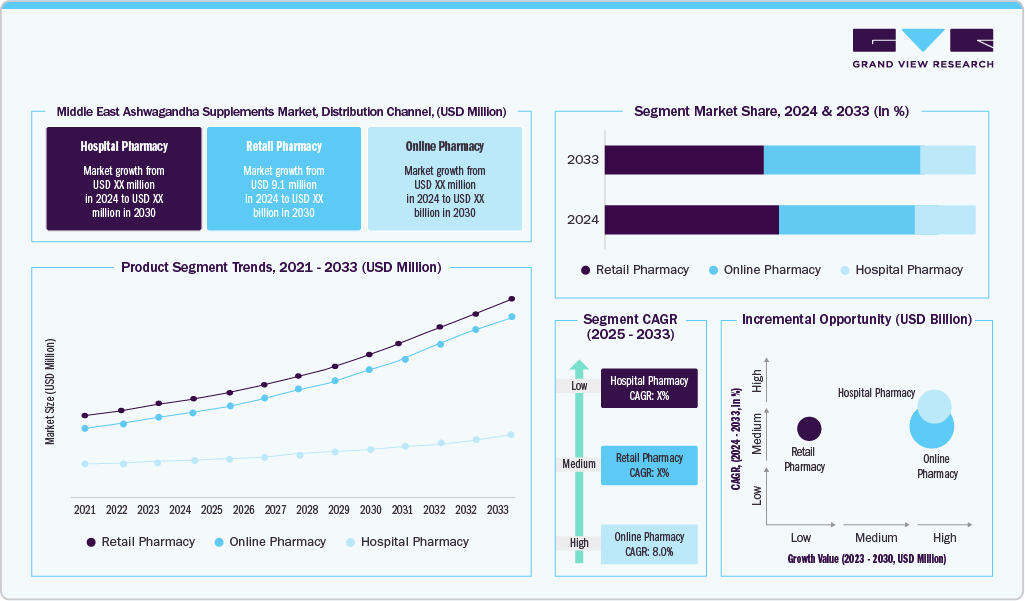
The online pharmacy segment is estimated to grow at a CAGR of 7.9% from 2025 to 2033. Online pharmacies are expanding rapidly as more people in the Middle East turn to e-commerce. Websites such as iHerb Middle East, Amazon.ae, and Noon.com make it convenient for consumers to order ashwagandha supplements directly to their homes, especially in regions of the Gulf where physical stores are few.
Country Insights
Saudi Arabia Ashwagandha Supplements Market Trends
The ashwagandha supplements market in Saudi Arabia accounted for 36.51% of the revenue in 2024, driven by the growing awareness of potential health benefits associated with botanical supplements and the increasing demand for natural and herbal remedies. The region is experiencing a surge in the popularity of Ashwagandha, an ancient medicinal herb traditionally used in Ayurvedic medicine.
UAE Ashwagandha Supplements Market Trends
The ashwagandha supplements market in UAE is expected to grow with a CAGR of 7.9% from 2025 to 2033. This growth is largely due to increasing stress levels and health concerns related to lifestyle among urban professionals in Dubai and Abu Dhabi, along with a growing awareness of Ayurvedic and adaptogenic solutions. Local health retailers, including Life Pharmacy and Holland & Barrett, as well as online platforms such as Amazon.ae and Noon, have broadened their ashwagandha product ranges to serve both expatriates familiar with herbal remedies and health-conscious Emiratis looking for natural ways to manage stress.
Kuwait Ashwagandha Supplements Market Trends
Kuwait ashwagandha supplements market accounted for 6.14% of the revenue in 2024, fueled by the country’s high per-capita income and strong preference for premium, imported wellness products. Consumers in Kuwait rely heavily on specialized pharmacies and boutique health stores, such as Supercare and Al-Dawaa, to access herbal supplements. In addition, the rising influence of fitness clubs and wellness influencers in Kuwait City has boosted the popularity of ashwagandha for stress relief and energy enhancement, driving steady growth.
Key Middle East Ashwagandha Supplements Company Insights
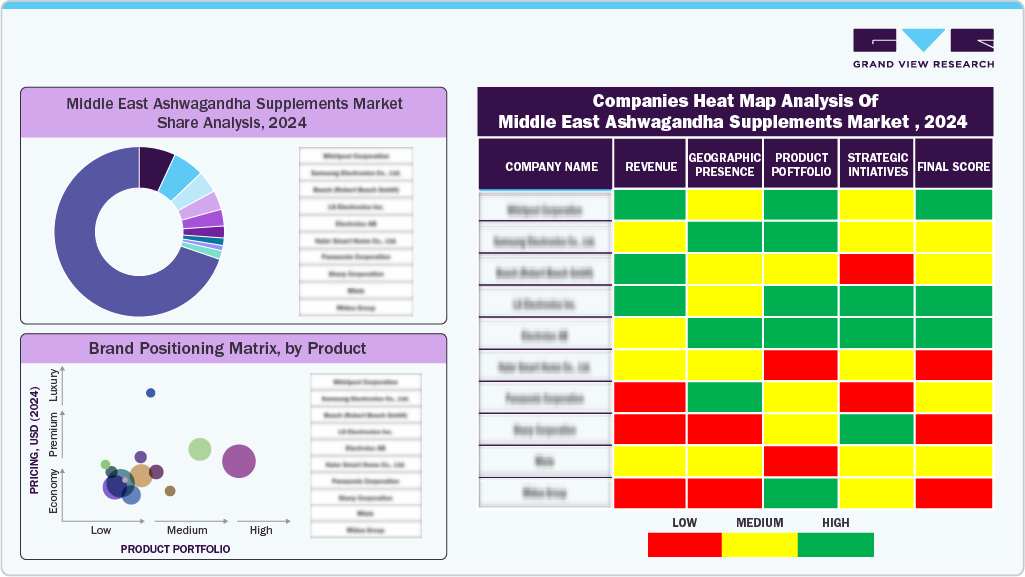
Himalaya Wellness, Organic India, KSM-66 (Ixoreal Biomed), Gaia Herbs, NOW Foods, Nature’s Way, Nature Made, Horbäach, GNC Middle East, and Herbochem are among the leading players in the significantly competitive Middle East ashwagandha supplements market.
Key players in the market are focusing on product development to cater to evolving consumer demands and preferences. They are introducing new formulations, such as organic, vegan, and sugar-free supplements, to meet the needs of health-conscious consumers.
In addition, strategic mergers and acquisitions are shaping the market landscape, with larger companies acquiring smaller players to expand their product portfolios and strengthen their market position.
Key Middle East Ashwagandha Supplements Companies:
- Himalaya Wellness
- Organic India
- KSM-66 (Ixoreal Biomed)
- Gaia Herbs
- NOW Foods
- Nature’s Way
- Nature Made
- Horbäach
- GNC Middle East
- Herbochem
Recent Developments
-
In June 2025, Natural Remedies introduced Ashwa.30, a new Ashwagandha extract developed to support stress relief, boost energy, and enhance endurance. Standardized to 15% withanolides, it also includes a proprietary ATP-active component designed to aid cellular energy production.
-
In May 2024, Herbochem launched +91 ASHWAGANDHA ingredients that can help formulate capsules, tablets, gummies, or any other desired form.
-
In October 2021, Gaia Herbs launched a new line of botanical gummies, including Ashwagandha, Sleep, and Relax Gummies. The Ashwagandha Gummies are designed to support stress reduction and enhance the body's resilience to stress by leveraging Ashwagandha's adaptogenic properties.
Middle East Ashwagandha Supplements Market Report Scope
|
Report Attribute
|
Details
|
|
Market size value in 2025
|
USD 21.1 million
|
|
Revenue forecast in 2033
|
USD 36.7 million
|
|
Growth rate (Revenue)
|
CAGR of 7.1% from 2025 to 2033
|
|
Actuals
|
2021 - 2024
|
|
Forecast period
|
2025 - 2033
|
|
Quantitative units
|
Revenue in USD million/billion, and CAGR from 2025 to 2033
|
|
Report coverage
|
Revenue forecast, company ranking, competitive landscape, growth factors, and trends
|
|
Segments covered
|
Form, distribution channel, country
|
|
Country scope
|
Oman; Kuwait; UAE; Saudi Arabia; Egypt
|
|
Key companies profiled
|
Himalaya Wellness; Organic India; KSM-66 (Ixoreal Biomed); Gaia Herbs; NOW Foods; Nature’s Way; Nature Made; Horbäach; GNC Middle East; Herbochem
|
|
Customization scope
|
Free report customization (equivalent up to 8 analysts working days) with purchase. Addition or alteration to country, regional & segment scope.
|
|
Pricing and purchase options
|
Avail customized purchase options to meet your exact research needs. Explore purchase options
|
Middle East Ashwagandha Supplements Market Report Segmentation
This report forecasts revenue growth at country levels and provides an analysis of the industry trends in each of the sub-segments from 2021 to 2033. For the purpose of this study, Grand View Research has segmented the Middle East ashwagandha supplements market report on the basis of form, distribution channel, and country:
-
Form Outlook (Revenue, USD Million, 2021 - 2033)
-
Capsules
-
Tablets & Pills
-
Powder
-
Liquid
-
Others
-
Distribution Channel Outlook (Revenue, USD Million, 2021 - 2033)
-
Hospital Pharmacy
-
Retail Pharmacy
-
Online Pharmacy
-
Country Outlook (Revenue, USD Million, 2021 - 2033)
-
Saudi Arabia
-
UAE
-
Egypt
-
Kuwait
-
Oman
Frequently Asked Questions About This Report
b. The Middle East ashwagandha supplements market size was estimated at USD 19.9 million in 2024 and is expected to reach USD 21.1 million in 2025.
b. The Middle East ashwagandha supplements market is expected to grow at a compound annual growth rate (CAGR) of 7.1% from 2025 to 2033 to reach USD 36.7 million by 2033.
b. The capsules segment accounted for a revenue share of 47.37% in 2024. This can be attributed to the fact that capsules are widely recognized, easy to consume, and most convenient for users across all ages.
b. Some key players in the Middle East ashwagandha supplements market include Himalaya Wellness; Organic India; KSM-66 (Ixoreal Biomed); Gaia Herbs; NOW Foods; Nature’s Way; Nature Made; Horbäach; GNC Middle East; Herbochem
b. The Middle East ashwagandha supplements market growth can be attributed to rising adoption of herbal supplements, consumer demand for natural remedies for sleep, stress, immunity, and overall wellness and expanding distribution channels in the region.

 Download Sample Report
















