
- Home
- »
- Power Generation & Storage
- »
-
Middle East Battery Recycling Market Size Report, 2033GVR Report cover
![Middle East Battery Recycling Market Size, Share & Trends Report]()
Middle East Battery Recycling Market (2025 - 2033) Size, Share & Trends Analysis Report By Chemistry (Lithium-ion, Lead Acid), By Application (Transportation, Consumer Electronics), By Country, And Segment Forecasts
- Report ID: GVR-4-68040-727-3
- Number of Report Pages: 110
- Format: PDF
- Historical Range: 2021 - 2023
- Forecast Period: 2025 - 2033
- Industry: Energy & Power
- Report Summary
- Table of Contents
- Segmentation
- Methodology
- Download FREE Sample
-
 Download Sample Report
Middle East Battery Recycling Market Summary
The Middle East battery recycling market size was estimated at approximately USD 71.6 million in 2024 and is projected to reach USD 281.3 million by 2033, growing at a CAGR of 15.2% from 2025 to 2033. Recycling deployment in the region spans lead-acid, lithium-ion, nickel, and other chemistries, supporting applications across transportation, industrial, and consumer electronics sectors.
Key Market Trends & Insights
- Saudi Arabia battery recycling market held the largest share of 36.50% of the Middle East market in 2024.
- The battery recycling market in the Middle East is expected to grow significantly over the forecast period.
- By chemistry, lead acid batteries held the largest market share of 58.56% in 2024.
- Based on applications, the industrial segment held the largest market share in 2024.
Market Size & Forecast
- 2024 Market Size: USD 71.6 Million
- 2033 Projected Market Size: USD 281.3 Million
- CAGR (2025-2033): 15.2%
- Saudi Arabia: Largest market in 2024
- Oman: Fastest growing market
National strategies such as Saudi Vision 2030, the UAE’s Circular Economy Policy 2031, and Oman’s National Energy Strategy are accelerating investments in sustainable waste management systems to enhance resource security, reduce landfill dependency, and recover critical raw materials. Countries across the Gulf Cooperation Council (GCC), Turkey, Israel, and the Levant are increasingly adopting recycling facilities to process used automotive batteries, e-mobility packs, and energy storage systems, while supporting regional goals of reducing carbon footprints and achieving higher levels of resource efficiency.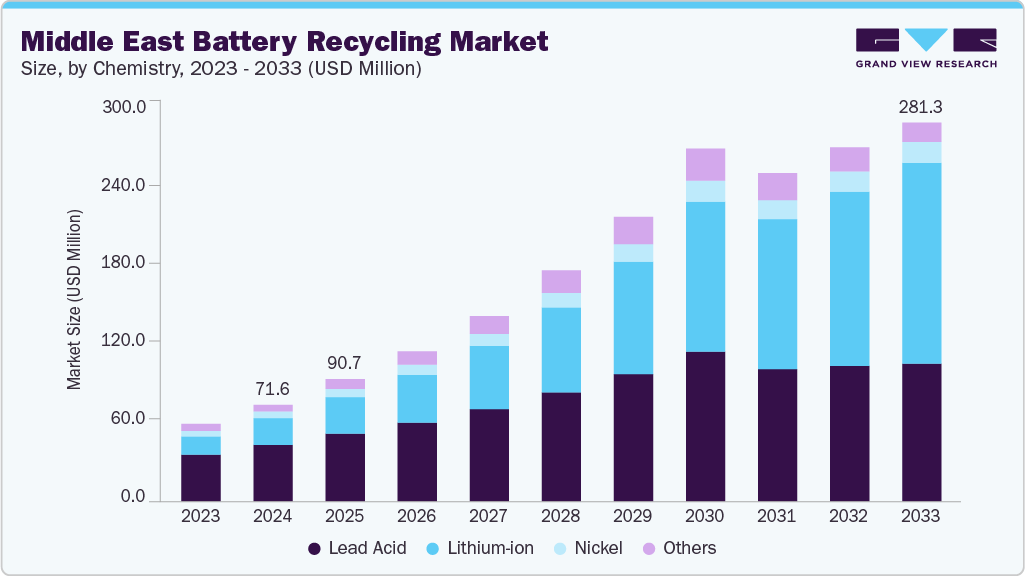
Growth in the market is driven by the rapid uptake of electric vehicles (EVs), expansion of renewable-plus-storage projects, and stringent regulatory frameworks promoting extended producer responsibility (EPR) and circular economy practices. Advances in hydrometallurgical and pyrometallurgical recycling and the emergence of direct recycling technologies are improving recovery yields for lithium, cobalt, nickel, and lead. Industrial recycling hubs capable of processing mixed chemistries are gaining traction for handling legacy lead-acid streams and new-generation lithium-ion waste from grid storage and EV fleets. Regional initiatives, such as cross-border recycling partnerships in the GCC and technology collaborations with Europe and Asia, are expected to strengthen supply chains and reduce reliance on imported raw materials. With leading companies such as EnviroServe, Duesmann & Hensel Recycling, TES, and regional utilities spearheading collection and processing initiatives, the Middle East battery recycling industry is set for robust and sustained growth over the coming decade.
Drivers, Opportunities & Restraints
The Middle East battery recycling industry is driven by the surge in electric vehicle (EV) adoption, renewable-plus-storage deployments, and supportive government circular economy initiatives. National agendas such as Saudi Vision 2030, the UAE Circular Economy Policy 2031, and Oman’s sustainability programs emphasize responsible waste management and critical mineral recovery, boosting demand for advanced recycling facilities. The dominance of lead-acid batteries in the automotive and industrial sectors continues to ensure a steady recycling stream, while the rapid growth of lithium-ion batteries from EV fleets and stationary storage projects is reshaping industry dynamics. Rising environmental concerns, stricter regulations on hazardous waste disposal, and the need to reduce reliance on imported raw materials further strengthen the business case for battery recycling in the region.
Opportunities in the market lie in establishing regional recycling hubs for EV batteries, industrial storage units, and consumer electronics, as well as partnerships with European and Asian recyclers to transfer technology and expertise. The increasing penetration of hydrometallurgical and direct recycling methods offers pathways to improve efficiency and material recovery, particularly for lithium, cobalt, and nickel. Growing investments in green metals supply chains and international collaborations for e-waste management open avenues for the Middle East to position itself as a strategic supplier of secondary raw materials. However, the market faces restraints such as high initial investment requirements for advanced recycling plants, limited collection infrastructure in certain countries, and regulatory fragmentation across the region. Technical challenges in safely handling mixed chemistries and fluctuating commodity prices for recovered materials can also impact profitability and deter large-scale private investments.
Chemistry Insights
The lead-acid segment held the largest market share of 58.56% in the market in 2024, supported by its extensive use across the automotive, industrial, and backup power sectors. The region’s reliance on lead-acid batteries for conventional vehicles, telecom towers, uninterruptible power supply (UPS) systems, and off-grid applications ensures a consistent recycling stream. High collection rates, well-established recycling infrastructure, and proven economic viability of lead recovery further cement its dominance. Countries such as Saudi Arabia, the UAE, Oman, and Egypt are witnessing a steady flow of spent lead-acid batteries from automotive fleets and industrial users, driving large-scale recycling operations. The ability to recover up to 95% of lead content makes it a sustainable and commercially attractive segment, particularly as governments tighten regulations on hazardous waste management and landfill disposal.
Supportive policies that encourage adopting circular economy practices and stringent handling standards for toxic materials fuel recycling investments. The segment also benefits from growing demand for secondary lead in domestic and regional manufacturing, reducing dependence on imports of virgin raw materials. Technological advancements in smelting efficiency, pollution control, and automated collection systems enhance recovery rates and reduce environmental risks. However, challenges such as informal recycling practices, compliance enforcement gaps, and ecological concerns around lead emissions continue to pose risks in certain markets. Despite these hurdles, the lead-acid chemistry remains the backbone of the Middle East battery recycling industry, while emerging lithium-ion recycling initiatives are beginning to attract investment as EV adoption and energy storage deployment expand across the region.
Application Insights
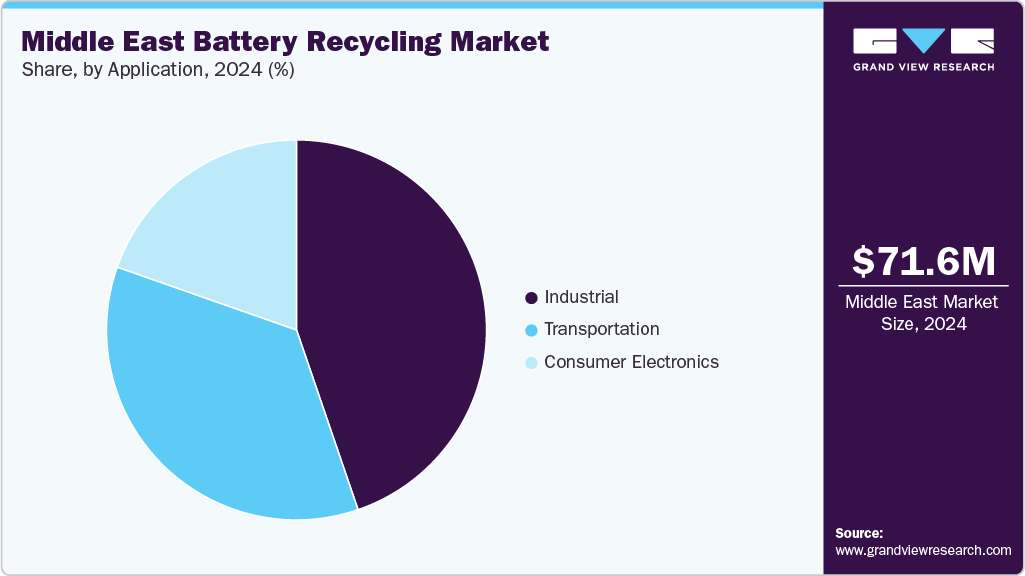
The industrial segment held the largest revenue share of 44.75% in the market in 2024 and is expected to retain its dominance over the forecast period. This segment’s leadership is driven by the widespread use of batteries across oil & gas, manufacturing, construction, data centers, and utility sectors, which generate a consistent supply of end-of-life batteries. Heavy reliance on lead-acid batteries for backup power, forklifts, and telecom towers, alongside increasing deployment of lithium-ion batteries in renewable energy storage systems, positions the industrial segment as the primary contributor to regional recycling flows. Countries such as Saudi Arabia, the UAE, and Qatar are witnessing rising demand for safe, large-scale recycling infrastructure to process industrial scrap batteries, ensuring compliance with hazardous waste regulations and supporting resource recovery.
National energy transition strategies, carbon neutrality goals, and the need for operational continuity in mission-critical environments further drive the growth of microgrids in the government sector. Advanced control systems, real-time monitoring platforms, and hybrid configurations combining renewable and dispatchable sources enable governments to optimize power generation, manage peak demand, and improve disaster resilience. Policy mandates for renewable energy adoption, budget allocations for sustainable infrastructure, and strategic partnerships with global technology providers are accelerating investment in government microgrid projects. As Middle Eastern nations continue to modernize public infrastructure, enhance energy independence, and strengthen national security, the government segment will remain a pivotal driver of microgrid deployment across the region over the forecast period.
Country Insights
Saudi Arabia battery recycling industry accounted for the largest revenue share in the Middle East region in 2024, holding over 36.50%, driven by the country’s expanding automotive, industrial, and renewable energy sectors. The Kingdom generates substantial volumes of lead-acid and lithium-ion batteries from automobiles, telecom networks, grid storage, and consumer electronics, creating a robust supply stream for recycling facilities. Government initiatives under Vision 2030, emphasizing sustainable waste management, circular economy practices, and reduced landfill dependency, are accelerating investment in advanced recycling infrastructure. Local companies, supported by international technology providers, are establishing state-of-the-art facilities to process lead-acid and lithium-based chemistries, ensuring compliance with environmental regulations and meeting growing domestic and regional demand for secondary raw materials.
The rise of electric mobility, renewable energy projects, and large-scale industrial operations further fuels demand for battery recycling solutions in Saudi Arabia. The Kingdom’s regulatory frameworks encourage the safe collection, transportation, and processing of end-of-life batteries, while public-private partnerships drive innovation in extraction efficiency and resource recovery. Moreover, sovereign-backed funds and strong industrial players position Saudi Arabia as a regional hub for sustainable battery recycling. With increasing emphasis on resource security, supply chain localization, and environmental stewardship, Saudi Arabia is expected to maintain its dominant share of the Middle East market throughout the forecast period.
The UAE battery recycling industry is emerging as one of the fastest-growing markets in the Middle East, supported by its strong renewable energy deployment and sustainability-focused government policies under the UAE Energy Strategy 2050. The country’s high penetration of electric vehicles, large-scale solar projects, and industrial expansion contribute significantly to the volume of end-of-life lead-acid and lithium-ion batteries available for recycling. Dubai and Abu Dhabi have introduced structured frameworks for hazardous waste management, while public-private collaborations are enabling the establishment of advanced recycling plants capable of handling complex battery chemistries. With its strategic geographic location and well-developed logistics infrastructure, the UAE is positioning itself as a hub for regional recycling and re-export of recovered materials.
Strong regulatory oversight, open investment policies, and favorable financing conditions are further accelerating the development of the UAE’s recycling ecosystem. The presence of global energy players and clean-tech innovators is fostering technology transfer and enabling higher efficiency in resource recovery. The country’s growing green hydrogen economy and renewable energy adoption are expected to generate greater demand for lithium-ion battery recycling in the coming decade. With its proactive policy stance and international partnerships, the UAE is set to consolidate its position as a regional leader in advanced battery recycling solutions.
Israel’s battery recycling industry is expanding steadily, driven by rising consumer electronics, electric vehicles, and renewable energy storage systems consumption. The government’s sustainability goals, and international collaborations are facilitating investments in recycling infrastructure for lead-acid and lithium-ion batteries. Increasing environmental awareness and regulatory pressure to reduce hazardous waste have established advanced collection networks and treatment facilities. Moreover, Israel’s growing role as a technology hub allows the integration of AI, robotics, and chemical process innovations into its recycling operations, enhancing efficiency and material recovery rates.
As the country scales up solar and wind projects, the demand for grid-scale energy storage will significantly increase the volume of lithium-ion batteries entering the recycling stream in the coming years. Independent Power Producers (IPPs) and private sector players actively invest in solutions to recover valuable materials such as cobalt, nickel, and lithium, aligning with the global circular economy movement. With strong policy backing and an innovative industrial ecosystem, Israel is expected to become a key contributor to the Middle market, particularly in high-value, technology-driven recycling solutions.
Oman battery recycling industry is emerging as a promising market for battery recycling, underpinned by the country’s renewable energy push under Vision 2040 and its growing industrial and automotive sectors. The widespread use of lead-acid batteries in transportation and the early adoption of renewable energy storage generate substantial recycling opportunities. The government has introduced structured environmental policies to promote safe disposal and recycling of hazardous waste. At the same time, international partnerships are being leveraged to build local capacity for lithium-ion and nickel-based battery recycling. Pilot projects are underway to establish scalable recycling infrastructure and support the country’s transition toward a more sustainable energy and waste management system.
With rising investments in solar and wind energy, particularly in Dhofar and other southern regions, Oman is expected to see increased demand for energy storage solutions, thereby driving the recycling of lithium-ion batteries. Initiatives such as Hydrogen Oman (Hydrom), focused on green hydrogen, are expected to boost lithium-ion usage and recycling requirements indirectly. Despite challenges in policy execution and infrastructure gaps, Oman’s growing emphasis on circular economy practices and renewable energy integration will support the long-term expansion of its battery recycling market.
Qatar’s battery recycling industry is at an early but expanding stage, supported by the country’s diversification plans under Qatar National Vision 2030 and its carbon neutrality targets. Rising demand from the transportation, industrial, and consumer electronics sectors contributes to a steady supply of lead-acid and lithium-ion batteries for recycling. Government-backed initiatives encourage environmentally safe disposal and the development of recycling centers, while partnerships with global players are introducing advanced technologies for efficient recovery of critical materials. The increasing adoption of EVs and large-scale renewable energy projects further supports lithium-ion battery recycling capacity growth.
Establishing new industrial facilities and rising environmental awareness are expected to accelerate Qatar’s progress in structured recycling practices. The country is exploring integrating recycling solutions with its existing energy and industrial clusters to maximize efficiency and reduce costs. While fossil fuels still dominate Qatar’s economy, the growing emphasis on green technologies and waste reduction is positioning the country to strengthen its role in the regional battery recycling landscape over the forecast period.
Key Middle East Battery Recycling Company Insights
Some of the key players operating in the Middle East market include Dubatt Battery Recycling LLC, Green Land Recycling Solutions LLC, Planet Green Recycling L.L.C., among others. These companies are actively engaged in collecting, processing, and recycling spent batteries, recovering valuable materials such as lead, lithium, nickel, and cobalt, and reducing the environmental impact of hazardous waste.
Key Middle East Battery Recycling Companies:
- Dubatt Battery Recycling LLC
- Green Land Recycling Solutions LLC
- Planet Green Recycling L.L.C.
- Ecyclex International Recycling
- Enviroserve
- Tadweer Group
- Lohum Cleantech
- Arab Lead Company LLC
- Gravita Group
- Umicore
Recent Developments
-
In March 2025, Dubatt Battery Recycling LLC inaugurated a state-of-the-art lead-acid and lithium-ion battery recycling facility in Dubai Industrial City with a processing capacity of 50,000 tons per year. The plant is designed to recover lead, plastics, and critical battery metals such as lithium and cobalt, reducing landfill dependency and minimizing environmental hazards.
Middle East Battery Recycling Market Report Scope
Report Attribute
Details
Market size value in 2025
USD 90.7 million
Revenue forecast in 2033
USD 281.3 million
Growth Rate
CAGR of 15.2% from 2025 to 2033
Base year for estimation
2024
Historical data
2021 - 2023
Forecast period
2025-2033
Quantitative Units
Volume in Tons, Revenue in USD million, and CAGR from 2025 to 2033
Report coverage
Revenue forecast, competitive landscape, growth factors, and trends
Segments covered
Chemistry, application, country
Country scope
UAE; Saudi Arabia; Israel; Oman; Qatar
Key companies profiled
Dubatt Battery Recycling LLC; Green Land Recycling Solutions LLC; Planet Green Recycling LLC.; Ecyclex International Recycling; Enviroserve; Tadweer Group; Lohum Cleantech; Arab Lead Company LLC; Gravita Group; Umicore
Customization scope
Free report customization (equivalent up to 8 analysts working days) with purchase. Addition or alteration to country, regional & segment scope.
Pricing and purchase options
Avail customized purchase options to meet your exact research needs. Explore purchase options
Middle East Battery Recycling Market Report Segmentation
This report forecasts revenue & volume growth at country levels and provides an analysis of the latest industry trends in each of the sub-segments from 2021 to 2033. For this study, Grand View Research has segmented the Middle East battery recycling market report based on chemistry, application, and country.
-
Chemistry Outlook (Volume, Tons; Revenue, USD Million, 2021 - 2033)
-
Lithium-ion
-
Lead Acid
-
Nickel
-
Others
-
-
Application Outlook (Volume, Tons; Revenue, USD Million, 2021 - 2033)
-
Transportation
-
Consumer electronics
-
Industrial
-
-
Country Outlook (Volume, Tons; Revenue, USD Million, 2021 - 2033)
-
Middle East
-
UAE
-
Saudi Arabia
-
Israel
-
Oman
-
Qatar
-
Frequently Asked Questions About This Report
b. The Middle East battery recycling market size was estimated at USD 71.6 million in 2024 and is expected to reach USD 90.7 million in 2025.
b. The Middle East battery recycling market is expected to grow at a compound annual growth rate of 15.2% from 2025 to 2033 to reach USD 281.3 million by 2033.
b. Based on the application segment, the industrial sector held the largest revenue share of 44.75% in the Middle East battery recycling market in 2024, supported by the region’s increasing demand for efficient recycling of large-scale batteries used in manufacturing, telecom, data centers, and heavy industries.
b. Some of the key vendors operating in the Middle East battery recycling market include Dubatt Battery Recycling LLC; Green Land Recycling Solutions LLC; Planet Green Recycling L.L.C.; Ecyclex International Recycling; Enviroserve; Tadweer Group; Lohum Cleantech; Arab Lead Company LLC; Gravita Group; and Umicore, among others.
b. The key factors driving the Middle East battery recycling market include ambitious national sustainability strategies, the rapid increase in electric vehicle (EV) adoption, and the growing need for efficient waste management solutions.


Share this report with your colleague or friend.
Need a Tailored Report?
Customize this report to your needs — add regions, segments, or data points, with 20% free customization.


ISO 9001:2015 & 27001:2022 Certified
We are GDPR and CCPA compliant! Your transaction & personal information is safe and secure. For more details, please read our privacy policy.
Trusted market insights - try a free sample
See how our reports are structured and why industry leaders rely on Grand View Research. Get a free sample or ask us to tailor this report to your needs.













