
- Home
- »
- Biotechnology
- »
-
Middle East Cell Culture Media Market, Industry Report 2033GVR Report cover
![Middle East Cell Culture Media Market Size, Share & Trends Report]()
Middle East Cell Culture Media Market (2025 - 2033) Size, Share & Trends Analysis Report By Product (Serum-free Media, Classical Media), By Type, By Application, By End-use, By Country, And Segment Forecasts
- Report ID: GVR-4-68040-746-9
- Number of Report Pages: 150
- Format: PDF
- Historical Range: 2021 - 2023
- Forecast Period: 2025 - 2033
- Industry: Healthcare
- Report Summary
- Table of Contents
- Segmentation
- Methodology
- Download FREE Sample
-
 Download Sample Report
Market Size & Trends
The Middle East cell culture media market size was estimated at USD 55.9 million in 2024 and is projected to reach USD 163.8 billion by 2033, growing at a CAGR of 12.98% from 2025 to 2033. Market growth is driven by increasing investments in biotechnology and pharmaceutical R&D, rising demand for advanced biologics and personalized therapies, and the establishment of new biomanufacturing and research facilities across Saudi Arabia, the UAE, and Qatar.
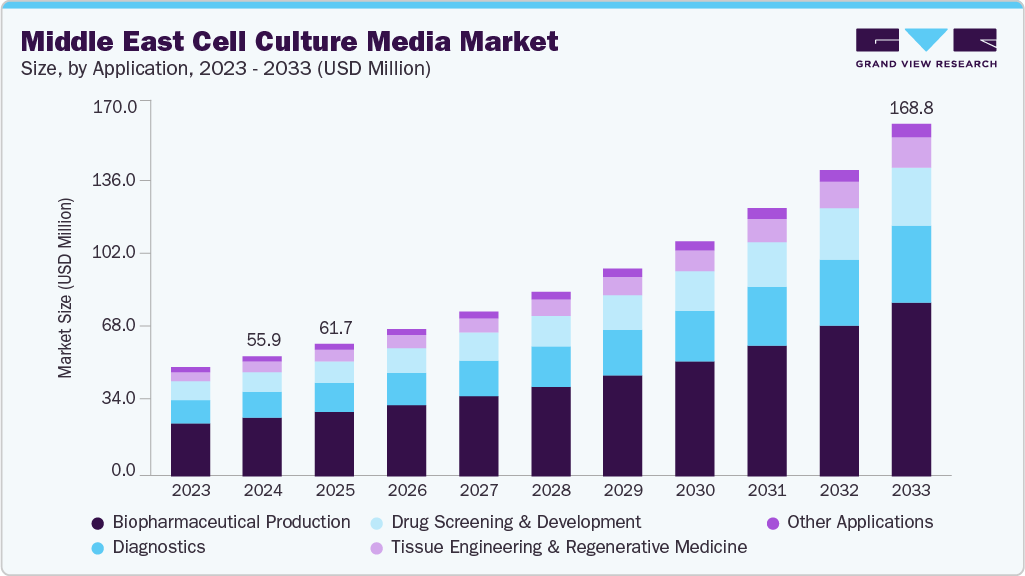
Government-backed initiatives to diversify economies, coupled with the expansion of clinical trials and academic-industry collaborations, are further accelerating adoption. In addition, growing healthcare infrastructure, rising prevalence of chronic diseases, and increasing focus on cell-based research are supporting market expansion across the region.
Adoption of Advanced And Specialized Media Formulations
The Middle East cell culture media industry is witnessing a notable shift toward advanced and specialized media formulation, driven by increasing demand for high-performance solutions in biopharmaceutical production, stem cell research, and diagnostics. Traditional media formulations, while reliable, often face limitations in consistency, reproducibility, and scalability, prompting manufacturers and research institutions to adopt more refined options such as serum-free, chemically defined, and stem cell-specific media.
Serum-free media, which eliminates the need for animal-derived components, is gaining prominence due to its ability to reduce variability, minimize contamination risks, and support regulatory compliance. Chemically defined media further enhances process reproducibility by providing precise, consistent nutrient compositions, enabling large-scale biomanufacturing with predictable outcomes. These formulations are particularly important for monoclonal antibody production, vaccine manufacturing, and regenerative medicine applications, where quality and consistency are critical.
Stem cell media is becoming increasingly important in the Middle East, driven by rising investments in regenerative therapies, personalized medicine, and academic research. Such media support specific growth requirements, maintain pluripotency, and facilitate differentiation of stem cells for therapeutic and research purposes. The adoption of these specialized media not only improves experimental reliability but also accelerates product development timelines, offering a competitive advantage to biopharmaceutical companies and research institutions operating in the region.
Overall, the transition toward advanced and specialized cell culture media formulations is a strategic response to the evolving needs of the Middle East biotechnology and healthcare sectors. By enabling higher efficiency, reducing variability, and supporting complex research and production processes, these formulations are expected to remain a key growth driver throughout the forecast period. Manufacturers and institutions that invest in these technologies are well-positioned to meet the region’s growing demand for high-quality biologics, diagnostics, and stem cell-based innovations.
Expansion And Modernization of Healthcare Infrastructure
The Middle East cell culture media industry is witnessing strong growth driven by enhancements in healthcare infrastructure, which are facilitating broader adoption of advanced cell culture techniques. Key markets, including the UAE, Saudi Arabia, and Qatar, are investing in modernizing hospitals, research laboratories, and biomanufacturing facilities. Initiatives such as establishing state-of-the-art labs, upgrading existing infrastructure, and integrating technologies like automated cell culture systems, bioreactors, and high-throughput screening platforms are improving operational efficiency and ensuring compliance with international standards.
These infrastructure developments are also supporting the expansion of specialized research centers and biotech hubs focused on stem cell research, regenerative medicine, and biologics production. Investments in laboratory equipment, training, and quality management systems are enhancing the capacity to perform complex experiments with higher precision. By strengthening local production capabilities and enabling scalable biomanufacturing, these upgrades are attracting multinational life sciences companies and fostering regional collaborations. Overall, the expansion and modernization of healthcare infrastructure remain key drivers of cell culture media adoption and market growth in the Middle East.
Market Concentration & Characteristics
The moderate degree of innovation in cell culture media is a key driver of market growth in the Middle East, enabling improved product formulations, enhanced cell viability, and more efficient bioprocessing. These advancements are attracting investments from biopharmaceutical companies and research institutions, fostering regional adoption and accelerating the development of biologics and cell-based therapies.
M&A activity in the Middle East cell culture media industry is low to moderate, reflecting its early growth and adoption phase, with companies primarily focusing on capacity building, local partnerships, and technology collaborations rather than large-scale consolidation.
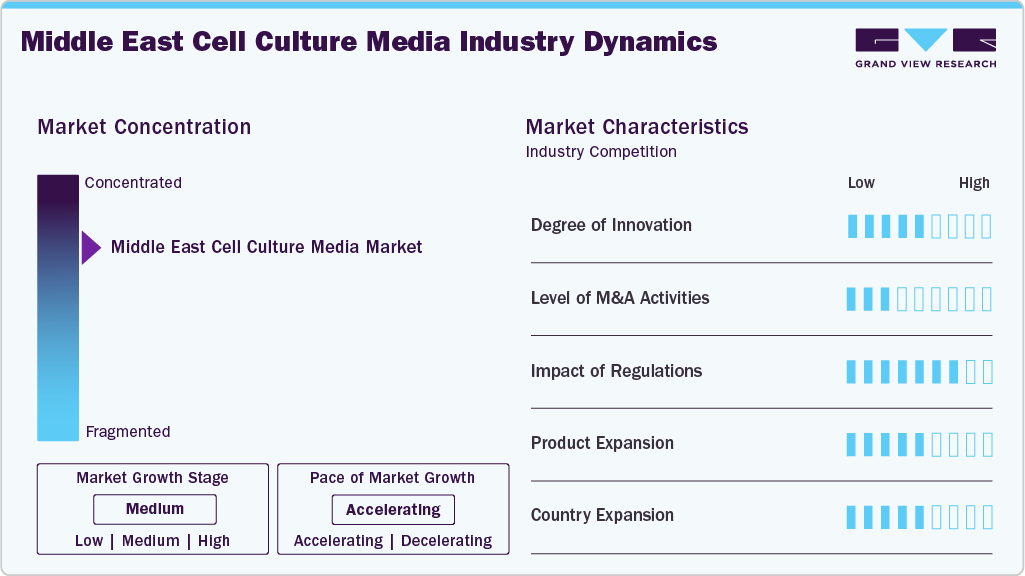
Regulations greatly impact on the Middle East cell culture media industry, shaping quality standards, import approvals, and compliance requirements. Stringent oversight ensures product safety and consistency while encouraging adherence to international guidelines, which builds market credibility and supports the expansion of biopharmaceutical manufacturing and research activities across the region.
Product expansion drives growth in the Middle East cell culture media industry by introducing advanced formulations that enhance cell productivity, support diverse cell lines, and improve bioprocess efficiency, enabling local manufacturers and research institutes to meet rising demand for biologics and accelerate regional biopharmaceutical development.
The Middle East cell culture media industry is expanding across countries like the UAE, Saudi Arabia, and Qatar, driven by rising biotech investments, growing biopharmaceutical manufacturing, government-led healthcare initiatives, and increasing demand for advanced cell-based research and biologics production.
Product Insights
The serum-free media segment led the market with the largest revenue share of 33.16% in 2024 and is anticipated to grow at the fastest CAGR over the forecast period. This growth is driven by its consistent performance, reduced risk of contamination, and suitability for large-scale biopharmaceutical production, making it a preferred choice for research and manufacturing applications. The rising shift toward defined and animal-component-free formulations will remain a key growth driver throughout the forecast period.
Thestem cell culture media segment is anticipated to witness at a significant CAGR of 13.14% over the forecast period. This growth is fueled by increasing stem cell research initiatives, expanding regenerative medicine applications, and rising government and private sector investments, driving demand for specialized, high-quality media formulations across research institutions and biopharmaceutical companies.
Application Insights
The biopharmaceutical production segment led the market with the largest revenue share of 48.79% in 2024 and is anticipated to grow at the fastest CAGR over the forecast period. Growth is driven by increasing production of monoclonal antibodies, vaccines, and recombinant proteins, along with rising investments in biomanufacturing facilities across Saudi Arabia, the UAE, and Qatar. The segment’s expansion is further supported by demand for high-quality, scalable cell culture media, which will remain a key growth driver throughout the forecast period.
The diagnostics segment is projected to witness at a significant CAGR of 13.01% over the forecast period. This growth is driven by rising demand for accurate and rapid diagnostic testing, increasing adoption of cell-based assays, and expanding investments in healthcare infrastructure across the Middle East, supporting enhanced research capabilities and improved disease detection and monitoring.
Type Insights
The liquid media segment accounted for the largest market revenue share in 2024 and is anticipated to grow at the fastest CAGR over the forecast period. This is attributed to its ease of use, superior nutrient availability, and compatibility with large-scale bioprocessing and research applications. Growing adoption in biopharmaceutical manufacturing, stem cell research, and diagnostics further supports its expansion. The segment’s versatility, efficiency, and ability to meet rising demand for high-quality cell culture solutions will remain a key growth driver throughout the forecast period.
The semi-solid & solid media segment is projected to witness a significant CAGR of 11.87% over the forecast period. This growth is driven by its widespread use in microbial and tissue culture applications, ease of storage and handling, and suitability for research and diagnostic purposes. Increasing adoption in academic and clinical laboratories across the Middle East will remain a key growth driver throughout the forecast period.
End Use Insights
The pharmaceutical & biotechnology companies segment led the market with the largest revenue share of 34.24% in 2024 and is anticipated to grow at the fastest CAGR over the forecast period. This growth is driven by increasing biopharmaceutical production, rising investments in research and development, and the expansion of biologics and personalized medicine initiatives across the region. The segment’s focus on high-quality, scalable cell culture media solutions to support drug development and manufacturing will remain a key growth driver throughout the forecast period.
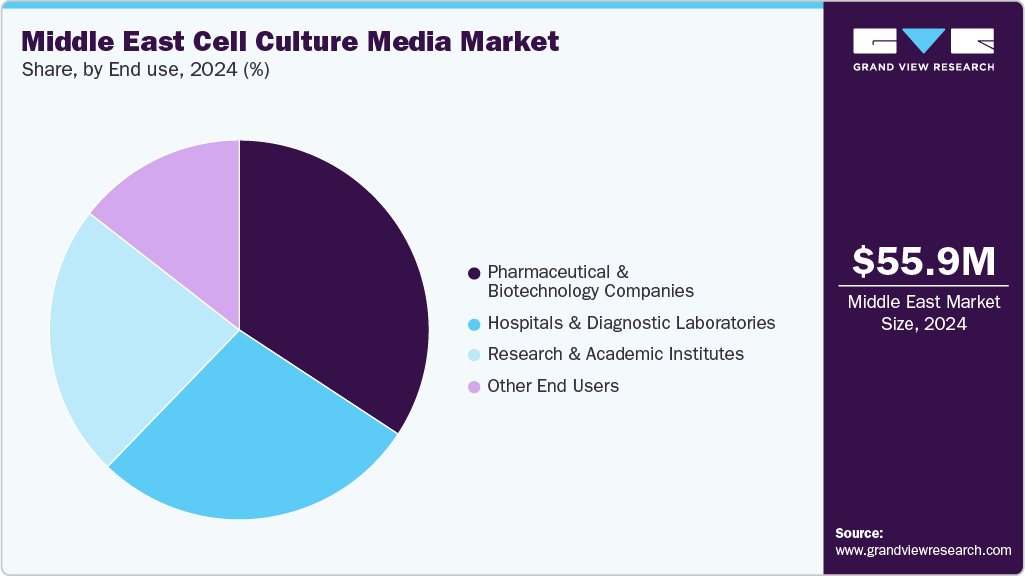
The hospitals & diagnostic laboratories segment is estimated to witness at a significant CAGR of 12.87% throughout the forecast period. This growth is driven by increasing demand for advanced diagnostic testing, rising adoption of cell-based assays for disease detection, and expanding healthcare infrastructure, which is enhancing the capacity of hospitals and laboratories to support research, diagnostics, and clinical applications across the region.
Country Insights
Kuwait Cell Culture Media Market Trends
The cell culture media market in Kuwait is gradually growing, supported by increasing healthcare investments, rising demand for advanced diagnostic and therapeutic solutions, and expanding collaborations between hospitals, research institutions, and international biopharmaceutical companies, which are fostering the adoption of cell-based research and biomanufacturing capabilities in the country.
UAE Cell Culture Media Market Trends
The UAE cell culture media market is a regional leader, driven by substantial government investments in biotechnology, the presence of advanced research infrastructure, growing biopharmaceutical manufacturing capabilities, and strong public-private partnerships that promote innovation, clinical research, and the adoption of cutting-edge cell-based technologies across the country.
Key Middle East Cell Culture Media Company Insights
The Middle East cell culture media industry is moderately consolidated, with a mix of global leaders and regional distributors driving growth. Major international players such as Thermo Fisher Scientific Inc., Merck KGaA, Cytiva, Lonza Group AG, and Corning Incorporated hold a significant collective market share, leveraging their extensive product portfolios, strong distribution networks, and established brand presence. These companies cater to a broad range of applications, including biopharmaceutical production, stem cell research, and diagnostics. They position themselves as preferred suppliers for large-scale research and manufacturing facilities across the region.
Regional growth is further supported by the presence of local distributors and niche suppliers that partner with global manufacturers to expand market access. These regional firms primarily focus on supplying culture media and related reagents to hospitals, academic institutes, and contract research organizations, while also providing technical support and training. Their role is critical in facilitating the adoption of advanced cell culture technologies, particularly in emerging markets such as Kuwait, Oman, and Bahrain, where local infrastructure and expertise are still developing.
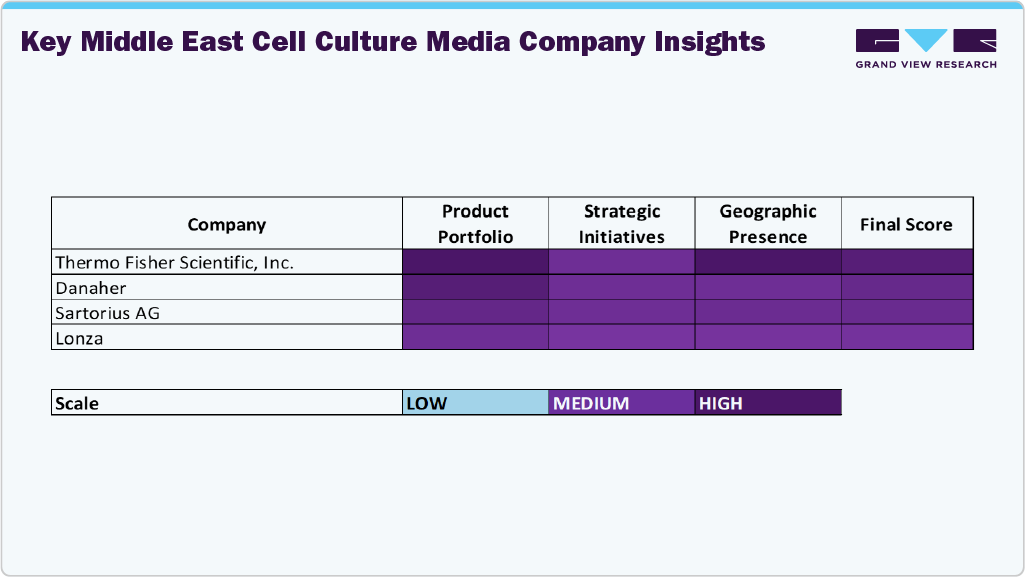
The competitive landscape is shaped by ongoing efforts of leading players to expand their footprint through strategic collaborations, distribution agreements, and the establishment of regional offices and warehouses. Companies are increasingly investing in strengthening local supply chains and improving product availability to reduce lead times and ensure quality consistency. In addition, several multinational firms are collaborating with government-backed biotech hubs in the UAE, Saudi Arabia, and Qatar to support local manufacturing and R&D capacity-building, further solidifying their market position.
Market share concentration is expected to remain moderate over the coming years as demand continues to rise and new entrants emerge. However, the dominance of established global brands is likely to persist due to their technological expertise, regulatory compliance, and ability to offer high-quality, scalable solutions. As the industry matures, competitive differentiation will increasingly depend on product innovation, customized media formulations, and value-added services such as technical consulting and training, which are becoming key strategies for sustaining market leadership in the Middle East cell culture media industry.
Key Middle East Cell Culture Media Companies:
- Sartorius AG
- Danaher
- Merck KGaA
- Thermo Fisher Scientific, Inc.
- FUJIFILM Corporation
- Lonza
- BD
- STEMCELL Technologies
- Cell Biologics, Inc.
- PromoCell GmbH
Recent Developments
-
In May 2022, Lonza and the Israel Biotech Fund (IBF) announced a two-year framework agreement to support the development and manufacturing of biologics and small molecules for IBF’s portfolio companies. This partnership strengthens Israel’s biotech infrastructure and contributes to the growth and advancement of the Middle East cell culture media industry.
Middle East Cell Culture Media Market Report Scope
Report Attribute
Details
Market size value in 2025
USD 61.7 million
Revenue forecast in 2033
USD 163.8 million
Growth rate
CAGR of 12.98% from 2025 to 2033
Base year for estimation
2024
Historical data
2021 - 2023
Forecast period
2025 - 2033
Quantitative units
Revenue in USD million/billion and CAGR from 2025 to 2033
Report coverage
Revenue forecast, company ranking, competitive landscape, growth factors, and trends
Segments covered
Product, application, type, end use, country
Regional scope
Middle East
Country scope
Saudi Arabia; UAE; Kuwait; Qatar; Oman
Key companies profiled
Sartorius AG; Danaher; Merck KGaA; Thermo Fisher Scientific, Inc.; FUJIFILM Corporation; Lonza; BD; STEMCELL Technologies; Cell Biologics, Inc.; PromoCell GmbH
Customization scope
Free report customization (equivalent up to 8 analyst’s working days) with purchase. Addition or alteration to country, regional & segment scope.
Middle East Cell Culture Media Market Report Segmentation
This report forecasts revenue growth and provides an analysis on the latest trends in each of the sub-segments from 2021 to 2033. For this report, Grand View Research has segmented the Middle East cell culture media market report based on the product, workflow, end use, and country:
-
Product Outlook (Revenue, USD Million, 2021 - 2033)
-
Serum-free Media
-
CHO Media
-
HEK 293 Media
-
BHK Medium
-
Vero Medium
-
Other Serum-free Media
-
-
Classical Media
-
Stem Cell Culture Media
-
Mesenchymal Stem Cells (MSCs)
-
Hematopoietic Stem Cells (HSCs)
-
Induced Pluripotent Stem Cells (iPSCs)
-
Other Stem Cells
-
-
Immunology Media
-
T Cells
-
B Cells
-
Natural Killer (NK) Cells
-
Other Immune Cells
-
-
Chemically Defined Media
-
Specialty Media
-
Other Cell Culture Media
-
-
Application Outlook (Revenue, USD Million, 2021 - 2033)
-
Biopharmaceutical Production
-
Monoclonal Antibodies
-
Vaccines Production
-
Other Therapeutic Proteins
-
-
Diagnostics
-
Drug Screening & Development
-
Tissue Engineering & Regenerative Medicine
-
Cell and Gene Therapy
-
Other Tissue Engineering & Regenerative Medicine Applications
-
-
Other Applications
-
-
Type Outlook (Revenue, USD Million, 2021 - 2033)
-
Liquid Media
-
Semi-solid & Solid Media s
-
-
End Use Outlook (Revenue, USD Million, 2021 - 2033)
-
Pharmaceutical & Biotechnology Companies
-
Hospitals & Diagnostic Laboratories
-
Research & Academic Institutes
-
Other End Users
-
-
Country Outlook (Revenue, USD Million, 2021 - 2033)
-
Saudi Arabia
-
UAE
-
Kuwait
-
Qatar
-
Oman
-
Frequently Asked Questions About This Report
b. The Middle East cell culture media market size was estimated at USD 55.9 million in 2024 and is expected to reach USD 61.7 million in 2025.
b. The Middle East cell culture media market is expected to grow at a compound annual growth rate of 12.98% from 2025 to 2033 to reach USD 163.8 million by 2033.
b. Saudi Arabia held the largest share of 37.66% of the overall revenue in 2024. This large share can be attributed to strong government investment in biotechnology, growing biomanufacturing capacity, and the establishment of advanced research and healthcare infrastructure.
b. Some key players operating in the Middle East cell culture media market include Sartorius AG; Danaher; Merck KGaA; Thermo Fisher Scientific, Inc.; FUJIFILM Corporation; Lonza; BD; STEMCELL Technologies; Cell Biologics, Inc.; and PromoCell GmbH among others.
b. Rising investments in biotechnology, expanding biopharmaceutical production, and increasing adoption of advanced cell culture techniques are the major factors likely to drive the Middle East cell culture media market.


Share this report with your colleague or friend.
Need a Tailored Report?
Customize this report to your needs — add regions, segments, or data points, with 20% free customization.


ISO 9001:2015 & 27001:2022 Certified
We are GDPR and CCPA compliant! Your transaction & personal information is safe and secure. For more details, please read our privacy policy.
Trusted market insights - try a free sample
See how our reports are structured and why industry leaders rely on Grand View Research. Get a free sample or ask us to tailor this report to your needs.













