Middle East Digital Textile Printing Inks Market Summary
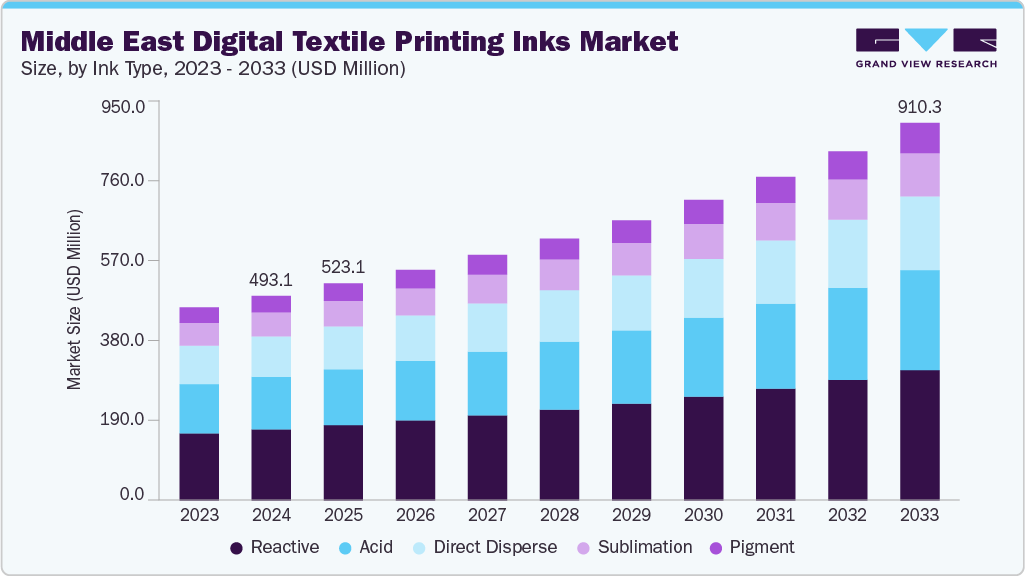
The Middle East digital textile printing inks market size was estimated at USD 493.10 million in 2024 and is projected to reach USD 910.27 million by 2033, growing at a CAGR of 7.2% from 2025 to 2033. The industry is witnessing steady growth, supported by the region’s expanding textile and apparel industry, particularly in countries such as Turkey, the UAE, and Saudi Arabia.
Key Market Trends & Insights
- Saudi Arabia dominated the Middle East digital textile printing inks market with the largest revenue share of 51.4% in 2024.
- The market in the UAE is expected to grow at a significant CAGR of 7.6% from 2025 to 2033.
- By ink type, the acid digital textile printing inks segment is expected to grow at the highest CAGR of 7.6% from 2025 to 2033 in terms of revenue.
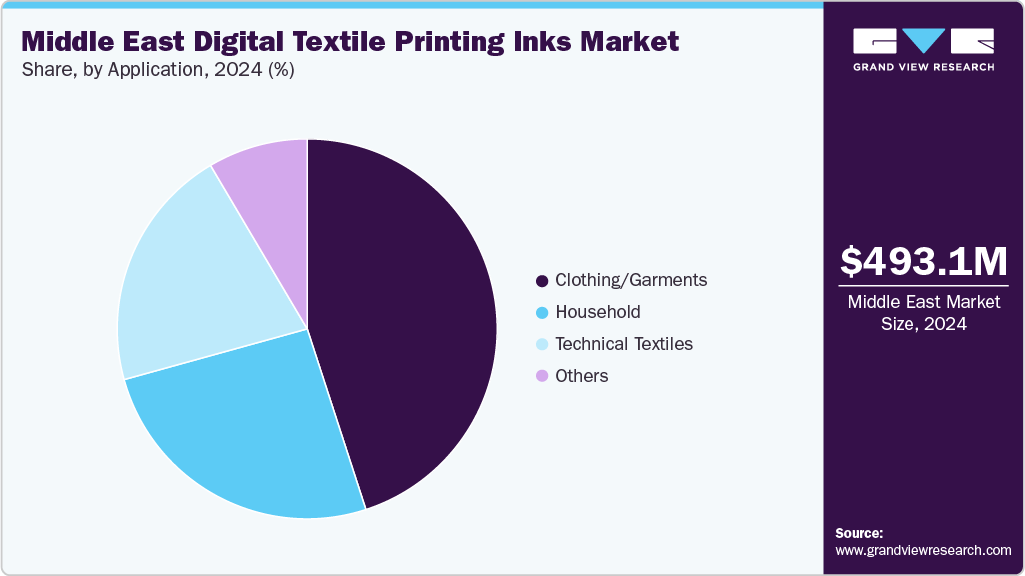
- By application, the clothing/garments segment held the largest revenue share of 45.0% in 2024 in terms of value.
Market Size & Forecast
- 2024 Market Size: USD 493.10 Million
- 2033 Projected Market Size: USD 910.27 Million
- CAGR (2025-2033): 7.2%
Digital printing technology is increasingly being adopted as it enables faster turnaround, shorter production runs, and customization - attributes well-aligned with the evolving consumer preference for personalized fashion and home décor products. The technology’s reduced water and chemical consumption compared to conventional printing also appeals to regional manufacturers facing mounting environmental and regulatory pressures.
One of the primary growth drivers is the increasing focus on sustainability in the textile value chain. Digital textile printing inks, particularly water-based formulations, significantly reduce wastewater generation, chemical discharge, and energy consumption compared to traditional rotary screen printing. This aligns with regional government initiatives promoting water conservation and greener industrial practices, especially in water-scarce nations like Saudi Arabia and the UAE. As a result, adoption of digital inks is accelerating, making sustainability not just a compliance requirement but also a competitive differentiator for textile producers in the Middle East.
Another factor shaping the market is the shift toward technical textiles and interior applications. With rising demand for digitally printed fabrics in home furnishings, sportswear, and promotional textiles, manufacturers are investing in pigment and reactive inks that provide superior colorfastness and compatibility with natural fibers. The hospitality and real estate growth across the Gulf region has further stimulated demand for printed upholstery, curtains, and decorative fabrics, creating a new revenue stream for ink producers and textile printers alike.
Market Concentration & Characteristics
The industry is characterized by its strong alignment with the global shift toward on-demand and sustainable textile production. Unlike conventional printing methods, digital printing requires minimal setup, enabling shorter production runs, faster lead times, and greater design flexibility. This makes it highly suitable for fashion, home décor, and technical textile applications where customization and rapid product cycles are critical. The market is also marked by a growing preference for water-based inks, such as reactive, pigment, and sublimation inks, due to their compatibility with diverse fabric types and their ability to deliver high-quality, durable prints.
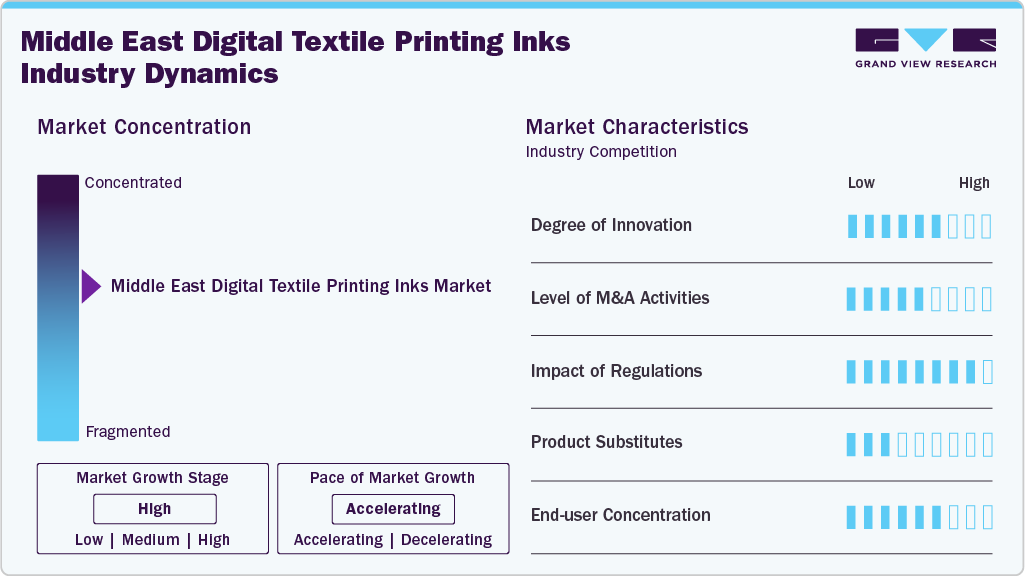
Another defining characteristic of this market is its technology-driven innovation and sustainability orientation. Ink manufacturers are investing in eco-friendly formulations that reduce water and chemical usage, supporting compliance with environmental standards such as OEKO-TEX and REACH. Additionally, the market exhibits a dynamic competitive landscape, with established chemical companies and niche ink producers competing through product differentiation in color vibrancy, print durability, and adaptability to high-speed digital printers. These characteristics make the market both highly innovative and increasingly indispensable to the modern textile value chain.
Ink Type Insights
The reactive segment dominated the market with a revenue share of 34.8% in 2024. This is primarily due to its strong compatibility with natural fibers such as cotton, which dominate the region’s textile and apparel industry. Reactive inks are favored for their ability to deliver vibrant colors, excellent wash fastness, and long-lasting prints, making them suitable for fashion and home furnishing applications. With increasing demand for high-quality printed fabrics in export-oriented textile hubs like Turkey and the Gulf, the adoption of reactive inks is expanding. Moreover, the shift toward sustainable printing processes is further supporting their use, as they align with eco-friendly practices compared to traditional dyeing methods.
The acid segment is expected to grow with a CAGR of 7.6% during the forecast period. The market is driven by its application in printing on protein-based fibers such as silk and wool, which are widely used in premium apparel and luxury textiles. Acid inks are known for delivering deep, rich colors and excellent print definition, making them ideal for high-end fashion and specialty fabrics. Demand for these inks is growing in niche markets across the region, particularly in countries with strong luxury textile and export markets like Turkey and the UAE. Additionally, increasing consumer preference for premium quality and customization in textiles is further supporting the adoption of acid inks.
Applications Insights
The clothing/garments by application segment dominated the market with a revenue share of 45.0% in 2024. The region’s emphasis on maximizing gasoline and light olefin yields from crude oil. These catalysts enhance conversion efficiency and product quality, making them vital for high-capacity refineries. Rising fuel demand, along with ongoing refinery expansions in countries like Saudi Arabia and the UAE, continues to strengthen the adoption of FCC catalysts in the region.
The technical textiles application segment is expected to grow at a CAGR of 7.8% from 2025-2033. This is driven by the region’s focus on producing cleaner fuels that comply with international sulfur reduction standards. These catalysts are widely used to remove impurities such as sulfur, nitrogen, and metals from feedstocks, improving fuel quality and meeting environmental regulations. Growing export-oriented refining capacities and stricter fuel specifications are expected to sustain strong demand for hydrotreating catalysts in the region.
Country Insights
The Middle East digital textile printing inks market is witnessing steady growth, supported by the region’s expanding textile and apparel sector, particularly in Iran, the UAE, and Saudi Arabia. Rising consumer demand for fast fashion, customized designs, and sustainable printing methods is driving the adoption of digital inks over traditional printing techniques. Moreover, government initiatives promoting local textile manufacturing and export competitiveness are further boosting market penetration. The shift toward eco-friendly inks and advanced printing technologies is also shaping the regional market dynamics.
Saudi Arabia Digital Textile Printing Inks Market Trends
Saudi Arabia digital textile printing inks market dominated the Middle East market with a revenue share of 51.35% in 2024. the digital textile printing inks market is gaining traction as the country diversifies its economy under Vision 2030 and invests in local textile and apparel production. Growing demand for customized fabrics, home décor, and fashion items is encouraging the shift from traditional printing methods to digital solutions. The preference for eco-friendly and water-efficient printing technologies aligns with sustainability goals in the region. Additionally, rising youth-driven fashion trends and the expansion of retail and e-commerce channels are creating strong opportunities for digital textile printing inks in the country.
Key Middle East Digital Textile Printing Inks Company Insights
Key players operating in the Middle East digital textile printing inks market are undertaking various initiatives to strengthen their presence and increase the reach of their products and services. Strategies such as expansion activities and partnerships are key in propelling the market growth. Key players such as Dow, DuPont, Huntsman Corporation, and Kornit Digital Limited are dominating the market.
- BASF SE is a chemical production company based in Germany and offers products to several end-use industries, including agriculture, chemicals, construction, electronic & electric, energy & resources, pharmaceuticals, and automotive & transportation. It operates through five business segments, namely performance products, chemicals, agricultural solutions, functional ink type & solutions, and oil & gas. The chemicals segment specializes in the manufacturing of products such as petrochemicals, catalysts, intermediates, and monomers. It also provides surface disinfectants for applications, including home care and industrial & institutional, comprising sub-applications such as laundry, dishwashing, food & beverage processing, and industrial cleaning, among others. The company operates through its various subsidiaries and joint ventures in over 80 countries, with more than 353 production sites spread across the globe. It also has 13 operating divisions and around 84 sub-business units worldwide. The company operates in various locations, including Germany, the U.S., Belgium, Brazil, Canada, Chile, the Netherlands, Norway, Poland, Portugal, Korea, Japan, India, Malaysia, the UAE, South Africa, and China.
Key Middle East Digital Textile Printing Inks Companies:
- Dow
- DuPont
- BASF SE
- Huntsman Corporation
- Sensient Technologies
- Dover Corporation
- Dystar Group
- Kornit Digital Limited
- Leibinger Group
- AM Printex
- Digitex India Inc.
- T&K Toka Corporation
- Sun Chemicals
- INX International Ink Co.,
Recent Developments
- In April 2025, Iran is projected to lead Middle East additions in Fluid Catalytic Cracking Unit (FCCU) capacity by 2030, accounting for over 40% of the region's planned and announced increase. This significant growth is primarily driven by the Siraf Refinery Complex project, which alone will contribute a major portion of the new capacity. The expansion is part of a broader regional trend, with Iran, Kuwait, and Oman collectively representing most of the Middle East's forthcoming FCCU capacity. The primary motivation for this investment is to increase domestic production of gasoline and other valuable lighter products, maximizing value from heavier crude oil fractions and enhancing refining self-sufficiency.
Middle East Digital Textile Printing Inks Market Report Scope
|
Report Attribute
|
Details
|
|
Market size value in 2025
|
USD 523.10 million
|
|
Revenue forecast in 2033
|
USD 910.27 million
|
|
Growth rate
|
CAGR of 7.2% from 2025 to 2033
|
|
Base year for estimation
|
2024
|
|
Historical data
|
2021 - 2023
|
|
Forecast period
|
2025 - 2033
|
|
Quantitative units
|
Volume in kilotons; revenue in USD million/billion and CAGR from 2025 to 2033
|
|
Report coverage
|
Volume & revenue forecast, company ranking, competitive landscape, growth factors, and trends
|
|
Segments covered
|
Ink type, application, country
|
|
Regional scope
|
Middle East
|
|
Country scope
|
Saudi Arabia; UAE; Iran; Israel
|
|
Key companies profiled
|
Dow; DuPont; BASF SE; Huntsman Corporation; Sensient Technologies; Dover Corporation; Dystar Group; Kornit Digital; Leibinger Group; AM Printex; Digitex India Inc.; T&K Toka Corporation; Sun Chemicals; INX International Ink Co.
|
|
Customization scope
|
Free report customization (equivalent up to 8 analysts’ working days) with purchase. Addition or alteration to country, regional & segment scope.
|
|
Pricing and purchase options
|
Avail customized purchase options to meet your exact research needs. Explore purchase options
|
Middle East Digital Textile Printing Inks Market Report Segmentation
This report forecasts volume & revenue growth at regional and country levels and provides an analysis of the latest industry trends in each of the sub-segments from 2021 to 2033. For this study, Grand View Research has segmented the Middle East digital textile printing inks market report based on ink type, application, and country.
-
Ink Type Outlook (Volume, Kilotons; Revenue, USD Million, 2021 - 2033)
-
Reactive
-
Acid
-
Direct Disperse
-
Sublimation
-
Pigment
-
Application Outlook (Volume, Kilotons; Revenue, USD Million, 2021 - 2033)
-
Clothing/Garments
-
Household
-
Technical Textiles
-
Other Applications
-
Country Outlook (Volume, Kilotons; Revenue, USD Million, 2021 - 2033)
-
Middle East
-
Saudi Arabia
-
UAE
-
Iran
-
Israel
Frequently Asked Questions About This Report
b. The Middle East digital textile printing inks market size was estimated at USD 493.10 million in 2024 and is expected to reach USD 523.10 million in 2025.
b. The Middle East digital textile printing inks market is expected to grow at a compound annual growth rate of 7.2% from 2025 to 2033 to reach USD 910.27 million by 2033.
b. Saudi Arabia's digital textile printing inks market dominated the MEA market with a revenue share of 51.4% in 2024. The digital textile printing inks market is gaining traction as the country diversifies its economy under Vision 2030 and invests in local textile and apparel production
b. Some key players operating in the Middle East digital textile printing inks market include Dow, DuPont, BASF SE, Huntsman Corporation, Sensient Technologies, Dover Corporation, Dystar Group, Kornit Digital Corporation, Leibinger Group, AM Printex, Digitex India Inc., T&K Toka Corporation, The DyStar Group, Sun Chemicals, and INX International Ink Co.,
b. The market is witnessing steady growth, supported by the region’s expanding textile and apparel industry, particularly in countries such as Turkey, the UAE, and Saudi Arabia. Digital printing technology is increasingly being adopted as it enables faster turnaround, shorter production runs, and customization, attributes well-aligned with the evolving consumer preference for personalized fashion and home décor products

 Download Sample Report
















