
- Home
- »
- Automotive & Transportation
- »
-
Middle East Logistics Automation Market Size Report, 2033GVR Report cover

Middle East Logistics Automation Market (2026 - 2033) Size, Share & Trends Analysis Report By Component (Hardware, Software), By Function, By Logistics, By Organization Size, By Software Application, By Vertical (Automotive, Healthcare, By Region, And Segment Forecasts
Middle East Logistics Automation Market Summary
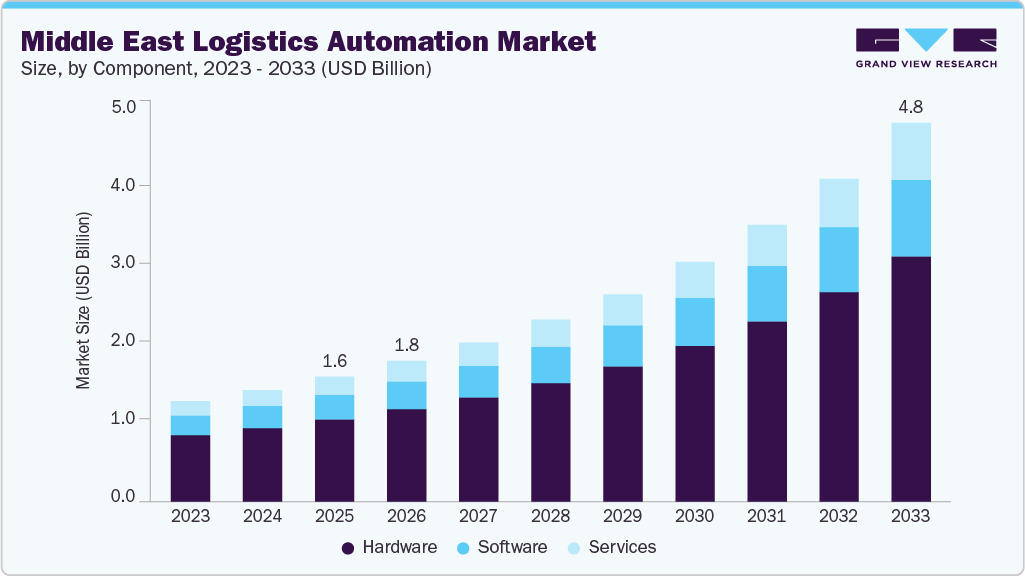
The Middle East logistics automation market size was estimated at USD 1.58 billion in 2025 and is projected to reach USD 4.78 billion by 2033, growing at a CAGR of 15.2% from 2026 to 2033. The logistics sector across the Middle East is undergoing a notable transformation, driven in large part by rapid growth in e-commerce.
Key Market Trends & Insights
- Saudi Arabia logistics automation industry accounted for a 30.55% share of the overall market in 2025.
- By component, the hardware segment accounted for the largest share in 2025.
- Based on logistics, the sales logistics segment dominated the market in 2025.
- By function, the transportation management segment dominated the market in 2025.
- By software application, the order management segment dominated the market in 2025.
Market Size & Forecast
- 2025 Market Size: USD 1.58 Billion
- 2033 Projected Market Size: USD 4.78 Billion
- CAGR (2026-2033): 15.2%
Three ways to get this report
Buy it, customize it, or ask a question.Ask an Analyst
Analyst response in 1 business day
- AccessReport author, directly
- Reply timeWithin 1 working day
- No sales callDirect answer only
- FormatEmail reply
- CostFree, no cost
Get the Full Report
What the study covers
- FormatsPDF · Excel · Dashboard
- Timeline2026–2033 annual, 2025 base
- Coverage20+ countries, 5 regions
- Companies10+ key players profiled
Customize the Report
20% free customization
- IncludeCountries, segments, points
- TailorTo your product definition
- ExtendDeeper competitor detail
- OrA fully bespoke study
- Turnaround5–10 working days
As consumers increasingly turn to online platforms for everyday purchases, logistics operators are under pressure to process higher order volumes with faster turnaround times. In response, companies are accelerating investments in automation technologies such as autonomous mobile robots (AMRs), automated guided vehicles (AGVs), and automated storage and retrieval systems (AS/RS), which help streamline picking, storage, and fulfillment tasks in warehouses of all sizes. These investments not only enhance throughput but also support more flexible operations that can scale with fluctuating demand.Rising labor costs and workforce constraints are prompting logistics firms to rethink traditional operations. With wages climbing and shortages in manual labor becoming more apparent, especially in urbanized markets like the UAE and Saudi Arabia, automation is seen as a strategic response to maintain competitiveness. By replacing or augmenting manual processes with robotic systems, companies can reduce dependency on labor while improving accuracy and safety. This shift is lending urgency to the adoption of robotics and sensor-based automation throughout material handling and inventory workflows.
 Source: Grand View Research, IR Documents, Primary Interviews, Paid DatabasesTo learn more about this report,
 Download Free Sample Report
 The degree of innovation in the logistics automation market is high. Cutting-edge technologies such as artificial intelligence, machine learning, and robotics are continually being developed and integrated into logistics operations. These innovations enhance efficiency, accuracy, and speed in supply chain management. Advanced automation systems, including autonomous vehicles and drones, are revolutionizing last-mile delivery. Smart warehouses equipped with IoT devices and sensors are optimizing inventory management and reducing operational costs. Developing countries, in particular, struggle with the adoption of these advanced systems due to a lack of expertise. Thus, the high degree of innovation drives significant growth and transformation in the logistics automation industry.
Advances in artificial intelligence (AI), the Internet of Things (IoT), and data analytics are at the heart of the next frontier in logistics automation. AI-driven predictive analytics and real-time data systems are enabling smarter decision making, from demand forecasting to dynamic route optimization. Integrating digital twins and sensor networks into warehouses allows operators to visualize and adjust processes in real time, leading to better uptime, reduced waste, and more efficient space utilization. Governments have also underscored these technologies in national strategies, signaling broader support for digital logistics ecosystems.
Another trend gaining traction is the expansion of autonomous transport and last-mile delivery innovations. Pilot programs for driverless delivery vehicles and frameworks for autonomous heavy trucks reflect a growing interest in reducing delivery costs and meeting consumer expectations for speed and transparency. While still emerging, these initiatives illustrate how automation in logistics is extending beyond warehouses and into the transport network itself, with implications for overall supply chain efficiency.
Component Insights
Based on components, the market is segmented into hardware, software, and services. The hardware segment dominated the market with a market share of 65.73% in 2025. The hardware segment continues to dominate the Middle East market as companies prioritize tangible assets that directly boost operational efficiency and throughput. Warehouses and distribution centers are increasingly adopting solutions such as automated storage and retrieval systems (AS/RS), conveyor systems, robotics, and automated guided vehicles (AGVs) to manage rising volumes and reduce manual dependencies. With e-commerce demand surging, logistics operators are turning to hardware investments that deliver immediate performance gains, shorten order cycle times, and improve space utilization.
The services segment is expected to register the fastest CAGR from 2026 to 2033. The services segment is emerging as a critical growth enabler in the Middle East logistics automation industry as companies move beyond standalone automation hardware toward integrated, end-to-end solutions. As warehouses adopt robotics, automated material handling systems, and smart control platforms, demand is rising for consulting, deployment and integration, and ongoing support services that ensure seamless implementation and sustained performance. Logistics operators increasingly rely on service providers to customize automation systems to local operational needs, integrate new technologies with legacy infrastructure, and maintain system uptime in high-throughput environments.
Function Insights
Based on transportation mode, the market is segmented into inventory & storage management and transportation management. The transportation management segment dominated the market in 2025, with a market share of 61.4%. The transportation management function continues to dominate the Middle East market as companies focus on optimizing movement of goods across complex supply chains. With the rapid expansion of regional trade corridors and the rise of e-commerce, there is heightened emphasis on automated route planning, real-time fleet tracking, and digital freight matching to improve delivery speed and reliability. Cloud-based transportation management systems (TMS) are increasingly adopted to centralize planning, enhance visibility, and reduce freight costs through dynamic optimization
The inventory & storage management segment is expected to grow at the fastest CAGR from 2026 to 2033. The shift toward automation in this area is driven by the need to handle increasing SKU diversity, short delivery windows, and higher order volumes without proportional increases in labor. Technologies such as automated storage and retrieval systems (AS/RS), robotics for picking and sorting, and AI-enabled inventory tracking are helping warehouses maintain real-time stock visibility and reduce shrinkage. Integration of these systems with warehouse management software also supports smarter slotting, demand forecasting, and replenishment planning.
Logistics Insights
Based on logistics, the market is segmented into sales logistics, production logistics, recovery logistics, and procurement logistics. Among these, the sales logistics segment dominated the market in 2025. The sales logistics segment continues to dominate the Middle East market as businesses concentrate on fulfilling customer orders quickly, accurately, and cost-efficiently. With e-commerce growth driving higher expectations for fast delivery and real-time tracking, companies are investing in automation technologies that enhance order processing, outbound logistics, and last-mile fulfillment. Automated systems such as advanced warehouse control, intelligent picking robots, and integrated transportation management platforms are enabling smoother coordination across the sales logistics value chain.
The production logistics segment is expected to grow at the fastest CAGR from 2026 to 2033. Driven by increasing adoption of Industry 4.0 principles and the integration of smart manufacturing with logistics operations, businesses are exploring automated solutions for intra-plant transport, real-time inventory staging, and synchronization of materials with production schedules. Technologies such as autonomous guided vehicles (AGVs), automated conveyors, and sensor-based tracking systems are being introduced to minimize manual handling and improve coordination between production and logistics functions.
Organization Size Insights
The large enterprises' segment dominated the market in 2025. Large enterprises continue to dominate the Middle East market as they have the resources and strategic incentives to deploy comprehensive automation solutions at scale. These organizations are under pressure to manage high volumes, complex networks, and multi-channel distribution efficiently, making technologies like automated storage and retrieval systems (AS/RS), robotics, and advanced transportation management platforms essential. Large players also benefit from economies of scale when integrating digital tools such as IoT sensors and AI-powered analytics to boost visibility, optimize routes, and reduce operational costs.
The SME segment is expected to grow at a considerable CAGR from 2026 to 2033. Cloud-based solutions, subscription-based platforms, and scalable robotics are lowering entry barriers, enabling SMEs to automate critical functions like inventory tracking, order fulfillment, and delivery coordination without significant upfront investment. The growing availability of integrated service support from implementation consulting to maintenance also gives SMEs confidence to adopt automation incrementally. As competition intensifies and customer expectations rise, more SMEs view automation not just as a cost saver but as a way to enhance service quality and grow market share, making this segment an important emerging force in the regional logistics automation landscape.
Software Application Insights
The order management segment dominated the market in 2025. The order management software segment is gaining strong traction in the Middle East market as businesses strive to synchronize customer orders across channels and accelerate fulfillment cycles. With the rapid rise of e-commerce and omnichannel sales, companies are investing in order management systems (OMS) that provide real-time visibility into orders, enable intelligent order allocation, and support seamless integration with warehouse and transportation platforms. Advanced OMS solutions are incorporating AI-driven demand forecasting, dynamic prioritization of orders, and automated workflows that reduce manual intervention and errors.
The inventory management segment is expected to grow at the fastest CAGR from 2026 to 2033. The inventory management software segment is emerging as a crucial component of logistics automation in the Middle East, enabling companies to optimize stock levels, minimize holding costs, and improve fulfillment accuracy. As product assortments expand and supply chains become more complex, real-time inventory visibility has become essential for preventing stockouts and overstock situations. Inventory management systems (IMS) that integrate with automated scanning technologies, IoT sensors, and warehouse execution systems are helping businesses achieve more accurate and timely insights into stock movements and warehouse capacity.
Vertical Insights
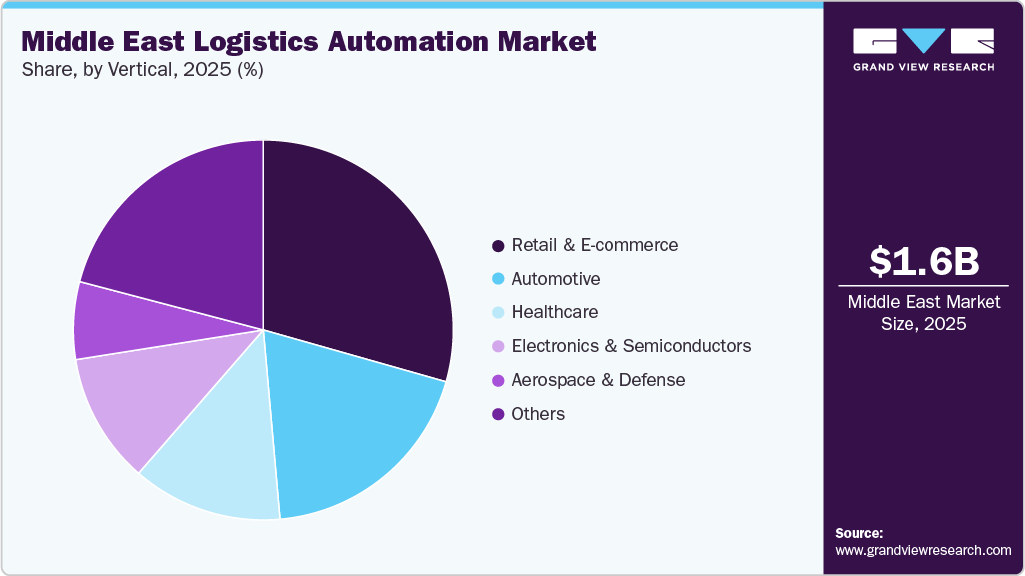
The retail and e-commerce segment dominated the market in 2025. The retail and e-commerce vertical continues to dominate the Middle East market due to exponential growth in online shopping and omnichannel fulfillment demands. Rising customer expectations for fast delivery, real-time tracking, and flexible return policies are pushing retailers to adopt advanced automation solutions across the supply chain. Automated picking systems, robotics, smart conveyors, and integrated warehouse management platforms are helping businesses process higher order volumes with greater accuracy and reduced lead times.
 To learn more about this report, Download Free Sample Report
 The healthcare segment is anticipated to register a significant CAGR over the forecast period. The complexity of handling temperature-sensitive pharmaceuticals, medical devices, and surgical supplies is driving demand for automation technologies that ensure stringent compliance and reduce the risk of errors. Automated storage and retrieval systems, robotics for precise inventory handling, and real-time tracking platforms are being deployed to improve stock visibility and expedite fulfillment of urgent orders. Adoption is also supported by healthcare providers’ focus on patient safety, operational efficiency, and cost containment, which automation solutions can directly address.
Country Insights
Saudi Arabia Logistics Automation Market Trends
Saudi Arabia logistics automation industry dominated the Middle East market and accounted for a share of 30.5% in 2025. Logistics automation in Saudi Arabia is being driven by large-scale infrastructure expansion and a strong push to modernize supply chains in line with national economic transformation goals. Rapid growth in domestic consumption, expanding industrial zones, and rising e-commerce activity are creating demand for high-capacity automated warehouses and digitally enabled transportation systems. Companies are increasingly investing in automation to manage long-distance distribution efficiently, reduce operational costs, and improve delivery reliability across vast geographies.
UAE Middle East Digital Banking Platform Market Trends
The UAE logistics automation industry is expected to grow at the fastest CAGR of 16.9% from 2026 to 2033. Logistics automation is gaining momentum as the country focuses on speed, precision, and innovation across its supply chain ecosystem. High urban density, strong e-commerce penetration, and a well-established role as a regional trade and re-export hub are driving demand for advanced automation in warehousing, order fulfillment, and transportation management. Logistics operators are adopting smart automation solutions to support same-day and next-day delivery expectations while maintaining high service levels. Integration of AI-enabled planning, real-time tracking, and autonomous systems is helping businesses improve throughput and reduce turnaround times in both domestic and cross-border logistics.
Key Middle East Logistics Automation Company Insights
Some of the key companies operating in the Middle East market include Swisslog Holding AG,SSI SCHÄFER AG, and Daifuku Co., Ltd., among others.
-
Swisslog Holding AG is a global provider of automated warehouse and intralogistics solutions, specializing in robotics-driven material handling and intelligent automation systems. The company offers a broad portfolio that includes automated storage and retrieval systems (AS/RS), shuttle and conveyor systems, robotic picking solutions, and warehouse management and control software. Swisslog serves multiple end-use sectors such as retail & e-commerce, food & beverage, healthcare, and industrial logistics, delivering end-to-end solutions from system design and engineering to installation and lifecycle support.
-
SSI SCHÄFER AG is a leading supplier of modular warehouse and logistics solutions, providing a comprehensive range of products and services for storage, material handling, and intralogistics automation. Its portfolio includes racking systems, automated storage and retrieval systems, shuttle systems, conveyors, picking and sorting solutions, and warehouse management software. SSI SCHÄFER supports industries such as retail, e-commerce, manufacturing, and logistics service providers, offering customized solutions tailored to complex operational requirements.
Key Middle East Logistics Automation Companies:
- Swisslog Holding AG
- SSI SCHÄFER AG
- Daifuku Co., Ltd.
- Vanderlande Industries B.V.
- TGW Logistics Group
- Honeywell International Inc.
- DHL Supply Chain
- Kuehne + Nagel
- Kardex
- Agility Logistics
Recent Developments
-
In May 2025, Hellmann Worldwide Logistics deployed a robotics-based automated storage system at its e-commerce fulfillment center in Dubai CommerCity, the region’s first free zone dedicated to digital commerce. The solution is designed to increase storage capacity, streamline warehouse operations, and accelerate product delivery, supporting businesses across multiple sectors. As part of Hellmann’s User Acceptance Testing program, the system integrates advanced robotics and blockchain-based management technologies to enhance flexibility, reliability, and efficiency. The initiative reflects broader investments in digital transformation as logistics providers in the Middle East seek to optimize supply chains and meet rising e-commerce demand.
-
In January 2025, Aramex launched a cutting-edge automated robotic sorting facility at Jeddah Islamic Port, marking a major milestone in its digital transformation and commitment to Saudi Arabia’s Vision 2030. The facility features an advanced automated sorting system with three feeding lines and 120 robotic guided vehicles, capable of processing up to 96,000 shipments per day. By integrating robotics, artificial intelligence, and temperature-controlled environments, the system significantly boosts operational efficiency and scalability while supporting sustainable logistics practices. Alongside this launch, Aramex announced plans to introduce drone delivery services to enhance last-mile efficiency and reduce carbon emissions.
Middle East Logistics Automation Market Report Scope
Report Attribute
Details
Market size value in 2026
USD 1.78 billion
Revenue forecast in 2033
USD 4.78 billion
Growth Rate
CAGR of 15.2% from 2026 to 2033
Actual Data
2021 - 2025
Forecast period
2026 - 2033
Quantitative units
Revenue in USD million/billion and CAGR from 2026 to 2033
Report coverage
Revenue forecast, company ranking, competitive landscape, growth factors, and trends
Segments covered
Component, function, logistics, organization size, software application, vertical, region
Regional scope
Middle East
Country scope
KSA; UAE; Kuwait; Qatar
Key companies profiled
Swisslog Holding AG; SSI SCHÄFER AG; Daifuku Co., Ltd.; Vanderlande Industries B.V.; TGW Logistics Group; Honeywell International Inc.; DHL Supply Chain; Kuehne + Nagel; Kardex;Agility Logistics
Customization scope
Free report customization (equivalent up to 8 analysts working days) with purchase. Addition or alteration to country, regional & segment scope.
Pricing and purchase options
Avail customized purchase options to meet your exact research needs. Explore purchase options
Middle East Logistics Automation Market Report Segmentation
This report forecasts revenue growth at global, regional, and country levels and provides an analysis of the latest industry trends in each of the sub-segments from 2021 to 2033. For this study, Grand View Research has segmented the Middle East logistics automation market report based on component, function, logistics, organization size, software application, vertical, and country:
-
Component Outlook (Revenue, USD Million, 2021 - 2033)
-
Hardware
-
Autonomous Robots (AGV, AMR)
-
Automated Storage and Retrieval Systems (AS/RS)
-
Automated Sorting Systems
-
De-palletizing/Palletizing Systems
-
Conveyor Systems
-
Automatic Identification and Data Collection (AIDC)
-
-
Software
-
Warehouse Management System
-
Transportation Management System
-
-
Services
-
Consulting
-
Deployment & Integration
-
Support & Maintenance
-
-
-
Function Outlook (Revenue, USD Million, 2021 - 2033)
-
Inventory & Storage Management
-
Transportation Management
-
-
Logistics Outlook (Revenue, USD Million, 2021 - 2033)
-
Sales Logistics
-
Production Logistics
-
Recovery Logistics
-
Procurement Logistics
-
-
Organization Size Outlook (Revenue, USD Million, 2021 - 2033)
-
Large Enterprises
-
Small & Medium Enterprises
-
-
Software Application Outlook (Revenue, USD Million, 2021 - 2033)
-
Inventory Management
-
Order Management
-
Yard Management
-
Shipping Management
-
Labor Management
-
Vendor Management
-
Customer Support
-
Others
-
-
Vertical Outlook (Revenue, USD Million, 2021 - 2033)
-
Retail & E-commerce
-
Healthcare
-
Automotive
-
Aerospace & Defense
-
Electronics & Semiconductors
-
Others
-
-
Regional Outlook (Revenue, USD Million, 2021 - 2033)
-
Middle East and Africa (MEA)
-
KSA
-
UAE
-
Qatar
-
South Africa
-
-
Frequently Asked Questions About This Report
The Middle East logistics automation market size was estimated at USD 1.58 billion in 2025 and is expected to reach USD 1.78 billion in 2026.
The Middle East logistics automation market is expected to grow at a compound annual growth rate of 15.2% from 2026 to 2033 to reach USD 4.78 billion by 2033.
Saudi Arabia dominated the Middle East logistics automation industry, accounting for a 30.55% share in 2025. . Logistics automation in Saudi Arabia is being driven by large-scale infrastructure expansion and a strong push to modernize supply chains in line with national economic transformation goals.
Some key players operating in the Middle East logsitics automation market include Swisslog Holding AG, SSI SCHÄFER AG, Daifuku Co., Ltd. Vanderlande Industries B.V., TGW Logistics Group, Honeywell International Inc., DHL Supply Chain, Kuehne + Nagel, Kardex, Agility Logistics
The growth of the Middle East logistics automation market can be attributed to the rapid expansion of e-commerce and regional trade corridors, coupled with government-led smart infrastructure initiatives and rising labor cost pressures, which are accelerating the adoption of robotics, AI-driven warehouse systems, and real-time data platforms to improve throughput, accuracy, and supply-chain resilience across logistics operations.
About the Author(s)
Automotive & Transportation Research Team
Technology · Automotive & TransportationThis report was authored by the automotive & transportation research team at Grand View Research - comprising two research analysts, one senior research analyst, and one industry expert - with specialized expertise in the automotive & transportation segment of the technology industry. All findings are based on proprietary technology databases, executive interviews, and regulatory analysis, subject to internal peer review prior to publication.
Last Updated:
Speak to Analyst

Customize this report to your needs - add regions, segments, or data points, with 20% free customization.
Or view our licence options:


ISO 9001:2015 & 27001:2022 Certified
We are GDPR and CCPA compliant! Your transaction & personal information is safe and secure. For more details, please read our privacy policy.


