
- Home
- »
- Advanced Interior Materials
- »
-
Middle East Metal Matrix Composite Market Size Report 2033GVR Report cover

Middle East Metal Matrix Composite Market (2025 - 2033) Size, Share & Trends Analysis Report By End-use (Ground Transportation, Electronics/Thermal Management, Aerospace), By Product (Aluminum, Nickel, Refractory), By Country, And Segment Forecasts
Middle East Metal Matrix Composite Market Summary
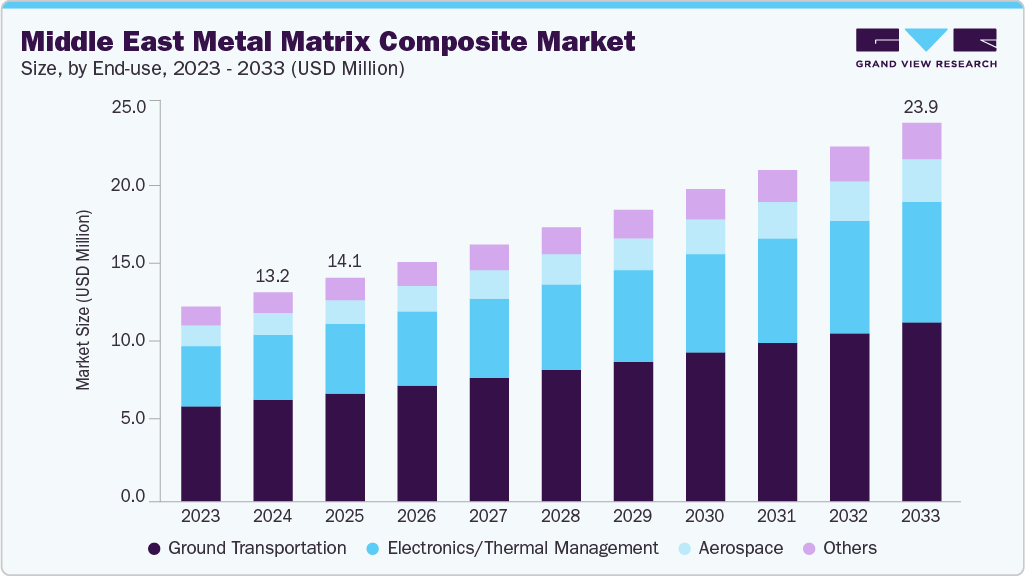
The Middle East metal matrix composite market size was estimated at USD 13.2 million in 2024 and is expected to reach USD 23.9 million by 2033, growing at a CAGR of 6.8% from 2025 to 2033. The region is experiencing a steady transformation in its automotive industry, with a growing focus on electric vehicles (EVs), fuel efficiency, and high-performance materials.
Key Market Trends & Insights
- Egypt is expected to grow at the fastest CAGR of 7.3% over the forecast period.
- By product, the refractory segment dominated the market and accounted for the largest revenue share of 42.5% in 2024.
- By end use, the ground transportation segment dominated the market and accounted for the largest revenue share of 48.6% in 2024.
Market Size & Forecast
- 2024 Market Size: USD 13.2 Million
- 2033 Projected Market Size: USD 23.9 Million
- CAGR (2025-2033): 6.8%
Prism AI by Grand View Research Free to tryAsk a question about the middle east metal matrix composite marketTry asking✓Every figure cited from GVR research Prefer the report? Download free sample →
MMCs are being increasingly utilized in the manufacturing of engine components, brake systems, and drivetrain parts due to their lightweight and durable properties. Governments across the region are also launching green mobility initiatives, which promote the use of sustainable and lightweight materials in vehicles. This push for innovation and sustainability is accelerating the adoption of MMCs in the transportation sector. Additionally, high-end vehicle customization and motorsport activities are contributing to niche demand for MMC-based components.Large-scale industrial and infrastructure projects under initiatives like Saudi Vision 2030 and the UAE’s economic diversification plans are bolstering the demand for advanced composite materials. MMCs are increasingly used in machinery, construction equipment, and structural components where high strength and resistance to wear and corrosion are essential. As these countries move away from oil dependence, investments in manufacturing, mining, and construction are surging, directly boosting the requirement for high-performance materials like MMCs. Furthermore, the push for modernization and smart infrastructure is fostering innovation and the integration of advanced materials into foundational projects.
 Source: Grand View Research, IR Documents, Primary Interviews, Paid DatabasesTo learn more about this report,
 Download Free Sample Report
The continuous development of new MMC formulations and processing techniques is significantly enhancing their mechanical properties, cost-effectiveness, and application range. In the Middle East, both public and private sectors are investing in research and development to support the local production and customization of composite materials. Collaborations between universities, research institutions, and international companies are fostering a robust innovation ecosystem for MMCs. These technological advancements are not only improving performance characteristics but also reducing manufacturing costs, making MMCs more accessible across industries. As regional capabilities in materials science grow, so too does the domestic MMC market potential.
Market Concentration & Characteristics
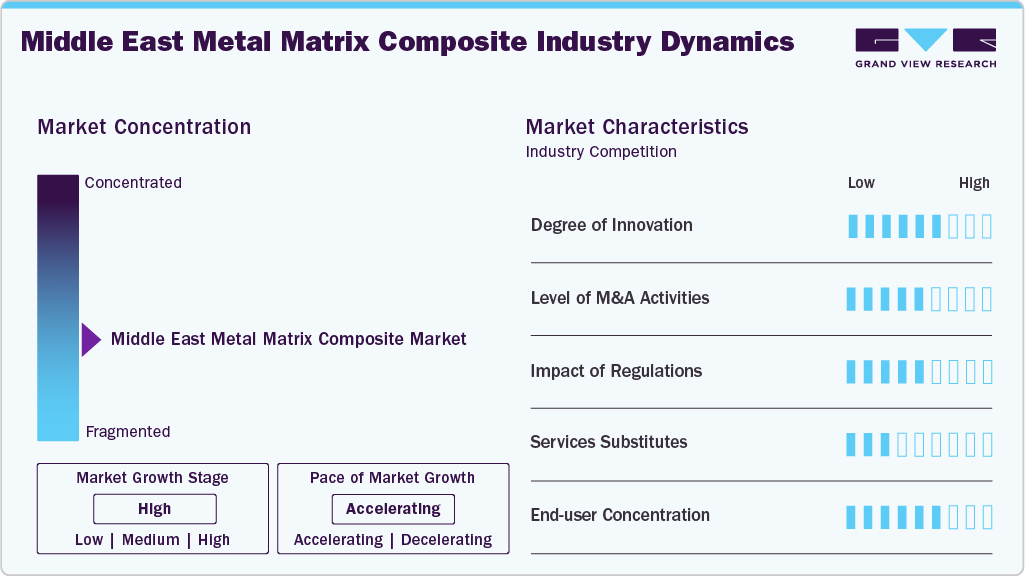
The Middle East MMC market is moderately concentrated, with a limited number of specialized manufacturers and international players dominating the space. The degree of innovation is high, driven by ongoing R&D in composite material science, especially in aerospace, automotive, and defense applications.
Local players are increasingly collaborating with global companies and research institutions to develop advanced MMCs tailored to regional requirements, including heat resistance, corrosion protection, and weight reduction. This innovation focus is essential due to the complex performance standards set by end-use industries. Moreover, advancements in powder metallurgy, additive manufacturing, and hybrid composite systems continue to expand the application scope of MMCs, enhancing market competitiveness.
 To learn more about this report, Download Free Sample Report
In terms of mergers and acquisitions, activity remains moderate but is growing, particularly as Middle Eastern nations aim to localize advanced material production and reduce reliance on imports. Regulatory frameworks, particularly those related to industrial standards, environmental compliance, and defense procurement policies, play a crucial role in shaping market dynamics. These regulations often mandate the use of lightweight, high-performance materials, indirectly favoring MMC adoption.
However, service substitutes, such as polymer matrix composites or traditional alloys, pose a challenge in cost-sensitive applications where MMCs may be seen as less economically viable. Finally, end-user concentration is high in sectors like aerospace, defense, and automotive, which account for a substantial share of total MMC demand, making industry-specific trends and government investment patterns critical to market growth.
End Use Insights
The ground transportation segment dominated the market and accounted for the largest revenue share of 48.6% in 2024, driven by rising demand for lightweight, durable materials in automotive applications. MMCs enhance fuel efficiency and vehicle performance by reducing weight without sacrificing strength. Components such as engine blocks, brake rotors, and drive shafts increasingly utilize aluminum-based MMCs.
The electronics/thermal management segment is expected to grow at the fastest CAGR of 7.1% over the forecast period. In the electronics and thermal management segment, MMCs are favored due to their excellent thermal conductivity and mechanical stability. These composites find extensive use in heat sinks, electronic packaging, and high-power electronic devices where effective heat dissipation is critical. Thermal management needs in consumer electronics, telecommunications infrastructure, and automotive electronics drive this demand.
Product Insights
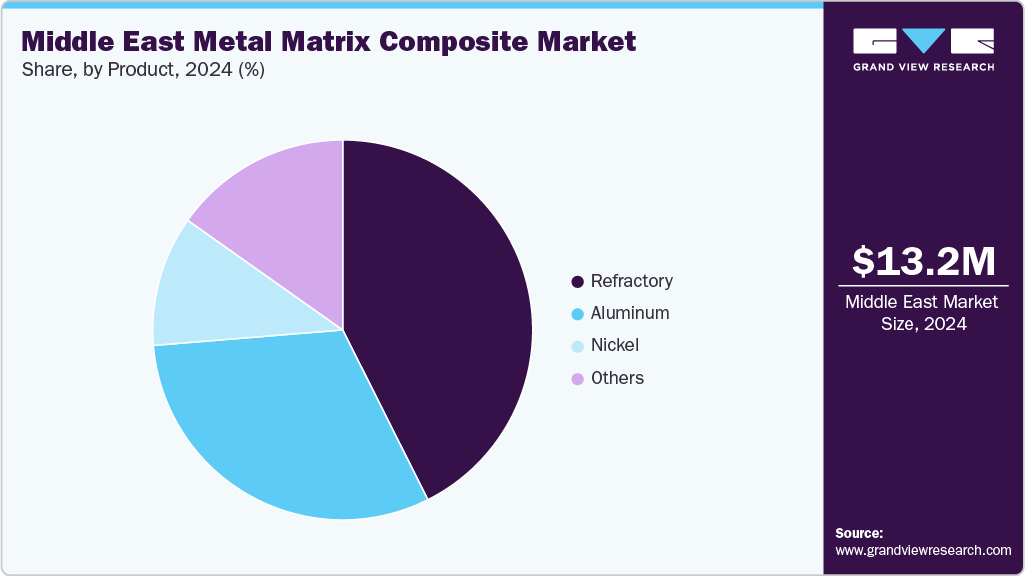
The refractory segment dominated the market and accounted for the largest revenue share of 42.5% in 2024. The refractory segment of the MMC market is substantial, characterized by materials that exhibit exceptional mechanical strength, wear resistance, and performance in extreme environments. Composites incorporating refractory metals like tungsten and molybdenum are prominent in industrial tooling, aerospace components, and electronics that demand high thermal stability and durability. This segment's growth is propelled by applications in cutting tools, aerospace engines, defense hardware, and nuclear facilities, reflecting its critical role in high-energy and harsh conditions.
 To learn more about this report, Download Free Sample Report
The aluminum segment is expected to grow significantly at a CAGR of 6.9% over the forecast period. Aluminum MMCs optimize the strength-to-weight ratio for structural and thermal applications across automotive, aerospace, and electronics industries. These composites support energy-efficient vehicle regulations and fuel economy standards by improving component performance, including electric vehicle battery enclosures and aerospace brackets. Continuous investment in manufacturing technologies enhances production capabilities and market penetration of aluminum MMCs.
Country Insights
Saudi Arabia Metal Matrix Composite Market Trends
Saudi Arabia’s MMC market is primarily driven by its defense modernization and industrial diversification strategies under Vision 2030. The Kingdom is heavily investing in localizing military production, including armored vehicles, aerospace components, and advanced manufacturing processes. MMCs, with their strength-to-weight advantages and durability, are critical in these high-performance applications. Additionally, growth in the mining and heavy equipment sectors, which demand wear-resistant materials, is further supporting MMC usage. Ongoing infrastructure mega-projects also contribute to increased demand for high-performance composites in structural applications.
UAE Metal Matrix Composite Market Trends
The UAE’s MMC market is fueled by its advanced aerospace and aviation sector, particularly through state-owned enterprises like EDGE and partnerships with global OEMs. The country has positioned itself as a regional hub for aerospace manufacturing and MRO (maintenance, repair, and overhaul), which extensively uses MMCs in engine parts and structural components. Moreover, the UAE’s push for electric vehicles and sustainable transport is increasing the adoption of lightweight composite materials in automotive applications. Strategic investments in advanced materials R&D and favorable trade policies further enhance the attractiveness of MMCs in the Emirates.
Egypt Metal Matrix Composite Market Trends
Egypt’s MMC market is driven by its rapidly expanding infrastructure and industrial base, supported by government-led economic reforms and foreign direct investment. The development of new cities, transportation networks, and industrial zones is creating demand for durable, lightweight materials in machinery, construction equipment, and transport systems. Additionally, the growth of local automotive assembly and manufacturing presents an opportunity for MMC integration in engine components and brake systems. While still emerging, technical partnerships and knowledge transfer are helping build local capabilities in advanced materials like MMCs.
Qatar Metal Matrix Composite Market Trends
Qatar’s MMC market is largely influenced by its focus on high-tech infrastructure and defense development, aligned with its National Vision 2030. The country is investing in strategic sectors like aerospace, defense, and advanced manufacturing, all of which benefit from the performance characteristics of MMCs. As Qatar develops its local manufacturing capabilities, especially in defense systems and UAVs, demand for lightweight and high-strength composites is increasing. Furthermore, government support for research institutions and innovation hubs is encouraging the exploration of MMC applications in niche, high-performance fields.
Kuwait Metal Matrix Composite Market Trends
In Kuwait, the MMC market is driven by industrial modernization initiatives and ongoing investments in the oil and gas sector, where MMCs are utilized for their corrosion resistance and thermal stability. As the country seeks to diversify its economy beyond hydrocarbons, MMCs are becoming relevant in emerging sectors like automotive parts production and precision engineering. The push for more efficient and durable materials in energy infrastructure and machinery also supports MMC adoption. Additionally, government-backed industrial development programs are encouraging collaborations with global materials firms, fostering gradual growth in composite usage.
Key Middle East Metal Matrix Composite Companies Insights
Key players operating in the Middle East metal matrix composite market are undertaking various initiatives to strengthen their presence and increase the reach of their products and services. Strategies such as expansion activities and partnerships are key in propelling the market growth.
Key Middle East Metal Matrix Composite Companies:
- Materion Corporation
- 3M Company
- CPS Technologies Corporation
- Plansee SE
- Sandvik AB
- GKN plc
- DWA Aluminum Composites USA, Inc.
- AMETEK Specialty Metal Products
- TISICS Ltd.
Middle East Metal Matrix Composite Market Report Scope
Report Attribute
Details
Market size value in 2025
USD 14.1 million
Revenue forecast in 2033
USD 23.9 million
Growth rate
CAGR of 6.8% from 2025 to 2033
Base year for estimation
2024
Historical data
2021 - 2023
Forecast period
2025 - 2033
Quantitative units
Revenue in USD million/billion and CAGR from 2025 to 2033
Report coverage
Revenue forecast, company ranking, competitive landscape, growth factors, and trends
Segments covered
End use, product, region
Regional scope
Middle East
Country scope
Saudi Arabia; UAE; Egypt; Qatar; Kuwait
Key companies profiled
Materion Corporation; 3M Company; CPS Technologies Corporation; Plansee SE; Sandvik AB; GKN plc; DWA Aluminum Composites USA, Inc.; AMETEK Specialty Metal Products; TISICS Ltd.
Customization scope
Free report customization (equivalent up to 8 analysts’ working days) with purchase. Addition or alteration to country, regional & segment scope.
Pricing and purchase options
Avail customized purchase options to meet your exact research needs. Explore purchase options
Middle East Metal Matrix Composite Market Report Segmentation
This report forecasts revenue growth at the regional and country levels and provides an analysis of the latest industry trends in each of the sub-segments from 2021 to 2033. For this study, Grand View Research has segmented the Middle East metal matrix composite market report based on end use, product, and country:
-
End Use Outlook (Revenue, USD Million, 2021 - 2033)
-
Ground Transportation
-
Electronics/Thermal Management
-
Aerospace
-
Others
-
-
Product Outlook (Revenue, USD Million, 2021 - 2033)
-
Aluminum
-
Nickel
-
Refractory
-
Others
-
-
Regional Outlook (Revenue, USD Million; 2021 - 2033)
-
Middle East
-
Saudi Arabia
-
UAE
-
Egypt
-
Qatar
-
Kuwait
-
-
Frequently Asked Questions About This Report
The Middle East metal matrix composite market size was estimated at USD 13.2 million in 2024 and is expected to reach USD 14.1 million in 2025.
The Middle East metal matrix composite market is expected to grow at a compound annual growth rate of 6.8% from 2025 to 2033 to reach USD 23.9 million by 2033.
The ground transportation segment dominated the market and accounted for the largest revenue share of 48.6% in 2024, driven by rising demand for lightweight, durable materials in automotive applications
Some of the prominent companies in the Middle East metal matrix composite market include Materion Corporation, 3M Company, CPS Technologies Corporation, Plansee SE, Sandvik AB, GKN plc, DWA Aluminum Composites USA, Inc., AMETEK Specialty Metal Products, and TISICS Ltd.
In the Middle East, demand for metal matrix composites is being propelled by the drive in aerospace and automotive industries for lightweight, high‑strength materials that improve fuel efficiency and meet performance demands under harsh operating conditions
About the Author(s)
Advanced Interior Materials Research Team
Advanced Materials · Advanced Interior MaterialsThis report was authored by the advanced interior materials research team at Grand View Research - comprising two research analysts, one senior research analyst, and one industry expert - with specialized expertise in the advanced interior materials segment of the advanced materials industry. All findings are based on proprietary advanced materials databases, executive interviews, and regulatory analysis, subject to internal peer review prior to publication.
Last Updated:
Speak to Analyst

Customize this report to your needs - add regions, segments, or data points, with 20% free customization.
Or view our licence options:


ISO 9001:2015 & 27001:2022 Certified
We are GDPR and CCPA compliant! Your transaction & personal information is safe and secure. For more details, please read our privacy policy.


