Middle East Prebiotics Market Summary
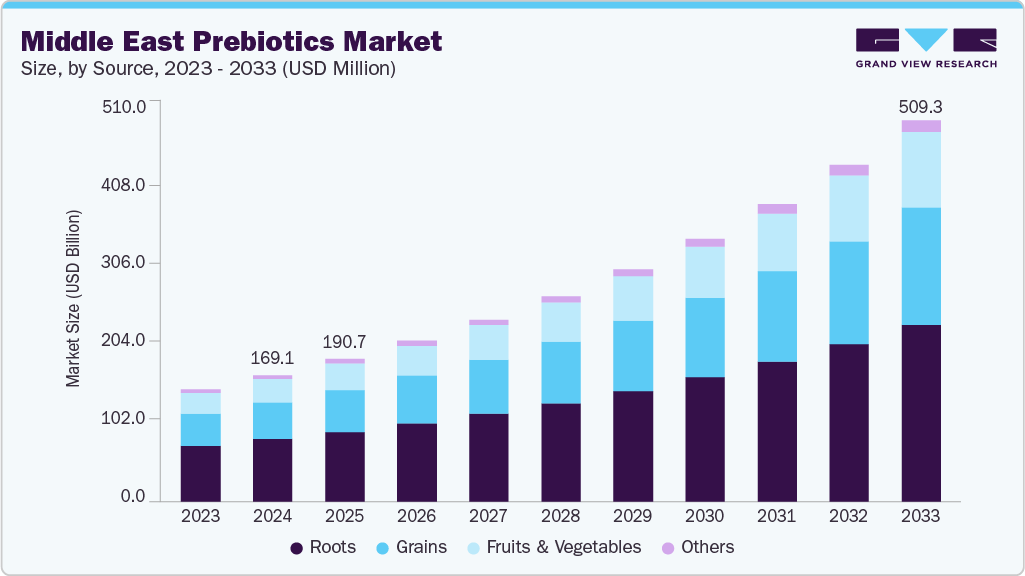
The Middle East prebiotics market size was estimated at USD 169.1 million in 2024 and is expected to reach USD 509.3 million by 2033, growing at a CAGR of 13.1% from 2025 to 2033. Rising awareness of the strong link between gut health, immunity, and overall well-being is prompting Middle Eastern consumers to actively seek products containing prebiotics, especially as health information becomes more accessible through social media and the guidance of healthcare professionals.
Key Market Trends & Insights
- By ingredients, inulinled the Middle East prebiotics market and accounted for a share of 34.10% in 2024.
- By source, the roots segment led the Middle East prebiotics market and accounted for a share of 49.26% in 2024.
- By form, powdered prebioticsled the market and accounted for a share of 56.33% in 2024.
- By functionality, gut healthled the Middle East prebiotics market and accounted for a share of 36.15% in 2024.
- By application, food & beveragesled the Middle East prebiotics market and accounted for a share of 54.82% in 2024.
Market Size & Forecast
- 2024 Market Size: USD 169.1 Million
- 2033 Projected Market Size: USD 509.3 Million
- CAGR (2025-2033): 13.1%
This demand is further amplified by higher disposable incomes and increasingly fast-paced urban lifestyles in markets like the UAE and Saudi Arabia, where consumers prefer convenient, functional foods and beverages that offer quick, everyday wellness benefits.
Ingredient innovation is becoming a major growth driver in the Middle East prebiotics market, with manufacturers increasingly diversifying beyond traditional fibers to incorporate advanced types, such as inulin, FOS, GOS, and resistant starch, into foods, beverages, and supplements. This shift enables brands to tailor products for specific functional benefits, such as improved digestive comfort, enhanced mineral absorption, or improved gut-microbiome support, while also improving taste and texture.
Dairy and beverage companies in the GCC are beginning to use chicory-root-derived inulin because it provides both prebiotic benefits and a smooth mouthfeel that suits popular formats, such as yogurts, laban drinks, and fortified juices. At the same time, warm regional climates require formulations that maintain stability and resist breakdown under heat, making ingredient selection and processing crucial. As a result, suppliers and manufacturers must balance functionality, regulatory acceptance, and local consumer preferences to create cost-effective, region-appropriate prebiotic products.
Ingredients Insights
The inulin segment held the largest revenue share of 34.10% in 2024. Inulin supports digestive health, an area of growing consumer interest, by promoting beneficial gut bacteria, especially important in diets low in fiber. Inulin is also plant-derived (commonly from chicory), making it suitable for halal and clean-label products. Additionally, it improves texture and sweetness in foods without adding sugar, which aligns with the region’s growing demand for reduced-sugar and diabetic-friendly products.
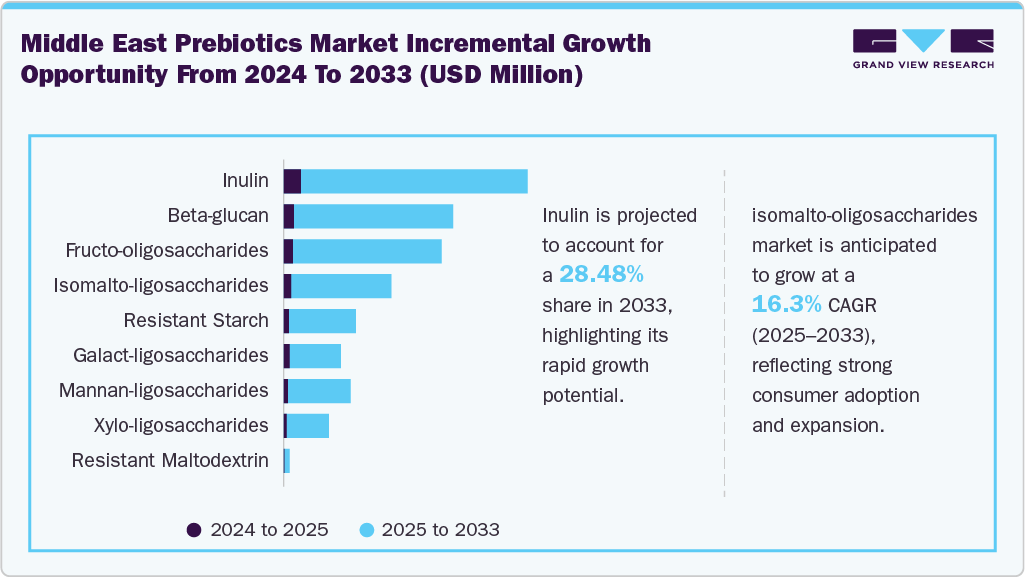
Isomalto-oligosaccharides (IMOs) are anticipated to witness a CAGR of 16.3% from 2025 to 2033. IMO is versatile, easy to formulate into beverages, baked goods, dairy alternatives, and supplements, and is plant-derived, supporting halal and natural ingredient claims. It also provides mild sweetness with far fewer calories than sugar, making it attractive for formulating diabetic-friendly and reduced-sugar products.
Source Insights
The roots segment accounted for the largest revenue share of 49.26% in 2024. These root-derived prebiotics fit clean-label and plant-based expectations, making them suitable for halal-compliant and natural product formulations. They also offer reliable functionality, as they are stable during processing, easy to blend into beverages, bakery, dairy, and nutraceutical products, and help improve texture and mouthfeel, since digestive wellness and fiber-enriched foods are fast-growing consumer trends in the region.
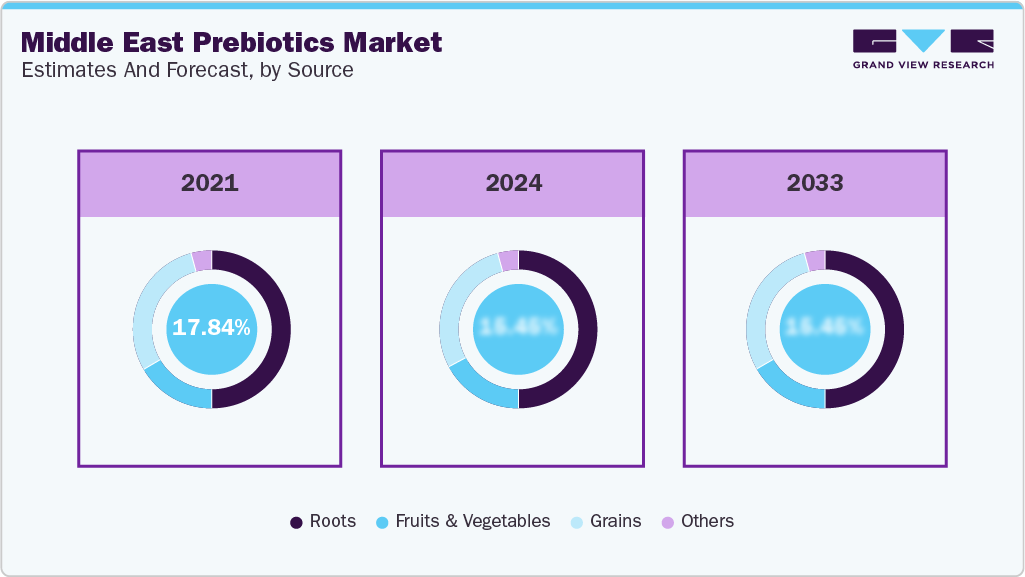
The fruits & vegetables segment is anticipated to witness a CAGR of 14.0% from 2025 to 2033. Fruit- and vegetable-derived fibers such as pectin, resistant starch, and oligosaccharides align with rising regional preferences for plant-based, halal-compliant, and minimally processed products. These sources also enable manufacturers to make stronger claims about the natural, real fruit, or vegetable content of their products, which enhances their appeal and credibility. Additionally, fruit and vegetable fibers are versatile for use in beverages, snacks, bakery products, baby foods, and supplements, helping brands meet the growing demand for digestive health.
Form Insights
Powdered prebiotics held the largest revenue share of 56.33% in 2024. They mix easily into drinks or foods without affecting taste, store well in the region’s hot climate, and have a longer shelf life than liquids. Powders are also lighter and more cost-effective to transport, making them easier for manufacturers to formulate into supplements and functional foods. They are also suitable for single-serve sachets, which are popular for on-the-go use.
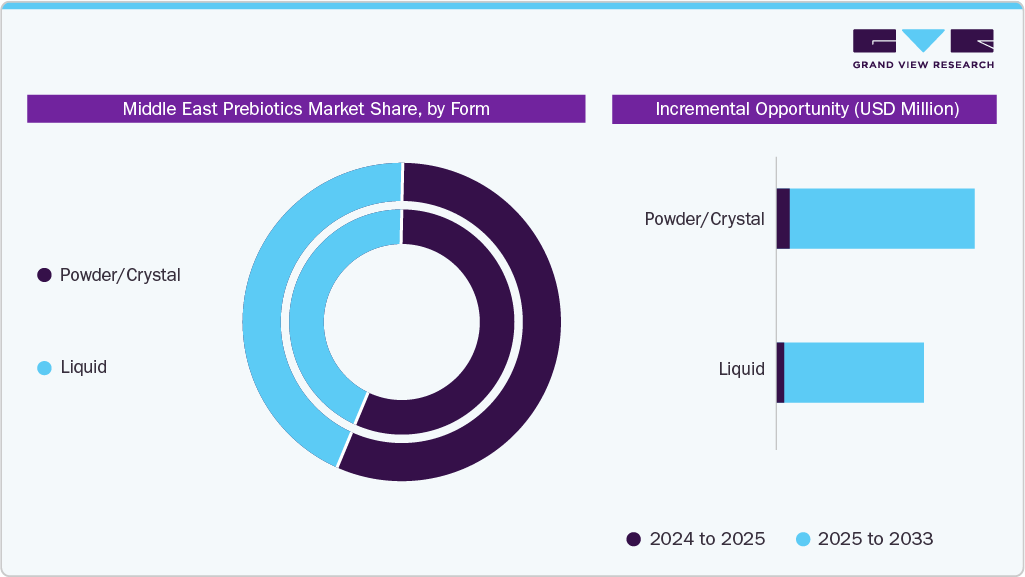
Liquid prebiotics are anticipated to witness a CAGR of 13.1% from 2025 to 2033. Liquid prebiotics are mostly used in beverages, dairy products, syrups, and liquid supplements because they blend seamlessly into fluid formulations without affecting texture or requiring dissolution. They are ideal for ready-to-drink products, flavored waters, yogurts, infant formulas, and functional syrups, where a smooth, uniform consistency is essential. It also enables precise dosing in industrial production lines, supporting large-scale manufacturing of beverages and dairy products.
Functionality Insights
The gut health segment held the largest revenue share of 36.15% in 2024. Digestive issues, low dietary fiber intake, and rising lifestyle-related conditions such as obesity and diabetes have made consumers more aware of the importance of maintaining a healthy gut. Prebiotics directly support this need by promoting the growth of beneficial gut bacteria, improving digestion, reducing bloating, and enhancing overall wellness. Health-conscious consumers in the region are increasingly seeking natural, non-pharmaceutical solutions, and prebiotics align well with this preference.
The weight management segment is anticipated to witness a CAGR of 14.3% from 2025 to 2033. Rising rates of obesity, diabetes, and metabolic disorders have made consumers more focused on controlling body weight. Prebiotics support weight management by improving satiety, reducing overeating, and helping regulate blood sugar, benefits that align with regional health priorities. As more people adopt healthier lifestyles, prebiotics are viewed as a natural, non-stimulant, and easy-to-use option that can be incorporated into daily diets without significant changes.
Application Insights
The food and beverages application accounted for the largest share of 54.82% in 2024. Prebiotics can be added to common regional products, such as juices, flavored waters, dairy drinks, yogurts, baked goods, and snacks, without altering their taste, making them highly acceptable to consumers. The region’s growing focus on functional foods, sugar reduction, and clean-label ingredients further increases demand for prebiotic-enhanced products. For manufacturers, adding prebiotics is a simple, cost-effective approach that allows for strong health claims, including gut health, immunity, and weight management, which boosts product appeal.
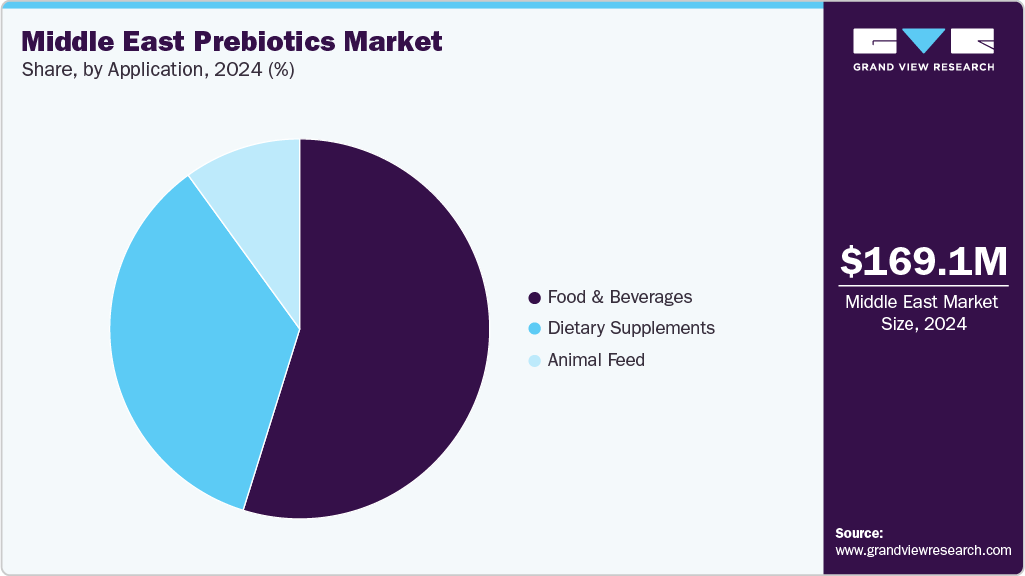
The dietary supplements segment is anticipated to witness a CAGR of 13.8% from 2025 to 2033. Busy lifestyles and inconsistent diets make supplements a convenient solution for ensuring daily fiber and gut health support. Rising awareness of microbiome health, promoted by healthcare professionals, pharmacies, and wellness influencers, has further boosted trust in supplement formats such as powders, capsules, and gummies. Supplements also allow precise dosing, are easy to carry, and fit well into modern wellness routines.
Country Insights
Saudi Arabia Prebiotics Market Trends
The Saudi Arabia prebiotics market accounted for a revenue share of 39.45% in 2024, driven by a confluence of demographic shifts and a growing emphasis on health and wellness. The nation's young and growing population, coupled with rising disposable incomes, is fueling demand for health-conscious food options. As awareness of the gut-brain axis and the broader implications of gut health on immunity and disease prevention grows, consumers are actively seeking products that can support these functions. This has translated into an increased demand for prebiotics in fortified foods, beverages, and dietary supplements. The Saudi government's Vision 2030 initiative, which prioritizes public health and aims to foster a healthier society, provides a supportive environment for the growth of the functional food and beverage sector, including prebiotics.
UAE Prebiotics Market Trends
The prebiotics market in the UAE is projected to grow at a CAGR of 13.4% from 2025 to 2033, fueled by a burgeoning awareness of gut health and its impact on overall well-being. Consumers are increasingly seeking functional foods and beverages that offer health benefits beyond basic nutrition, and prebiotics are at the forefront of this trend. This demand is further amplified by the UAE's diverse and affluent population, with a significant expatriate community that brings with it varied dietary habits and a high adoption rate of global health trends. The government's focus on promoting healthy lifestyles and preventative healthcare also plays a crucial role, encouraging food manufacturers to innovate and incorporate prebiotic ingredients into their product lines. This has led to a diversification of prebiotic-containing products, ranging from yogurts and dairy alternatives to baked goods and supplements, catering to evolving consumer preferences and a growing demand for convenient health solutions.
Key Middle East Prebiotics Company Insights
Key players operating in the Middle East prebiotics market are undertaking various initiatives to strengthen their presence and increase the reach of their products and services. Strategies such as expansion activities and partnerships are key in propelling the market growth.
Key Middle East Prebiotics Companies:
- Abbott Laboratories
- Cargill Inc.
- The Kraft Heinz Company
- Friesland Campina
- Archer Daniels Midland Company
- DSM‑Firmenich
- Kerry Group plc
- Yakult Honsha Co., Ltd.
- DuPont de Nemours, Inc.
- Ingredion
Recent Developments
-
In March 2025, PepsiCo acquired the prebiotic soda brand Poppi for USD 1.95 billion, reflecting its push into the fast-growing functional and gut health beverage market. The deal includes about USD 300 million in tax benefits, reducing the net cost to USD 1.65 billion. Poppi’s appeal lies in its formulation, which includes apple cider vinegar, added prebiotics, and a lower sugar content compared to typical sodas. The acquisition gives PepsiCo a ready brand with a growing health-conscious following, helping it expand beyond traditional soda into functional beverages globally.
Middle East Prebiotics Market Report Scope
|
Report Attribute
|
Details
|
|
Market size value in 2025
|
USD 190.7 million
|
|
Revenue Forecast in 2033
|
USD 509.3 million
|
|
Growth rate (revenue)
|
CAGR of 13.1% from 2025 to 2033
|
|
Actuals
|
2021 - 2024
|
|
Forecast period
|
2025 - 2033
|
|
Quantitative units
|
Volume in kilotons; revenue in USD million/billion, and CAGR from 2025 to 2033
|
|
Report coverage
|
Volume & revenue forecast, company ranking, competitive landscape, growth factors, and trends
|
|
Segments covered
|
Ingredients, source, form, functionality, application, country
|
|
Regional scope
|
Middle East
|
|
Country scope
|
Saudi Arabia; UAE; Qatar; Kuwait; Oman
|
|
Key companies profiled
|
Abbott Laboratories; Cargill Inc.; The Kraft Heinz Company; Friesland Campina; Archer Daniels Midland Company; DSM‑Firmenich; Kerry Group plc; Yakult Honsha Co., Ltd.; DuPont de Nemours, Inc.; Ingredion
|
|
Customization scope
|
Free report customization (equivalent up to 8 analysts’ working days) with purchase. Addition or alteration to country, regional & segment scope.
|
|
Pricing and purchase options
|
Avail customized purchase options to meet your exact research needs. Explore purchase options
|
Middle East Prebiotics Market Report Segmentation
This report forecasts volume & revenue growth at regional and country levels and provides an analysis of the latest trends and opportunities in each sub-segment from 2021 to 2033. For this study, Grand View Research has segmented the Middle East prebiotics market report by ingredients, source, form, functionality, application, and country:
-
Ingredients Outlook (Volume, Kilotons; Revenue, USD Million, 2021 - 2033)
-
Source Outlook (Volume, Kilotons; Revenue, USD Million, 2021 - 2033)
-
Roots
-
Fruits & Vegetables
-
Grains
-
Others
-
Form Outlook (Volume, Kilotons; Revenue, USD Million, 2021 - 2033)
-
Functionality Outlook (Volume, Kilotons; Revenue, USD Million, 2021 - 2033)
-
Gut Health
-
Cardiovascular Health
-
Bone Health
-
Immunity
-
Weight Management
-
Others
-
Application Outlook (Volume, Kilotons; Revenue, USD Million, 2021 - 2033)
-
Food & Beverages
-
Dairy Products
-
Infant Foods
-
Cereals
-
Beverage
-
Meat Products
-
Others
-
Dietary Supplements
-
Food Supplements
-
Nutritional Supplements
-
Specialty Supplements
-
Animal Feed
-
Poultry
-
Swine
-
Cattle
-
Aquaculture
-
Pet Food
-
Country Outlook (Volume, Kilotons; Revenue, USD Million, 2021 - 2033)
-
Saudi Arabia
-
UAE
-
Qatar
-
Kuwait
-
Oman
Frequently Asked Questions About This Report
b. The Middle East prebiotics market was estimated at USD 169.1 million in 2024 and is expected to reach USD 190.7 million in 2025.
b. The Middle East prebiotics market is expected to grow at a compound annual growth rate of 12.9% from 2025 to 2033 to reach USD 509.3 million by 2033.
b. The inulin segment held the largest revenue share of the Middle East prebiotics industry in 2024, accounting for a share of 34.10%. It supports digestive health, an area of growing consumer interest, by promoting beneficial gut bacteria, especially important in diets low in fiber.
b. Some of the key players in the Middle East prebiotics market is Abbott Laboratories; Cargill Inc.; The Kraft Heinz Company; Friesland Campina; Archer Daniels Midland Company; DSM‑Firmenich; Kerry Group plc; Yakult Honsha Co., Ltd.; DuPont de Nemours, Inc.; Ingredion
b. Rising awareness of the strong link between gut health, immunity, and overall well-being is prompting Middle Eastern consumers to actively seek products containing prebiotics, especially as health information becomes more accessible through social media and the guidance of healthcare professionals.

 Download Sample Report
















