
- Home
- »
- Advanced Interior Materials
- »
-
Middle East Recycling Equipment Market, Industry Report 2033GVR Report cover

Middle East Recycling Equipment Market (2025 - 2033) Size, Share & Trends Analysis Report By Equipment (Baler Press, Shredders, Granulators, Agglomerators, Shears), By Processed Material (Metal, Plastic, Construction Waste, Paper), By Country, And Segment Forecasts
Middle East Recycling Equipment Market Summary
The Middle East recycling equipment market size was estimated at USD 1,172.7 million in 2024 and is projected to reach USD 2,039.3 million by 2033, growing at a CAGR of 6.4% from 2025 to 2033. The Middle East recycling equipment market is being driven by growing government initiatives to promote sustainable waste management and reduce landfill dependency.
Key Market Trends & Insights
- The Middle East recycling equipment market in Israel is expected to grow at a substantial CAGR of 8.5% from 2025 to 2033.
- By equipment, the baler press machines hold the largest share in the Middle East recycling equipment market and accounted for 24.0% share in 2024.
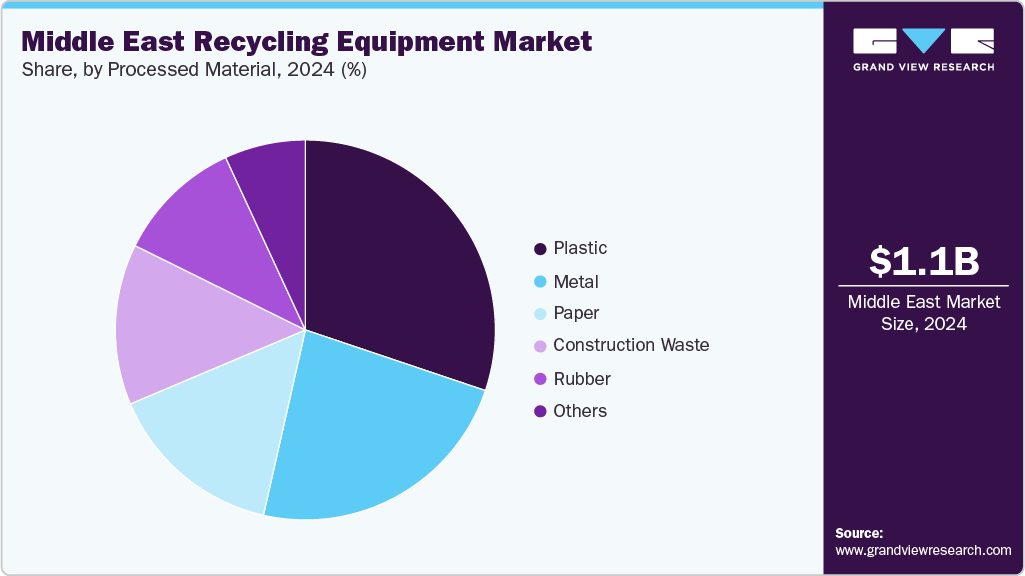
- By processed material, the plastic recycling dominates the Middle East recycling equipment market in 2024 and accounted for 30.2% share.
Market Size & Forecast
- 2024 Market Size: USD 1,172.7 Million
- 2033 Projected Market Size: USD 2,039.3 Million
- CAGR (2025-2033): 6.4%
GVR research-powered AIAsk Prism AI about the middle east recycling equipment marketGet cited answers from GVR research on market growth, segments, regulations and forecasts.Start with✓ Source-linked answers ✓ Market-specific context ✓ Traceable figuresExplore Prism AI ↗
Countries such as the UAE, Saudi Arabia, and Qatar are introducing stringent recycling targets and extended producer responsibility (EPR) policies, which are boosting demand for advanced sorting, shredding, and compacting machines. Another key factor driving the market is the increasing corporate focus on environmental, social, and governance (ESG) commitments and circular economy models. Large manufacturing, packaging, and construction companies are investing in in-house recycling equipment to reduce waste disposal costs and improve resource recovery. Technological advancements, such as AI-enabled sorting systems and energy-efficient processing units, are making recycling operations more cost-effective and scalable.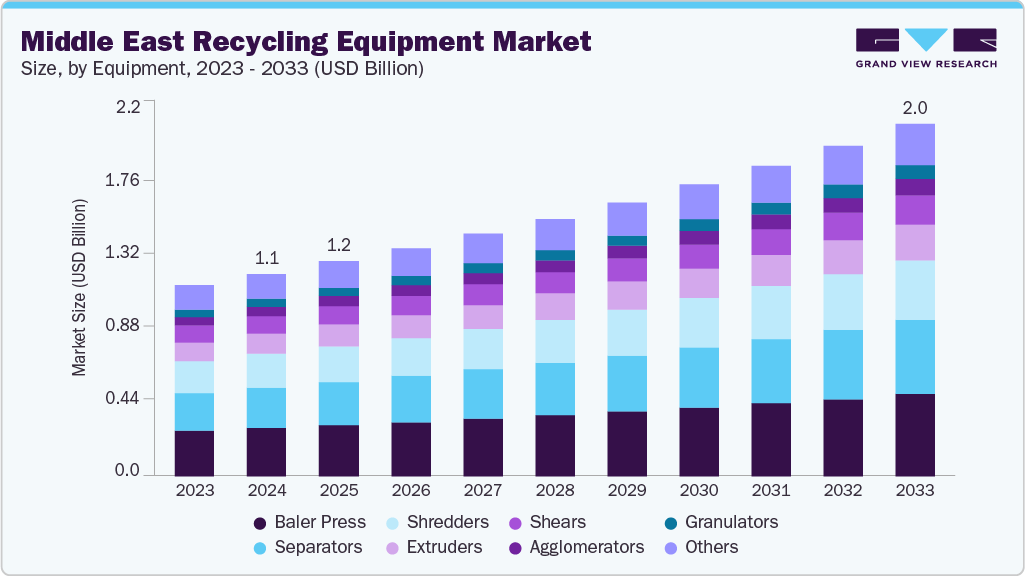 Source: Grand View Research, IR Documents, Primary Interviews, Paid DatabasesTo learn more about this report,
 Download Free Sample Report
 Market Concentration & Characteristics
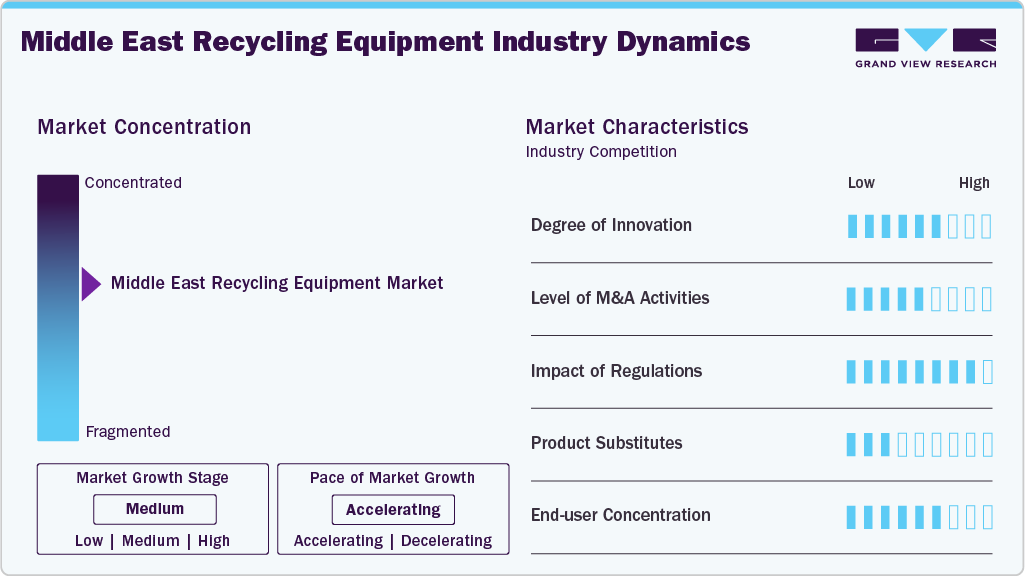
The Middle East recycling equipment market is moderately concentrated, with a few established regional and international players holding a significant share. These companies benefit from strong distribution networks, advanced technology offerings, and long-term government contracts. However, emerging local manufacturers are gradually entering the space, particularly in niche equipment categories. The combination of dominant global suppliers and rising regional competitors creates a competitive yet consolidated market landscape.
The Middle East recycling equipment market is witnessing steady innovation, driven by the need for efficient waste sorting and processing technologies. AI-based recognition systems, automated conveyors, and energy-efficient shredders are being adopted to improve operational performance. Regional players are also adapting global technologies to suit local waste compositions and climate conditions. Innovation is further encouraged by collaborations between equipment suppliers, research institutes, and government sustainability programs.
 To learn more about this report, Download Free Sample Report
 Mergers and acquisitions in the Middle East recycling equipment sector are moderate, often involving global companies acquiring or partnering with local firms to strengthen market presence. Such deals help multinational players access government projects, local distribution channels, and region-specific expertise. Local companies also benefit from advanced technologies and financial resources through these partnerships.
Regulatory frameworks in the Middle East are significantly shaping the recycling equipment market, with countries such as Saudi Arabia, the UAE, and Qatar introducing stricter waste management and recycling mandates. Compliance with environmental laws is pushing industries to invest in modern equipment for material recovery and waste diversion. Government-led recycling targets and incentives for sustainable practices are accelerating adoption.
Drivers, Opportunities & Restraints
The Middle East recycling equipment market is driven by rising government investments in sustainable waste management and circular economy initiatives. Rapid urbanization and industrial growth are generating higher volumes of waste, increasing the need for efficient recycling solutions. Public-private partnerships are enhancing infrastructure development and technology adoption. In addition, growing environmental awareness among businesses and consumers is fueling demand for advanced recycling equipment.
There is significant growth potential in developing specialized recycling solutions for sectors such as construction, packaging, and e-waste across the Middle East. Expansion of smart city projects and industrial zones offers new avenues for integrated waste processing facilities. Technological innovations, such as AI-enabled sorting systems and robotics, present opportunities for efficiency gains. Furthermore, regional policies promoting foreign investment in environmental technology are creating a favorable business environment.
The market faces challenges due to high capital costs of advanced recycling equipment, which can deter smaller operators. Inconsistent waste segregation practices in some Middle Eastern countries reduce recycling efficiency. Limited technical expertise and workforce training also hinder optimal equipment utilization. In addition, fluctuating commodity prices for recovered materials can impact the profitability of recycling operations.
Equipment Insights
Baler press machines hold the largest share in the Middle East recycling equipment market and accounted for 24.0% share in 2024, due to their wide application in compressing recyclable materials like paper, plastics, and metals for easier storage and transport. Their cost-effectiveness, ease of operation, and ability to handle high volumes make them popular among waste management companies. Government-driven recycling programs are further boosting their adoption in municipal and industrial sectors.
Separators segment is expected to grow at a significant CAGR of 7.0% from 2025 to 2033 in terms of revenue. Separators are the fastest-growing segment, driven by the rising need for precise material sorting in mixed waste streams across the Middle East. Technological advancements, such as sensor-based and magnetic separation systems, are improving efficiency and purity levels of recovered materials. Increasing demand for high-quality recycled outputs in industries like construction, packaging, and metals is accelerating their uptake.
Processed Material Insights
Plastic recycling dominates the Middle East recycling equipment market in 2024 and accounted for 30.2% share, due to the high volume of plastic waste generated from packaging, consumer goods, and industrial applications. Government bans on single-use plastics in countries such as the UAE and Saudi Arabia are driving investments in advanced plastic processing equipment. The demand for recycled plastic in manufacturing sectors, such as packaging and textiles, further supports its market share.
 To learn more about this report, Download Free Sample Report
 The rubber segment is expected to grow at a significant CAGR of 6.5% from 2025 to 2033 in terms of revenue. Rubber recycling is witnessing significant growth, largely fueled by the rising number of end-of-life tires generated by the region’s expanding automotive sector. Countries are promoting rubber recycling to reduce landfill waste and support sustainable infrastructure projects. Recycled rubber is increasingly being used in applications such as road construction, sports surfaces, and industrial products.
Country Insights
Saudi Arabia Recycling Equipment Market Trends
Saudi Arabia leads the Middle East recycling equipment market and accounted for 48.5% share, due to its largescale waste generation from industrial, construction, and urban sectors. The government’s Vision 2030 plan emphasizes circular economy practices, driving investments in modern recycling facilities and equipment. Public-private partnerships are boosting the adoption of advanced machinery for metal, plastic, and e-waste processing. In addition, strong regulatory enforcement ensures steady demand for high-performance recycling solutions.
Israel Recycling Equipment Market Trends
The Middle East recycling equipment market is witnessing rapid growth, with Israel emerging as the fastest-growing country. This surge is driven by increasing government initiatives promoting sustainable waste management. Rising awareness of environmental conservation and resource recovery is further boosting demand. In addition, technological adoption in advanced recycling equipment is accelerating market expansion in Israel.
Key Middle East Recycling Equipment Company Insights
Some of the key players operating in the market include LEFORT, BHS-Sonthofen, Eldan Recycling
-
LEFORT specializes in manufacturing heavy-duty scrap processing machinery, with a strong focus on shears, balers, and shredders designed for the metal recycling industry. The company’s equipment is known for its high compression force, durability, and ability to handle large volumes of ferrous and non-ferrous metals. LEFORT’s product range supports efficient material preparation for smelting and reuse. Their machines are widely used in automotive dismantling, steelworks, and large-scale scrap yards. The brand is recognized in the Middle East for supplying robust solutions that meet industrial-scale recycling demands.
-
BHS-Sonthofen is renowned for its advanced mechanical process engineering solutions, particularly in recycling and waste processing technologies. The company’s recycling systems are designed for high-efficiency material separation, fine shredding, and selective crushing. Their expertise extends to handling complex waste streams such as e-waste, construction debris, and composite materials. In the Middle East, BHS-Sonthofen’s equipment is valued for its precision, reliability, and adaptability to region-specific waste compositions. The company’s solutions contribute to maximizing material recovery and reducing landfill dependency.
Key Middle East Recycling Equipment Companies:
- LEFORT
- BHS-Sonthofen
- Eldan Recycling
- General Kinematics
- Suny Group.
- POLYSTAR Machinery
- Danieli & C. S.p.A.
- FOR REC S.p.A.
- Metso
- Kiverco
Recent Developments
-
In January 2024, Eldan Recycling collaborated with Picvisa to develop new sorting machines, the Multi-Purpose Sorter (MPS) and Small Purpose Sorter (SPS). These systems use AI and infrared technology to improve identification of materials such as e-waste, non-ferrous metals, mixed scrap, and plastics. A dedicated brand, “Eldan Sorting,” was launched to focus on these advanced solutions. The innovation aims to enhance recycling efficiency and material recovery across multiple sectors.
-
In July 2023, LEFORT acquired French recycling equipment maker Copex S.A., known for its hydraulic shears and balers. Copex will keep operating under its brand while aligning with LEFORT’s global network. The move brings leadership changes, with Fawaz Ezzat appointed as general manager. Together, the companies now employ around 300 people and target annual revenues exceeding €110 million.
Middle East Recycling Equipment Market Report Scope
Report Attribute
Details
Market size value in 2025
USD 1,244.4 million
Revenue forecast in 2033
USD 2,039.3 million
Growth Rate
CAGR of 6.4% from 2025 to 2033
Historical data
2021 - 2023
Forecast period
2025 - 2033
Quantitative units
Revenue in USD million/billion and CAGR from 2025 to 2033
Report coverage
Revenue forecast, company ranking, competitive landscape, growth factors, and trends
Segments covered
Equipment, processed material, region
Regional scope
Middle East
Country scope
Saudi Arabia; Oman; UAE; Israel; Qatar; Kuwait
Key companies profiled
LEFORT; BHS-Sonthofen; Eldan Recycling; General Kinematics; Suny Group.; POLYSTAR Machinery; Danieli & C. S.p.A.; FOR REC S.p.A.; Metso; Kiverco
Customization scope
Free report customization (equivalent up to 8 analysts working days) with purchase. Addition or alteration to country, regional & segment scope.
Pricing and purchase options
Avail customized purchase options to meet your exact research needs. Explore purchase options
Middle East Recycling Equipment Market Segmentation
This report forecasts revenue growth at country levels and provides an analysis of the latest industry trends in each of the sub-segments from 2021 to 2033. For this study, Grand View Research has segmented the Middle East recycling equipment market report based on equipment, processed material, and country:
-
Equipment Outlook (Revenue, USD Million, 2021 - 2033)
-
Baler Press
-
Shredders
-
Granulators
-
Agglomerators
-
Shears
-
Separators
-
Extruders
-
Others
-
-
Processed Material Outlook (Revenue, USD Million, 2021 - 2033)
-
Metal
-
Plastic
-
Construction Waste
-
Paper
-
Rubber
-
Others
-
-
Country Outlook (Revenue, USD Million, 2021 - 2033)
-
Saudi Arabia
-
Oman
-
UAE
-
Qatar
-
Israel
-
Kuwait
-
Frequently Asked Questions About This Report
The Middle East recycling equipment market size was estimated at USD 1,172.7 million in 2024 and is expected to be USD 1,244.4 million in 2025.
The Middle East recycling equipment market, in terms of revenue, is expected to grow at a compound annual growth rate of 6.4% from 2025 to 2033 to reach USD 2,039.3 million by 2033.
Plastic recycling dominates the Middle East recycling equipment market in 2024 and accounted for 30.2% share, due to the high volume of plastic waste generated from packaging, consumer goods, and industrial applications. Government bans on single-use plastics in countries like the UAE and Saudi Arabia are driving investments in advanced plastic processing equipment.
Some of the key players operating in the Middle East recycling equipment market include LEFORT, BHS-Sonthofen, Eldan Recycling, General Kinematics, Suny Group., Metso Corp, Danieli & C. S.p.A., FOR REC S.p.A., Metso, Kiverco.
The Middle East recycling equipment market is driven by government sustainability initiatives, strict waste management regulations, and growing investments in recycling infrastructure. Rapid urbanization and industrial expansion are generating higher waste volumes, increasing the need for efficient processing solutions. Rising environmental awareness and demand for recycled materials are further boosting equipment adoption across the region.
About the Author(s)
Advanced Interior Materials Research Team
Advanced Materials · Advanced Interior MaterialsThis report was authored by the advanced interior materials research team at Grand View Research - comprising two research analysts, one senior research analyst, and one industry expert - with specialized expertise in the advanced interior materials segment of the advanced materials industry. All findings are based on proprietary advanced materials databases, executive interviews, and regulatory analysis, subject to internal peer review prior to publication.
Last Updated:
Speak to Analyst

Customize this report to your needs - add regions, segments, or data points, with 20% free customization.
Or view our licence options:


ISO 9001:2015 & 27001:2022 Certified
We are GDPR and CCPA compliant! Your transaction & personal information is safe and secure. For more details, please read our privacy policy.


