
- Home
- »
- Advanced Interior Materials
- »
-
Military Personal Protective Equipment Market Report, 2026-2033GVR Report cover

Military Personal Protective Equipment Market (2026 - 2033)
Size, Share & Trends Analysis Report By Product (Body Armor, Tactical Clothing), By Distribution Channel (Government & Defense Tenders, Direct Institutional Procurement), By End Use, By Region, And Segment Forecasts
Market Size, 2025
$17.3BMarket Estimate, 2026
$18.6BMarket Forecast, 2033
$30.0BCAGR, 2026–2033
7.1%Military Personal Protective Equipment Market Summary
The global military personal protective equipment market size was valued at USD 17.3 billion in 2025 and is projected to grow from USD 18.6 billion in 2026 to USD 30.0 billion by 2033, at a CAGR of 7.1% from 2026 to 2033. The market in North America dominated with a revenue share of 35.8% in 2025. Increased military expenditure and comprehensive modernization programs are major forces driving the demand for military.
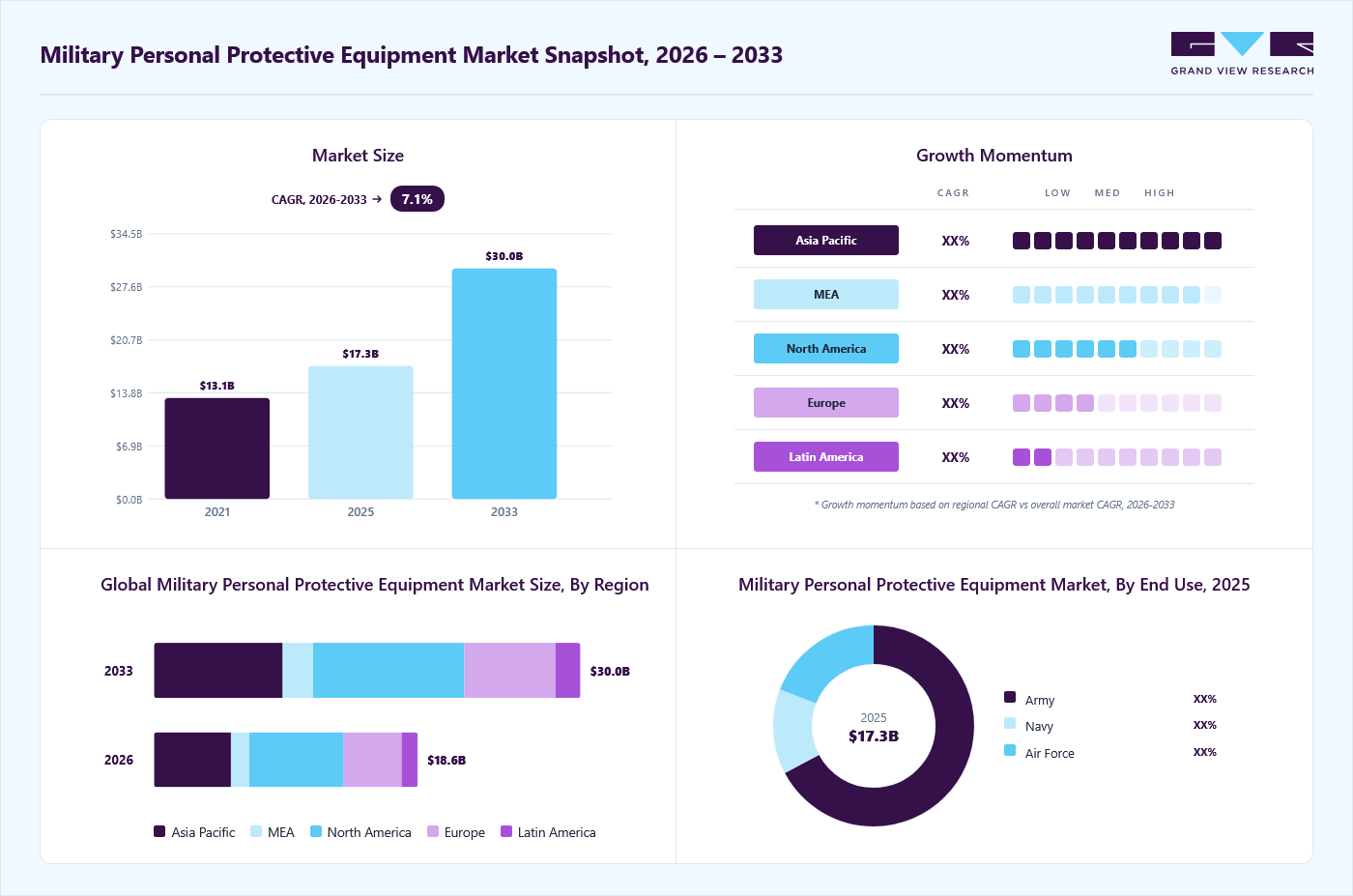 Source: Grand View Research, IR Documents, Primary Interviews, Paid DatabasesTo learn more about this report,
 Download Free Sample Report
 Key Market Trends & Insights
- By product: Body armor segment held the largest market share of 28.0% in 2025.
- By distribution channel: Government & defense tenders segment held the largest market share of 49.5% in 2025.
- By end use: Army segment held the largest market share of 67.2% in 2025.
Regional Highlights
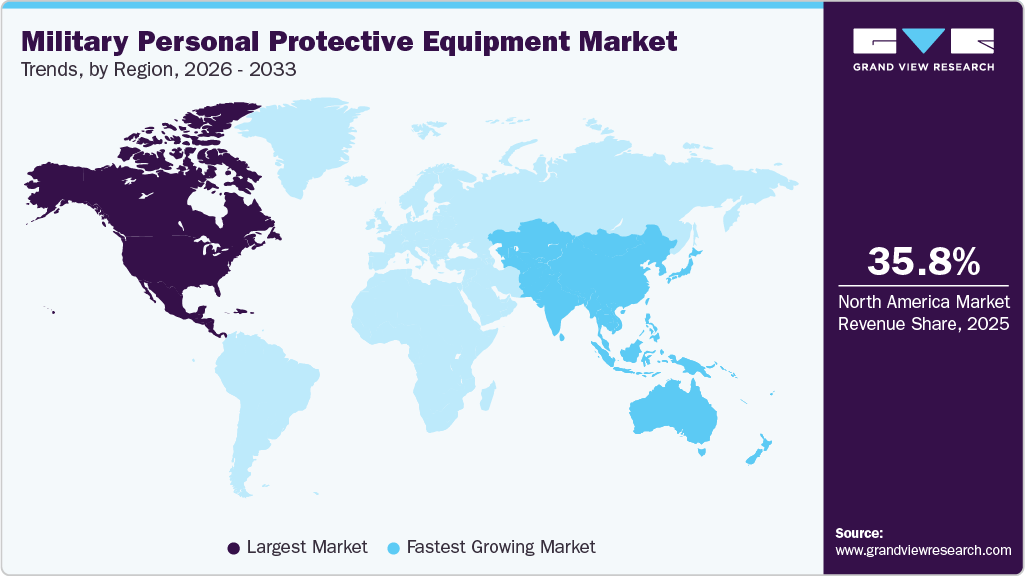
- Largest regional market: North America (35.8% revenue share, 2025)
- Fastest-growing regional market: Asia Pacific (highest CAGR, 2026-2033)
- By country: The U.S. held the largest market share in 2025
Market Size & Forecast
- Market size in 2025: USD 17.3 Billion
- Estimated market size in 2026: USD 18.6 Billion
- Projected market size by 2033: USD 30.0 Billion
- CAGR (2026-2033): 7.1%
Three ways to get this report
Buy it, customize it, or ask a question.Ask an Analyst
Analyst response in 1 business day
- AccessReport author, directly
- Reply timeWithin 1 working day
- No sales callDirect answer only
- FormatEmail reply
- CostFree, no cost
Get the Full Report
What the study covers
- FormatsPDF · Excel · Dashboard
- Timeline2026–2033 annual, 2025 base
- Coverage20+ countries, 5 regions
- Companies10+ key players profiled
Customize the Report
20% free customization
- IncludeCountries, segments, points
- TailorTo your product definition
- ExtendDeeper competitor detail
- OrA fully bespoke study
- Turnaround5–10 working days
As global security dynamics evolve marked by rising geopolitical tensions, territorial disputes, terrorism, and the emergence of advanced warfare technologies governments are allocating greater portions of national budgets to strengthen defense capabilities. Higher defense spending enables militaries to upgrade legacy equipment and invest in next-generation protective systems that enhance soldier survivability in increasingly complex battle environments.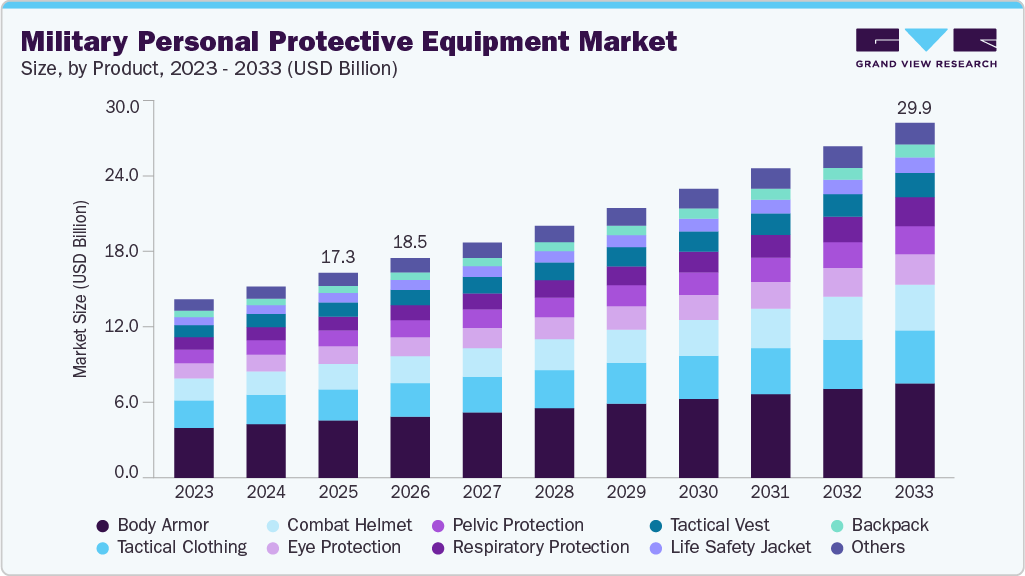 To learn more about this report, Download Free Sample Report
 Technological advancements in military and first responder personal protective equipment have focused on creating lighter, more versatile, and highly efficient respiratory protection. Innovations such as low-profile designs, lightweight materials, and high-efficiency filtration systems enable operators to quickly don protective gear in fast-evolving threat environments, thereby enhancing mobility and situational readiness.
 To learn more about this report, Download Free Sample Report
 Market Concentration & Characteristics
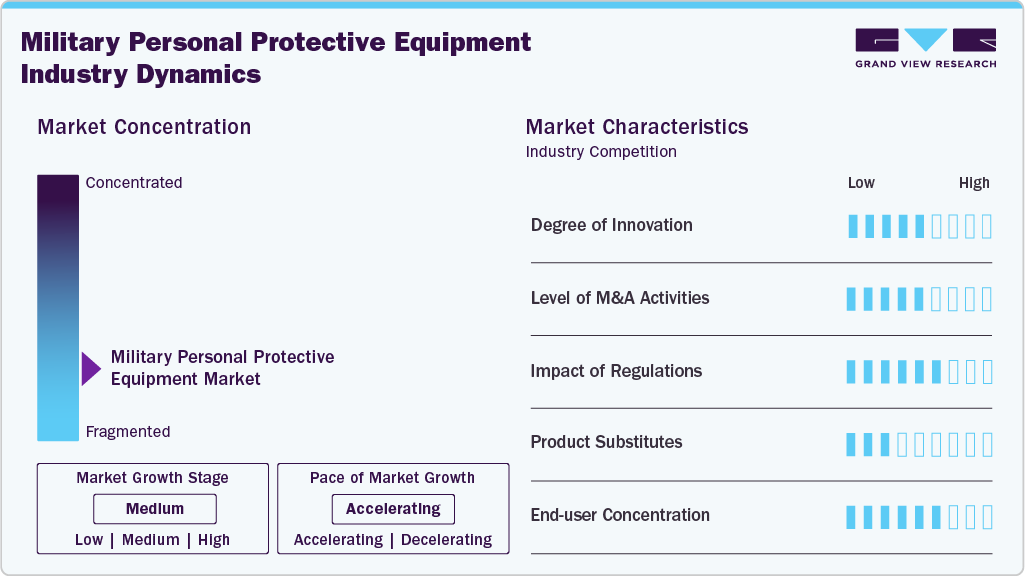
The military personal protective equipment industry is fragmented, with a wide range of global defense contractors, regional manufacturers, and specialized suppliers, each focusing on different types of protective equipment such as body armor, helmets, CBRN gear, and eye protection. Procurement differs across countries and military branches, preventing any single player from dominating the military personal protective equipment (PPE) industry. Frequent technological upgrades, varied certification requirements, and mission-specific needs further diversify the supplier base, resulting in a competitive and highly segmented industry landscape.
The military personal protective equipment industry shows a high degree of innovation, driven by advances in lightweight materials, smart textiles, sensor integration, and improved ballistic and blast resistance. Emerging technologies, such as modular armor systems, enhanced chemical and biological protection, and ergonomic designs, further elevate performance and comfort. Continuous R&D investments and collaboration with defense agencies ensure the ongoing development of more durable, adaptive, and mission-specific protective solutions tailored to modern battlefield requirements.
 To learn more about this report, Download Free Sample Report
 Mergers and acquisitions in the military PPE industry are significant, driven by companies seeking to expand product portfolios, strengthen manufacturing capabilities, and access new defense contracts. Large defense suppliers often acquire specialized PPE manufacturers to integrate advanced materials or niche technologies. These consolidations enhance competitiveness, streamline supply chains, and support innovation. Although not frequent, strategic acquisitions have a significant influence on market positioning and long-term partnerships within the defense procurement ecosystem.
Regulations strongly shape the military personal protective equipment industry by enforcing strict safety, performance, and certification standards for ballistic, chemical-biological, and environmental protection. Defense agencies require compliance with rigorous testing protocols to ensure reliability in high-risk operations. These regulations drive manufacturers to invest in advanced materials, quality control, and continuous product improvement. In addition, evolving battlefield threats and updated military specifications push the industry toward innovation, ensuring PPE meets emerging operational and situational demands.
Drivers, Opportunities & Restraints
Rising geopolitical tensions, ongoing conflicts, and evolving security threats are significant drivers of market growth, as nations increasingly prioritize the safety and survivability of their armed forces. Global instability, driven by territorial disputes, proxy wars, and competition among major powers such as the U.S., China, Russia, and regional powers in the Middle East and Asia-Pacific, has heightened the likelihood of conventional and asymmetric military engagements. These tensions are further exacerbated by factors such as terrorism, insurgency, piracy, and cross-border conflicts, which expose military personnel to unpredictable and high-risk environments. As a result, defense organizations are compelled to enhance protective measures for soldiers operating in these volatile regions.
Growing adoption of digital and smart safety technologies is significantly creating opportunities in the military personal protective equipment industry. IoT-enabled sensors, wearable devices, autonomous monitoring systems, and real-time communication tools can significantly improve visibility into underground conditions. Mines transitioning toward automation and data-driven operations need integrated safety solutions, creating room for innovation. Emerging markets with expanding mining activities also offer strong potential, particularly for cost-effective, rugged, and easily deployable equipment tailored to diverse geological and regulatory environments.
Technological advancements present one of the most significant opportunities in the military personal protective equipment industry, driving innovation and improving the effectiveness and usability of protective gear. One of the key developments is the use of lightweight and high-strength materials, such as advanced composites, ultra-high-molecular-weight polyethylene (UHMWPE), and next-generation ceramics. These materials enable the creation of body armor, helmets, and protective vests that offer superior ballistic and blast resistance while minimizing weight, thereby reducing fatigue and enhancing soldier mobility on the battlefield.
Product Insights
The body armor segment led the market with the largest revenue share of 28.0% in 2025. Body armor constitutes a major component of military personal protective equipment, designed to safeguard personnel against ballistic, fragmentation, and stab threats. Modern systems incorporate advanced composite materials such as aramid fibers, UHMWPE (Ultra-High Molecular Weight Polyethylene), and ceramic strike plates to achieve higher protection levels without excessive weight. The category includes soft armor inserts, hard armor plates, and modular plate carriers, each tailored to meet specific operational requirements ranging from low-intensity patrol duties to high-risk combat missions.
The respiratory protection segment is anticipated to grow at the fastest CAGR of 10.1% from 2026 to 2033. Respiratory protection is used to safeguard military personnel from hazardous airborne threats, including chemical agents, biological contaminants, toxic industrial vapors, smoke, particulates, and oxygen-deficient environments. Equipment in this category ranges from air-purifying respirators and powered air-purifying respirators to full self-contained breathing apparatus designed for high-risk scenarios. Key design priorities include secure facial sealing, low breathing resistance, compatibility with helmets and optical devices, and sustained comfort during extended missions. Systems must function reliably across a wide range of operational conditions, from CBRN incidents to confined-space rescue, base maintenance, and battlefield exposures.
Distribution Channel Insights
The government & defense tenders segment led the market with the largest revenue share of 49.5% in 2025. Government and defense tenders form the primary procurement route for military PPE, reflecting centralized acquisition processes and long-term strategic planning. These tenders are typically issued by national defense ministries, armed forces procurement offices, or specialized procurement agencies, ensuring standardization, regulatory compliance, and interoperability across units. The process emphasizes competitive bidding, strict qualification criteria, and thorough technical evaluation to ensure that supplied equipment meets operational, safety, and performance standards required for military use.
The authorized distributors segment is projected to grow at the fastest CAGR of 7.5% from 2026 to 2033, as these entities maintain inventory, offer logistical support, and ensure that equipment complies with military standards and manufacturer specifications. Their role is significant in enabling the timely availability of replacement components, accessories, and standard-issue PPE items, especially in regions where manufacturers do not maintain a direct operational presence.
End Use Insights
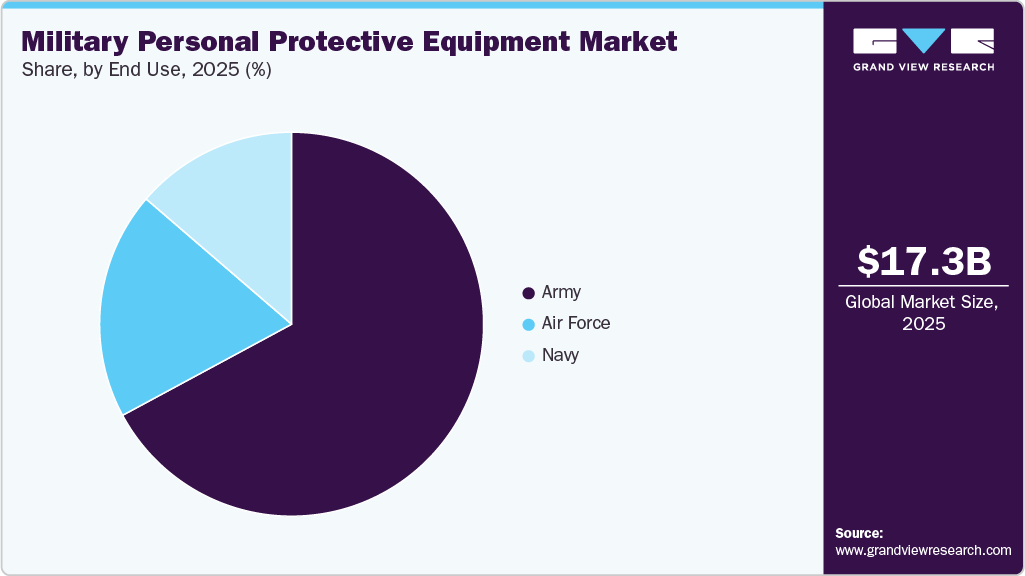
The army segment led the market with the largest revenue share of 67.2% in 2025 and is projected to grow at the fastest CAGR during the forecast period, reflecting the extensive personnel base and the wide range of operational environments in which ground forces operate. PPE requirements for this segment cover protection against ballistic threats, fragmentation, blast pressure, environmental hazards, and operational fatigue. Equipment is designed to offer mobility during dismounted patrols, mechanized operations, urban engagements, and extended field missions.
 To learn more about this report, Download Free Sample Report
 The navy segment is expected to grow at a significant CAGR of 7.0% from 2026 to 2033. Naval warfare, shipboard operations, and maritime security missions shape the Navy’s requirements for PPE. PPE for naval personnel typically addresses risks associated with confined spaces, machinery operation, flight deck activity, and over-water movement. Equipment offers durability in corrosive saltwater environments, supports clear visibility in low-light conditions, and maintains compatibility with life safety systems and maritime survival gear. Additional considerations include fire resistance, thermal protection, and integration with communication systems used in shipboard and amphibious operations.
Regional Insights
North America dominated the military personal protective equipment market with the largest revenue share of 35.8% in 2025, supported by rising defense allocations, modernization-driven procurement cycles, and expanding security responsibilities across armed forces and security agencies. There is a consistent push in the region toward upgrading protective systems to meet evolving operational demands, ranging from high-intensity combat preparedness to internal security missions and rapid-response operations.
 To learn more about this report, Download Free Sample Report
 U.S. Military Personal Protective Equipment Market Trends
The military personal protective equipment market in the U.S. is shaped by sustained federal defense spending, evolving threat environments, and an institutional commitment to continually modernizing soldier protection systems. Given the growing asymmetric warfare, international alliances, urban engagements, and missions requiring rapid deployment, the U.S. Department of Defense prioritizes PPE that delivers higher ballistic resilience, improved blast mitigation, and better ergonomic performance to enhance soldier survivability.
The Mexico military personal protective equipment market is expanding due to a boost in funding associated with expanded roles for the National Guard and Navy, and reflects a broader commitment to strengthening internal security and border enforcement. The growing budget provides a strong financial foundation for the procurement of personal protective equipment (PPE), including body armor, helmets, tactical gear, and other equipment necessary for an increasingly militarized internal security environment.
Europe Military Personal Protective Equipment Market Trends
The military personal protective equipment market in Europe is entering a period of strong, sustained growth as countries across the region increase defense budgets, rebuild force structures, and modernize equipment in response to heightened geopolitical tensions. The war in Ukraine, renewed NATO obligations, and broader concerns over territorial security have driven governments to accelerate spending on soldier-level protection, generating rising demand for helmets, body armor, modular vests, protective clothing, load-bearing gear, and environmental equipment suited to diverse European operating conditions.
The Germany military personal protective equipment market is anticipated to grow at a significant CAGR during the forecast. The recent wave of rearmament in Germany is reshaping its military personal protective equipment industry, creating strong momentum for growth driven by big structural changes in defense policy, procurement, and force expansion. Under its newly adopted defense posture, Germany is rapidly increasing military spending, relaxing previous fiscal constraints, and aiming to rebuild its armed forces. These moves collectively generate substantial demand for military PPE across multiple categories.
The military personal protective equipment market in the UK is expected to experience steady growth as the nation boosts defense spending and advances its force-modernization programs. Increased investment in next-generation protective gear, including ballistic armor, helmets, and CBRN equipment, is driven by evolving security challenges and the need to enhance troop safety. Ongoing modernization across the Army, Royal Navy, and Royal Air Force further supports long-term demand for advanced military PPE.
Asia Pacific Military Personal Protective Equipment Market Trends
The military personal protective equipment market in the Asia Pacific is expected to grow at the fastest CAGR during the forecast period, supported by sustained increases in defense spending, broad capability modernization, and expanding operational requirements among major powers. Defense expenditure across the region continues to rise at a pace exceeding global averages, with several governments adopting long-range procurement plans that prioritize both platform acquisition and the improvement of individual soldier protection. This environment establishes a stable foundation for the procurement of protective equipment, covering ballistic systems, modular vests, protective clothing, and specialized gear for diverse climatic and operational conditions.
The China military personal protective equipment market continues to increase defense spending year after year, reflecting a long-term commitment to modernizing its armed forces and expanding its global military reach. Increased defense spending, technological upgrades, and a focus on enhancing soldier survivability are driving demand for advanced PPE such as ballistic armor, tactical helmets, CBRN protection suits, and high-performance combat gear. China’s robust manufacturing capabilities and investments in next-generation materials, such as lightweight composites and high-strength fibers, are further accelerating market growth. Rising geopolitical tensions and China’s push for self-reliance in defense equipment also contribute to sustained demand for military protective solutions.
The military personal protective equipment market in India is positioned for significant and long-term expansion as the country deepens defense spending, modernizes its armed forces, and strengthens preparedness across multiple fronts. The growth of domestic manufacturing under the Make in India initiative, along with collaborations between global defense companies and Indian firms, is accelerating technological advancements. In addition, border tensions and counter-terrorism operations continue to drive consistent demand for reliable, high-quality military protective equipment.
Middle East & Africa Military Personal Protective Equipment Market Trends
The military personal protective equipment market in the Middle East & Africa is shaped by a combination of sustained defense expenditure, active operational environments, and growing emphasis on domestic defense-industrial capability. Across the region, governments continue to prioritize large standing forces, internal security structures, and readiness for multi-domain contingencies, all of which generate consistent requirements for military personal protective equipment.
The Saudi Arabia The military personal protective equipment market is poised for robust growth due to rising defense expenditure, ongoing military modernization, and heightened regional security challenges. The country is prioritizing advanced protective solutions such as ballistic vests, combat helmets, blast-resistant gear, and CBRN protective systems to enhance soldier survivability. Saudi Arabia’s Vision 2030 initiative, which encourages domestic defense production and technology transfer, is further accelerating market development. Increased procurement programs, joint ventures with global defense companies, and continuous upgrades across its land, air, and naval forces are expected to sustain strong demand for military PPE.
Latin America Military Personal Protective Equipment Market Trends
The military personal protective equipment market in Latin America is shaped by a combination of constrained defense budgets, high personnel expenditure, and selective advancement efforts across the region. Defence institutions generally operate within tight fiscal environments, where a significant portion of available resources is allocated to salaries, pensions, and administrative costs.
The Brazil The military personal protective equipment market is expected to grow as the country strengthens its defense capabilities, modernizes its armed forces, and expands investment in soldier protection. Rising security concerns, including border control, organized crime, and peacekeeping commitments, are increasing demand for advanced ballistic armor, helmets, tactical gear, and CBRN protective equipment. Government initiatives to upgrade equipment within the Army, Navy, and Air Force, alongside growing partnerships with international defense suppliers and domestic manufacturers, are further fueling technological advancements and supporting steady market expansion in Brazil’s military PPE sector.
Key Military Personal Protective Equipment Company Insights
Some of the key players operating in the market include 3M, Avon Protection, Drägerwerk AG & Co. KGaA, and GENTEX CORPORATION.
-
3M’s defense PPE verticals center on advanced respiratory systems, tactical communication headsets, and integrated head-face protection solutions tailored for high-risk military environments. The company delivers mission-specific equipment such as PELTOR tactical hearing protection and Scott breathing systems to support CBRN response, aircraft ground operations, and combat field conditions.
-
Avon Protection operates across specialized defence verticals centered on advanced respiratory systems, including full-face masks, respirators, and self-contained breathing apparatus engineered for CBRN threat environments. Its portfolio also includes ballistic and tactical head protection systems designed for combat and high-risk operational scenarios.
Key Military Personal Protective Equipment Companies:
The following are the leading companies in the military personal protective equipment market. These companies collectively hold the largest market share and dictate industry trends.
- 3M
- NFM Group
- SnigelDesign AB
- Varusteleka
- SAVOTTA
- PGD
- Avon Protection
- Drägerwerk AG & Co. KGaA
- uvex group
- GENTEX CORPORATION
- ArmorWorks
- Eagle Industries
- ArmorSource, LLC.
- Premier Body Armor
Recent Developments
-
In September 2025, Avon Protection introduced the MITR-PG1 Powered Goggle at DSEI 2025 as a new eye protection solution for tactical operations in environments with particulate and low-level CBRN threats. The system features an integrated powered airflow mechanism that continuously clears moisture and prevents lens fogging.
-
In July 2025, 3M Scott expanded its SCBA portfolio by introducing a new Vision C5 facepiece option for the X3-21 Pro system, enhancing its suitability for tactical and high-risk operations. The upgraded facepiece delivers improved panoramic visibility and supports integrated communication features for clearer coordination in critical environments.
Military Personal Protective Equipment Market Report Scope
Report Attribute
Details
Market size in 2025
USD 17.3 billion
Estimated market size in 2026
USD 18.6 billion
Projected market size by 2033
USD 30.0 billion
Growth rate
CAGR of 7.1% from 2026 to 2033
Base year for estimation
2025
Historical data
2021 - 2024
Forecast period
2026 - 2033
Quantitative units
Revenue in USD million/billion and CAGR from 2026 to 2033
Report coverage
Revenue forecast, company ranking, competitive landscape, growth factors, and trends
Segments covered
Product, distribution channel, end use, region
Regional scope
North America; Europe; Asia Pacific; Latin America; Middle East & Africa
Country scope
U.S.; Canada; Mexico; UK; Germany; France; Italy; Sweden; Norway; Finland; China; Japan; India; Australia; South Korea; Brazil; Argentina; Saudi Arabia; Iran; Israel
Key companies profiled
3M; NFM Group; SnigelDesign AB; Varusteleka; SAVOTTA; PGD; Avon Protection; Drägerwerk AG & Co. KGaA; uvex group; GENTEX CORPORATION; ArmorWorks; Eagle Industries; ArmorSource LLC; Premier Body Armor
Customization scope
Free report customization (equivalent up to 8 analysts working days) with purchase. Addition or alteration to country, regional & segment scope.
Pricing and purchase options
Avail customized purchase options to meet your exact research needs. Explore purchase options
Global Military Personal Protective Equipment Market Report Segmentation
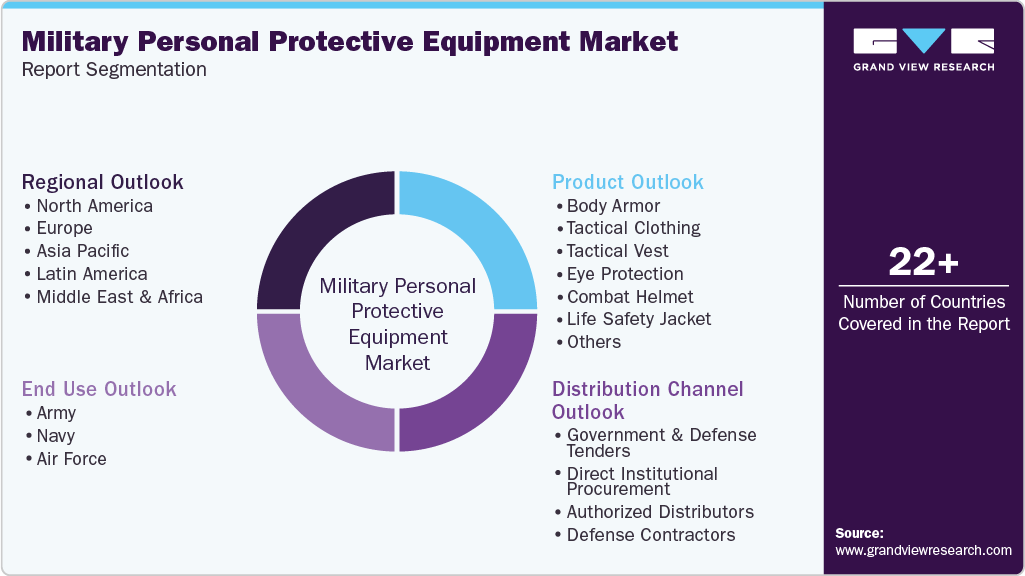
This report forecasts revenue growth at global, regional, and country levels and provides an analysis of the latest industry trends in each of the sub-segments from 2021 to 2033. For this study, Grand View Research has segmented the global military personal protective equipment market report based on product, distribution channel, application, and region:
 To learn more about this report, Download Free Sample Report
 -
Product Outlook (Revenue, USD Million, 2021 - 2033)
-
Body Armor
-
Tactical Clothing
-
Tactical Vest
-
Eye Protection
-
Combat Helmet
-
Life Safety Jacket
-
Backpack
-
Pelvic Protection
-
Respiratory Protection
-
Others
-
-
Distribution Channel Outlook (Revenue, USD Million, 2021 - 2033)
-
Government & Defense Tenders
-
Direct Institutional Procurement
-
Authorized Distributors
-
Defense Contractors
-
-
End Use Outlook (Revenue, USD Million, 2021 - 2033)
-
Army
-
Navy
-
Air Force
-
-
Regional Outlook (Revenue, USD Million, 2021 - 2033)
-
North America
-
U.S.
-
Canada
-
Mexico
-
-
Europe
-
Germany
-
Italy
-
France
-
Russia
-
UK
-
Sweden
-
Norway
-
Finland
-
-
Asia Pacific
-
China
-
India
-
Japan
-
South Korea
-
Australia
-
-
Latin America
-
Brazil
-
Argentina
-
-
Middle East and Africa
-
Saudi Arabia
-
Israel
-
Iran
-
-
Frequently Asked Questions About This Report
North America dominated with a 35.8% revenue share in 2025.
Key factors driving the global military personal protective equipment market include rising geopolitical tensions, modernization of armed forces, increasing focus on soldier survivability, advancements in lightweight and high-performance materials, and growing demand for enhanced protection against ballistic, chemical, biological, and environmental threats.
Asia Pacific is the fastest-growing region over the forecast period.
Body armor segment led with a 28.0% revenue share in 2025, while respiratory protection is the fastest-growing segment.
Government & defense tenders segment led with a 49.5% revenue share in 2025, while authorized distributors is the fastest-growing area.
Army segment led with a 67.2% revenue share in 2025.
The global military personal protective equipment market size was valued at USD 17.3 billion in 2025 and is estimated at USD 18.6 billion in 2026.
The global military personal protective equipment market is expected to grow at a CAGR of 7.1% from 2026 to 2033, reaching USD 30.0 billion by 2033.
Key players include 3M, NFM Group, SnigelDesign AB, Varusteleka, SAVOTTA, PGD, Avon Protection, Drägerwerk AG & Co. KGaA, uvex group, GENTEX CORPORATION, ArmorWorks, Eagle Industries, ArmorSource LLC, Premier Body Armor
About the Author(s)
Advanced Interior Materials Research Team
Advanced Materials · Advanced Interior MaterialsThis report was authored by the advanced interior materials research team at Grand View Research - comprising two research analysts, one senior research analyst, and one industry expert - with specialized expertise in the advanced interior materials segment of the advanced materials industry. All findings are based on proprietary advanced materials databases, executive interviews, and regulatory analysis, subject to internal peer review prior to publication.
Last Updated:
Speak to Analyst

Customize this report to your needs - add regions, segments, or data points, with 20% free customization.
Or view our licence options:


ISO 9001:2015 & 27001:2022 Certified
We are GDPR and CCPA compliant! Your transaction & personal information is safe and secure. For more details, please read our privacy policy.


