
- Home
- »
- Automotive & Transportation
- »
-
Mountain E-bikes Market Size And Share Report, 2026-2033GVR Report cover
![Mountain E-bikes Market (2026 - 2033)Report]()
Mountain E-bikes Market (2026 - 2033)
Size, Share & Trends Analysis Report By Drive (Belt Drive, Chain Drive), By Battery (Lead-acid Battery, Lithium-ion Battery), By Propulsion (Pedal-assisted, Throttle-assisted), By Region, And Segment Forecasts
Market Size, 2025
$8.9BMarket Estimate, 2026
$9.8BMarket Forecast, 2033
$17.5BCAGR, 2026–2033
8.7%Mountain E-bikes Market Summary
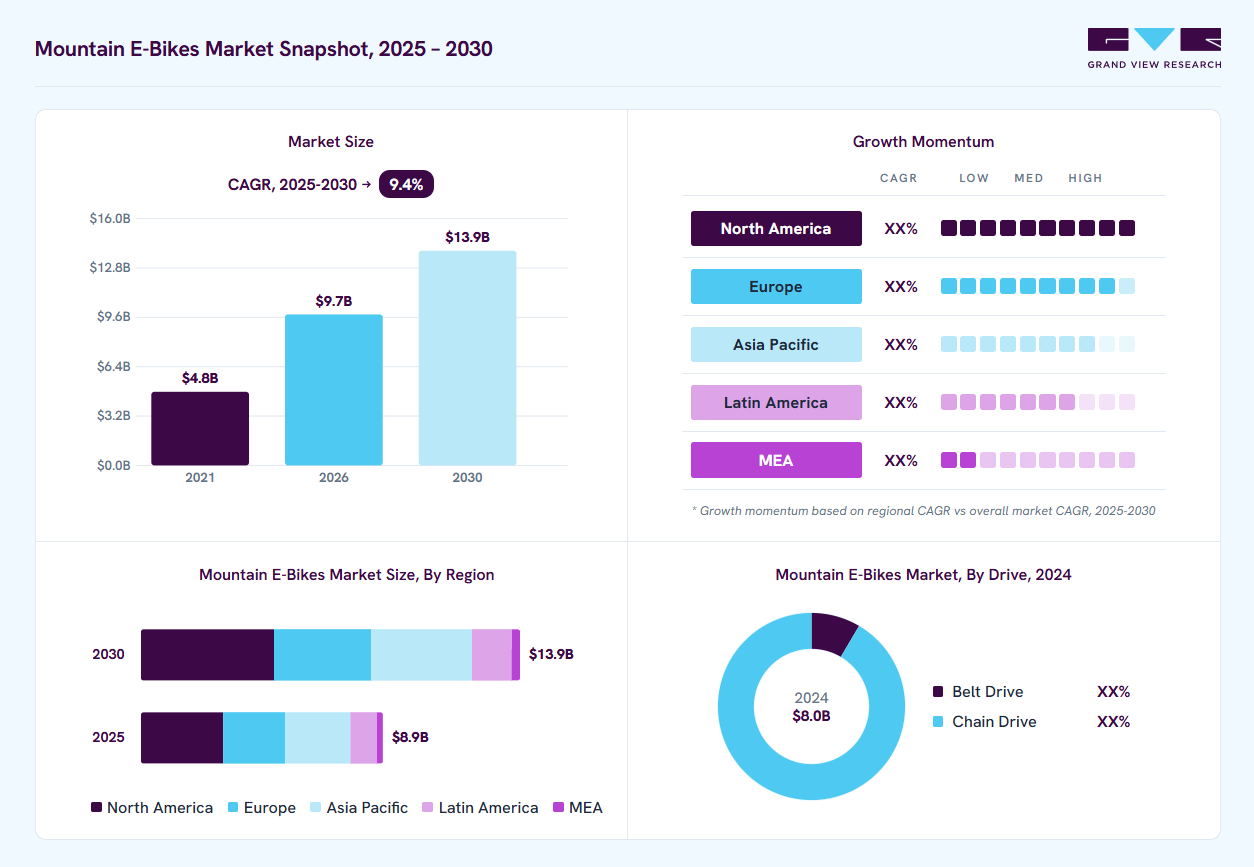
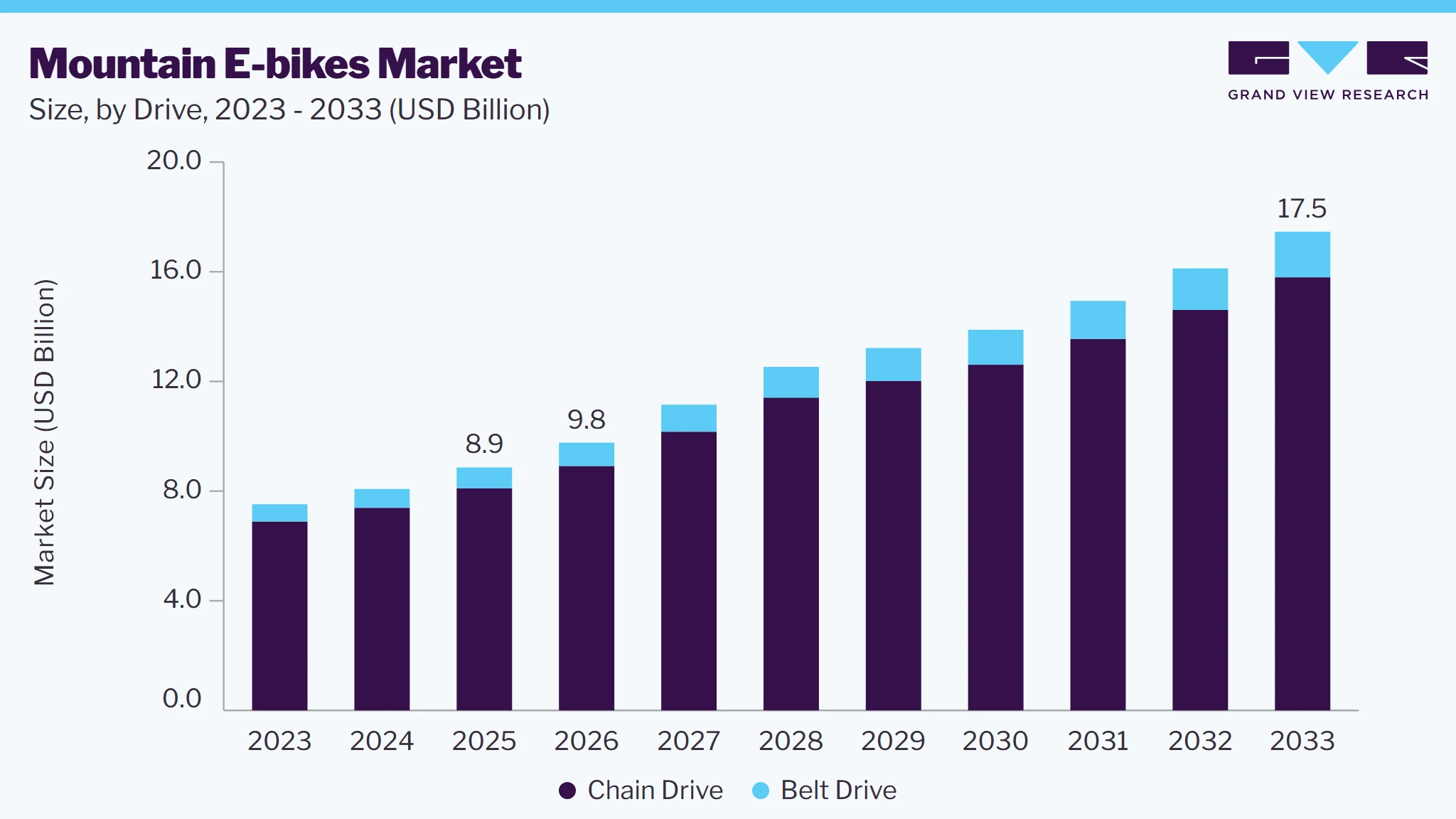
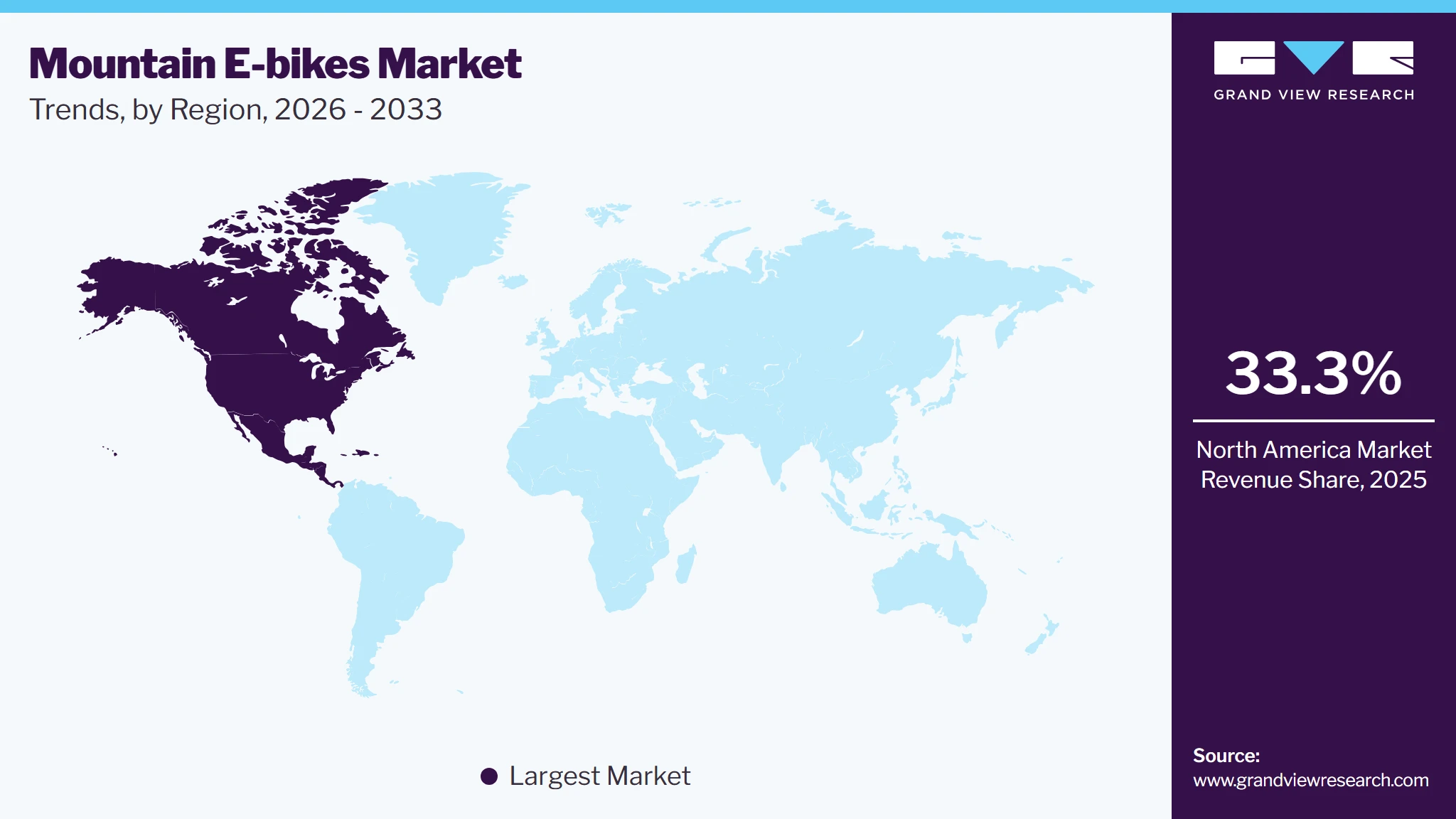
The global mountain e-bikes market size was valued at USD 8.9 billion in 2025 and is projected to grow from USD 9.8 billion in 2026 to USD 17.5 billion by 2033, at a CAGR of 8.7% from 2026 to 2033. North America dominated the market, accounting for a revenue share of 33.3% in 2025. The rising popularity of outdoor recreation and adventure sports is a major factor contributing to the market growth.
Key Market Trends & Insights
- By drive: Chain Drive segment dominated the market, with a revenue share of 92.0% in 2025.
- By battery: Lithium-ion Battery segment held the largest market share of 93.2% in 2025.
- By propulsion: Pedal-assisted segment led the market with the largest revenue share of 81.0% in 2025.
Regional Highlights
- Largest regional market: North America (33.3% revenue share, 2025)
- By country: The US is the fastest growing country in 2025.
Market Size & Forecast
- Market size in 2025: USD 8.9 Billion
- Estimated market size in 2026: USD 9.8 Billion
- Projected market size by 2033: USD 17.5 Billion
- CAGR (2026-2033): 8.7%
Three ways to get this report
Buy it, customize it, or ask a question.Get the Full Report
What the study covers
- FormatsPDF · Excel · Dashboard
- Timeline2026–2033 annual, 2025 base
- Coverage20+ countries, 5 regions
- Companies10+ key players profiled
Customize the Report
20% free customization
- IncludeCountries, segments, points
- TailorTo your product definition
- ExtendDeeper competitor detail
- OrA fully bespoke study
- Turnaround5–10 working days
Ask Prism AI
A cited answer in seconds
- Corpus30K studies, 1.2M points
- ScopeAll markets, not just this
- CitationTraced to report & table
- HonestySays "not covered" if so
- SpeedSeconds, not days
Mountain e-bikes, with their electric assist features, allow riders of various skill levels to tackle challenging terrains and explore new trails with ease. This accessibility is attracting a broader demographic, including older riders and those new to mountain biking. The trend of combining exercise with adventure is driving demand for mountain e-bikes, contributing to the market's expansion.Technological advancements in e-bike components, such as motors, batteries, and drivetrains, are a major driving force in the industry. High-performance mid-drive motors and efficient battery systems now offer increased torque, extended range, and smoother power delivery, making mountain e-bikes more capable on rugged terrains. Innovations such as smart sensors and integrated displays enhance rider experience by providing real-time data and ride customization options. These advancements are pushing the boundaries of what mountain e-bikes can achieve, making them more appealing to both novice and experienced riders. As technology continues to evolve, it is expected to further fuel the market growth.
The increasing emphasis on sustainability and eco-friendly transportation options is positively impacting the industry. Mountain e-bikes offer a greener alternative to traditional off-road vehicles, such as dirt bikes and ATVs, by producing no emissions and reducing the environmental footprint of outdoor activities. As environmental awareness grows, consumers are more inclined to choose sustainable transportation solutions, including e-bikes, for both commuting and recreational purposes. This shift is further supported by government policies and incentives promoting the use of electric vehicles, including e-bikes, to reduce carbon emissions. Consequently, the mountain e-bike market is benefiting from the broader trend towards sustainable and eco-friendly mobility solutions.
The expansion of e-bike infrastructure and increased access to trails suitable for e-bikes are also key drivers of the mountain e-bike market. Many regions are investing in dedicated e-bike trails, bike parks, and charging stations, making it easier for riders to explore new areas and enjoy longer rides without range anxiety. Additionally, changes in regulations allowing e-bikes on certain trails previously restricted to non-motorized bikes are opening up more riding opportunities. This enhanced infrastructure not only attracts local riders but also boosts e-bike tourism, as riders seek out new destinations and experiences. The improved accessibility and infrastructure are making mountain e-bikes a more viable option for adventure enthusiasts, driving industry growth.
The demand for customization and specialized mountain e-bike models is another significant trend influencing the market. Riders are increasingly seeking e-bikes tailored to their specific needs, whether for cross-country, downhill, or all-mountain riding styles. Manufacturers are responding by offering a wider range of models with various frame designs, suspension systems, and power options to cater to different preferences and terrains. Additionally, the trend of customization extends to components, with riders opting for upgrades in brakes, tires, and other accessories to enhance performance. This focus on personalized riding experiences is not only enhancing customer satisfaction but also further driving the market growth.
Market Dynamics
Advancements in battery technologies, lightweight frame materials, electric drive systems, smart connectivity features, and motor efficiency are significantly enhancing the performance, range, durability, and riding experience of mountain e-bikes across recreational, sports, adventure tourism, and commuting applications. The integration of features such as GPS navigation, ride analytics, smartphone connectivity, adaptive power assistance, and advanced suspension systems further improves rider comfort, safety, and trail performance. However, high upfront purchase costs, battery replacement expenses, limited charging infrastructure in remote trail locations, and varying regulatory frameworks governing e-bike usage on public trails and protected areas pose challenges to wider market adoption. Meanwhile, growing consumer interest in outdoor recreational activities, increasing participation in mountain biking, rising demand for sustainable mobility solutions, expansion of adventure tourism, and continuous investments by manufacturers in high-performance and lightweight e-bike models are creating opportunities for the development of technologically advanced, long-range, and premium mountain e-bikes tailored to evolving consumer preferences.
The increasing participation in outdoor recreational activities, adventure tourism, and mountain biking sports is significantly driving demand for mountain e-bikes across North America, Europe, and Asia Pacific. Modern mountain e-bikes equipped with high-torque mid-drive motors, long-range lithium-ion batteries, advanced suspension systems, and lightweight frames enable riders to tackle challenging terrains, steep gradients, and long-distance trails with reduced physical exertion. These capabilities enhance accessibility for riders of varying fitness levels, making mountain e-bikes an attractive option for recreational users, enthusiasts, and aging cycling populations.
The market is also witnessing growing integration of smart technologies and connected cycling solutions. Features such as GPS navigation, smartphone connectivity, ride performance analytics, adaptive power assistance, and battery management systems provide an enhanced riding experience and improve safety, convenience, and energy efficiency. Additionally, the expansion of mountain biking trail networks, increasing investments in cycling tourism infrastructure, supportive policies promoting low-emission mobility, and rising consumer preference for sustainable outdoor transportation are further accelerating the adoption of mountain e-bikes worldwide.
The adoption of mountain e-bikes requires a substantial initial investment, primarily due to the high costs associated with premium electric drive systems, lithium-ion batteries, lightweight frame materials, advanced suspension components, and integrated smart technologies. High-performance mountain e-bikes are often priced significantly above conventional mountain bikes, which can limit affordability for recreational riders and price-sensitive consumers, particularly in emerging markets. In addition, periodic battery replacement, maintenance of electronic components, and specialized servicing requirements contribute to higher total ownership costs over the product lifecycle.
The market also faces challenges related to charging accessibility, battery longevity, and after-sales service availability. Riders using mountain e-bikes for long-distance trail riding or adventure tourism may encounter limitations due to battery range constraints and the lack of charging infrastructure in remote outdoor locations. Furthermore, the need for trained technicians to diagnose and repair electrical systems, coupled with varying regulations governing e-bike classifications and trail access across regions, can create adoption barriers and increase operational complexity for consumers and rental operators.
The rapid growth of adventure tourism, outdoor recreation activities, and experiential travel is creating significant opportunities for mountain e-bike manufacturers worldwide. Increasing consumer interest in nature-based tourism, guided trail experiences, and eco-friendly recreational activities is driving demand for mountain e-bikes across popular cycling destinations, resorts, and national parks. Mountain e-bikes enable riders to access challenging terrains with less physical effort, broadening participation among older adults, novice riders, and tourists seeking premium outdoor experiences.
The market is also benefiting from the expansion of e-bike rental and sharing services, particularly in tourist destinations and mountain biking hubs. Rental operators, hospitality providers, and adventure tour companies are increasingly investing in high-performance mountain e-bike fleets to cater to growing customer demand for sustainable and low-emission mobility options. In addition, government initiatives promoting active transportation, investments in cycling infrastructure, and supportive policies encouraging electric mobility adoption are creating substantial opportunities for manufacturers to develop lightweight, long-range, and technologically advanced mountain e-bikes tailored to recreational, tourism, and adventure sports applications.
Analyst Perspective
The growing popularity of outdoor recreation, adventure tourism, and sustainable mobility is driving the mountain e-bikes market. Consumers are increasingly adopting mountain e-bikes for challenging terrain, recreational riding, fitness, and longer-distance travel, supported by advances in battery technology, lightweight frames, electric drive systems, suspension systems, and smart connectivity.
Innovation in batteries, pedal-assistance systems, navigation, and connected technologies is expanding adoption among cycling enthusiasts, rental operators, and adventure tourism providers. Growing rental services, trail networks, and government support for low-emission mobility are further supporting market growth. However, high purchase costs, limited charging infrastructure, regulatory variations, and maintenance requirements remain key challenges.
Drive Insights
Based on drive, the chain drive segment led the market with the largest revenue share of 92.0% in 2025. The chain drive segment remains the dominant force in the industry due to its proven durability, strength, and cost-effectiveness. Chain drives have long been favored by riders for their ability to handle the rigorous demands of off-road cycling, including steep climbs, rocky paths, and muddy conditions. Their widespread availability and compatibility with most bike components make chain drives a versatile choice, appealing to a broad range of riders from beginners to seasoned mountain bikers. Additionally, the relatively simple design of chain drives facilitates easy maintenance and repairs, further enhancing their popularity. As a result, chain drives continue to be the preferred drivetrain for mountain e-bikes, supporting their leading position in the industry.
The belt drive segment is expected to grow at a significant CAGR during the forecast period. The growth of the segment can be attributed to its unique benefits and growing appeal among riders seeking a quieter, low-maintenance alternative. Unlike traditional chain drives, belt drives do not require lubrication, making them cleaner and more convenient for riders who prioritize low upkeep. Belt drives are also highly durable and resistant to rust and wear, which is especially beneficial in wet or muddy riding conditions often encountered in mountain biking. Furthermore, the smooth and quiet operation of belt drives enhances the riding experience, attracting a new segment of e-bike enthusiasts looking for innovative drivetrain solutions. As awareness of these benefits increases, the belt drive segment is poised for significant growth, positioning itself as a modern, efficient alternative to the traditional chain drive.
Battery Insights
Based on battery, the Lithium-ion Battery segment led the market with the largest revenue share of 93.2% in 2025. The lithium-ion battery segment continues to dominate the mountain e-bikes market due to its superior performance characteristics, including higher energy density, longer lifespan, and lighter weight compared to other battery types. Riders prefer lithium-ion batteries because they offer a longer range and quicker charging times, which are crucial for extended mountain biking adventures. These batteries also support the increasing demand for high-performance e-bikes capable of handling challenging terrains and long-distance rides without frequent recharging. Moreover, advancements in lithium-ion technology have led to improved safety features, such as thermal management systems, making them a more reliable choice for manufacturers and consumers alike.
The lead-acid battery segment is expected to grow at a significant CAGR during the forecast period. Recent advancements in lead-acid battery technology have improved their energy efficiency and reduced their weight, making them more viable for use in e-bikes. These batteries are also known for their reliability and ability to perform well in extreme weather conditions, which appeals to riders in regions with harsh climates. Additionally, lead-acid batteries are relatively easy to recycle, aligning with the growing consumer demand for more sustainable and environmentally friendly options. As the market expands to include more budget-conscious consumers and regions with varying climate conditions, the lead-acid battery segment is gaining traction as an accessible and durable alternative, contributing to its emerging status.
Propulsion Insights
Based on propulsion, the Pedal-assisted segment led the market with the largest revenue share of 81.0% in 2025. The growth of the segment can be attributed to its ability to provide a more natural biking experience while offering the benefits of electric assistance. Pedal-assisted e-bikes are favored by riders who seek the thrill and exercise benefits of traditional mountain biking but with added support to conquer steep inclines and challenging trails. This segment appeals to a wide range of consumers, from fitness enthusiasts to casual riders, as it promotes active pedaling while reducing the physical strain associated with difficult terrain. The growing popularity of pedal-assisted mountain e-bikes is further bolstered by regulations in various regions that classify them similarly to regular bicycles, allowing access to a broader range of trails.
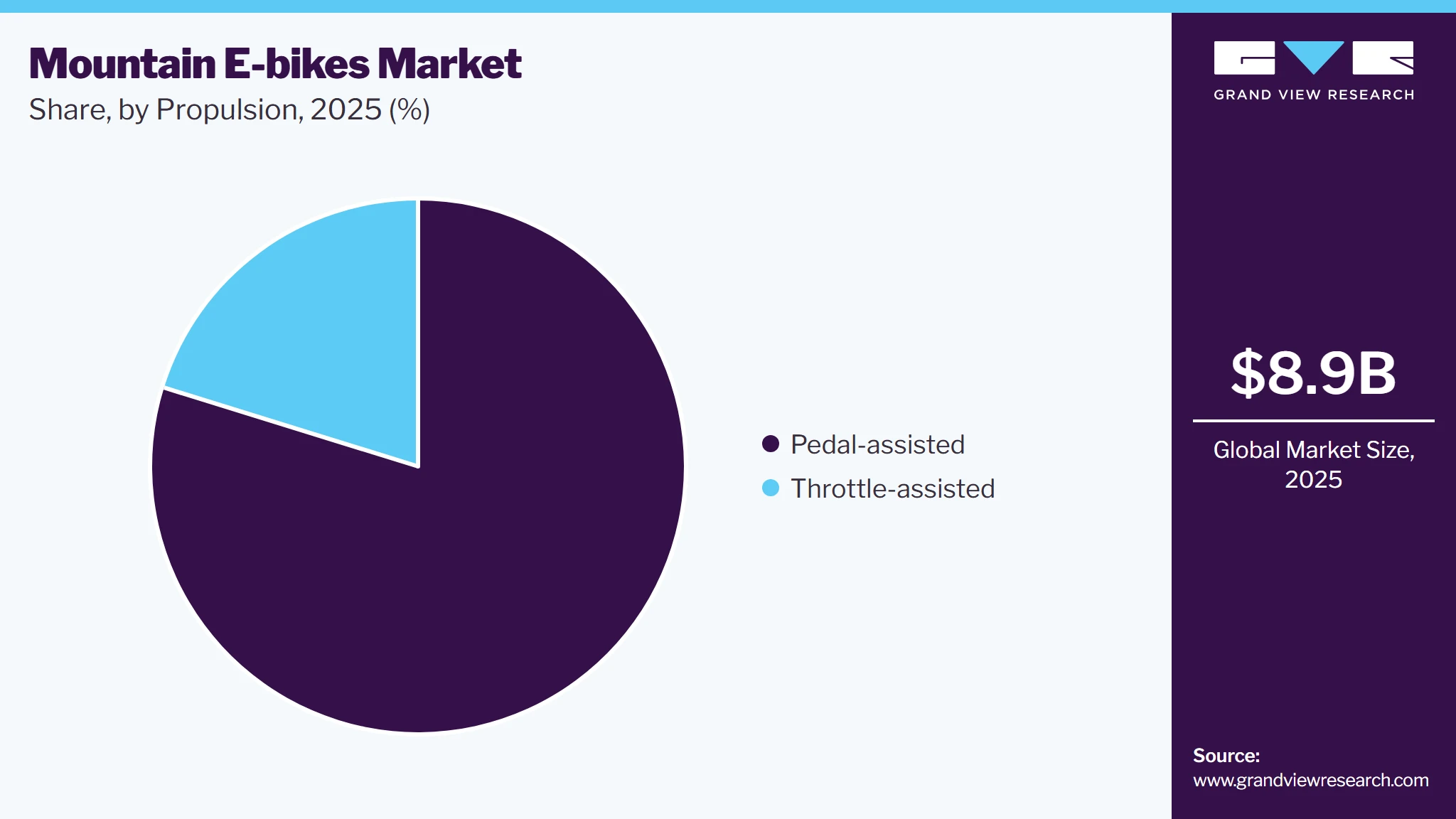
The throttle-assisted segment is projected to grow at the fastest CAGR over the forecast period. The growth of the segment is driven by its convenience and appeal to riders seeking a less strenuous option. Throttle-assisted e-bikes allow riders to engage the electric motor independently of pedaling, making them ideal for those who want to enjoy the outdoors without the physical demands of continuous pedaling. This feature is particularly attractive to older riders, individuals with physical limitations, and those looking for an easier ride on steep or uneven terrain. Additionally, throttle-assisted e-bikes offer a more accessible entry point for beginners and casual users who are less familiar with mountain biking techniques.
Regional Insights
North America dominated the global mountain e-bikes market with the largest revenue share of 33.3% in 2025. The growth is driven by its convenience and appeal to riders seeking a less strenuous option. Throttle-assisted e-bikes allow riders to engage the electric motor independently of pedaling, making them ideal for those who want to enjoy the outdoors without the physical demands of continuous pedaling. This feature is particularly attractive to older riders, individuals with physical limitations, and those looking for an easier ride on steep or uneven terrain. Additionally, throttle-assisted e-bikes offer a more accessible entry point for beginners and casual users who are less familiar with mountain biking techniques.
U.S. Mountain E-bikes Industry Trends
US is the fastest growing country in the North America mountain e-bikes market. As a pioneer in technological advancements, the U.S. is at the forefront of developing high-performance e-bikes that cater to both recreational riders and fitness enthusiasts. The expansion of pedal-assisted bike-sharing programs and the establishment of more extensive off-road biking trails are contributing to the market's expansion. Additionally, government incentives and rebates for electric bike purchases are encouraging wider adoption.
Europe Mountain E-bikes Industry Trends
The mountain e-bikes market in Europe was identified as a lucrative region in 2024. Europe’s strong emphasis on sustainability and the rising trend of eco-friendly transportation are significant factors contributing to the growth of the market. European countries, particularly Germany, France, and the Netherlands, are actively promoting cycling as a green alternative to traditional vehicles, with mountain e-bikes gaining popularity for both pedal-assisted commuting and leisure activities. The region’s commitment to reducing carbon emissions and advancing green technologies is fostering innovation in e-bike design and functionality. Enhanced battery life, improved motor efficiency, and supportive regulatory frameworks are key factors driving market expansion.
The U.K. mountain e-bikes market is expected to grow rapidly in the coming years due to the rising awareness of the importance of physical fitness has significantly contributed to the popularity of mountain biking in the U.K. As more individuals prioritize exercise to combat sedentary lifestyles, mountain biking offers an appealing way to improve cardiovascular health, build muscle strength, and reduce stress.
The mountain e-bike market in Germany held a substantial market share in 2024 owing to the established cycling culture, which supports the growth of the mountain biking segment. The country is known for its extensive network of cycling paths and trails, many of which cater to mountain bikers. Regions like the Bavarian Alps, the Black Forest, and the Harz Mountains offer diverse and challenging terrains, attracting both domestic and international riders. This established culture of cycling serves as a strong foundation for the continued rise in mountain biking.
Asia Pacific Mountain E-bikes Industry Trends
The mountain e-bikes market in Asia Pacific is anticipated to grow significantly during the forecast period. Major economies such as China, Japan, and South Korea are witnessing increased adoption of mountain e-bikes, supported by government policies promoting green transportation and reduced reliance on fossil fuels. The rising popularity of outdoor activities and the expansion of dedicated cycling paths in pedal-assisted areas are further stimulating market growth. Technological advancements in battery systems and lightweight materials are making mountain e-bikes more accessible and attractive to a broader range of consumers. As the region continues to embrace sustainable transportation options, the market is expected to expand rapidly, underpinned by innovation and favorable economic conditions.
Japan mountain e-bike market is expected to grow rapidly in the coming years due to a significant surge in interest in outdoor activities, particularly post-pandemic. People are seeking opportunities to engage with nature to rejuvenate both physically and mentally. Mountain biking offers an appealing mix of adventure, exploration, and fitness, making it a popular choice among outdoor enthusiasts.
The mountain e-bike market in China held a substantial market share in 2024 owing to the country’s ongoing efforts to promote eco-friendly lifestyles aligned with the principles of cycling. Mountain biking is a low-impact activity that promotes environmental stewardship and appeals to younger generations and eco-conscious consumers.
Key Mountain E-bikes Company Insights
Some of the key companies in the mountain e-bikes market include Bulls Bikes USA, Accell Group, Heybike Inc., Husqvarna E-Bicycles, and others. Organizations are focusing on increasing customer base to gain a competitive edge in the industry. Therefore, key players are taking several strategic initiatives, such as mergers and acquisitions, and partnerships with other major companies.
-
Husqvarna E-Bicycles, a division of Husqvarna Motorcycles known for its innovative approach to e-mobility, particularly in the electric mountain bike (eMTB) segment. The company's product lineup includes the Mountain Cross (MC) series, designed to enhance the riding experience for all skill levels with high-quality components and a minimalist Scandinavian design. Husqvarna E-Bicycles aims to combine performance with user-friendly features, allowing riders to push their limits while enjoying intuitive handling on challenging trails.
-
Bulls Bikes USA is an organization specializing in a diverse range of e-bikes, including eMTBs, eCity, and trekking models. Its product portfolio includes AMINGA EVA TR 1, COPPERHEAD EVO AM 1.5, COPPERHEAD EVO AM 1750, COPPERHEAD EVO AM 2 750, and others. Bulls Bikes USA aims to increase cycling participation by collaborating with advocacy groups and addressing common barriers to cycling mobility.
Key Mountain E-bikes Companies:
The following are the leading companies in the mountain e-bikes market.
- Bulls Bikes USA
- Accell Group
- Cycling Sports Group, Inc.
- Heybike Inc.
- Husqvarna E-Bicycles
- Magnum Electric Bikes
- RANDRIDE
- VAAN ELECTRIC MOTO PRIVATE LIMITED
- Pedego
- Polygon Bikes
Competitive Benchmarking
Category
Operating Strategies
Competitive Edge
Weakness
Established Players (Bulls Bikes USA, Accell Group, Cycling Sports Group)
- Focus on developing high-performance mountain e-bikes equipped with lightweight frames, advanced suspension systems, high-torque mid-drive motors, and long-range lithium-ion batteries.
- Continuous investment in battery technologies, smart connectivity solutions, integrated ride analytics, and premium component partnerships.
- Strong global brand recognition, extensive dealer and distribution networks, and established customer loyalty among cycling enthusiasts.
- Significant R&D capabilities, economies of scale, and access to premium component suppliers enable the launch of technologically advanced products.
- High manufacturing and development costs associated with premium materials, battery systems, and smart technologies.
- Greater exposure to supply chain disruptions affecting batteries, motors, semiconductors, and drivetrain components.
Emerging Players (Heybike Inc., Magnum Electric Bikes)
- Focus on specialized mountain e-bike models, customizable configurations, direct-to-consumer sales channels, and cost-competitive offerings.
- Emphasize modular designs, innovative styling, localized production, and targeted solutions for recreational riders, rental operators, and tourism providers.
- Greater agility in responding to changing consumer preferences, technological trends, and niche market opportunities.
- Faster product development cycles, flexible customization options, and competitive pricing strategies.
- Limited global market presence, smaller distribution footprints, and lower brand recognition compared with established manufacturers.
- Reduced financial resources for large-scale R&D investments, marketing campaigns, and dealer network expansion.
Recent Developments
-
In May 2024, Audi expanded its e-mobility offerings with the launch of a limited-edition electric mountain bike (eMTB) designed in collaboration with Fantic. This new enduro-style eMTB features a robust aluminum frame and is equipped with a powerful Brose S-MAG 250-watt motor, providing up to 90 Newton meters of torque and four levels of electrical assistance: Tour, Eco, Sport, and Boost.
-
In July 2024, DJI entered the electric bike market with the Amflow PL, a carbon fiber electric mountain bike featuring their new Avinox drive system. The bike includes a mid-drive motor with smart assistance technology, offering four standard assist modes and a Boost mode, all customizable via the Avinox app. It comes with two battery options, 600Wh and 800Wh, with fast charging capabilities using GaN technology. The bike features a 2-inch OLED touchscreen display with advanced connectivity options and a range of smart features including bike security and real-time status updates.
Mountain E-bikes Market Report Scope
Report Attribute
Details
Market size in 2025
USD 8.9 billion
Estimated market size in 2026
USD 9.8 billion
Projected market size by 2033
USD 17.5 billion
Growth rate
CAGR of 8.7% from 2026 to 2033
Base year for estimation
2025
Historical data
2021 - 2024
Forecast period
2026 - 2033
Quantitative units
Revenue in USD million/billion and CAGR from 2026 to 2033
Report coverage
Revenue forecast, company ranking, competitive landscape, growth factors, and trends
Segments covered
Drive, battery, propulsion, region
Regional scope
North America; Europe; Asia Pacific; Latin America; MEA
Country scope
U.S.; Canada; Mexico; U.K.; Germany; France; China; Japan; India; Australia; South Korea; Brazil; Kingdom of Saudi Arabia (KSA); UAE; South Africa
Key companies profiled
Bulls Bikes USA; Accell Group; Cycling Sports Group, Inc.; Heybike Inc.; Husqvarna E-Bicycles; Magnum Electric Bikes; RANDRIDE; VAAN ELECTRIC MOTO PRIVATE LIMITED; Pedego; Polygon Bikes
Customization scope
Free report customization (equivalent up to 8 analysts' working days) with purchase. Addition or alteration to country, regional & segment scope.
Pricing and purchase options
Avail customized purchase options to meet your exact research needs. Explore purchase options
Global Mountain E-bikes Market Report Segmentation
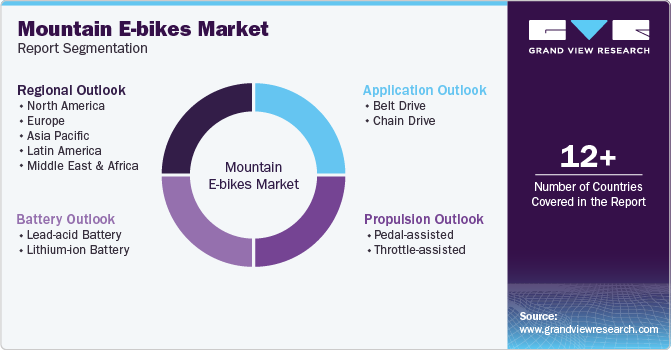
This report forecasts revenue growth at global, regional, and country levels and provides an analysis of the latest industry trends in each of the sub-segments from 2021 to 2033. For this study, Grand View Research has segmented the global mountain e-bikes market report based on drive, battery, propulsion, and region.
-
Drive Outlook (Revenue, USD Billion, 2021 - 2033)
-
Belt Drive
-
Chain Drive
-
-
Battery Outlook (Revenue, USD Billion, 2021 - 2033)
-
Lead-acid Battery
-
Lithium-ion Battery
-
-
Propulsion Outlook (Revenue, USD Billion, 2021 - 2033)
-
Pedal-assisted
-
Throttle-assisted
-
-
Regional Outlook (Revenue, USD Billion, 2021 - 2033)
-
North America
-
U.S.
-
Canada
-
Mexico
-
-
Europe
-
Germany
-
U.K.
-
France
-
-
Asia Pacific
-
China
-
Japan
-
India
-
South Korea
-
Australia
-
-
Latin America
-
Brazil
-
-
Middle East and Africa (MEA)
-
KSA
-
UAE
-
South Africa
-
-
Research Methodology
The mountain E-bikes market figures in this report are based on a proven research process that combines executive interviews with secondary research from proprietary databases, company filings, and recognized regulatory and institutional sources. Market size is built through value-chain sizing - reconciling supply-side and demand-side estimates - and triangulated with bottom-up and top-down approaches. Every estimate passes multiple levels of expert validation before publication, with each mountain E-bikes segment quantified using the revenue-capture definitions in the table below.
Segment Definition
Segment - Drive
Revenue Capture Definition
Belt Drive
This segment captures revenue generated from mountain e-bikes equipped with belt drive systems that replace traditional metal chains with reinforced carbon fiber belts. Belt-driven mountain e-bikes are increasingly preferred by recreational riders, commuters, and adventure enthusiasts due to their low maintenance requirements, quiet operation, corrosion resistance, and extended service life. These systems are particularly attractive for premium e-bike models designed to deliver smooth power transfer and enhanced riding comfort across diverse terrains.
Chain Drive
This segment includes revenue derived from mountain e-bikes utilizing conventional chain drive systems for transmitting power from the motor and pedals to the rear wheel. Chain-driven mountain e-bikes are widely adopted owing to their cost-effectiveness, high torque handling capability, compatibility with multi-speed drivetrains, and ease of replacement and servicing. These systems are commonly used in entry-level, mid-range, and performance-oriented mountain e-bikes intended for trail riding, off-road adventures, and competitive cycling applications.
Segment- Battery
Revenue Capture Definition
Lead-acid Battery
This segment captures revenue generated from mountain e-bikes powered by lead-acid batteries. These batteries are primarily utilized in low-cost and entry-level e-bike models due to their lower upfront costs and established manufacturing base. However, their higher weight, lower energy density, shorter lifespan, and longer charging times limit their adoption in high-performance mountain e-bikes designed for demanding off-road and long-distance riding applications.
Lithium-ion Battery
This segment includes revenue derived from mountain e-bikes equipped with lithium-ion battery systems. Lithium-ion batteries offer superior energy density, lighter weight, faster charging capabilities, longer cycle life, and improved thermal management compared with conventional battery technologies. Their ability to provide extended riding range, consistent power output, and enhanced overall efficiency has made them the preferred energy storage solution for premium, high-performance, and long-range mountain e-bikes used in recreational, sports, and adventure tourism applications.
Segment - Propulsion
Revenue Capture Definition
Pedal-assisted
This segment captures revenue generated from pedal-assisted mountain e-bikes that provide electric motor support only when the rider is actively pedaling. These systems utilize sensors to adjust power assistance based on pedaling cadence, torque, or speed, enabling riders to navigate steep inclines, rugged trails, and extended distances with reduced physical exertion. Pedal-assisted mountain e-bikes are widely adopted due to their natural riding feel, improved battery efficiency, regulatory acceptance in many regions, and suitability for recreational, fitness, and adventure cycling activities.
Throttle-assisted
This segment includes revenue derived from throttle-assisted mountain e-bikes that allow riders to engage the electric motor through a throttle mechanism without the need for continuous pedaling. These e-bikes are favored by users seeking additional convenience, reduced rider fatigue, and enhanced mobility over challenging terrains. Throttle-assisted systems are commonly utilized in specific regional markets and recreational applications where regulations permit their use, offering instant acceleration and greater accessibility for riders with varying fitness levels and physical capabilities.
Estimation Model
Layer Name
Key Question
Description
Cycling Participation & Outdoor Recreation Layer
Where are mountain e-bikes used and what drives demand?
Establish the total potential demand base by identifying mountain e-bike usage across recreational mountain biking, trail riding, adventure tourism, fitness activities, commuting, and outdoor sports. Demand is influenced by increasing participation in cycling activities, expansion of mountain biking trails, growth in eco-tourism, consumer preference for sustainable mobility, and rising interest in electric-assisted outdoor recreation.
Addressable Consumer Market Layer
Which consumers can realistically adopt mountain e-bikes?
Refine the total cycling participant base into the realistically serviceable market by considering factors such as disposable income levels, consumer awareness of e-bike technologies, accessibility to cycling infrastructure, battery charging availability, purchasing power, regional regulations governing e-bike use, age demographics, and preferences for premium outdoor recreational products.
Mountain E-bike Procurement Layer
Who is actively purchasing, upgrading, or replacing mountain e-bikes?
Estimate annual demand generation by analyzing purchases from recreational riders, cycling enthusiasts, adventure tourists, e-bike rental operators, sports clubs, and hospitality providers. Demand is further influenced by replacement cycles, technological advancements in batteries and motors, expansion of rental fleets, increasing adoption of connected mobility solutions, and growing investments in cycling tourism and sustainable transportation initiatives.
Revenue Layer
How is revenue generated from mountain e-bike sales?
Revenue is generated through the sale of mountain e-bikes across various drive systems (belt drive and chain drive), battery technologies (lead-acid and lithium-ion), and propulsion types (pedal-assisted and throttle-assisted). Market revenue is calculated by considering unit shipments, vehicle specifications, motor power ratings, battery capacities, smart connectivity features, aftermarket accessories, maintenance services, regional pricing variations, distribution channel margins, and value chain participation across manufacturers, component suppliers, distributors, rental operators, and retailers.
Delivered Customizations
This report has been delivered with the following In-depth customizations
Client Request
Customization Delivered
Value Adds
Mountain E-bikes Market Assessment
Structured evaluation of market dynamics including key drivers, restraints, opportunities, and industry trends across the mountain e-bikes value chain.
Assessment of technology evolution across battery systems, electric drive units, lightweight frame materials, smart connectivity features, suspension technologies, and integrated ride management platforms.
Clear visibility into market growth drivers, consumer adoption patterns, and key barriers to market expansion.
Strategic input for market entry, product portfolio expansion, and investment decision-making.
End-Use and Application Insights
Analysis of demand distribution across recreational riding, adventure tourism, sports and fitness activities, e-bike rental services, commuting, and hospitality applications.
Evaluation of evolving consumer requirements related to riding range, battery performance, lightweight construction, smart mobility features, sustainability preferences, and off-road capabilities.
Identification of high-growth and high-value application segments.
Support for targeted product development, customer segmentation, and go-to-market strategies.
Technology and Competitive Landscape Review
Benchmarking of key mountain e-bike technologies including belt drive and chain drive systems, lead-acid and lithium-ion batteries, and pedal-assisted and throttle-assisted propulsion systems.
Analysis of major players' innovation strategies, battery advancements, motor technologies, connected ecosystem capabilities, product differentiation initiatives, and regional market presence.
Competitive intelligence for technology positioning and portfolio optimization.
Guidance for R&D prioritization, partnership evaluation, distribution strategy development, and long-term growth planning.
Frequently Asked Questions About This Report
The global mountain e-bikes market size was estimated at USD 8.9 billion in 2025 and is expected to reach USD 9.8 billion in 2026.
Some key players operating in the mountain e-bikes market include Bulls Bikes USA; Accell Group; Cycling Sports Group, Inc.; Heybike Inc.; Husqvarna E-Bicycles; Magnum Electric Bikes; RANDRIDE; VAAN ELECTRIC MOTO PRIVATE LIMITED; Pedego; Polygon Bikes.
Key factors that are driving the market growth include the rising popularity of outdoor recreation and adventure sports and the increasing emphasis on sustainability and eco-friendly transportation options.
Chain Drive segment dominated the global mountain e-bikes market with a share of 92.0% in 2025.
Lithium-ion Battery segment dominated the global mountain e-bikes market with a share of 93.2% in 2025.
The global mountain e-bikes market is expected to grow at a compound annual growth rate of 8.7% from 2026 to 2033 to reach USD 17.5 billion by 2033.
North America dominated the mountain e-bikes market with a share of 33.3% in 2025. The growth of the region is driven by its convenience and appeal to riders seeking a less strenuous option.
Germany dominated the Europe mountain e-bikes market with a share in 2025.
About the Author(s)
Automotive & Transportation Research Team
Technology · Automotive & TransportationThis report was authored by the automotive & transportation research team at Grand View Research - comprising two research analysts, one senior research analyst, and one industry expert - with specialized expertise in the automotive & transportation segment of the technology industry. All findings are based on proprietary technology databases, executive interviews, and regulatory analysis, subject to internal peer review prior to publication.
Last Updated:
Speak to Analyst


Customize this report to your needs - add regions, segments, or data points, with 20% free customization.
Or view our licence options:


ISO 9001:2015 & 27001:2022 Certified
We are GDPR and CCPA compliant! Your transaction & personal information is safe and secure. For more details, please read our privacy policy.


