
- Home
- »
- IT Services & Applications
- »
-
Multi-vendor Support Services Market Size Report, 2033GVR Report cover

Multi-vendor Support Services Market (2026 - 2033)
Size, Share & Trends Analysis Report By Service (Hardware Support, Software Support), By Application, By Enterprise Size, By End Use, By Region, And Segment Forecasts
Market Size, 2025
$58.3BMarket Estimate, 2026
$60.9BMarket Forecast, 2033
$82.0BCAGR, 2026–2033
4.3%Multi-vendor Support Services Market Summary
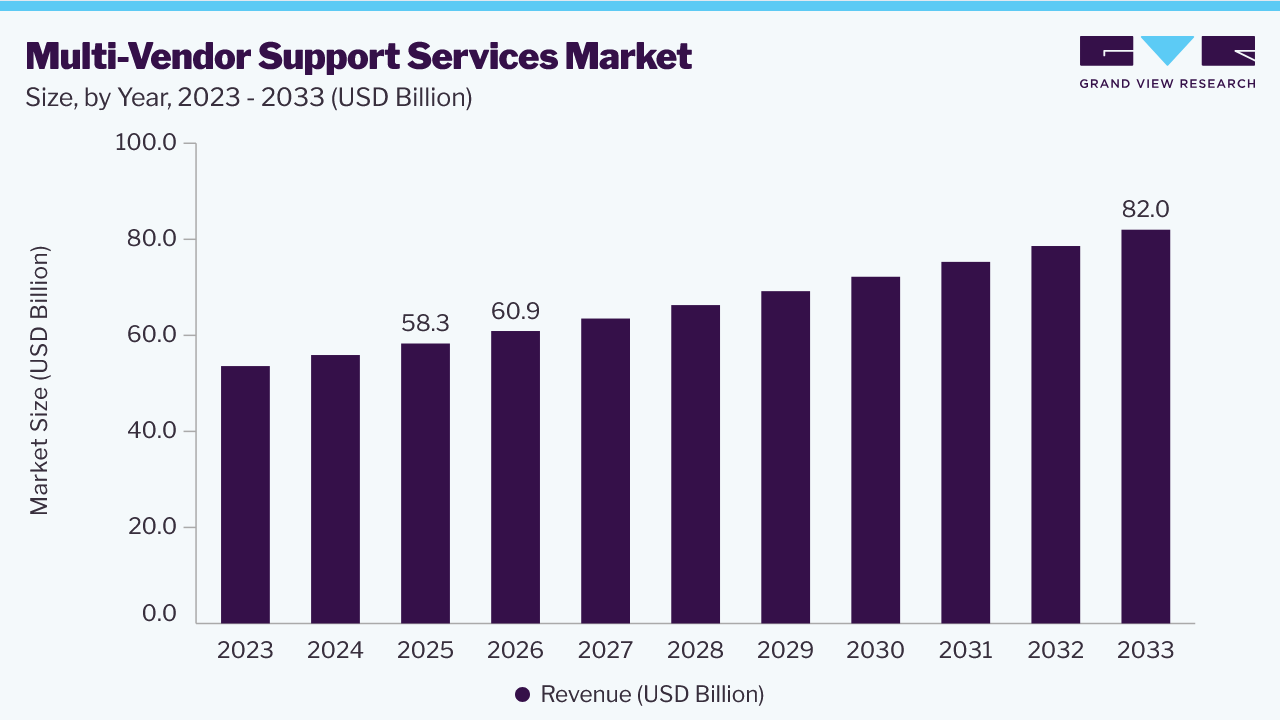
The global multi-vendor support services market size was valued at USD 58.3 billion in 2025 and is projected to grow from USD 60.9 billion in 2026 to USD 82.0 billion by 2033, at a CAGR of 4.3% from 2026 to 2033. North America dominated the market, accounting for a largest revenue share of 40.0% in 2025. The market is primarily driven by the increasing complexity and heterogeneity of IT environments in modern organizations.
 Source: Grand View Research, IR Documents, Primary Interviews, Paid DatabasesTo learn more about this report,
 Download Free Sample Report
Key Market Trends & Insights
- By service: Hardware support segment held the largest market share of around 60.0% in 2025.
- By enterprise size: Large enterprises segment held the largest market share in 2025.
- By application: IT operations segment held the largest market share of over 35.0% in 2025.
- By end use: BFSI segment held the largest market share in 2025.
Regional Highlights
- Largest regional market: North America (40.0% revenue share, 2025)
Market Size & Forecast
- Market size in 2025: USD 58.3 Billion
- Estimated market size in 2026: USD 60.9 Billion
- Projected market size by 2033: USD 82.0 Billion
- CAGR (2026-2033): 4.3%
Prism AI by Grand View Research Free to tryAsk a question about the multi-vendor support services marketTry asking✓Every figure cited from GVR research Prefer the report? Download free sample →As businesses adopt a diverse array of hardware, software, and networking solutions from multiple manufacturers, the need for integrated support services to manage and optimize these multi-vendor ecosystems becomes critical. In addition, the demand for cost-effective, streamlined operations compels organizations to seek unified support services, thereby reducing the logistical burden of coordinating with multiple vendors. The rapid pace of technological advancements and the proliferation of cloud-based solutions further amplify the necessity for comprehensive multi-vendor support, ensuring uninterrupted performance and facilitating seamless integration and innovation across diverse IT landscapes.
The multi-vendor support services market encompasses specialized companies' services for managing, maintaining, and optimizing equipment and software from multiple manufacturers. These services include technical support, repair, maintenance, and IT infrastructure management to ensure seamless interoperability and peak performance across diverse technological ecosystems. Businesses leverage multi-vendor support services to streamline operations, reduce downtime, and minimize the complexity of dealing with multiple vendors, enhancing efficiency and cost-effectiveness. This market is driven by the growing complexity of IT environments and the need for comprehensive, integrated solutions that can adapt to rapidly evolving technological landscapes.
The increasing complexity and heterogeneity of IT environments in modern organizations significantly drive the market, necessitating comprehensive management solutions capable of handling diverse technologies. As businesses integrate various hardware, software, and networking components from multiple vendors to meet specific operational needs, the intricacy of maintaining and optimizing these disparate systems grows.
This complexity poses greater challenges for internal IT departments, which may require more specialized expertise to manage all aspects effectively. Consequently, organizations turn to multi-vendor support services to ensure seamless interoperability, reduce the risk of downtime, and streamline troubleshooting processes. These services offer the expertise and unified approach needed to navigate the multifaceted IT landscapes, enhancing operational efficiency and enabling businesses to focus on core activities while ensuring their technological infrastructure remains robust and reliable.
Analyst Perspective
The market is growing steadily as organizations seek unified solutions to manage complex IT infrastructures, reduce costs, and limit vendor dependency. Hardware support leads the market, driven by the need to manage diverse enterprise IT assets efficiently. Large enterprises are the main adopters due to the complexity of their environments, while IT operations represent the largest application segment as businesses focus on reliability, interoperability, and minimizing downtime. The increasing adoption of hybrid cloud, AI-driven IT management, and digital transformation is expected to further boost demand for multi-vendor support services worldwide.
Service Insights
The hardware support segment accounted for the largest market share of around 60.0% in 2025, driven by the proliferation of diverse and sophisticated hardware solutions within organizations. As businesses deploy a wide range of devices and equipment from various manufacturers to address specific operational requirements, the complexity of managing, maintaining, and repairing these heterogeneous hardware components increases. Internal IT teams often face challenges in keeping up with each vendor's technical specifications and support protocols.
Consequently, organizations seek multi-vendor hardware support services to ensure efficient and consistent management of their hardware assets. These services provide specialized expertise, streamlined maintenance processes, and comprehensive support, enabling organizations to minimize downtime, extend the lifecycle of their hardware investments, and optimize overall performance.
The software support segment is anticipated to grow at the highest CAGR over the forecast period. The demand for software support multi-vendor support services is propelled by the diverse array of software applications and platforms utilized by modern businesses. As organizations adopt many software solutions to enhance productivity, streamline operations, and foster innovation, the need for cohesive management and support of these applications becomes critical. Internal IT departments may need help keeping pace with updates, patches, and the specific support requirements of each software vendor.
Multi-vendor software support services address this challenge by offering centralized and expert management of software ecosystems, ensuring compatibility, seamless integration, and timely updates. These services help organizations maintain the stability and security of their software environments, reduce the complexity of managing multiple vendor relationships, and enable IT teams to focus on strategic initiatives rather than routine maintenance tasks.
Enterprise Size Insights
The large enterprise segment accounted for the largest market share in 2025. Large enterprises' adoption of multi-vendor support services is primarily driven by the scale and complexity of their IT environments. Large enterprises typically operate extensive and diverse technological infrastructures, incorporating various hardware, software, and networking solutions from multiple vendors. The sheer volume and variety of these components necessitate a unified support approach to ensure seamless integration, efficient troubleshooting, and optimal performance. Multi-vendor support services provide large enterprises with the expertise and comprehensive management needed to handle the intricacies of such complex ecosystems, enabling them to reduce downtime, enhance operational efficiency, and focus on strategic business objectives without the burden of managing numerous vendor relationships and support protocols.
The small & medium enterprises segment is anticipated to expand at a CAGR of over 4.0% during the forecast period. The adoption of multi-vendor support services by small and medium-sized enterprises (SMEs) is driven by the need for cost-effective and efficient IT management. SMEs often need more resources and specialized IT personnel to maintain and support a diverse set of technologies from various vendors. By leveraging multi-vendor support services, SMEs can access a centralized, expert resource for managing their IT infrastructure, helping streamline operations, minimize costs, and ensure reliability. These services offer SMEs the ability to scale their support needs in line with business growth, providing flexibility and reducing the administrative and operational burden of dealing with multiple support channels.
Application Insights
The IT operations segment accounted for the largest market share of over 35.0% in 2025. Adopting multi-vendor support services for IT operations applications is driven by the need for streamlined management and optimized performance across diverse, complex IT infrastructures. IT operations encompass many critical functions, including network management, server maintenance, data storage, and cybersecurity. Managing these disparate systems becomes increasingly challenging as organizations integrate various IT solutions from multiple vendors to meet their operational needs. Multi-vendor support services offer a cohesive and expert approach to ensure interoperability, reduce downtime, and enhance the overall efficiency of IT operations.
The finance & accounting segment is anticipated to grow at the highest CAGR during the forecast period. The adoption of multi-vendor support services for finance and accounting applications is driven by the imperative for accuracy, compliance, and seamless integration within financial processes. Finance and accounting applications often involve complex and sensitive data that require robust support to ensure integrity, security, and compliance with regulatory standards. As organizations employ a variety of financial software from different vendors, the need for integrated support services becomes paramount. Multi-vendor support services offer the expertise to effectively manage and troubleshoot these applications, ensuring that financial data is accurate, systems are up-to-date, and compliance requirements are met.
End Use Insights
The BFSI segment accounted for the largest market share in 2025. The adoption of multi-vendor support services in the Banking, Financial Services, and Insurance (BFSI) sector is primarily driven by the need for enhanced security, compliance, and operational efficiency. The BFSI industry handles vast amounts of sensitive financial data and operates under stringent regulatory requirements. Managing diverse IT systems from multiple vendors to meet these demands requires specialized expertise and comprehensive support. Multi-vendor support services provide BFSI institutions with a unified approach to maintaining and securing their IT infrastructure, ensuring standard regulatory compliance, and minimizing the risk of data breaches.
The technology and communication segment is anticipated to grow during the forecast period. In the technology and communication industries, the adoption of multi-vendor support services is driven by the rapid pace of technological advancement and the need for seamless integration of cutting-edge solutions. Companies in these sectors rely on hardware, software, and networking products from various vendors to remain competitive and innovative. The complexity of managing and supporting such diverse and evolving technological ecosystems necessitates a specialized and cohesive support strategy. Multi-vendor support services offer the expertise to ensure interoperability, optimize performance, and quickly resolve technical issues.
Regional Insights
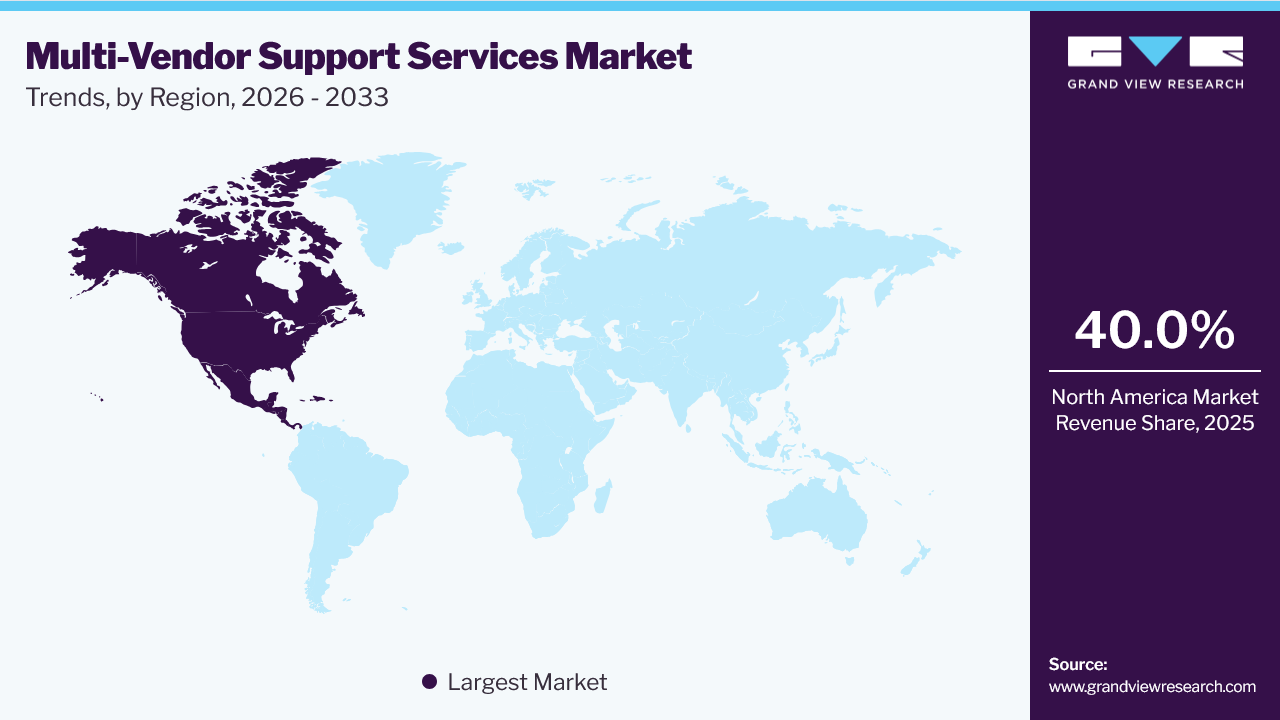
The North America multi-vendor support services market held the largest share of around 40.0% in 2025, driven by the increasing complexity of IT infrastructures and the need for streamlined operations. Businesses seek comprehensive solutions from various manufacturers to manage diverse systems and equipment. The U.S. is at the forefront of this trend, strongly emphasizing reducing downtime and enhancing system efficiency. The presence of significant technology hubs and a high adoption rate of advanced IT solutions contribute to the robust demand in this region.
 To learn more about this report, Download Free Sample Report
U.S. Multi-Vendor Support Services Market Trends
The multi-vendor support services market in the U.S. is expanding rapidly due to the heightened focus on cost optimization and operational efficiency. Enterprises are leveraging these services to handle the complexity of multi-vendor environments, ensuring seamless integration and maintenance of heterogeneous systems. The demand is further propelled by technological advancements and the increasing reliance on digital transformation initiatives, which necessitate robust support infrastructures.
Europe Multi-Vendor Support Services Market Trends
The multi-vendor support services market in Europe is expected to grow at a significant CAGR from 2026 to 2033. A growing inclination toward outsourcing IT marks Europe's multi-vendor support services market's shift to specialized providers. This trend is fueled by the need to manage diverse IT ecosystems more effectively and cost-efficiently. Countries such as Germany, the UK, and France are leading this shift, driven by stringent regulatory requirements and the push for enhanced data security and compliance. For instance, in November 2025, Evernex opened a new office in Vienna, Austria, to strengthen its European presence, improve customer proximity, and enhance multi-vendor IT infrastructure maintenance and lifecycle support services in Central Europe. Moreover, the increasing adoption of cloud computing and IoT technologies necessitates proficient multi-vendor support services.
Asia Pacific Multi-Vendor Support Services Market Trends
The multi-vendor support services market in Asia Pacific is expected to grow at a significant CAGR from 2026 to 2033. The Asia Pacific region is witnessing a burgeoning demand for multi-vendor support services, attributed to rapid digitalization and the expansion of IT infrastructure. Countries such as China, India, and Japan are at the forefront, with businesses increasingly adopting these services to manage the growing complexity of their IT environments. The rising number of SMEs seeking cost-effective solutions to maintain and optimize their multi-vendor systems and the region's focus on technological innovation and development also support market growth.
Key Multi-Vendor Support Services Company Insights
Key players operating in the market are focusing on various strategic initiatives, including new product development, partnerships & collaborations, and agreements to gain a competitive advantage over their rivals. The following are some instances of such initiatives.
Key Multi-Vendor Support Services Companies
The following key companies have been profiled for this study on the Multi-vendor Support Services Market:
-
Atos SE
-
Cisco Systems, Inc.
-
Dell Inc.
-
DXC TECHNOLOGY COMPANY
-
Fujitsu
-
Hewlett Packard Enterprise Development LP
-
Hitachi, Ltd.
-
International Business Machines Corporation
-
Oracle
-
Unisys
Recent Developments
- In January 2026, Park Place Technologies announced the completion of its merger with Service Express, creating a global leader in data center and IT infrastructure services. The combined company expands its capabilities across traditional, cloud, and AI-driven environments, strengthens its global engineering workforce, and enhances multi-vendor hardware maintenance, software support, and IT lifecycle management services for over 20,000 customers worldwide.
- In November 2024, Evernex announced its acquisition of Ultra Support. This acquisition strengthens Evernex's presence in the UK and expands its multi-vendor maintenance capabilities by integrating Ultra Support's channel-focused support network. As a result, Evernex can now offer broader IT lifecycle and enterprise infrastructure support services.
Multi-Vendor Support Services Market Report Scope
Report Attribute
Details
Market size in 2025
USD 58.3 billion
Estimated market size in 2026
USD 60.9 billion
Projected market size by 2033
USD 82.0 billion
Growth rate
CAGR of 4.3% from 2026 to 2033
Base year for estimation
2025
Actual data
2021 – 2024
Forecast period
2026 – 2033
Quantitative units
Revenue in USD billion, and CAGR from 2026 to 2033
Report coverage
Revenue forecast, company ranking, competitive landscape, growth factors, and trends
Segments covered
Service, enterprise size, application, end use, region
Regional scope
North America; Europe; Asia Pacific; Latin America; MEA
Country scope
U.S.; Canada; Mexico UK; Germany; France; China; India; Japan; Australia; South Korea; Brazil; UAE; Saudi Arabia; South Africa
Key companies profiled
Atos SE; Cisco Systems, Inc.; Dell Inc.; DXC TECHNOLOGY COMPANY; Fujitsu; Hewlett Packard Enterprise Development LP; Hitachi, Ltd.; International Business Machines Corporation; Oracle; Unisys
Customization scope
Free report customization (equivalent up to 8 analysts working days) with purchase. Addition or alteration to country, regional & segment scope.
Pricing and purchase options
Avail of customized purchase options to meet your exact research needs. Explore purchase options
Global Multi-Vendor Support Services Market Report Segmentation
This report forecasts revenue growth at global, regional, and country levels and provides an analysis of the latest industry trends and opportunities in each of the sub-segments from 2021 to 2033. For this study, Grand View Research has segmented the global multi-vendor support services market report based on service, enterprise size, application, end use, and region:
-
Service Outlook (Revenue, USD Billion, 2021 - 2033)
-
Hardware Support
-
Software Support
-
-
Enterprise Size Outlook (Revenue, USD Billion, 2021 - 2033)
-
Large Enterprises
-
Small & Medium Enterprises
-
-
Application Outlook (Revenue, USD Billion, 2021 - 2033)
-
Finance & Accounting
-
Sales & Marketing
-
IT Operations
-
Human Resource
-
Production
-
Others
-
-
End Use Outlook (Revenue, USD Billion, 2021 - 2033)
-
BFSI
-
Government
-
Healthcare & Life Sciences
-
Retail & Consumer Products
-
Technology & Communication
-
Industrial & Manufacturing
-
Energy & Utilities
-
Others
-
-
Regional Outlook (Revenue, USD Billion, 2021 - 2033)
-
North America
-
U.S.
-
Canada
-
Mexico
-
-
Europe
-
Germany
-
UK
-
France
-
-
Asia Pacific
-
China
-
India
-
Japan
-
South Korea
-
Australia
-
-
Latin America
-
Brazil
-
-
Middle East & Africa
-
UAE
-
Saudi Arabia
-
South Africa
-
-
Frequently Asked Questions About This Report
The global multi-vendor support services market size was valued at USD 58.3 billion in 2025 and is estimated at USD 60.9 billion for 2026.
The hardware support segment accounted for the largest revenue share of around 60.0% in 2025.
North America dominated with an approximately 40.0% revenue share in 2025.
Key players in the market include Atos SE, Cisco Systems, Inc., Dell Inc., DXC TECHNOLOGY COMPANY, Fujitsu, Hewlett Packard Enterprise Development LP, Hitachi, Ltd., International Business Machines Corporation, Oracle, Unisys, and others.
The global multi-vendor support services market is expected to grow at a CAGR of 4.3% from 2026 to 2033, reaching USD 82.0 billion.
About the Author(s)
IT Services & Applications Research Team
Technology · IT Services & ApplicationsThis report was authored by the it services & applications research team at Grand View Research - comprising two research analysts, one senior research analyst, and one industry expert - with specialized expertise in the it services & applications segment of the technology industry. All findings are based on proprietary technology databases, executive interviews, and regulatory analysis, subject to internal peer review prior to publication.
Last Updated:
Speak to Analyst

Customize this report to your needs - add regions, segments, or data points, with 20% free customization.
Or view our licence options:


ISO 9001:2015 & 27001:2022 Certified
We are GDPR and CCPA compliant! Your transaction & personal information is safe and secure. For more details, please read our privacy policy.


