
- Home
- »
- Advanced Interior Materials
- »
-
Nano-enhanced Waterproofing Market Size Report, 2033GVR Report cover

Nano-enhanced Waterproofing Market (2026 - 2033)
Size, Share & Trends Analysis Report By Product (Coatings, Membranes, Admixtures, Sealants), By Application (Roofs & Terraces, Walls & Facades, Basements & Foundations), By End-use, By Region, And Segment Forecasts
Market Size, 2025
$493.7MMarket Estimate, 2026
$560.3MMarket Forecast, 2033
$1,359.7MCAGR, 2026–2033
13.5%Nano-enhanced Waterproofing Market Summary
The global nano-enhanced waterproofing market size was valued at USD 493.7 million in 2025 and is projected to grow from USD 560.3 million in 2026 to USD 1,359.7 million by 2033, at a CAGR of 13.5% from 2026 to 2033. Asia Pacific dominated the market, accounting for the largest revenue share of 38.7% in 2025. The nano-enhanced waterproofing industry is gaining traction as construction and infrastructure owners increasingly seek advanced solutions that can provide durable protection against water ingress, moisture, corrosion, and environmental degradation.
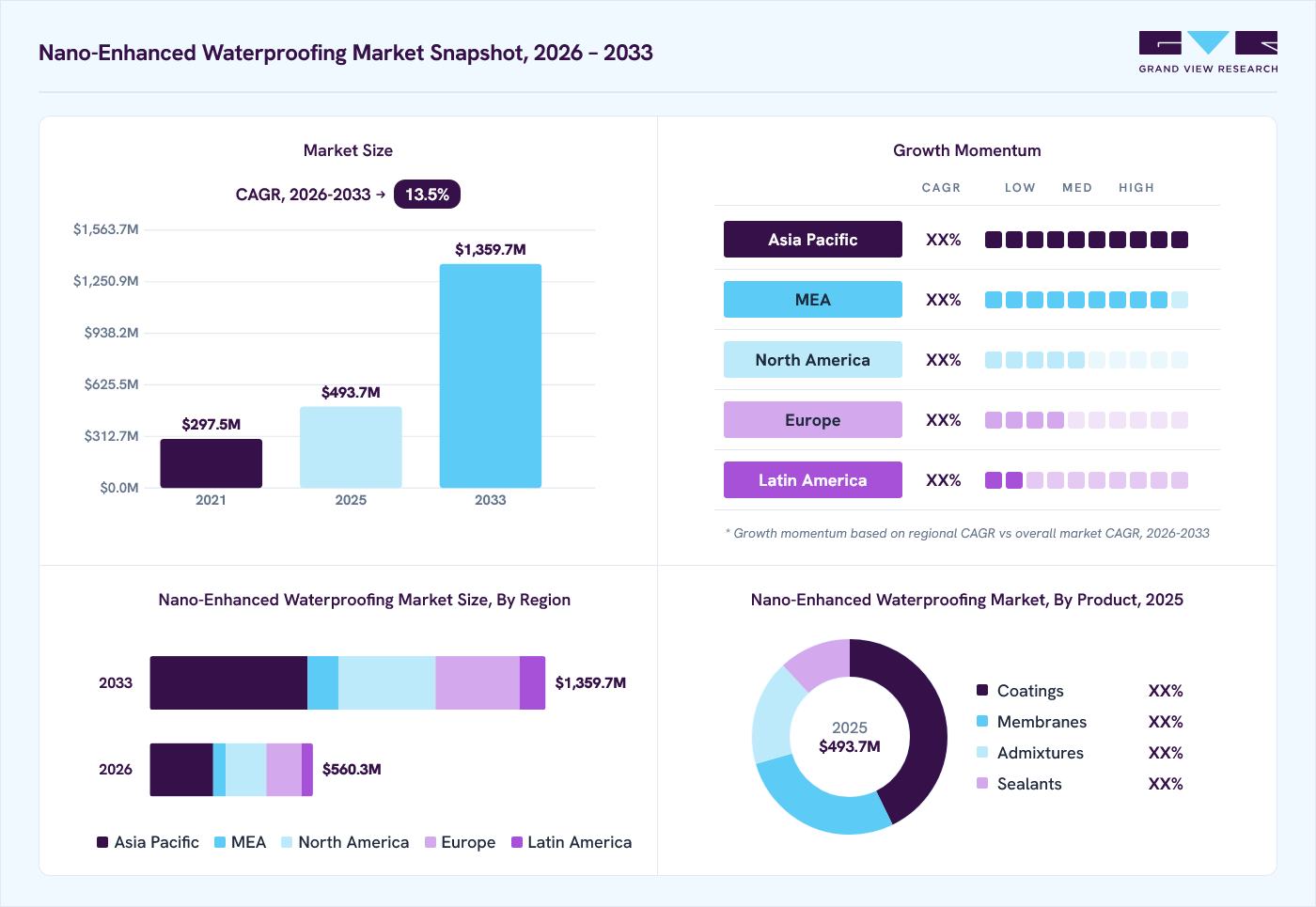 Source: Grand View Research, IR Documents, Primary Interviews, Paid DatabasesTo learn more about this report,
 Download Free Sample Report
Key Market Trends & Insights
- By product: The coatings segment held the largest revenue share of 42.7% in 2025.
- By application: The roofs & terraces segment dominated the market with a revenue share of 32.5% in 2025.
- By end-use: The residential segment held the largest revenue market share of 38.4% in 2025.
Regional Highlights
- Largest regional market: Asia Pacific (38.7% revenue share, 2025)
- By country: China held the largest share in 2025.
Market Size & Forecast
- Market Size in 2025: USD 493.7 Million
- Estimated Market Size in 2026: USD 560.3 Million
- Projected Market Size by 2033: USD 1,359.7 Million
- CAGR (2026-2033): 13.5%
GVR research-powered AIAsk Prism AI about the nano-enhanced waterproofing marketGet cited answers from GVR research on market growth, segments, regulations and forecasts.Start with✓ Source-linked answers ✓ Market-specific context ✓ Traceable figuresExplore Prism AI ↗
Conventional waterproofing systems can face limitations related to cracking, surface deterioration, permeability, and the need for repeated maintenance, creating demand for higher-performance materials. Nano-enhanced formulations incorporate nanoscale materials into coatings, membranes, sealants, cementitious systems, and admixtures to improve barrier properties and surface performance. Nanostructured surfaces can enhance water repellency while also supporting self-cleaning and contamination-resistant properties. Recent research highlights the growing use of nanocomposite and superhydrophobic coatings for protecting concrete and other construction substrates.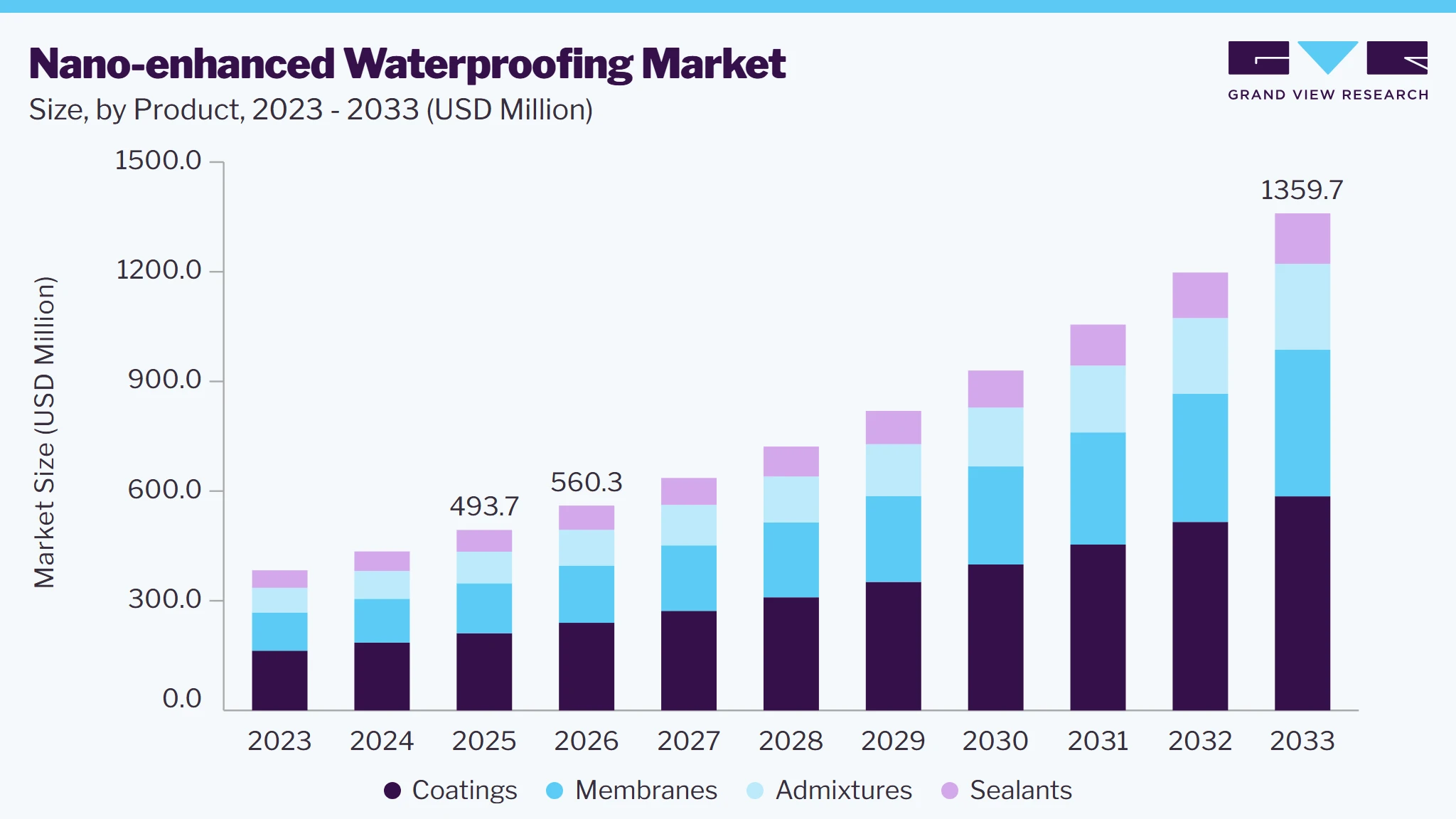 To learn more about this report, Download Free Sample Report
Demand is further supported by the increasing emphasis on extending the service life of buildings, bridges, tunnels, foundations, roofs, water-retaining structures, and other infrastructure assets. Moisture penetration can accelerate corrosion, freeze-thaw deterioration, microbial growth, and degradation of construction materials, making waterproofing an important component of preventive maintenance. Nano-enhanced systems can improve pore refinement, reduce surface wettability, and create stronger barriers against water and aggressive substances.
Market Dynamics
The nano-enhanced waterproofing market is shaped by increasing requirements for long-lasting moisture protection, infrastructure durability, advanced construction materials, and multifunctional surface technologies. The integration of nanomaterials enables waterproofing products to meet multiple performance requirements simultaneously, including water repellency, pore refinement, corrosion protection, self-cleaning, and environmental resistance.
The increasing need to protect concrete, steel, masonry, roofs, foundations, tunnels, and other construction assets from moisture-related deterioration is a major driver of the market. Nano-enhanced waterproofing systems can reduce water penetration and limit exposure of substrates to corrosive and aggressive substances, supporting longer service life and lower maintenance requirements.
The development of superhydrophobic nanocomposite coatings is further strengthening demand because these systems can combine water repellency with anti-corrosion, anti-fouling, self-cleaning, anti-icing, and contamination-resistant properties. Such multifunctionality increases their attractiveness for infrastructure where conventional waterproofing alone may not provide sufficient protection.
The relatively high cost of nanomaterials, specialized formulation requirements, dispersion challenges, and limited long-term field data can restrict widespread adoption. Maintaining uniform nanoparticle distribution and stable performance within commercial formulations can also increase manufacturing complexity. In addition, some advanced nano-enhanced systems remain more established in laboratory and pilot applications than in large-scale construction projects, creating uncertainty regarding lifecycle economics and durability.
The development of multifunctional waterproofing materials represents a significant opportunity for manufacturers. Combining waterproofing with self-cleaning, antibacterial, anti-corrosion, thermal, UV-resistant, or self-healing characteristics can expand applications across infrastructure and specialized construction environments. Research is also moving toward environmentally preferable nanocomposites, waste-derived materials, solvent-free processing, and scalable application methods, creating opportunities for differentiated products with improved sustainability and lifecycle performance.
Market Concentration & Characteristics
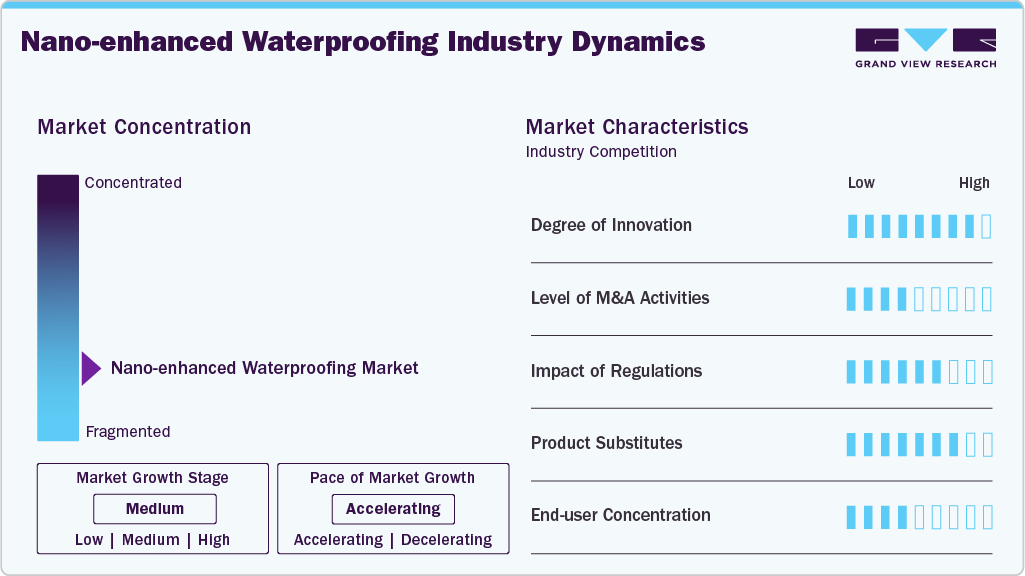
The nano-enhanced waterproofing market is moderately fragmented, with participation from established construction-chemical manufacturers, specialty coating producers, waterproofing-system suppliers, nanomaterial developers, and emerging technology companies. Large construction-material companies benefit from established distribution networks, formulation capabilities, project relationships, and technical support infrastructure, while smaller companies and research-driven firms compete through specialized nanomaterials, proprietary surface treatments, advanced coatings, and application technologies.
 To learn more about this report, Download Free Sample Report
The industry faces competition from conventional cementitious waterproofing, bituminous membranes, polyurethane coatings, acrylic coatings, silane and siloxane treatments, crystalline waterproofing systems, polymer-modified membranes, and traditional sealants. These alternatives benefit from established installation practices, contractor familiarity, broad availability, and comparatively predictable cost structures. Conventional hydrophobic treatments based on silane, siloxane, polyurethane, and related materials remain effective for many applications, particularly where advanced nanostructured functionality is not required.
Analyst Perspective
The nano-enhanced waterproofing market is positioned as an emerging high-value segment within the broader waterproofing and construction chemicals industry, driven by the shift toward longer-lasting, multifunctional, and performance-oriented building protection solutions. Nano-enhanced coatings, membranes, admixtures, and sealants offer potential advantages such as improved water repellency, reduced permeability, enhanced adhesion, self-cleaning properties, and greater resistance to environmental degradation. From an analyst perspective, adoption is likely to remain concentrated initially in premium construction, infrastructure rehabilitation, industrial facilities, and applications where lifecycle durability justifies higher material costs. Market expansion will depend on manufacturers' ability to improve nanoparticle dispersion, formulation stability, scalability, application efficiency, environmental performance, and cost competitiveness.
Product Insights
The coatings segment held the largest revenue share of 42.7% in 2025, supported by its broad applicability across roofs, terraces, walls, facades, concrete structures, and other exposed surfaces. Nano-enhanced coatings provide a continuous protective layer while improving water repellency, surface durability, adhesion, and resistance to environmental degradation. Their relatively straightforward application through spraying, brushing, or rolling also supports adoption in both new construction and renovation projects.
The membranes segment is expected to grow at a CAGR of 14.4% over the forecast period, as demand increases for durable, continuous barriers to water penetration in demanding construction applications. Nano-enhanced membranes can provide improved flexibility, crack resistance, adhesion, mechanical strength, and resistance to moisture and environmental exposure compared with conventional systems. Growth is particularly supported by increasing construction of basements, foundations, tunnels, roofs, and other structures where hydrostatic pressure and long-term moisture exposure create stringent waterproofing requirements.
Application Insights
The roofs & terraces segment held the largest revenue share of 32.5% in 2025, due to the direct and continuous exposure of these surfaces to rainfall, humidity, temperature fluctuations, UV radiation, and weathering. Nano-enhanced waterproofing coatings and treatments are increasingly used to provide water repellency while improving surface durability and resistance to environmental deterioration. The segment benefits from both new construction and renovation demand, particularly as building owners seek to prevent leakage, reduce maintenance requirements, and extend roof service life.
The basements & foundations segment is expected to grow at a CAGR of 14.1% over the forecast period, as urban construction increasingly requires deeper foundations and below-grade structures, increasing exposure to groundwater and hydrostatic pressure. Waterproofing in these areas is critical because water intrusion can cause concrete deterioration, corrosion, mold development, and structural damage. Nano-enhanced waterproofing technologies can improve pore refinement, water resistance, crack protection, and long-term durability, making them suitable for demanding below-grade applications.
End-use Insights
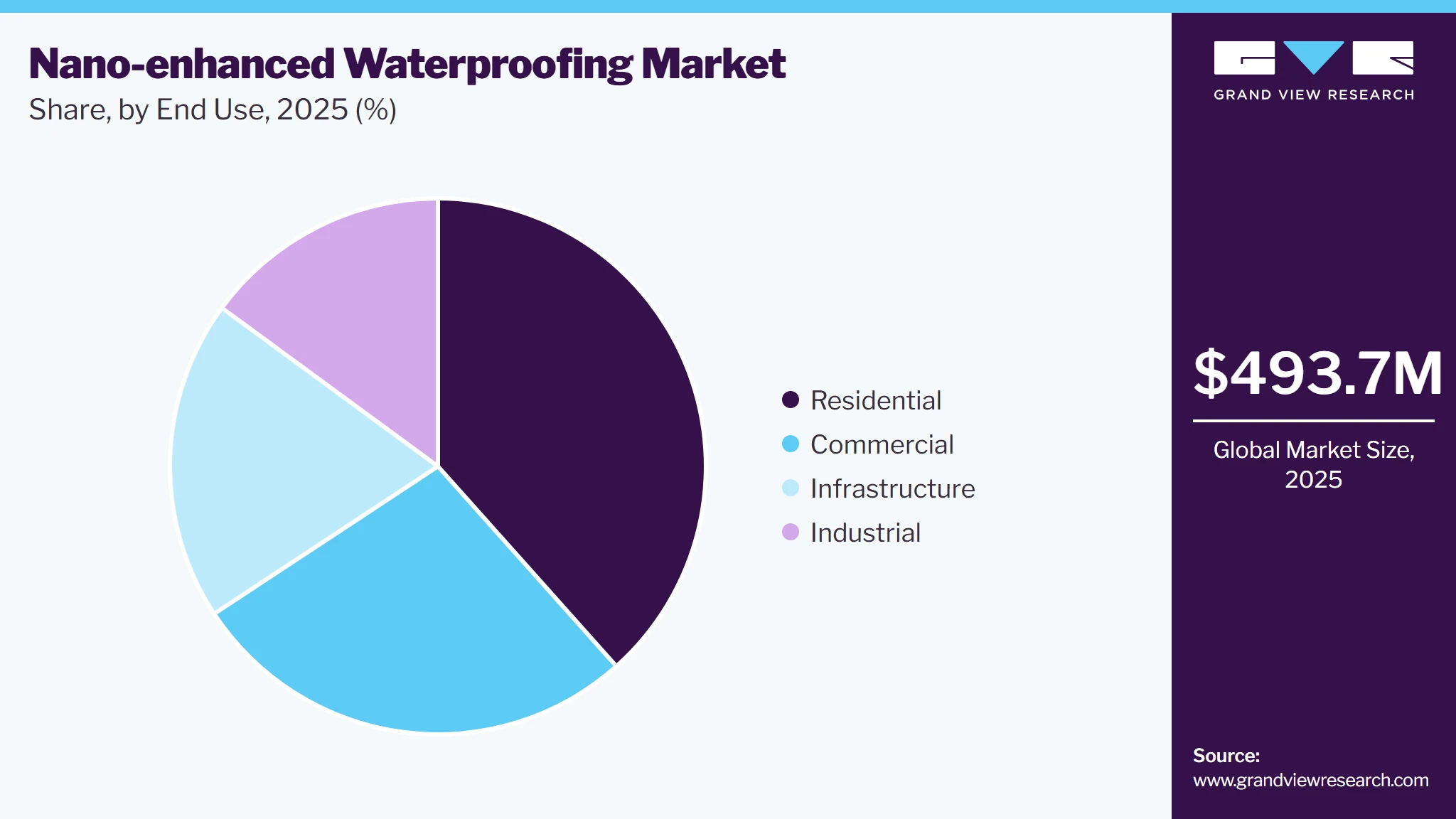
The residential segment held the largest revenue market share of 38.4% in 2025, supported by extensive demand for waterproofing across homes, apartments, housing complexes, balconies, bathrooms, terraces, roofs, and foundations. Increasing homeowner awareness regarding preventive maintenance and the cost of repairing water-related damage is encouraging the use of higher-performance waterproofing products. Nano-enhanced solutions can appeal to residential users by providing water repellency, surface protection, durability, and, in some cases, multifunctional benefits with relatively thin applications.
 To learn more about this report, Download Free Sample Report
The infrastructure segment is expected to grow at a CAGR of 14.2% over the forecast period, as governments and private developers increase investment in bridges, tunnels, transportation networks, water infrastructure, underground structures, dams, and other civil-engineering assets. These applications require waterproofing systems capable of withstanding prolonged exposure to water, hydrostatic pressure, mechanical stress, and changing environmental conditions. Nano-enhanced waterproofing can provide improved impermeability and durability while supporting longer asset service life and reduced maintenance requirements.
Regional Insights
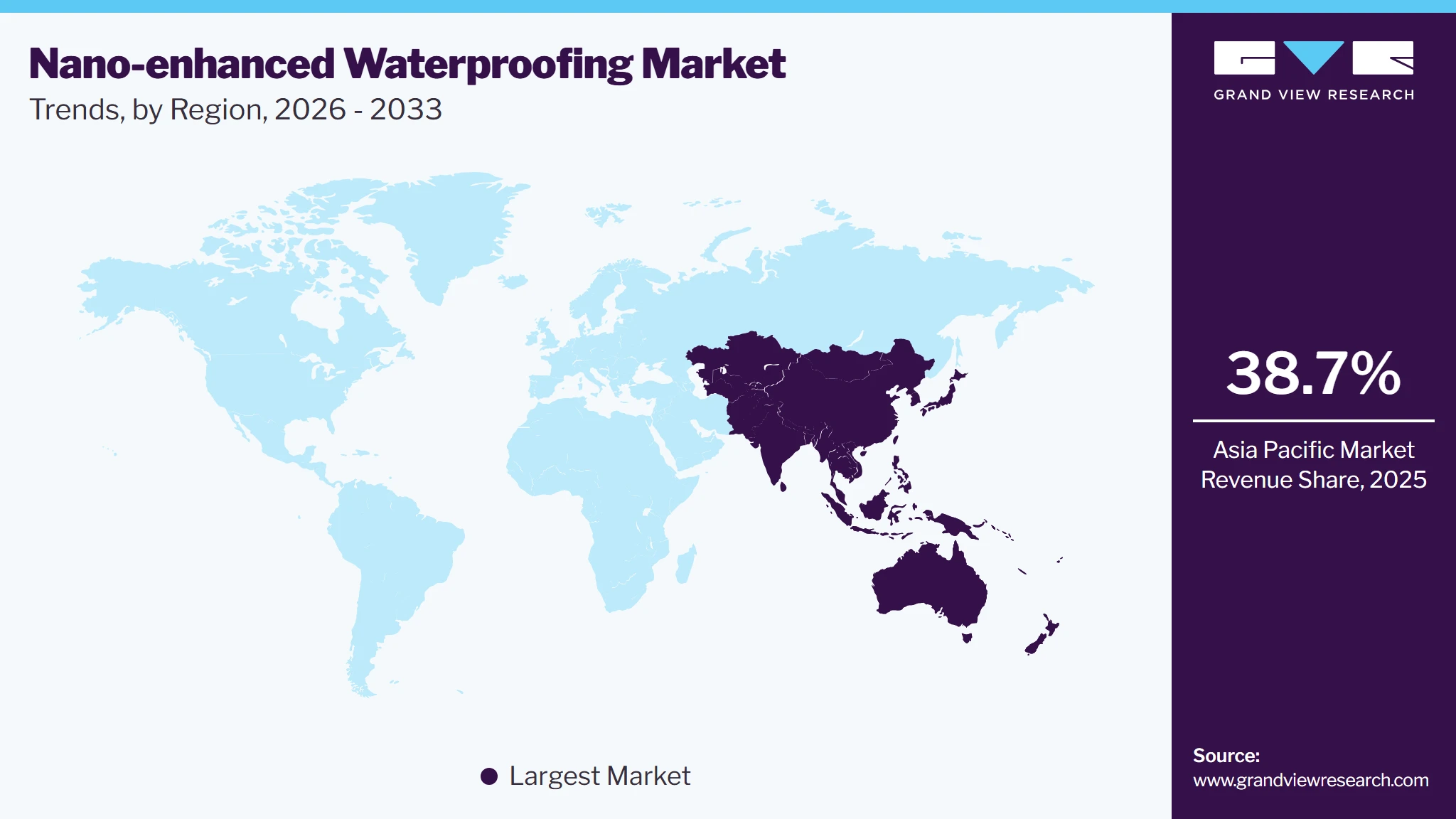
Asia Pacific dominated the global nano-enhanced waterproofing market, accounting for the largest revenue share of 38.7% in 2025, driven by rapid urban development, infrastructure expansion, construction activity, and increasing emphasis on building durability. Large-scale residential, commercial, industrial, transportation, and water infrastructure projects create extensive opportunities for advanced moisture-protection technologies. The region is also an important center for nanomaterials research and construction-material innovation, supporting development of locally adapted formulations.
 To learn more about this report, Download Free Sample Report
China Nano-enhanced Waterproofing Market Trends
The China nano-enhanced waterproofing market is a significant hub for advanced waterproofing technologies due to its extensive construction base, infrastructure modernization, industrial development, and growing focus on improving building quality and durability. Domestic manufacturers are increasingly developing sophisticated construction chemicals, protective coatings, nanomaterials, and functional surface treatments. Demand is particularly relevant across high-rise buildings, transportation infrastructure, industrial facilities, underground structures, and large-scale civil engineering projects.
North America Nano-enhanced Waterproofing Market Trends
The nano-enhanced waterproofing market in North America has gained traction on the back of strong demand for infrastructure rehabilitation, building-envelope protection, concrete durability, and advanced construction materials. Aging infrastructure creates opportunities for protective technologies capable of extending asset service life and reducing maintenance requirements. The market also benefits from sophisticated construction-chemical distribution networks and strong adoption of high-performance coatings and sealants. Demand is expected to increasingly favor multifunctional products that combine waterproofing with corrosion resistance, self-cleaning, UV protection, and improved durability.
The nano-enhanced waterproofing market in the U.S. expects a major opportunity due to extensive construction and infrastructure assets requiring protection against moisture, corrosion, weather exposure, and deterioration. Demand extends across commercial buildings, residential construction, bridges, roads, tunnels, parking structures, industrial facilities, and water infrastructure. Advanced construction materials are gaining attention as owners and contractors increasingly evaluate lifecycle performance rather than relying solely on initial installation cost.
Europe Nano-enhanced Waterproofing Market Trends
The nano-enhanced waterproofing market in Europe is characterized by strong demand for durable, sustainable, and technologically advanced construction materials. Renovation of existing buildings and infrastructure, stringent attention to environmental performance, and increasing emphasis on lifecycle sustainability create opportunities for nano-enhanced waterproofing technologies. Manufacturers are focusing on low-emission formulations, longer service life, resource efficiency, and improved material performance.
The Germany nano-enhanced waterproofing market is an attractive market due to its advanced construction-material industry, strong engineering capabilities, building renovation activity, and emphasis on high-quality construction systems. Demand for durable waterproofing is supported by commercial buildings, industrial facilities, transportation infrastructure, basements, roofs, and concrete structures. German manufacturers and technology developers are positioned to contribute to the market through advanced coatings, construction chemicals, nanomaterials, and automated application technologies. Sustainability and long-term performance are expected to remain important purchasing considerations.
Central and South America Nano-enhanced Waterproofing Market Trends
The nano-enhanced waterproofing market in Central and South America offers growing opportunities for nano-enhanced waterproofing as urbanization, construction development, infrastructure investment, and climate-related moisture challenges increase demand for protective building materials. Waterproofing requirements are particularly relevant in regions exposed to heavy rainfall, high humidity, coastal conditions, and temperature variations. Adoption is likely to initially focus on high-value construction, infrastructure rehabilitation, industrial facilities, and applications where conventional systems face durability limitations.
Middle East & Africa Nano-enhanced Waterproofing Market Trends
The nano-enhanced waterproofing market in the Middle East & Africa is supported by large-scale construction, infrastructure development, commercial projects, industrial facilities, and harsh climatic conditions. High temperatures, dust, UV exposure, occasional heavy rainfall, and demanding operating environments increase the need for durable protective coatings and waterproofing systems. Nano-enhanced technologies can provide opportunities where conventional materials require frequent maintenance or additional protection. Adoption is expected to be strongest in premium construction, infrastructure, industrial applications, water-related facilities, and projects emphasizing long-term asset performance.
Key Nano-enhanced Waterproofing Company Insights
Some of the key players operating in the market include Zydex Industries and NanoPhos S.A.
-
Zydex Industries is an India-based specialty materials company offering nano-enabled waterproofing and surface-protection solutions, including its Zycosil range. Its products are designed to provide water repellency and protection for construction surfaces, supporting applications across buildings and infrastructure.
-
NanoPhos is a Greek nanotechnology company that develops and manufactures nano-based waterproofing and protective coatings. Its SurfaPore range uses nanoparticles to penetrate porous construction materials and provide water repellency while maintaining surface breathability and appearance.
StarShield Smart Paints & Coatings and Octagreen Nano Products India Pvt. Ltd. are some of the emerging market participants in the nano-enhanced waterproofing market.
-
StarShield is an India-based manufacturer specializing in nano-material-based smart paints and coatings, including waterproofing solutions for roofs, terraces, walls, and other surfaces. Its portfolio combines waterproofing with additional surface-protection functionalities.
-
Octagreen Nano manufactures nano-technology-based, water-based, and low-VOC paints and waterproofing solutions for residential, commercial, and industrial applications. Its portfolio includes waterproofing plaster and elastomeric waterproofing coatings, with a focus on durability and environmentally preferable formulations.
Key Nano-enhanced Waterproofing Companies
The following key companies have been profiled for this study on the nano-enhanced waterproofing market.
-
Zydex Industries
-
NanoPhos S.A.
-
MOSHE 3000
-
NANOFIX
-
WinOne Product Technologies Pvt. Ltd.
-
Magicrete Building Solutions Pvt. Ltd.
-
Octagreen Nano Products India Pvt. Ltd.
-
StarShield Smart Paints & Coatings
-
BT Corp
-
Nano4Life
Competitive Benchmarking
Category
Operating Strategies
Competitive Edge
Weakness
Established Players Zydex Industries, NanoPhos S.A., MOSHE 3000, NANOFIX, WinOne Product Technologies Pvt. Ltd., Magicrete Building Solutions Pvt. Ltd.
- Develop nano-based coatings, waterproofing treatments, and construction chemicals.
- Expand through contractors, builders, distributors, and infrastructure partnerships.
- Improve water repellency, durability, adhesion, and application efficiency.
- Strong expertise in nanotechnology-based waterproofing.
- Established construction-sector relationships and distribution networks.
- Proprietary formulations differentiate products from conventional waterproofing.
- Higher nanomaterial and formulation costs.
- Performance depends on formulation and application conditions.
- Limited awareness can slow adoption.
Emerging Players Octagreen Nano Products India Pvt. Ltd., StarShield Smart Paints & Coatings, BT Corp, Nano4Life
- Develop nano-enhanced coatings and hydrophobic treatments.
- Build partnerships with contractors, distributors, and construction companies.
- Focus on durability, easy application, sustainability, and multifunctionality.
- Specialized nano-coating expertise.
- Agile product development and focused portfolios.
- Strong positioning in advanced surface protection.
- Smaller production and distribution scale.
- Dependence on partnerships and raw-material availability.
- Challenges in cost competitiveness and large-scale adoption.
Recent Developments
-
In September 2025, Zydex Industries entered into a strategic license agreement with KEIM Farben GmbH to bring silicate paint technology to India through local manufacturing and distribution. The partnership strengthens Zydex’s position across paints and waterproofing while adding sustainable, durable coating technology to its portfolio.
-
In December 2025, MOSHE 3000 announced its first U.S. expansion through Orlando, establishing operations at the UCF Business Incubation Program. The company launched its nanotechnology-based waterproofing and protective-coating portfolio in the U.S. and planned to develop a manufacturing and sales hub in Central Florida.
Nano-enhanced Waterproofing Market Report Scope
Report Attribute
Details
Market size in 2025
USD 493.7 million
Estimated market size in 2026
USD 560.3 million
Projected market Size by 2033
USD 1,359.7 million
Growth rate
CAGR of 13.5% from 2026 to 2033
Base year for estimation
2025
Actual estimates/Historical data
2021 - 2024
Forecast period
2026 - 2033
Quantitative units
Revenue in USD million and CAGR from 2026 to 2033
Report coverage
Revenue forecast, company ranking, competitive landscape, growth factors, and trends
Segments covered
Product, application, end-use, region
Regional scope
North America; Europe; Asia Pacific; Central & South America; Middle East & Africa
Country scope
U.S.; Canada; Mexico; Germany; UK; France; Italy; Spain; China; Japan; India; South Korea; Brazil; Saudi Arabia
Key companies profiled
Zydex Industries; NanoPhos S.A.; MOSHE 3000; NANOFIX; WinOne Product Technologies Pvt. Ltd.; Magicrete Building Solutions Pvt. Ltd.; Octagreen Nano Products India Pvt. Ltd.; StarShield Smart Paints & Coatings; BT Corp; Nano4Life
Customization scope
Free report customization (equivalent up to 8 analysts working days) with purchase. Addition or alteration to country, regional & segment scope.
Pricing and purchase options
Avail customized purchase options to meet your exact research needs. Explore purchase options
Global Nano-enhanced Waterproofing Market Report Segmentation
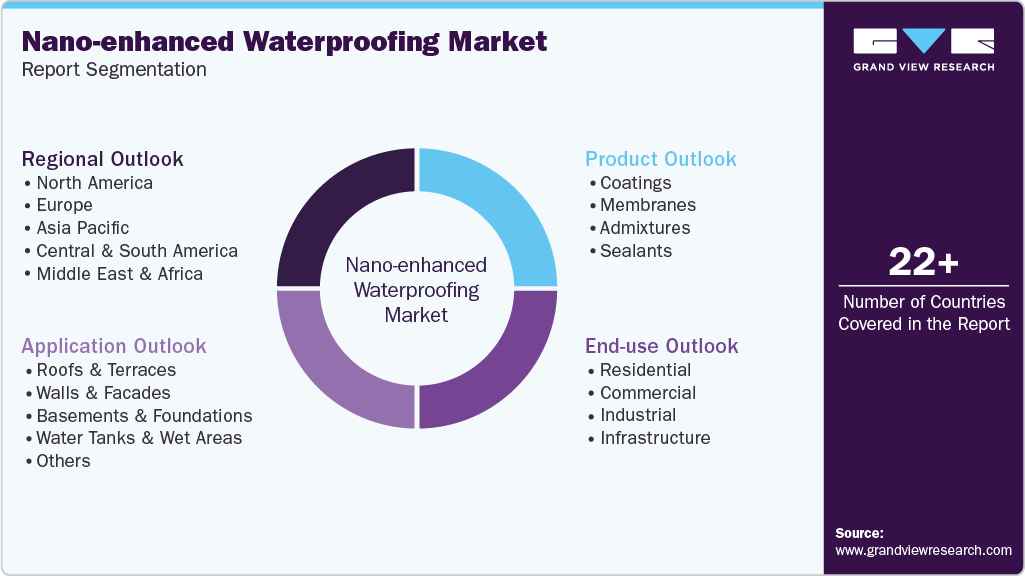
This report forecasts revenue growth at the global, regional & country levels and provides an analysis on the industry trends in each of the sub-segments from 2021 to 2033. For the purpose of this study, Grand View Research has segmented the global nano-enhanced waterproofing market report on the basis of product, application, end-use, and region:
 To learn more about this report, Download Free Sample Report
-
Product Outlook (Revenue, USD Million, 2021 - 2033)
-
Coatings
-
Membranes
-
Admixtures
-
Sealants
-
-
Application Outlook (Revenue, USD Million, 2021 - 2033)
-
Roofs & Terraces
-
Walls & Facades
-
Basements & Foundations
-
Water Tanks & Wet Areas
-
Others
-
-
End-use Outlook (Revenue, USD Million, 2021 - 2033)
-
Residential
-
Commercial
-
Industrial
-
Infrastructure
-
-
Regional Outlook (Revenue, USD Million, 2021 - 2033)
-
North America
-
U.S.
-
Canada
-
Mexico
-
-
Europe
-
UK
-
Germany
-
France
-
Italy
-
Spain
-
-
Asia Pacific
-
China
-
Japan
-
India
-
South Korea
-
-
Central and South America
-
Brazil
-
-
Middle East and Africa
-
Saudi Arabia
-
-
Research Methodology
The nano-enhanced waterproofing market figures in this report are based on a proven research process that combines executive interviews with secondary research from proprietary databases, company filings, and recognized regulatory and institutional sources. Market size is built through value-chain sizing-reconciling supply-side and demand-side estimates-and triangulated with bottom-up and top-down approaches. Every estimate passes multiple levels of expert validation before publication, with eachnano-enhanced waterproofing segment quantified using the revenue-capture definitions in the table below.
Segment Definition
Segment - Product
Revenue capture definition
Coatings
Revenue generated from the sale of nano-enhanced waterproofing coatings formulated with nanomaterials to provide water repellency, moisture resistance, surface protection, and enhanced durability across construction and infrastructure surfaces.
Membranes
Revenue generated from the sale of nano-enhanced waterproofing membranes incorporating nanomaterials or nanocomposite layers to provide continuous barriers against water penetration in building and infrastructure applications.
Admixtures
Revenue generated from the sale of nano-enhanced waterproofing admixtures added to concrete, mortar, cementitious mixtures, or other construction materials to reduce water permeability and improve moisture resistance and durability.
Sealants
Revenue generated from the sale of nano-enhanced waterproofing sealants containing nanomaterials to seal joints, cracks, gaps, penetrations, and construction interfaces against water and moisture ingress.
Segment - Application
Revenue capture definition
Roofs & Terraces
Revenue generated from the sale of nano-enhanced waterproofing products used to protect roofs, terraces, rooftop structures, and associated surfaces against rainwater, moisture penetration, UV exposure, and weather-related deterioration.
Walls & Facades
Revenue generated from the sale of nano-enhanced waterproofing products applied to exterior walls, facades, cladding, masonry, concrete, and other building-envelope surfaces to prevent water ingress and improve surface durability.
Basements & Foundations
Revenue generated from the sale of nano-enhanced waterproofing products used for basements, foundations, underground structures, retaining walls, and below-grade surfaces to protect against groundwater and soil moisture penetration.
Water Tanks & Wet Areas
Revenue generated from the sale of nano-enhanced waterproofing products used in water tanks, bathrooms, kitchens, swimming pools, wastewater areas, and other wet environments requiring resistance to continuous or intermittent water exposure.
Others
Revenue generated from the sale of nano-enhanced waterproofing products used in applications outside roofs and terraces, walls and facades, basements and foundations, and water tanks and wet areas, including tunnels, parking structures, bridges, decks, and other specialized surfaces.
Segment - End Use
Revenue capture definition
Residential
Revenue generated from the sale of nano-enhanced waterproofing products used in residential buildings, including single-family homes, apartments, condominiums, housing complexes, and other residential structures.
Commercial
Revenue generated from the sale of nano-enhanced waterproofing products used in commercial buildings and facilities, including offices, retail properties, hotels, restaurants, educational buildings, healthcare facilities, and other commercial structures.
Industrial
Revenue generated from the sale of nano-enhanced waterproofing products used in industrial facilities, including manufacturing plants, warehouses, processing facilities, factories, and other industrial structures requiring protection from water and moisture.
Infrastructure
Revenue generated from the sale of nano-enhanced waterproofing products used in infrastructure assets, including bridges, tunnels, roads, rail infrastructure, water infrastructure, parking structures, dams, and other civil engineering projects.
Estimation Model
Layer Name
Key Question
Description
Parent Market Analysis
What is the overall size and growth outlook of the global waterproofing materials, construction chemicals, protective coatings, membranes, sealants, and nanomaterials markets?
The estimation begins by evaluating the broader waterproofing materials, construction chemicals, protective coatings, membranes, sealants, concrete protection, and nanomaterials markets. Construction activity, infrastructure development, building renovation, moisture protection requirements, demand for durable construction materials, nanomaterial adoption, and investments in advanced building technologies are analyzed to establish the total addressable market for nano-enhanced waterproofing.
Nano-enhanced Waterproofing Penetration Analysis
What proportion of the overall waterproofing, protective coating, membrane, sealant, and construction chemical market is represented by nano-enhanced waterproofing across products and applications?
This layer estimates the penetration of nano-enhanced waterproofing within the broader waterproofing and construction-material market. Adoption is assessed across coatings, membranes, admixtures, sealants, and other nano-enhanced waterproofing systems. Penetration is further evaluated across nanomaterial technologies, including nanosilica, nanoclay, graphene-based materials, nanoparticles, nanocomposites, and other emerging nanotechnologies, to determine their contribution to the overall waterproofing market.
Regional & End-use Demand Assessment
Which regions and end-use industries contribute the highest demand for nano-enhanced waterproofing?
Market demand is evaluated across major regions based on construction activity, infrastructure development, building renovation, climatic exposure, moisture-related deterioration, waterproofing requirements, regulatory standards, and adoption of advanced construction materials. Demand is further assessed across residential, commercial, industrial, and infrastructure end uses and applications such as roofs and terraces, walls and facades, basements and foundations, water tanks and wet areas, and other specialized structures to determine regional and application-level penetration.
Company Revenue Validation & Market Forecasting
How is the final market size validated and forecast?
Final estimates are validated using company revenues, nano-enhanced waterproofing product portfolios, manufacturing capacities, production facilities, technology deployment, nanomaterial integration, product launches, construction-project adoption, distribution networks, partnerships, certifications, investments, and announced capacity expansions. Bottom-up and top-down approaches are triangulated using company-level, product-level, technology-level, application-level, and end-use data to generate reliable market estimates and forecasts for nano-enhanced waterproofing.
Delivered Customizations
We have successfully delivered the following deep-dive customizations
Client Request
Customization Delivered
Value Adds
Technology & Formulation Assessment
Evaluate nanomaterial integration, dispersion technologies, formulation methods, coating technologies, membrane production, admixture incorporation, and sealant manufacturing processes used to develop nano-enhanced waterproofing solutions.
Identifies key technology differentiators, manufacturing complexities, performance advantages, and opportunities for technology improvement and product innovation.
Application & End-use Opportunity Assessment
Assess demand for nano-enhanced waterproofing across roofs and terraces, walls and facades, basements and foundations, water tanks and wet areas, and other construction applications across residential, commercial, industrial, and infrastructure end uses.
Helps identify high-potential applications and end-use segments based on moisture exposure, durability requirements, construction activity, maintenance needs, and willingness to adopt advanced waterproofing technologies.
Competitive & Product Benchmarking Assessment
Benchmark leading companies and products based on nano-enhanced waterproofing technologies, product portfolios, performance characteristics, application methods, certifications, geographic presence, partnerships, and innovation activities.
Provides visibility into competitive positioning, technology leadership, product differentiation, market gaps, and potential areas for portfolio expansion.
Frequently Asked Questions About This Report
The nano-enhanced waterproofing market is expected to grow at a CAGR of 13.5% from 2026 to 2033 to reach USD 1,359.7 million by 2033.
The coatings segment held the largest revenue share of 42.7% in 2025, while membranes segment is the fastest growing product.
Asia Pacific dominated the market, accounting for the largest revenue share of 38.7% in 2025.
The nano-enhanced waterproofing market size was valued at USD 493.7 million in 2025 and is projected to reach USD 560.3 million in 2026.
Key factors driving the nano-enhanced waterproofing market include rising demand for durable and long-lasting moisture protection, increasing construction and infrastructure activity, growing adoption of high-performance nanocoatings, and the need to reduce maintenance costs and extend the service life of buildings and structures.
Some key players in the nano-enhanced waterproofing market include Zydex Industries, NanoPhos S.A., MOSHE 3000, NANOFIX, WinOne Product Technologies Pvt. Ltd., Magicrete Building Solutions Pvt. Ltd., Octagreen Nano Products India Pvt. Ltd., StarShield Smart Paints & Coatings, Nano4Life, and BT Corp.
The residential segment held the largest revenue market share of 38.4% in 2025, while infrastructure segment is the fastest growing end-use.
The roofs & terraces segment held the largest revenue share of 32.5% in 2025, while the basements & foundations segment is the fastest growing product.
About the Author(s)
Advanced Interior Materials Research Team
Advanced Materials · Advanced Interior MaterialsThis report was authored by the advanced interior materials research team at Grand View Research - comprising two research analysts, one senior research analyst, and one industry expert - with specialized expertise in the advanced interior materials segment of the advanced materials industry. All findings are based on proprietary advanced materials databases, executive interviews, and regulatory analysis, subject to internal peer review prior to publication.
Last Updated:
Speak to Analyst

Customize this report to your needs - add regions, segments, or data points, with 20% free customization.
Or view our licence options:


ISO 9001:2015 & 27001:2022 Certified
We are GDPR and CCPA compliant! Your transaction & personal information is safe and secure. For more details, please read our privacy policy.


