
- Home
- »
- Petrochemicals
- »
-
Naphthalene Market Size, Share & Trends Report 2026-2033GVR Report cover

Naphthalene Market (2026 - 2033)
Size, Share & Trends Analysis Report By Source (Coal Tar, Petroleum), By Application (Phthalic Anhydride, Pesticides, Naphthalene Sulfonates, Moth Repellent, Low-Volatility Solvents), By Region, And Segment Forecasts
Market Size, 2025
$1.7BMarket Estimate, 2026
$1.8BMarket Forecast, 2033
$2.3BCAGR, 2026–2033
3.7%Naphthalene Market Summary
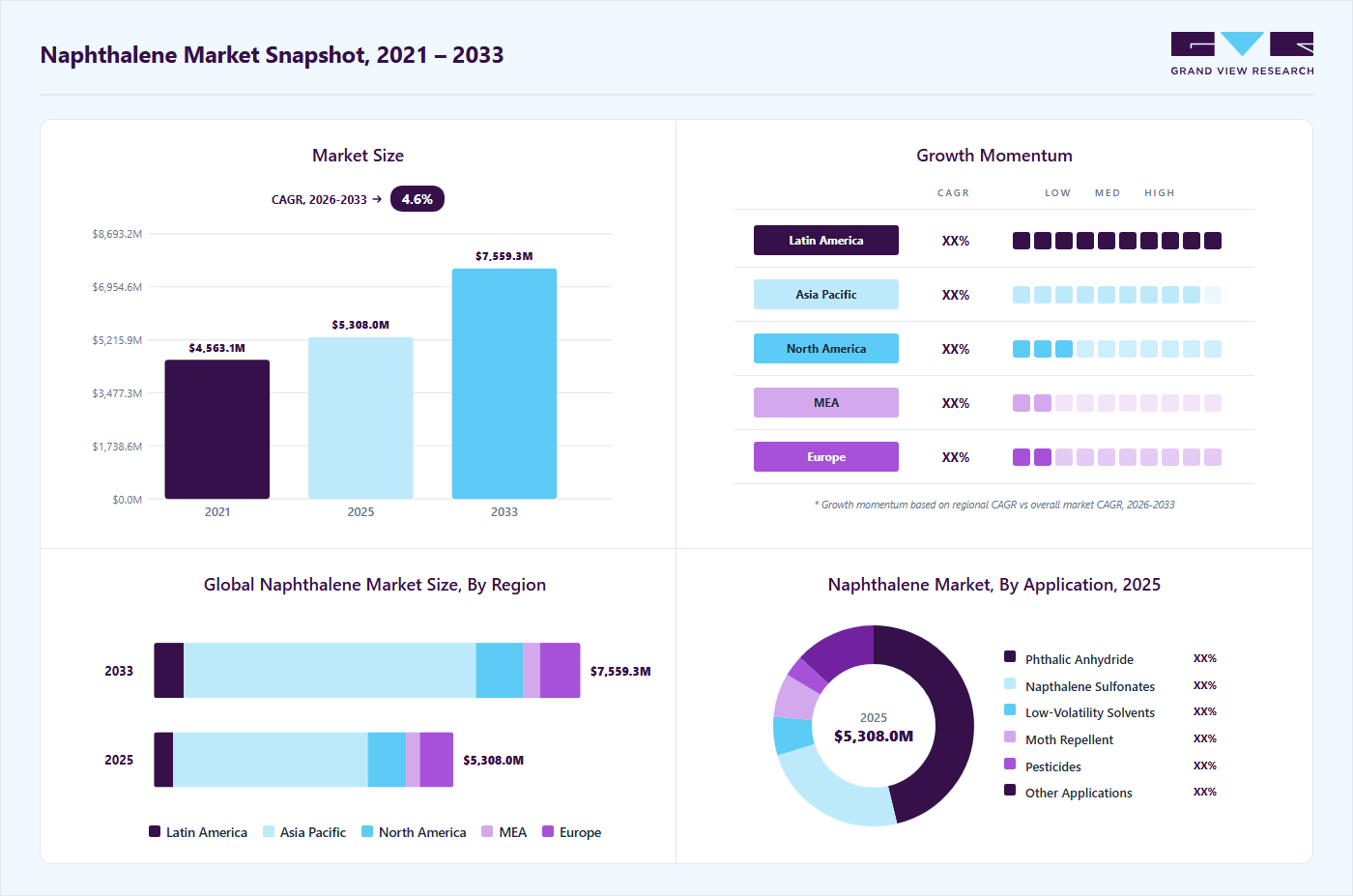
The global naphthalene market size was valued at USD 1.7 billion in 2025 and is projected to grow from USD 1.8 billion in 2026 to USD 2.3 billion by 2033, at a CAGR of 3.7% from 2026 to 2033. Asia Pacific dominated the market, accounting for the largest revenue share of 63.5% in 2025. The market is experiencing increasing demand due to its growing use in the construction industry as a plasticizer in various concrete admixtures, specifically naphthalene sulfonate formaldehyde.
 Source: Grand View Research, IR Documents, Primary Interviews, Paid DatabasesTo learn more about this report,
 Download Free Sample Report
Key Market Trends & Insights
- By product: Refined naphthalene segment dominated the market and accounted for the largest revenue share of 59.9% in 2025.
- By application: Naphthalene sulfonic acid segment is expected to grow fastest, with a CAGR of 4.3% in terms of revenue from 2026 to 2033.
Regional Highlights
- Largest regional market: Asia Pacific (63.5% revenue share, 2025)
- By country: China held the largest market share in 2025.
Market Size & Forecasts
- Market size in 2025: USD 1.7 Billion
- Estimated market size in 2026: USD 1.8 Billion
- Projected market size by 2033: USD 2.3 Billion
- CAGR (2025-2033): 3.7%
Three ways to get this report
Buy it, customize it, or ask a question.Ask an Analyst
Analyst response in 1 business day
- AccessReport author, directly
- Reply timeWithin 1 working day
- No sales callDirect answer only
- FormatEmail reply
- CostFree, no cost
Get the Full Report
What the study covers
- FormatsPDF · Excel · Dashboard
- Timeline2026–2033 annual, 2025 base
- Coverage20+ countries, 5 regions
- Companies10+ key players profiled
Customize the Report
20% free customization
- IncludeCountries, segments, points
- TailorTo your product definition
- ExtendDeeper competitor detail
- OrA fully bespoke study
- Turnaround5–10 working days
 To learn more about this report, Download Free Sample Report
Market Dynamics
The market is experiencing stable growth, supported by increasing demand from the construction, chemicals, agrochemicals, and textile industries. Naphthalene is widely used as a feedstock for the production of phthalic anhydride, naphthalene sulfonates, dyes, pigments, and insect repellents. Rising infrastructure development, growing consumption of concrete admixtures, and expanding industrial manufacturing activities are contributing to market expansion. In addition, ongoing investments in chemical production and demand for high-performance construction materials are supporting the long-term market growth.
The increasing use of naphthalene-based superplasticizers in the construction industry is a major market driver. Sulfonated naphthalene formaldehyde (SNF) is widely used in concrete admixtures to improve workability, strength, and durability while reducing water consumption. Rapid urbanization, infrastructure modernization, and large-scale residential and commercial construction projects across emerging economies are driving demand for high-performance concrete. In addition, government investments in transportation, energy, and public infrastructure projects continue to support the consumption of naphthalene derivatives.
Stringent environmental regulations regarding the handling, production, and emissions of naphthalene pose significant challenges to market growth. Naphthalene is classified as a hazardous substance in several countries due to its potential health and environmental impacts, resulting in stricter compliance requirements for manufacturers. The availability of alternative plasticizers, concrete admixture technologies, and environmentally friendly chemical intermediates may reduce dependence on naphthalene in certain applications. Volatility in coal tar prices, the primary raw material for naphthalene production, also affects manufacturing costs and profitability.
Growing demand for specialty chemicals and increasing industrialization in emerging economies present significant market opportunities. Rising consumption of phthalic anhydride, dispersants, dyes, pigments, and crop protection chemicals is creating new avenues for market growth. In addition, investments in modern chemical manufacturing facilities across Asia-Pacific, the Middle East, and Latin America are expected to increase demand for naphthalene as a key industrial feedstock. Technological advancements in production processes and the development of higher-purity naphthalene grades are further expected to enhance product applications and create long-term growth opportunities.
Market Concentration & Characteristics
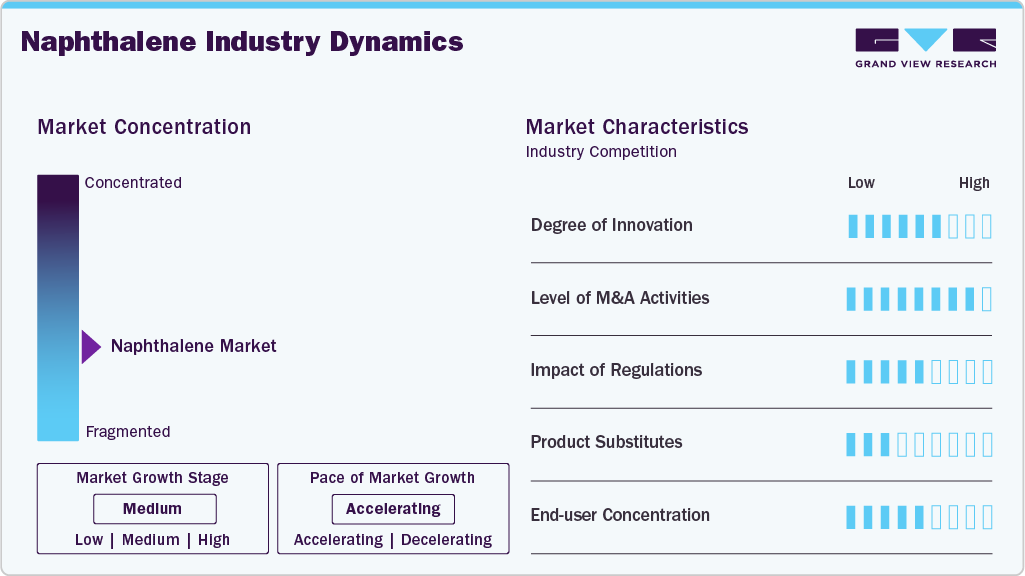
The market is fragmented with the presence of a number of manufacturers. Multinational corporations in the market have established a global supply chain through in-house supply channels or third-party distributors. For instance, companies such as ExxonMobil, Epsilon Carbon Private Limited, and Rain Carbon Inc. have appointed third-party distributors to supply their products in the global market.
 To learn more about this report, Download Free Sample Report
Given the competitive nature of the market, continuous research and development efforts are necessary for companies to stay ahead. The rising demand for naphthalene as a raw material in various industries such as chemicals, textiles, pharmaceuticals, plastics, and construction. Companies can find a sustainable and alternative solution for the production of naphthalene rather than the traditional method, boosting the circular economy and sustainable environment awareness.
Analyst Perspective
The global naphthalene market is expected to remain centered on technical, refined, and pure naphthalene grades, with demand differentiated by purity requirements across downstream applications. Phthalic anhydride, naphthalene sulfonic acid, sulphonated naphthalene formaldehyde, and alkyl naphthalene sulfonates represent key consumption areas, while hydrogenated naphthalene, alkylated naphthalene, and naphthol serve specialty chemical requirements. Pure and refined grades are gaining relevance where downstream processes require tighter impurity control and consistent performance. Moth balls and applications such as carbaryl and naphthylamines remain comparatively smaller-volume outlets.
Product Insights
Refined naphthalene dominated the global market, accounting for 59.9% of the total revenue share in 2025. The segment's leadership is attributed to its widespread use in the production of phthalic anhydride, naphthalene sulfonates, dyes, pigments, and specialty chemical intermediates. Its higher purity compared to technical-grade naphthalene makes it suitable for applications requiring consistent performance and product quality. Growing demand from the construction, textiles, plastics, and chemical industries, particularly for concrete admixtures, resins, and industrial dispersants, continues to drive the consumption of refined naphthalene globally.
Pure naphthalene is expected to register steady growth during the forecast period, driven by its high purity and suitability for specialty chemical applications. Pure naphthalene is extensively utilized in the production of high-value chemical intermediates, pharmaceutical ingredients, laboratory reagents, and advanced specialty formulations where stringent quality standards are required. Growing investments in specialty chemicals, pharmaceuticals, and high-performance materials, coupled with increasing demand for premium-grade raw materials with consistent composition, are expected to support the expansion of the pure naphthalene segment over the coming years.
Application Insights
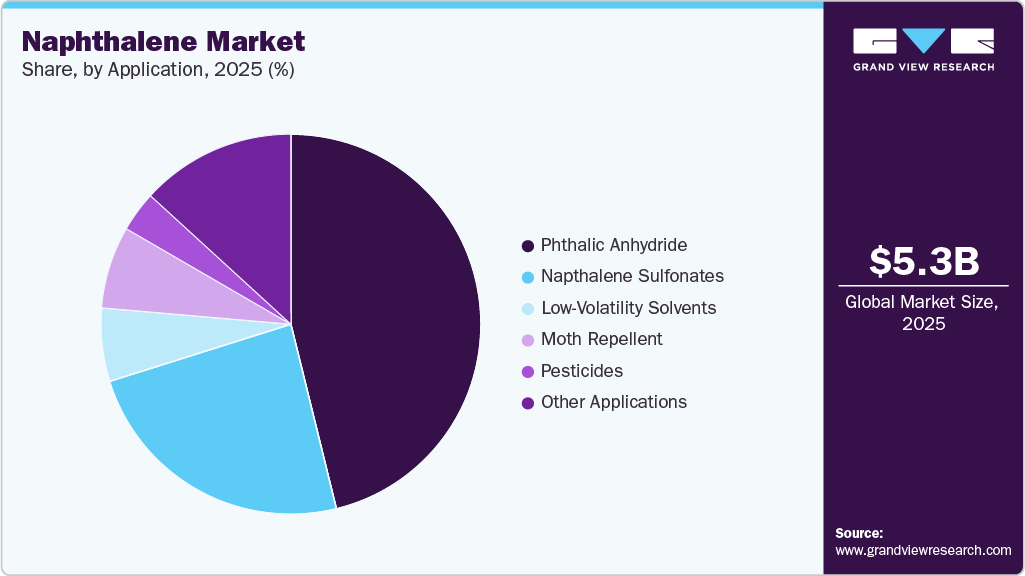
Phthalic anhydride dominated the market, accounting for 57.6% of the total revenue share in 2025. The segment's dominance is driven by the extensive use of phthalic anhydride in the production of plasticizers, alkyd resins, unsaturated polyester resins, and coatings used across the construction, automotive, and packaging industries. Rising demand for flexible plastics, paints, adhesives, and composite materials, particularly in emerging economies, continues to support the consumption of naphthalene as a key feedstock for phthalic anhydride production.
 To learn more about this report, Download Free Sample Report
Naphthalene sulfonic acid is expected to register the fastest growth of CAGR of 4.3% during the forecast period. The growth is primarily attributed to its increasing use in the manufacture of superplasticizers and concrete admixtures, which enhance the workability and strength of concrete in infrastructure and commercial construction projects. In addition, expanding applications in dye intermediates, dispersing agents, and specialty chemical formulations, along with rising investments in infrastructure development, are expected to accelerate demand for naphthalene sulfonic acid over the forecast period.
Regional Insights
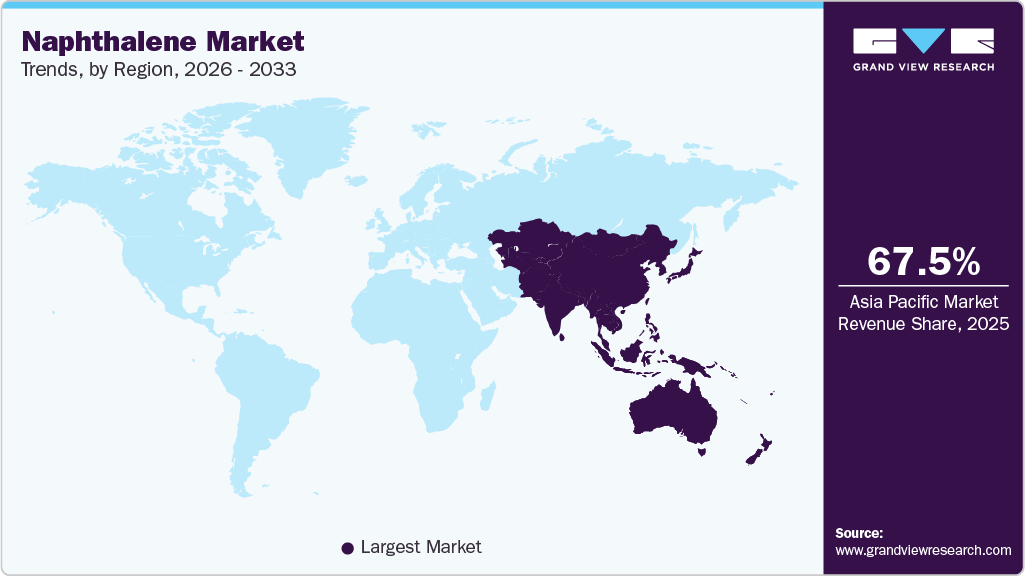
Asia Pacific dominated the market with a revenue share of 63.5% in 2025 and maintains a dominating position in the global market. This growth is attributed to factors such as infrastructure development and increasing consumer demand. Asia Pacific is also the hub for the textile industry in the world, and this has also led to a rise in demand for naphthalene, which is used in textiles as dyes and surfactants.
 To learn more about this report, Download Free Sample Report
China Naphthalene Market Trends
The naphthalene market in China dominated the Asia Pacific market with a revenue share of 61.5% in 2025. The Chinese market is growing owing to attributes such as rising demand for mothballs and production of phthalic anhydride and synthetic resins.
North America Naphthalene Market Trends
The naphthalene market in North America accounted for a significant market share in terms of revenue in 2025. This is attributed to the rising use of naphthalene in the construction industry and the increasing use of pesticides. This has led to market growth in North America.
The U.S. naphthalene market is expected to grow at the fastest CAGR over the forecast period, which is attributed to rising demand from applications such as naphthalene sulfonate, low-volatility solvents, pesticides, and moth repellents.
Europe Naphthalene Market Trends
The naphthalene market in Europe is expected to grow at a significant CAGR over the forecast period. This growth is attributed to the increased usage of naphthalene in the manufacturing of insecticides, particularly due to the extensive agricultural land, which contributes to market growth.
Germany naphthalene market is dominating in Europe. This is because rising investment and improving infrastructure in the country have led to market growth.
The naphthalene market in the UK is expected to grow at the fastest CAGR over the forecast period. This growth is attributed to a rise in demand for moth repellents, pesticides, and naphthalene sulfonates, which have various applications, leading to a rise in demand for market growth.
Latin America Naphthalene Market Trends
The naphthalene market in Latin America is estimated to grow at the fastest CAGR over the forecast period, owing to an increase in infrastructure and production facilities in Brazil, Argentina, Chile, and other countries. Central and South America have a diverse range of industries, including chemicals, construction, textiles, pharmaceuticals, and agrochemicals, leading to a rise in demand for market growth.
Brazil naphthalene market is expected to dominate the Latin America region. This growth is attributed to the rising agricultural sector in the country. This has led to rising demand for pesticides, which use naphthalene as one of the raw materials, leading to a rise in demand for market growth in the country.
Middle East & Africa Naphthalene Market Trends
The naphthalene market in MEA is estimated to grow at the fastest CAGR over the forecast period. The growing demand for naphthalene sulfonate in the region is driven by factors such as the growth of construction and growing infrastructure, which has led to a rise in demand for naphthalene in the region.
Saudi Arabia naphthalene market is expected to grow at a significant CAGR over the forecast period, due to the rise in the construction sector in the region. The country has been undertaking extensive infrastructure development projects, which will lead to a rise in demand for market growth.
Key Naphthalene Company Insights
Some of the key players operating in the market include Rain Carbon Inc., ExxonMobil Corporation, and Epsilon Carbon Private Limited, among others.
-
ExxonMobil is a multinational oil and gas company that produces crude oil, oil products, natural gas, petrochemicals, and power.
-
Rain Carbon Inc. is a producer of raw materials that are used worldwide in the manufacturing of carbon products and advanced materials. Its products are essential for producing aluminum, steel, titanium dioxide, coatings, plastics, concrete, and tires. The company makes calcined petroleum coke, coal tar pitch, and raw materials for various industrial processes and products. Its carbon black oils are used as feedstocks, which are converted by end users into carbon black for a wide variety of uses, such as pigments in plastics, rubber, and print toners.
CARBOTEX, JFE Chemical Corporation, and Koppers Inc., among others, are some of the emerging market participants in the global market.
-
Epsilon Carbon Private Limited is a company that produces chemicals. Their products, such as aluminum, graphite, tire manufacturing, and infrastructure, are used in various sectors in India. One of their products is hard carbon black, used in producing tire treads and mechanical rubber goods.
-
Koppers Holdings Inc. is a global company that provides products and services for several industries. Koppers also develops and provides chemicals that are essential to the operation and success of manufacturers. They repurpose waste generated from other industries into critical components that support the production of rubber products, plastics, resins, treated wood, and steel.
Key Naphthalene Companies
The following key companies have been profiled for this study on the naphthalene market.
-
Rain Carbon Inc.
-
ExxonMobil Corporation
-
Epsilon Carbon Private Limited
-
CARBOTECH
-
DEZA a.s.
-
JFE Chemical Corporation
-
Koppers Inc.
-
PCC Rokita SA
-
Gautam Zen International
-
Dong-Suh Chemical Ind. Co., Ltd.
-
TULSTAR PRODUCTS INC.
-
Quimica del Nalon S.A.
Competitive Benchmarking
Category
Operating Strategies
Competitive Edge
Weakness
Established Players (Rain Carbon Inc.; ExxonMobil Corporation; Epsilon Carbon Private Limited; JFE Chemical Corporation; Koppers Inc.; PCC Rokita SA; Quimica del Nalon S.A.)
- Expand production capacity for high-purity and refined naphthalene grades to meet growing industrial demand.
- Invest in process optimization, emission reduction technologies, and energy-efficient production facilities.
- Strengthen long-term supply agreements with downstream manufacturers of phthalic anhydride, construction chemicals, dyes, and agrochemicals.
- Expand global distribution networks through strategic partnerships, acquisitions, and regional manufacturing investments.
- Integrated operations with reliable access to coal tar and petroleum feedstocks.
- Large-scale manufacturing capabilities are supported by advanced refining technologies.
- Well-established relationships with major downstream chemical manufacturers worldwide.
- Strong financial resources enabling continuous capacity expansion and technology upgrades.
- High exposure to fluctuations in coal tar and crude oil-derived feedstock prices.
- Stringent environmental and occupational safety regulations increase compliance costs.
- Capital-intensive production facilities require significant ongoing investments.
- Dependence on cyclical demand from the construction and industrial manufacturing sectors.
Emerging & Regional Players (CARBOTECH; DEZA A.S.; Gautam Zen International; Dong-Suh Chemical Ind. Co., Ltd.; TULSTAR PRODUCTS INC.)
- Focus on the regional supply of technical and specialty naphthalene grades for niche industrial applications.
- Enhance competitiveness through cost-efficient production and customized product offerings.
- Expand sales via local distributors and partnerships with regional chemical manufacturers.
- Invest in product quality improvements and specialty-grade development to penetrate higher-value applications.
Greater operational flexibility in serving regional markets and customized customer requirements.
- Competitive pricing is supported by lower operating costs and localized supply chains.
- Faster response to regional demand fluctuations and customer-specific specifications.
- Ability to establish strong relationships with local downstream industries.
- Limited production capacity compared with multinational manufacturers.
- Smaller export footprint and restricted global distribution network.
- Lower investment capability for large-scale capacity expansion and advanced technologies.
- Higher vulnerability to raw material supply disruptions and regional economic fluctuation
Recent Developments
-
In February 2025, ExxonMobil announced the completion of buying naphtha shipments for its newly launched petrochemical site in southern China, as the U.S. prepares for the formal startup of the USD 10 billion plant. The new facility is expected to have a positive impact on petrochemical feedstock and enhance Asian naphtha refining margins in the near term, primarily because reduced Russian supplies already support them.
Naphthalene Market Report Scope
Report Attribute
Details
Market size in 2025
USD 1.7 billion
Estimated market size in 2026
USD 1.8 billion
Projected market size by 2033
USD 2.3 billion
Growth rate
CAGR of 3.7% from 2026 to 2033
Historical data
2021 - 2025
Forecast period
2026 - 2033
Quantitative units
Volume in kilotons, revenue in USD billion, and CAGR from 2026 to 2033
Report coverage
Volume & Revenue forecast, company ranking, competitive landscape, growth factors, and trends
Segments covered
Product, application, region
Regional scope
North America; Europe; Asia Pacific; Latin America; MEA
Country scope
U.S.; Canada; Mexico; Germany; UK; France; Italy; Spain; China; India; Japan; South Korea; Brazil; Argentina; South Africa; Saudi Arabia
Key companies profiled
Rain Carbon Inc.; ExxonMobil Corporation; Epsilon Carbon Private Limited; CARBOTECH; DEZA A.S.; JFE Chemical Corporation; Koppers Inc.; PCC Rokita SA; Gautam Zen International; Dong-Suh Chemical Ind. Co., Ltd.; TULSTAR PRODUCTS INC.; Quimica del Nalon S.A.
Customization scope
Free report customization (equivalent up to 8 analyst’s working days) with purchase. Addition or alteration to country, regional & segment scope.
Pricing and purchase options
Avail customized purchase options to meet your exact research needs. Explore purchase options
Global Naphthalene Market Report Segmentation
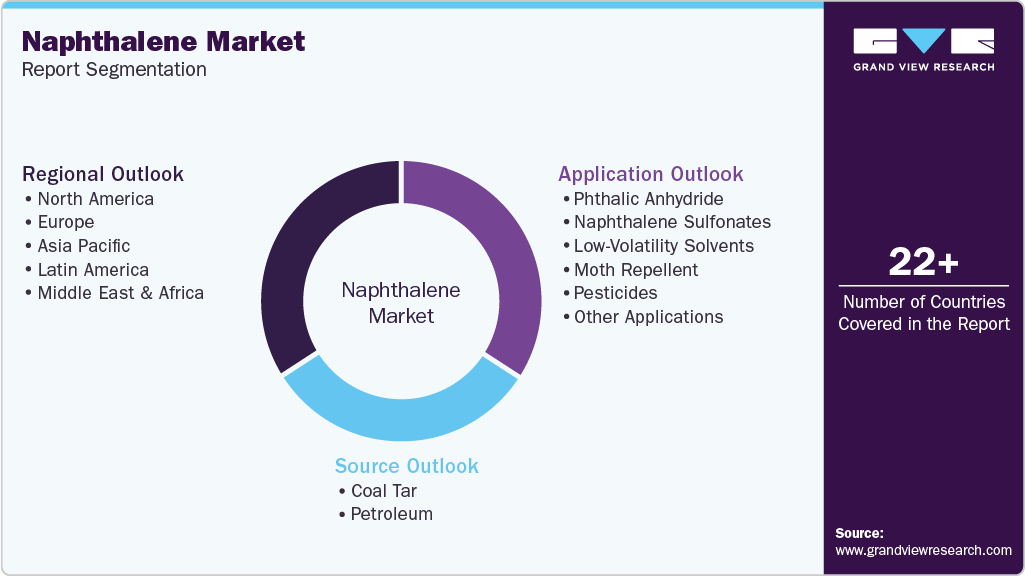
This report forecasts revenue growth at global, regional, and country levels and provides an analysis of the latest industry trends in each of the sub-segments from 2021 to 2033. For this study, Grand View Research has segmented the global naphthalene market report based on product, application, and region:
 To learn more about this report, Download Free Sample Report
-
Product Outlook (Volume, Kilotons; Revenue, USD Billion, 2021 - 2033)
-
Technical Naphthalene
-
Refined Naphthalene
-
Pure Naphthalene
-
-
Application Outlook (Volume, Kilotons; Revenue, USD Billion, 2021 - 2033)
-
Phthalic Anhydride
-
Hydrogenated Naphthalene (Tetralin, Decalin)
-
Alkylated Naphthalene
-
Moth Balls
-
Naphthalene Sulfonic Acid
-
Naphthol
-
Alkyl Naphthalene Sulfonates
-
Sulphonated Naphthalene Formaldehyde
-
Others (carbaryl, naphthylamines, etc.)
-
-
Regional Outlook (Volume, Kilotons; Revenue, USD Billion, 2021 - 2033)
-
North America
-
U.S.
-
Canada
-
Mexico
-
-
Europe
-
Germany
-
UK
-
France
-
Italy
-
Spain
-
-
Asia Pacific
-
China
-
India
-
Japan
-
South Korea
-
-
Latin America
-
Brazil
-
Argentina
-
-
Middle East and Africa
-
Saudi Arabia
-
South Africa
-
-
Research Methodology
The naphthalene market figures in this report are based on a proven research process that combines executive interviews with secondary research from proprietary databases, company filings, and recognized regulatory and institutional sources. Market size is built through value-chain sizing-reconciling supply-side and demand-side estimates-and triangulated with bottom-up and top-down approaches. Every estimate passes multiple levels of expert validation before publication, with each naphthalene segment quantified using the revenue-capture definitions in the table below.
Segment Definition
Segment - Product
Revenue capture definition
Technical Naphthalene
Captures revenue from the sale of technical-grade naphthalene supplied for manufacturing phthalic anhydride, concrete admixtures, dyes, pigments, and other industrial chemical intermediates.
Refined Naphthalene
Represents revenue generated through refined naphthalene with enhanced purity used in specialty chemicals, agrochemicals, pigments, and pharmaceutical intermediate production.
Pure Naphthalene
Accounts for revenue associated with high-purity naphthalene utilized in research applications, specialty formulations, electronic chemicals, and other high-value industrial processes requiring stringent purity standards.
Segment - Application
Revenue capture definition
Phthalic Anhydride
Includes revenue generated from naphthalene utilized as a feedstock for producing phthalic anhydride used in plasticizers, alkyd resins, coatings, and unsaturated polyester resins.
Hydrogenated Naphthalene (Tetralin, Decalin)
Represents revenue associated with naphthalene consumed in the manufacture of tetralin and decalin for industrial solvents, heat transfer fluids, and chemical processing applications.
Alkylated Naphthalene
Covers revenue from naphthalene processed into alkylated naphthalene compounds for synthetic lubricants, transformer oils, and specialty industrial fluids.
Moth Balls
Accounts for revenue generated through naphthalene supplied for moth repellents and household pest control products used to protect clothing, fabrics, and stored goods.
Naphthalene Sulfonic Acid
Reflects revenue from naphthalene used as a raw material in the production of naphthalene sulfonic acid for dyes, pigments, dispersants, and specialty chemical formulations.
Naphthol
Measures revenue derived from naphthalene converted into naphthol for the manufacture of azo dyes, pigments, pharmaceuticals, and rubber processing chemicals.
Alkyl Naphthalene Sulfonates
Covers revenue generated using naphthalene in producing alkyl naphthalene sulfonates for surfactants, emulsifiers, wetting agents, and dispersants.
Sulphonated Naphthalene Formaldehyde
Represents revenue earned from naphthalene consumed in the production of sulphonated naphthalene formaldehyde (SNF) used as a high-performance concrete superplasticizer.
Others (carbaryl, naphthylamines, etc.)
Includes revenue associated with naphthalene utilized in manufacturing carbaryl, naphthylamines, antioxidants, rubber chemicals, and various specialty chemical intermediates.
Estimation Model
Layer Name
Key Question
Description
Naphthalene Production Layer
What forms is the supply base?
Identify the global production capacity of naphthalene from coal tar and petroleum-derived feedstocks by assessing raw material availability, distillation and refining capacities, production technologies, purity grades (technical, refined, and pure), and manufacturing facilities. This layer establishes the global supply base for industrial and chemical applications.
Application Adoption Layer
Where are naphthalene utilized?
Estimate the distribution of naphthalene consumption across major applications, including phthalic anhydride, sulphonated naphthalene formaldehyde, naphthalene sulfonic acid, naphthol, alkylated naphthalene, hydrogenated naphthalene, mothballs, agrochemicals, and other specialty chemical applications by analyzing industry demand and regional consumption patterns.
Consumption Intensity Layer
How much naphthalene is consumed?
Assess naphthalene consumption across end-use industries by evaluating production volumes of downstream chemicals, construction activity, demand from dyes and pigments, agrochemicals, and industrial manufacturing to estimate annual consumption across major regional markets.
Revenue Layer
How is market revenue generated?
Market revenue is generated through the sale of technical, refined, and pure naphthalene to manufacturers of phthalic anhydride, concrete admixtures, dyes, pigments, agrochemicals, lubricants, moth repellents, and other industrial chemicals through direct sales, distributors, and global chemical supply networks.
Delivered Customizations
This report has been delivered with the following In-depth customizations
Client Request
Customization Delivered
Value Adds
Cross-Segmentation Analysis
Detailed cross-segmentation assessment evaluating the relationship between product (Technical Naphthalene, Refined Naphthalene, and Pure Naphthalene) and application (Phthalic Anhydride, Sulphonated Naphthalene Formaldehyde, Naphthol, Naphthalene Sulfonic Acid, Hydrogenated Naphthalene, Alkylated Naphthalene, Moth Balls, Alkyl Naphthalene Sulfonates, and Others). The analysis identifies demand patterns, application intensity, and revenue contribution across each product-application combination.
Supports product portfolio optimization and market prioritization by identifying the highest-value product-application combinations, enabling better production planning, investment decisions, and sales strategy development.
Competitive Benchmarking
Comparative evaluation of leading naphthalene manufacturers based on product portfolio, production capacity, product purity, manufacturing capabilities, feedstock integration, geographic presence, downstream industry focus, sustainability initiatives, and recent strategic developments across major regional markets.
Assist competitive intelligence and strategic decision-making by providing insights into market positioning, production strengths, technological capabilities, and competitive advantages.
Opportunity Assessment
Comprehensive assessment of emerging opportunities across high-purity naphthalene grades, expanding downstream chemical applications, infrastructure-driven demand for concrete admixtures, and growth in specialty chemicals and agrochemicals across key regional markets.
Helps identify high-growth product segments and application areas, supporting capacity expansion, product development, market entry strategies, and long-term revenue growth.
Frequently Asked Questions About This Report
The phthalic anhydride segment accounted for the largest revenue share in 2025.
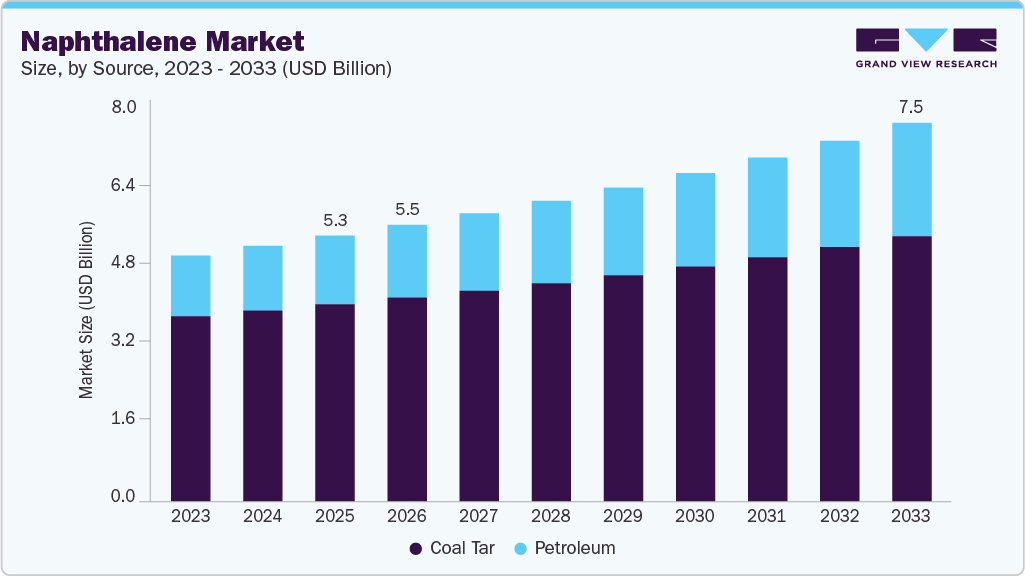
The coal tar segment segment held the highest market share of 74.2% in 2025.
Asia Pacific accounted for a revenue share of over 67.5% in 2025.
Key factors include growing use in the construction industry as a plasticizer in various concrete admixtures, specifically naphthalene sulfonate formaldehyde.
The global napthalene market is anticipated to expand at a CAGR of 4.6% during the forecast period and reach USD 7.6 billion by 2033.
Some prominent players in the global naphthalene market include Química del Nalon; China Steel Chemical Corporation (CSCC); Junsei Chemical Co., Ltd.; Koppers Inc.; JFE Chemical Corporation; Epsilon Carbon Private Limited.; Deza, a.s.; Shyam Kemicals; Rain Industries Limited; Carl Roth; ALOK INDUSTRIES; ARHAM PETROCHEM PRIVATE LIMITED; Himadri Speciality Chemical Ltd; Monument Chemical; Bilbaína de Alquitranes, S.A.; Akshar Chemical India Private Limited
The global naphthalene market size was valued at USD 5.3 billion in 2025 and is projected to reach USD 5.5 billion in 2026.
About the Author(s)
Petrochemicals Research Team
Bulk Chemicals · PetrochemicalsThis report was authored by the petrochemicals research team at Grand View Research - comprising two research analysts, one senior research analyst, and one industry expert - with specialized expertise in the petrochemicals segment of the bulk chemicals industry. All findings are based on proprietary bulk chemicals databases, executive interviews, and regulatory analysis, subject to internal peer review prior to publication.
Last Updated:
Speak to Analyst

Customize this report to your needs - add regions, segments, or data points, with 20% free customization.
Or view our licence options:


ISO 9001:2015 & 27001:2022 Certified
We are GDPR and CCPA compliant! Your transaction & personal information is safe and secure. For more details, please read our privacy policy.


