New Zealand Lubricants Market Summary
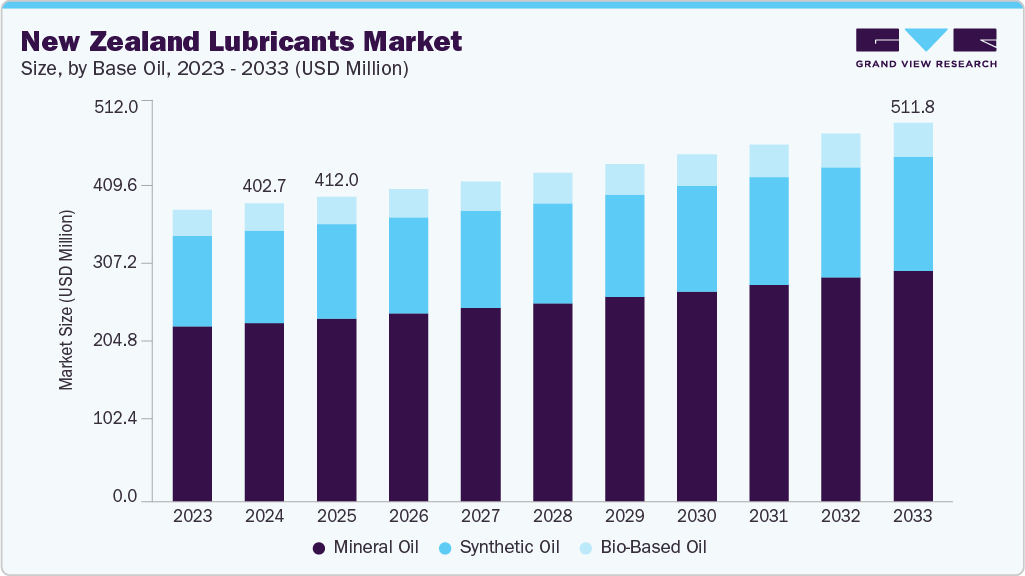
The New Zealand lubricants market size was estimated at USD 402.7 million in 2024 and is projected to reach USD 511.8 million by 2033, growing at a CAGR of 2.7% from 2025 to 2033. This growth is primarily driven by the rising demand for lubricants in automotive and industrial applications.
Key Market Trends & Insights
- The New Zealand lubricants market is projected to grow at a CAGR of 2.7% from 2025 to 2033.
- By base oil, mineral oil-based lubricants dominated the market with a revenue share of 60.0% in 2024.
- The bio-based segment is expected to witness a CAGR of 2.7% from 2025 to 2033.
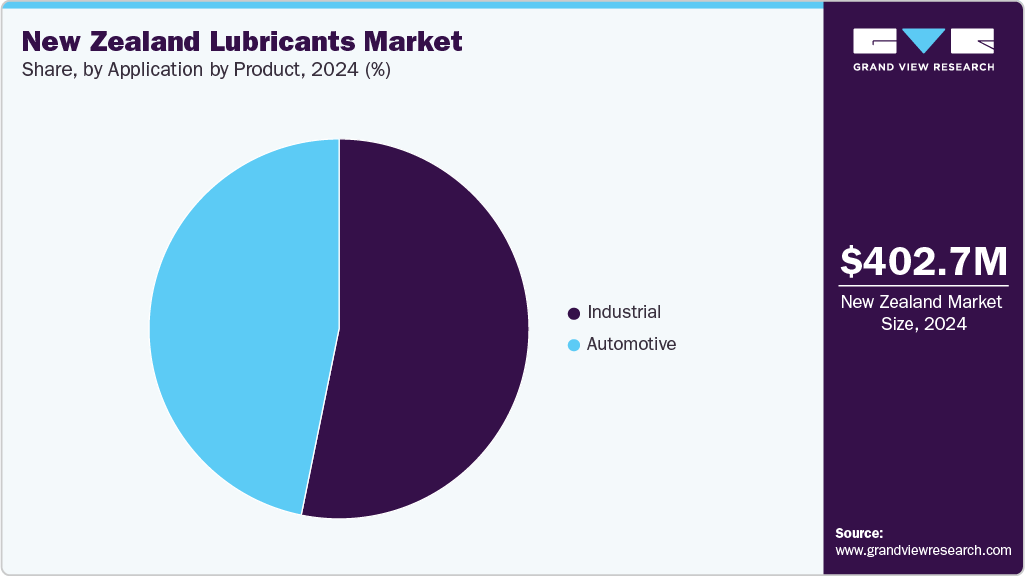
- By product, industrial-based lubricants dominated the market with a revenue share of 53.2% in 2024.
Market Size & Forecast
- 2024 Market Size: USD 402.7 Million
- 2033 Projected Market Size: USD 511.8 Million
- CAGR (2025-2033): 2.7%
As vehicle ownership increases across both urban and rural regions, there is a growing need for engine oils, gear oils, and other lubricants that enhance fuel efficiency, reduce engine wear, and ensure smooth operation. In rural areas, the prevalence of farming equipment and off-road vehicles further adds to the lubricant demand, as these machines require frequent maintenance due to heavy-duty usage. Industrial activity also plays a crucial role in driving lubricant consumption. Sectors such as agriculture, forestry, construction, and manufacturing depend heavily on machinery that needs regular lubrication to perform efficiently and minimize breakdowns. For instance, modern farming machinery includes hydraulic systems and engines that operate under high pressure and require specialized lubricants to prevent wear and overheating. In construction, heavy equipment like excavators and loaders functions in demanding environments, where high-performance lubricants help extend equipment life and reduce operational costs. The reliability of industrial processes depends significantly on the consistent performance of machinery, which is directly tied to proper lubrication.
Environmental awareness and sustainability trends are also influencing the market’s direction. There is a growing demand for biodegradable and eco-friendly lubricants, particularly in industries where environmental protection is critical, such as agriculture, marine, and forestry. These lubricants reduce the risk of soil and water contamination, making them a preferred option in environmentally sensitive areas. Additionally, synthetic lubricants, which last longer and perform better under extreme temperatures and pressure, are being adopted in both industrial and automotive sectors due to their efficiency and lower frequency of oil changes. This shift not only supports environmental goals but also improves the total cost of ownership for users.
Improved infrastructure and maintenance practices are further supporting market growth. As awareness around preventive maintenance increases, more consumers and businesses are investing in quality lubricants to extend the lifespan of their vehicles and machinery. Additionally, the availability of lubricants across regional service centers and supply chains ensures accessibility, even in remote locations. This widespread access, combined with better consumer knowledge about lubricant types and their benefits, is helping the market expand gradually. The consistent demand from multiple sectors, coupled with evolving environmental and maintenance standards, is expected to sustain the upward trend in lubricant usage across New Zealand.
Market Concentration & Characteristics
The lubricants market in New Zealand is consolidated, with a limited number of established players holding the majority of the market share. These companies dominate through long-standing distribution networks, strong brand recognition, and well-established relationships with industrial, automotive, and agricultural sectors. To strengthen their market presence, leading manufacturers are expanding their production capacities, introducing high-performance lubricant variants, and investing in localized blending facilities to reduce dependence on imports. Many are also focusing on technical services, offering tailored lubricant solutions and condition monitoring to cater to sector-specific needs such as heavy machinery, marine operations, and advanced manufacturing.
Despite the dominance of a few key players, the industry is beginning to attract emerging companies, particularly from the Asia-Pacific region. These new entrants see opportunity in the country's stable economy, increasing industrialization, and growing demand for environmentally sustainable products. The shift toward bio-based and synthetic lubricants creates a niche space for innovation-focused companies that offer advanced formulations. New players are also leveraging e-commerce and digital platforms to bypass traditional distribution channels, helping them reach end-users more efficiently while keeping operational costs lower. Additionally, New Zealand’s transparent regulatory environment and focus on sustainable practices align well with modern lubricant technologies, making it an appealing market for international and regional challengers.
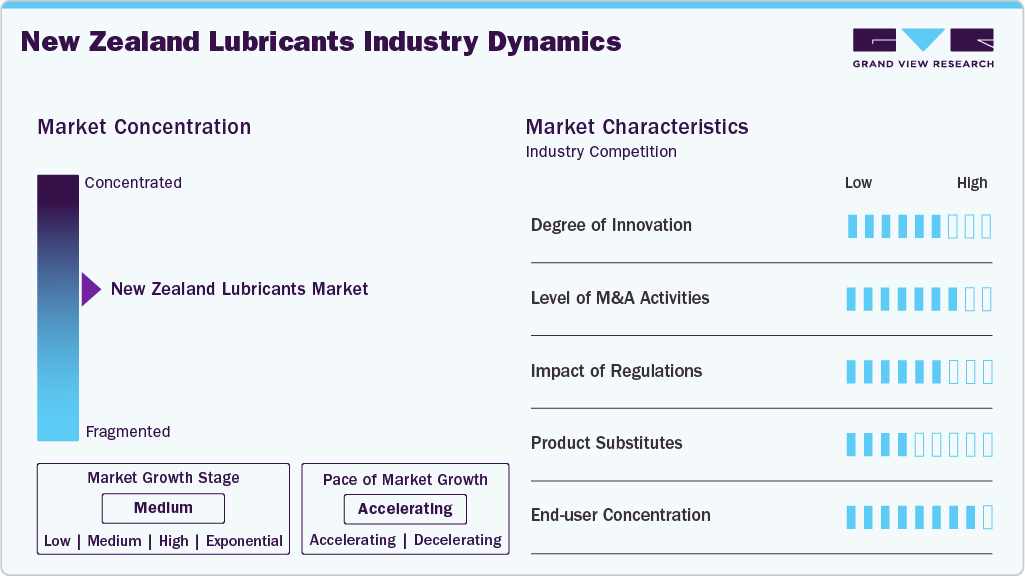
However, companies operating in New Zealand’s lubricant market face several notable challenges. High import dependence for base oils and additives increases exposure to global supply chain disruptions and price volatility. Additionally, stringent environmental regulations around emissions, waste disposal, and chemical use can raise compliance costs and complicate product approvals. The market’s limited scale also means that achieving economies of scale is more difficult, especially for new or smaller players. Rising consumer awareness about environmental impact further pushes manufacturers to invest in costly research and reformulation, which may strain profit margins in an already competitive and concentrated environment.
Base Oil Insights
Mineral oil-based lubricants held a 60.0% share in 2024 due to their affordability, wide availability, and suitability for standard automotive and industrial applications. These lubricants meet the performance requirements of commonly used machinery and vehicles without the higher cost of synthetics. Additionally, the country’s reliance on imported lubricant products favors mineral oils, which are less expensive to transport and store. Their long-standing use across agriculture, construction, and transportation sectors ensures familiarity and widespread acceptance, making them the default choice for many end-users prioritizing cost-efficiency and basic performance.
The bio-based lubricants segment is projected to grow at a CAGR of 2.7% from 2025 to 2033 due to increasing environmental regulations and industry demand for sustainable alternatives. These lubricants are biodegradable and pose lower ecological risks, making them attractive in sectors like agriculture, forestry, and marine operations where environmental impact is closely monitored. Growing awareness around carbon reduction and the government’s push for greener industrial practices further support this trend. Additionally, advancements in bio-lubricant formulation are closing the performance gap with mineral oils, encouraging adoption in both public and private sectors, and prioritizing sustainability.
Product Insights
Industrial lubricants accounted for 53.2% of the market in 2024 due to the country’s strong reliance on primary and secondary industries such as agriculture, food processing, forestry, and construction. These sectors operate heavy machinery, processing equipment, and hydraulic systems that require consistent lubrication for efficiency and reliability. The widespread use of greases, compressor oils, and hydraulic fluids in these applications drives sustained demand. Additionally, preventive maintenance practices in industrial operations have become more prevalent, encouraging regular lubricant use to reduce equipment downtime, improve energy efficiency, and extend machinery lifespan, contributing to this segment’s dominant market share.
Metalworking fluids within the automotive segment are projected to grow at a CAGR of 3.4% from 2025 to 2033, driven by increased automotive component manufacturing, precision machining, and aftermarket services in New Zealand. These fluids are essential for cooling, lubrication, and chip removal during metal forming and cutting processes. With the growth of small-scale fabrication units, auto repair workshops, and rising demand for locally machined parts, the usage of metalworking fluids is expanding. Furthermore, stricter quality standards in manufacturing and a shift toward higher-performance machining operations require advanced fluid formulations, accelerating adoption in both OEM and maintenance applications across the country.
Application by Product Insights
The passenger cars segment within the automotive lubricants dominated with a 72.7% share in 2024 due to the country's high rate of vehicle ownership, averaging over 800 vehicles per 1,000 people. The widespread use of personal vehicles for daily commuting, especially in suburban and rural areas, leads to consistent demand for engine oils, coolants, and brake fluids. A significant portion of the car fleet comprises used imports, which typically require more frequent servicing. These factors, combined with routine maintenance culture and the longevity of vehicle use, drive the high lubricant consumption in this segment.
The farming and agriculture sector is expected to grow at a 3.7% CAGR from 2025 to 2033 within New Zealand’s industrial lubricants segment due to the increasing mechanization and expansion. As farms adopt advanced machinery for tasks like harvesting, irrigation, and soil preparation, the need for reliable lubrication, particularly for engines, transmissions, and hydraulics, intensifies. Frequent equipment use in challenging environments requires specialized lubricants to reduce wear and extend machine life. Additionally, the government’s support for agricultural modernization and exports incentivizes farmers to invest in machinery upkeep, directly boosting the consumption of industrial lubricants in this high-priority sector.
Key New Zealand Lubricants Companies Insights
Key players operating in the New Zealand lubricants market are undertaking various initiatives to strengthen their presence and increase the reach of their products and services. Strategies such as expansion activities and partnerships are key in propelling the market growth.
Key New Zealand Lubricants Companies:
- Blaser Swisslube
- Kluber Lubrication Munchen SE & Co. KG
- Bel-Ray Company
- AMSOIL
- Lucas Oil
- Yushiro Chemical Industry
- Phillips 66
- Idemitsu Kosan Co Ltd
Recent Developments
-
In June 2025, Redox’s partnership with Kangtai introduces advanced lubricant additive technologies to the New Zealand market, enhancing the quality and performance of lubricants used in industrial and automotive sectors. This strategic move supports growing demand for high-efficiency, specialized lubricants and reflects the market’s shift toward innovation and superior formulation capabilities.
-
In March 2025, TDX secured a five-year renewal as the official distributor for Shell Lubricants in New Zealand, reinforcing its role in supplying high-performance lubrication solutions. The partnership ensures continued support for industrial, transport, and agriculture sectors, combining Shell’s innovation with TDX’s local expertise and strong service capabilities across key markets.
New Zealand Lubricants Market Report Scope
|
Report Attribute
|
Details
|
|
Market size value in 2025
|
USD 412.0 million
|
|
Revenue forecast in 2033
|
USD 511.8 million
|
|
Growth rate
|
CAGR of 2.7% from 2025 to 2033
|
|
Base year for estimation
|
2024
|
|
Historical data
|
2018 - 2023
|
|
Forecast period
|
2025 - 2033
|
|
Quantitative units
|
Volume in kilotons; revenue in USD million/billion, and CAGR from 2025 to 2033
|
|
Report coverage
|
Volume & revenue forecast, company ranking, competitive landscape, growth factors, and trends
|
|
Segments covered
|
Base oil, product, and application by product
|
|
Key companies profiled
|
Blaser Swisslube; Kluber Lubrication Munchen SE & Co. KG; Bel-Ray Company; AMSOIL; Lucas Oil; Yushiro Chemical Industry; Phillips 66; Idemitsu Kosan Co. Ltd.
|
|
Customization scope
|
Free report customization (equivalent to up to 8 analyst’s working days) with purchase. Addition or alteration to country, regional & segment scope.
|
|
Pricing and purchase options
|
Avail customized purchase options to meet your exact research needs. Explore purchase options
|
New Zealand Lubricants Market Report Segmentation
This report forecasts volume & revenue growth at the country level and provides an analysis of the latest industry trends in each of the sub-segments from 2018 to 2033. For this study, Grand View Research has segmented the New Zealand lubricants market report based on base oil, product, and application by product:
-
Base Oil Outlook (Volume, Kilotons; Revenue, USD Million, 2018 - 2033)
-
Mineral Oil
-
Synthetic Oil
-
Bio-Based Oil
-
Product Outlook (Volume, Kilotons; Revenue, USD Million, 2018 - 2033)
-
Industrial
-
Process Oils
-
General Industrial Oils
-
Metalworking Fluids
-
Industrial Engine Oils
-
Greases
-
Others
-
Automotive
-
Engine Oils
-
0W-20
-
0W-30
-
0W-40
-
5W-20
-
5W-30
-
5W-40
-
10W-60
-
10W-40
-
15W-40
-
Others
-
Gear Oils
-
Transmission Fluids
-
Brake Fluids
-
Coolants
-
Greases
-
Application by Product Outlook (Volume, Kilotons; Revenue, USD Million, 2018 - 2033)
Frequently Asked Questions About This Report
b. The New Zealand lubricants market size was estimated at USD 402.7 million in 2024 and is expected to reach USD 412.0 million in 2025.
b. The New Zealand lubricants market is expected to grow at a compound annual growth rate of 2.7% from 2025 to 2033 to reach USD 511.8 million by 2033.
b. The mineral oil segment held the largest revenue share in 2024 due to its low cost, wide availability, and compatibility with existing machinery. Its ease of sourcing and proven reliability sustain strong demand across key sectors.
b. Some of the key players operating in the New Zealand lubricants market include Blaser Swisslube, Kluber Lubrication Munchen SE & Co. KG, Bel-Ray Company, AMSOIL, Lucas Oil, Yushiro Chemical Industry, Phillips 66, and Idemitsu Kosan Co Ltd.
b. The New Zealand lubricants market is driven by growing vehicle ownership, industrial expansion, increased agricultural mechanization, demand for efficient machinery maintenance, and rising adoption of synthetic and eco-friendly lubricants in response to environmental regulations and performance-focused maintenance practices.

 Download Sample Report
















