
- Home
- »
- Electronic Devices
- »
-
Non-destructive Testing For Nuclear Industry Size, Growth Report, 2026-2033GVR Report cover

Non-destructive Testing For Nuclear Industry (2026 - 2033)
Size, Share & Trends Analysis Report By Type (Ultrasonic Testing, Eddy Current Testing), By Application (Routine Maintenance, Asset Management), By End-use, By Region, And Segment Forecasts
Market Size, 2025
$573.4MMarket Estimate, 2026
$671.4MMarket Forecast, 2033
$1,120.4MCAGR, 2026–2033
8.9%Non-destructive Testing For Nuclear Industry Summary
The global non-destructive testing for nuclear industry size was valued at USD 573.4 million in 2025 and is projected to grow from USD 671.4 million in 2026 to USD 1120.4 million by 2033, at a CAGR of 8.9% from 2026 to 2033. North America dominated the global market, accounting for the largest revenue share of 37.8% in 2025. Market growth is attributed to stringent safety regulations to ensure operational safety and prevent potential hazards, which is driving continuous demand for advanced inspection and testing services.
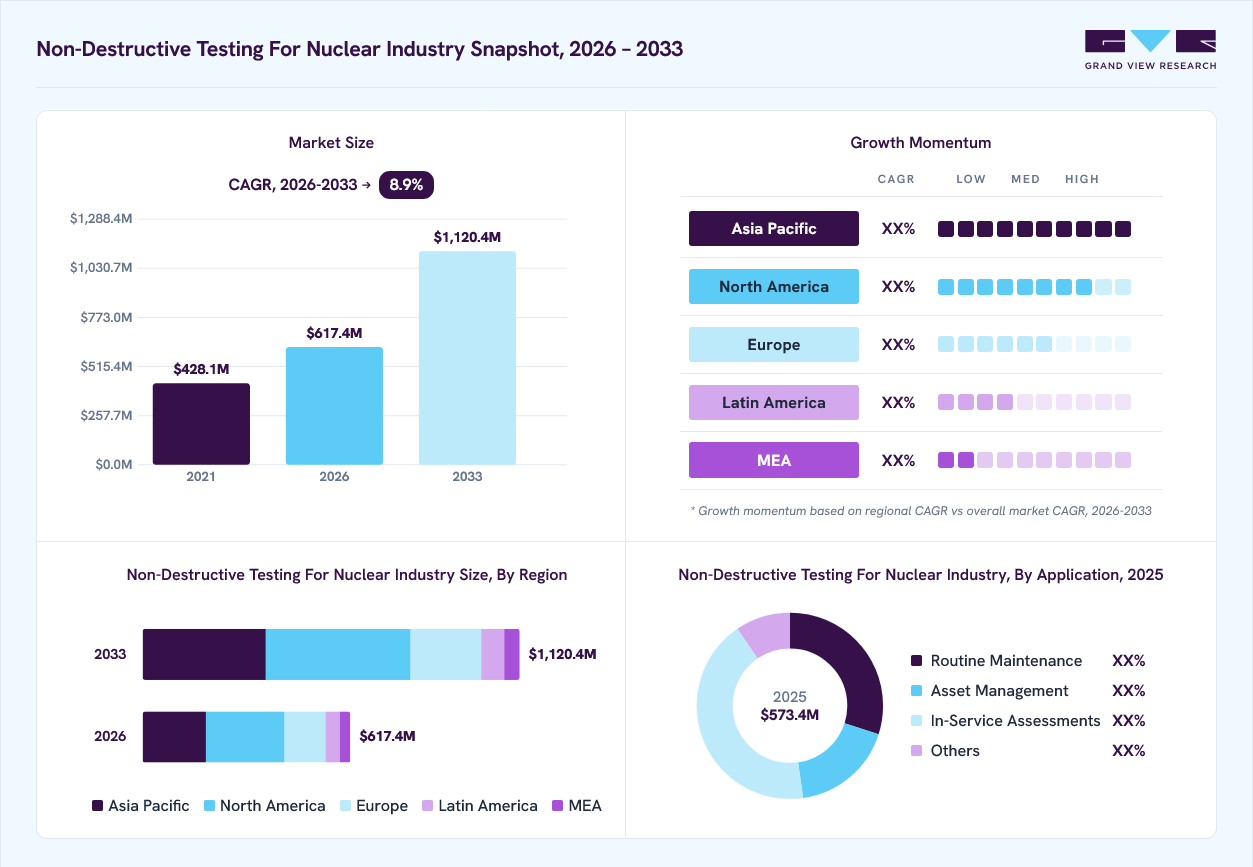 Source: Grand View Research, IR Documents, Primary Interviews, Paid DatabasesTo learn more about this report,
 Download Free Sample Report
 Key Market Trends & Insights
- By type: Ultrasonic (UT) testing segment dominated the market in 2025 and accounted for the largest share of 32.8%.
- By application: Routine maintenance segment accounted for the largest market share in 2025.
- By end-use: Nuclear power plants segment dominated the market in 2025.
Regional Highlights
- Largest regional market: North America (37.8% revenue share, 2025)
- Fastest-growing regional market: Asia Pacific (highest CAGR, 2026-2033)
- By country: The U.S. is a major contributor to the global market.
Market Size & Forecast
- Market size in 2025: USD 573.4 Million
- Estimated market size in 2026: USD 671.4 Million
- Projected market size by 2033: USD 1120.4 Million
- CAGR (2026-2033): 8.9%
Three ways to get this report
Buy it, customize it, or ask a question.Ask an Analyst
A direct answer, usually in 1 working day
- AccessReport author, directly
- Reply timeWithin 1 working day
- No sales callDirect answer only
- FormatEmail reply
- CostFree, no cost
Get the Full Report
What the study covers
- FormatsPDF · Excel · Dashboard
- Timeline2026–2033 annual, 2025 base
- Coverage20+ countries, 5 regions
- Companies10+ key players profiled
Customize the Report
20% free customization
- IncludeCountries, segments, points
- TailorTo your product definition
- ExtendDeeper competitor detail
- OrA fully bespoke study
- Turnaround5–10 working days
In addition, life-extension nuclear reactors are being operated beyond their original design life, resulting in increased emphasis on frequent and high-precision inspections to assess material integrity and prevent failures, thereby driving the growth of the non-destructive testing Industry in the nuclear industry.
The Industry growth is attributed to global expansion of nuclear power capacity coupled with the increasing adoption of advanced inspection technologies for enhanced safety. Automated and robotic NDT systems, digital radiography, and data analytics are increasingly used to improve inspection accuracy and improve efficiency. These innovations enable faster and more reliable defect detection and help meet critical nuclear safety requirements. Moreover, rising energy demand and decarbonization goals globally is resulting in increasing construction of new nuclear plants in several countries for energy harvesting purpose. As nuclear infrastructure grows, demand for inspection services during construction and operation increases. This expanding pipeline of nuclear projects continues to drive global demand for NDT solutions.
 To learn more about this report, Download Free Sample Report
 Technological advancements in the Non-Destructive Testing (NDT) market for the nuclear industry are being driven by the integration of automation, robotics, and digital inspection technologies to improve safety and accuracy. Advanced techniques such as phased-array ultrasonic testing (PAUT), digital radiography, and remote visual inspection are widely adopted to detect defects with greater precision while minimizing human exposure to hazardous environments. For instance, in June 2025, Eddyfi Technologies, provider of non-destructive testing (NDT) inspection technologies, announced the commercial release of Cypher, a next-generation ultrasonic inspection platform integrating phased-array ultrasonic testing (PAUT) and the Total Focusing Method (TFM). The system was designed to deliver faster, high-resolution inspections with improved accuracy and real-time data capabilities, particularly for critical industries such as nuclear and power generation. In addition, the use of data analytics and AI-based inspection systems is enabling predictive maintenance and real-time monitoring of critical components.
Furthermore, expansion in non-destructive testing (NDT) within the nuclear industry is accelerating due to the growing need for improved safety assurance and the increasing complexity of inspection requirements in modern nuclear projects. Companies are increasingly expanding their capabilities to integrate advanced technologies, streamline expertise, and improve support for large-scale and technically demanding operations. For instance, in November 2025, SPIE Nucléaire, a subsidiary of SPIE, announced the consolidation of its NDT expertise under the new entity SPIE Horus. This integration brought together the capabilities of its subsidiaries (ABC, ETC and SIRAC) and marked a significant step in expanding its NDT expertise, while strengthening its ability to support complex nuclear projects more efficiently.
The regulatory landscape for non-destructive testing (NDT) in the nuclear industry is critical, as it ensures the structural integrity, safety, and reliability of nuclear facilities under highly stringent operating conditions. Organizations are continuously updating regulatory frameworks to incorporate advanced inspection technologies, strengthen safety requirements, and ensure uniform standards across nuclear operations. For instance, in July 2025, the American Society of Mechanical Engineers (ASME) released an updated edition of the Boiler and Pressure Vessel Code (BPVC), which became effective in January 2026. This update introduced improved requirements for non-destructive examination methods, including stricter qualification criteria, revised inspection procedures, and improved guidelines for in-service inspection of critical components. Such regulatory advancements are driving the adoption of more reliable and technology-driven NDT practices across the nuclear industry.
The non-destructive testing (NDT) for nuclear industry faces significant challenges, mainly high implementation costs and a shortage of skilled personnel. Advanced NDT technologies, such as phased-array ultrasonic testing, digital radiography, and robotic inspection systems, require substantial capital investment and ongoing maintenance and calibration. These expenses can be prohibitive, particularly for smaller operators or those with limited budgets. In addition, NDT in nuclear settings requires specialized training and strict certification, such as those set by the American Society of Mechanical Engineers (ASME). The shortage of qualified personnel can delay inspections and increase operational risks. These factors together limit the broader adoption and efficiency of NDT in the nuclear sector.
Type Insights
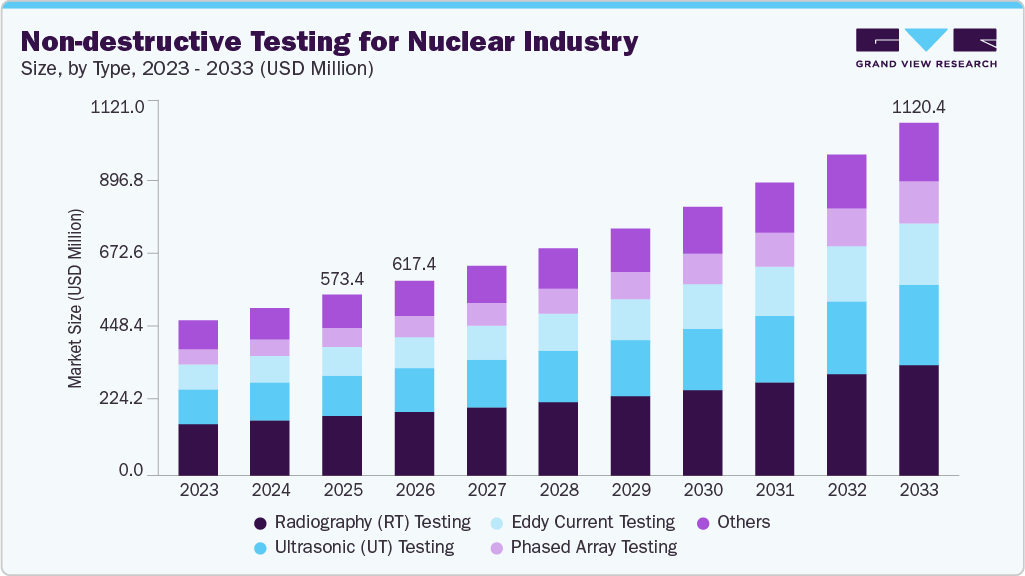
The ultrasonic (UT) testing segment dominated the market in 2025 and accounted for the largest share of 32.8%. The segment growth is driven by its long-standing adoption as a reliable, standardized inspection technique across nuclear facilities. It is widely used for its strong ability to detect internal and subsurface defects in critical components, such as reactor pressure vessels, piping systems, and welded joints. This method is widely accepted for its high penetration and accuracy, and consistent performance even in thick, dense materials commonly found in nuclear infrastructure. In addition, strong alignment with stringent regulatory frameworks and established inspection codes has ensured its continued preference. The ease of integration into existing inspection procedures and the availability of a skilled workforce further support its sustained dominance in the market.
The phased array testing segment is expected to grow at the fastest CAGR during the forecast period. The segment’s growth is attributed to rising demand for advanced, high-precision inspection technologies in the nuclear sector. Enhanced imaging, real-time data visualization, and improved defect characterization set this technology apart from conventional UT methods. Its ability to inspect from multiple angles with a single probe increases flexibility and improves the detection of complex flaws. In addition, reduced inspection time and minimized maintenance downtime support rapid adoption of phased array testing. As nuclear facilities modernize and focus on efficiency and automation, phased-array ultrasonic testing is increasingly preferred for inspecting complex geometries and critical components.
Application Insights
The routine maintenance segment accounted for the largest market share in 2025. Routine maintenance is widely used to ensure continuous monitoring and the safe operation of critical nuclear components. Regular inspection activities are mandated under strict regulatory frameworks, which require periodic evaluation of reactor systems, pipelines, and structural components to detect early-stage defects and prevent potential failures. The aging nuclear infrastructure in many regions coupled with consistent need for scheduled inspections, has led to the sustained dominance of this segment.
The asset management segment is expected to grow at the fastest CAGR during the forecast period. The segment's growth is attributed to the increasing emphasis placed on long-term operational efficiency and lifecycle management of nuclear assets. Advanced NDT techniques are being integrated with digital monitoring systems to support predictive maintenance strategies and real-time condition assessment. This approach enables better decision-making regarding repair, replacement, and life extension of critical assets. As nuclear operators focus more on optimizing performance, reducing unplanned downtime, and extending plant lifespans, the demand for NDT-driven asset management solutions is being significantly accelerated.
End-use Insights
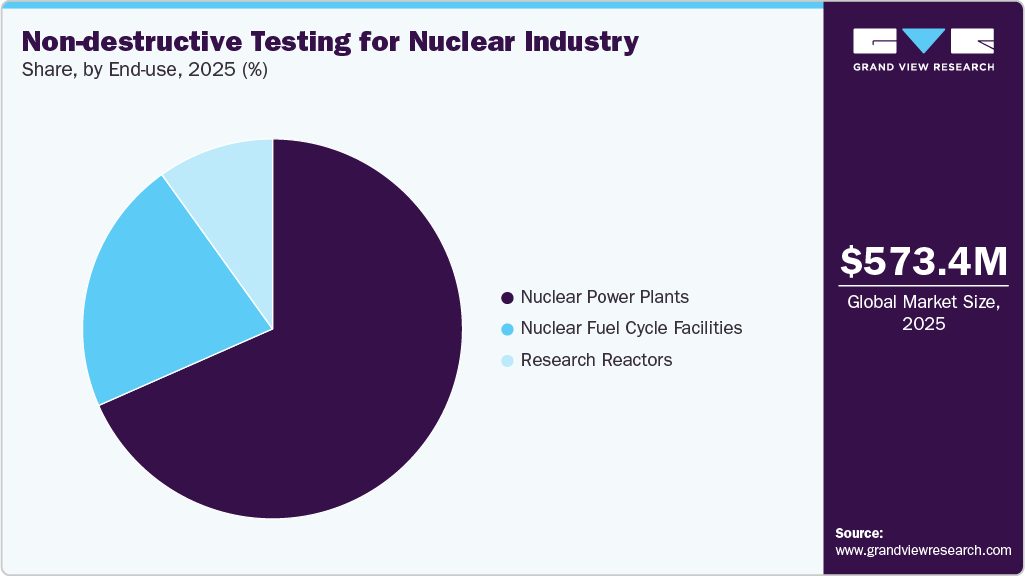
The nuclear power plants segment dominated the market in 2025. The segment’s growth is primarily driven by stringent regulatory requirements and the aging nuclear reactor. Strict government regulations pertaining to labor safety results in increasing adoption of NDT services for continuous inspection and monitoring. Moreover, the aging nuclear reactors in several regions has significantly increased the frequency of inspection and maintenance activities, as older infrastructure requires more rigorous, frequent assessments to prevent failures and extend operational life.
 To learn more about this report, Download Free Sample Report
 The nuclear fuel cycle facilities segment is expected to grow at the fastest CAGR during the forecast period. The segment’s growth can be attributed to the expansion of nuclear energy programs and the increasing need for secure management of nuclear materials. As nuclear facilities for fuel fabrication, enrichment, storage, and reprocessing are developed and upgraded, thus the demand for advanced inspection solutions is increasing to maintain efficiency and meet strict safety and quality standards. Moreover, the heightened focus on risk prevention and contamination control, due to the potential impact of even minor defects, is accelerating the adoption of advanced NDT techniques. These techniques improve inspection accuracy, ensure regulatory compliance, and support the safe and long-term operation of nuclear fuel cycle facilities.
Regional Insights
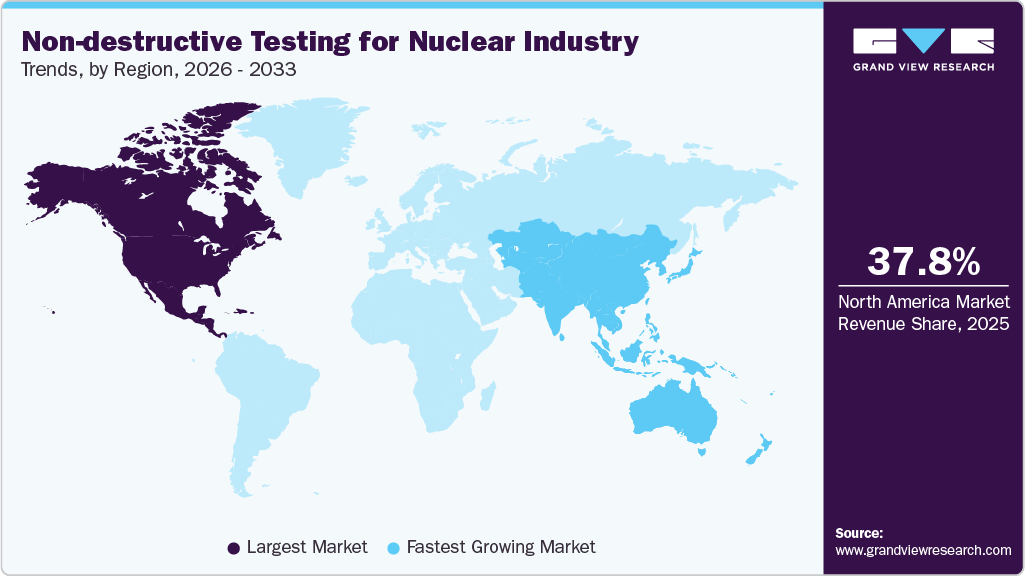
North America non-destructive testing for nuclear industry dominated the global market and accounted for a share of 37.8% in 2025. The region's growth is driven by a robust regulatory framework, advanced technology adoption, and a mature nuclear power infrastructure. Furthermore, regulatory oversight ensures strict compliance with safety and inspection standards, promoting the use of high-precision testing methods. For instance, the U.S. Nuclear Regulatory Commission requires periodic in-service inspections, mandating qualified non-destructive examinations of critical components, such as reactor pressure vessels and piping systems, during scheduled outages. This approach enables early flaw detection and encourages ongoing adoption of advanced NDT techniques. Moreover, the presence of leading NDT service providers and the continuous advancement of robotics and AI-based inspection systems also support market growth in the region.
 To learn more about this report, Download Free Sample Report
 U.S. Non-destructive Testing For Nuclear Industry Trends
The U.S. non-destructive testing for nuclear industry held a dominant position in the North American region in 2025. The country’s growth is primarily driven by the presence of a large and aging nuclear reactor and the increasing focus on predictive maintenance strategies. The substantial number of operational reactors require continuous inspection and monitoring to ensure safety and efficiency, driving sustained demand for advanced NDT techniques, particularly during outages and critical component evaluations. In addition, a strong emphasis is being placed on predictive maintenance, with data-driven NDT solutions used to improve asset reliability and extend the operational lifespan of nuclear facilities.
Asia Pacific Non-destructive Testing For Nuclear Industry Trends
The Asia Pacific non-destructive testing for nuclear industry is expected to grow at the fastest CAGR during the forecast period. Several countries in the region are investing in new reactor construction and upgrading existing facilities to meet rising energy demand, which is creating strong demand for advanced inspection solutions. Furthermore, stricter safety regulations and risk awareness are driving the adoption of high-precision, automated NDT technologies. For instance, in March 2025, China Nuclear Power Operation Technology Corporation implemented the DeepSeek AI platform, improving data analysis and response efficiency by 40% to 50%. In addition, advanced robotics, independently developed by China National Nuclear Corporation, has been used for non-destructive testing in high-radiation environments, enhancing safety and operational efficiency. This development highlights the region’s growing emphasis on integrating advanced NDT solutions to support safe and large-scale nuclear operations.
The China non-destructive testing for nuclear industry held a significant market share in 2025 in the Asia Pacific region. The country is continuously developing new reactors and upgrading existing facilities, thereby generating substantial demand for advanced inspection technologies. Furthermore, the rapid adoption of digital and automated NDT solutions, including AI-based analytics and robotic inspection systems, is improving inspection efficiency, particularly in high-radiation and complex environments, thereby accelerating the deployment of high-precision NDT techniques.
India non-destructive testing for nuclear industry is expected to grow at the fastest growth rate during the forecast period. The country’s growth is propelled by increasing integration of advanced inspection methods, such as automated ultrasonic testing and remote monitoring systems, to improve maintenance efficiency and reduce human exposure to hazardous environments. Furthermore, rising investments in indigenous nuclear technologies and infrastructure development are contributing to the demand for reliable and cost-effective NDT solutions tailored to local operational requirements.
Europe Non-destructive Testing For Nuclear Industry Trends
Europe non-destructive testing for nuclear industry is expected to register a moderate CAGR from 2026 to 2033. Many countries in the region are extending the operational life of aging nuclear reactors, increasing the need for frequent, highly reliable inspection services. Moreover, strict regulatory frameworks are implemented to ensure high safety and inspection standards across all nuclear facilities. For instance, bodies such as the European Nuclear Safety Regulators Group play a key role in coordinating regulatory approaches among European countries by issuing safety recommendations and guidelines for nuclear operations. This has led to the widespread adoption of advanced NDT technologies, including automated and digital inspection systems, to improve accuracy and ensure compliance.
The UK non-destructive testing for nuclear industry is expected to grow at a significant growth rate during the forecast period. The country has a significant number of reactors approaching the end of their operational life, creating strong demand for inspection and monitoring solutions during decommissioning activities to ensure safe dismantling and waste handling. Moreover, investments in new nuclear projects, including next-generation reactor designs, are increasing the need for advanced NDT applications during construction and commissioning phases.
The France non-destructive testing for nuclear industry held a substantial market share in 2025. The country’s growth is propelled by strong reliance on nuclear energy and its well-established nuclear infrastructure. France operates one of the key nuclear power fleets globally, led by Électricité de France (EDF), which necessitates continuous inspection, maintenance, and safety assurance of reactors and related components. Stringent regulatory requirements enforced by the Autorité de sûreté nucléaire (ASN) further drive the demand for advanced NDT solutions to ensure operational safety and compliance.
Key Non-destructive Testing For Nuclear Industry Company Insights
Some of the key companies in the non-destructive testing for nuclear industry include Mistras Group, SGS SA, Intertek Group plc, among others. Organizations are focusing on increasing customer base to gain a competitive edge in the industry. Therefore, key players are taking several strategic initiatives, such as mergers and acquisitions, and partnerships with other major companies.
-
Mistras Group is a provider of asset integrity management and non-destructive testing services for the nuclear industry. The company supports nuclear power plants throughout their entire lifecycle, including construction, operation, maintenance, and decommissioning. Its services are critical in ensuring structural reliability and safe operation of nuclear assets. The company specializes in advanced NDT techniques, including ultrasonic, acoustic emission, and radiographic testing. It is particularly recognized for its structural health monitoring systems, which enable early detection of defects and help operators meet strict regulatory requirements.
-
SGS SA provides testing, inspection, and certification services, which are essential to the nuclear industry in maintaining safety and compliance. The company offers a wide range of non-destructive testing services along with materials testing, inspection, and third-party certification for nuclear facilities. SGS SA leverages advanced technologies such as digital inspection tools and automated NDT systems to improve accuracy and efficiency. The company's independence and expertise in international standards enables it to support nuclear operators and regulators by ensuring strict compliance with quality and safety standards for reliable, long-term plant operations.
Key Non-destructive Testing For Nuclear Industry Companies:
The following key companies have been profiled for this study on the non-destructive testing for nuclear industry.
- Mistras Group
- SGS SA
- Intertek Group plc
- Applus+
- Baker Hughes Company
- Bureau Veritas
- Olympus Corporation
- Eddyfi Technologies
- Element Materials Technology
- Framatome
Recent Developments
-
In July 2025, Bureau Veritas, provider of testing, inspection, and certification (TIC) services, signed agreements for three targeted acquisitions across cybersecurity, nuclear, and sustainability sectors to strengthen its service portfolio. As part of this strategy, the company acquired Dornier Hinneburg in Spain from Dornier Group to expand its capabilities in the nuclear industry. The acquisition was aimed at enhancing technical advisory and radiation protection services, particularly in nuclear decommissioning.
-
In May 2025, SGS SA, provider of inspection, verification, testing and certification services, announced the opening of a new non-destructive testing (NDT) facility in Whangārei, New Zealand, to expand its service capabilities in the Northland region. The facility was a strategic investment aimed at increasing capacity and meeting growing demand for NDT services nationwide. SGS also expanded its team by adding certified professionals to improve service delivery. The new site was equipped to offer both standard and advanced NDT techniques to support asset integrity, regulatory compliance, and operational reliability.
Non-destructive Testing For Nuclear Industry Report Scope
Report Attribute
Details
Market size in 2025
USD 573.4 million
Estimated Market size in 2026
USD 617.4 million
Projected Market size by 2033
USD 1,120.4 million
Growth rate
CAGR of 8.9% from 2026 to 2033
Base year for estimation
2025
Historical data
2021 - 2024
Forecast period
2026 - 2033
Quantitative units
Revenue in USD million and CAGR from 2026 to 2033
Report coverage
Revenue forecast, company ranking, competitive landscape, growth factors, and trends
Segments covered
Type, application, end-use, region
Regional scope
North America; Europe; Asia Pacific; Latin America; MEA
Country scope
U.S.; Canada; Mexico; Spain; UK; France; China; Japan; India; South Korea; Australia; Brazil; UAE; South Africa
Key companies profiled
MISTRAS Group; SGS SA; Intertek Group plc; Applus+; Baker Hughes Company; Bureau Veritas; Olympus Corporation; Eddyfi Technologies; Element Materials Technology; Framatome
Customization scope
Free report customization (equivalent up to 8 analysts working days) with purchase. Addition or alteration to country, regional & segment scope.
Pricing and purchase options
Avail customized purchase options to meet your exact research needs. Explore purchase options
Global Non-destructive Testing For Nuclear Industry Report Segmentation
This report forecasts revenue growth at global, regional, and country levels and provides an analysis of the latest industry trends in each of the sub-segments from 2021 to 2033. For this study, Grand View Research has segmented the global non-destructive testing for nuclear industry report based on type, application, end-use, and region:
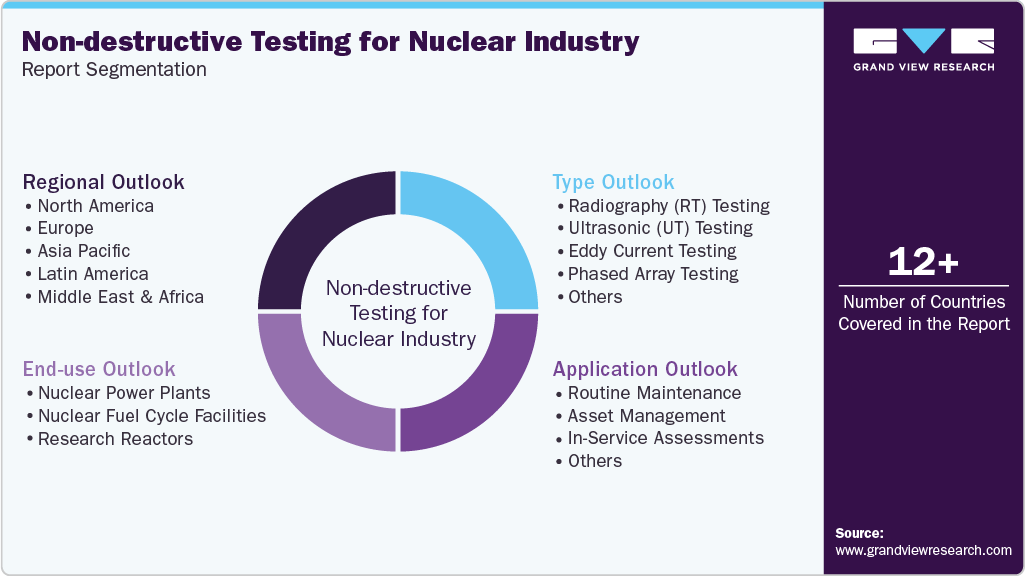 To learn more about this report, Download Free Sample Report
 -
Type Outlook (Revenue, USD Million, 2021 - 2033)
-
Radiography (RT) Testing
-
Ultrasonic (UT) Testing
-
Eddy Current Testing
-
Phased Array Testing
-
Others
-
-
Application Outlook (Revenue, USD Million, 2021 - 2033)
-
Routine Maintenance
-
Asset Management
-
In-Service Assessments
-
Others
-
-
End-use Outlook (Revenue, USD Million, 2021 - 2033)
-
Nuclear Power Plants
-
Nuclear Fuel Cycle Facilities
-
Research Reactors
-
-
Regional Outlook (Revenue, USD Million, 2021 - 2033)
-
North America
-
U.S.
-
Canada
-
Mexico
-
-
Europe
-
UK
-
France
-
Spain
-
-
Asia Pacific
-
China
-
Japan
-
India
-
South Korea
-
Australia
-
-
Latin America
-
Brazil
-
-
Middle East and Africa (MEA)
-
UAE
-
South Africa
-
-
Frequently Asked Questions About This Report
North America dominated with a 37.8% revenue share in 2025.
Asia Pacific is the fastest-growing region over the forecast period.
The routine maintenance segment held the largest revenue share in 2025, while asset management is the fastest-growing application.
The nuclear power plants segment held the largest revenue share in 2025, while nuclear fuel cycle facilities is the fastest-growing segment.
The ultrasonic (UT) testing segment dominated the market in 2025 and accounted for the largest share of 32.8%. The segment growth is driven by its long-standing adoption as a reliable, standardized inspection technique across nuclear facilities.
Key players include MISTRAS Group; SGS SA; Intertek Group plc; Applus+; Baker Hughes Company; Bureau Veritas; Olympus Corporation; Eddyfi Technologies; Element Materials Technology; Framatome.
The market growth is attributed to stringent safety regulations and the aging fleet of nuclear power plants, which ensure operational safety and prevent potential hazards, thereby driving continuous demand for advanced inspection and testing services.
The global non-destructive testing for nuclear industry size was valued at USD 573.4 million in 2025 and is estimated at USD 671.4 million for 2026.
The global non-destructive testing for nuclear industry is expected to grow at a CAGR of 8.9% from 2026 to 2033, reaching USD 1,120.4 million by 2033.
About the Author(s)
Electronic Devices Research Team
Semiconductors & Electronics · Electronic DevicesThis report was authored by the electronic devices research team at Grand View Research - comprising two research analysts, one senior research analyst, and one industry expert - with specialized expertise in the electronic devices segment of the semiconductors & electronics industry. All findings are based on proprietary semiconductors & electronics databases, executive interviews, and regulatory analysis, subject to internal peer review prior to publication.
Last Updated:
Speak to Analyst

Customize this report to your needs - add regions, segments, or data points, with 20% free customization.
Or view our licence options:


ISO 9001:2015 & 27001:2022 Certified
We are GDPR and CCPA compliant! Your transaction & personal information is safe and secure. For more details, please read our privacy policy.


