
- Home
- »
- Specialty & Chemicals
- »
-
North America beverage botanical ingredients Market Report, 2026-2033GVR Report cover

North America Beverage Botanical Ingredients Market (2026 - 2033)
Size, Share & Trends Analysis Report By Ingredient Type (Whole & Cut Botanicals, Powdered Botanicals, Essential Oils & Oleoresins, Botanical Colorants, Botanical Extracts), By Country, And Segment Forecasts
Market Size, 2025
$2.4BMarket Estimate, 2026
$2.5BMarket Forecast, 2033
$3.6BCAGR, 2026–2033
5.1%North America Beverage Botanical Ingredients Market Summary
The North America beverage botanical ingredients market size was valued at USD 2.4 billion in 2025 and is projected to grow from USD 2.5 billion in 2026 to USD 3.6 billion in 2033, at a CAGR of 5.1% from 2026 to 2033. The growth is supported by increasing consumer preference for natural, clean-label beverages enriched with ingredients that provide functional health benefits such as immunity support, stress relief, and digestive wellness.
Key Market Trends & Insights
- By ingredient type: The botanical extracts (including liquid & dry) segment held the largest revenue share of 49.8% in 2025.
Regional Highlights
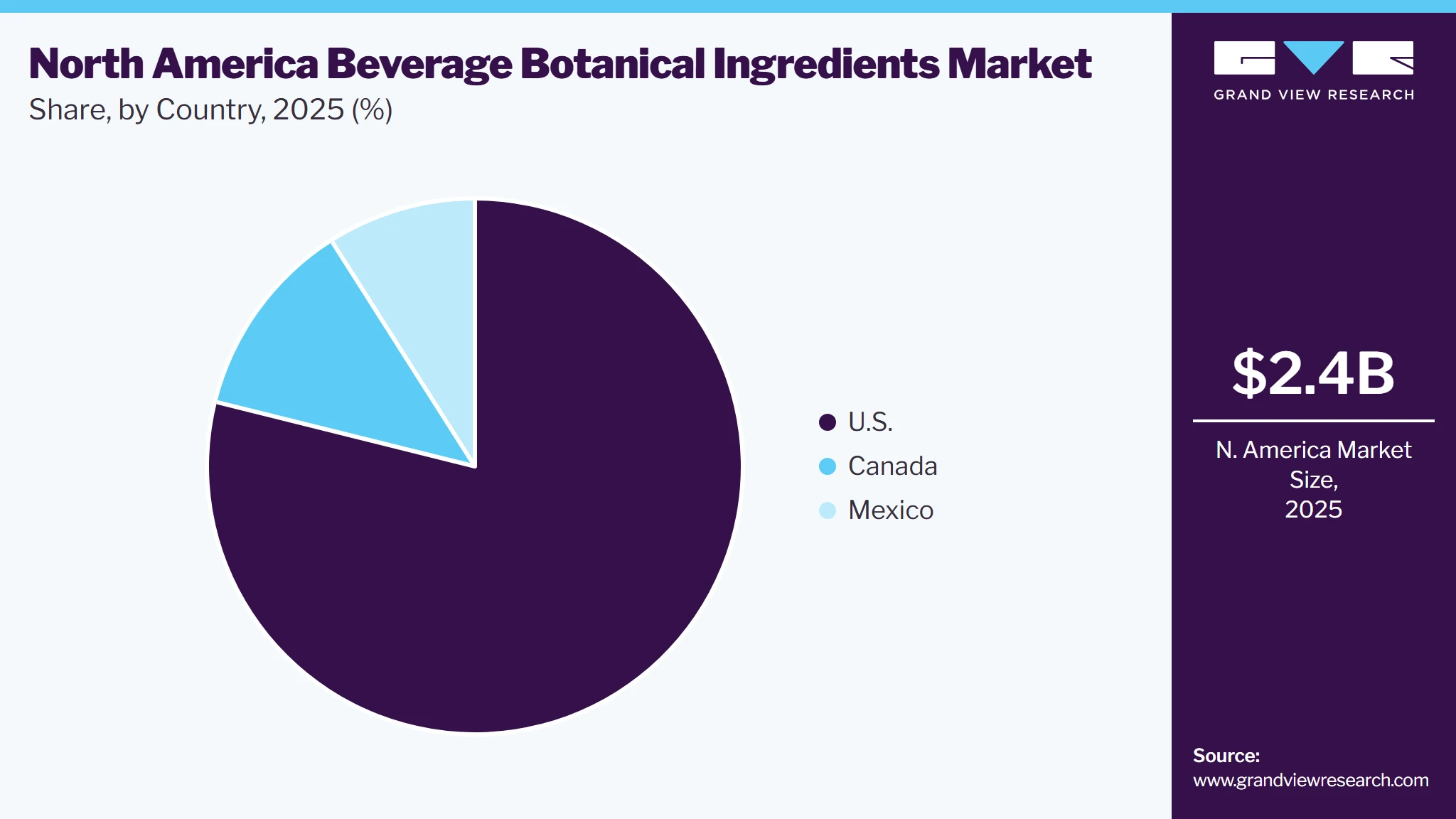
- Largest country market: The U.S. (84.3% revenue share, 2025)
- Fastest-growing country market: Mexico (fastest CAGR, 2026-2033)
Market Size & Forecast
- Market size in 2025: USD 2.4 Billion
- Estimated market size in 2026: USD 2.5 Billion
- Projected market size by 2033: USD 3.6 Billion
- CAGR (2026-2033): 5.1%
Prism AI by Grand View Research Free to tryAsk a question about the north america beverage botanical ingredients marketTry asking✓Every figure cited from GVR research Prefer the report? Download free sample →
Consumers are increasingly prioritizing health, wellness, and transparency when selecting beverages, resulting in a strong preference for products formulated with naturally derived botanical ingredients. Categories such as ready-to-drink teas, functional waters, kombucha, plant-based beverages, energy drinks, and wellness shots are witnessing higher adoption as consumers seek products that deliver benefits, including immune support, digestive health, cognitive performance, hydration, relaxation, and stress management. Herbal extracts, floral infusions, spices, and fruit-derived extracts are increasingly being incorporated to provide both functional value and authentic natural flavors.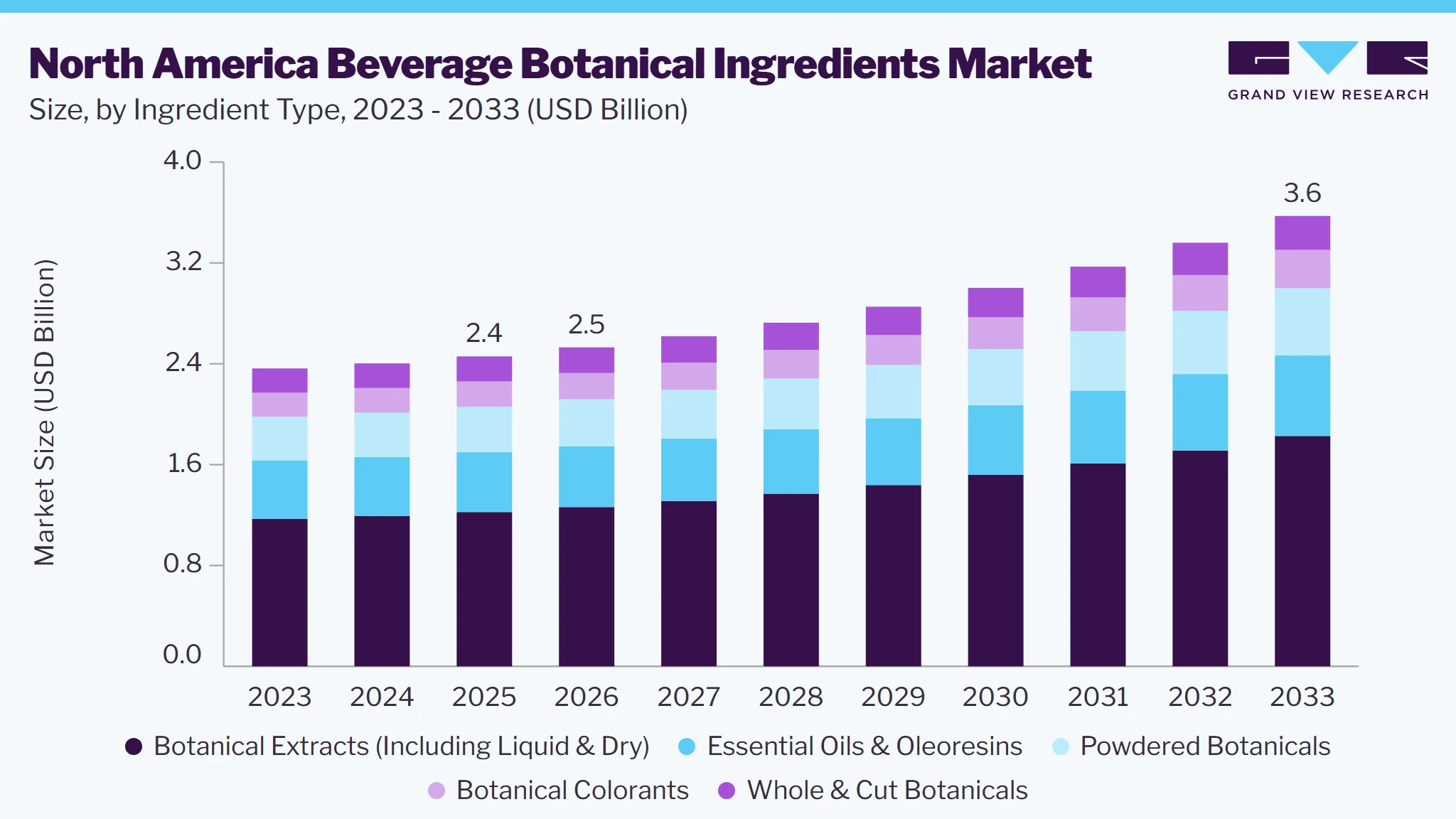 Source: Grand View Research, IR Documents, Primary Interviews, Paid DatabasesTo learn more about this report,
 Download Free Sample Report
Market Dynamics
The North America beverage botanical ingredients market is supported by increasing consumer demand for natural, clean-label, and plant-based beverages that offer both flavor enhancement and functional health benefits. Growing interest in wellness-oriented products, including functional beverages, herbal teas, flavored waters, kombucha, and botanical-infused energy drinks, is encouraging beverage manufacturers to incorporate botanical extracts, essential oils, natural colorants, and other plant-derived ingredients into their formulations. Advances in extraction and processing technologies are improving ingredient stability, solubility, and consistency, enabling the development of high-performance botanical solutions tailored for a wide range of beverage applications. In addition, the premiumization of beverages and rising consumer interest in immunity support, digestive health, stress management, and hydration are creating opportunities for suppliers to develop innovative, value-added botanical ingredient portfolios. To strengthen their competitive position, companies are investing in sustainable sourcing, advanced extraction technologies, strategic collaborations with beverage manufacturers, and customized ingredient solutions, enabling them to meet evolving consumer expectations while reinforcing long-term growth in the North American beverage industry.
The growing consumer focus on health and wellness is a primary factor driving the North America beverage botanical ingredients market. Consumers are increasingly seeking beverages formulated with naturally derived ingredients that provide functional benefits beyond basic nutrition, including immune support, digestive health, cognitive wellness, hydration, and stress management. This evolving preference has accelerated demand for botanical extracts, herbal infusions, essential oils, and natural colorants across a wide range of beverage categories, including ready-to-drink teas, flavored waters, kombucha, sports drinks, energy beverages, and low- or no-alcohol drinks. As ingredient transparency becomes a key purchasing criterion, manufacturers are prioritizing clean-label formulations that eliminate artificial additives and emphasize recognizable plant-based ingredients.
In response to these changing consumption patterns, beverage manufacturers are expanding investments in botanical ingredient innovation and premium product development. Ingredient suppliers are introducing standardized botanical extracts with improved functionality, flavor consistency, and processing stability, enabling beverage companies to deliver differentiated products while maintaining production efficiency. Continuous innovation in botanical formulations, coupled with growing demand for premium wellness beverages, is expected to sustain long-term market expansion and strengthen the adoption of botanical ingredients across the North American beverage sector.
Compliance with evolving food safety regulations and labeling requirements represents a significant restraint for the North America beverage botanical ingredients market. Botanical ingredients intended for beverage applications must meet rigorous standards related to ingredient safety, quality, traceability, permissible usage levels, and labeling established by regulatory authorities. Manufacturers must ensure that health, nutritional, and functional benefit claims are supported by adequate scientific evidence to comply with advertising and food labeling regulations. These requirements increase the complexity of product development and extend commercialization timelines, particularly for beverages incorporating novel or less-established botanical ingredients.
The regulatory landscape also varies across North American countries, requiring companies to adapt formulations, documentation, and labeling strategies to meet country-specific compliance requirements. Ingredient suppliers and beverage manufacturers must invest in extensive testing, quality assurance programs, regulatory expertise, and scientific validation to support market access and maintain consumer confidence. These additional compliance costs and longer approval processes can be particularly challenging for small and mid-sized companies, potentially slowing innovation and limiting the speed at which new botanical beverage products are introduced to the market.
The increasing emphasis on sustainability and premium product positioning presents a significant opportunity for companies operating in the North America beverage botanical ingredients market. Beverage brands are actively seeking responsibly sourced botanical ingredients that support corporate sustainability objectives while addressing consumer demand for environmentally responsible products. Investments in traceable supply chains, regenerative agricultural practices, and certified botanical sourcing are creating opportunities for ingredient manufacturers to strengthen customer relationships and differentiate their offerings in an increasingly competitive marketplace.
At the same time, technological advancements in extraction and formulation are enabling the commercialization of next-generation botanical ingredients with improved solubility, stability, and functionality. The development of multifunctional botanical blends, water-dispersible extracts, and naturally derived flavor and color systems allows beverage manufacturers to create premium products that deliver both sensory appeal and targeted health benefits. As consumers continue to embrace premium, plant-based, and wellness-focused beverages, suppliers that invest in sustainable innovation and high-value ingredient solutions are expected to capture significant long-term growth opportunities.
Market Concentration & Characteristics
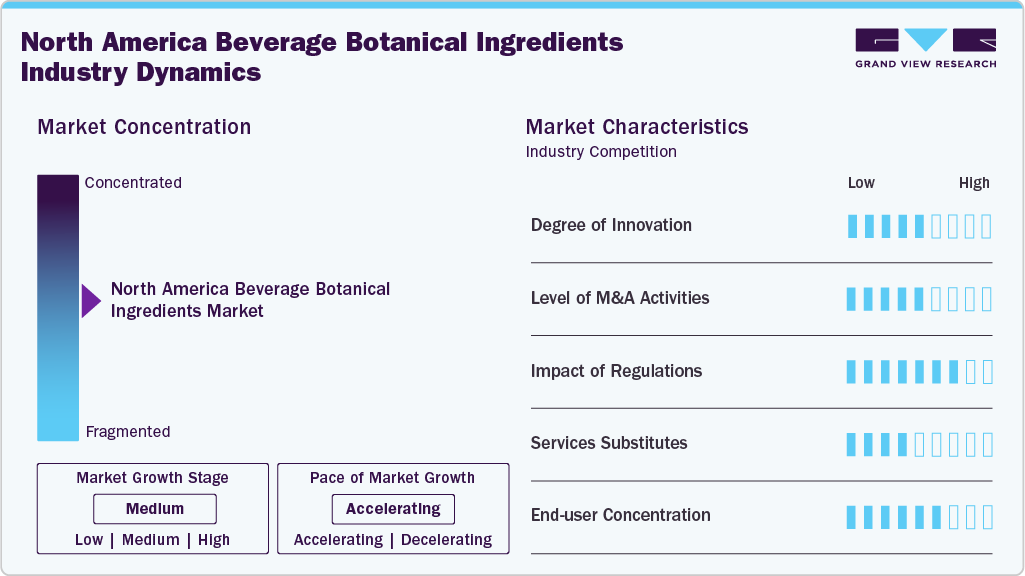
The North America beverage botanical ingredients industry is moderately consolidated, with competition centered on product innovation, botanical sourcing capabilities, extraction technologies, formulation expertise, and long-term supply partnerships with beverage manufacturers. Leading companies are expanding their portfolios of botanical extracts, essential oils, natural colorants, and functional plant-based ingredients to address the growing demand for clean-label, wellness-oriented, and premium beverage formulations. Investments in advanced extraction methods, standardized ingredient quality, and sustainable sourcing practices have become key competitive differentiators.
 To learn more about this report, Download Free Sample Report
Participants are also strengthening their position through strategic acquisitions, collaborative product development, and expansion of regional manufacturing and application support capabilities. Companies are increasingly working with beverage brands to develop customized solutions tailored to specific flavor profiles, functional claims, and processing requirements. In addition, investments in traceable supply chains, regenerative sourcing programs, and research are enabling manufacturers to differentiate their offerings while meeting evolving regulatory requirements and consumer expectations.
Analyst Perspective
The North America beverage botanical ingredients market is driven by the rising popularity of functional, clean-label, and plant-based beverages. Consumer demand for natural ingredients with health and wellness benefits is driving innovation in botanical extracts, natural colorants, and flavor solutions across diverse beverage categories. Advances in extraction technologies and sustainable sourcing practices are enhancing ingredient performance and supply chain resilience. Companies that invest in customized botanical formulations, traceable sourcing, and premium product development are expected to strengthen their competitive advantage and capitalize on evolving consumer preferences.
Ingredient Type Insights
Botanical extracts (including liquid & dry) led the North America beverage botanical ingredients industry, accounting for the largest revenue share of 49.8% in 2025, due to their versatility, standardized compositions, and ability to deliver both functional benefits and natural flavor enhancement in beverage applications. Their high solubility, formulation flexibility, and compatibility with a broad range of beverages-including herbal teas, energy drinks, flavored waters, and wellness beverages-have made them the preferred ingredient format for manufacturers. Increasing demand for plant-based functional ingredients and premium beverage innovation continues to reinforce the segment's market leadership.
The botanical colorants segment is expected to grow at the fastest CAGR of 5.6% from 2026 to 2033. The segment growth is driven by the increasing replacement of synthetic food colors with naturally derived alternatives in formulations. Growing consumer preference for clean-label products, coupled with stricter scrutiny of artificial additives, is encouraging beverage manufacturers to incorporate plant-based colorants sourced from fruits, vegetables, flowers, and spices. Continuous advancements in color stability and processing technologies are further expanding their application across functional beverages, flavored waters, juices, and premium ready-to-drink products.
Country Insights
The North America beverage botanical ingredient market is expected to grow at a CAGR of 5.1% during the forecast period. North America represents one of the most developed markets, supported by rising consumer demand for natural, functional, and premium products. Botanical ingredients are increasingly being incorporated into ready-to-drink teas, flavored waters, energy drinks, sports beverages, kombucha, and premium non-alcoholic beverages as manufacturers seek to differentiate products through unique flavor profiles and wellness-oriented positioning. Ingredients such as hibiscus, ginger, chamomile, elderberry, peppermint, and green tea have transitioned from niche applications to mainstream beverage formulations.
 To learn more about this report, Download Free Sample Report
U.S. Beverage Botanical Ingredients Market Trends
The U.S accounted for 78.9% of the North America beverage botanical ingredients industry in 2025, making it the dominant contributor to regional revenue. The U.S. serves as the primary growth contributor due to its highly developed beverage sector and strong culture of product innovation. The market is characterized by the rapid adoption of emerging beverage concepts, particularly within functional beverages, premium teas, botanical waters, and wellness-focused drink categories. Consumers increasingly favor products formulated with recognizable plant-based ingredients, encouraging beverage companies to expand the use of botanical extracts, herbal infusions, and natural flavor systems.
Canada Beverage Botanical Ingredients Market Trends
Canada's beverage botanical ingredients market is being shaped by rising demand for clean label, minimally processed, and naturally sourced beverages. Consumers increasingly prioritize ingredient transparency and authenticity, leading beverage manufacturers to incorporate botanical ingredients that align with these preferences. Botanical extracts, herbal infusions, and natural flavor systems are gaining traction across premium teas, sparkling beverages, wellness drinks, and other health-oriented beverage categories.
Mexico Beverage Botanical Ingredients Market Trends
Mexico is supported by its rich heritage and abundant availability of indigenous herbs, spices, and fruit-derived ingredients. Growing investments in functional beverages, flavored waters, herbal teas, and natural soft drinks, along with rising consumer preference for clean-label and plant-based formulations, are driving demand for botanical ingredients. The country's expanding food and beverage manufacturing sector and increasing exports of naturally formulated beverages continue to strengthen its position within the regional market.
Key North America Beverage Botanical Ingredients Company Insights
Companies operating are adopting strategies centered on portfolio diversification, technological innovation, and sustainable sourcing to strengthen their competitive position. Leading ingredient manufacturers are expanding their offerings of botanical extracts, natural colorants, essential oils, and multifunctional plant-based ingredients to address the growing demand for clean-label and functional beverages. They are also investing in advanced extraction and processing technologies to improve ingredient purity, stability, solubility, and consistency, enabling beverage manufacturers to develop high-performance formulations with reliable sensory characteristics.
-
Döhler is a leading global supplier of natural ingredients, ingredient systems, and integrated solutions with a strong focus on botanical innovation. The company offers an extensive portfolio of botanical extracts, natural flavors, fruit and vegetable ingredients, plant-based color solutions, and functional ingredients that support clean-label and health-oriented beverage formulations. Its expertise in product development, sensory optimization, and sustainable sourcing enables manufacturers across North America to develop differentiated products that align with evolving consumer demand for natural and functional beverages.
-
Archer Daniels Midland Company (ADM) is a global leader in human nutrition and agricultural processing, providing a broad portfolio of botanical extracts, natural flavors, citrus ingredients, plant-based nutrition solutions, and specialty ingredients for the beverage industry. The company leverages its integrated global sourcing network, advanced extraction capabilities, and research and development expertise to deliver high-quality botanical ingredients that enhance flavor, functionality, and nutritional value. ADM continues to strengthen its position through investments in innovation, sustainable ingredient sourcing, and customized formulation solutions for functional and clean-label beverages.
Key North America Beverage Botanical Ingredients Companies
-
Givaudan
-
Symrise
-
International Flavors & Fragrances (IFF)
-
Sensient Technologies Corporation
-
Döhler
-
MartinBauer Group
-
Kalsec, Inc.
-
Bio-Botanica, Inc.
-
Prinova
-
Archer Daniels Midland Company
Competitive Benchmarking
Operating Strategies
Competitive Edge
Weaknesses
Mature Players: Givaudan; Symrise; International Flavors & Fragrances (IFF); Sensient Technologies Corporation; Döhler; MartinBauer Group; Kalsec, Inc.; Archer Daniels Midland Company (ADM)
- Invest heavily in R&D to develop innovative botanical extracts, natural colorants, and functional ingredient solutions.
- Expand through acquisitions, strategic partnerships, and regional manufacturing facilities.
- Strengthen sustainable sourcing, traceability, and certified botanical supply chains.
- Collaborate with beverage manufacturers to develop customized ingredient systems for premium and functional beverages.
- Extensive global sourcing networks ensure consistent access to high-quality botanical raw materials.
- Broad and diversified product portfolios cater to multiple beverage applications.
- Strong formulation expertise and technical support capabilities foster long-term customer relationships.
- Established global brands, financial strength, and extensive distribution networks reinforce market leadership.
- Large organizational structures can slow innovation and decision-making.
- High operating and regulatory compliance costs impact cost competitiveness.
- Less flexibility in addressing niche or rapidly evolving market requirements.
- Complex global operations increase integration and supply chain management challenges.
Emerging Players: Bio-Botanica, Inc.; Prinova
- Focus on specialty botanical extracts and customized ingredient solutions.
- Develop clean-label, organic, and plant-based botanical ingredient portfolios.
- Form strategic partnerships with regional beverage manufacturers and distributors.
- Enhance customer engagement through technical support and targeted product innovation.
- High operational agility enables faster response to changing consumer trends.
- Specialized expertise in niche botanical ingredients creates product differentiation.
- Flexible business models support customized formulations and shorter development cycles.
- Strong customer focus enables tailored solutions for regional beverage brands.
- Limited manufacturing capacity compared to multinational competitors.
- Smaller geographic presence restricts market penetration.
- Lower R&D investment limits the pace of product and technology development.
- Greater exposure to raw material price fluctuations and supply chain disruptions due to limited sourcing scale.
Recent Developments
-
In October 2025, MartinBauer announced the acquisition of American Botanicals, a leading U.S. supplier of wildcrafted botanical ingredients. The acquisition significantly expands MartinBauer’s agricultural footprint across the U.S. and strengthens its access to domestically sourced botanical raw materials.
-
In February 2026, Döhler North America acquired Premier Juices to strengthen its position and expand its capabilities in fruit-based ingredient solutions. The acquisition enhances Döhler’s access to high-quality juice ingredients, strengthens regional production capabilities, and improves its ability to serve beverage manufacturers with customized ingredient solutions.
North America Beverage Botanical Ingredients Market Report Scope
Report Attribute
Details
Market size in 2025
USD 2.4 billion
Estimated market size in 2026
USD 2.5 billion
Projected market size by 2033
USD 3.6 billion
Growth rate
CAGR of 5.1% from 2026 to 2033
Base year for estimation
2025
Historical data
2021 - 2024
Forecast period
2026 - 2033
Quantitative units
Revenue in USD million/billion and CAGR from 2026 to 2033
Report coverage
Revenue forecast, company ranking, competitive landscape, growth factors, and trends
Segments covered
Ingredient type, country
Country scope
U.S.; Canada; Mexico
Key companies profiled
Givaudan; Symrise; International Flavors & Fragrances (IFF); Sensient Technologies Corporation; Döhler; MartinBauer Group; Kalsec; Inc.; Bio-Botanica; Inc.; Prinova; Archer Daniels Midland Company
Customization scope
Free report customization (equivalent up to 8 analysts’ working days) with purchase. Addition or alteration to country, regional & segment scope.
Pricing and purchase options
Avail customized purchase options to meet your exact research needs. Explore purchase options
North America beverage botanical ingredients Market Report Segmentation
This report forecasts revenue growth at the regional and country levels and provides an analysis of the latest industry trends in each of the sub-segments from 2021 to 2033. For this study, Grand View Research has segmented the North America beverage botanical ingredients market report based on ingredient type and country:
-
Ingredient Type Outlook (Revenue, USD Million/Billion, 2021 - 2033)
-
Whole & Cut Botanicals
-
Powdered Botanicals
-
Botanical Extracts (including liquid & dry)
-
Essential Oils & Oleoresins
-
Botanical Colorants
-
-
Country Outlook (Revenue, USD Million/Billion, 2021 - 2033)
-
U.S.
-
Canada
-
Mexico
-
Research Methodology
The North America beverage botanical ingredients market figures in this report are based on a proven research process that combines executive interviews with secondary research from proprietary databases, company filings, and recognized regulatory and institutional sources. Market size is built through value-chain sizing-reconciling supply-side and demand-side estimates-and triangulated with bottom-up and top-down approaches. Every estimate passes multiple levels of expert validation before publication, with each North America beverage botanical ingredients segment quantified using the revenue-capture definitions in the table below.
Segment Definition
Segment - Ingredient Type
Revenue capture definition
Whole & Cut Botanicals
Market value is created through the commercial supply of dried herbs, flowers, roots, leaves, bark, and spices incorporated into herbal infusions, botanical teas, craft beverages, and specialty drink formulations. Rising preference for authentic and minimally processed ingredients continues to strengthen demand.
Powdered Botanicals
Sales are generated from the manufacture and distribution of finely milled plant-based powders used in instant beverage mixes, fortified drinks, functional nutrition products, and wellness beverages. Their formulation flexibility, longer shelf life, and ease of handling support increasing industry adoption.
Botanical Extracts (including liquid & dry)
Income is driven by the commercialization of concentrated liquid and dry extracts that provide natural flavor, aroma, color, and functional properties across a broad spectrum of beverage applications. Their superior consistency, standardized composition, and formulation versatility make them the largest value-generating ingredient category.
Essential Oils & Oleoresins
Commercial returns arise from the utilization of concentrated aromatic oils and oleoresins that enhance flavor complexity and sensory characteristics in premium beverages, botanical drinks, mixers, and alcoholic formulations. Expanding demand for natural flavor systems continues to support segment growth.
Botanical Colorants
Market earnings are supported by the supply of naturally derived pigments extracted from botanical sources that enhance visual appeal while replacing synthetic coloring agents in beverage formulations. Greater emphasis on clean-label products and naturally sourced ingredients is accelerating adoption across multiple beverage categories
Estimation Model
Layer Name
Key Question
Description
Raw Material & Production Layer
What forms the supply base?
Identify the sourcing and production of beverage botanical ingredients derived from herbs, spices, flowers, fruits, roots, leaves, bark, seeds, and other plant-based raw materials. Evaluate cultivation and harvesting practices, extraction technologies (including solvent extraction, steam distillation, cold pressing, and supercritical CO₂ extraction), ingredient standardization, processing capacities, supply chain dynamics, and key production hubs supporting commercial availability across North America.
Application Adoption Layer
Where are beverage botanical ingredients consumed?
Assess the adoption of botanical ingredients across major beverage applications, including functional beverages, ready-to-drink (RTD) teas, flavored waters, juices, energy drinks, sports beverages, kombucha, alcoholic beverages, and botanical soft drinks. Demand is driven by increasing consumer preference for clean-label, plant-based, naturally flavored, and wellness-focused beverage formulations, alongside continuous product innovation by beverage manufacturers.
Consumption Intensity Layer
How many botanical ingredients are utilized?
Analyze ingredient consumption by evaluating the use of botanical extracts, essential oils, botanical colorants, powdered botanicals, and whole & cut botanicals in finished beverage products. The assessment considers formulation dosage, production volumes, new product introductions, consumer purchasing trends, and beverage manufacturing activity to estimate annual botanical ingredient utilization across North America.
Revenue Layer
How is market revenue generated?
Market revenue is generated through the cultivation, extraction, processing, formulation, and commercial sale of botanical ingredients used in beverage applications, including botanical extracts, essential oils, botanical colorants, powdered botanicals, and whole & cut botanicals. Revenue growth is supported by expanding demand for functional and clean-label beverages, premium product innovation, sustainable sourcing initiatives, and the increasing use of plant-based ingredients that enhance flavor, color, aroma, and nutritional functionality.
Delivered Customizations
This report has been delivered with the following In-depth customizations
Client Request
Customization Delivered
Value Adds
Regional segmentation
The assessment includes country-level market size and forecasts; demand patterns by ingredient type and beverage application; consumption trends for functional beverages, RTD teas, flavored waters, juices, energy drinks, and alcoholic beverages; regulatory and clean-label developments; domestic production and import-export dynamics; competitive landscape; distribution networks; consumer purchasing behavior; and investment opportunities shaping the botanical ingredients market across each country.
Supports sourcing optimization, supplier evaluation, and pricing strategy development by providing visibility into ingredient cost drivers, seasonal procurement risks, and regional price competitiveness. Helps identify premium pricing opportunities for sustainably sourced and clean-label botanical ingredients while improving cost management, procurement planning, and long-term supplier negotiations.
Opportunity Assessment
Detailed evaluation of emerging growth opportunities across functional beverages, botanical-infused sparkling waters, herbal teas, energy and wellness drinks, kombucha, natural flavor systems, and clean-label beverage formulations. The assessment covers evolving consumer preferences for plant-based ingredients, innovations in botanical extraction technologies, demand for adaptogens and herbal extracts, sustainable sourcing initiatives, and opportunities created by premium beverage innovation across the U.S., Canada, and Mexico.
Enables prioritization of high-growth beverage categories and investment opportunities across the North American botanical ingredients value chain. Supports strategic expansion, product innovation, premium portfolio development, and sustainability initiatives through insights into evolving consumer preferences, technological advancements, regulatory developments, and long-term demand potential for botanical beverage ingredients.
Competitive Benchmarking
Comparative assessment of leading North America beverage botanical ingredient suppliers based on product portfolio, botanical sourcing capabilities, extraction technologies, sustainability initiatives, manufacturing footprint, innovation capabilities, regional presence, strategic partnerships, and expansion strategies. The benchmarking also evaluates expertise in botanical extracts, essential oils, natural colorants, functional ingredient systems, application support, and supply chain resilience for beverage manufacturers.
Supports benchmarking against key competitors while identifying gaps in product innovation, sourcing efficiency, technological capabilities, and customer engagement. Enables informed decision-making related to strategic alliances, portfolio enhancement, manufacturing investments, market expansion, and long-term competitive positioning within the North America beverage botanical ingredients market.
Frequently Asked Questions About This Report
The North America beverage botanical ingredients market size was estimated at USD 2.4 billion in 2025 and is projected to grow from USD 2.5 billion in 2026.
The North America beverage botanical ingredients market is growing at a CAGR of 5.1% from 2026 to 2033 and expected to reach USD 3.6 billion by 2033.
Based on ingredient type, the botanical extracts (including liquid & dry) segment accounted for the highest market share, representing 49.8% of total revenue in 2025. Due to their versatility, standardized composition, and ability to deliver both functional benefits and natural flavor enhancement in beverage applications.
The U.S accounted for 78.9% of the North American market in 2025, making it the dominant contributor to regional revenue. The U.S. serves as the primary growth contributor due to its highly developed beverage sector and strong culture of product innovation.
The North America beverage botanical ingredients market is driven by growing consumer demand for clean-label, plant-based, and functional beverages that offer health and wellness benefits. Rising interest in natural flavors, botanical extracts with antioxidant and adaptogenic properties, and innovative ready-to-drink formulations is further accelerating market growth, supported by continuous product innovation from beverage manufacturers.
Some of the key players operating in the North America beverage botanical ingredients market Givaudan, Symrise, International Flavors & Fragrances (IFF), Sensient Technologies Corporation, Dohler, MartinBauer Group, Kalsec, Inc., Bio-Botanica, Inc., Prinova, Archer Daniels Midland Company.
Botanical colorants is the fastest-growing ingredient type segment, with a CAGR of 5.6% from 2026 to 2033. The segment is driven by the increasing replacement of synthetic food colors with naturally derived alternatives in formulations.
Mexico is the fastest growing region with a CAGR of 5.9% in the forecast period. Mexico is supported by its rich heritage and abundant availability of indigenous herbs, spices, and fruit-derived ingredients.
The increasing emphasis on sustainability and premium product positioning presents a significant opportunity for companies operating in the North America beverage botanical ingredients market. Beverage brands are actively seeking responsibly sourced botanical ingredients that support corporate sustainability objectives while addressing consumer demand for environmentally responsible products.
About the Author(s)
Specialty & Chemicals Research Team
Research · Specialty & ChemicalsThis report was authored by the specialty & chemicals research team at Grand View Research - comprising two research analysts, one senior research analyst, and one industry expert - with specialized expertise in the specialty & chemicals segment of the research industry. All findings are based on proprietary research databases, executive interviews, and regulatory analysis, subject to internal peer review prior to publication.
Last Updated:
Speak to Analyst

Customize this report to your needs - add regions, segments, or data points, with 20% free customization.
Or view our licence options:


ISO 9001:2015 & 27001:2022 Certified
We are GDPR and CCPA compliant! Your transaction & personal information is safe and secure. For more details, please read our privacy policy.


