
- Home
- »
- Animal Health
- »
-
North America Veterinary Vitamin Manufacturing Market Report, 2033GVR Report cover

North America Veterinary Vitamin Manufacturing Market (2026 - 2033)
Size, Share & Trends Analysis Report By Animal (Production, Companion), By Product (Vitamin B12, Vitamin D3, Vitamin K), By Type, By Dosage Form, By Value Chain, By Country, And Segment Forecasts
Market Size, 2025
$439.5MMarket Estimate, 2026
$456.9MMarket Forecast, 2033
$764.3MCAGR, 2026–2033
7.6%North America Veterinary Vitamin Manufacturing Market Summary
The North America veterinary vitamin manufacturing market size was valued at USD 439.5 million in 2025 and is projected to grow from USD 456.9 million in 2026 to USD 764.3 million by 2033, at a CAGR of 7.6% from 2026 to 2033. The market growth is driven by large livestock and poultry production, rising companion animal ownership, increasing adoption of preventive animal healthcare, and growing demand for feed-grade vitamin premixes.
Key Market Trends & Insights
- By animal: Production animals segment held the largest share of 51.2% of the market in 2025.
- By product: Vitamin B-complex segment held the largest market share of 27.0% in 2025.
- By type: Finished drug products segment held the largest market share of 61.5% in 2025.
- By dosage form:Oral segment dominated the market, accounting for 74.2% in 2025.
- By value chain:Animal feed & nutrition companies accounted for the largest revenue share of 38.6% in 2025.
Market Size & Forecast
- Market Size in 2025: USD 439.5 Million
- Estimated Market Size in 2026: USD 456.9 Million
- Projected Market Size by 2033: USD 764.3 Million
- CAGR (2026-2033): 7.6%
Prism AI by Grand View Research Free to tryAsk a question about the north america veterinary vitamin manufacturing marketTry asking✓Every figure cited from GVR research Prefer the report? Download free sample →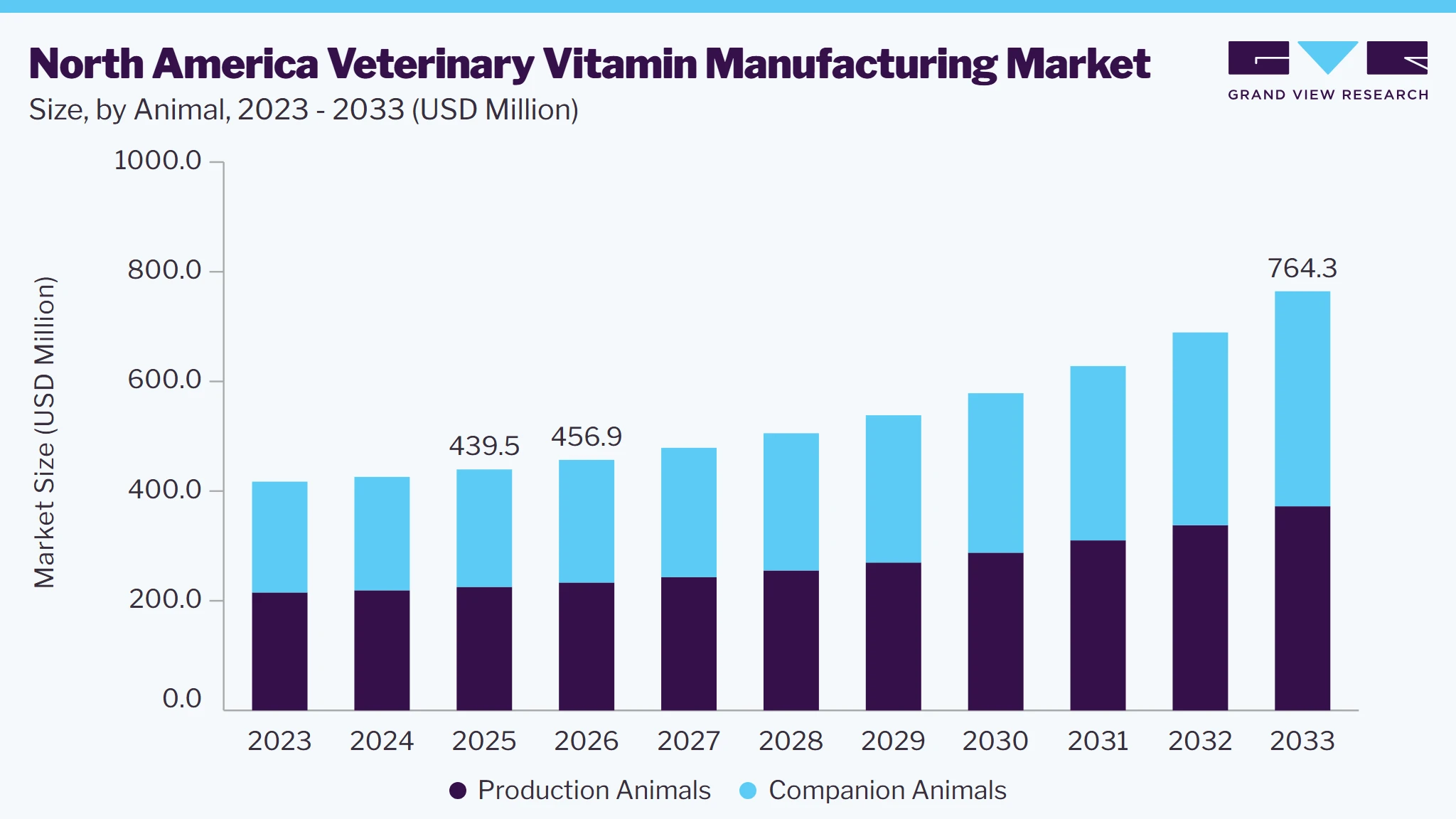 Source: Grand View Research, IR Documents, Primary Interviews, Paid DatabasesTo learn more about this report,
 Download Free Sample Report
Other factors contributing to market growth include advanced feed manufacturing infrastructure, stringent animal welfare and food safety standards, antimicrobial stewardship initiatives, higher pet wellness spending, and the presence of established animal health, nutrition, and contract manufacturing companies.
Market Dynamics
The market is shifting toward advanced formulation and stability-enhancement technologies. Manufacturers are using microencapsulation, controlled-release systems, improved emulsification, precision blending, and automated dosing to improve potency retention, batch uniformity, and feed compatibility. Digital batch monitoring, in-line quality checks, and traceability systems are also gaining relevance. Companion animal products are moving toward palatable formats such as chews, liquids, powders, and functional blends, while production animal products require heat-stable, water-soluble, and feed-compatible vitamin formats that can withstand processing, storage, and on-farm handling conditions.
The market meets challenges related to raw material price volatility, import dependence, formulation stability, regulatory complexity, and margin pressure. Several vitamin APIs and intermediates are globally sourced, exposing manufacturers to freight disruption, supplier concentration, and cost fluctuation. Stability loss during heat processing, oxidation, storage, and feed mixing is still a major technical issue, especially for sensitive vitamins. Buyers increasingly require complete documentation, traceability, and consistent batch quality, which increases the compliance burden. Feed and premix buyers remain highly price-sensitive, which pressures margins. Smaller manufacturers could struggle with supplier audits, advanced quality systems, and formulation capability.
Growing adoption of preventive animal healthcare is supporting veterinary vitamin manufacturing demand throughout North America. As vitamins are increasingly positioned as routine nutritional inputs rather than only corrective supplements, with applications across immune support, reproductive health, growth performance, recovery care, mobility, skin health, and overall animal wellness. This shift is driving demand for species-specific multivitamins, injectable vitamins, water-soluble supplements, feed premixes, fortified pet nutrition, and veterinary-grade nutraceutical products across companion animals, livestock, poultry, and equine channels.
Besides, the role of vitamins in preventive animal health is supported by their wide biological relevance. For instance, the International Journal of Veterinary Sciences and Animal Husbandry notes that at least 14 vitamins are considered essential, including four fat-soluble and ten water-soluble vitamins. These vitamins are associated with immunity, growth, reproduction, disease prevention, and the prevention of deficiency-related conditions such as rickets, osteomalacia, infertility, night blindness, and poultry paralysis. This factor is projected to drive the market shift from deficiency correction toward preventive and performance-oriented veterinary nutrition.
Value Chain Analysis
Value Chain Analysis Parameter
Scope of Analysis
Raw Material Sourcing
Vitamin APIs, intermediates, excipients, carriers, stabilizers, premix bases, packaging materials, and supplier dependence.
Ingredient Supply Dependence
Dependence on imported vitamin raw materials, specialty intermediates, global supplier concentration, and price volatility.
Formulation Development
Dosage form selection, species-specific formulation, palatability, potency, bioavailability, stability, and compatibility with feed or water systems.
Manufacturing Process
Blending, granulation, encapsulation, liquid preparation, injectable filling, premix production, batch processing, and packaging.
Quality Control & Testing
Potency testing, purity checks, stability testing, microbial testing, batch release, and shelf-life validation.
Regulatory Compliance
GMP standards, feed additive rules, veterinary supplement regulations, labeling, documentation, and traceability requirements.
Distribution & Channel Access
Veterinary distributors, feed mills, livestock integrators, pet supplement brands, clinics, farm supply stores, e-commerce, and direct farm sales.
End Users
Companion animal owners, veterinarians, livestock farms, poultry producers, dairy farms, swine farms, aquaculture farms, and feed manufacturers.
Value Addition Points
Branded supplements, customized premixes, injectable vitamins, condition-specific formulations, regulatory approvals, and technical support services.
Rising volatility in raw material vitamin prices is expected to limit market growth. The market depends on a steady supply of vitamin APIs, intermediates, carriers, excipients, and premix ingredients used in finished products such as feed premixes, oral liquids, powders, boluses, injectables, and water-soluble supplements. Price fluctuations in key vitamins, including Vitamin A, Vitamin D3, Vitamin E, Vitamin B-complex, and Vitamin B12, can directly raise production costs and affect manufacturer margins.
This restraint is more visible in high-volume livestock, poultry, and pet nutrition channels, where buyers are cost-conscious and long-term supply agreements are common. Animal feed companies, veterinary pharmaceutical companies, and pet nutrition brands might face higher procurement costs as vitamin input prices rise. Contract manufacturers may also face margin pressure if raw material costs increase faster than pricing revisions allowed under customer agreements.
Private-label veterinary vitamin manufacturing offers a strong opportunity for specialized manufacturers and CMO/CDMOs across North America. As pet nutrition brands, veterinary distributors, farm supply retailers, and animal feed companies are seeking differentiated vitamin products without investing in dedicated manufacturing assets. It creates demand for outsourced production of soft chews, powders, oral liquids, boluses, feed premixes, water-soluble supplements, and companion animal wellness products. This opportunity is projected to drive the formulation support, dosage development, packaging, labeling, and quality testing. For manufacturers, private-label cooperations can improve capacity utilization, support recurring production contracts, and provide access to customer segments across pet health, livestock nutrition, poultry nutrition, and veterinary clinic channels.
Market Concentration & Characteristics
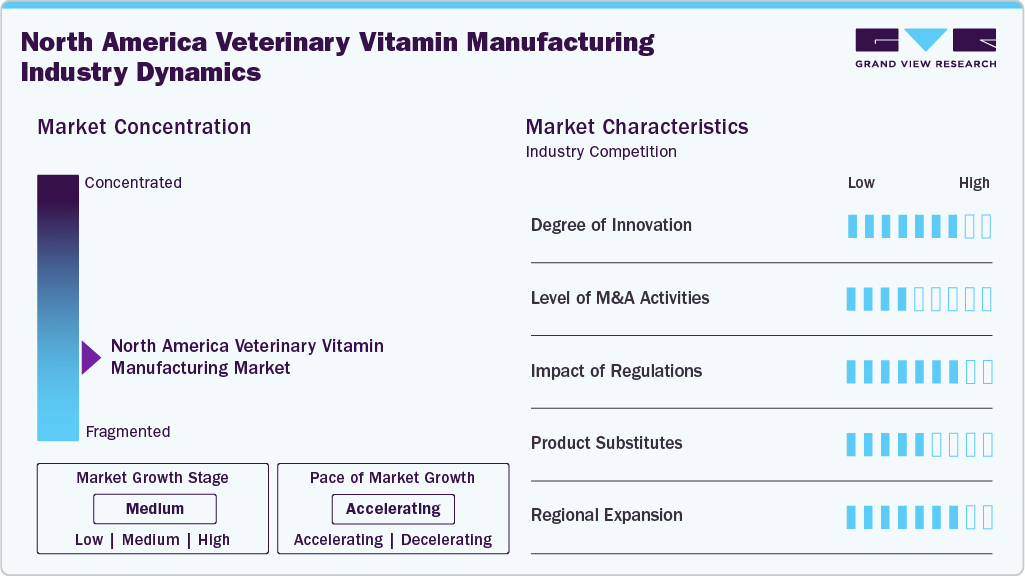
The industry is highly fragmented, due to the presence of animal health companies, feed additive suppliers, premix manufacturers, nutraceutical producers, veterinary supplement brands, and contract manufacturers across North America. The large number of participants offering diverse product portfolios and catering to various livestock and companion animal nutrition needs creates an intensely competitive market with no single company holding a dominant market share.
The industry demonstrates a high degree of innovation, driven by advancements in vitamin formulation technologies, microencapsulation, controlled-release systems, and highly bioavailable vitamin premixes for livestock and companion animals. Manufacturers are increasingly investing in precision nutrition, customized formulations, and sustainable production processes to enhance product stability, shelf life, and nutrient absorption while meeting the evolving nutritional requirements of different animal species.
The industry is witnessing moderate merger and acquisition activity as manufacturers seek to expand production capacity, strengthen raw material sourcing capabilities, and diversify their veterinary nutrition portfolios. Strategic acquisitions of specialty premix manufacturers, nutraceutical producers, and formulation companies are enabling manufacturers to enhance manufacturing capabilities, improve operational efficiencies, and expand their presence across North America.
 To learn more about this report, Download Free Sample Report
The industry operates under stringent regulatory standards governing manufacturing practices, ingredient quality, labeling, and product safety established by agencies such as the FDA Center for Veterinary Medicine (FDA-CVM), AAFCO, and the Canadian Food Inspection Agency (CFIA). Compliance with Good Manufacturing Practices (GMP), quality assurance protocols, and traceability requirements remains essential for ensuring product consistency and regulatory compliance.
The threat of product substitutes is moderate, as veterinary vitamin manufacturers offer standardized, scientifically formulated products with consistent quality and efficacy. Although natural feed ingredients and fortified commercial feeds provide baseline nutritional support, they generally cannot replace targeted vitamin formulations developed to address specific nutritional deficiencies, production performance, or therapeutic supplementation requirements.
Manufacturers are expanding their production footprint across North America through investments in manufacturing capacity, automation, contract manufacturing partnerships, and advanced quality control infrastructure. Increasing demand for premium animal nutrition products, growing livestock production, and rising companion animal health expenditure continue to encourage manufacturers to strengthen domestic production capabilities and optimize regional supply chains.
Analyst Perspective
The North America veterinary vitamin manufacturing industry is experiencing steady growth, driven by rising demand for scientifically formulated nutritional products for both companion and production animals, with manufacturers moving beyond conventional vitamin production toward customized, species-specific formulations, value-added contract manufacturing, and private-label solutions to meet the evolving needs of veterinary nutrition companies, feed manufacturers, and animal health brands; this growth is further reinforced by advances in formulation technologies, stringent quality standards, and investments in GMP-compliant manufacturing facilities, alongside expanding veterinary distribution networks, growing adoption of preventive animal healthcare, and increasing outsourcing of formulation and manufacturing activities, positioning companies that prioritize flexible manufacturing, technical formulation support, regulatory compliance, and premium product development to capitalize on rising demand for differentiated veterinary nutrition products while strengthening their competitive standing across North America.
Animal Insights
The production animals segment dominated the market with a share of 51.2% in 2025, owing to the rising demand for meat, milk, eggs, and aquaculture products, along with increasing adoption of preventive animal healthcare practices across commercial farming systems. Besides, most manufacturers in North America are focusing on improving animal productivity, health, and farm efficiency, which is expected to drive the demand for vitamin-enriched feed supplements and pre-mixes. Vitamins such as A, D3, E, K, and B-complex vitamins are commonly added to feed and supplement products to support immunity, bone development, reproductive performance, growth, and overall production. For instance, PLAGRO offers Triumix-MVP, a cattle premix containing vitamin A, vitamin D3, vitamin E, and biotin, designed to support immunity and cattle health. Such formulations indicate the increasing reliance of livestock producers on vitamin premixes to enhance herd productivity and support milk and meat output.
The companion animals segment is growing at the fastest rate in the coming years, with rising pet ownership, higher pet healthcare spending, and increasing use of preventive nutrition products through veterinary clinics, online platforms, specialty pet retail, and pet supplement brands. For instance, according to the American Veterinary Medical Association, in 2025, the number of U.S. households owning dogs and cats stood at 56.3 million and 43.1 million. This large pet-owning base has created rising demand for daily vitamin products used for deficiency management, skin and coat health, immunity, digestion, mobility, aging support, recovery, and overall wellness.
Product Insights
The vitamin B-complex segment dominated the market with a 27.0% share in 2025, owing to the essential role of B vitamins in animal metabolism and productivity. These water-soluble vitamins help convert carbohydrates, fats, and proteins into usable energy, supporting growth, feed efficiency, production performance, and recovery during stress conditions. In production animals, vitamin B complex products are used to improve metabolic activity, support feed utilization, reduce stress-related weakness, and maintain productivity during growth, lactation, transport, disease recovery, and high-performance phases. These vitamin B- complex support nervous system function, red blood cell formation, immune response, and reproductive health, making them relevant across dairy cattle, poultry, swine, sheep, goats, and aquaculture species.
The vitamin D3 segment is growing at the fastest rate over the forecast period, driven by increasing focus on animal health, portfolio expansion, and the launch of advanced Vitamin D3 ingredients. Besides, the growing adoption of commercial livestock farming systems has increased the need for adequate Vitamin D3 supplementation to maintain skeletal health, improve mineral utilization, and reduce the risk of nutritional deficiencies. Across poultry, swine, ruminants, aquaculture species, and companion animals, Vitamin D3-based formulations are used to support bone strength, growth performance, immunity, and overall productivity.
Type Insights
The finished drug products segment dominated the market with a share of 61.5% in 2025 and is the fastest-growing segment, due to rising demand for ready-to-use, accurately dosed animal health solutions that improve administration convenience, compliance, and consistency across livestock and companion animal applications. Livestock producers, veterinarians, pet supplement companies, and feed nutrition brands increasingly prefer finished vitamin formulations because they reduce dosing errors and offer greater value through formulation, packaging, labeling, and shelf-life management. Products such as injectables, oral liquids, boluses, chews, powders, and premixes are used to support immunity, productivity, recovery, the correction of deficiencies, and overall animal performance.
The API segment is growing at a significant rate over the forecast period due to veterinary pharmaceutical companies, animal nutrition manufacturers, feed premix producers, and contract manufacturers that require high-quality active ingredients for large-scale production. Vitamins such as A, D3, E, K, B-complex, B12, and other specialty vitamins are sourced as APIs before being converted into finished veterinary formulations. Since vitamins are sensitive to heat, light, moisture, oxygen, and processing conditions, API manufacturing requires strict control over assay value, impurity profile, particle size, stability, packaging, and storage conditions.
Dosage Form Insights
By dosage form, the oral segment dominated the market, accounting for 74.2% in 2025. Oral vitamin formats for production animals, such as feed premixes, water-soluble powders, boluses, and liquid supplements, are widely used across cattle, poultry, swine, and other farm species. These formats enable uniform supplementation across large herds and flocks without individual animal handling, thereby reducing labor requirements and veterinary intervention costs. Their scalability makes them highly relevant for commercial livestock and poultry systems, where consistent vitamin intake is required to support immunity, growth, feed efficiency, reproductive performance, and stress management.
The injectable is the second fastest-growing segment in the market. Injectable vitamin formulations are widely used for rapid correction of deficiencies, recovery support, metabolic management, reproductive support, and stress management in cattle, horses, sheep, goats, calves, and in clinical veterinary care. These products are particularly relevant for sick, stressed, weak, or high-performance animals, where oral supplementation may be slower or less effective. According to a study published in February 2026 in Animals by MDPI, injectable trace minerals and vitamins in calves improved copper and selenium status, antioxidant capacity, and immune response modulation, highlighting the role of injectable supplementation in supporting animal health outcomes.
Value Chain Insights
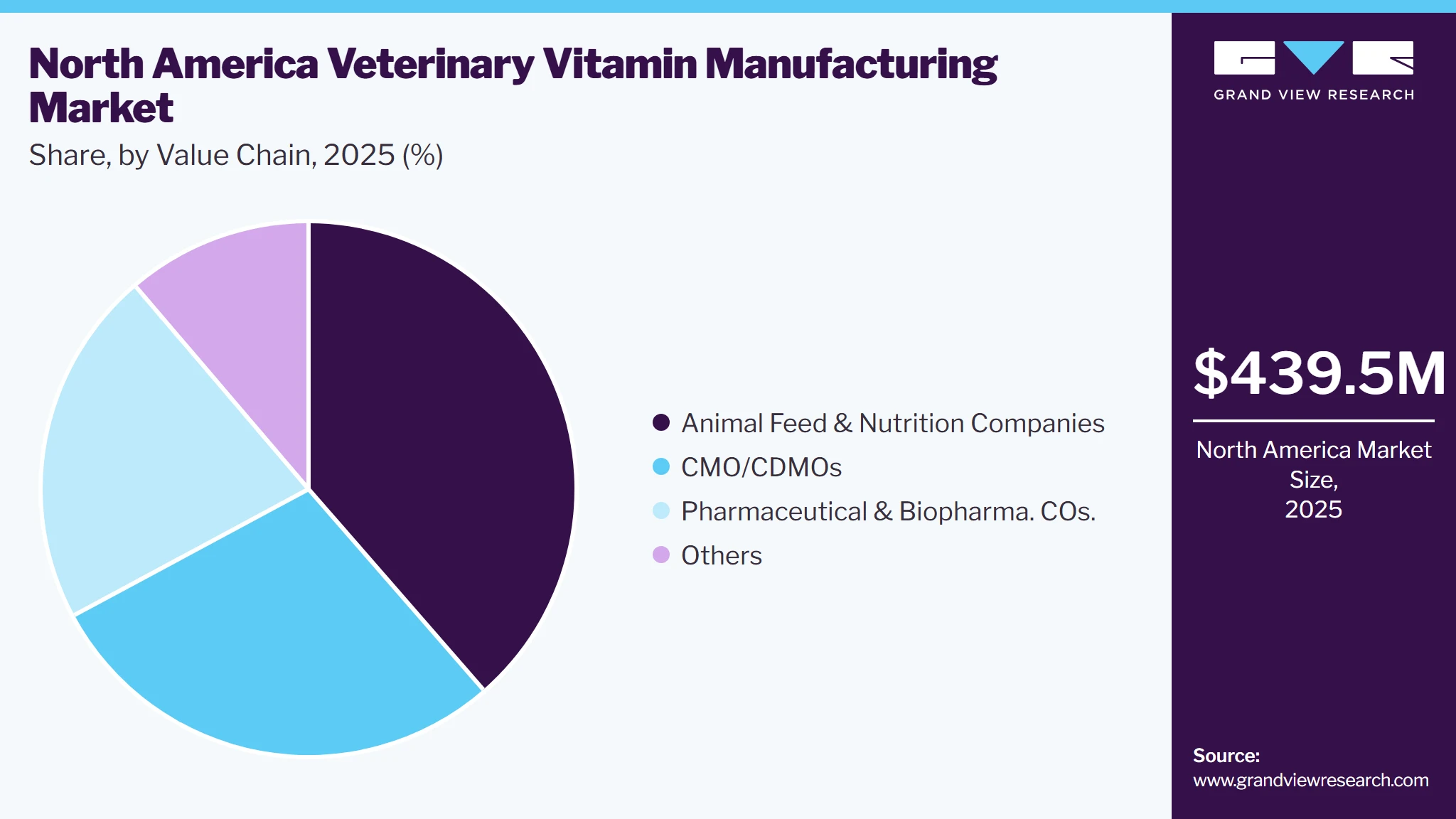
Animal feed & nutrition companies accounted for the largest revenue share of 38.6% in 2025, due to the rising demand for bulk vitamins and fortified feed products that enhance animal health, productivity, feed efficiency, and consistent performance across commercial livestock and poultry production systems. Vitamins play a critical role in supporting growth rates, feed conversion efficiency, reproductive performance, immunity, and overall productivity across cattle, poultry, swine, and dairy production systems. Feed and nutrition companies are expanding the use of vitamins A, D, E, K, B-complex, and other micronutrients in species-specific formulations to meet the nutritional requirements of different animal species and production stages.
 To learn more about this report, Download Free Sample Report
The CMO/CDMOs segment is estimated to grow the fastest at a CAGR, as animal health companies, feed additive manufacturers, and pet supplement brands increasingly outsource veterinary vitamin production to specialized manufacturing partners. This approach helps companies reduce capital expenditure, optimize operating costs, and focus on product development, branding, marketing, and distribution, while gaining access to formulation expertise, scalable capacity, regulatory knowledge, and quality systems required for consistent product performance and compliance.
Country Insights
The U.S. market held the largest revenue share of 79.5% in 2025. The U.S. veterinary vitamin manufacturing market is driven by the presence of integrated animal health companies, specialized veterinary pharmaceutical developers, animal nutrition suppliers, and manufacturers serving both companion and production animal segments. Key participants include Zoetis, Elanco Animal Health, Merck Animal Health, Phibro Animal Health Corporation, Nutramax Laboratories, and Dechra Pharmaceuticals, which maintain strong market positions through broad product portfolios and established distribution networks across veterinary and livestock production channels.
In addition, the presence of established domestic livestock production provides a strong demand base for veterinary vitamins. According to USDA livestock inventory data published in January 2026, the U.S. had approximately 86.2 million cattle and calves. In addition, the USDA Poultry Production and Value Summary, published in April 2026, reported that the U.S. produced approximately 9.4 billion broiler chickens in 2025, representing a 1.0% increase from the previous year. This large production base supports demand for injectable vitamin B-complex formulations, vitamin D3 products, water-soluble supplements, and feed-incorporated vitamin premixes used to improve animal health, productivity, and feed efficiency.
Key North America Veterinary Vitamin Manufacturing Company Insights
The market is characterized by moderate to high competition and is moderately fragmented, with the presence of established animal nutrition companies, veterinary pharmaceutical manufacturers, feed additive producers, premix manufacturers, and contract manufacturing organizations. Leading companies such as Trouw Nutrition, Phibro Animal Health Corporation, Nutramax Laboratories Veterinary Sciences, Virbac, Zoetis Inc., Elanco Animal Health, Vetoquinol, and VetPharma compete by expanding their manufacturing capacities, developing species-specific vitamin formulations, strengthening raw material sourcing, and investing in advanced formulation technologies. Companies are also emphasizing quality assurance, GMP-compliant manufacturing, and customized private-label production to address the growing demand for high-quality veterinary nutritional supplements across both livestock and companion animal segments.
Key North America Veterinary Vitamin Manufacturing Companies:
The following key companies have been profiled for this study on the North America veterinary vitamin manufacturing market:
-
Zoetis Services LLC
-
Merck & Co., Inc.
-
Virbac
-
Boehringer Ingelheim
-
Elanco
-
Phibro Animal Health Corporation
-
ADM Animal Nutrition
-
Trouw Nutrition
-
Dechra
-
Vetoquinol
Competitive Benchmarking
Operating Strategies
Competitive Edge
Weaknesses
Mature Players: Zoetis Services LLC; Dechra; Trouw Nutrition; Merck & Co., Inc.; Virbac; Boehringer Ingelheim; Elanco; Nutramax Laboratories
- Established manufacturers focus on expanding veterinary vitamin portfolios through advanced formulation capabilities, species-specific products, and investments in manufacturing capacity. They emphasize GMP-compliant production, high-quality raw material sourcing, customized premixes, and value-added nutritional solutions for companion animals and livestock. Strategic partnerships with veterinary distributors, feed manufacturers, and private-label brands, along with continuous investments in R&D, regulatory compliance, and manufacturing automation, strengthen their market presence and production capabilities.
- These companies benefit from strong global brands, extensive manufacturing infrastructure, integrated supply chains, diversified product portfolios, and long-standing relationships with veterinary clinics, feed companies, and animal health distributors. Their technical expertise, regulatory experience, and ability to manufacture at commercial scale enable consistent product quality, reliable supply, and sustained market leadership.
- Established players often face high manufacturing, quality assurance, and regulatory compliance costs associated with maintaining GMP-certified facilities and multi-country operations. Longer product development timelines, complex supply chains, and dependence on global raw material sourcing can increase operational costs. Large organizational structures may also reduce flexibility in responding quickly to evolving customer requirements and niche formulation opportunities.
Emerging Players: STUARTPRODUCTS, Inc.; AdvaCare Pharma; VetPlus; VetPharma
- Emerging manufacturers focus on customized veterinary vitamin formulations, private-label manufacturing, contract manufacturing services, and niche nutritional products for specific animal species and life stages. They emphasize flexible production, faster product development, competitive pricing, and close collaboration with veterinary brands, distributors, and regional animal nutrition companies. Their strategies prioritize customer-specific formulations, shorter commercialization timelines, and expansion through regional partnerships and specialized manufacturing services.
- Emerging companies compete through manufacturing flexibility, customized product development, responsive customer support, and specialized formulation expertise. Their ability to deliver smaller production batches, private-label solutions, and tailored nutritional products enables them to serve niche markets efficiently while responding rapidly to changing customer demands.
- Emerging manufacturers generally operate with limited production capacity, smaller distribution networks, and lower financial resources than multinational competitors. Limited brand recognition, narrower product portfolios, and fewer regulatory and technical resources may restrict expansion into larger markets. They may also face challenges in securing long-term supply contracts and competing against companies with integrated manufacturing capabilities and established customer relationships.
Recent Developments
-
In May 2026, Bimeda introduced its enhanced Bovitalize Plus, incorporating Aspergillus oryzae to enhance digestive efficiency and nutritional performance in livestock. The upgraded formulation is designed to support rumen health, improve feed utilization, and enhance overall productivity, driving the market toward the adoption of enzyme-enhanced and functional feed additives.
-
In February 2026, AdvaCare strengthened its AdvaMate pet supplement platform by emphasizing premium functional ingredients, traceability, and quality standards, supporting growth in companion animal nutritional supplements and wellness products globally.
-
In February 2025, Elanco Animal Health launched Pet Protect, a science-backed, veterinarian-formulated supplement portfolio for dogs and cats. The range includes multivitamins, joint health, digestive health, Omega-3, calming, skin, allergy, and immune support products, strengthening Elanco’s presence in the pet supplements market and expanding its companion animal health offerings.
North America Veterinary Vitamin Manufacturing Market Report Scope
Report Attribute
Details
Market size value in 2025
USD 439.5 million
Market size value in 2026
USD 456.9 million
Revenue forecast in 2033
USD 764.3 million
Growth rate
CAGR of 7.6% from 2026 to 2033
Historical data
2021 - 2025
Forecast period
2026 - 2033
Quantitative units
Revenue in USD million/billion and CAGR from 2026 to 2033
Report coverage
Revenue forecast, company ranking, competitive landscape, growth factors, and trends
Segments covered
Animal, product, type, dosage form, value chain, country
Country scope
U.S.; Canada; Mexico
Key companies profiled
Zoetis Services LLC; Merck & Co., Inc.; Virbac; Boehringer Ingelheim; Elanco; Phibro Animal Health Corporation; ADM Animal Nutrition; Trouw Nutrition; Dechra; Vetoquinol
Customization scope
Free report customization (equivalent up to 8 analysts working days) with purchase. Addition or alteration to country, regional & segment scope.
Pricing and purchase options
Avail customized purchase options to meet your exact research needs. Explore purchase options
North America Veterinary Vitamin Manufacturing Market Report Segmentation
This report forecasts revenue growth at country levels and provides an analysis of the latest industry trends in each of the sub-segments from 2021 to 2033. For this study, Grand View Research has segmented the North America Veterinary Vitamin Manufacturing market report based on animal, product, type, dosage form, value chain, and country.
-
Animal Outlook (Revenue, USD Million, 2021 - 2033)
-
Companion Animals
-
Production Animals
-
-
Product Outlook (Revenue, USD Million, 2021 - 2033)
-
Vitamin B-Complex
-
Vitamin B12
-
Vitamin K
-
Vitamin D3
-
Other Vitamins
-
-
Type Outlook (Revenue, USD Million, 2021 - 2033)
-
API
-
Finished Drug Products
-
-
Dosage Form Outlook (Revenue, USD Million, 2021 - 2033)
-
Oral
-
Injectables
-
-
Value Chain Outlook (Revenue, USD Million, 2021 - 2033)
-
Pharmaceutical & Biopharmaceutical Companies
-
Animal Feed & Nutrition Companies
-
CMO/CDMOs
-
Others
-
-
Country Outlook (Revenue, USD Million, 2021 - 2033)
-
U.S.
-
Canada
-
Mexico
-
Research Methodology
The north america veterinary vitamin manufacturing market figures in this report are based on a proven research process that combines executive interviews with secondary research from proprietary databases, company filings, and recognized regulatory and institutional sources. Market size is built through value-chain sizing-reconciling supply-side and demand-side estimates-and triangulated with bottom-up and top-down approaches. Every estimate passes multiple levels of expert validation before publication, with each north america veterinary vitamin manufacturing segment quantified using the revenue-capture definitions in the table below.
Segment Definition
Segment - Animal
Revenue capture definition
Companion Animals
This segment captures revenue generated from the manufacturing of veterinary vitamins formulated for pets and non-production animals kept primarily for companionship, including dogs, cats, horses, and small/exotic pets across North America
Production Animals
This segment captures revenue generated from the manufacturing of veterinary vitamins intended for livestock, poultry, aquaculture, and other food-producing species where vitamin supplementation directly impacts growth performance, reproductive efficiency, and product yield across North America
Segment - Product
Revenue capture definition
Vitamin B-Complex
This segment captures revenue generated from the manufacturing of multi-B vitamin formulations combining two or more B-group vitamins (e.g., B1, B2, B3, B5, B6, B7, B9) for veterinary use in energy metabolism, neurological function, and reproductive support across companion and production animals
Vitamin B12
This segment captures revenue generated from the manufacturing of cyanocobalamin and hydroxocobalamin-based veterinary formulations used to support red blood cell production, neurological health, and metabolic function in companion and production animals across North America
Vitamin K
This segment captures revenue generated from the manufacturing of Vitamin K1 (phytonadione) and Vitamin K3 (menadione) veterinary formulations used to support blood coagulation, bone metabolism, and treatment of anticoagulant toxicosis in companion and production animals
Vitamin D3
This segment captures revenue generated from the manufacturing of cholecalciferol-based veterinary formulations used to regulate calcium-phosphorus homeostasis, support bone development, and maintain immune function in companion and production animals
Other Vitamins
This segment captures revenue generated from the manufacturing of all remaining veterinary vitamin formulations not classified under B-Complex, B12, Vitamin K, or Vitamin D3, including fat-soluble vitamins (A, E) and standalone water-soluble vitamins used across companion and production animals in North America
Segment - Type
Revenue capture definition
API (Active Pharmaceutical Ingredient)
This segment captures revenue generated from the manufacturing and supply of bulk veterinary vitamin active pharmaceutical ingredients in their pure, unformulated form, sold to downstream formulators, finished drug product manufacturers, feed premix producers, and CMO/CDMOs
Finished Drug Products
This segment captures revenue generated from the manufacturing of fully formulated, market-ready veterinary vitamin products in their final dosage form (oral, injectable), packaged and labeled for direct administration to animals or for distribution through veterinary and retail channels
Segment - Dosage Form
Revenue capture definition
Oral
This segment captures revenue generated from the manufacturing of veterinary vitamin finished drug products designed for oral administration, including tablets, capsules, powders, liquids, pastes, gels, chewables, and feed-additive premix formats for companion and production animals.
Injectables
This segment captures revenue generated from the manufacturing of sterile veterinary vitamin formulations designed for parenteral administration via intramuscular, intravenous, or subcutaneous routes, used where rapid systemic availability or bypass of gastrointestinal absorption is required across companion and production animals
Segment - Value Chain
Revenue capture definition
Pharmaceutical & Biopharmaceutical Companies
This segment captures revenue generated from the in-house manufacturing of veterinary vitamin active ingredients (APIs), formulations, and finished dosage forms by animal health pharmaceutical and biopharmaceutical companies
Animal Feed & Nutrition Companies
This segment captures revenue generated from the manufacturing of vitamin premixes, fortified feed additives, nutritional supplements, and feed-grade vitamin formulations by animal feed and nutrition companies
CMO/CDMOs
This segment captures revenue generated from contract development and manufacturing activities performed by Contract Manufacturing Organizations (CMOs) and Contract Development & Manufacturing Organizations (CDMOs)
Others
This segment captures revenue generated from veterinary vitamin manufacturing activities undertaken by organizations such as veterinary nutraceutical manufacturers, private-label manufacturers, research-focused production facilities, cooperatives, and specialized manufacturing service providers. across
Estimation Model
North America Veterinary Vitamin Manufacturing - Revenue Estimation Models
Bottom-Up Revenue Model
Livestock & Companion Animal Nutrition Demand Model
Manufacturing Capacity & Product Utilization Model
Distribution Channel & Customer Demand Model
- Market size is estimated by identifying leading veterinary vitamin manufacturers, premix producers, feed additive companies, nutraceutical manufacturers, and contract manufacturing organizations (CMOs/CDMOs) operating across North America.
- Revenue attributable to veterinary vitamin manufacturing is derived from annual reports, investor presentations, product portfolios, manufacturing capabilities, company disclosures, and production facilities dedicated to animal nutrition.
- Individual company revenues are aggregated and validated using manufacturing capacity, production footprint, customer base, product mix, and estimated revenue contribution from veterinary vitamin manufacturing.
- Market value is estimated by assessing livestock and companion animal populations across the U.S., Canada, and Mexico, segmented by cattle, poultry, swine, equine, dogs, cats, and other animals.
- Animal population, production cycles, nutritional deficiency trends, preventive healthcare adoption, and vitamin supplementation rates are evaluated across key species.
- The addressable market is calculated by applying veterinary vitamin utilization rates and species-wise supplementation frequency to the eligible animal population.
- Market value is estimated by evaluating annual production and utilization of veterinary vitamin products, including injectable vitamins, oral dosages, soft chews, boluses, water-soluble supplements, and feed premixes.
- The model assesses formulation volumes, production capacity utilization, batch output, dosage formats, and demand across livestock and companion animal applications.
- Revenue is calculated by applying average selling prices (ASPs) to annual production volumes while validating manufacturing output through production capacity and customer demand.
- Market value is estimated by analyzing product movement through veterinary distributors, feed mills, veterinary hospitals & clinics, farm supply retailers, pet specialty stores, and e-commerce platforms.
- The model evaluates purchasing patterns among veterinary pharmaceutical companies, feed manufacturers, livestock producers, companion animal brands, and private-label customers.
- Revenue is generated by applying channel-wise product sales volumes and ASPs while validating demand using distributor sales, manufacturing contracts, and regional supply chain data.
Summary:
This estimation framework strengthens market accuracy by integrating manufacturer revenues, animal population statistics, vitamin supplementation rates, production capacity, product utilization, and distribution channel performance. The triangulated methodology validates estimates from both supply-and demand-side perspectives, providing reliable forecasts by capturing evolving animal nutrition practices, manufacturing expansion, preventive healthcare adoption, and regional market dynamics across North America.
Delivered Customizations
This report has been delivered with the following In-depth customizations
Client Request
Customization Delivered
Value Adds
Value Chain, Manufacturing Ecosystem & Business Model Assessment
Conducted a comprehensive assessment of the North American veterinary vitamin manufacturing ecosystem, covering raw material suppliers, vitamin API manufacturers, premix producers, contract manufacturers (CMOs/CDMOs), veterinary nutrition companies, distributors, feed manufacturers, veterinary clinics, and retail channels. Evaluated manufacturing models, sourcing strategies, production technologies, quality standards, and value creation opportunities across the supply chain.
Provides a holistic understanding of the manufacturing value chain, operational dependencies, sourcing dynamics, and revenue opportunities, enabling stakeholders to strengthen strategic positioning, identify partnership opportunities, and optimize manufacturing investments.
Pricing, Cost Structure & Manufacturing Economics Analysis
Performed a detailed evaluation of pricing trends across injectable vitamins, oral supplements, feed premixes, boluses, water-soluble formulations, and soft chews. Assessed raw material costs, production economics, packaging expenses, contract manufacturing costs, distribution margins, and pricing strategies across companion animal and livestock applications.
Supports informed pricing decisions, margin optimization, sourcing strategies, and cost management while helping manufacturers evaluate commercial viability across different product categories and customer segments.
Competitive Landscape & Manufacturing Benchmarking
Benchmarked leading veterinary vitamin manufacturers based on manufacturing capacity, formulation capabilities, product portfolio, regulatory compliance, private-label manufacturing services, geographic presence, distribution network, strategic partnerships, R&D investments, and production technologies. Compared multinational manufacturers with regional and specialty producers to identify competitive differentiation and market positioning.
Enables identification of competitive strengths, manufacturing capabilities, expansion opportunities, and strategic gaps while supporting investment planning, partnership evaluation, and long-term competitive growth stra
Frequently Asked Questions About This Report
The North America Veterinary Vitamin Manufacturing market size was valued at USD 439.5 million in 2025 and is estimated at USD 456.9 million in 2026.
The North America Veterinary Vitamin Manufacturing market is expected to grow at a CAGR of 7.6% from 2026 to 2033, reaching USD 764.3 million in 2033.
Key factors include large livestock and poultry production, rising companion animal ownership, increasing adoption of preventive animal healthcare, and growing demand for feed-grade vitamin premixes
Oral segment dominated the market, accounting for 74.2% in 2025.
Animal feed & nutrition companies accounted for the largest revenue share of 38.6% in 2025.
The vitamin B-complex segment led with a 27.0% revenue share in 2025, while the vitamin D3 is the fastest-growing segment
The production animals segment led with a 51.2% revenue share in 2025, while the companion animals is the fastest-growing segment
The finished drug products segment led with a 61.5% revenue share in 2025, and is the fastest-growing segment
Key players include Zoetis Services LLC, Merck & Co., Inc, Virbac, Boehringer Ingelheim, Elanco, Phibro Animal Health Corporation, ADM Animal Nutrition, Trouw Nutrition, Dechra, Vetoquinol
About the Author(s)
Animal Health Research Team
Healthcare · Animal HealthThis report was authored by the animal health research team at Grand View Research - comprising two research analysts, one senior research analyst, and one industry expert - with specialized expertise in the animal health segment of the healthcare industry. All findings are based on proprietary healthcare databases, executive interviews, and regulatory analysis, subject to internal peer review prior to publication.
Last Updated:
Speak to Analyst

Customize this report to your needs - add regions, segments, or data points, with 20% free customization.
Or view our licence options:


ISO 9001:2015 & 27001:2022 Certified
We are GDPR and CCPA compliant! Your transaction & personal information is safe and secure. For more details, please read our privacy policy.


