
- Home
- »
- Advanced Interior Materials
- »
-
Oil Filter Market Size, Share And Trends Report, 2026-2033GVR Report cover

Oil Filter Market (2026 - 2033)
Size, Share & Trends Analysis Report By Product (Spin-on Oil Filters, Cartridge Oil Filters, Centrifugal Oil Filters), By Filter Media (Cellulose/Paper, Synthetic), By End Use, By Distribution Channel, By Region, And Segment Forecasts
Market Size, 2025
$9.6BMarket Estimate, 2026
$10.1BMarket Forecast, 2033
$14.3BCAGR, 2026–2033
5.1%Oil Filter Market Summary
The global oil filter market size was valued at USD 9.6 billion in 2025 and is projected to grow from USD 10.1 billion in 2026 to USD 14.3 billion by 2033, at a CAGR of 5.1% from 2026 to 2033. Asia Pacific dominated the market, accounting for a revenue share of 41.7% in 2025. Increasing vehicle production, expansion of the automotive fleet, and rising demand for routine vehicle maintenance are driving the oil filter market.
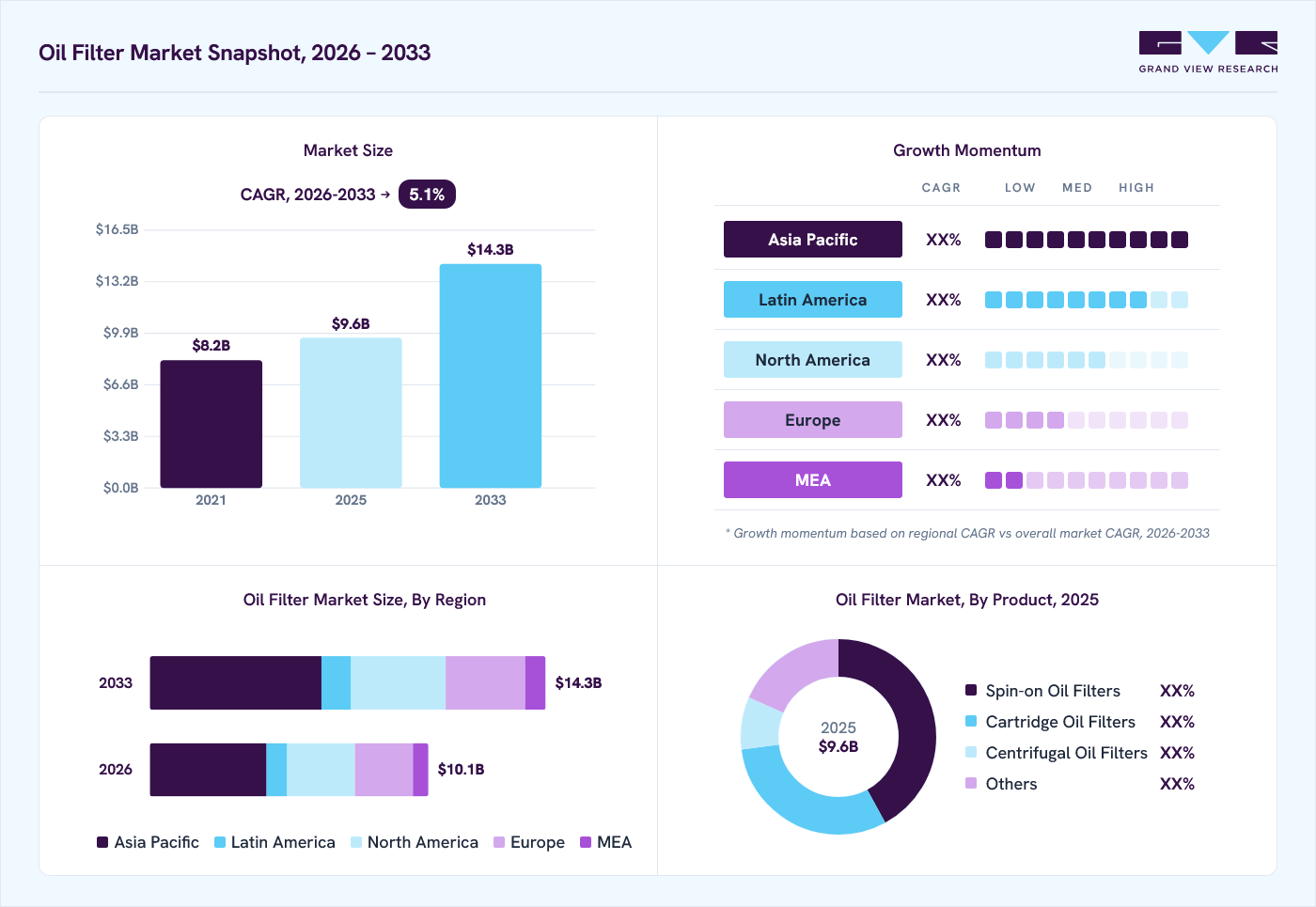 Source: Grand View Research, IR Documents, Primary Interviews, Paid DatabasesTo learn more about this report,
 Download Free Sample Report
Key Market Trends & Insights
- By product: Spin-on oil filters segment dominated the market with a revenue share of 42.0% in 2025 .
- By filter media: Cellulose/paper segment dominated the market in 2025, accounting for 47.0% market share.
- By distribution channel: Aftermarket segment dominated the market in 2025, capturing a 60.4% revenue share.
- By end use: Automotive segment accounted for the largest revenue share of 64.2% in 2025.
Regional Highlights
- Largest regional market: Asia Pacific (41.7% revenue share, 2025)
- By country: China held the largest share in the Asia Pacific region in 2025.
Market Size & Forecast
- Market Size in 2025: USD 9.6 Billion
- Estimated Market Size in 2026: USD 10.1 Billion
- Projected Market Size by 2033: USD 14.3 Billion
- CAGR (2026-2033): 5.1%
Prism AI by Grand View Research Free to tryAsk a question about the oil filter market✓Every figure cited from GVR research Prefer the report? Download free sample →
The increasing installation of industrial equipment such as compressors, pumps, turbines, machine tools, and hydraulic systems is increasing the need for lubricant filtration. These systems require clean oil to reduce particulate contamination, protect moving components, and maintain operating efficiency.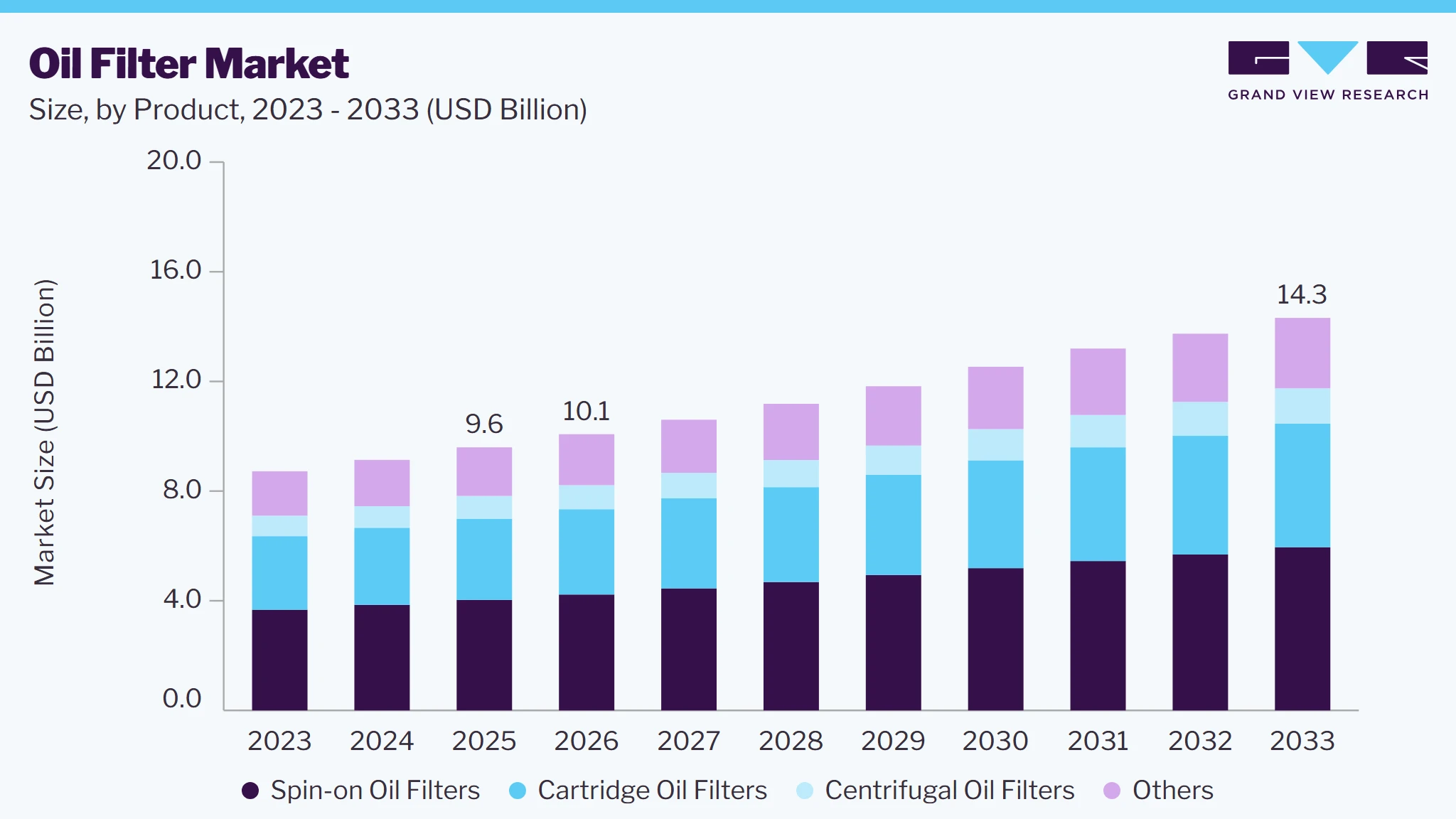 To learn more about this report, Download Free Sample Report
As industrial facilities expand production capacity and add machinery, demand for oil filters used in lubrication and hydraulic circuits increases accordingly.
Market Dynamics
The industry is influenced by vehicle production, fleet size, industrial equipment use, maintenance practices, and engine performance requirements. Demand comes from passenger vehicles, commercial vehicles, construction machinery, agricultural equipment, and industrial systems. Increasing engine operating efficiency and tighter component tolerances require effective lubricant filtration. At the same time, electric vehicle adoption may reduce demand for conventional engine oil filters in some automotive applications. Product development is also focused on longer service intervals, improved filtration efficiency, and higher contaminant-holding capacity.
Increasing use of commercial vehicles, construction machinery, agricultural equipment, compressors, hydraulic systems, and manufacturing machinery supports demand for oil filters. These applications often operate for extended periods under high loads, elevated temperatures, dusty environments, and variable operating conditions. Such conditions can increase lubricant contamination and accelerate filter loading. Regular oil and filter replacement is therefore required to maintain lubricant cleanliness and protect engines and mechanical components. Expansion of these equipment fleets increases the installed base, requiring routine filtration and replacement.
The increasing adoption of battery electric vehicles is a restraint for the automotive oil filter market because fully electric vehicles do not use internal combustion engines, requiring conventional engine oil filtration. As EV penetration increases, the addressable vehicle base for engine oil filters can gradually decline. The effect is particularly relevant in passenger vehicles, where electrification is progressing across several major markets. However, commercial vehicles, hybrid vehicles, industrial machinery, and other equipment using internal combustion engines continue to require oil filtration.
Development of extended-life oil filters presents an opportunity as vehicle and equipment owners seek longer maintenance intervals. Manufacturers are developing filters with improved filter media, greater contaminant-holding capacity, stronger structural designs, and lower pressure drop. These characteristics can support longer operating periods between filter replacements while maintaining lubricant cleanliness. Increasing use of turbocharged engines, high-efficiency engines, and heavy-duty equipment creates requirements for filters capable of operating under higher temperatures, pressures, and contamination loads.
Market Concentration & Characteristics
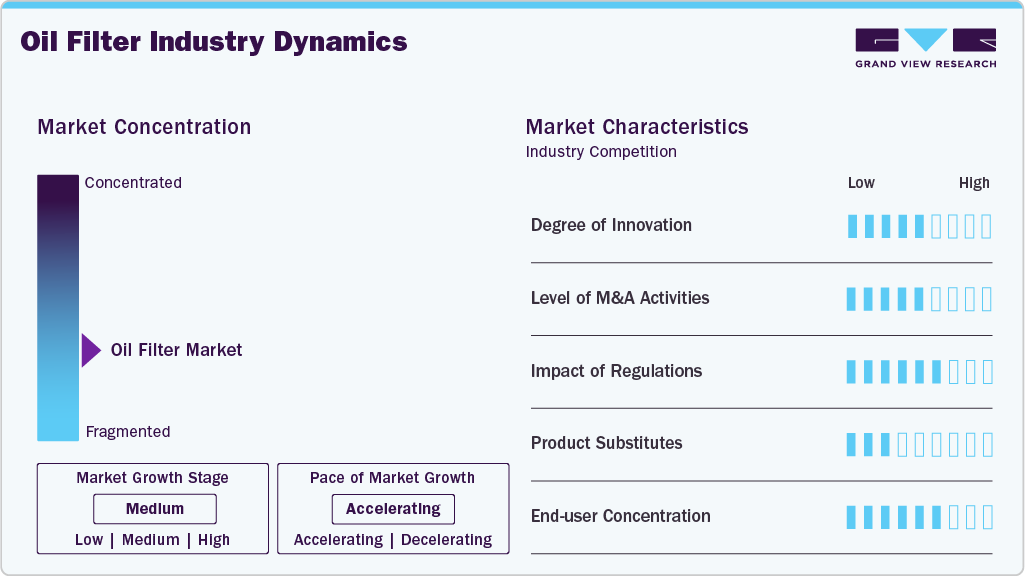
The industry is moderately fragmented as it includes multinational filtration companies, automotive component manufacturers, regional producers, and specialized filter suppliers. Companies compete across original equipment and aftermarket applications based on filtration efficiency, product compatibility, durability, pricing, and distribution coverage. Regional suppliers often serve specific vehicle or industrial segments, while larger manufacturers operate across multiple geographic markets and application categories.
Manufacturers are developing advanced synthetic and composite filter media, improved pleating designs, and lightweight filter structures. Sensor-integrated filtration systems are also being developed for condition monitoring. Product development increasingly considers engine downsizing, higher operating temperatures, extended service intervals, and compatibility with modern lubricants.
 To learn more about this report, Download Free Sample Report
Emission standards encourage manufacturers to maintain engine lubrication systems and filtration performance under increasingly demanding operating conditions. Environmental regulations also affect filter materials, manufacturing processes, and disposal practices. Requirements for recycling used filters and managing hazardous oil residues are influencing product design and aftermarket collection practices.
Analyst Perspective
The market is supported by increasing vehicle production, expansion of industrial equipment fleets, and rising demand for effective engine and machinery lubrication management. Growing adoption of passenger vehicles, commercial vehicles, construction equipment, agricultural machinery, generators, and industrial engines is increasing the need for regular oil filter replacement. In addition, stricter engine performance requirements and greater emphasis on contamination control are supporting demand for synthetic and high-efficiency filter media. Manufacturers are also developing compact filter designs, improved filtration efficiency, longer service intervals, and application-specific filtration solutions for automotive and industrial equipment.
Product Insights
The spin-on oil filters segment dominated the market with a revenue share of 42.0% in 2025 due to their widespread use in passenger vehicles, commercial vehicles, agricultural machinery, and industrial equipment. Their integrated housing, standardized installation, relatively simple replacement process, and broad vehicle compatibility support aftermarket demand. Increasing vehicle parc and routine maintenance requirements continue to generate replacement needs for spin-on filters across different applications.
The centrifugal oil filters segment is expected to grow at a 5.7% CAGR during the forecast period, with increasing use in heavy-duty engines, commercial vehicles, generators, and industrial equipment. These filters use centrifugal force to separate contaminants from lubricating oil and can support continuous filtration. Demand is influenced by applications requiring extended operating periods, lubricant cleanliness, and reduced particulate accumulation in engines and mechanical systems.
Filter Media Insights
The cellulose/paper segment dominated the market with a revenue share of 47.0% in 2025 due to its established use in automotive and industrial oil filters. Its relatively low material cost established manufacturing processes, and compatibility with conventional filtration designs support continued adoption. Growth in vehicle fleets, routine maintenance, and replacement filter demand will continue generating requirements for cellulose-based media across standard oil filtration applications.
The synthetic segment is anticipated to register the fastest CAGR of 5.6% during the forecast period as modern engines and industrial equipment require improved filtration performance and longer service intervals. Synthetic media can provide finer particle filtration, higher dirt-holding capacity, and improved resistance to temperature and chemical conditions compared with conventional paper media. Increasing use of high-performance engines and demanding operating environments is supporting the adoption of synthetic filtration media.
Distribution Channel Insights
The aftermarket segment dominated with a 60.4% market share in 2025. Its strong market position is driven by the expanding vehicle parc and increasing maintenance of passenger cars, commercial vehicles, agricultural machinery, and industrial equipment. Oil filters require periodic replacement based on operating hours, mileage, and maintenance schedules. Growth in vehicle age and used-vehicle ownership can further increase replacement demand through independent workshops, service centers, retailers, and online distribution channels.
The OEM segment is expected to grow due to the increasing production of vehicles and machinery equipped with internal combustion engines. Manufacturers install oil filters during initial equipment assembly to meet engine filtration requirements. Increasing production of passenger and commercial vehicles, construction equipment, agricultural machinery, generators, and industrial equipment supports OEM filter demand. Requirements for improved filtration performance can also influence OEM filter specifications.
End Use Insights
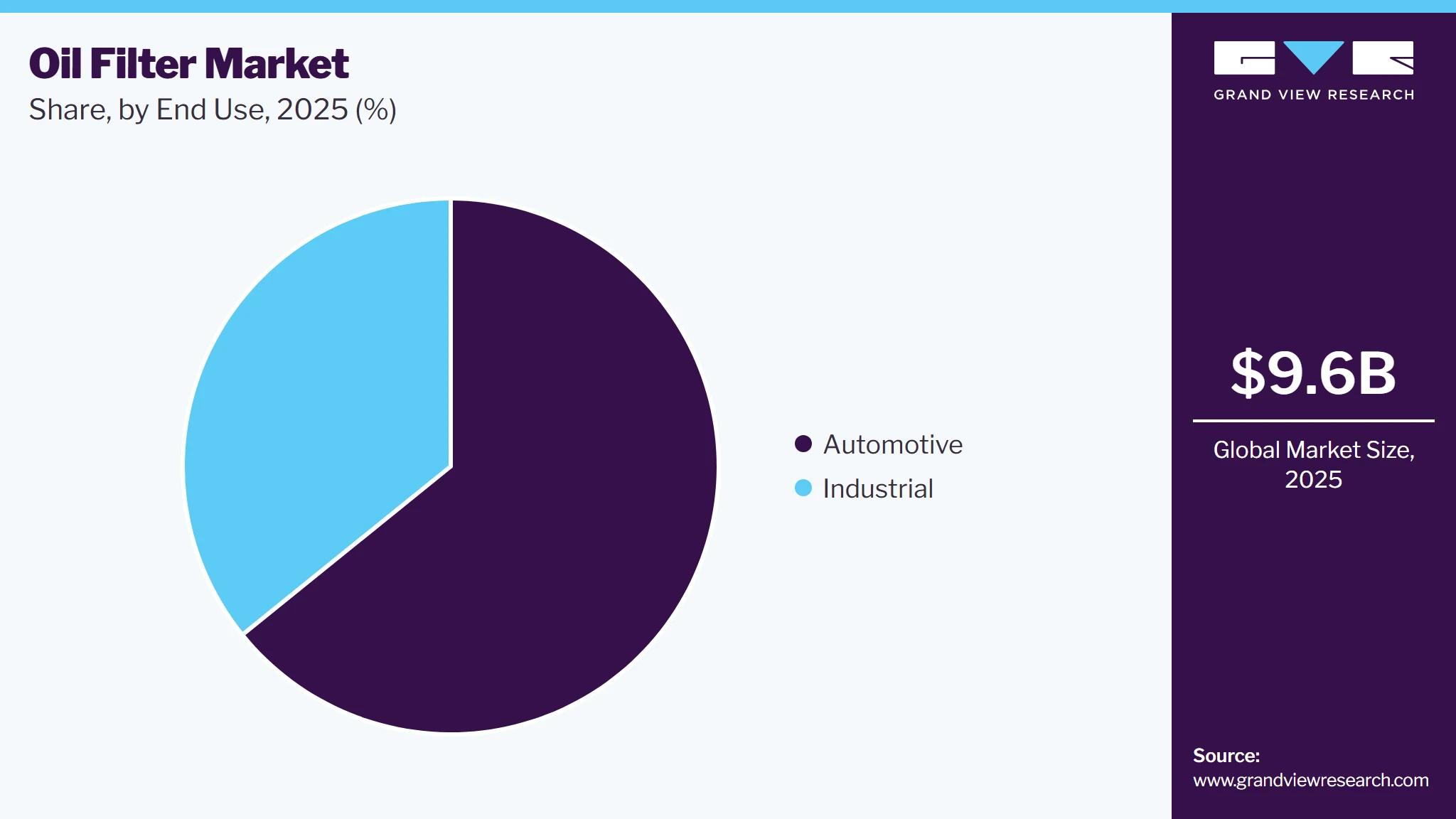
The automotive segment accounted for the largest revenue share of 64.2% in 2025. The segment's dominance is attributed to increasing vehicle production, expanding vehicle fleets, and routine maintenance requirements. Passenger and commercial vehicles using internal combustion engines require regular oil filtration to remove contaminants and protect engine components. Growth in used-vehicle servicing, replacement demand, and continued production of hybrid and conventional vehicles will support oil filter requirements across automotive applications.
 To learn more about this report, Download Free Sample Report
The industrial segment is expected to grow with the increasing use of machinery requiring continuous lubrication and oil filtration. Manufacturing equipment, compressors, hydraulic systems, generators, turbines, and other industrial machinery use oil filters to remove particulates and contaminants. Expansion of industrial production capacity, equipment installations, and maintenance activities will increase demand for replacement and original-equipment oil filters across industrial applications.
Regional Insights
The North America oil filter market is supported by a large installed base of passenger vehicles, commercial vehicles, construction machinery, agricultural equipment, and industrial systems. Regular vehicle servicing and replacement of engine oil filters sustain aftermarket demand. Industrial activity also generates requirements for lubricant filtration in machinery and hydraulic systems. The region’s established automotive manufacturing and distribution networks provide access to both OEM and replacement filters.
U.S. Oil Filter Market Trends
The oil filter market in the U.S. is driven by its large vehicle fleet, extensive commercial transportation activity, and established automotive aftermarket. Passenger vehicles, trucks, construction equipment, and agricultural machinery require periodic oil and filter replacement. Industrial manufacturing, power generation, and other equipment applications also contribute to demand. The presence of automotive service centers, parts retailers, and online distribution channels supports replacement filter availability across the country.
Europe Oil Filter Market Trends
The oil filter market in Europe is driven by vehicle maintenance, commercial transportation, industrial machinery, and established automotive manufacturing. Passenger and commercial vehicles with internal combustion engines continue to require periodic oil filtration, while industrial applications generate additional demand. Increasing vehicle efficiency requirements influence filter performance and design. The growing adoption of electric vehicles may gradually reduce conventional engine oil filter demand in some automotive applications, although industrial and hybrid applications continue to require filtration.
The Germany oil filter market is supported by its automotive manufacturing sector, large vehicle fleet, commercial transportation activity, and industrial machinery base. Oil filters are used in vehicle production as well as aftermarket maintenance. Industrial manufacturing, engineering, construction equipment, and power-related applications create additional lubricant filtration requirements. Demand is also influenced by the maintenance of older vehicles and commercial fleets, while increasing electric vehicle production may reduce conventional automotive oil filter requirements over time.
The oil filter market in the UK is supported by passenger and commercial vehicle maintenance, industrial machinery, and aftermarket servicing. Oil filters remain necessary for vehicles powered by internal combustion engines, including conventional and hybrid models. The large installed vehicle base generates recurring replacement demand through garages, service centers, and automotive parts distributors. Industrial applications such as manufacturing equipment, generators, compressors, and hydraulic systems provide additional demand for lubricant filtration.
Asia Pacific Oil Filter Market Trends
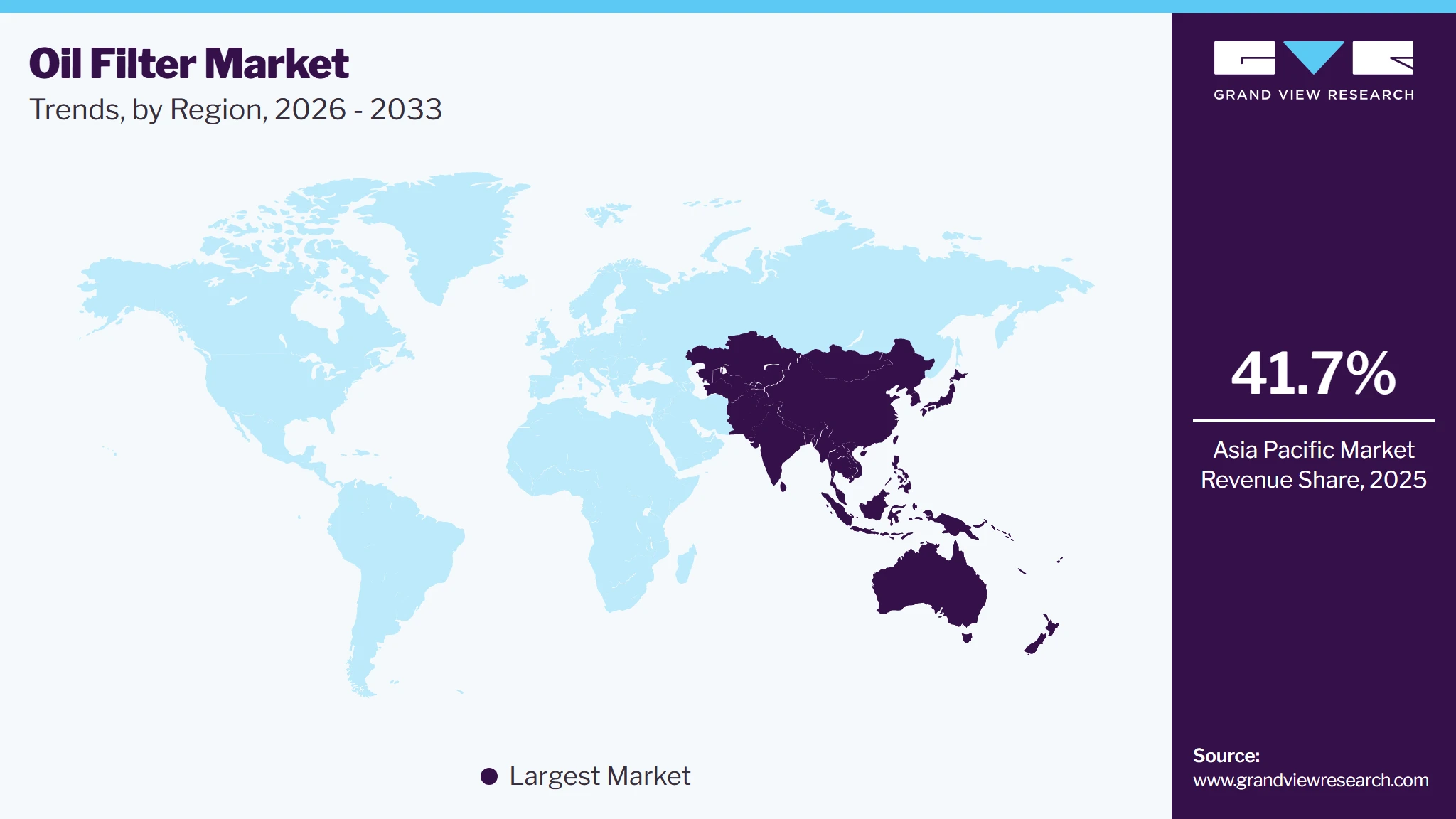
The oil filter market in Asia Pacific accounted for the largest revenue share of 41.7% in 2025 and fastest-growing regional market due to expanding vehicle production, increasing vehicle ownership, industrialization, and construction and agricultural machinery use. China, India, Japan, and Southeast Asian countries contribute substantially to regional demand. Growing automotive manufacturing creates OEM requirements, while expanding vehicle fleets generates aftermarket replacement demand. Industrial production and infrastructure development further increase the use of equipment requiring lubricant filtration.
 To learn more about this report, Download Free Sample Report
The China oil filter market dominates the region with its large automotive manufacturing base, vehicle fleet, commercial transportation sector, and industrial machinery production. Oil filters are required in passenger cars, trucks, construction equipment, agricultural machinery, generators, and industrial systems. Vehicle servicing and replacement requirements contribute to aftermarket demand, while automotive and machinery production support OEM consumption. Continued industrial activity and equipment deployment maintain demand for lubricant filtration.
The oil filter market in India is experiencing steady growth, driven by increasing vehicle ownership, commercial transportation, agricultural mechanization, and industrial equipment deployment. Passenger vehicles, motorcycles with oil filtration requirements, trucks, tractors, construction machinery, and generators contribute to demand. Regular maintenance and replacement of filters support the aftermarket, while expanding automotive and machinery manufacturing supports OEM demand. Growth in manufacturing and infrastructure activity also increases requirements for lubricant filtration in industrial equipment.
Middle East & Africa Oil Filter Market Trends
The oil filter market in the Middle East & Africa is driven by commercial transportation, construction, mining, oil and gas activities, agriculture, and industrial equipment use. Heavy-duty machinery operating in dusty and high-temperature environments requires regular lubricant filtration and maintenance. Vehicle fleets and industrial equipment generate both OEM and replacement demand. Construction and energy projects also contribute to requirements for filters used in engines, hydraulic systems, compressors, and generators.
The Saudi Arabia oil filter market is supported by transportation, construction, industrial activity, oil and gas operations, and agricultural equipment use. Heavy-duty vehicles and machinery operating in high-temperature and dusty conditions require regular oil filtration and maintenance. Oil and gas facilities also use equipment such as compressors, generators, pumps, and engines requiring lubricant filtration. Infrastructure and industrial development contribute to the demand for filters across automotive and industrial applications.
Latin America Oil Filter Market Trends
The oil filter market in Latin America is expected to grow at a 5.3% CAGR during the forecast period, supported by vehicle ownership, commercial transportation, agriculture, mining, construction, and industrial activity. Agricultural and construction machinery operating under demanding conditions also requires lubricant filtration. Brazil, Argentina, and other regional markets contribute to demand through automotive production, equipment use, and maintenance activities across transportation and industrial sectors.
The Brazil oil filter market is supported by its large vehicle fleet, automotive manufacturing, agricultural machinery base, construction activity, and industrial production. The country’s agricultural sector generates additional demand for filters used in tractors and harvesting machinery. Manufacturing, mining, and construction equipment also require oil filtration to manage contaminants and protect engines and mechanical components.
Key Oil Filter Companies Insights
Some of the key players operating in the oil filter market include Mann+Hummel, Parker Hannifin Corporation, Donaldson Company, Inc., and Cummins Filtration.
-
MANN+HUMMEL is a German filtration company that develops and manufactures filtration systems for automotive, industrial, and life science applications. Its automotive portfolio includes oil filters, air filters, fuel filters, and cabin filters for passenger vehicles and commercial vehicles. The company supplies filtration products to original equipment manufacturers and the aftermarket. Its oil filtration portfolio includes spin-on filters, filter elements, and other lubrication filtration solutions for different engine and equipment applications.
-
Parker Hannifin Corporation is a U.S.-based manufacturer of motion and control technologies, including filtration products for industrial and mobile equipment applications. Its filtration portfolio includes products for hydraulic, lubrication, fuel, and other fluid systems. Parker supplies filtration solutions for construction equipment, transportation, manufacturing, energy, and other industrial applications. Its oil filtration products are designed to remove particulate contamination from lubricating fluids and support equipment operation and maintenance requirements.
Key Oil Filter Companies
Some prominent players in the global oil filter market include:
-
Mann+Hummel
-
Parker Hannifin Corporation
-
MAHLE GmbH
-
Donaldson Company, Inc.
-
Cummins Filtration
-
Bosch
-
DENSO Corporation
-
K&N Engineering, Inc.
-
Sogefi S.p.A.
-
Purolator Filters LLC
-
Champion Laboratories, Inc.
-
UFI Filters
-
FRAM Group IP LLC
-
Hengst SE
-
Luber-finer
Competitive Benchmarking
Category
Operating Strategies
Competitive Edge
Weakness
Established Players (e.g., MANN+HUMMEL, Parker Hannifin Corporation, MAHLE GmbH, Donaldson Company, Inc., Cummins Filtration, Bosch, DENSO Corporation)
- Established players focus on expanding oil filter portfolios across automotive, commercial vehicle, heavy-duty, and industrial applications.
- They invest in advanced filter media, automated manufacturing, OEM partnerships, aftermarket distribution, product testing, and global service networks to maintain coverage across major application segments.
- Broad product portfolios, established OEM relationships, large manufacturing capacities, recognized filtration expertise, and extensive distribution networks support participation across multiple applications and regions.
- Long-term relationships with vehicle and equipment manufacturers also support recurring demand across original equipment and replacement markets.
- Established players face high costs associated with product development, manufacturing capacity, testing, certification, and global distribution.
- Large organizational structures can lengthen decision-making and product development cycles. Dependence on automotive and industrial demand also exposes them to changes in production volumes and technology.
Emerging & Regional Players (e.g., Luber-finer, Champion Laboratories, Hengst SE)
- Emerging players generally focus on specific vehicles, equipment, or regional applications, emphasizing competitive pricing and product customization.
- They expand through aftermarket distributors, independent service centers, regional manufacturing, and specialized filtration products while gradually developing relationships with OEMs and larger equipment manufacturers.
- Greater flexibility in product development, shorter decision-making processes, competitive pricing, and stronger access to specific regional aftermarket or application segments.
- Regional knowledge and established distributor relationships can also provide access to localized aftermarket demand.
- Emerging players generally have smaller manufacturing capacities, narrower product portfolios, and limited international distribution compared with established manufacturers.
- Lower financial resources can constrain investment in advanced filter media, testing infrastructure, automation, and research. Limited OEM relationships may also restrict access to large original-equipment programs.
Recent Developments:
-
In May 2026, MANN+HUMMEL expanded its aftermarket portfolio, introducing additional oil filters using lignin-based filter media. The plant-derived material is part of the company’s transition toward lower-carbon filter production.
-
In March 2025, Purolator launched the 20K Premium Oil Filter for vehicles operating under high-performance driving conditions. The filter is designed to provide engine protection for up to 20,000 miles while supporting extended service intervals.
Oil Filter Market Report Scope
Report Attribute
Details
Market size in 2025
USD 9.6 billion
Estimated market size in 2026
USD 10.1 billion
Projected market size by 2033
USD 14.3 billion
Growth rate
CAGR of 5.1% from 2026 to 2033
Historical data
2021 - 2024
Forecast period
2026 - 2033
Quantitative units
Revenue in USD billion and CAGR from 2026 to 2033
Report coverage
Revenue forecast, company ranking, competitive landscape, growth factors, and trends
Segments covered
Product, filter media, end use, distribution channel, region
Regional scope
North America; Europe; Asia Pacific; Latin America; Middle East & Africa
Country scope
U.S.; Canada; Mexico; UK; Germany; France; Spain; Italy; China; Japan; India; Australia; South Korea; Brazil; Argentina; Saudi Arabia; South Africa; UAE
Key companies profiled
Mann+Hummel; Parker Hannifin Corporation; MAHLE GmbH; Donaldson Company, Inc.; Cummins Filtration; Bosch; DENSO Corporation; K&N Engineering, Inc.; Sogefi S.p.A.; Purolator Filters LLC; Champion Laboratories, Inc.; UFI Filters; FRAM Group IP LLC; Hengst SE; Luber-finer
Customization scope
Free report customization (equivalent up to 8 analysts working days) with purchase. Addition or alteration to country, regional & segment scope.
Pricing and purchase options
Avail customized purchase options to meet your exact research needs. Explore purchase options
Global Oil Filter Market Report Segmentation
This report forecasts revenue growth at global, regional, and country levels and provides an analysis of the latest industry trends in each of the sub-segments from 2021 to 2033. For this study, Grand View Research has segmented the global oil filter market report based on product, filter media, end use, distribution channel, and region.
-
Product Outlook (Revenue, USD Billion, 2021 - 2033)
-
Spin-on Oil Filters
-
Cartridge Oil Filters
-
Centrifugal Oil Filters
-
Others
-
-
Filter Media Outlook (Revenue, USD Billion, 2021 - 2033)
-
Cellulose/Paper
-
Synthetic
-
Fiberglass
-
Others
-
-
End Use Outlook (Revenue, USD Billion, 2021 - 2033)
-
Automotive
-
Industrial
-
-
Distribution Channel Outlook (Revenue, USD Billion, 2021 - 2033)
-
Aftermarket
-
OEM
-
-
Regional Outlook (Revenue, USD Billion, 2021 - 2033)
-
North America
-
U.S.
-
Canada
-
Mexico
-
-
Europe
-
Germany
-
France
-
Italy
-
Spain
-
UK
-
-
Asia Pacific
-
China
-
India
-
Japan
-
South Korea
-
Australia
-
-
Latin America
-
Brazil
-
Argentina
-
-
Middle East and Africa
-
Saudi Arabia
-
UAE
-
South Africa
-
-
Research Methodology
The oil filter market figures in this report are based on a proven research process that combines executive interviews with secondary research from proprietary databases, company filings, and recognized regulatory and institutional sources. Market size is built through value-chain sizing—reconciling supply-side and demand-side estimates—and triangulated with bottom-up and top-down approaches. Every estimate passes multiple levels of expert validation before publication, with each oil filter segment quantified using the revenue-capture definitions in the table below.
Segment Definition
Product
Revenue Capture Definition
Spin-on Oil Filters
Revenue captured from sales of integrated, disposable oil filter units used primarily in automotive and industrial applications.
Cartridge Oil Filters
Revenue generated from replaceable filter cartridges sold for engines and lubrication systems requiring reusable filter housings.
Centrifugal Oil Filters
Revenue captured from centrifugal filtration units that remove contaminants from engine or industrial lubricating oil.
Others
Revenue generated from other oil filtration products, including specialized and application-specific filter configurations.
Filter Media
Revenue Capture Definition
Cellulose/Paper
Revenue generated from oil filters using cellulose or paper-based media to remove contaminants from lubricating oils.
Synthetic
Revenue captured from filters incorporating synthetic media designed for oil filtration across automotive and industrial applications.
Fiberglass
Revenue generated from oil filters using fiberglass media for fine contaminant removal from lubricating oils.
Others
Revenue captured from oil filters utilizing alternative media materials not classified as cellulose, synthetic, or fiberglass.
End Use
Revenue Capture Definition
Automotive
Revenue generated from oil filters used in passenger vehicles, commercial vehicles, and other automotive applications.
Industrial
Revenue captured from oil filters used in industrial machinery, equipment, engines, and lubrication systems.
Distribution Channel
Revenue Capture Definition
Aftermarket
Revenue generated through replacement oil filter sales after the original vehicle or equipment purchase.
OEM
Revenue captured from oil filters supplied directly to vehicle and equipment manufacturers for factory installation.
Estimation Model
Layer No.
Layer Name
Key Question
Description
01
Vehicle & Equipment Population Demand Layer
Where are oil filters required?
Analyze the installed base of passenger vehicles, commercial vehicles, off-highway equipment, industrial machinery, engines, generators, and other oil-lubricated equipment. Assess engine populations, operating hours, oil-change intervals, and filtration requirements to establish the addressable demand for oil filters.
02
Vehicle Production & Equipment Investment Layer
Where is new oil filter demand being created?
Evaluate vehicle production, industrial equipment manufacturing, engine production, machinery investments, fleet expansion, and replacement of aging equipment. Assess OEM production volumes, new industrial installations, and equipment replacement cycles that generate demand for factory-installed and replacement oil filters.
03
Product Adoption & Replacement Layer
Which oil filter technologies are being deployed and replaced?
Segment demand by spin-on, cartridge, centrifugal, and other oil filter types, along with cellulose/paper, synthetic, fiberglass, and other media. Apply adoption rates based on engine design, filtration efficiency, operating conditions, manufacturer specifications, vehicle type, equipment requirements, and oil-change intervals.
04
Revenue Generation Layer
How much market revenue is generated?
Estimate annual oil filter shipments and average selling prices across Product, filter media, end use, distribution channel, and region. Quantify revenue generated from new oil filters supplied through OEMs and aftermarket channels for automotive and industrial applications.
Delivered Customizations
This report has been delivered with the following In-depth customizations
CLIENT REQUEST
CUSTOMIZATION DELIVERED
VALUE ADDS
Competitive Benchmarking
A competitive benchmarking analysis was conducted by evaluating leading oil filter manufacturers based on product portfolio, spin-on and cartridge filter offerings, filter media technologies, filtration efficiency, application coverage, manufacturing capabilities, distribution networks, aftermarket presence, OEM relationships, and product development capabilities.
The benchmarking provided insights into competitive strengths, product differentiation, supplier capabilities, and market positioning, helping stakeholders assess competitors and identify areas for product and portfolio development.
Regional Segmentation
A comprehensive regional assessment was provided across North America, Europe, Asia Pacific, Latin America, and the Middle East & Africa, analyzing oil filter demand across automotive and industrial applications. The analysis considered vehicle production, industrial equipment demand, fleet size, maintenance practices, replacement cycles, and aftermarket distribution infrastructure.
The regional analysis helped stakeholders identify high-growth markets, evaluate regional demand potential, prioritize expansion opportunities, and align product offerings with automotive and industrial filtration requirements.
Opportunity Assessment
A detailed opportunity assessment was conducted by evaluating increasing vehicle production, expansion of commercial and industrial fleets, growing adoption of high-efficiency filtration media, extended oil-change intervals, engine technology development, and rising demand for filtration solutions in heavy-duty and industrial equipment.
The assessment enabled stakeholders to prioritize growth opportunities, support investment planning, and align product development with evolving requirements for filtration efficiency, equipment protection, durability, and maintenance performance.
Frequently Asked Questions About This Report
Spin-on oil filters segment leads the market with a revenue share of 42.0% in 2025 .
The cellulose/paper segment dominated the market with a revenue share of 47.0% in 2025 while synthetic segment is second fastest growing market.
The automotive segment accounted for the largest revenue share of 64.2% in 2025.
The Asia Pacific region led the market and accounted for 41.7% of the global market revenue share in 2025.
Key factors driving the oil filter market include rising vehicle production and ownership, expansion of commercial and industrial equipment, increasing engine performance requirements, shorter contamination-control intervals, growing aftermarket replacement demand, and adoption of high-efficiency synthetic filter media for improved filtration and equipment protection.
Key companies operating in the oil filter market include Mann+Hummel, Parker Hannifin Corporation, MAHLE GmbH, Donaldson Company, Inc., Cummins Filtration, Bosch, DENSO Corporation, K&N Engineering, Inc., Sogefi S.p.A., Purolator Filters LLC, Champion Laboratories, Inc., UFI Filters, FRAM Group IP LLC, Hengst SE, and Luber-finer.
The global oil filter market size was valued at USD 9.6 billion in 2025 and is estimated at USD 10.1 billion in 2026.
The oil filter market, in terms of revenue, is expected to grow at a compound annual growth rate of 5.1% from 2026 to 2033, reaching USD 14.3 billion by 2033.
About the Author(s)
Advanced Interior Materials Research Team
Advanced Materials · Advanced Interior MaterialsThis report was authored by the advanced interior materials research team at Grand View Research - comprising two research analysts, one senior research analyst, and one industry expert - with specialized expertise in the advanced interior materials segment of the advanced materials industry. All findings are based on proprietary advanced materials databases, executive interviews, and regulatory analysis, subject to internal peer review prior to publication.
Last Updated:
Speak to Analyst

Customize this report to your needs - add regions, segments, or data points, with 20% free customization.
Or view our licence options:


ISO 9001:2015 & 27001:2022 Certified
We are GDPR and CCPA compliant! Your transaction & personal information is safe and secure. For more details, please read our privacy policy.


