
- Home
- »
- Petrochemicals
- »
-
Olefin Derivatives Market Size & Share Report, 2026-2033GVR Report cover
![Olefin Derivatives Market Size, Share & Trends Report]()
Olefin Derivatives Market (2026 - 2033) Size, Share & Trends Analysis Report By Product (Ethylene-Based, Propylene-Based, Butadiene-Based, Alpha Olefin), By End-use (Packaging, Automotive & Transportation, Building & Construction, Consumer Goods), By Region, And Segment Forecasts
Market Size, 2025
$243.4BMarket Estimate, 2026
$255.5BMarket Forecast, 2033
$370.9BCAGR, 2026–2033
5.5%Olefin Derivatives Market Summary
The global olefin derivatives market size was valued at USD 243.4 billion in 2025 and is projected to grow from USD 255.5 billion in 2026 to USD 370.9 billion by 2033, at a CAGR of 5.5% from 2026 to 2033. Asia Pacific dominated the global market accounting for the largest market share of 41.1% in 2025. The market growth is primarily driven by rising demand for olefin derivatives across packaging, automotive, construction, healthcare, and industrial manufacturing applications, where lightweight properties, chemical resistance, and material versatility are critical.

Key Market Trends & Insights
- China olefin derivatives industry accounted for a 46.5% market share of the Asia Pacific region in 2025.
- By product, the ethylene-based segment held the largest revenue share of 42.9% in 2025.
- Based on end-use, the packaging segment emerged as the dominant segment in 2025, contributing 28.9% to the overall market revenue.
Market Size & Forecast
- 2025 Market Size: USD 243.4 Billion
- 2033 Projected Market Size: USD 370.9 Billion
- CAGR (2026-2033): 5.5%
- Asia Pacific: Largest market in 2025
Increasing adoption of olefin-based polymers and petrochemical intermediates for flexible packaging, automotive components, consumer goods, and specialty chemical applications, along with the growing focus on high-performance materials and sustainable production technologies across end use industries is further supporting market expansion. A key factor driving the growth of the global market for olefin derivatives is its widespread application across high-demand industries, including packaging, automotive & transportation, building & construction, healthcare, and consumer goods, where lightweight properties, durability, chemical resistance, and process efficiency are critical.

These applications often require olefin derivatives with enhanced characteristics, including high tensile strength, thermal stability, flexibility, and consistent material performance, to ensure reliable manufacturing operations and product quality. With increasing focus on improving production efficiency, reducing material weight, and meeting evolving sustainability standards, manufacturers are investing in advanced petrochemical processing technologies and high-performance polymer formulations to address changing market requirements.
Rising demand for flexible packaging materials, lightweight automotive components, specialty polymers, and industrial intermediates, along with growing adoption of olefin derivatives in medical packaging, electrical components, textiles, and construction materials, is further supporting market expansion. However, challenges such as fluctuating crude oil and feedstock prices, environmental concerns associated with petrochemical production, and stringent regulatory policies regarding emissions and plastic waste management continue to influence the competitive dynamics of the global olefin derivatives industry.
Market Dynamics
The rising demand from the packaging industry is a major driver for the global market for olefin derivatives, as increasing consumption of flexible packaging, food-grade containers, films, and protective materials continues to accelerate the use of olefin-based polymers globally. Rapid growth in e-commerce, packaged food consumption, pharmaceutical packaging, and consumer goods manufacturing is significantly increasing the demand for polyethylene, polypropylene, and other olefin derivatives across both developed and emerging economies.
The growing emphasis on lightweight, durable, and cost-effective packaging materials is further strengthening the adoption of olefin derivatives in modern packaging applications. Industry participants are increasingly focusing on improving material performance, recyclability, and production efficiency to address evolving sustainability requirements and changing consumer preferences. As a result, olefin derivatives are becoming an essential raw material component across flexible packaging, industrial packaging, and high-performance consumer packaging solutions worldwide.
Olefin derivatives are primarily manufactured using petrochemical feedstock such as ethylene, propylene, butadiene, and crude oil-based intermediates, making the market highly vulnerable to fluctuations in raw material prices and changing global supply-demand dynamics. Volatility in crude oil and natural gas prices, along with disruptions in petrochemical supply chains and feedstock availability, continues to impact production economics and operational expenses for olefin derivatives manufacturers worldwide.
In addition, stringent environmental regulations related to carbon emissions, plastic waste management, petrochemical processing, and industrial sustainability are creating operational challenges across the industry. These factors often result in higher compliance costs, production restrictions, and increased investments in recycling technologies and sustainable manufacturing processes, while also encouraging end users to reduce conventional plastic consumption and adopt alternative materials, thereby restraining the growth of the global olefin derivatives industry over the forecast period.
Market Concentration & Characteristics
The global olefin derivatives industry is moderately fragmented, with market share distributed among leading petrochemical companies, polymer manufacturers, and regional chemical producers. Key participants, including major players such as BASF SE, and SABIC among others, play a significant role in shaping the competitive landscape. These companies leverage strong research and development capabilities, advanced petrochemical processing technologies, integrated manufacturing operations, and extensive distribution networks, enabling them to meet the rising demand across applications such as packaging, automotive components, construction materials, healthcare products, consumer goods, and specialty chemical manufacturing industries.
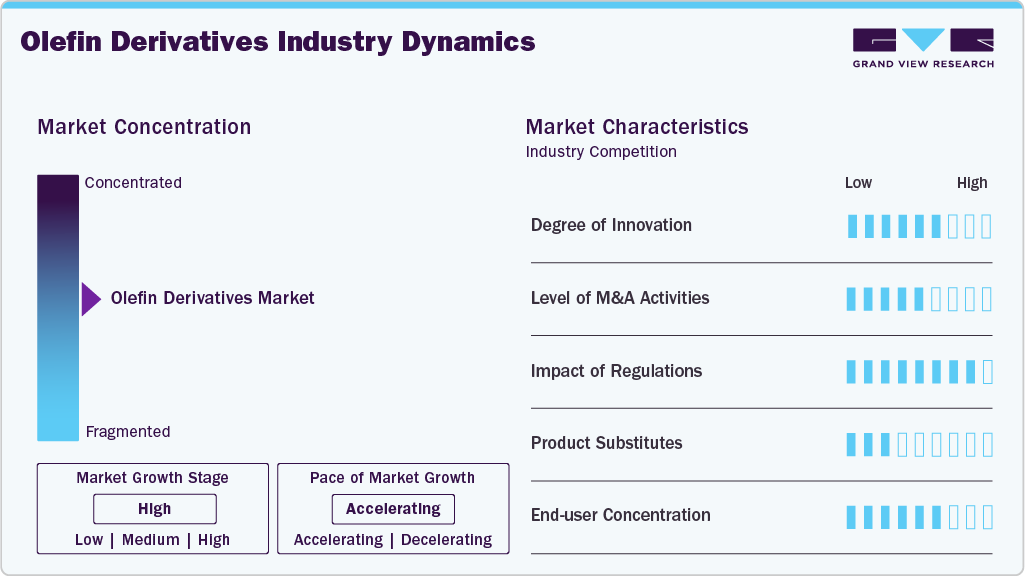
At the same time, emerging players in Asia Pacific, Latin America, and the Middle East & Africa are steadily expanding their presence in the global market by leveraging cost-efficient petrochemical production, growing downstream manufacturing infrastructure, and rising regional demand for packaging materials, automotive components, construction products, and specialty polymer applications. These regional suppliers are supported by strategic investments in advanced polymer processing technologies, research and development capabilities, and integrated production facilities to enhance material performance, production efficiency, and operational consistency.
Product Insights
The ethylene-based segment generated the dominant revenue in 2025, holding 42.9% market share. Its leading position is supported by widespread adoption across packaging, construction, consumer goods, and industrial manufacturing applications, due to its cost-effectiveness, material versatility, and ability to provide essential functional properties such as durability, flexibility, chemical resistance, and consistent processing performance. The segment benefits from strong demand in polyethylene production and downstream polymer manufacturing operations, where product quality and operational efficiency are critical.
The alpha olefin segment emerged as the fastest-growing segment, growing at a CAGR of 6.2% between 2026 and 2033. Increasing demand for high-performance and specialty olefin derivatives, capable of delivering properties such as improved lubrication performance, chemical stability, and formulation versatility, is accelerating adoption across lubricant additives, detergents, surfactants, and specialty chemical manufacturing applications, particularly in emerging industrial markets and advanced processing operations.
End-use Insights
The packaging segment remained the dominant end use segment in 2025, accounting for 28.9% market share of overall revenue. The segment’s dominance is supported by the widespread use of olefin derivatives in flexible packaging, rigid containers, films, and food-grade packaging applications, where properties such as durability, lightweight performance, chemical resistance, and processing efficiency are critical. Rising demand for packaged food products, e-commerce packaging solutions, and sustainable packaging materials is further driving segment growth.

The healthcare & pharmaceuticals segment is forecast to grow at the fastest CAGR of 6.6% through 2033. Growing demand for high-performance olefin derivatives that provide properties such as sterility compatibility, chemical stability, and material safety is encouraging adoption across medical packaging, healthcare products, and pharmaceutical manufacturing applications. In addition, innovations in specialty polymers, advanced medical-grade materials, and high-purity polymer formulations are enabling enhanced production efficiency and expanded application capabilities across healthcare and pharmaceutical manufacturing sectors.
Regional Insights
Asia Pacific olefin derivatives industry accounted for the largest revenue share of 41.1% in 2025, driven by strong demand from packaging, automotive, construction, textile, and industrial manufacturing applications across the region. The market benefits from well-established petrochemical infrastructure, large-scale polymer production capacities, and increasing adoption of high-performance olefin derivatives aimed at enhancing material durability, processing efficiency, and product performance. The presence of both major global petrochemical companies and regional manufacturers, along with rising consumption of ethylene-based, propylene-based, and specialty olefin derivatives in downstream industrial operations, continues to support substantial market growth throughout the region.

China olefin derivatives market accounted for a 46.5% market share of the Asia Pacific region in 2025, driven by strong demand from packaging, automotive, construction, textile, and specialty polymer manufacturing operations. The country’s large-scale petrochemical base, advanced manufacturing capabilities, and focus on high-performance and cost-efficient polymer solutions continue to support market growth. Both domestic manufacturers and global petrochemical companies are actively developing advanced olefin derivative products to meet evolving quality requirements and industrial standards across key applications, including flexible packaging, automotive components, consumer goods, and specialty chemical processing.
North America Olefin Derivatives Market Trends
The North America olefin derivatives market is driven by strong demand for packaging, automotive, healthcare, and specialty polymer applications, supported by a well-established petrochemical infrastructure, technological advancements, and high adoption of performance-oriented material solutions. Increasing emphasis on product quality, production efficiency, and sustainable manufacturing practices is accelerating the use of advanced olefin derivatives across key applications, including flexible packaging, automotive components, medical products, and industrial polymers. Manufacturers are increasingly leveraging high-performance and multifunctional olefin derivative formulations to enhance material durability, processing efficiency, and operational consistency across downstream manufacturing operations.
U.S. Olefin Derivatives Market Trends
The U.S. olefin derivatives market accounted for a market share of 78.4% of the North American region in 2025, driven by strong demand from packaging, automotive, healthcare, and specialty polymer manufacturing applications. The country’s advanced petrochemical infrastructure, technological capabilities, and increasing focus on high-performance and sustainable material solutions continue to support market growth. Both domestic manufacturers and global petrochemical companies are actively developing advanced olefin derivative products to meet evolving industrial requirements and regulatory standards across key applications, including flexible packaging, automotive components, medical products, and specialty chemical processing.
Europe Olefin Derivatives Market Trends
The European olefin derivatives market is fueled by growing demand for high-performance packaging, automotive, construction, and specialty polymer applications, supported by a mature petrochemical infrastructure and strong focus on innovation and material quality. Rising adoption of sustainable and multifunctional olefin derivative products is driving growth across sectors such as automotive manufacturing, consumer goods, healthcare, and industrial processing, where lightweight properties, chemical resistance, durability, and operational efficiency are key priorities.
The Germany olefin derivatives market is a key country-level market within Europe, driven by robust demand from packaging, automotive manufacturing, construction materials, and specialty polymer production applications. Growth is supported by the country’s focus on technological innovation, high-quality petrochemical manufacturing, and compliance with strict environmental and industrial sustainability standards. Manufacturers are increasingly adopting advanced olefin derivative products to improve material performance, chemical resistance, and production efficiency across applications such as flexible packaging, automotive components, industrial polymers, and specialty chemical processing, reinforcing Germany’s position as a leading market within the region.
Latin America Olefin Derivatives Market Trends
The Latin America olefin derivatives market is experiencing robust growth, driven by rising demand for high-performance packaging materials, automotive components, and specialty polymer applications across industrial manufacturing operations. Expansion of petrochemical infrastructure, adoption of advanced polymer processing technologies, and increasing focus on material quality, durability, and production efficiency are supporting regional market development. Key countries with growing manufacturing activities and industrial development projects are providing new opportunities for the use of specialty and multifunctional olefin derivatives across a range of high-performance industrial applications.
Middle East and Africa Olefin Derivatives Market Trends
The Middle East & Africa olefin derivatives market is witnessing steady growth, driven by increasing demand for high-performance packaging materials, specialty polymers, and industrial manufacturing applications across downstream processing operations. Rising adoption of olefin derivatives with enhanced durability, chemical resistance, and processing efficiency, particularly in packaging, construction materials, automotive components, and specialty chemical applications, is fueling regional market expansion. Also, ongoing investments in petrochemical manufacturing capacities, advanced polymer processing technologies, and distribution networks are supporting broader market penetration and strengthening the region’s position in the global olefin derivatives industry.
Key Olefin Derivatives Company Insights
The global olefin derivatives industry features a mix of established petrochemical companies, polymer manufacturers, and industrial materials providers. Leading participants focus on developing high-performance olefin-based products while incorporating sustainable manufacturing practices and advanced processing technologies. Companies are increasingly investing in specialty polymer formulations, recyclable material solutions, and innovative petrochemical production techniques to enhance competitiveness and comply with evolving industrial standards and environmental regulations.
Prominent players in the market include BASF SE, Dow Inc., LyondellBasell Industries, and SABIC among others. These companies leverage extensive R&D capabilities, global manufacturing networks, and advanced technological expertise to deliver high-performance olefin derivatives solutions across applications such as packaging, automotive components, construction materials, healthcare products, consumer goods, and specialty chemical processing operations worldwide.
Key Olefin Derivatives Companies:
The following key companies have been profiled for this study on the olefin derivatives market.
-
BASF SE
-
Mitsubishi Chemical
-
Exxon Mobil Corporation
-
Chevron Phillips Chemical Company LLC
-
Evonik Industries AG
-
INEOS
-
Qatar Chemical Company Ltd.
-
SABIC
-
Repsol
-
China Petroleum & Chemical
Recent Developments
-
In January 2026, SABIC announced the divestment of its European Petrochemicals business to AEQUITA and its Engineering Thermoplastics business in the Americas and Europe to Mutares for a combined enterprise value of USD 950 million. The transactions are part of SABIC’s broader portfolio optimization strategy aimed at strengthening operational efficiency and focusing on high-growth business segments. Such strategic restructuring activities are expected to support innovation, improve competitiveness, and accelerate investments in advanced and sustainable olefin derivative products, thereby contributing to long-term market growth.
-
In May 2024, Marubeni Corporation, Neste, and Resonac Corporation entered into a strategic cooperation agreement to support the production of renewable olefins and derivatives in Japan. Under the collaboration, Neste will supply renewable Neste RE™ feedstock to Resonac’s Oita Complex, while Marubeni will manage logistics and supply chain operations. Such developments are accelerating the adoption of sustainable and bio-based olefin derivatives, supporting the transition toward low-carbon petrochemical manufacturing and driving long-term growth opportunities in the global olefin derivatives industry.
Competitive Benchmarking
Operating Strategies
Competitive Edge
Weaknesses
Mature Players: BASF SE; Exxon Mobil Corporation; SABIC; INEOS; Chevron Phillips Chemical Company LLC
- Focus on expanding olefin and downstream derivative production capacities to strengthen integrated petrochemical supply chains across packaging, automotive, and industrial applications.
- Invest in sustainable production technologies, circular economy initiatives, and advanced polymer development to improve operational efficiency and environmental performance.
- Strong petrochemical infrastructure, diversified polymer portfolios, and established relationships across packaging, automotive, construction, and specialty manufacturing industries.
- Advanced technological expertise, integrated feedstock access, and global distribution capabilities supporting large-scale international operations.
- Exposure to volatility in crude oil and feedstock prices impacting production economics and profitability.
- High capital investment requirements and increasing regulatory pressure related to carbon emissions and plastic waste management.
Emerging Players: Mitsubishi Chemical; Evonik Industries AG; Qatar Chemical Company Ltd.; Repsol; China Petroleum & Chemical
- Emphasize specialty olefin derivative development and regional production expansion targeting high-growth packaging, healthcare, and industrial manufacturing markets.
- Strengthen strategic partnerships, sustainable material innovations, and customer-specific product offerings to improve regional and international market penetration.
- Benefit from operational flexibility, regional feedstock advantages, and growing investments in specialty polymer and sustainable material solutions.
- Ability to address customized application requirements and rapidly expanding industrial demand across emerging markets.
- Limited global production scale and downstream integration compared to large multinational petrochemical companies.
- Challenges associated with fluctuating raw material costs, competitive market pricing, and evolving sustainability compliance requirements.
Olefin Derivatives Market Report Scope
Report Attribute
Details
Market size value in 2026
USD 255.5 billion
Revenue forecast in 2033
USD 370.9 billion
Growth rate
CAGR of 5.5% from 2026 to 2033
Base year for estimation
2025
Historical data
2021 - 2024
Forecast period
2026 - 2033
Quantitative units
Revenue in USD million/billion, volume in kilotons and CAGR from 2026 to 2033
Report coverage
Revenue forecast, company ranking, competitive landscape, growth factors, and trends
Segments covered
Product, end-use, region
Regional scope
North America; Europe; Asia Pacific; Middle East & Africa; Latin America
Country scope
U.S.; Canada; Mexico; Germany; UK; France; Italy; Spain; China; India; Japan; South Korea; Brazil; Argentina; South Africa; Saudi Arabia
Key companies profiled
BASF SE; Mitsubishi Chemical; Exxon Mobil Corporation; Chevron Phillips Chemical Company LLC; Evonik Industries AG; INEOS; Qatar Chemical Company Ltd.; SABIC; Repsol; China Petroleum & Chemical
Customization scope
Free report customization (equivalent up to 8 analysts’ working days) with purchase. Addition or alteration to country, regional & segment scope.
Pricing and purchase options
Avail customized purchase options to meet your exact research needs. Explore purchase options
Global Olefin Derivatives Market Report Segmentation
This report forecasts revenue growth at global, regional, and country levels and provides an analysis of the latest industry trends in each of the sub-segments from 2021 to 2033. For this study, Grand View Research has segmented the global olefin derivatives market report based on product, end-use, and region:

-
Product Outlook (Volume, Kilotons; Revenue, USD Billion, 2021 - 2033)
-
Ethylene-Based
-
Propylene-Based
-
Butadiene-Based
-
Alpha Olefin
-
Other Products
-
-
End-use Outlook (Volume, Kilotons; Revenue, USD Billion, 2021 - 2033)
-
Packaging
-
Automotive & Transportation
-
Building & Construction
-
Textile Industry
-
Electrical & Electronics
-
Healthcare & Pharmaceuticals
-
Consumer Goods
-
Industrial Manufacturing
-
Other End-use
-
-
Regional Outlook (Volume, Kilotons; Revenue, USD Billion, 2021 - 2033)
-
North America
-
U.S.
-
Canada
-
Mexico
-
-
Europe
-
Germany
-
UK
-
France
-
Italy
-
Spain
-
-
Asia Pacific
-
China
-
India
-
Japan
-
South Korea
-
-
Latin America
-
Brazil
-
Argentina
-
-
Middle East & Africa
-
Saudi Arabia
-
South Africa
-
-
Frequently Asked Questions About This Report
The ethylene-based segment held the largest share of 42.9% in 2025 within the global olefin derivatives market. This dominant position is largely due to its cost-effectiveness, material versatility, and ability to provide essential functional properties such as durability, chemical resistance, processing efficiency, and consistent industrial performance.
Some of the key players operating in the global olefin derivatives market include BASF SE, Mitsubishi Chemical, Exxon Mobil Corporation, Chevron Phillips Chemical Company LLC, Evonik Industries AG, INEOS, Qatar Chemical Company Ltd., SABIC, Repsol, and China Petroleum & Chemical.
Key factors driving the growth of the global olefin derivatives market include increasing demand for high-performance packaging materials, automotive components, and specialty polymer applications across industrial manufacturing operations, along with a growing emphasis on enhancing production efficiency, material durability, and product quality. Rising adoption of multifunctional olefin derivative products, offering properties such as chemical resistance, lightweight performance, processing stability, and material versatility, is further supporting overall market expansion.
The global olefin derivatives market size was estimated at USD 243.4 billion in 2025 and is expected to reach USD 255.5 billion in 2026.
The global olefin derivatives market is expected to grow at a compound annual growth rate of 5.5% from 2026 to 2033 to reach USD 370.9 billion by 2033.
About the Author(s)
Petrochemicals Research Team
Bulk Chemicals · PetrochemicalsThis report was authored by the petrochemicals research team at Grand View Research - comprising two research analysts, one senior research analyst, and one industry expert - with specialized expertise in the petrochemicals segment of the bulk chemicals industry. All findings are based on proprietary bulk chemicals databases, executive interviews, and regulatory analysis, subject to internal peer review prior to publication.
Last Updated:
Speak to Analyst


Customize this report to your needs — add regions, segments, or data points, with 20% free customization.
Or view our licence options:


ISO 9001:2015 & 27001:2022 Certified
We are GDPR and CCPA compliant! Your transaction & personal information is safe and secure. For more details, please read our privacy policy.


