
- Home
- »
- IT Services & Applications
- »
-
OCP Rack Market Size, Share & Trends Report, 2026-2033GVR Report cover

OCP Rack Market (2026 - 2033)
Size, Share & Trends Analysis Report By Component (Power Shelves, Cooling Components), By Rack Type (Open Rack V1, Open Rack V2), By Cooling Technology (Air Cooling, Immersion Cooling), By End-use, And Segment Forecasts
Market Size, 2025
$1.8BMarket Estimate, 2026
$2.1BMarket Forecast, 2033
$8.2BCAGR, 2026–2033
21.4%OCP Rack Market Summary
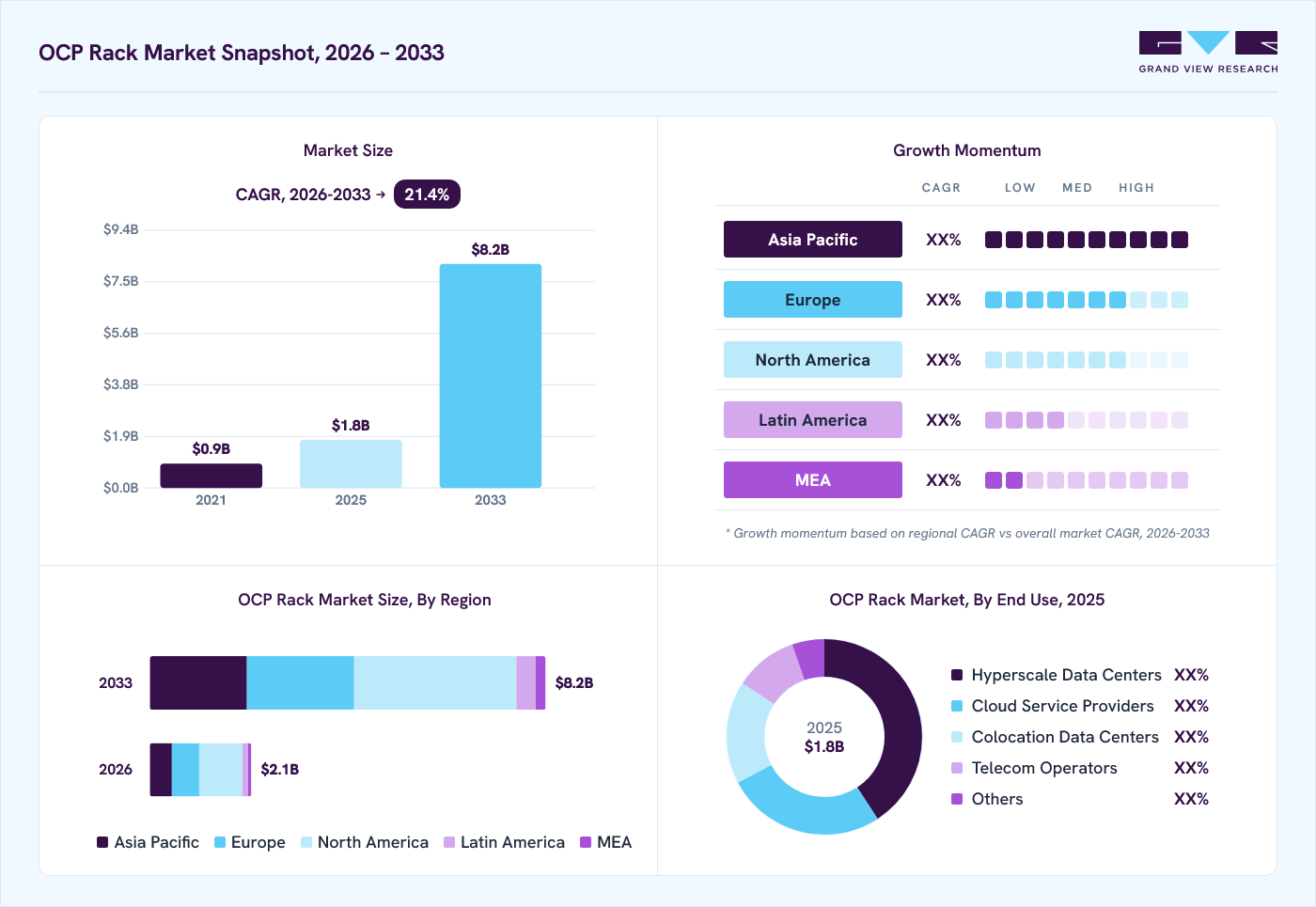
The global OCP rack market size was valued at USD 1.8 billion in 2025 and is projected to grow from USD 2.1 billion in 2026 to USD 8.2 billion by 2033, at a CAGR of 21.4% from 2026 to 2033. North America dominated the market, accounting for the largest revenue share of 42.7% in 2025. Growing adoption of open and standardized data center architectures is driving market growth.
 Source: Grand View Research, IR Documents, Primary Interviews, Paid DatabasesTo learn more about this report,
 Download Free Sample Report
 Key Market Trends & Insights
- By component: Rack frames and enclosures segment dominated the market, with a revenue share of 28.5% in 2025
- By rack type: Open rack V3 led the market and accounted for a share of 44.6% in 2025
- By cooling technology: Air cooling segment dominated the market, with a revenue share of 39.8% in 2025
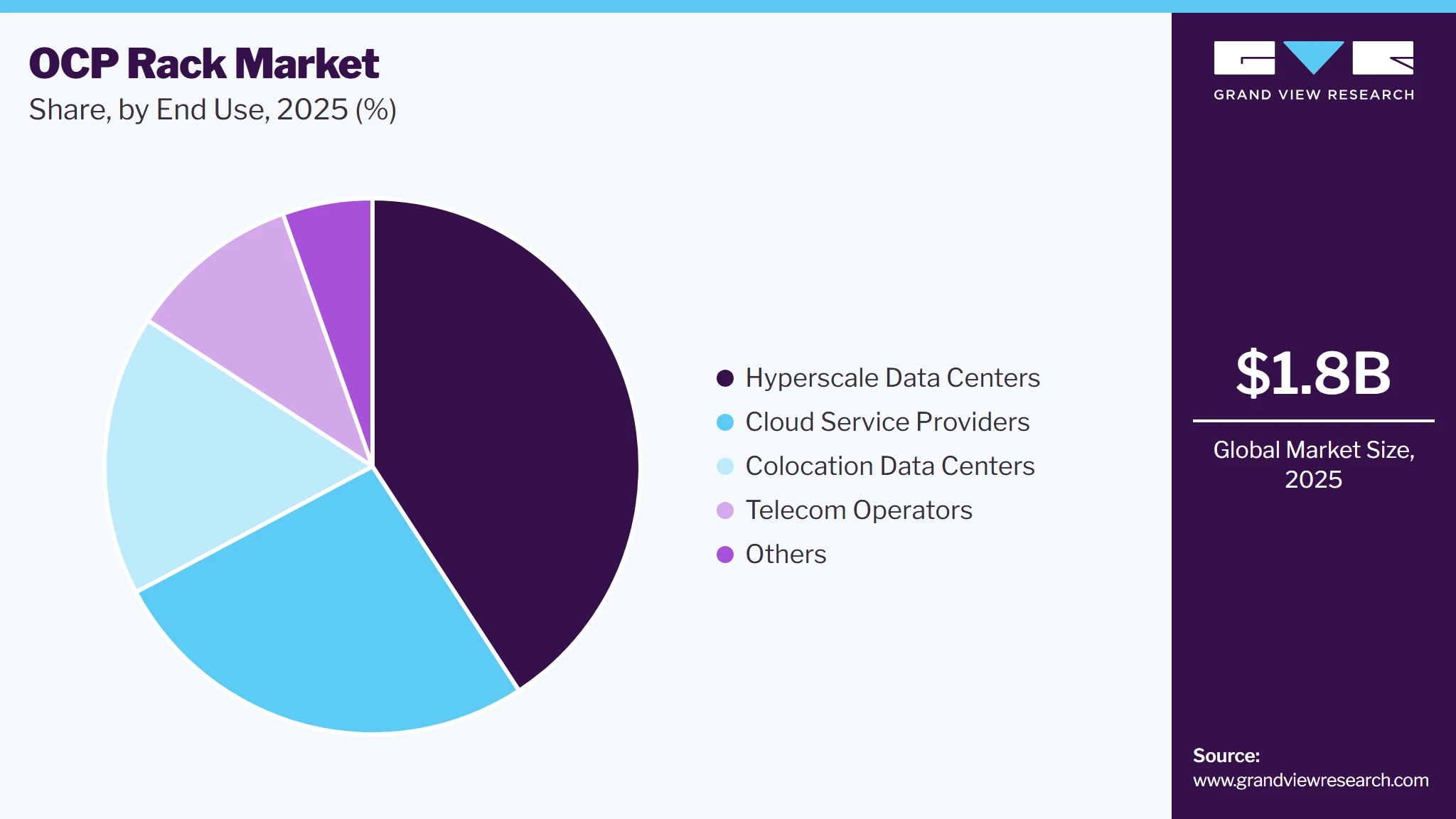
- By end-use: Hyperscale data centers segment held the largest revenue share of 40.8% in 2025
Regional Highlights
- Largest regional market: North America (42.7% revenue share, 2025)
- Fastest-growing regional market: Asia Pacific (highest CAGR, 2026-2033)
- By country: The U.S. held the largest market share in 2025.
Market Size & Forecast
- Market size in 2025: USD 1.8 Billion
- Estimated market size in 2026: USD 2.1 Billion
- Projected market size by 2033: USD 8.2 Billion
- CAGR (2026-2033): 21.4%
GVR research-powered AIAsk Prism AI about the OCP rack marketGet cited answers from GVR research on market growth, segments, regulations and forecasts.Start with✓ Source-linked answers ✓ Market-specific context ✓ Traceable figuresExplore Prism AI ↗
The rapid expansion of hyperscale data center infrastructure is driving market growth in the OCP rack market by increasing demand for standardized, high-density rack architectures that support large-scale cloud and digital infrastructure deployments. Hyperscale operators increasingly require rack systems that can accommodate greater computing density, improved airflow management, integrated power distribution, and modular deployment strategies across thousands of server installations. OCP racks are increasingly adopted in large cloud campuses where operational consistency, manufacturing standardization, and deployment efficiency are critical priorities. Their open architecture enables easier integration of servers, networking equipment, storage systems, and cooling components while supporting rapid infrastructure expansion. The growing construction of hyperscale facilities across global cloud ecosystems is propelling demand for OCP rack solutions.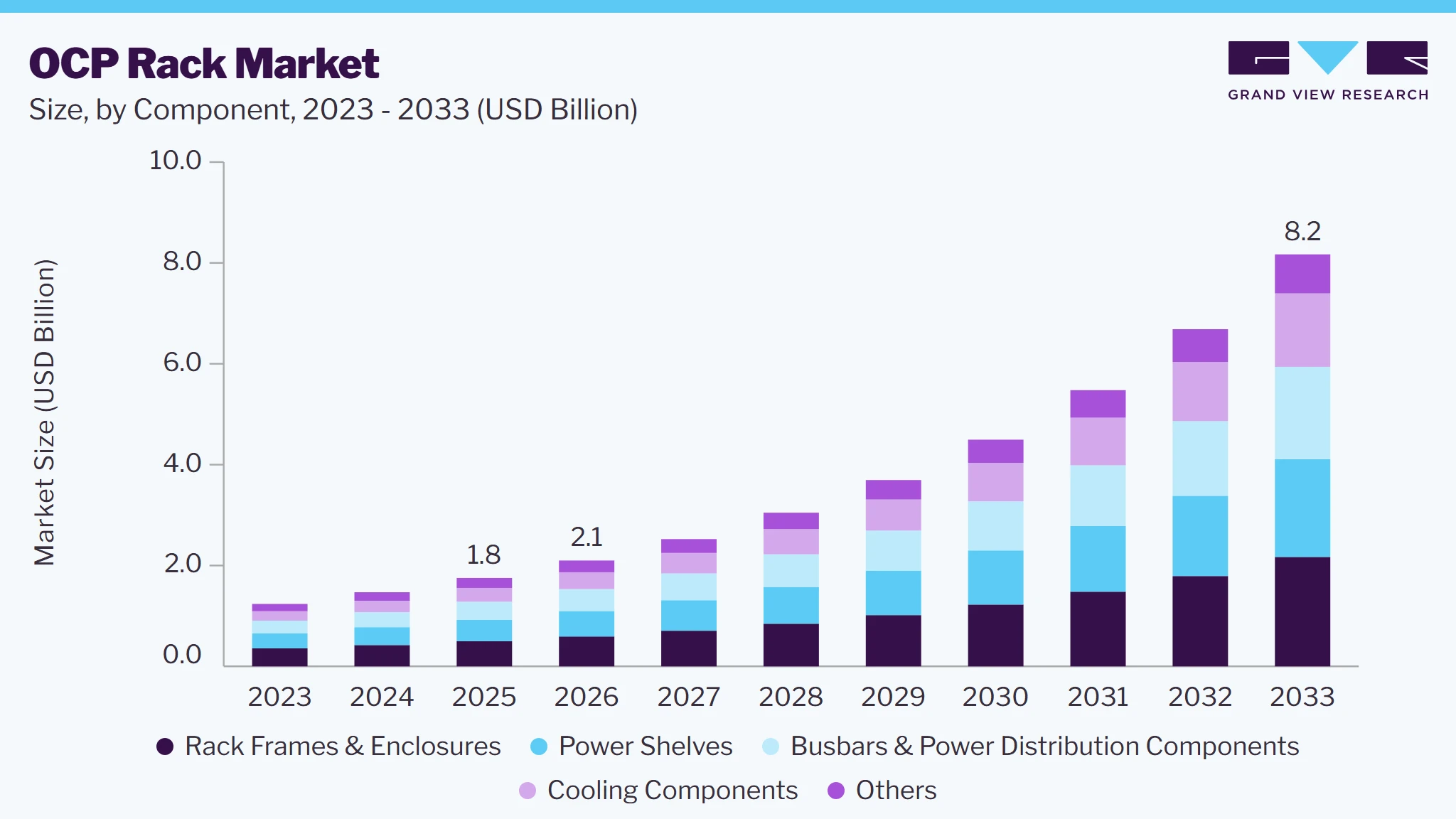 To learn more about this report, Download Free Sample Report
 The increasing adoption of artificial intelligence and high-performance computing workloads is driving market growth for OCP racks, as data centers require rack platforms that support power-intensive GPU servers and accelerated computing infrastructure. AI clusters generate substantial thermal loads and require optimized rack layouts that facilitate efficient airflow, cable management, and power delivery across densely populated server environments. OCP rack designs are increasingly aligned with modern AI infrastructure requirements that prioritize scalability, serviceability, and integration with advanced cooling technologies. Operators increasingly deploy rack systems that support flexible equipment configurations while accommodating future increases in computing density. The continued expansion of AI-ready data center infrastructure drives market growth in advanced rack architectures.
The growing emphasis on modular data center construction is driving market growth in the OCP rack market by encouraging the adoption of standardized infrastructure components that simplify deployment and expansion. Data center operators increasingly construct facilities with prefabricated modules and standardized infrastructure designs, reducing installation complexity and accelerating project execution. OCP racks support modular deployment strategies through standardized dimensions, interoperable component compatibility, and simplified integration with power and cooling infrastructure. This approach allows operators to expand capacity incrementally while maintaining architectural consistency across multiple facilities. The growing preference for modular, scalable data center construction contributes to the broader adoption of OCP rack systems.
Market Dynamics
The OCP rack market is gaining momentum as hyperscale data centers, cloud service providers, and enterprise facilities increasingly adopt Open Compute Project (OCP) infrastructure to improve scalability, power efficiency, and hardware interoperability. OCP racks are designed to support high-density computing, advanced cooling architectures, modular power distribution, and standardized hardware configurations, making them well suited for artificial intelligence, machine learning, and high-performance computing workloads. The rapid expansion of data center capacity, rising demand for energy-efficient infrastructure, and increasing deployment of liquid cooling and next-generation server architectures are accelerating the adoption of OCP rack systems. In addition, investments in hyperscale facilities and disaggregated data center infrastructure are driving strong demand for rack platforms capable of supporting higher power loads and flexible equipment configurations.
The rising deployment of hyperscale data centers worldwide is driving growth in the OCP rack market by creating sustained demand for standardized rack architectures that support extremely large computing environments. Hyperscale operators increasingly construct facilities housing thousands of servers, networking devices, storage systems, and power distribution units that must be deployed with high consistency and operational efficiency. OCP-compatible rack designs align with these requirements through standardized dimensions, modular construction, optimized airflow, and simplified integration with power and cooling infrastructure. Large cloud providers increasingly prioritize infrastructure platforms that can be replicated across multiple facilities with minimal engineering variation. The continued global expansion of hyperscale cloud infrastructure is propelling demand for OCP-compatible rack systems across new data center developments.
High initial investment required for OCP-compatible infrastructure deployment is constraining growth in the OCP rack market, particularly among enterprises and data center operators that continue to operate conventional rack environments. Transitioning to OCP-compatible infrastructure often requires more than replacing rack cabinets, since organizations may need compatible power distribution systems, busbar infrastructure, cooling modifications, cabling redesign, monitoring equipment, and supporting hardware designed around open rack standards. Existing facilities built around traditional rack architectures may require significant engineering adjustments before OCP-compatible racks can be deployed effectively. Many organizations evaluate these infrastructure changes as part of a broader modernization program rather than a simple rack procurement decision. The substantial capital required for facility adaptation and infrastructure integration can delay adoption across organizations with constrained investment budgets.
The rising demand for modular data center construction is creating significant opportunities in the OCP rack market by increasing the need for standardized infrastructure that can be integrated into prefabricated and scalable data center designs. Data center developers increasingly prefer modular construction approaches that allow computing capacity to be added in repeatable units rather than through large single-phase facility expansions. OCP racks align well with modular engineering principles through standardized dimensions, interoperable components, and simplified integration with power, cooling, and networking infrastructure. Manufacturers can develop rack solutions specifically optimized for prefabricated modules, enabling rapid assembly and transportation across different deployment environments. The growing adoption of modular construction methodologies is expanding opportunities for OCP rack providers across hyperscale, colocation, enterprise, and telecommunications data center projects.
Analyst Perspective
The OCP rack market is evolving from a niche open-hardware infrastructure segment into a strategic component of next-generation data center architecture. Unlike conventional rack markets that compete primarily on enclosure design and cost, competitive differentiation in the OCP ecosystem is increasingly driven by power-density support, cooling integration, modularity, and compatibility with rapidly evolving AI and cloud hardware platforms. Suppliers that can provide racks optimized for liquid cooling, high-current power distribution, and large-scale standardized deployments are likely to strengthen their position as data centers transition toward higher-density computing environments. As AI workloads continue to reshape infrastructure requirements, OCP racks are expected to become a key enabling platform for efficient, scalable, and interoperable data center expansion.
Component Insights
The rack frames and enclosures segment accounted for the largest market share of 28.5% in 2025 in the OCP rack market. The increasing demand for high-density server deployments is driving growth in the rack frames and enclosures segment of the OCP rack market. Modern data centers increasingly deploy compute-intensive servers, GPU systems, storage arrays, and high-capacity networking equipment that require structurally optimized rack frames capable of supporting greater weight and equipment density. Rack frames and enclosures designed around OCP principles provide improved mechanical strength, standardized dimensions, and efficient equipment organization, accommodating evolving hardware requirements. Operators increasingly require rack structures that can support future generations of servers without requiring repeated infrastructure replacement. The continuous increase in equipment density across cloud, AI, and enterprise data centers is propelling demand for advanced rack frame and enclosure solutions.
The cooling components segment is anticipated to grow at the fastest CAGR during the forecast period. The growing adoption of AI-ready data center infrastructure is driving demand for advanced cooling components that can meet future thermal requirements. Next-generation processors, accelerators, memory systems, and networking platforms continue to increase power density within rack environments, requiring more sophisticated cooling technologies than in previous generations of data center infrastructure. OCP-compatible cooling components are increasingly designed to support higher coolant flow rates, improved thermal transfer, advanced monitoring capabilities, and integration with intelligent infrastructure management systems. Operators increasingly require cooling architectures that remain compatible with evolving server designs while supporting long-term infrastructure scalability. The continued expansion of AI-focused computing environments is driving growth in cooling components within the OCP rack market.
Rack Type Insights
The open rack V3 segment accounted for the largest market share of 44.6% in 2025 in the OCP rack market. The increasing deployment of modular and prefabricated data center infrastructure is driving demand for open rack V3 solutions. Data center developers increasingly adopt modular construction approaches that require standardized rack systems capable of efficient factory integration and repeatable deployment across multiple facilities. Open rack V3 architectures align well with modular engineering strategies through consistent mechanical specifications, scalable power integration, and compatibility with prefabricated infrastructure modules. Operators increasingly seek rack platforms that support rapid deployment while maintaining architectural consistency across phased capacity expansions. The growing adoption of modular data center construction is contributing to market growth in the open rack V3 segment.
The open rack V2 segment is expected to register significant CAGR from 2026 to 2033. The ongoing deployment of regional and distributed computing infrastructure is driving market growth for open rack V2 solutions. Telecommunications providers, enterprise organizations, cloud operators, financial institutions, healthcare networks, and government agencies increasingly establish regional data centers that require standardized and reliable rack platforms without necessarily adopting the most advanced high-density architectures. Open rack V2 systems provide sufficient scalability, structural reliability, and infrastructure compatibility for a wide range of distributed computing applications operating across metropolitan and regional facilities. Their mature ecosystem enables efficient procurement, deployment, and maintenance across geographically dispersed infrastructure environments. The continued expansion of distributed digital infrastructure contributes to sustained growth in the open rack V2 segment of the OCP rack market.
Cooling Technology Insights
The air cooling segment accounted for the largest market share of 39.8% in 2025 in the open compute project (OCP) rack market. The growing expansion of regional and edge computing facilities is driving demand for air-cooled OCP rack systems. Telecommunications providers, cloud operators, industrial organizations, financial institutions, healthcare networks, and government agencies increasingly establish distributed data centers that require standardized rack infrastructure capable of operating efficiently across diverse geographic environments. Air cooling remains a widely used thermal management approach in many regional and edge facilities, where deployment flexibility, maintenance accessibility, and familiarity with the infrastructure are important operational priorities. OCP-compatible air-cooled racks provide scalable infrastructure that supports a broad range of distributed computing applications while maintaining standardized engineering characteristics. The continued growth of regional and edge digital infrastructure is propelling demand for air-cooled OCP rack solutions.
The direct-to-chip liquid cooling segment is expected to register a significant CAGR from 2026 to 2033. The rapid deployment of AI and GPU-intensive computing infrastructure is driving market growth for the direct-to-chip liquid cooling segment within the open compute project (OCP) rack market. Modern AI servers, accelerator clusters, and high-performance computing platforms generate significantly higher heat concentrations at the processor level than conventional enterprise hardware, making direct thermal management increasingly important. Direct-to-chip liquid cooling systems are designed to remove heat from CPUs, GPUs, and other critical components, enabling rack architectures to support substantially higher power densities in standardized OCP environments. Data center operators increasingly require cooling technologies that can maintain stable processor temperatures while supporting continuously increasing computational intensity. The ongoing expansion of AI-ready digital infrastructure is driving demand for direct-to-chip liquid-cooling solutions integrated with advanced OCP rack platforms.
End-use Insights
The hyperscale data centers segment accounted for the largest market share of 40.8% in 2025 in the OCP rack market. The growing integration of advanced power distribution architectures is driving market growth across the hyperscale data centers segment. Modern hyperscale facilities increasingly deploy higher rack-level power capacities, busbar-based distribution systems, intelligent power monitoring, and scalable electrical infrastructure, all of which require rack platforms specifically designed for these advanced power environments. OCP-compatible racks provide greater flexibility for integrating modern electrical architectures while supporting increasingly power-intensive server and networking deployments. Hyperscale operators increasingly prioritize rack systems that can accommodate future increases in electrical density without requiring repeated infrastructure replacements. The ongoing evolution of hyperscale power infrastructure contributes to market growth for advanced OCP rack technologies.
 To learn more about this report, Download Free Sample Report
 The cloud service providers segment is anticipated to register the fastest CAGR during the forecast period. The increasing use of high-capacity networking infrastructure is driving market growth within the cloud service providers segment. Cloud providers continue upgrading data center networks to support larger east-west traffic volumes, distributed storage systems, AI clusters, cloud-native applications, and software-defined infrastructure environments. These networking environments require rack platforms that accommodate dense switch deployments, structured cable management, and scalable power distribution for high-performance interconnect architectures. OCP-compatible racks provide the flexibility needed to efficiently integrate modern networking equipment into hyperscale cloud facilities. The continued expansion of high-capacity cloud networking environments is propelling demand for open compute project (OCP) rack systems.
Regional Insights
North America dominated the OCP rack market, accounting for 42.7% of revenue in 2025. The rising deployment of edge computing infrastructure across North America is driving market growth for standardized rack platforms. Telecommunications operators, cloud providers, industrial organizations, financial institutions, healthcare networks, and government agencies continue establishing regional and edge data centers to support latency-sensitive applications and distributed digital services. These facilities require compact, scalable, and standardized rack architectures that support computing, storage, networking, and power infrastructure across geographically distributed locations. OCP-compatible racks provide operational consistency across regional deployment environments while supporting modular infrastructure expansion strategies. The continued expansion of edge computing infrastructure across North America contributes to growth in the OCP rack market.
 To learn more about this report, Download Free Sample Report
 U.S. OCP Rack Market Trends
The U.S. OCP rack market is projected to grow significantly during the forecast period. The growing modernization of enterprise data centers across the U.S. is driving demand for standardized rack infrastructure. Financial institutions, healthcare organizations, government agencies, manufacturers, retailers, and technology enterprises continue upgrading legacy facilities to support cloud-native applications, digital transformation initiatives, virtualization environments, and advanced networking infrastructure. OCP-compatible racks provide a scalable foundation for integrating modern servers, storage systems, networking equipment, and intelligent power management technologies within evolving enterprise environments. Organizations increasingly seek rack systems that support higher equipment density and long-term infrastructure flexibility while maintaining standardized deployment practices across multiple facilities. The continued modernization of enterprise digital infrastructure contributes to market growth within the U.S. OCP rack market.
Asia Pacific OCP Rack Market Trends
The OCP rack market in Asia Pacific is expected to grow at the fastest CAGR from 2026 to 2033. The increasing investment in domestic cloud infrastructure by regional technology companies is driving market growth for OCP-compatible rack systems across the Asia Pacific. Local cloud providers, telecommunications operators, internet platforms, and enterprise technology firms are expanding their own data center networks to reduce dependence on external infrastructure and improve service delivery within regional markets. These operators require scalable rack architectures that support high-density server deployments, advanced networking equipment, and efficient power distribution across large facilities. OCP-compatible racks align well with the operational requirements of rapidly expanding cloud infrastructure by providing standardized mechanical and electrical configurations. The growing expansion of locally operated cloud ecosystems contributes to sustained demand for OCP rack technologies across the region.
The OCP rack market in China is projected to grow significantly during the forecast period. The growing deployment of 5G network infrastructure across China is driving demand for OCP-compatible rack systems within telecommunications environments. Telecom operators continue building cloud-native network platforms, edge computing facilities, distributed processing locations, and virtualized infrastructure environments that require standardized rack architectures capable of supporting mixed IT and telecommunications equipment. OCP-compatible racks provide flexibility for integrating networking, computing, storage, and power systems within rapidly evolving telecom infrastructure while supporting scalable deployment across multiple operational locations. Operators continue expanding digital infrastructure to support next-generation communication services, industrial connectivity, and intelligent network applications throughout China. The ongoing modernization of telecommunications infrastructure contributes to market growth within the OCP rack ecosystem.
India OCP rack market is projected to grow significantly during the forecast period. The increasing emphasis on energy-efficient data center design across India is driving demand for OCP-compatible rack systems that support optimized thermal and electrical performance. Data center operators increasingly prioritize infrastructure that improves space utilization, airflow management, cooling efficiency, and power distribution as electricity consumption becomes a critical operational consideration. OCP-compatible racks provide standardized layouts that facilitate efficient integration with modern cooling technologies, intelligent power monitoring, and advanced infrastructure management systems. Operators continue to invest in infrastructure platforms that support long-term operational efficiency while accommodating growing computing requirements across new and existing facilities. The growing focus on efficient digital infrastructure is propelling the adoption of OCP rack technologies across India.
Europe OCP Rack Market Trends
The OCP rack market in Europe is anticipated to grow steadily from 2026 to 2033. The increasing investment in research, semiconductor design, and advanced digital infrastructure across Europe is driving demand for next-generation rack systems. Research institutions, technology companies, industrial enterprises, cloud operators, and high-performance computing organizations continue deploying increasingly power-intensive processors, accelerators, networking technologies, and storage platforms that require advanced rack architectures capable of supporting evolving thermal and electrical requirements. OCP-compatible racks provide flexibility for integrating emerging hardware platforms while supporting scalable cooling and power distribution strategies across advanced computing environments. Organizations continue investing in infrastructure platforms that can accommodate successive generations of digital hardware technologies without extensive facility redesign.
The OCP rack market in the U.K. is expected to grow significantly during the forecast period. The increasing adoption of financial technology infrastructure across the U.K. is driving market growth for OCP-compatible rack systems. Banks, payment processors, digital banking platforms, investment firms, insurance companies, and financial technology providers continue expanding computing environments that support transaction processing, analytics platforms, fraud detection systems, and cloud-based financial services. These facilities require scalable rack architectures that support dense compute, storage, and networking deployments in highly connected operational environments. OCP-compatible racks provide flexibility for integrating evolving financial technology infrastructure while supporting long-term operational scalability across multiple facilities. The continued expansion of financial technology computing infrastructure contributes to sustained demand for OCP rack solutions across the U.K.
Germany OCP rack market is expected to grow significantly during the forecast period. The rapid expansion of industrial digitalization across Germany is driving growth in the OCP rack market, as manufacturing companies continue to invest heavily in advanced computing infrastructure to support automation, smart factories, robotics, industrial analytics, and connected production environments. German industrial enterprises increasingly require scalable data center infrastructure capable of handling large volumes of operational data generated by sensors, production equipment, engineering systems, and digital manufacturing platforms. OCP-compatible racks provide standardized infrastructure that supports high-density server deployments, advanced networking equipment, and efficient power distribution across industrial computing environments. Manufacturers increasingly prioritize rack architectures that simplify long-term infrastructure expansion while maintaining operational consistency across multiple facilities.
Key OCP Rack Market Company Insights
Some prominent players in the OCP rack market include Eaton and Legrand North America, LLC, among others.
-
Eaton develops electrical, industrial, aerospace, and hydraulic technologies that help customers manage power more efficiently, safely, and sustainably. Its key OCP rack-related products include Open Rack v2-compatible power shelves, busbar power distribution systems, rack power distribution units (PDUs), intelligent PDUs, uninterruptible power supply (UPS) systems, battery energy storage solutions, and rack power management platforms. These products are engineered to align with OCP principles of efficiency, scalability, and standardized infrastructure, enabling data center operators to deploy high-density computing environments with improved power utilization and simplified maintenance.
-
Legrand North America, LLC is a provider of electrical and digital infrastructure solutions. Legrand North America provides a range of infrastructure solutions designed to support hyperscale, cloud, colocation, and enterprise data center deployments based on OCP principles. Its OCP rack-related product portfolio includes Open Rack-compatible enclosures, rack frames, power distribution systems, busbar power infrastructure, intelligent rack power distribution units (PDUs), cable management systems, containment solutions, and high-density networking infrastructure products.
Key OCP Rack Market Companies
The following key companies have been profiled for this study on the OCP rack market.
-
Advanced Energy
-
Amphenol Communications Solutions
-
ASRock Rack Inc.
-
Belden Inc.
-
Chatsworth Products
-
Eaton
-
GIGA-BYTE Technology Co., Ltd.
-
Legrand North America, LLC
-
Molex, LLC
-
Moxa Inc.
-
Rittal GmbH & Co. KG
Competitive Benchmarking
Operating Strategies
Competitive Edge
Weakness
Mature Players: Schneider Electric; Vertiv; Rittal; Eaton; Delta Electronics
- Established players focus on supplying OCP-compatible rack infrastructure for hyperscale data centers, cloud facilities, and AI computing environments.
- They invest in modular rack architectures, advanced power distribution systems, and cooling-ready designs that support high-density server deployments.
- These companies benefit from extensive manufacturing capabilities, global service networks, and strong relationships with cloud and colocation operators.
- Their ability to deliver complete rack, power, and cooling solutions enables efficient large-scale deployments. Proven engineering expertise and established supply chains further strengthen their competitive position.
- High production costs and significant capital investment requirements can reduce pricing flexibility.
- Dependence on large hyperscale customers and lengthy procurement cycles may also affect revenue stability and project timelines.
Emerging Players: Zella DC; Wiwynn; Quanta Cloud Technology; Hyve Solutions; AIC Inc.
- Emerging players focus on developing OCP rack systems optimized for AI servers, GPU clusters, and next-generation cloud infrastructure. They emphasize rapid customization, flexible manufacturing, and open hardware designs that can adapt quickly to changing data center requirements.
- Their strategies also prioritize collaboration with cloud-native customers and support for liquid-cooling and high-density computing configurations.
- These companies offer agile engineering capabilities and faster product customization for specialized data center deployments.
- Their focus on OCP-native designs enables efficient support for evolving AI and cloud infrastructure requirements. Flexible manufacturing approaches also help accelerate product development and deployment timelines.
- Smaller global support networks and limited enterprise relationships can restrict large-scale international deployments.
- Expanding manufacturing capacity and competing with established infrastructure vendors remain important challenges for broader market growth.
Recent Developments
-
In April 2026, Giga Computing, a subsidiary of GIGABYTE, launched OCP-compliant platforms specifically developed for AI-focused data center environments. The portfolio includes the the GIGABYTE TO86-SD1, based on the NVIDIA HGX B200 platform, both designed to provide high-performance computing capabilities for large-scale AI training. Developed using open standards and modular architecture principles, these platforms support seamless scalability across hyperscale and enterprise data center infrastructures.
-
In November 2025, Moxa Inc. launched its first AI-ready rackmount industrial PCs, the RKP-C220 Series, designed to deliver AI-accelerated computing performance at the edge. The RKP-C220 features an x16 PCIe slot that supports full-length discrete GPU cards, enabling powerful edge AI processing, while additional x8 and x1 PCIe slots provide flexible expansion capabilities. Its robust fanless thermal architecture, high-performance processor, and extensive I/O expansion options allow the system to efficiently manage distributed devices and demanding Edge AI workloads.
OCP Rack Market Report Scope
Report Attribute Details Market size in 2025
USD 1.8 billion
Estimated market size in 2026
USD 2.1 billion
Projected market size by 2033
USD 8.2 billion
Growth rate
CAGR of 21.4% from 2026 to 2033
Actual data
2021 - 2025
Forecast period
2026 - 2033
Quantitative units
Revenue in USD billion and CAGR from 2026 to 2033
Report coverage
Revenue forecast, company share, competitive landscape, growth factors, and trends
Segments covered
Component, technology, cooling technology, end-use, region
Regional scope
North America, Europe, Asia Pacific, Latin America, MEA
Country scope
U.S., Canada, Mexico U.K., Germany, France, China, India, Japan, Australia, South Korea, Brazil, UAE, Saudi Arabia, and South Africa
Key companies profiled
Advanced Energy, Amphenol Communications Solutions, ASRock Rack Inc., Belden Inc., Chatsworth Products, Eaton, GIGA-BYTE Technology Co., Ltd., Molex, LLC, Moxa Inc., Rittal GmbH & Co. KG
Customization scope
Free report customization (equivalent to 8 analysts working days) with purchase. Addition or alteration to country, regional & segment scope.
Pricing and purchase options
Avail customized purchase options to meet your exact research needs. Explore purchase options
Global OCP Rack Market Segmentation
This report forecasts revenue growth at global, regional, and country levels and provides an analysis of the latest industry trends in each of the sub-segments from 2021 to 2033. For this study, Grand View Research has segmented the global OCP rack market report based on component, rack type, cooling technology, end-use, and region:
-
Component Outlook (Revenue, USD Million, 2021 - 2033)
-
Rack Frames and Enclosures
-
Power Shelves
-
Busbars and Power Distribution Components
-
Cooling Components
-
Others
-
-
Rack Type Outlook (Revenue, USD Million, 2021 - 2033)
-
Open Rack V1
-
Open Rack V2
-
Open Rack V3
-
Others
-
-
Cooling Technology Outlook (Revenue, USD Million, 2021 - 2033)
-
Air Cooling
-
Direct-to-Chip Liquid Cooling
-
Immersion Cooling
-
Hybrid Cooling
-
Others
-
-
End-use Outlook (Revenue, USD Million, 2021 - 2033)
-
Hyperscale Data Centers
-
Cloud Service Providers
-
Colocation Data Centers
-
Telecom Operators
-
Others
-
-
Regional Outlook (Revenue, USD Million, 2021 - 2033)
-
North America
-
U.S.
-
Canada
-
Mexico
-
Europe
-
Germany
-
U.K.
-
France
-
Asia Pacific
-
China
-
India
-
Japan
-
South Korea
-
Australia
-
Latin America
-
Brazil
-
Middle East & Africa
-
UAE
-
Saudi Arabia
-
South Africa
-
Research Methodology
The OCP rack market figures in this report are based on a proven research process that combines executive interviews with secondary research from proprietary databases, company filings, and recognized regulatory and institutional sources. Market size is built through value-chain sizing-reconciling supply-side and demand-side estimates-and triangulated with bottom-up and top-down approaches. Every estimate passes multiple levels of expert validation before publication, with each OCP rack segment quantified using the revenue-capture definitions in the table below.
Segment Definition
Component
Revenue capture definition
Rack Frames and Enclosures
The largest component segment, capturing value through standardized Open Compute Project rack structures, cabinets, rails, and modular enclosure systems used to house high-density server and networking equipment. Demand is driven by hyperscale data center expansion, server refresh cycles, and increasing adoption of open hardware architectures that reduce infrastructure costs and improve scalability.
Power Shelves
Market value is derived from integrated power shelves that distribute and regulate electrical power across multiple rack-mounted servers and storage systems. Operators invest in high-efficiency power shelf designs to improve energy utilization, simplify power management, and support increasingly power-intensive computing workloads.
Busbars and Power Distribution Components
Commercial activity centers on busbar systems, connectors, power distribution modules, and electrical infrastructure that enable efficient power delivery within OCP racks. These components become increasingly important as data centers pursue higher rack power densities and more flexible power architectures.
Cooling Components
Revenue opportunities arise from rack-level cooling hardware, cold plate interfaces, coolant distribution assemblies, fans, heat exchangers, and other thermal management components integrated into OCP infrastructure. Adoption is accelerating as AI, high-performance computing, and accelerated workloads significantly increase thermal management requirements.
Others
This category includes cable management systems, monitoring modules, sensors, rack accessories, mounting hardware, and other supporting infrastructure components. Suppliers create additional value by providing modular upgrades and compatibility solutions that enhance rack functionality and operational efficiency.
Rack Type
Revenue capture definition
Open Rack V1
Market value is supported by legacy OCP deployments and by organizations that maintain compatibility with earlier open rack infrastructure standards. Demand is primarily driven by installed-base expansion, replacement components, and the continued operation of existing Open Rack V1 environments.
Open Rack V2
Commercial demand is driven by improved power distribution, enhanced mechanical design, and broader compatibility with modern server and storage configurations. Many operators continue deploying Open Rack V2, where cost optimization and mature ecosystem support remain important purchasing considerations.
Open Rack V3
The fastest-growing rack segment is capturing value by supporting higher power densities, advanced cooling integration, modular architecture, and AI-ready infrastructure. Investment is concentrated among hyperscale operators and cloud providers building next-generation data centers optimized for accelerated computing workloads.
Others
This segment includes customized OCP rack variants, transitional rack architectures, and specialized open rack configurations designed for edge computing, telecom facilities, and application-specific infrastructure deployments.
Cooling Technology
Revenue capture definition
Air Cooling
The largest cooling segment is supported by the widespread deployment of fans, heat sinks, airflow-optimization systems, and conventional data center thermal-management infrastructure. Air cooling remains attractive due to established operational expertise, lower implementation complexity, and compatibility with a broad range of rack deployments.
Direct-to-Chip Liquid Cooling
Market value is created through liquid cooling systems that transfer heat directly from CPUs, GPUs, and AI accelerators using cold plates and coolant distribution networks. Adoption is rapidly increasing as data centers deploy high-performance computing and artificial intelligence infrastructure with significantly higher thermal densities.
Immersion Cooling
Commercial opportunities arise from systems that submerge servers and components in thermally conductive dielectric fluids to achieve exceptional cooling efficiency and energy savings. The technology is gaining traction among operators seeking to maximize rack density while reducing power consumption and cooling overhead.
Hybrid Cooling
Demand is driven by facilities combining air and liquid cooling technologies to balance performance, flexibility, and infrastructure investment. Hybrid architectures allow operators to support mixed workloads and gradually transition toward more advanced thermal management solutions.
Others
This category includes rear-door heat exchangers, evaporative cooling integrations, refrigerant-based systems, and emerging advanced cooling technologies. Innovation in thermal management continues to expand the range of specialized cooling options for next-generation OCP deployments.
End Use
Revenue capture definition
Hyperscale Data Centers
The largest end-use segment is capturing substantial infrastructure investment from operators building large-scale cloud and AI computing facilities. Hyperscalers adopt OCP racks to improve standardization, reduce hardware costs, increase deployment speed, and support extremely high-density computing environments.
Cloud Service Providers
Cloud providers deploy OCP rack infrastructure to support scalable compute, storage, networking, and virtualization services delivered across public and hybrid cloud platforms. Growth is fueled by expanding cloud workloads, enterprise digital transformation, and demand for AI-enabled cloud infrastructure.
Colocation Data Centers
Market value is derived from facilities that provide shared infrastructure, power, cooling, and connectivity services to multiple enterprise and cloud customers. Colocation operators increasingly invest in OCP-compatible infrastructure to attract hyperscale, AI, and high-density computing tenants.
Telecom Operators
Commercial demand is supported by telecom providers modernizing network infrastructure, deploying edge computing facilities, supporting 5G workloads, and expanding cloud-native telecommunications environments. OCP rack adoption helps improve operational efficiency and infrastructure standardization across distributed network deployments.
Others
This category includes enterprise data centers, government facilities, research institutions, financial organizations, and specialized high-performance computing environments. Organizations across these sectors adopt OCP rack infrastructure to improve energy efficiency, scalability, modularity, and long-term data center performance.
Estimation Model
Layer No.
Layer
Question
Analysis
01
Data Center Architecture Layer
Where are OCP rack solutions being deployed?
Identify data center environments that benefit from open, modular rack architectures, including hyperscale cloud facilities, AI and high-performance computing clusters, colocation providers, enterprise data centers, and edge computing sites. This layer defines demand based on the need for standardized infrastructure that supports high-density computing, efficient power distribution, advanced cooling, and rapid deployment of server and networking equipment.
02
Open Hardware Standardization Layer
What enables organizations to adopt OCP rack architectures?
Assess the availability of OCP-compliant servers, networking equipment, power shelves, busbar systems, cooling technologies, and compatible infrastructure components. Adoption depends on interoperability with Open Compute Project standards, supply chain maturity, engineering expertise, and the ability to integrate open hardware platforms into existing or newly designed data center environments.
03
High-Density Infrastructure Integration Layer
How are OCP racks incorporated into modern data center operations?
Analyze the deployment of OCP racks within AI workloads, GPU clusters, cloud computing platforms, storage infrastructure, and next-generation networking environments. Operators increasingly integrate OCP racks with liquid cooling systems, centralized power architectures, intelligent monitoring platforms, and automated infrastructure management tools to improve power efficiency, thermal performance, scalability, and operational flexibility.
04
Infrastructure Efficiency & Ecosystem Value Layer
How is commercial value generated within the OCP rack ecosystem?
Evaluate revenue generation through rack system sales, power and cooling modules, integration services, custom rack configurations, deployment engineering, maintenance contracts, and infrastructure modernization projects. Additional value is created through reduced total cost of ownership, improved energy efficiency, faster deployment cycles, standardized procurement, and long-term expansion opportunities as data centers continue scaling AI, cloud, and high-performance computing capacity.
Delivered Customization
This report has been delivered with the following In-depth customizations
Client Request
Customization Delivered
Value Adds
Open Compute Rack Architecture & Hyperscale Infrastructure Trends
Conducted a focused analysis of OCP rack adoption across hyperscale data centers, cloud service providers, AI infrastructure deployments, and enterprise data center modernization projects, covering rack standardization, high-density server integration, and modular infrastructure design.
Helps stakeholders identify high-growth deployment environments, evaluate hyperscale infrastructure trends, and assess commercialization opportunities in open-standard rack solutions.
High-Density AI, Power Distribution & Thermal Management Adoption Trends
Evaluated adoption trends for OCP rack systems supporting GPU clusters, liquid cooling readiness, busbar-based power distribution, open rack power shelves, and efficient cable management for next-generation computing workloads.
Provides insights into AI-driven infrastructure requirements, power and cooling optimization opportunities, and commercially attractive rack configurations supporting high-performance computing environments.
Modular Data Center Infrastructure & Open Hardware Ecosystem Opportunity Assessment
Assessed demand for interoperable rack ecosystems, rapid deployment infrastructure, prefabricated data center modules, and compatibility with open hardware standards, along with challenges related to retrofit integration, supply chain standardization, and multi-vendor interoperability.
Supports investment and expansion strategies by identifying modular infrastructure opportunities, evaluating deployment readiness, and strengthening long-term growth potential in scalable and open data center ecosystems.
Frequently Asked Questions About This Report
North America dominated the market, accounting for the largest revenue share of 42.7% in 2025.
Asia Pacific is the fastest-growing region over the forecast period.
The rack frames and enclosures segment led with an 28.5% revenue share in 2025, while cooling components segment is the fastest-growing segment.
The open rack V3 segment accounted for the largest market share of 44.6% in 2025 in the OCP rack market.
The air cooling segment accounted for the largest market share of 39.8% in 2025, while direct-to-chip liquid cooling segment is the fastest-growing segment.
The global OCP rack market size was valued at USD 1.8 billion in 2025 and is expected to reach USD 2.1 billion in 2026.
The global OCP Rack market is expected to grow at a CAGR of 21.4% from 2026 to 2033 to reach USD 8.2 billion by 2033.
Key factors include growing adoption of open and standardized data center architectures, rising deployment of hyperscale data centers worldwide, and rising demand for modular data center construction.
Key players operating in the OPC Rack market include Advanced Energy, Amphenol Communications Solutions, ASRock Rack Inc., Belden Inc., Chatsworth Products, Eaton, GIGA-BYTE Technology Co., Ltd., Molex, LLC, Moxa Inc., Rittal GmbH & Co. KG.
About the Author(s)
IT Services & Applications Research Team
Technology · IT Services & ApplicationsThis report was authored by the it services & applications research team at Grand View Research - comprising two research analysts, one senior research analyst, and one industry expert - with specialized expertise in the it services & applications segment of the technology industry. All findings are based on proprietary technology databases, executive interviews, and regulatory analysis, subject to internal peer review prior to publication.
Last Updated:
Speak to Analyst

Customize this report to your needs - add regions, segments, or data points, with 20% free customization.
Or view our licence options:


ISO 9001:2015 & 27001:2022 Certified
We are GDPR and CCPA compliant! Your transaction & personal information is safe and secure. For more details, please read our privacy policy.


