
- Home
- »
- Next Generation Technologies
- »
-
Operational Intelligence Market Size, Share Report, 2033GVR Report cover
![Operational Intelligence Market (2026 - 2033)Report]()
Operational Intelligence Market (2026 - 2033)
Size, Share, & Trends Analysis Report By Component (Software, Services), By Deployment (Cloud, On-premises), By Enterprise Size(Large Enterprises, Small & Medium Enterprises (SMEs)), By End Use, By Region, And Segment Forecasts
Market Size, 2025
$3.3BMarket Estimate, 2026
$3.7BMarket Forecast, 2033
$10.1BCAGR, 2026–2033
15.5%Operational Intelligence Market Summary
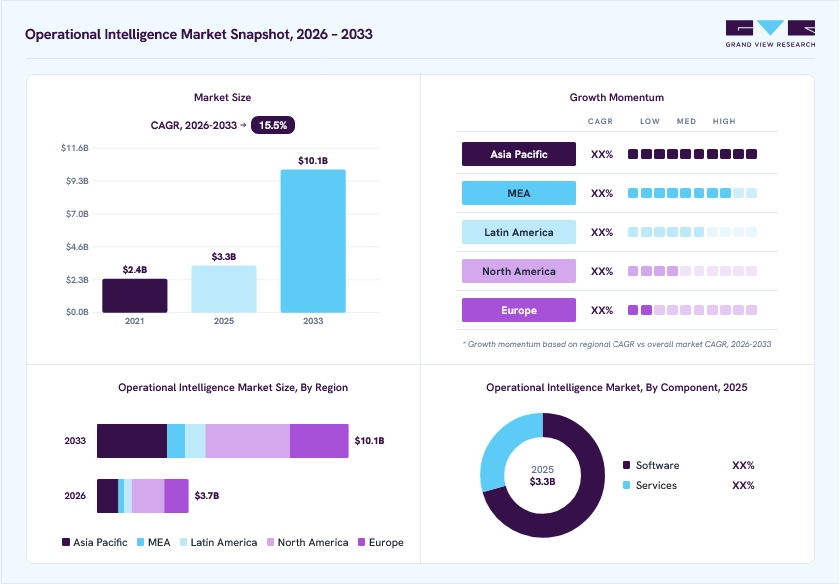
The global operational intelligence market size was valued at USD 3.3 billion in 2025 and is projected to grow from USD 3.7 billion in 2026 to USD 10.1 billion by 2033, at a CAGR of 15.5% from 2026 to 2033. North America dominated the market, accounting for the largest revenue share of 35.7% in 2025. Growing adoption of real-time analytics and AI-driven decision-making is accelerating demand for operational intelligence across enterprises.
Key Market Trends & Insights
- By component: The software segment dominated the market, with a revenue share of 70.6% in 2025
- By deployment: The cloud segment led the market and accounted for a share of 62.7% in 2025
- By enterprise size: The large enterprises segment dominated the market, with a revenue share of 70.4% in 2025
- By end use: The manufacturing segment held the largest revenue share in 2025
Regional Highlights
- Largest regional market: North America (35.7% revenue share, 2025)
- Fastest-growing regional market: Asia Pacific (highest CAGR, 2026-2033)
- By country: The U.S. held the largest market share in 2025.
Market Size & Forecast
- Market size in 2025: USD 3.3 Billion
- Estimated market size in 2026: USD 3.7 Billion
- Projected market size by 2033: USD 10.1 Billion
- CAGR (2026-2033): 15.5%
The operational intelligence market is driven by the growing need for real-time visibility into business operations and faster data-driven decision-making. Organizations are increasingly integrating operational intelligence platforms with IoT devices, enterprise applications, cloud infrastructure, ERP, CRM, and streaming data sources to continuously monitor events and processes. The rising volume and velocity of operational data across manufacturing, BFSI, healthcare, retail, and telecommunications is increasing demand for solutions that can correlate data from multiple sources, identify anomalies, generate alerts, and provide actionable insights in real time. The adoption of AI and machine learning is further enhancing predictive analytics, automated event detection, and intelligent decision support, encouraging enterprises to move beyond traditional historical business intelligence.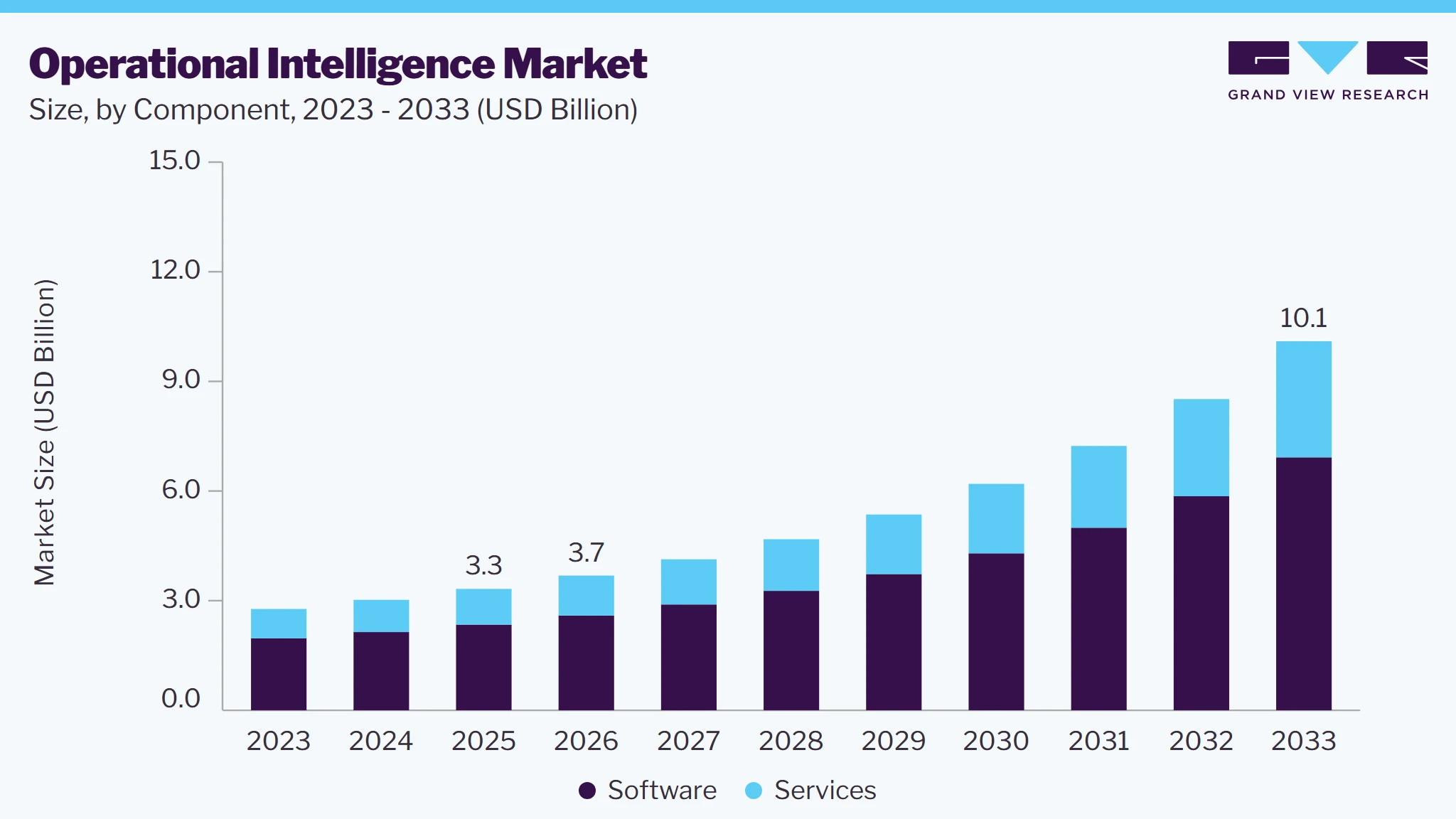
Enterprises are deploying operational intelligence to detect process bottlenecks, equipment failures, cybersecurity incidents, supply chain disruptions, and customer service issues before they significantly affect business performance. In manufacturing, integration with industrial IoT and connected assets enables real-time production monitoring and predictive maintenance, while financial institutions use operational intelligence for transaction monitoring, fraud detection, and compliance. Similarly, retailers and healthcare organizations leverage real-time analytics to optimize inventory, customer interactions, resource utilization, and service delivery. The expansion of cloud-based and scalable analytics platforms is also lowering deployment barriers, particularly for SMEs, thereby broadening the addressable market.
Market Dynamics
The operational intelligence market is driven by the increasing need to transform continuously generated operational data into immediate, actionable insights across business processes, IT environments, customer operations, and physical assets. Organizations are moving beyond periodic reporting toward event-driven monitoring that can identify deviations, correlate multiple operational signals, and trigger timely responses. The growing adoption of cloud infrastructure, distributed applications, IoT-enabled assets, APIs, and streaming data environments is creating increasingly dynamic operational ecosystems, making continuous visibility and automated response capabilities important for maintaining business performance.
The proliferation of event-driven architectures is accelerating demand for operational intelligence, as enterprises increasingly need to monitor and respond to business events in real time rather than relying on periodic analysis. For instance, in June 2026, Confluent’s survey reported that 72% of 4,625 IT leaders globally identified insufficient real-time data infrastructure as a barrier to scaling AI, highlighting the growing importance of continuously available operational data. Modern applications generate continuous streams of events from APIs, transactions, applications, devices, customer interactions, and infrastructure, creating demand for technologies capable of detecting meaningful patterns and triggering automated actions. Operational intelligence platforms can correlate these events across disparate systems, identify exceptions, and provide contextual alerts to relevant users. The expansion of microservices, API-driven applications, distributed cloud environments, and real-time digital services is therefore creating a broader requirement for event-based operational monitoring and decision support.The effectiveness of operational intelligence depends heavily on the availability, quality, consistency, and accessibility of operational data, creating challenges for organizations operating fragmented technology environments. Enterprises often maintain data across legacy applications, databases, cloud platforms, IoT systems, third-party applications, and departmental repositories with different data structures and integration mechanisms. Inconsistent data definitions, duplicate records, incomplete information, and latency between source systems can reduce the accuracy and reliability of real-time insights. Organizations must also address data governance, access controls, lineage, and security requirements when operational intelligence platforms process sensitive or business-critical information. These integration and governance requirements can increase implementation complexity and delay deployment, particularly where enterprises have highly heterogeneous IT environments.The increasing convergence of operational intelligence with AI, machine learning, automation, and intelligent workflow technologies presents a significant opportunity for market expansion. Instead of limiting analytics to dashboards and alerts, enterprises are increasingly seeking systems that can interpret operational events, recommend responses, initiate workflows, and automatically execute predefined corrective actions. This creates opportunities for operational intelligence platforms to support closed-loop operations, in which detection, analysis, decision-making, and response are integrated into a single operational workflow. Applications can extend across automated incident remediation, supply-chain exception management, fraud response, customer-service orchestration, IT operations, and industrial process optimization. Integration with generative AI and AI agents could further enable natural-language interaction with operational data and facilitate automated investigation and resolution of complex events.Analyst Perspective
The operational intelligence market is expected to evolve from conventional real-time dashboards and event monitoring toward AI-enabled, event-driven, and increasingly autonomous operational ecosystems. As enterprises adopt distributed architectures and generate greater volumes of continuously changing operational data, the value of operational intelligence will increasingly depend on its ability to correlate events across applications, infrastructure, processes, and external data sources while providing contextual recommendations and automated responses. Integration with AIOps, business process management, observability, workflow automation, AI agents, and streaming analytics is expected to broaden the role of operational intelligence from monitoring toward continuous operational decision-making.
Component Insights
The software segment dominated the market and accounted for the revenue share of 70.6% in 2025, driven by the increasing demand for centralized platforms that can consolidate operational data, perform real-time event correlation, and provide actionable intelligence through dashboards, alerts, anomaly detection, and automated workflows. Enterprises are increasingly moving beyond fragmented monitoring tools toward integrated software that connects applications, infrastructure, IoT devices, databases, and business processes within a common intelligence layer.
The services segment is anticipated to grow at a significant CAGR during the forecast period, driven by the increasing need for specialized expertise to integrate operational intelligence platforms with complex enterprise environments and translate real-time data into operational use cases. Organizations frequently require consulting, implementation, integration, customization, training, and managed services because operational intelligence deployments span multiple applications, data sources, workflows, and organizational functions.
Deployment Insights
The cloud segment dominated the market and accounted for the revenue share of 62.7% in 2025 due to the need for elastic computing and analytics capacity as organizations process increasingly variable volumes of operational data. Cloud environments allow enterprises to scale processing resources according to workload requirements without making equivalent investments in dedicated infrastructure, making them particularly suitable for organizations with fluctuating data volumes and geographically distributed operations.
The on-premises segment is anticipated to grow at a significant CAGR during the forecast period, supported by the organizations' requirements for greater control over sensitive operational data, infrastructure configuration, security policies, and system availability. Enterprises operating in highly regulated or mission-critical environments may prefer to retain Operational Intelligence workloads within their own infrastructure to maintain tighter control over data residency, access management, latency, and integration with legacy systems.
Enterprise Size Insights
The large enterprises segment dominated the market and accounted for the revenue share of 70.4% in 2025, driven by the complexity of managing operations across multiple business units, geographic locations, technology environments, and high-volume data sources. Large organizations typically operate extensive application estates and generate substantial operational data, increasing the value of platforms that provide enterprise-wide visibility rather than isolated departmental monitoring.
The small & medium enterprises (SMEs) segment is expected to grow at a significant CAGR during the forecast period, driven by the increasing availability of lower-cost, scalable intelligence technologies that reduce the infrastructure and specialist resources historically required for advanced operational analytics. Cloud-based platforms, subscription-based software, preconfigured analytics applications, and managed services enable smaller organizations to access capabilities that previously required substantial internal IT and data science teams.
End Use Insights
The manufacturing segment dominated the market and accounted for the revenue share of 20.3% in 2025, supported by the increasing convergence of IT and OT environments and the need to obtain a unified view of machines, production lines, quality processes, supply chains, and workforce activities. Manufacturers are increasingly connecting ERP, MES, SCADA, industrial IoT, and shop-floor systems, creating large volumes of operational data that require continuous analysis to identify bottlenecks, quality deviations, equipment conditions, and production inefficiencies.
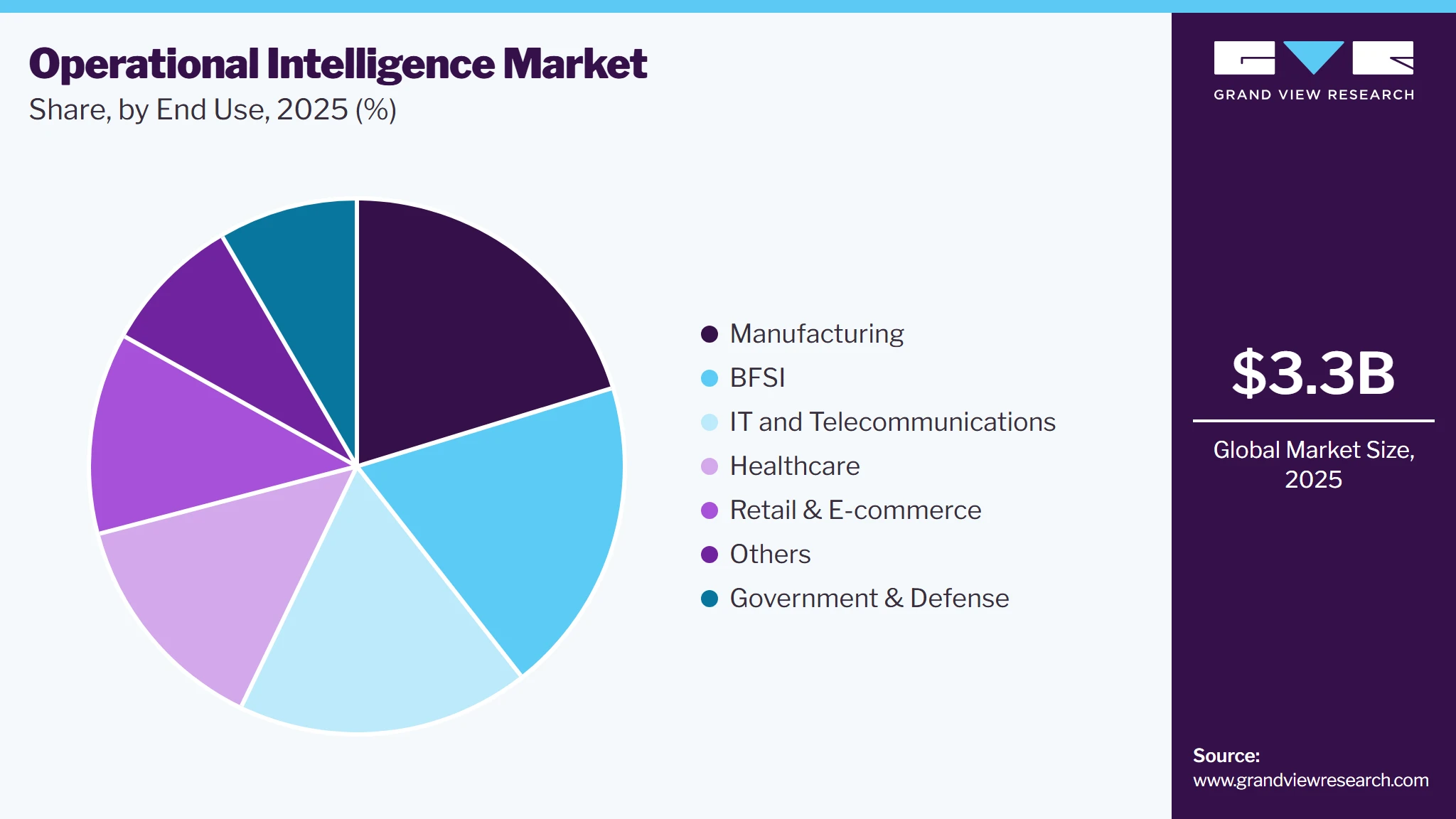
The BFSI segment is expected to grow at a significant CAGR over the forecast period, driven by the increasing requirement for continuous monitoring of financial transactions, risk exposures, customer activities, regulatory events, and operational exceptions across highly time-sensitive financial environments. Banks and financial institutions increasingly need intelligence systems that can identify abnormal behavior, prioritize risks, support compliance processes, and enable rapid intervention across large transaction volumes.
Regional Insights
The North America operational intelligence market dominated the global industry with the largest revenue share of 35.7% in 2025, driven by the rapid transition of enterprises toward AI-enabled autonomous operations and real-time enterprise data foundations. Organizations across the region are increasingly integrating operational data with AI agents, workflow automation, and intelligent decision systems to move from analytics and monitoring toward automated execution.

U.S. Operational Intelligence Market Trends
The operational intelligence market in the U.S. is expected to grow significantly, at a CAGR of 14.6%, from 2026 to 2033, driven by the increasing adoption of AI agents and autonomous enterprise workflows. U.S. organizations are progressing from generative AI experimentation toward systems that can interpret operational information, make recommendations, initiate workflows, and execute actions with limited human intervention.
Europe Operational Intelligence Market Trends
The operational intelligence market in Europe is anticipated to register considerable growth from 2026 to 2033, driven by the region's increasing emphasis on trusted AI, digital sovereignty, and governed data infrastructure. In January 2026, the European Commission allocated approximately USD 359 million (EUR 307.3 million) under Horizon Europe to strengthen AI and digital innovation, including trustworthy AI services, innovative data services, and European strategic autonomy.
The UK operational intelligence market is expected to grow rapidly in the coming years, owing to by increasing government and enterprise investment in AI-enabled critical infrastructure and intelligent public services. The expansion of AI into infrastructure monitoring is increasing demand for technologies capable of continuous event detection, automated exception identification, and real-time operational decision support across transportation, utilities, government, and other critical environments.
The operational intelligence market in Germany held a substantial market share in 2025 due to the rapid adoption of AI within industrial production and manufacturing processes, where operational data is increasingly being used to improve quality, production planning, and maintenance.
Asia Pacific Operational Intelligence Market Trends
The operational intelligence market in the Asia Pacific region is expected to exhibit the fastest CAGR over the forecast period. The growth is largely due to the region's accelerated industrial digital transformation and AI adoption, particularly among manufacturers seeking to improve productivity and competitiveness. In May 2026, Rockwell Automation reported that 95% of APAC manufacturers considered digital transformation essential to competitiveness, while 71% planned to increase AI and machine-learning use during the following 12 months.
The Japan operational intelligence market is expected to grow rapidly in the coming years, driven by the need to use AI-ready industrial data and automation to address structural labor shortages and improve manufacturing productivity. Japan's aging workforce and constrained labor supply are encouraging organizations to automate routine monitoring, maintenance, quality control, and decision support activities.
The operational intelligence market in China held a substantial market share in 2025, due to the rapid development of smart manufacturing and industrial digitalization under the nation’s broader manufacturing modernization agenda. Chinese manufacturers are increasingly deploying industrial IoT, robotics, machine vision, digital platforms, and AI across production environments, creating demand for technologies that can integrate large volumes of machine and process information.
Key Operational Intelligence Company Insights
Key players operating in the operational intelligence industry are IBM Corporation, Microsoft, ServiceNow, Splunk LLC, SAP SE, and Oracle. The companies are focusing on various strategic initiatives, including new product development, partnerships & collaborations, and agreements to gain a competitive advantage over their rivals. The following are some instances of such initiatives.
-
In July 2026, IBM Corporation launched IBM Power Autonomous Operations, an AI-agent-based capability designed to continuously monitor Power systems and autonomously identify and resolve operational issues. The company also introduced the IBM Power S1112 entry-level server, designed to support local AI inference in compact on-premises environments.
-
In June 2026, Splunk LLC introduced IT Service Intelligence (ITSI) 5.0, adding AI-powered service and KPI discovery, and expanded alert integrations. The release introduced Event iQ Detect and Diagnose, which uses AI-powered event correlation, root-cause guidance, episode summarization, CMDB enrichment, and change context to reduce alert noise and accelerate troubleshooting. It converts large volumes of operational events into prioritized, contextual insights for IT teams.
Key Operational Intelligence Companies
The following key companies have been profiled for this study on the operational intelligence market.
-
Broadcom
-
Cloud Software Group, Inc.
-
Datadog
-
Dynatrace
-
elasticsearch B.V.
-
IBM Corporation
-
Microsoft
-
Oracle
-
SAP SE
-
ScienceLogic
-
ServiceNow
-
Software AG
-
Splunk LLC
-
Sumo Logic
-
Vitria
Competitive Benchmarking
Category
Operating Strategies
Competitive Edge
Weakness
Established Players (IBM Corporation, Microsoft, ServiceNow, Splunk LLC, SAP SE, Oracle)
- Invest in comprehensive Operational Intelligence, AIOps, observability, event-streaming, AI analytics, workflow automation, enterprise data management, and real-time decision-support platforms.
- Expand capabilities through AI and agentic AI integration, cloud-native architectures, strategic partnerships, acquisitions, interoperability initiatives, and integration with ERP, CRM, ITSM, IoT, cybersecurity, and enterprise application ecosystems.
- Strong global brands, extensive enterprise customer bases, and established relationships across large organizations. Broad technology portfolios spanning AI, cloud, observability, IT operations, enterprise applications, data analytics, workflow automation, and cybersecurity enable these participants to provide integrated
- Operational intelligence environments. Significant R&D capabilities, global implementation networks, and large partner ecosystems support development and deployment of sophisticated real-time intelligence solutions.
- High licensing, implementation, integration, migration, and customization costs can constrain adoption among SMEs. Complex product portfolios and enterprise architectures can result in lengthy deployment and procurement cycles.
- Integrating multiple applications, data sources, legacy systems, and operational environments can also require substantial technical expertise, data governance, interoperability, workforce training, and organizational change management.
Emerging Players (Cloud Software Group, Inc., Software AG, Sumo Logic, Vitria)
- Focus on specialized and modular operational analytics, event processing, observability, application performance monitoring, integration, streaming analytics, business-process intelligence, and real-time event correlation solutions.
- Emphasize API-driven architectures, cloud-native deployment, AI-enabled monitoring, event-driven processing, open integration frameworks, and interoperability with established IT, enterprise application, IoT, and data platforms.
- Greater flexibility, specialized functionality, and potentially faster deployment compared with broad enterprise technology suites.
- Modular and cloud-oriented architectures can reduce infrastructure requirements and allow organizations to implement operational intelligence capabilities incrementally for specific operational use cases.
- Smaller customer bases and comparatively lower brand recognition can make it more difficult to compete for large enterprise-wide deployments.
- Limited ownership of complementary enterprise applications, cloud infrastructure, ERP, CRM, or ITSM platforms can increase dependence on third-party ecosystems.
Operational Intelligence Market Report Scope
Report Attribute
Details
Market size in 2025
USD 3.3 billion
Estimated market size in 2026
USD 3.7 billion
Projected market size by 2033
USD 10.1 billion
Growth rate
CAGR of 15.5% from 2026 to 2033
Actual data
2021 - 2025
Forecast period
2026 - 2033
Quantitative units
Revenue in USD billion and CAGR from 2026 to 2033
Report coverage
Revenue forecast, company share, competitive landscape, growth factors, and trends
Segments covered
Component, deployment, enterprise size, end use, region
Regional scope
North America; Europe; Asia Pacific; Latin America; MEA
Country scope
U.S.; Canada; Mexico; UK; Germany; France; China; India; Japan; Australia; South Korea; Brazil; UAE; Kingdom of Saudi Arabia; South Africa
Key companies profiled
Broadcom; Cloud Software Group, Inc.; Datadog; Dynatrace; elasticsearch B.V.; IBM Corporation; Microsoft; Oracle; SAP SE; ScienceLogic; ServiceNow; Software AG; Splunk LLC; Sumo Logic; Vitria
Customization scope
Free report customization (equivalent to 8 analysts working days) with purchase. Addition or alteration to country, regional & segment scope.
Pricing and purchase options
Avail customized purchase options to meet your exact research needs. Explore purchase options
Global Operational Intelligence Market Report Segmentation
This report forecasts revenue growth at the global, regional, and country levels and provides an analysis of the latest industry trends in each of the sub-segments from 2021 to 2033. For this study, Grand View Research has segmented the global operational intelligence market report based on component, deployment, enterprise size, end use, and region.
-
Component Outlook (Revenue, USD Billion, 2021 - 2033)
-
Software
-
Services
-
-
Deployment Outlook (Revenue, USD Billion, 2021 - 2033)
-
Cloud
-
On-premises
-
-
Enterprise Size Outlook (Revenue, USD Billion, 2021 - 2033)
-
Large Enterprises
-
Small & Medium Enterprises (SMEs)
-
-
End Use Outlook (Revenue, USD Billion, 2021 - 2033)
-
BFSI
-
Healthcare
-
Retail & E-commerce
-
Manufacturing
-
IT and Telecommunications
-
Government & Defense
-
Others
-
-
Regional Outlook (Revenue, USD Billion, 2021 - 2033)
-
North America
-
U.S.
-
Canada
-
Mexico
-
-
Europe
-
UK
-
Germany
-
France
-
-
Asia Pacific
-
China
-
India
-
Japan
-
South Korea
-
Australia
-
-
Latin America
-
Brazil
-
-
Middle East & Africa
-
UAE
-
Saudi Arabia
-
South Africa
-
-
Research Methodology
The operational intelligence marketfigures in this report are based on a proven research process that combines executive interviews with secondary research from proprietary databases, company filings, and recognized regulatory and institutional sources. Market size is built through value-chain sizing-reconciling supply-side and demand-side estimates-and triangulated with bottom-up and top-down approaches. Every estimate passes multiple levels of expert validation before publication, with eachoperational intelligence segment quantified using the revenue-capture definitions in the table below.
Segment Definition
Component
Revenue capture definition
Software
Market value captured from software platforms and applications that enable operational intelligence (OI) processes, including real-time event processing, operational analytics, event correlation, anomaly detection, monitoring, alerting, dashboards, predictive analytics, AI-enabled decision support, workflow intelligence, and automated operational response. Revenue includes software licenses, subscriptions, usage-based fees, and recurring software charges attributable to Operational Intelligence capabilities.
Services
Market value captured from professional and managed services supporting the planning, implementation, integration, customization, deployment, maintenance, optimization, and ongoing management of Operational Intelligence platforms. Revenue includes consulting, system integration, implementation, training, technical support, managed services, and other service fees directly attributable to OI deployments.
Deployment
Revenue capture definition
Cloud
Market value captured from Operational Intelligence software and associated capabilities delivered through public, private, hybrid, or multi-cloud environments, where the underlying OI functionality is hosted and accessed through cloud infrastructure. Revenue includes cloud subscriptions, software-as-a-service (SaaS) fees, usage-based charges, and recurring cloud-based platform fees attributable to OI capabilities.
On-premises
Market value captured from Operational Intelligence software deployed and operated within the customer's own physical or privately controlled IT infrastructure. Revenue includes perpetual or term software licenses, maintenance and support fees, and other recurring or non-recurring charges directly attributable to on-premises OI deployments.
Enterprise Size
Revenue capture definition
Large Enterprises
The large enterprises segment, with respect to the number of employees, typically comprises organizations employing more than 1,000 employees for multinational corporations.
Small & Medium Enterprises (SMEs)
The SMEs segment, with respect to the number of employees, generally includes organizations employing between 10 and 999 employees.
End Use
Revenue capture definition
BFSI
Market value captured from Operational Intelligence solutions deployed by banks, financial institutions, insurance companies, and other financial-service organizations for transaction monitoring, fraud and anomaly detection, risk monitoring, compliance, customer operations, IT operations, and real-time business-process intelligence.
Healthcare
Market value captured from OI solutions deployed across hospitals, healthcare providers, pharmaceutical companies, medical organizations, and healthcare technology environments for patient-flow monitoring, resource utilization, clinical operations, infrastructure monitoring, supply-chain visibility, and operational process optimization.
Retail & E-commerce
Market value captured from OI solutions used by retailers, e-commerce companies, marketplaces, and omnichannel businesses for inventory monitoring, order and fulfillment operations, customer activity analysis, supply-chain visibility, fraud detection, pricing operations, and real-time store or digital-channel performance monitoring.
Manufacturing
Market value captured from OI solutions deployed across manufacturing plants and industrial operations for production monitoring, equipment and asset performance, process optimization, quality monitoring, industrial IoT analytics, supply-chain operations, predictive maintenance, and real-time factory intelligence.
IT and Telecommunications
Market value captured from OI solutions used by IT service providers, software companies, telecommunications operators, data-center operators, and digital infrastructure organizations for application and infrastructure monitoring, network operations, service assurance, incident management, event correlation, performance optimization, and automated IT operations.
Government & Defense
Market value captured from OI solutions deployed by government agencies, defense organizations, public-sector institutions, and critical infrastructure authorities for infrastructure monitoring, cybersecurity operations, mission-critical systems, public-service operations, situational awareness, resource management, and real-time operational decision-making.
Others
Market value captured from Operational Intelligence deployments across energy & utilities, transportation & logistics, education, media & entertainment, hospitality, and other industries not separately categorized above, covering applications such as asset monitoring, service operations, process optimization, risk management, and real-time operational analytics.
Estimation Model
Layer
Question
Analysis
Operational Environment & Enterprise Operations Layer
Where are Operational Intelligence solutions required?
Identify operational environments requiring continuous visibility, event monitoring, and real-time decision support. This layer evaluates BFSI, healthcare, manufacturing, retail & e-commerce, IT & telecommunications, government & defense, and other sectors where OI supports transaction monitoring, production operations, service assurance, customer operations, infrastructure monitoring, risk management, and process optimization.
Data, Event & Intelligence Infrastructure Layer
What enables Operational Intelligence implementation?
Assess technologies and data sources enabling OI, including event-streaming platforms, IoT, application and infrastructure telemetry, APIs, databases, cloud infrastructure, AI/ML, observability, analytics, data integration, and workflow technologies. Evaluate their ability to collect, correlate, contextualize, analyze, and operationalize high-volume data and events from heterogeneous enterprise environments.
Operational Intelligence Workflow & Enterprise Deployment Layer
How are OI capabilities delivered across the enterprise?
Analyze OI deployment across IT operations, business processes, production environments, customer operations, supply chains, infrastructure, and enterprise functions. Evaluate cloud and on-premises environments supporting real-time monitoring, event correlation, anomaly detection, predictive analytics, dashboards, alerting, workflow automation, and AI-enabled decision support through software platforms, data integrations, APIs, and implementation services.
OI Solutions & Enterprise Economics Layer
How is value generated within the Operational Intelligence ecosystem?
Evaluate OI revenue from software licenses, SaaS subscriptions, cloud services, implementation, integration, consulting, customization, managed services, training, maintenance, and support. Assess enterprise value through faster incident detection and resolution, reduced operational downtime, improved resource utilization, enhanced process efficiency, proactive risk management, automated responses, improved service quality, and faster operational decision-making.
Delivered Customizations
This report has been delivered with the following In-depth customizations
Client Request
Customization Delivered
Value Adds
Operational Intelligence Technology Integration & Real-Time Data Trends
Analyzed OI technologies including event streaming, real-time analytics, AI/ML, IoT, observability, APIs, cloud computing, data integration, anomaly detection, and workflow automation.
Evaluated integration of operational, application, infrastructure, machine, transaction, and customer data across enterprise systems.
Helps identify emerging OI technology and integration opportunities.
Provides insights into real-time data processing, event correlation, operational visibility, and cross-system intelligence.
Operational Intelligence, AI & Autonomous Operations Trends
·Evaluated adoption of AI-enabled monitoring, predictive analytics, intelligent event correlation, AI agents, automated decision support, and autonomous remediation.
Assessed the convergence of AI, real-time analytics, observability, and workflow automation across operational environments.
Highlights emerging OI and autonomous-operations opportunities.
Enables understanding of how AI and automation are transforming operational monitoring, decision-making, incident response, and process execution.
OI Application & Enterprise Opportunity Assessment
Assessed OI applications across BFSI, healthcare, manufacturing, retail & e-commerce, IT & telecommunications, government & defense, and other industries.
Evaluated cloud vs. on-premises deployment, large enterprises vs. SMEs, and software vs. services adoption.
Supports identification of high-growth applications, industries, deployment models, and enterprise opportunities.
Helps prioritize opportunities for OI software providers, cloud and technology vendors, observability providers, system integrators, and managed service providers.
Frequently Asked Questions About This Report
The global operational intelligence market size was estimated at USD 3.3 billion in 2025 and is expected to reach USD 3.7 billion in 2026.
The global operational intelligence market is expected to grow at a compound annual growth rate of 15.5% from 2026 to 2033 to reach USD 10.1 billion by 2033.
Key factors include the growing need for real-time visibility into business operations and faster data-driven decision-making.
Asia Pacific is the fastest-growing region over the forecast period.
The software segment led with a 70.6% revenue share in 2025, while the services segment is the fastest-growing segment.
The cloud segment led with a 62.7% revenue share in 2025, while the on-premises segment is the fastest-growing segment.
The manufacturing segment held the largest revenue share in 2025
Key players operating in the operational intelligence market include Broadcom, Cloud Software Group, Inc., Datadog, Dynatrace, elasticsearch B.V., IBM Corporation, Microsoft, Oracle, SAP SE, ScienceLogic, ServiceNow, Software AG, Splunk LLC, Sumo Logic, Vitria
North America dominated the market, accounting for the largest revenue share of 35.7% in 2025.
About the Author(s)
Next Generation Technologies Research Team
Technology · Next Generation TechnologiesThis report was authored by the next generation technologies research team at Grand View Research - comprising two research analysts, one senior research analyst, and one industry expert - with specialized expertise in the next generation technologies segment of the technology industry. All findings are based on proprietary technology databases, executive interviews, and regulatory analysis, subject to internal peer review prior to publication.
Last Updated:
Speak to Analyst


Customize this report to your needs — add regions, segments, or data points, with 20% free customization.
Or view our licence options:


ISO 9001:2015 & 27001:2022 Certified
We are GDPR and CCPA compliant! Your transaction & personal information is safe and secure. For more details, please read our privacy policy.


