GVR Report cover Overhead Cranes Market (2026 - 2033)Report

Overhead Cranes Market (2026 - 2033)

Size, Share & Trend Analysis Report By Type (Gantry Cranes, Jib Cranes), By Lifting Capacity (Up to 5 Ton, 6-10 Ton), By End-use Industry (Manufacturing, Construction), By Region, And Segment Forecasts

Market Size, 2025

$5.9B

Market Estimate, 2026

$6.3B

Market Forecast, 2033

$10.1B

CAGR, 2026–2033

7.0%

Overhead Cranes Market Summary

The global overhead cranes market size was valued at USD 5.9 billion in 2025 and is projected to grow from USD 6.3 billion in 2026 to USD 10.1 billion by 2033, at a CAGR of 7.0% from 2026 to 2033. Asia Pacific dominated the global market with the largest revenue share of 37.6% in 2025. The market is witnessing robust growth due to rising demand across several end-user industries, such as manufacturing, construction, automotive, and power generation.
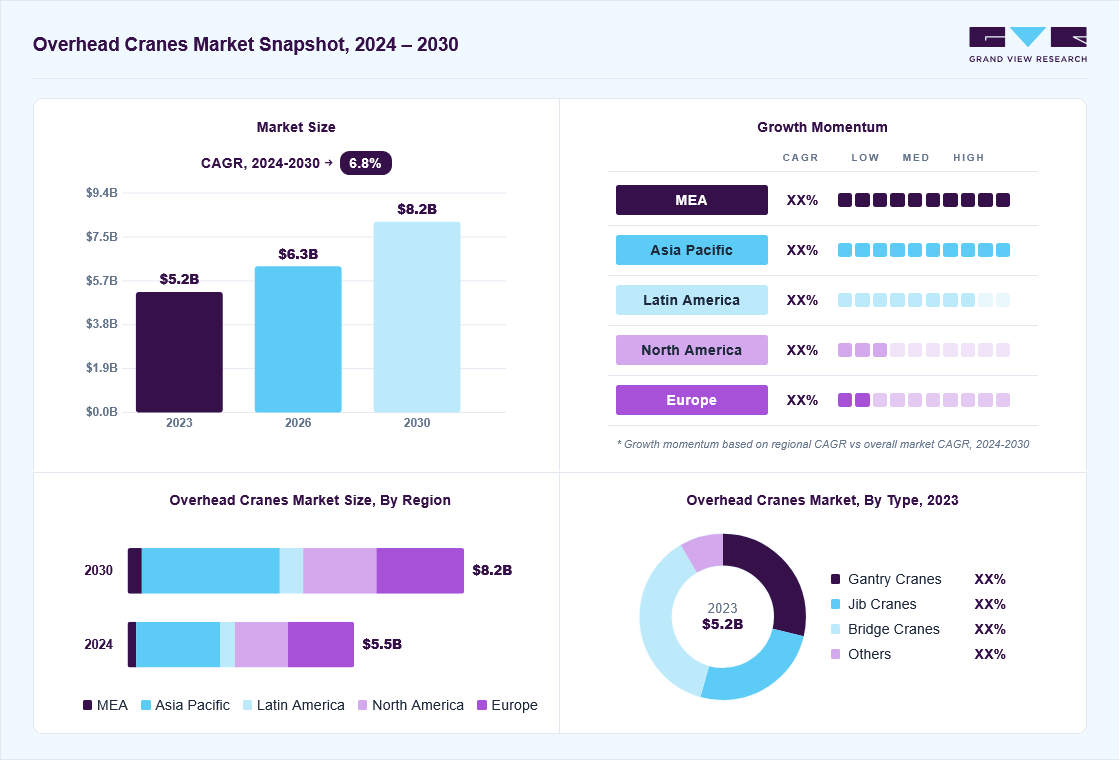
Overhead cranes market overview: Grand View Research estimates the global market size at USD 5.9 billion in 2025, projected to grow from USD 6.3 billion in 2026 to USD 10.1 billion by 2033 at a 7.0% CAGR, with regional growth momentum.

Key Market Trends & Insights

  • By type: Bridge cranes segment dominated the market, with a revenue share of 37.1% in 2025.
  • By capacity: Up to 5 ton segment held the largest market share of 36.6% in 2025.
  • By end use industry: Manufacturing segment held the largest revenue share in 2025.

Regional Highlights

  • Largest regional market: Asia Pacific (37.6% revenue share, 2025)
  • By country: India is the fastest growing country in 2025.

Market Size & Forecast

  • Market size in 2025: USD 5.9 Billion
  • Estimated market size in 2026: USD 6.3 Billion
  • Projected market size by 2033: USD 10.1 Billion
  • CAGR (2026-2033): 7.0%


As these sectors expand, they require efficient material handling solutions to manage increased workloads and improve productivity. Overhead cranes enable heavy lifting and the transport of goods, which is essential for meeting the increased output requirements of these industries. Rapid urbanization and increasing infrastructure development across the globe are driving the demand for overhead cranes. Governments are investing heavily in infrastructure projects such as bridges, highways, and power plants, which require substantial lifting equipment such as overhead cranes. Overhead cranes are essential for their versatility in lifting and transporting materials across construction sites. Thus, rising government investments in infrastructure projects and a growing focus on sustainable building practices are fueling the market's growth.
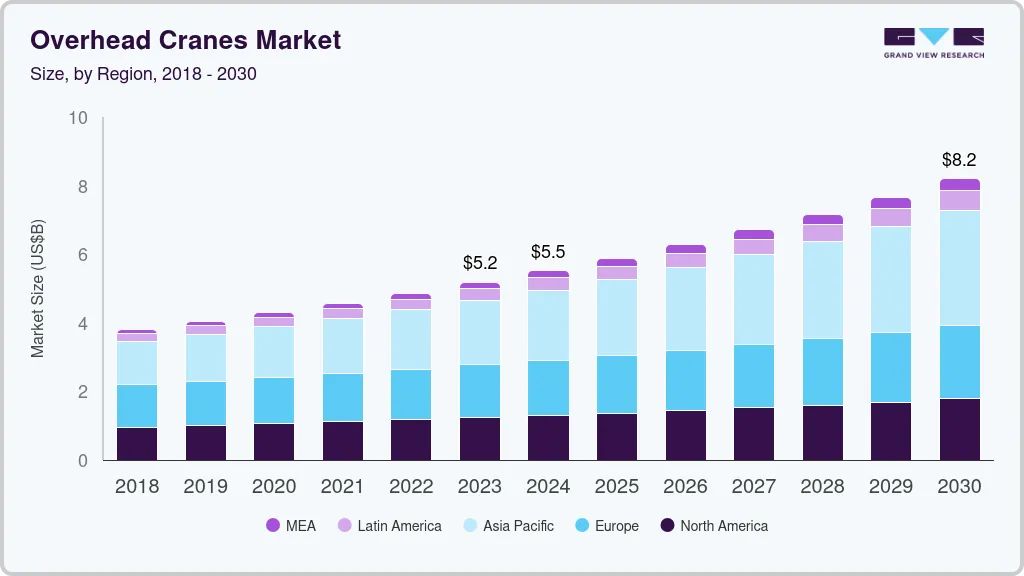
Overhead cranes market size and growth forecast (2023-2033)

Technological advancement is a pivotal trend in the overhead crane market. Integrating advanced technologies such as automation, variable-speed drives, and automated positioning systems enhances operational efficiency and precision in material handling. These advancements reduce total production time and minimize personnel costs. Safety features such as collision avoidance systems and overload protection have become increasingly important to improve worker safety and reduce the rate of accidents. The ongoing development of remote monitoring capabilities allows for real-time performance tracking and predictive maintenance, further optimizing crane operations and thereby driving the market's growth.

Furthermore, sustainability is emerging as a core focus for industries worldwide. Manufacturers are innovating to produce energy-efficient cranes that consume less power and reduce carbon footprints. Technologies such as regenerative drives and lightweight materials are being utilized to enhance energy efficiency. Additionally, companies are demanding cranes that can integrate with renewable energy sources. Thus, as industries move toward greener practices, the demand for sustainable lifting solutions is expected to increase, and contribute to the market's growth.

The high initial investment needed for purchasing and maintaining overhead cranes is a major factor that could hamper market growth. Ongoing maintenance expenses, such as regular inspections and component replacements, can add up over time, resulting in a long-term financial burden for companies. The time-consuming and costly nature of inspections varies based on the crane's size and complexity. These inspection costs can be a significant barrier for small businesses or those with limited budgets. However, the advantages of regular overhead crane inspections far outweigh the drawbacks, as they ensure the safety of both workers and equipment while helping companies maintain productivity and profitability.

Market Dynamics

Increasing industrial automation, expansion of manufacturing facilities, and growing investments in material handling modernization are significantly driving the adoption of overhead cranes across automotive, metals, machinery, aerospace, logistics, power, and construction industries. Advancements in crane technologies, including automation, remote operation, anti-sway systems, condition monitoring, IoT-enabled predictive maintenance, and energy-efficient drives, are improving lifting precision, operational safety, equipment utilization, and overall plant productivity. The integration of smart controls and digital asset management platforms further enhances real-time performance monitoring, minimizes unplanned downtime, and optimizes maintenance schedules. However, high upfront capital expenditure, complex installation processes, facility customization requirements, and the shortage of skilled crane operators and maintenance personnel increase implementation costs and may hinder adoption, particularly among small and medium-sized enterprises. Meanwhile, rising investments in industrial infrastructure, warehouse expansion, renewable energy projects, port modernization, and the transition toward smart factories under Industry 4.0 initiatives are creating opportunities for manufacturers to develop intelligent, automated, energy-efficient, and application-specific overhead crane solutions that address evolving material handling requirements across diverse end-use industries.

The increasing adoption of industrial automation and smart manufacturing practices is significantly driving demand for advanced overhead cranes across automotive, metals, machinery, aerospace, power generation, logistics, and heavy engineering industries. Modern overhead cranes equipped with automated controls, variable frequency drives (VFDs), anti-sway technology, remote operation systems, and IoT-enabled sensors enable precise load handling, improved workplace safety, higher operational efficiency, and reduced dependence on manual labor. These next-generation lifting solutions support continuous production processes, optimize material flow, and enhance equipment utilization, making them integral components of modern manufacturing facilities and warehouses.

The market is also witnessing growing integration of digital technologies, including artificial intelligence, predictive analytics, and condition monitoring platforms. AI-enabled monitoring systems facilitate real-time performance tracking, predictive maintenance, load cycle analysis, and fault detection, helping plant operators minimize unplanned downtime, extend equipment lifespan, and reduce maintenance costs. Additionally, the adoption of cloud-based asset management platforms and Industrial Internet of Things (IIoT) technologies is enabling seamless communication between overhead cranes, production equipment, warehouse management systems (WMS), and enterprise resource planning (ERP) platforms, supporting the transition toward smart factories and Industry 4.0-enabled operations..

The deployment of overhead crane systems requires substantial capital investment in crane structures, hoists, runways, electrification systems, automation technologies, and supporting infrastructure. The high upfront costs associated with equipment procurement, engineering design, installation, testing, and commissioning often limit adoption among small and medium-sized enterprises (SMEs), particularly in cost-sensitive industries and emerging markets. Additionally, end users may need to undertake facility modifications, including building reinforcement, runway beam installation, and power supply upgrades, further increasing total cost of ownership.

The market also faces challenges related to complex installation, customization, and system integration requirements. Overhead cranes must operate seamlessly with production lines, warehouse management systems (WMS), manufacturing execution systems (MES), enterprise resource planning (ERP) platforms, and other automated material handling equipment. Ensuring compatibility across multiple technologies and existing plant infrastructure often requires specialized engineering expertise, extended project timelines, and additional integration costs. Furthermore, temporary production interruptions during installation or modernization activities can impact operational efficiency, posing implementation challenges for facilities operating under continuous production schedules.

The rapid expansion of industrial infrastructure, coupled with increasing investments in manufacturing modernization, is creating significant opportunities for overhead crane manufacturers worldwide. The establishment of new production facilities, warehouse expansions, and capacity enhancement projects across automotive, metals, machinery, aerospace, and heavy engineering sectors is driving demand for advanced lifting solutions. Overhead cranes play a critical role in streamlining material flow, improving production efficiency, and enabling safe handling of heavy and oversized components, making them indispensable assets in modern industrial facilities.

The market is also benefiting from the growing deployment of renewable energy projects, including wind turbine manufacturing plants, solar equipment production facilities, and power generation infrastructure. The handling of large and high-value components requires high-capacity, precision-controlled overhead cranes capable of ensuring operational safety and minimizing downtime. Additionally, the increasing adoption of Industry 4.0 and smart factory initiatives is encouraging end users to invest in automated, IoT-enabled, and energy-efficient crane systems equipped with remote diagnostics, predictive maintenance capabilities, and advanced control technologies. These trends are creating substantial opportunities for manufacturers to develop intelligent, application-specific overhead crane solutions tailored to the evolving requirements of industrial and energy sectors.


Analyst Perspective

The overhead cranes market is growing steadily, driven by rising industrial automation, smart manufacturing, and increasing demand for efficient material handling solutions. Industries are adopting overhead cranes to improve operational efficiency, workplace safety, and productivity, while advancements in IoT-enabled monitoring, predictive maintenance, automated controls, and remote operation are enhancing crane performance and reliability. Despite challenges such as high installation costs and skilled labor shortages, investments in industrial modernization, manufacturing expansion, renewable energy projects, and infrastructure development are expected to support continued market growth.

Type Insights

Based on type, the bridge cranes overhead cranes segment led the market with the largest revenue share of 37.7% in 2025. The segment growth can be attributed to the increasing adoption of bridge cranes in various industries owing to their versatility and efficiency in material handling. Designed to traverse large areas, these cranes provide significant lifting capabilities and can easily handle heavy loads. In addition, the growing demand for automation in manufacturing and warehousing is further driving the adoption of bridge cranes equipped with advanced control systems and IoT technologies.

The gantry cranes segment is expected to register significant growth from 2024 to 2030. Gantry cranes are gaining traction, especially in outdoor applications and construction settings, where their flexibility and portability provide significant advantages. These cranes are designed to move along tracks. They can easily lift and transport heavy materials, making them ideal for loading and unloading containers, equipment, and large machinery. The rising focus on construction and infrastructure development, particularly in emerging economies, is propelling the demand for gantry cranes.

Lifting Capacity Insights

Based on lifting capacity, the Up to 5 ton segment led the market with the largest revenue share of 36.6% in 2025. Overhead cranes with a lifting capacity of up to 5 tons are experiencing strong demand, particularly in small to medium-sized enterprises and light industrial applications. These cranes are ideal for assembly, maintenance, and material handling in warehouses, automotive shops, and smaller manufacturing facilities. The trend toward automation and improved safety standards drives investments in overhead cranes with a lifting capacity of 5 tons that can easily integrate into existing workflows.

The 6–10 Ton segment is expected to register significant growth from 2024 to 2030. Overhead cranes with lifting capacities between 6 and 10 tons are becoming increasingly popular in sectors that require more robust material handling solutions, such as manufacturing, construction, and logistics. Furthermore, advancements in overhead crane technology, including improved safety features and enhanced control systems, are increasing the appeal of these cranes. Various industries focus on maximizing productivity and minimizing downtime, thereby driving the demand for overhead cranes with lifting capacities between 6 and 10 tons.

End Use Industry Insights

Based on end use industry, the manufacturing segment led the market with the largest revenue share of 24.1% in 2025. The growing demand for efficient material handling in the manufacturing industry is a major growth factor behind the segment’s growth. In the manufacturing industry, overhead cranes streamline operations by automating lifting tasks and movement of heavy materials, which enhances productivity and reduces labor costs. In addition, the rising adoption of advanced crane technologies, such as automation and remote monitoring in the manufacturing sector, is further boosting the segment growth.
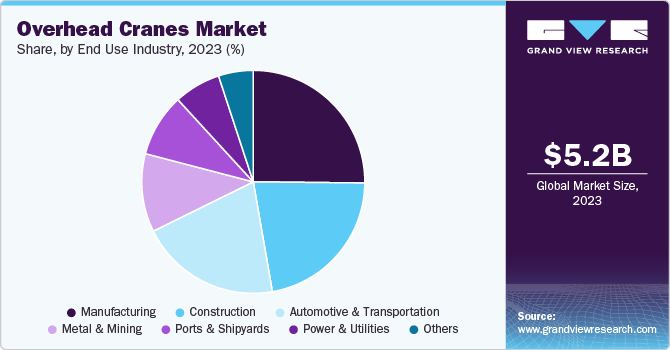
Overhead Cranes Market Share

The automotive and transportation segment is expected to register significant growth from 2024 to 2030. The automotive and transportation sectors are heavily dependent on overhead cranes to enhance their manufacturing and logistics operations. In automotive production, these cranes facilitate the movement of critical components such as engines, transmissions, chassis, and axles between stations on the assembly line, as well as the lifting and transport of entire vehicles during assembly. In addition, overhead cranes significantly boost assembly line efficiency by enabling the rapid and seamless transfer of parts and vehicles. In transportation sector, overhead cranes are essential for unloading ships and efficiently transporting finished vehicles from the assembly line to the shipping area. By accelerating the movement of large items, these cranes optimize both production and shipping processes, contributing to overall operational efficiency, and thereby driving the growth of the segment.

Regional Insights

Asia Pacific dominated the global overhead cranes market with the largest revenue share of 37.6% in 2025. A high demand for advanced material handling solutions and a strong industrial base is a major driver behind the market growth in the region. The region's focus on automation and technological innovation drives the adoption of sophisticated overhead cranes equipped with smart features such as remote monitoring and control systems. Furthermore, government investments in infrastructure projects, including bridges and highways, are expected to further enhance demand for overhead cranes. India is the fastest growing country in the Aisa Pacific overhead cranes market. 

Overhead Cranes Market Trends, by Region, 2026 - 2033

U.S. Overhead Cranes Market Trends

Overhead cranes market in the U.S.is anticipated to register significant growth from 2024 to 2030. The ongoing trend towards automation in the country’s automotive and manufacturing industries is driving demand for overhead cranes that can handle heavy loads with precision and efficiency. In addition, the U.S. government's infrastructure initiatives are creating opportunities for overhead crane manufacturers as businesses invest in upgrading their equipment to meet modern safety and efficiency standards.

Europe Overhead Cranes Market Trends

Overhead cranes market in Europeis poised for moderate growth from 2024 to 2030. The region's well-established manufacturing base, particularly in automotive and aerospace sectors, drives demand for innovative lifting solutions that enhance productivity while ensuring worker safety. European manufacturers are increasingly adopting automation technologies to streamline operations and reduce labor costs associated with manual handling. Additionally, government regulations promoting sustainability are encouraging investments in eco-friendly overhead crane technologies across the region.

Asia Pacific Overhead Cranes Market Trends

Overhead cranes market in Asia Pacific dominated the global market and accounted for 36.38% of the global revenue share in 2023. The market growth in the region is driven by rapid industrialization and urbanization in countries such as China, India, Japan, and Australia. The region's expanding manufacturing sector requires efficient material handling solutions to manage increased production demands. Significant investments in infrastructure projects such as roads, bridges, and power plants further propel the need for high-capacity overhead cranes. Moreover, the expansion of e-commerce and logistics industries demands advanced warehousing solutions that rely heavily on overhead cranes for efficient operations, thereby propelling the market’s growth.

Key Overhead Cranes Company Insights

The competitive landscape of the market is characterized by mix of established brands and emerging players, with key companies focusing on various strategic initiatives, including new product development, partnerships & collaborations, and agreements to gain a competitive advantage over their rivals. For instance, in August 2024, Konecranes introduced the Konecranes X-series industrial crane, which succeeds its renowned CXT model. This new product features a compact design along with advanced, safe, and reliable technology. The X-series aims to transform industrial lifting with cutting-edge technology and lifting capacities of up to 20 tons. Its unique wireless upgrade feature provides customers with enhanced flexibility. Additionally, the groundbreaking ergonomic radio and low headroom hoist improve the operator experience. The X-series is equipped with an upgraded hoisting motor and components designed to optimize efficiency and reduce environmental impact.

Key Overhead Cranes Companies

The following key companies have been profiled for this study on the overhead cranes market.

  • Konecranes,

  • Indef Manufacturing Limited

  • American Crane & Equipment Corporation

  • Dongqi Crane

  • Aicrane

  • WeiHuaCrane

  • Munck Cranes Inc.

  • Columbus McKinnon Corporation.

  • Tri-State Overhead Crane

  • Hoosier Crane Service Company.

Market Participant Categorization

Operating Strategies

Competitive Edge

Weakness

Established Players (Konecranes, Columbus McKinnon Corporation, Weihua Crane, Dongqi Crane)

  • Focus on developing a broad portfolio of overhead cranes, hoists, automated lifting systems, and smart material handling solutions for diverse industrial applications.
  • Continuous investment in digitalization, IoT-enabled condition monitoring, predictive maintenance, remote diagnostics, anti-sway technologies, and Industry 4.0 capabilities.
  • Expansion through global distribution networks, strategic partnerships, localized manufacturing, and aftermarket service offerings.
  • Strong global presence, established brand recognition, extensive manufacturing capabilities, and comprehensive product portfolios covering light-duty to ultra-heavy-duty applications.
  • Proven expertise in executing large-scale industrial projects and providing end-to-end lifting solutions, including engineering, installation, modernization, and lifecycle services.
  • Robust service networks and long-standing relationships with customers in manufacturing, metals, mining, ports, shipyards, and power sectors.
  • Higher operating costs associated with maintaining global production facilities, service networks, and advanced technology platforms.
  • Longer sales cycles due to project-specific customization, engineering requirements, and capital-intensive customer investments.
  • Greater exposure to cyclical fluctuations in industrial capital expenditure.

Emerging Players (American Crane & Equipment Corporation, Aicrane, Munck Cranes Inc.)

  • Focus on customized overhead crane solutions, crane modernization projects, replacement services, and niche industrial applications.
  • Emphasis on flexible engineering capabilities, modular crane designs, competitive pricing, and responsive customer support.
  • Greater agility in addressing customer-specific lifting requirements and adapting to changing industry demands.
  • Faster project execution timelines, closer customer engagement, and cost-effective offerings for retrofit, upgrade, and maintenance projects.
  • Limited international footprint, smaller manufacturing capacities, and lower financial resources compared with global market leaders.
  • Narrower product portfolios and reduced ability to execute large turnkey projects involving multiple facilities or geographies.

Recent Developments

  • In August 2024, Konecranes introduced the Konecranes X-series industrial crane, which succeeds its renowned CXT model. This new product features a compact design along with advanced, safe, and reliable technology. The X-series aims to transform industrial lifting with cutting-edge technology and lifting capacities of up to 20 tons. Its unique wireless upgrade feature provides customers with enhanced flexibility. Additionally, the groundbreaking ergonomic radio and low headroom hoist improve the operator experience. The X-series is equipped with an upgraded hoisting motor and components designed to optimize efficiency and reduce environmental impact.

Overhead Cranes Market Report Scope

Report Attribute

Details

Market size in 2025

USD 5.9 billion

Estimated market size in 2026

USD 6.3 billion

Projected market size by 2033

USD 10.1 billion

Growth rate

CAGR of 7.0% from 2026 to 2033

Base year for estimation

2025

Historical data

2021 - 2024

Forecast period

2026 - 2033

Quantitative units

Revenue in USD million/billion and CAGR from 2026 to 2033

Report coverage

Revenue forecast, company ranking, competitive landscape, growth factors, and trends

Segments covered

Type, lifting capacity, end-use industry, region

Regional scope

North America; Europe; Asia Pacific; Latin America; MEA

Country scope

U.S.; Canada; Mexico; U.K.; Germany; France; China; Japan; India; Australia; South Korea; Australia; Brazil; Kingdom of Kingdom of Saudi Arabia (KSA); UAE; South Africa

Key companies profiled

Konecranes; Indef Manufacturing Limited; American Crane & Equipment Corporation; Dongqi Crane; Aicrane; WeiHuaCrane; Munck Cranes Inc.; Columbus McKinnon Corporation.; Tri-State Overhead Crane; Hoosier Crane Service Company

Customization scope

Free report customization (equivalent up to 8 analysts' working days) with purchase. Addition or alteration to country, regional & segment scope.

Pricing and purchase options

Avail customized purchase options to meet your exact research needs. Explore purchase options

Global Overhead Cranes Market Report Segmentation

The report forecasts revenue growth at global, regional, and country levels and provides an analysis of the latest industry trends in each of the sub-segments from 2018 to 2030. For this study, Grand View Research has segmented the overhead cranes market based on type, lifting capacity, end-use industry, and region.
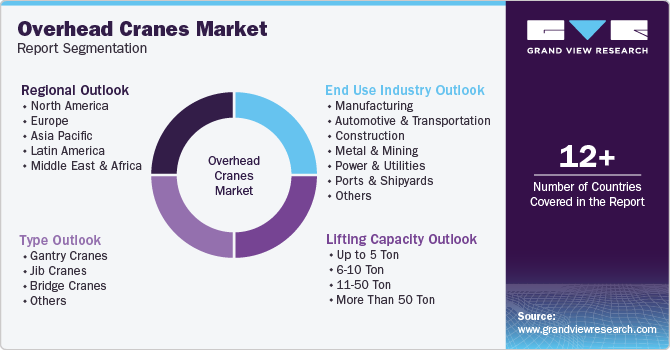
Global Overhead Cranes Market Report Segmentation

  • Type Outlook (Revenue, USD Million, 2021 - 2033)

    • Gantry Cranes

    • Jib Cranes

    • Bridge Cranes

    • Others

  • Lifting Capacity Outlook (Revenue, USD Million, 2021 - 2033)

    • Up to 5 Ton

    • 6-10 Ton

    • 11-50 Ton

    • More Than 50 Ton

  • End Use Industry Outlook (Revenue, USD Million, 2021 - 2033)

    • Manufacturing

    • Automotive and Transportation

    • Construction

    • Metal and Mining

    • Power and Utilities

    • Ports and Shipyards

    • Others

  • Regional Outlook (Revenue, USD Million, 2021 - 2033)

    • North America

      • U.S.

      • Canada

      • Mexico

    • Europe

      • Germany

      • UK

      • France

    • Asia Pacific

      • China

      • India

      • Japan

      • South Korea

      • Australia

    • Latin America

      • Brazil 

    • Middle East & Africa (MEA)

      • UAE

      • Kingdom of Saudi Arabia (KSA)

      • South Africa

Research Methodology

The overhead cranes market figures in this report are based on a proven research process that combines executive interviews with secondary research from proprietary databases, company filings, and recognized regulatory and institutional sources. Market size is built through value-chain sizing-reconciling supply-side and demand-side estimates-and triangulated with bottom-up and top-down approaches. Every estimate passes multiple levels of expert validation before publication, with each overhead cranes segment quantified using the revenue-capture definitions in the table below.

Segment Definition

Segment- Type

Revenue Capture Definition

Gantry Cranes

This segment captures revenue generated from gantry cranes designed for outdoor and heavy-duty material handling applications. These cranes are widely utilized in shipyards, ports, construction sites, rail yards, precast yards, and industrial facilities where flexible lifting capabilities, large coverage areas, and high load capacities are required.

Jib Cranes

This segment includes revenue derived from jib cranes engineered for localized lifting and material positioning applications. These cranes are commonly deployed in manufacturing plants, workshops, warehouses, assembly lines, and maintenance facilities where repetitive lifting tasks, workstation efficiency, and compact installation footprints are essential.

Bridge Cranes

This segment captures revenue generated from bridge cranes, including single-girder and double-girder configurations, designed for efficient movement of heavy materials within industrial buildings. These cranes are extensively used in manufacturing facilities, steel plants, automotive factories, power plants, warehouses, and fabrication shops requiring precise, continuous, and high-capacity lifting operations.

Others

This segment includes revenue generated from specialized overhead crane configurations such as monorail cranes, workstation cranes, process cranes, explosion-proof cranes, automated cranes, and custom-engineered lifting systems developed to address specific material handling requirements across diverse industrial applications.

Segment- Lifting capacity

Revenue Capture Definition

Up to 5 Ton

This segment captures revenue generated from overhead cranes with lifting capacities of up to 5 tons. These systems are primarily utilized in light-duty manufacturing, warehouses, workshops, assembly operations, and maintenance facilities for handling small components, tools, and packaged materials.

6–10 Ton

This segment includes revenue derived from overhead cranes designed to handle loads ranging from 6 to 10 tons. These cranes are widely adopted across medium-duty industrial applications, including machinery manufacturing, automotive component production, logistics facilities, and fabrication shops requiring enhanced lifting capabilities and operational flexibility.

11–50 Ton

This segment captures revenue generated from overhead cranes with lifting capacities between 11 and 50 tons. These cranes are extensively deployed in steel plants, heavy engineering facilities, automotive manufacturing plants, power generation sites, and industrial processing units where frequent lifting of large and heavy components is required.

More Than 50 Ton

This segment includes revenue derived from high-capacity overhead cranes capable of lifting loads exceeding 50 tons. These systems are predominantly used in shipbuilding yards, metal processing facilities, power plants, mining operations, and large-scale industrial projects where handling oversized equipment, structural components, and heavy machinery is critical.

Segment- End-use Industry

Revenue Capture Definition

Manufacturing

This segment captures revenue generated from overhead cranes utilized in general manufacturing facilities for raw material handling, assembly operations, production line support, inventory movement, and finished goods transportation. These systems improve operational efficiency, workplace safety, and production throughput.

Automotive and Transportation

This segment includes revenue derived from overhead cranes deployed in automotive manufacturing plants, railway workshops, aerospace facilities, and transportation equipment production sites. These cranes facilitate the lifting, positioning, and movement of vehicle components, engines, chassis, and other large assemblies, thereby enhancing production efficiency and precision.

Construction

This segment captures revenue generated from overhead cranes used in construction-related applications, including precast concrete manufacturing, infrastructure projects, equipment fabrication yards, and material staging facilities. These systems support safe and efficient handling of construction materials, structural elements, and heavy equipment.

Metal and Mining

This segment includes revenue derived from overhead cranes operating in steel mills, foundries, smelters, metal fabrication plants, and mining facilities. These cranes are designed to withstand harsh operating environments and support the handling of molten metals, coils, billets, ore, and other heavy materials.

Power and Utilities

This segment captures revenue generated from overhead cranes utilized in thermal, hydroelectric, nuclear, and renewable energy facilities for equipment installation, turbine maintenance, generator handling, and plant servicing activities. These cranes play a critical role in ensuring operational reliability and maintenance efficiency.

Ports and Shipyards

This segment includes revenue derived from overhead cranes deployed in ports, shipyards, dry docks, and marine equipment manufacturing facilities. These cranes support cargo handling, vessel assembly, component movement, and maintenance operations requiring high lifting capacities and extended operational reach.

Others

This segment captures revenue generated from overhead crane applications across industries such as logistics, chemicals, food and beverage, pharmaceuticals, paper and pulp, electronics, defense, and warehousing, where efficient, safe, and customized material handling solutions are required.

Estimation Model

Layer Name

Key Question

Description

Industrial Infrastructure & Material Handling Demand Layer

Where are overhead cranes used and what drives demand?

Establish the total potential demand base by identifying overhead crane deployment across manufacturing plants, automotive facilities, metal processing units, mining operations, power generation plants, construction yards, ports, shipyards, warehouses, and other industrial facilities requiring heavy-duty lifting and material handling solutions.

Addressable Industrial Equipment Market Layer

Which facilities can realistically adopt overhead crane solutions?

Refine the total industrial infrastructure base into the realistically serviceable market by considering factors such as production volumes, load handling requirements, facility dimensions, building structural compatibility, labor costs, automation readiness, capital investment capacity, safety regulations, and technological maturity across end-use industries and regions.

Overhead Cranes Procurement Layer

Who is actively purchasing, expanding, or upgrading overhead crane systems?

Estimate annual demand generation by analyzing new industrial facility construction, manufacturing capacity expansions, plant modernization initiatives, renewable energy projects, port development programs, mining investments, replacement cycles of aging lifting equipment, and adoption of Industry 4.0-enabled material handling solutions across key end-use sectors.

Revenue Layer

How is revenue generated from overhead crane sales?

Revenue is generated through the sale of overhead cranes across various types (gantry cranes, jib cranes, bridge cranes, and specialized systems), lifting capacities, and end-use industries. Market revenue is calculated by considering unit shipments, crane configurations, load capacity specifications, automation and control features, installation and commissioning services, maintenance contracts, regional pricing variations, and value chain margins across manufacturers, distributors, and engineering solution providers.

Delivered Customizations

This report has been delivered with the following In-depth customizations

Client Request

Customization Delivered

Value Adds

Overhead Cranes Market Assessment

Structured evaluation of market dynamics including key drivers, restraints, opportunities, and industry trends across the overhead cranes value chain.

Assessment of technology evolution across smart crane systems, IoT-enabled monitoring, predictive maintenance, remote operation, anti-sway technologies, and Industry 4.0-enabled material handling solutions.

Clear visibility into market growth drivers and adoption barriers.

Strategic input for market entry, capacity expansion planning, and investment decisions.

End-Use and Application Insights

Analysis of demand distribution across manufacturing, automotive & transportation, construction, metal & mining, power & utilities, ports & shipyards, and other end-use industries.

Evaluation of evolving industry requirements related to production automation, heavy-load handling, plant modernization, workplace safety, and operational efficiency initiatives.

Identification of high-growth and high-value application segments.

Support for targeted product development, customer prioritization, and go-to-market strategies.

Technology and Competitive Landscape Review

Benchmarking of key overhead crane technologies, including gantry cranes, jib cranes, bridge cranes, automated crane systems, and high-capacity lifting solutions.

Analysis of major players' innovation strategies, digitalization capabilities, product differentiation, service offerings, aftermarket expertise, and regional market presence.

Competitive intelligence for technology positioning and portfolio optimization.

Guidance for R&D prioritization, partnership evaluation, and long-term growth planning.

Frequently Asked Questions About This Report

About the Author(s)

Automotive & Transportation Research Team

Technology · Automotive & Transportation

This report was authored by the automotive & transportation research team at Grand View Research - comprising two research analysts, one senior research analyst, and one industry expert - with specialized expertise in the automotive & transportation segment of the technology industry. All findings are based on proprietary technology databases, executive interviews, and regulatory analysis, subject to internal peer review prior to publication.

Last Updated:

Speak to Analyst

Trusted market insights - try a free sample

See how our reports are structured and why industry leaders rely on Grand View Research. Get a free sample or ask us to tailor this report to your needs.

logo
GDPR & CCPA Compliant
logo
ISO 9001 Certified
logo
ISO 27001 Certified
logo
ESOMAR Member
Grand View Research is trusted by industry leaders worldwide
client logo
client logo
client logo
client logo
client logo
client logo