
- Home
- »
- Personal Care & Cosmetics
- »
-
Patchouli Alcohol Market Size & Share Report, 2025-2033GVR Report cover
![Patchouli Alcohol Market (2025 - 2033)Report]()
Patchouli Alcohol Market (2025 - 2033)
Size, Share & Trends Analysis Report Purity (High Purity (>99%), Medium Purity (98-99%)), By Application (Fragrances & Perfumes, Personal Care & Cosmetics, Aromatherapy, Pharmaceuticals) By Region, And Segment Forecasts
Market Size, 2024
$362.2MMarket Estimate, 2026
$395.8MMarket Forecast, 2033
$543.6MCAGR, 2025–2033
4.6%Patchouli Alcohol Market Summary
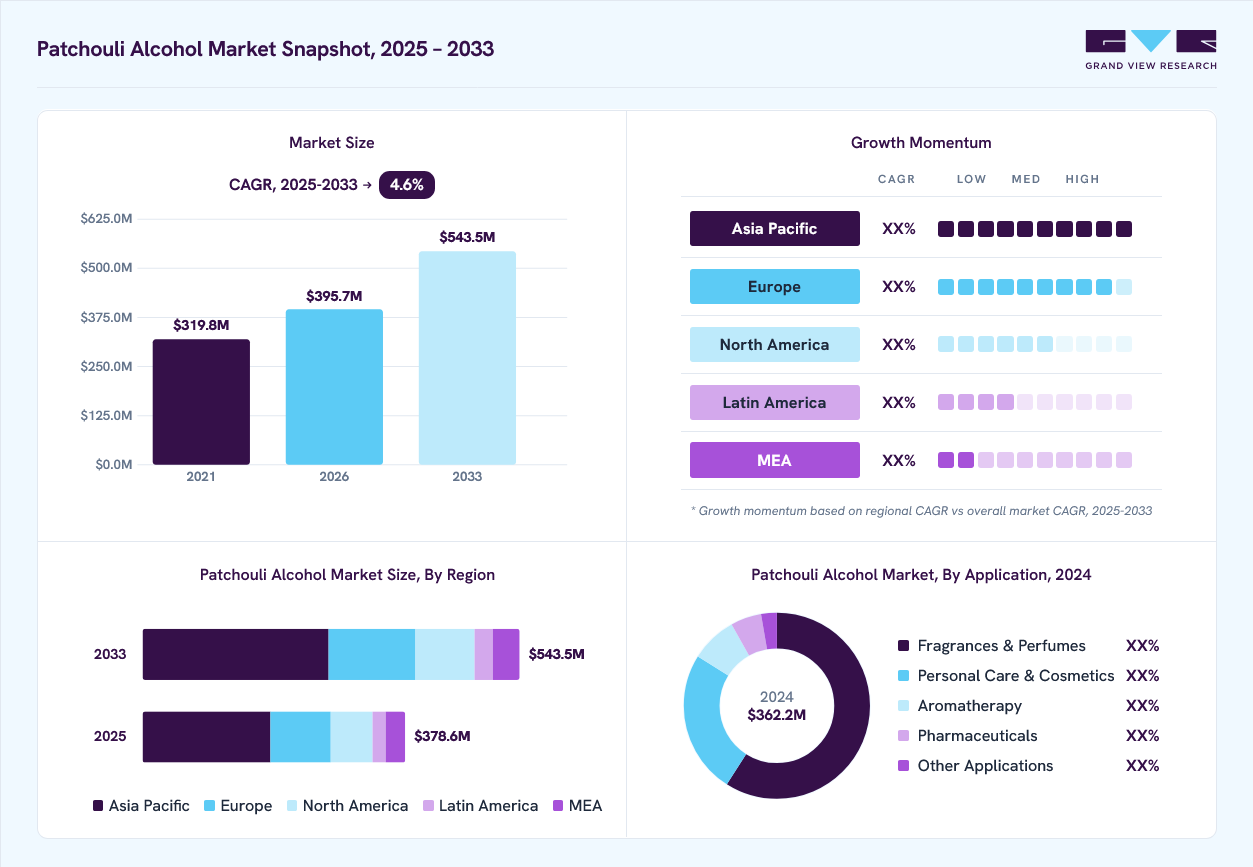
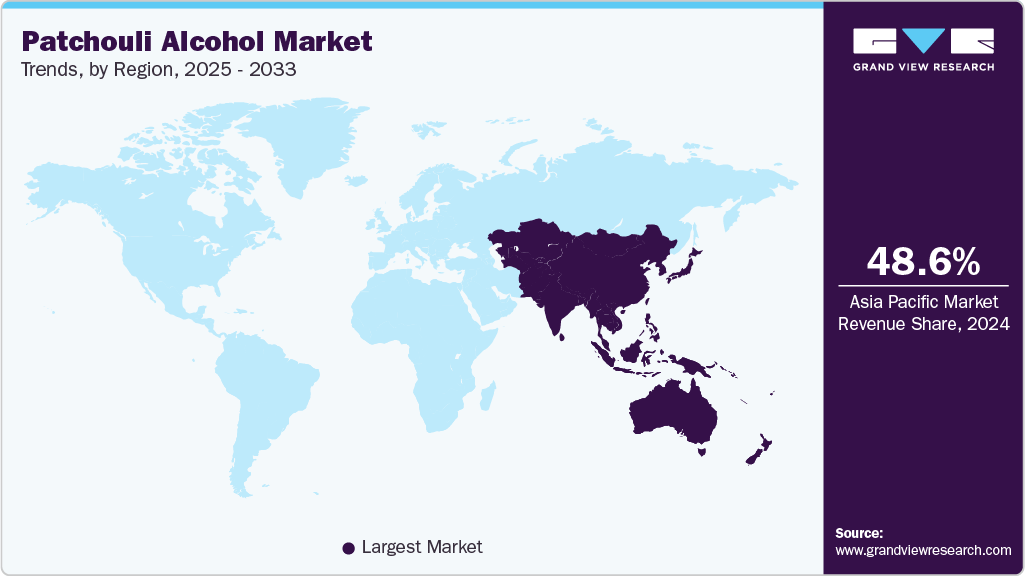
The global patchouli alcohol market size was valued at USD 362.2 million in 2024 and is projected to grow from USD 395.8 million in 2026 to USD 543.6 million by 2033, at a CAGR of 4.6% from 2025 to 2033. Asia Pacific dominated the market, accounting for a revenue share of 48.6% in 2024. The market growth is primarily driven by the rising demand for natural and plant-based ingredients in fragrances, personal care, and aromatherapy products.
Key Market Trends & Insights
- The China patchouli alcohol industry is expected to grow at the fastest CAGR of 5.1% from 2025 to 2033.
- By purity, the high purity (>99%) patchouli alcohol segment is expected to grow at the fastest CAGR of 4.8% from 2025 to 2033 in terms of revenue.
- By purity, the high purity (>99%) segment held the largest revenue share of 60.6% in 2024.
- By application, the fragrances & perfumes segment held the largest revenue share of 59.0% in 2024.
Market Size & Forecast
- 2024 Market Size: USD 362.2 Million
- 2033 Projected Market Size: USD 543.6 Million
- CAGR (2025-2033): 4.6%
- Asia Pacific: Largest market in 2024
Three ways to get this report
Buy it, customize it, or ask a question.Get the Full Report
What the study covers
- FormatsPDF · Excel · Dashboard
- Timeline2025–2033 annual, 2024 base
- Coverage20+ countries, 5 regions
- Companies10+ key players profiled
Customize the Report
20% free customization
- IncludeCountries, segments, points
- TailorTo your product definition
- ExtendDeeper competitor detail
- OrA fully bespoke study
- Turnaround5–10 working days
Ask Prism AI
A cited answer in seconds
- Corpus30K studies, 1.2M points
- ScopeAll markets, not just this
- CitationTraced to report & table
- HonestySays "not covered" if so
- SpeedSeconds, not days
Increasing consumer preference for organic and sustainable formulations, coupled with the expansion of the luxury perfumes and wellness industries, is fueling the growth of the patchouli alcohol industry. The therapeutic properties of patchouli alcohol, including antimicrobial and calming effects, are driving adoption across pharmaceuticals and aromatherapy applications.Emerging markets present significant growth opportunities as disposable incomes rise and awareness of premium fragrances and wellness products increases. The expansion of the aromatherapy and natural cosmetics segments, along with advancements in synthetic and semi-synthetic patchouli alcohol production, offers cost-effective alternatives to meet growing demand. Strategic collaborations between raw material suppliers and end-product manufacturers also provide potential for product innovation and market penetration.
The patchouli alcohol market faces challenges due to the high production cost and seasonal dependency of patchouli cultivation, which impacts raw material availability and pricing. Variability in purity levels and quality standards poses additional supply chain complexities. Furthermore, stringent regulatory requirements for natural extracts in personal care and pharmaceutical products, along with competition from synthetic alternatives, can limit market expansion.
Market Concentration & Characteristics
The market is characterized by a diverse array of players ranging from multinational chemical corporations to specialized fragrance and essential oil producers. Merck and Cayman Chemical lead in the high-purity segment, catering to pharmaceutical and analytical research applications. BioCrick BioTech and MedChemExpress focus on the scientific community, offering patchouli alcohol for research purposes. Frater Perfumes Ltd. and The Good Scents Company are prominent in the fragrance industry, known for their premium offerings. Chemical Bull and AOBIOUS INC. provide cost-effective solutions for the personal care and aromatherapy sectors. Selleck Chemicals and NAMIKI SHOJI Co., Ltd. contribute to the market with their specialized products and regional presence, respectively.
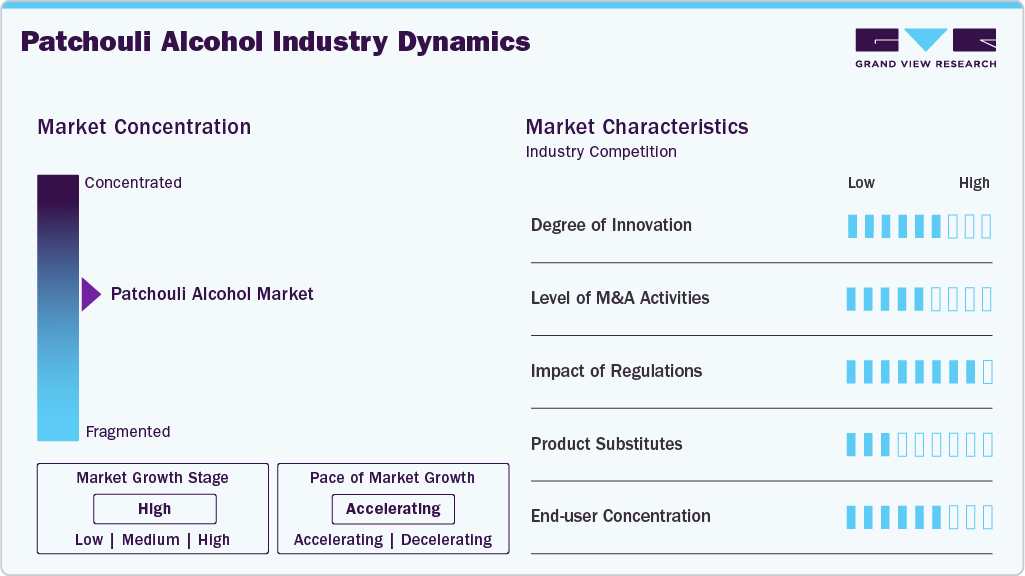
To strengthen their market positions, these companies have adopted various strategies. Merck emphasizes innovation and quality, maintaining a strong global presence through extensive distribution networks. Cayman Chemical focuses on expanding its product portfolio and enhancing customer relationships. BioCrick BioTech invests in research and development to offer high-quality products tailored to scientific needs. Frater Perfumes Ltd. differentiates itself by creating unique, luxury fragrances, while The Good Scents Company ensures optimal quality through sustainable sourcing. Chemical Bull highlights its commitment to customer satisfaction and timely delivery. AOBIOUS INC. leverages its online platform to reach a broader audience, and Selleck Chemicals focuses on providing specialized products for research applications. NAMIKI SHOJI Co., Ltd. capitalizes on its regional expertise to serve the Japanese market effectively.
Purity Insights
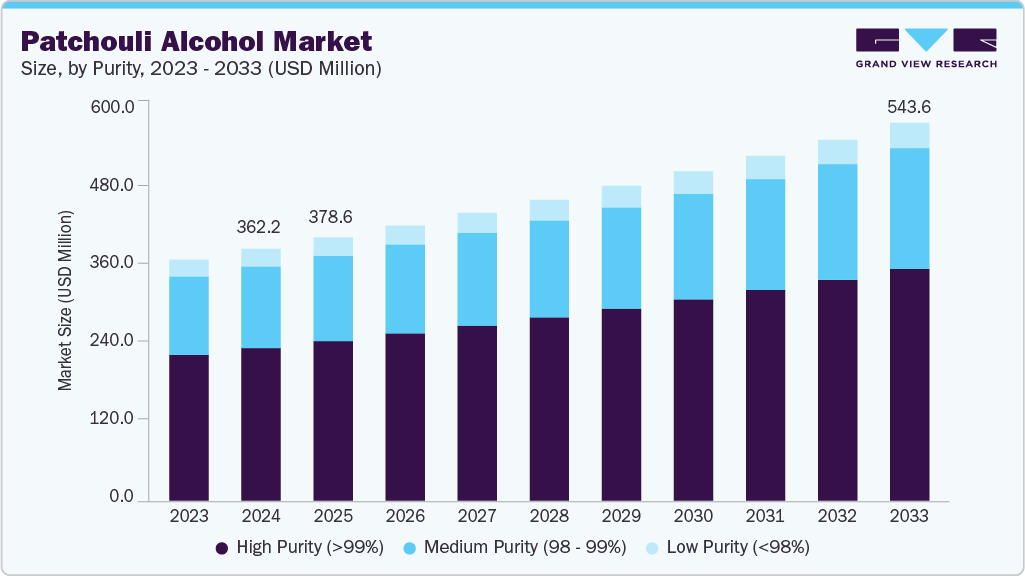
The High Purity (>99%) segment held the largest revenue share of 60.6% in 2024, primarily driven by its extensive use in luxury fragrances, high-end personal care products, and pharmaceutical applications. The superior aroma profile, consistent quality, and enhanced therapeutic properties of high-purity patchouli alcohol make it the preferred choice for premium formulations. Manufacturers and end-users are willing to pay a premium for high-purity variants due to their reliability, stability, and ability to blend seamlessly with other ingredients, which supports brand differentiation and product positioning in competitive markets.
In comparison, the Medium Purity (98-99%) and Low Purity (<98%) segments serve cost-sensitive and bulk applications. Medium-purity patchouli alcohol is widely adopted in mid-tier personal care products and fragrances, balancing quality and affordability, which drives steady market demand. The low-purity segment, although smaller in revenue share, is crucial for large-scale aromatherapy, industrial formulations, and lower-cost cosmetic products, where high-purity is not mandatory. The segmentation highlights a clear preference among end-users for high-quality, premium-grade patchouli alcohol, while medium and low-purity variants continue to cater to broader, price-conscious markets.
Application Insights
The fragrances & perfumes segment led the patchouli alcohol industry with the largest revenue share of 59.0% in 2024, driven by the rising global demand for luxury and niche perfumes that leverage high-quality patchouli alcohol for its long-lasting earthy aroma and superior blending properties. The segment benefits from strong consumer preference for natural and plant-based ingredients, especially in premium fragrance formulations. Additionally, the growing number of perfume launches in emerging markets, coupled with increasing disposable incomes and urbanization, has further bolstered the adoption of patchouli alcohol in this application, making it the most lucrative market segment.
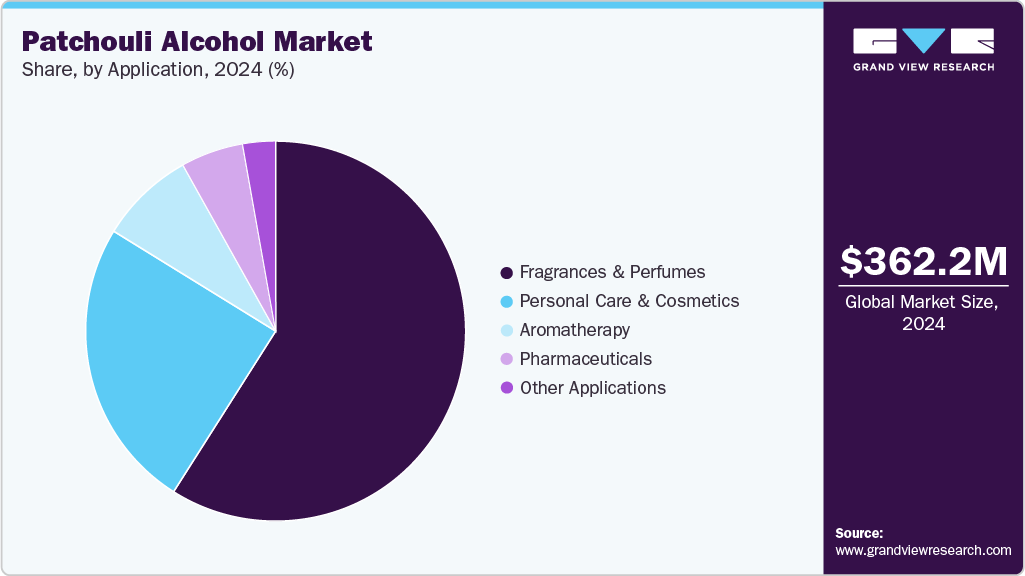
The personal care & cosmetics, aromatherapy, pharmaceuticals, and other applications segments collectively accounted for the remaining market share, reflecting steady growth driven by wellness, therapeutic, and functional benefits of patchouli alcohol. Personal care and cosmetic products utilize patchouli alcohol for its fragrance and antimicrobial properties, while aromatherapy leverages its calming and stress-relieving effects. Pharmaceuticals use it in topical and herbal formulations, and other applications, such as industrial flavorings and specialty chemicals, create niche demand. While these segments generate comparatively lower revenue than fragrances, their growth is supported by increasing consumer awareness of natural ingredients and expanding applications across wellness and therapeutic sectors.
Regional Insights
Asia Pacific dominated the patchouli alcohol market in 2024, holding a 48.6% share, driven by the region’s expanding fragrance, personal care, and aromatherapy industries. Rising disposable incomes, rapid urbanization, and increasing consumer preference for natural and plant-based ingredients have fueled demand across countries such as China, India, and Japan. Additionally, Asia Pacific benefits from the availability of raw materials, lower production costs, and a strong presence of local manufacturers, making it the most lucrative regional market for patchouli alcohol.
The China patchouli alcohol market emerged as a key space within Asia Pacific, accounting for 46.2% of global revenue in 2024. The country’s dominance is supported by a robust personal care and fragrance sector, growing e-commerce penetration, and increasing demand for premium and natural ingredients. Investments in research, product innovation, and local production facilities have further strengthened China’s position, enabling it to cater both to domestic consumption and export markets effectively.
Europe Patchouli Alcohol Market Trends
Europe accounted for 23.0% of the global patchouli alcohol industry in 2024, driven by high consumer awareness and the presence of well-established fragrance and cosmetics companies in countries such as France, Germany, and the UK. The region emphasizes sustainability and natural sourcing, which aligns with the increasing demand for organic and plant-based ingredients. Strong regulatory frameworks and innovation in premium perfumes and personal care products have also reinforced Europe’s position as a major revenue-generating market.
Germany's patchouli alcohol market stands out within Europe as a significant contributor to the market growth, supported by a mature cosmetics and fragrance industry, high consumer purchasing power, and a preference for quality natural ingredients. The country benefits from advanced R&D capabilities, strict quality standards, and a growing wellness and aromatherapy sector, which drives consistent demand for high-purity patchouli alcohol.
North America Patchouli Alcohol Market Trends
North America captured 16.0% of the global patchouli alcohol industry in 2024, driven by the U.S., which dominates regional consumption. The market is fueled by strong demand for luxury fragrances, natural personal care products, and aromatherapy solutions. Consumers in the region increasingly favor plant-based and sustainably sourced ingredients, while companies focus on product innovation, premium positioning, and multi-channel distribution to maintain market growth.
U.S. Patchouli Alcohol Market Trends
The U.S.accounted for a commanding 80.2% of North America’s patchouli alcohol industry in 2024, reflecting its position as the largest consumer of premium fragrances and personal care products. High consumer awareness regarding natural ingredients, coupled with a well-established fragrance and cosmetics industry, supports the demand for high-purity patchouli alcohol. Investments in R&D, product innovation, and sustainable sourcing practices further bolster market growth.
Middle East & Africa Patchouli Alcohol Market Trends
The Middle East & Africa accounted for a moderate market share in 2024, driven by growing luxury and premium fragrance consumption, particularly in GCC countries. High-income consumers and the increasing popularity of wellness and aromatherapy products have fueled demand. Strategic imports, distribution partnerships, and the rising presence of international cosmetic and fragrance brands in the region support market growth.
Latin America Patchouli Alcohol Market Trends
The Latin America patchouli alcohol industry is emerging steadily, supported by increasing urbanization, rising disposable incomes, and a growing preference for premium and natural fragrance products. Countries such as Brazil and Argentina are witnessing rising adoption in personal care, cosmetics, and aromatherapy applications, while local production capabilities and import strategies are gradually enhancing market penetration in the region.
Key Patchouli Alcohol Company Insights
Key players, such as Merck; Cayman Chemical; BioCrick BioTech; AOBIOUS INC.; Frater Perfumes Ltd.; and Chemical Bull, dominate the market.
-
Merck, a global leader in the life sciences and specialty chemicals sector, is renowned for its high-quality active ingredients, research-grade chemicals, and innovative solutions across pharmaceuticals, biotechnology, and laboratory applications. In the patchouli alcohol market, Merck focuses on high-purity variants (>99%), catering to premium fragrance manufacturers, personal care, and pharmaceutical industries. The company leverages robust R&D capabilities, a global distribution network, and stringent quality control standards to maintain product consistency and reliability. Strategic investments in innovation, sustainable sourcing, and collaborations with end-users enable Merck to strengthen its market position, reinforce brand credibility, and meet the growing demand for natural and high-quality ingredients worldwide.
Key Patchouli Alcohol Companies:
The following are the leading companies in the patchouli alcohol market. These companies collectively hold the largest market share and dictate industry trends.
- Merck
- Cayman Chemical
- BioCrick BioTech.
- AOBIOUS INC.
- Frater Perfumes Ltd.
- Chemical Bull
- Selleck Chemicals
- The Good Scents Company
- MedChemExpress
- NAMIKI SHOJI Co., Ltd.
Patchouli Alcohol Market Report Scope
Report Attribute
Details
Market size in 2024
USD 362.2 million
Estimated Market size in 2026
USD 395.8 million
Projected Market size by 2033
USD 543.6 million
Growth rate
CAGR of 4.6% from 2025 to 2033
Base year for estimation
2024
Historical data
2018 - 2023
Forecast period
2025 - 2033
Quantitative units
Revenue in USD million, volume in kilotons, and CAGR from 2025 to 2033
Report coverage
Revenue forecast, volume forecast, company ranking, competitive landscape, growth factors, and trends
Segments covered
Purity, application, region
Regional scope
North America; Europe; Asia Pacific; Middle East & Africa; Latin America
Country scope
U.S.; Canada; Mexico; Germany; UK;, France; Italy; Spain; China; India; Japan; South Korea; Brazil; Argentina; South Africa; Saudi Arabia
Key companies profiled
Merck; Cayman Chemical; BioCrick BioTech.; AOBIOUS INC.; Frater Perfumes Ltd.; Chemical Bull; Selleck Chemicals; The Good Scents Company; MedChemExpress; NAMIKI SHOJI Co., Ltd.
Customization scope
Free report customization (equivalent up to 8 analysts’ working days) with purchase. Addition or alteration to country, regional & segment scope.
Pricing and purchase options
Avail customized purchase options to meet your exact research needs. Explore purchase options
Global Patchouli Alcohol Market Report Segmentation
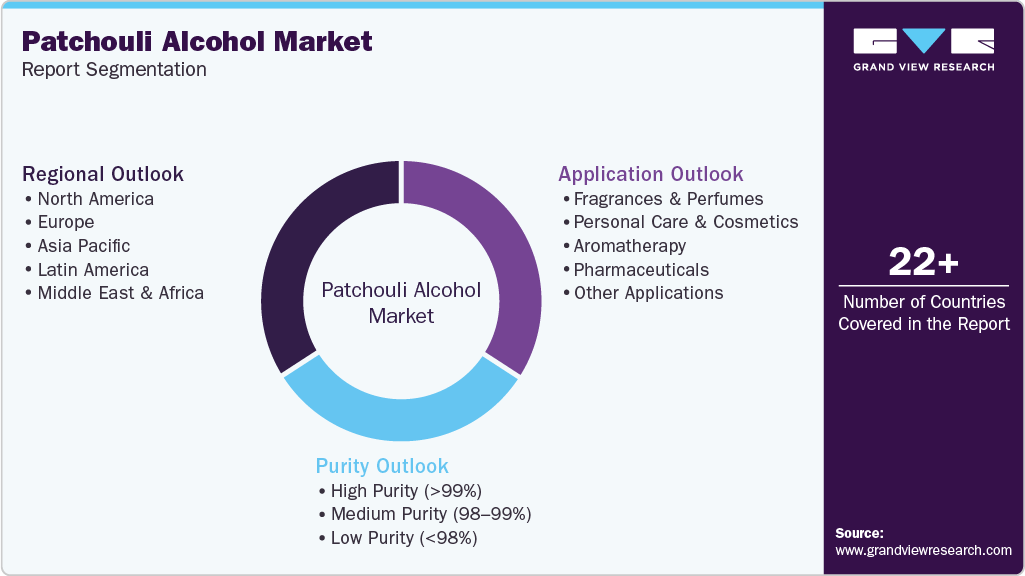
This report forecasts volume & revenue growth at the global, regional, and country levels and provides an analysis of the latest industry trends in each of the sub-segments from 2018 to 2033. For this study, Grand View Research has segmented the global patchouli alcohol market report based on purity, application, and region:
-
Purity Outlook (Volume, Kilotons; Revenue, USD Million, 2018 - 2033)
-
High Purity (>99%)
-
Medium Purity (98-99%)
-
Low Purity (<98%)
-
-
Application Outlook (Volume, Kilotons; Revenue, USD Million, 2018 - 2033)
-
Fragrances & Perfumes
-
Personal Care & Cosmetics
-
Aromatherapy
-
Pharmaceuticals
-
Other Applications
-
-
Regional Outlook (Volume, Kilotons; Revenue, USD Million, 2018 - 2033)
-
North America
-
U.S.
-
Canada
-
Mexico
-
-
Europe
-
Germany
-
UK
-
France
-
Italy
-
Spain
-
-
Asia Pacific
-
China
-
India
-
Japan
-
South Korea
-
-
Middle East & Africa
-
Saudi Arabia
-
South Africa
-
-
Latin America
-
Brazil
-
Argentina
-
-
Frequently Asked Questions About This Report
The fragrances & perfumes segment dominated the market with a 59.0% revenue share in 2024 due to strong global demand for luxury and niche perfumes that leverage high-quality patchouli alcohol for its long-lasting, earthy aroma and superior blending properties. Rising consumer preference for natural and plant-based ingredients further reinforced its dominance in premium fragrance formulations.
Some of the key players operating in the patchouli alcohol market include Merck, Cayman Chemical, BioCrick BioTech., AOBIOUS INC., Frater Perfumes Ltd., Chemical Bull, Selleck Chemicals, The Good Scents Company, MedChemExpress, and NAMIKI SHOJI Co., Ltd.
The market is driven by rising demand for natural and plant-based ingredients in fragrances, personal care, and aromatherapy products, coupled with growing consumer preference for luxury perfumes and wellness-focused formulations. Additionally, its antimicrobial and therapeutic properties are boosting adoption across pharmaceuticals and aromatherapy applications.
The global patchouli alcohol market size was valued at USD 362.2 million in 2024 and is estimated at USD 395.8 million for 2026.
The global patchouli alcohol market is expected to grow at a CAGR of 4.6% from 2025 to 2033, reaching USD 543.6 million by 2033.
About the Author(s)
Personal Care & Cosmetics Research Team
Bulk Chemicals · Personal Care & CosmeticsThis report was authored by the personal care & cosmetics research team at Grand View Research - comprising two research analysts, one senior research analyst, and one industry expert - with specialized expertise in the personal care & cosmetics segment of the bulk chemicals industry. All findings are based on proprietary bulk chemicals databases, executive interviews, and regulatory analysis, subject to internal peer review prior to publication.
Last Updated:
Speak to Analyst


Customize this report to your needs - add regions, segments, or data points, with 20% free customization.
Or view our licence options:


ISO 9001:2015 & 27001:2022 Certified
We are GDPR and CCPA compliant! Your transaction & personal information is safe and secure. For more details, please read our privacy policy.


