
- Home
- »
- Consumer F&B
- »
-
Pet Food E-Commerce Market Size, Share Report, 2033GVR Report cover

Pet Food E-commerce Market (2026 - 2033)
Size, Share & Trends Analysis Report By Pet Type (Dogs, Cats), By Price Range (Economy, Mid-range, Premium), By Region (North America, Europe, Asia Pacific), And Segment Forecasts
Market Size, 2025
$20.6BMarket Estimate, 2026
$22.1BMarket Forecast, 2033
$37.6BCAGR, 2026–2033
7.9%Pet Food E-commerce Market Summary
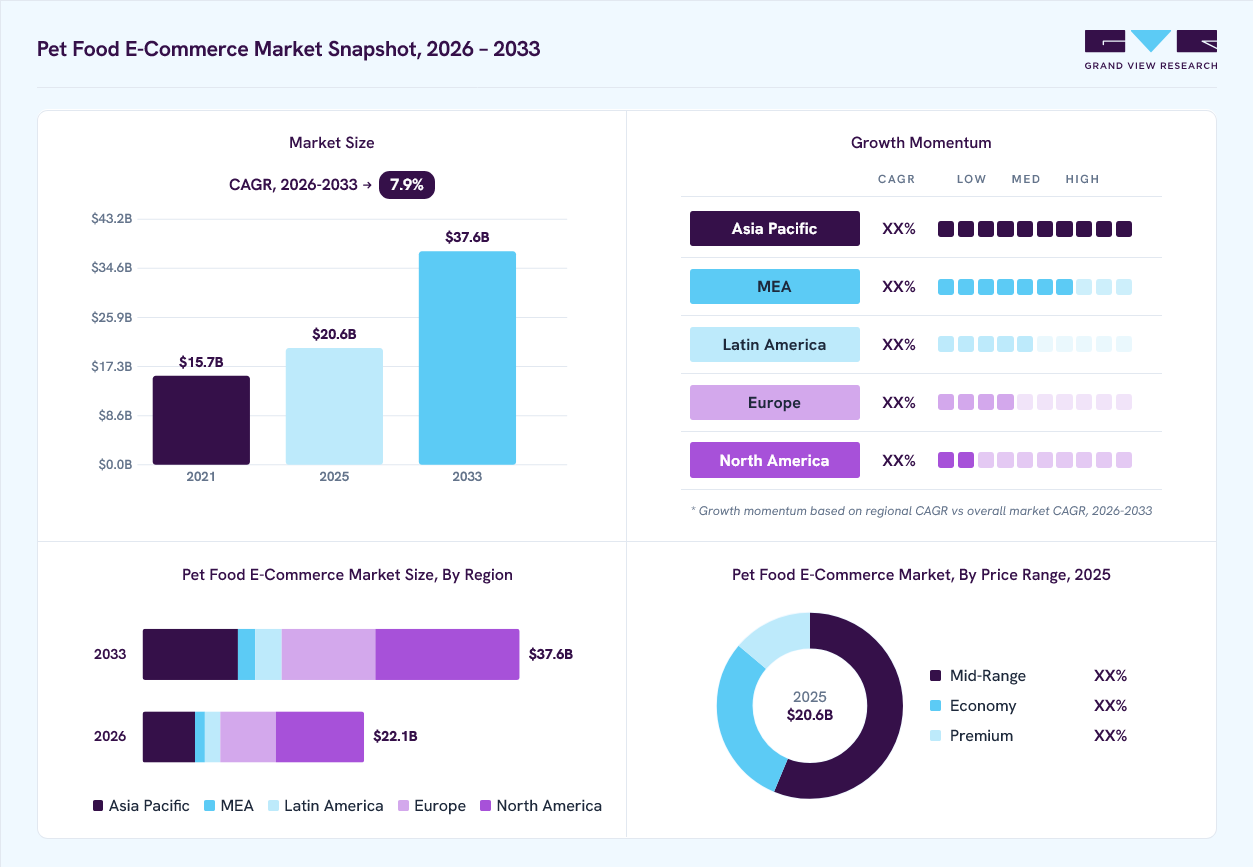
The global pet food e-commerce market size was valued at USD 20.6 billion in 2025 and is projected to grow from USD 22.1 billion in 2026 to USD 37.6 billion by 2033, at a CAGR of 7.9% from 2026 to 2033. North America dominated the market, accounting for a revenue share of 40.0% in 2025. The rising pet humanization and demand for premium, health-focused diets, combined with the convenience of fast delivery, subscriptions, and seamless digital shopping, are some of the factors fueling the growth of the industry.
 Source: Grand View Research, IR Documents, Primary Interviews, Paid DatabasesTo learn more about this report,
 Download Free Sample Report
 Key Market Trends & Insights
- By pet type: Dogs segment led the market with the largest revenue share of 65.8% in 2025.
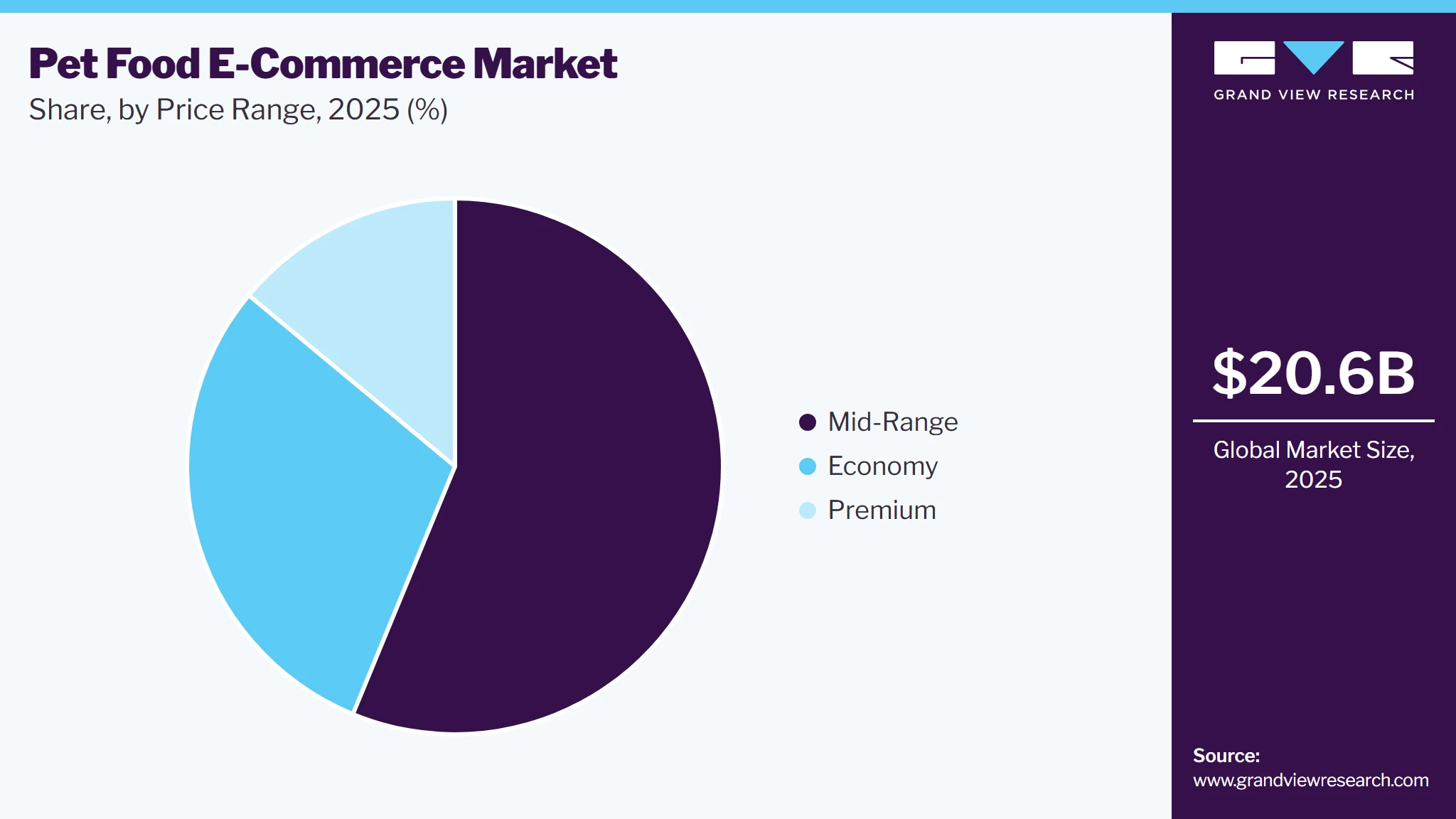
- By price range: Mid-range segment led the market with the largest revenue share of 56.2% in 2025.
Regional Highlights
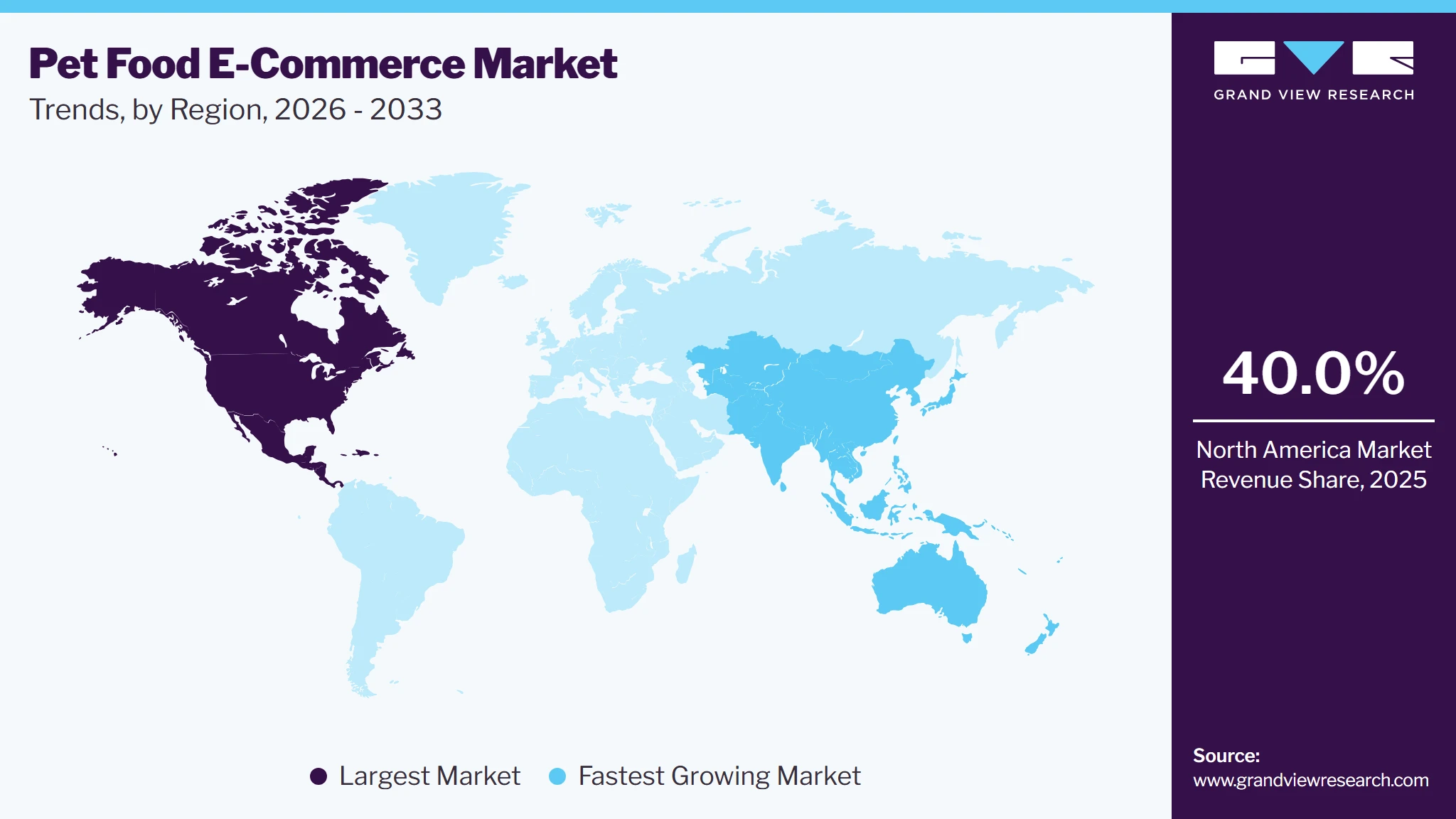
- Largest regional market: North America (40.0% revenue share, 2025)
- Fastest-growing regional market: Asia Pacific (highest CAGR, 2026-2033)
- By country: The U.S. held the largest market share in 2025.
Market Size & Forecast
- Market size in 2025: USD 20.6 Billion
- Estimated market size in 2026: USD 22.1 Billion
- Projected market size by 2033: USD 37.6 Billion
- CAGR (2026-2033): 7.9%
Three ways to get this report
Buy it, customize it, or ask a question.Ask an Analyst
Analyst response in 1 business day
- AccessReport author, directly
- Reply timeWithin 1 working day
- No sales callDirect answer only
- FormatEmail reply
- CostFree, no cost
Get the Full Report
What the study covers
- FormatsPDF · Excel · Dashboard
- Timeline2026–2033 annual, 2025 base
- Coverage20+ countries, 5 regions
- Companies10+ key players profiled
Customize the Report
20% free customization
- IncludeCountries, segments, points
- TailorTo your product definition
- ExtendDeeper competitor detail
- OrA fully bespoke study
- Turnaround5–10 working days
The expanding presence of D2C and personalized pet food brands further reinforces the shift toward online purchasing. Pet owners worldwide increasingly treat pets as family members, driving demand for high-quality, specialized, and health-focused nutrition. As consumers shift toward premium, organic, grain-free, and functional diets, they turn to e-commerce platforms for wider product availability than local retail stores can provide. This change is particularly strong among Millennials and Gen Z, who prioritize wellness ingredients, preventive care, and vet-recommended formulations that rely heavily on digital research and online reviews before purchasing.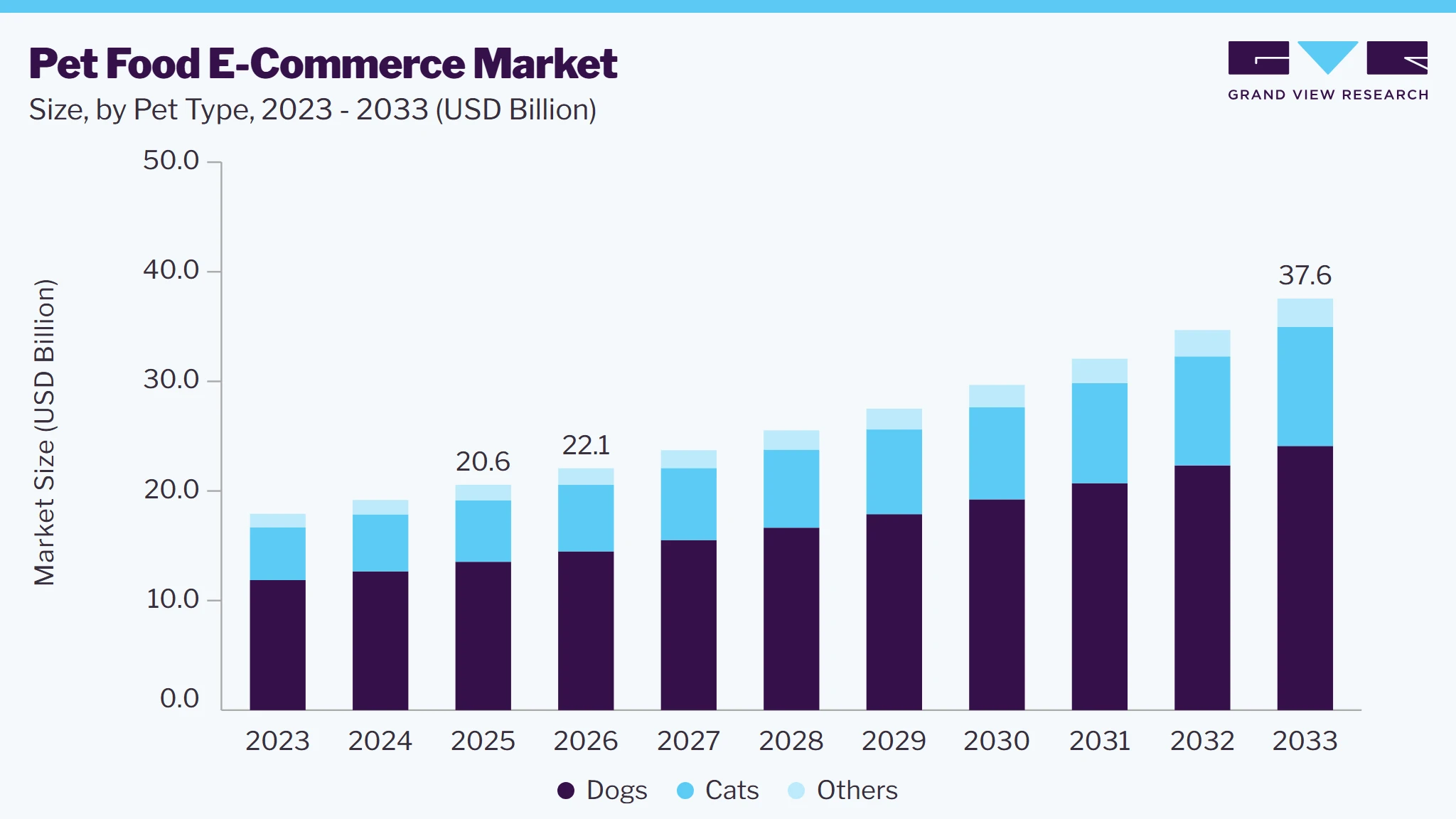 To learn more about this report, Download Free Sample Report
 Widespread penetration of smartphones, digital wallets, and mobile-first marketplaces has made online shopping seamless in both developed and emerging markets. Platforms such as Amazon, Chewy, Zooplus, JD.com, Tmall, Shopee, and Mercado Libre offer a superior user experience through secure payments, fast delivery, personalized recommendations, and easy reorder features. Improved logistics networks and last-mile delivery capabilities have also expanded the reach of online pet food delivery, making e-commerce the default channel for many urban households.
Market Dynamics
The pet food e-commerce market is witnessing steady expansion, driven by the increasing adoption of pets and the growing preference for convenient, digital purchasing channels. Online platforms provide pet owners with access to a broad range of products, including dry and wet food, breed-specific formulations, premium nutrition, treats, and specialized dietary solutions. The availability of product information, customer reviews, subscription-based delivery services, and personalized recommendations has enhanced consumer purchasing behavior and strengthened customer engagement. Additionally, rising awareness regarding pet health and nutrition, coupled with the demand for high-quality and functional pet food products, is expected to support the continued growth of the pet food e-commerce market.
The increasing preference for premium, minimally processed, and nutritionally advanced pet food products is creating significant opportunities for online pet food retailers. Pet owners are demonstrating a stronger willingness to invest in products formulated with high-quality ingredients, functional benefits, and tailored nutritional profiles. E-commerce platforms are particularly well-positioned to capitalize on this trend by offering a broader assortment of premium brands, subscription services, and personalized product recommendations that may not be readily available through traditional retail channels.
In June 2025, General Mills announced the expansion of its Blue Buffalo portfolio into the fresh pet food segment through the launch of "Love Made Fresh." The company also introduced the European premium pet food brand Edgard & Cooper to the U.S. market. The move reflects growing consumer demand for fresh, human-grade pet nutrition and highlights the increasing strategic focus on premium product categories within the pet food industry.
Maintaining product quality, safety, and consumer trust remains a significant restraint for the pet food e-commerce market. Unlike traditional retail environments where consumers can physically inspect packaging, expiration dates, and product conditions, online purchases rely heavily on digital information and supply chain integrity. The complexity of e-commerce fulfillment networks, coupled with the transportation and storage requirements of pet food products, increases the risk of quality deterioration, contamination incidents, packaging damage, and delayed recall awareness.
In 2025, the FDA recalled Savage Pet's raw chicken-based cat food due to potential H5N1 avian influenza contamination after reports of illness in a pet cat. The incident heightened consumer concerns over the safety of raw pet food products and increased regulatory scrutiny of the category, potentially affecting online sales growth.
The growing awareness of pet health and wellness has increased demand for nutrition solutions tailored to individual pet requirements rather than standardized feeding approaches. Traditional pet food products are generally formulated for broad pet categories, often overlooking differences in breed, age, activity level, weight, allergies, and specific health conditions. This has created a significant opportunity for companies to develop personalized nutrition offerings that cater to the unique dietary needs of companion animals.
In 2025, UK-based fresh pet food company KatKin secured USD 50 million in funding to support expansion and product development initiatives. The company offers personalized meal plans tailored to individual pet characteristics, including age, weight, activity levels, and dietary requirements, delivered through a direct-to-consumer subscription model. The investment highlights growing industry confidence in customized pet nutrition and subscription-based pet food services as high-growth segments within the e-commerce market.
Analyst Perspective
The pet food e-commerce market is evolving from a product distribution business into a customer-retention business. As online platforms increasingly offer similar product assortments and pricing, sustainable competitive advantage will depend less on product availability and more on the ability to own the pet owner's purchasing journey through personalization, subscriptions, and integrated pet care services. The most successful players will be those that leverage pet-specific data to predict nutritional needs, automate replenishment, and create high-frequency engagement beyond transactions. In our view, the market's next phase of value creation will be driven by companies that transform recurring pet food purchases into long-term, data-driven customer relationships, thereby increasing lifetime value while reducing customer acquisition dependence.
Consumer Insights for E-Commerce Pet Food
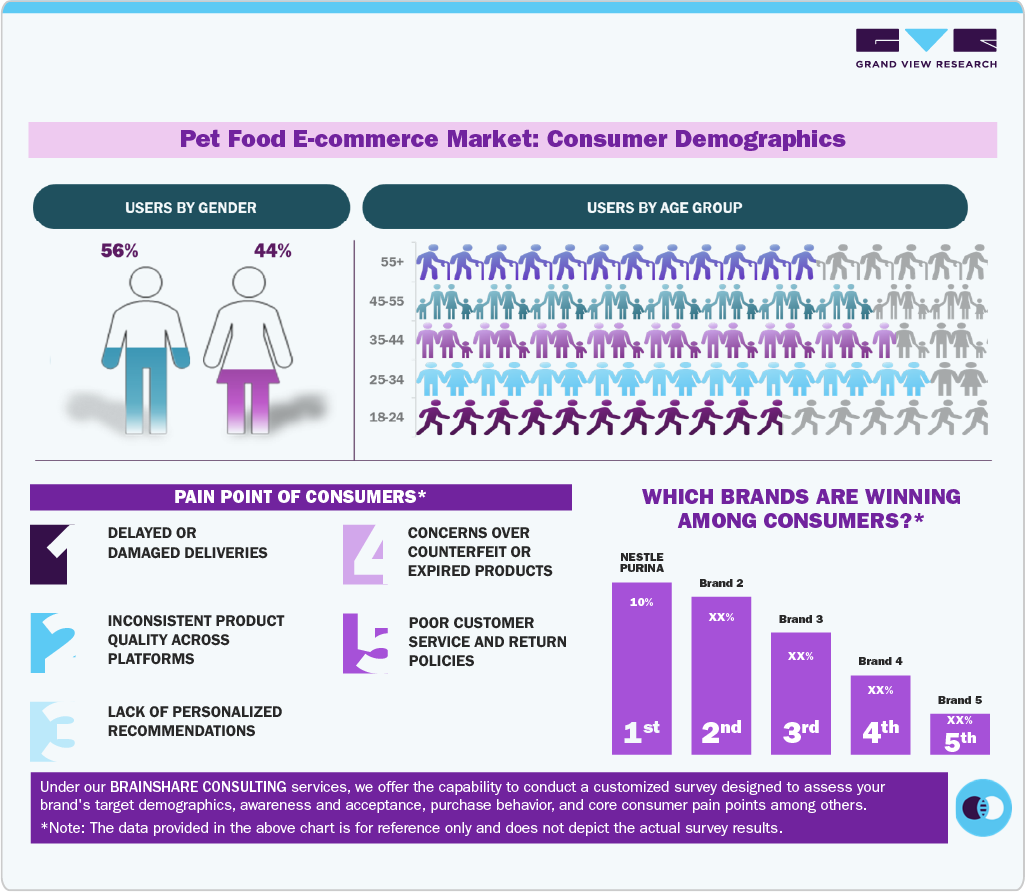
The global pet food e-commerce market is shaped by a diverse and expanding pet-owning population, with dogs and cats together representing the majority of household pets worldwide. While dog ownership remains slightly higher in North America, Latin America, and parts of Europe, cat ownership dominates in Western Europe and parts of Asia. This balanced distribution between dogs and cats creates steady demand across both product categories, driving innovation in breed-specific nutrition, functional diets, and life-stage-based formulations. As pet ownership rises globally-particularly among Millennials and Gen Z-consumer expectations around quality, transparency, and convenience continue to elevate market standards.
Across regions, consumers are increasingly prioritizing pet health, nutrition, and wellness, propelling stronger demand for premium, natural, and specialized pet food products. Shoppers globally conduct extensive research online, comparing ingredient lists, nutritional claims, and brand credibility before making purchase decisions. Veterinary-approved, organic, grain-free, hypoallergenic, and functional diets designed for digestion, skin health, joint care, or weight management are growing in popularity. Younger demographics, especially digital-first Millennials and Gen Z pet owners, rely heavily on online reviews, social media content, KOLs/influencers, and community recommendations, reinforcing the role of digital ecosystems in shaping brand perception and buyer trust.
 To learn more about this report, Download Free Sample Report
 E-commerce has become a central purchasing channel for pet food globally, driven by the growing appeal of home delivery, subscription/auto-ship models, and the ability to access a wider assortment than traditional offline retail can offer. Online marketplaces such as Amazon, Chewy, Zooplus, JD.com, Tmall, Lazada, and Mercado Libre provide not only extensive product ranges but also competitive pricing, discount bundles, and loyalty programs that incentivize repeat purchases. Consumers frequently combine pet food orders with related categories such as treats, litter, supplements, and accessories, to reduce delivery costs and maximize value.
The study titled “Customer Satisfaction in the Pet Food Subscription‑based Online Services” examined customer satisfaction in pet food subscription services using text-mining of 28,786 reviews. The study found that e-service quality, healthy ingredients, packaging, and nutritional value significantly increase satisfaction and loyalty, while price does not moderate this relationship. For the pet food e-commerce market, this underscores the importance of premium quality, service reliability, and tailored nutrition in driving customer retention and growth, particularly in subscription models.
Pet Type Insights
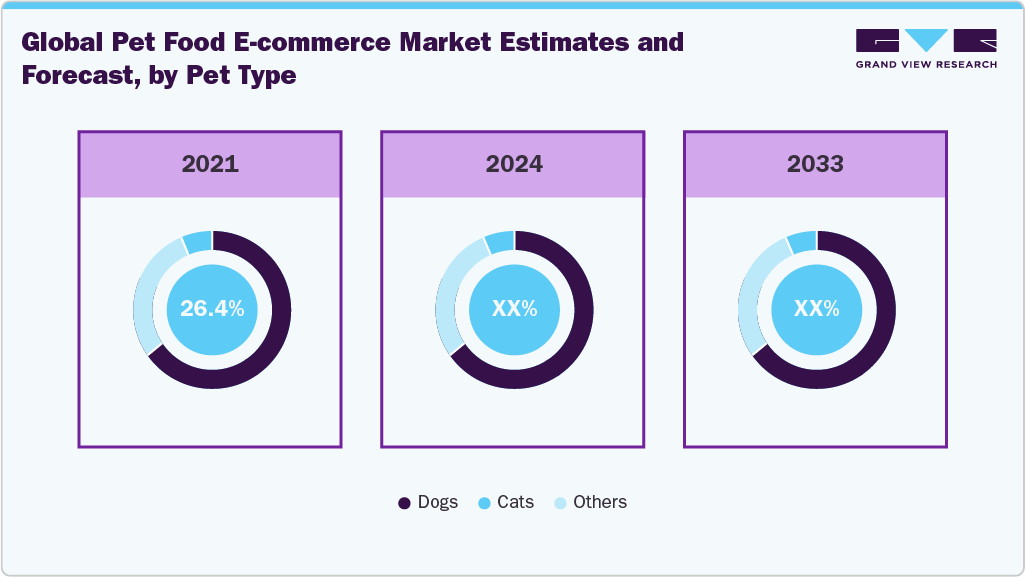
Based on pet type, dogs segment led the market with the largest revenue share of 65.8% in 2025 and is expected to grow at a CAGR of 7.5% over the forecast period. Dog ownership is more widespread, with around 68 million households in North America owning dogs, compared to 49 million owning cats. In addition, dog owners tend to spend more on their pets, purchasing larger quantities of food more regularly. Younger generations, particularly Gen Z and millennials, are driving demand for premium, subscription-based dog food products. Survey data from platforms such as Yummypets indicates that dog owners are more inclined to opt for home-delivery services, further boosting the e-commerce market. Moreover, increased consumer confidence in online dog food purchases, facilitated by broader product ranges and competitive pricing, is reinforcing this shift, as noted by regulators and ministries such as New Zealand’s Ministry for Primary Industries.
 To learn more about this report, Download Free Sample Report
 The Cat food sell through e-commerce globally is anticipated to register the fastest CAGR of 8.6% from 2025 to 2033. This growth is driven by the increasing number of cat owners, particularly in urban areas, and the rising trend of pet humanization, where pets are considered family members. As pet owners seek higher-quality, specialized food options for their cats, e-commerce platforms provide a convenient way to access a wider variety of products. The ease of home delivery, subscription services, and the ability to compare prices and product reviews are also encouraging more consumers to choose online shopping for their cat food needs. Additionally, the growing availability of premium and health-focused cat food options online is further fueling the market's expansion.
Price Range Insights
Based on price range, the mid-range segment led the market with the largest revenue share of 56.2% in 2025. This trend reflects the growing preference among pet owners for affordable yet quality products that provide a balance between price and nutritional value. Mid-range pet food is increasingly popular as it meets the demands of a broad consumer base, offering high-quality ingredients without the premium price tag. E-commerce platforms have made it easier for consumers to access these products, thanks to convenient shopping experiences, competitive pricing, and the ability to compare brands and formulations. This segment's dominance in online sales highlights the shift toward value-conscious purchasing, with more pet owners turning to digital channels for their pet food needs
 To learn more about this report, Download Free Sample Report
 The sales of premium pet food through e-commerce are expected to grow at a CAGR of 8.2% from 2026 to 2033. The growing trend of pet humanization, where pets are increasingly seen as family members, drives the demand for higher-quality, health-oriented food. Consumers are more aware of the benefits of premium formulations, such as improved nutrition and functional health benefits, which boost spending on these products. E-commerce platforms provide a convenient and accessible channel for premium pet food, offering a wider selection, subscription models, and better exposure for niche brands that may not be widely available in physical stores. Moreover, the rise in pet ownership, particularly in urban areas with higher disposable incomes, further supports the growth of premium pet food sales online.
Regional Insights
North America dominated the pet food e-commerce market with the largest revenue share of 40.0% in 2025. The market is mainly driven by pet humanization and demand for premium diets, ingredient transparency, and subscription-based auto-replenishment, with platforms like Chewy, marketplaces including Amazon, and D2C fresh meal brand The Farmer’s Dog benefiting from advanced logistics networks and strong digital buyer penetration across urban and rural households.
 To learn more about this report, Download Free Sample Report
 U.S. Pet Food E-commerce Market
The pet food e-commerce market in the U.S. held the largest share in the North America region in 2025. The growth in the U.S. market is driven by driven by high purchasing power, dense retailer-to-consumer logistics infrastructure, and strong penetration of app-based subscriptions in both dry kibble and fresh meal categories. Consumers increasingly seek hyper-convenient delivery of brands such as Royal Canin, Hill’s, Blue Buffalo, and fresh food subscriptions like The Farmer’s Dog.
Europe Pet Food E-commerce Market
The pet food e-commerce market in Europe held a significant market share of 27.7% in the global market The European market is being shaped by preference for quality ingredients, regulatory alignment on nutritional claims, and greater purchase consideration for sustainable, recyclable, and low-carbon packaging formats. Countries such as the United Kingdom, Germany, France, Italy, Poland, and the Nordics lead platform adoption for pet food delivery.
The Germany pet food e-commerce market expected to grow at a CAGR of 7.0% from 2026 to 2033. Consumers value domestic and global brands like Royal Canin and Zooplus-enabled large scale purchases of dry and wet pet diets. Growth rationale for Germany is supported by strong electronics and consumer internet adoption, and high preference for durable nutrition optimized for dogs and cats
Asia Pacific Pet Food E-commerce Market
The Asia Pacific pet food e-commerce market is projected to grow at the fastest CAGR of 8.8% from 2026 to 2033. The market is driven by a rapid rise in companion animal ownership-led largely by small dogs and indoor cats-along with increasing digital payments adoption through UPI, Alipay, and wallet ecosystems, higher repeat purchase and subscription uptake, and expanding cold-chain logistics that enable fresh and frozen pet meal deliveries; platforms such as Chewy’s regional alternatives including Zooplus-style marketplaces, local private labels, and international brands like Royal Canin are benefiting from demand for affordable, ingredient-transparent, and protein-rich diet bundles, widened SKU availability, and stronger last-mile fulfillment coverage across China, India, Japan, South Korea, Southeast Asia, and Australia, which is improving accessibility, order frequency, and average cart value for online pet nutrition purchases in the region.
Key Pet Food E-Commerce Company Insights
The global pet food e-commerce market comprises a mix of international and domestic players competing to strengthen their presence in the country. Leading companies are focusing on expanding product portfolios, improving supply chain efficiency, and leveraging digital marketing to attract tech-savvy pet owners. Partnerships with major e-commerce platforms, such as Shopee and Lazada, have become crucial for reaching a vast consumer base.
Key Pet Food E-commerce Companies:
The following key companies have been profiled for this study on the pet food e-commerce market.
-
Nestle Purina
-
Mars, Incorporated
-
Hill’s Pet Nutrition, Inc.
-
General Mills Inc.
-
Schell & Kampeter, Inc.
-
Zooplus SE
-
Charoen Pokphand Group
-
The J.M. Smucker Company
-
Chewy, Inc.
-
Petto
Competitive Benchmarking
Category
Operating Strategies
Competitive Edge
Weakness
Established Players (Nestlé Purina, Mars Incorporated, Hill’s Pet Nutrition, General Mills, Schell & Kampeter)
- Expand premium, functional, and veterinary nutrition portfolios.
- Leverage omnichannel distribution and global manufacturing networks.
- Strong brand recognition and established consumer trust.
- Extensive R&D capabilities and large-scale supply chain infrastructure.
- Higher operational complexity across multiple markets.
- Slower innovation cycles due to large organizational structures.
Emerging Players (Chewy, Inc., Petto)
- Focus on digital-first customer acquisition and subscription-based sales models.
- Utilize data-driven personalization and direct-to-consumer engagement strategies.
- Greater agility in launching new services and customer-centric solutions.
- Strong digital capabilities and personalized shopping experiences.
- Limited geographic presence and brand penetration compared to established players.
- Higher dependence on customer acquisition spending and external suppliers.
Recent Developments
-
In November 2025, Reliance Consumer Products Limited has entered India’s pet‑care market by launching a new brand, Waggies, offering science‑backed pet nutrition at prices positioned 20‑50% below existing premium players.
-
In June 2025, General Mills expanded its Blue Buffalo brand into the fresh pet food category with the launch of its “Love Made Fresh” line. Additionally, General Mills is introducing its recently acquired European premium pet food brand, Edgard & Cooper, to the U.S. market through an exclusive partnership with PetSmart. These moves reflect the company's strategic push to tap into the growing premium pet food market.
-
In February 2025, Meatly launched the world's first cultivated pet food, "Chick Bites," in collaboration with plant-based brand THE PACK, offering a sustainable, nutritious alternative to traditional dog treats. Made from cultivated meat produced from a single chicken cell sample, it provides all the essential nutrients while being kinder to animals and the environment. Pets at Home is the first retailer to sell this innovative pet food, marking a significant step in the sustainable pet food market.
Pet Food E-commerce Market Report Scope
Report Attribute
Details
Market size in 2025
USD 20.6 billion
Estimated market size in 2026
USD 22.1 billion
Projected market size by 2033
USD 37.6 billion
Growth rate
CAGR of 7.9% from 2026 to 2033
Base year for estimation
2025
Historical data
2021 - 2024
Forecast period
2026 - 2033
Quantitative units
Revenue in USD million/billion and CAGR from 2026 to 2033
Report coverage
Revenue forecast, company ranking, competitive landscape, growth factors, and trends
Segments covered
Pet type, price range, region
Regional scope
North America; Europe; Asia Pacific; Central & South America; Middle East & Africa
Country scope
U.S.; Canada; Mexico; Germany; UK; France; Italy; Spain; China; India; Japan; South Korea; Australia & New Zealand; Brazil; South Africa
Key companies profiled
Nestle Purina; Mars, Incorporated; Hill’s Pet Nutrition, Inc.; General Mills Inc.; Schell & Kampeter, Inc.; Betagro Pet; Charoen Pokphand Group; The J.M. Smucker Company; Chewy, Inc.; Petto
Customization scope
Free report customization (equivalent up to 8 analysts' working days) with purchase. Addition or alteration to country, regional & segment scope.
Pricing and purchase options
Avail customized purchase options to meet your exact research needs. Explore purchase options
Global Pet Food E-commerce Market Report Segmentation
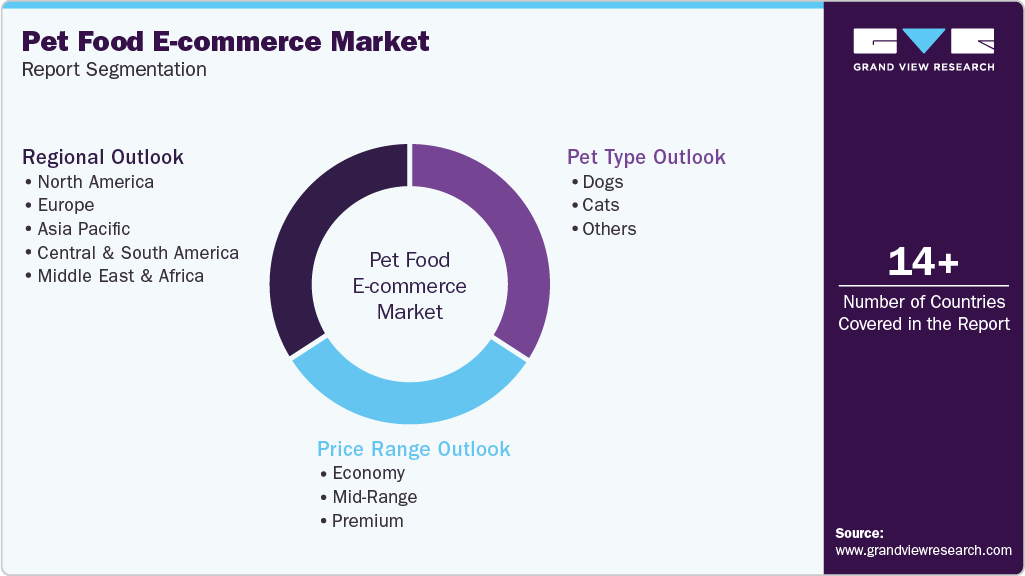
This report forecasts revenue growth at country level and provides an analysis of the latest trends and opportunities in each of the sub-segment from 2021 to 2033. For this study, Grand View Research has segmented the Global pet food e-commerce market based on pet type, price range, and region.
 To learn more about this report, Download Free Sample Report
 -
Pet Type Outlook (Revenue, USD Million, 2021 - 2033)
-
Dogs
-
Dry Food
-
Wet Food
-
Snacks/Treats
-
-
Cats
-
Dry Food
-
Wet Food
-
Snacks/Treats
-
-
Others
-
Dry Food
-
Wet Food
-
Snacks/Treats
-
-
-
Price Range Outlook (Revenue, USD Million, 2021 - 2033)
-
Economy
-
Mid-Range
-
Premium
-
-
Regional Outlook (Revenue, USD Million, 2021 - 2033)
-
North America
-
U.S.
-
Canada
-
Mexico
-
-
Europe
-
UK
-
Germany
-
France
-
Italy
-
Spain
-
-
Asia Pacific
-
China
-
Japan
-
India
-
Australia
-
South Korea
-
-
Central & South America
- Brazil
-
Middle East & Africa
-
South Africa
-
-
Research Methodology
The pet food E-commerce market figures in this report are based on a proven research process that combines executive interviews with secondary research from proprietary databases, company filings, and recognized regulatory and institutional sources. Market size is built through value-chain sizing - reconciling supply-side and demand-side estimates - and triangulated with bottom-up and top-down approaches. Every estimate passes multiple levels of expert validation before publication, with each pet food E-commerce segment quantified using the revenue-capture definitions in the table below.
Segment Definition
Segment - Pet Type
Revenue capture definition
Dogs
This segment includes the online sale of pet food products formulated for dogs, including dry food, wet food, treats, functional nutrition products, and breed-, age-, or health-specific diets. Revenue is generated through one-time purchases and subscription-based replenishment services offered via e-commerce platforms.
Cat
This segment includes the online sale of cat food products such as dry kibble, wet food, treats, and specialized nutrition formulations designed for different life stages and health requirements. Revenue is generated through direct online purchases, recurring subscriptions, and premium nutrition offerings.
Others
This segment includes the online sale of food products for companion animals such as birds, fish, rabbits, hamsters, guinea pigs, and reptiles. Revenue is generated through e-commerce sales of species-specific diets, nutritional supplements, and specialty feeding products.
Segment - Price Range
Revenue capture definition
Economy
This segment includes pet food products positioned at affordable price points and designed to meet basic nutritional requirements. Revenue is generated through online sales of value-oriented products targeting price-sensitive consumers.
Mid-Range
This segment includes pet food products that offer a balance between quality and affordability, featuring enhanced ingredients and nutritional benefits compared to economy offerings. Revenue is generated through e-commerce sales to consumers seeking reliable nutrition at moderate price points.
Premium
This segment includes high-quality pet food products formulated with premium ingredients, specialized nutrition, and advanced health benefits. Revenue is generated through online sales of premium, natural, functional, and customized nutrition products targeting health-conscious pet owners.
Estimation Model
Layer
Guiding Question
Description
Pet Ownership Layer
How many households own pets?
Identify the pet-owning population across key markets and classify by pet type (dogs, cats, and others) to establish the total addressable consumer base.
Digital Commerce Layer
How many pet owners purchase online?
Apply e-commerce adoption rates among pet owners to determine the population actively using digital channels for pet product purchases.
Pet Food Purchasing Layer
Who actively buys pet food online?
Estimate the proportion of online pet owners purchasing pet food through e-commerce platforms, considering purchase frequency and category penetration.
Monetization Layer
How much revenue is generated per buyer?
Multiply active online pet food buyers by annual average spending on pet food, subscriptions, and premium nutrition products to derive market revenue.
Delivered Customizations
This report has been delivered with the following In-depth customizations
Client Request
Customization Delivered
Value Adds
Personalized Pet Nutrition & Subscription Model Assessment
Evaluated the adoption of customized meal plans, AI-driven nutrition recommendations, auto-replenishment services, and direct-to-consumer subscription models.
Supports customer retention strategies, recurring revenue planning, and differentiation through personalized pet care offerings.
Competitive Benchmarking of Pet Food E-commerce Platforms
Compared leading e-commerce platforms and DTC brands based on product assortment, pricing, fulfillment capabilities, subscription services, and customer experience.
Assists in competitive positioning, market entry planning, and identification of white-space opportunities.
Private Label & Affordable Premium Pet Food Strategy Analysis
Assessed the viability of private-label offerings and value-premium positioning strategies across key e-commerce markets.
Helps companies improve margins, expand market reach, and address price-sensitive consumer segments.
Frequently Asked Questions About This Report
The global pet food e-commerce market size was valued at USD 20.6 billion in 2025 and and is expected to reach USD 22.1 billion in 2026.
The global pet food e-commerce market is expected to grow at a compounded growth rate of 7.9% from 2026 to 2033 to reach USD 37.6 billion by 2033.
Some key players operating in the market include TNestle Purina; Mars, Incorporated; Hill’s Pet Nutrition, Inc.; General Mills Inc.; Schell & Kampeter, Inc.; Zooplus SE; Charoen Pokphand Group; The J.M. Smucker Company; Chewy, Inc.; Petto.
The pet food e-commerce market is driven by the rising pet humanization and demand for premium, health-focused diets, combined with the convenience of fast delivery, subscriptions, and seamless digital shopping.
North America dominated the market with a revenue share of 40.0% in 2025.
Asia Pacific is the fastest growing regional market from 2026 to 2033.
Mid-range segment accounts the largest market share of 56.2% in 2025
The dog food segment in the global e-commerce pet food industry dominated the market and accounted for a revenue share of 65.8% in 2025. Younger generations, particularly Gen Z and millennials, are driving demand for premium, subscription-based dog food products. Survey data from platforms such as Yummypets indicates that dog owners are more inclined to opt for home-delivery services, further boosting the e-commerce market
About the Author(s)
Consumer F&B Research Team
Consumer Goods · Consumer F&BThis report was authored by the consumer f&b research team at Grand View Research - comprising two research analysts, one senior research analyst, and one industry expert - with specialized expertise in the consumer f&b segment of the consumer goods industry. All findings are based on proprietary consumer goods databases, executive interviews, and regulatory analysis, subject to internal peer review prior to publication.
Last Updated:
Speak to Analyst

Customize this report to your needs - add regions, segments, or data points, with 20% free customization.
Or view our licence options:


ISO 9001:2015 & 27001:2022 Certified
We are GDPR and CCPA compliant! Your transaction & personal information is safe and secure. For more details, please read our privacy policy.


