
- Home
- »
- Next Generation Technologies
- »
-
Pharmaceutical Cold Chain Packaging Market Report, 2033GVR Report cover

Pharmaceutical Cold Chain Packaging Market (2026 - 2033)
Size, Share & Trends Analysis Report By Material (Plastic, Paper, Metal), By Product (Small Boxes, Pallets, Large Sized Pallet Containers), By End-use, By Region, And Segment Forecasts
Market Size, 2025
$20.3BMarket Estimate, 2026
$23.1BMarket Forecast, 2033
$63.3BCAGR, 2026–2033
15.5%Pharmaceutical Cold Chain Packaging Market Summary
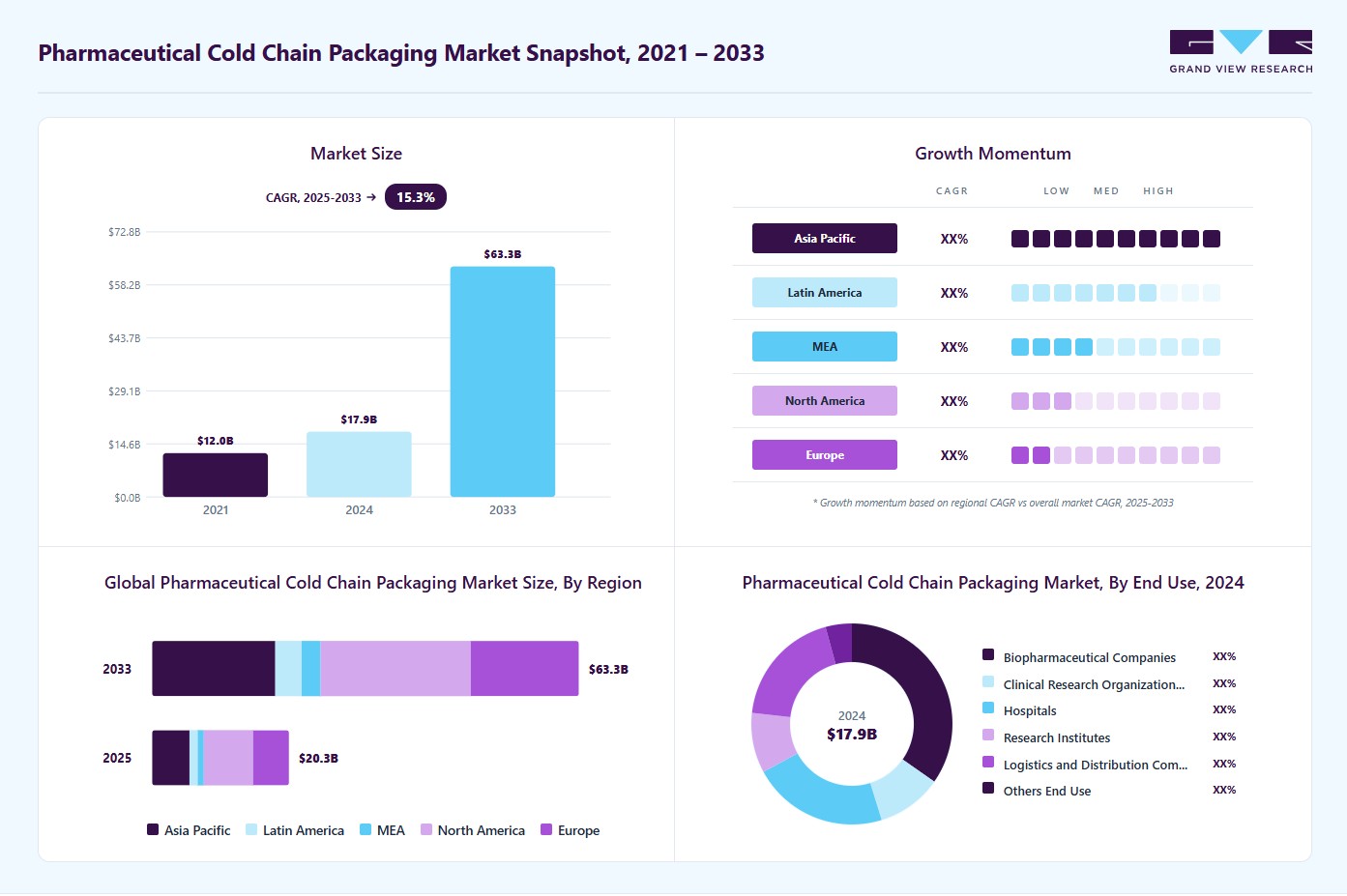
The global pharmaceutical cold chain packaging market size was valued at USD 20.3 billion in 2025 and is projected to grow from USD 23.1 billion in 2026 to USD 63.3 billion by 2033, at a CAGR of 15.5% from 2026 to 2033. North America market dominated, with a revenue share of 35.9% in 2025. The market is driven by the rising demand for temperature-sensitive biologics, vaccines, and specialty drugs that require strict thermal protection during storage and transportation.
 Source: Grand View Research, IR Documents, Primary Interviews, Paid DatabasesTo learn more about this report,
 Download Free Sample Report
 Key Market Trends & Insights
- By material: Plastic segment led the market with the largest revenue share of 74.5% in 2025.
- By product: Small boxes segment led the market with the largest revenue share of 42.6% in 2025.
- By end-use: Biopharmaceutical companies segment led the market with the largest revenue share of 34.5% in 2025.
Regional Highlights
- Largest regional market: North America (35.9% revenue share, 2025)
- Fastest-growing regional market: Asia Pacific (highest CAGR, 2026-2033)
- By country: The U.S. held the largest market share in 2025.
Market Size & Forecast
- Market size in 2025: USD 20.3 Billion
- Estimated market size in 2026: USD 23.1 Billion
- Projected market size by 2033: USD 63.3 Billion
- CAGR (2026-2033): 15.5%
Three ways to get this report
Buy it, customize it, or ask a question.Ask an Analyst
Analyst response in 1 business day
- AccessReport author, directly
- Reply timeWithin 1 working day
- No sales callDirect answer only
- FormatEmail reply
- CostFree, no cost
Get the Full Report
What the study covers
- FormatsPDF · Excel · Dashboard
- Timeline2026–2033 annual, 2025 base
- Coverage20+ countries, 5 regions
- Companies10+ key players profiled
Customize the Report
20% free customization
- IncludeCountries, segments, points
- TailorTo your product definition
- ExtendDeeper competitor detail
- OrA fully bespoke study
- Turnaround5–10 working days
Additionally, stringent regulatory guidelines for maintaining product integrity and safety are fueling investments in advanced cold chain packaging solutions. Biologics, including monoclonal antibodies and cell & gene therapies, are highly sensitive to temperature fluctuations and must be stored between 2°C to 8°C or even at ultra-low temperatures of -80°C. For instance, during the COVID-19 pandemic, vaccines from Pfizer-BioNTech and Moderna highlighted the critical role of advanced cold chain packaging systems, such as insulated shippers and phase change materials, to ensure safe delivery worldwide. The continued growth of biologics pipelines is fueling investments in robust packaging solutions that can handle stringent thermal requirements.With the globalization of the pharmaceutical industry, products are increasingly being manufactured in one region and distributed across multiple continents. This has intensified the need for reliable cold chain packaging solutions that can withstand long transit times, diverse climatic conditions, and multiple handling points. For example, Indian pharmaceutical manufacturers, who are among the largest exporters of generic drugs and vaccines, heavily depend on high-performance cold chain packaging to reach markets in North America, Europe, and Africa. As international trade volumes grow, particularly in emerging markets, demand for advanced cold chain packaging technologies such as vacuum-insulated panels, smart containers, and real-time monitoring systems is expected to surge.
 To learn more about this report, Download Free Sample Report
 Regulatory authorities such as the U.S. FDA, European Medicines Agency (EMA), and World Health Organization (WHO) mandate strict guidelines for the storage, handling, and transport of temperature-sensitive pharmaceuticals. Compliance with Good Distribution Practices (GDP) and Good Manufacturing Practices (GMP) necessitates the adoption of validated cold chain packaging solutions that ensure consistent product integrity.
Advancements in cold chain packaging technologies, combined with growing emphasis on sustainability, are accelerating market expansion. Packaging solutions are becoming smarter, lighter, and eco-friendlier, offering extended thermal protection while reducing carbon footprint. Companies are adopting reusable insulated containers, recyclable phase change materials, and AI-enabled monitoring systems to enhance performance and efficiency. For example, Pelican BioThermal and Sonoco ThermoSafe offers reusable systems that not only meet strict temperature requirements but also align with the pharmaceutical industry's sustainability goals. These innovations not only help reduce costs over time but also appeal to regulators and consumers seeking greener supply chain practices.
Market Dynamics
The pharmaceutical cold chain packaging market is experiencing steady growth, driven by rising demand for temperature-sensitive biologics, vaccines, specialty pharmaceuticals, and advanced therapies. Increasing pharmaceutical production, expanding global cold chain logistics, and advancements in insulated packaging and temperature-monitoring technologies are supporting market expansion. However, high packaging and transportation costs, stringent regulatory requirements, and temperature control challenges across supply chains may hinder growth. Growing adoption of sustainable packaging solutions and expanding pharmaceutical distribution in emerging economies are expected to create new opportunities for the market.
The growing demand for temperature-sensitive biologics, vaccines, biosimilars, and specialty pharmaceuticals is the primary driver of the pharmaceutical cold chain packaging market. Unlike conventional drugs, these products require strict temperature control throughout storage and transportation to preserve their efficacy, stability, and safety. The increasing prevalence of chronic diseases, rising adoption of biologic therapies, and expanding immunization programs have significantly increased the volume of temperature-sensitive pharmaceutical shipments worldwide, creating strong demand for advanced cold chain packaging solutions.
To meet these requirements, pharmaceutical manufacturers and logistics providers are investing in high-performance insulated packaging, phase change materials (PCMs), vacuum-insulated panels (VIPs), and real-time temperature monitoring technologies. Furthermore, stringent regulatory standards governing pharmaceutical transportation are encouraging the adoption of validated cold chain packaging systems that ensure product integrity and compliance. As biologics and advanced therapies continue to gain market share, the need for reliable and efficient cold chain packaging solutions is expected to increase steadily.
The high cost of cold chain packaging and temperature-controlled logistics remains a significant restraint for the pharmaceutical cold chain packaging market. Advanced insulated packaging materials, phase change materials (PCMs), temperature-monitoring devices, and specialized transportation systems substantially increase packaging and distribution expenses. These costs are further amplified by stringent regulatory compliance requirements, product validation processes, and the need for continuous temperature monitoring throughout the supply chain. As a result, small and mid-sized pharmaceutical companies and distributors often face challenges in adopting advanced cold chain packaging solutions, particularly in cost-sensitive and developing markets.
The expanding global distribution of biologics, biosimilars, cell and gene therapies, and other advanced pharmaceuticals presents a significant opportunity for the pharmaceutical cold chain packaging market. These high-value therapies require stringent temperature control to maintain their stability and effectiveness during storage and transportation, driving demand for advanced cold chain packaging solutions. Moreover, the expansion of pharmaceutical manufacturing, growing healthcare infrastructure in emerging economies, and increasing adoption of sustainable and reusable packaging systems are creating new growth opportunities for packaging manufacturers and cold chain logistics providers.
Market Concentration & Characteristics
The industry is innovation-driven, with continuous advancements in insulated containers, phase change materials, vacuum-insulated panels, and IoT-enabled monitoring systems. Smart packaging solutions, capable of providing real-time temperature, location, and humidity data, are transforming the efficiency of pharmaceutical supply chains. Additionally, sustainability trends are shaping product development, with companies increasingly adopting reusable and recyclable packaging solutions to reduce waste and meet corporate ESG goals.
 To learn more about this report, Download Free Sample Report
 The pharmaceutical cold chain packaging industry operates on a global scale, supporting manufacturers and distributors across developed and emerging markets. However, its globalized nature makes it highly sensitive to risks such as supply chain disruptions, geopolitical conflicts, and raw material shortages. For example, COVID-19 highlighted the need for robust and scalable cold chain infrastructure to handle vaccine surges. As a result, industry players focus on resilience-building strategies like regionalized production, partnerships with logistics providers, and digital integration of supply networks.
Analyst Perspective
The pharmaceutical cold chain packaging market is expected to grow steadily, driven by rising demand for temperature-sensitive biologics, vaccines, specialty pharmaceuticals, and advanced therapies. Expanding pharmaceutical production, stringent temperature-control regulations, and advancements in insulated packaging and monitoring technologies are supporting market growth. Furthermore, increasing adoption of sustainable and reusable cold chain packaging solutions is expected to create new growth opportunities and strengthen the market's long-term outlook.
Material Insights
Based on material, the plastic segment led the market with the largest revenue share of 74.5% in 2025. Plastic is the most widely used material in pharmaceutical cold chain packaging due to its durability, lightweight nature, and superior insulation properties. High-performance plastics such as polyethylene (PE), polypropylene (PP), polyurethane (PU), and expanded polystyrene (EPS) are commonly used in insulated containers, gel packs, and bubble wraps for maintaining temperature-sensitive drugs, vaccines, and biologics. Advanced engineered plastics, like vacuum-insulated panels (VIPs) with plastic linings, also ensure long shelf-life for specialty pharmaceuticals during long-haul transportation.
The paper segment is expected to grow at the fastest CAGR of 16.4% during the forecast period. Paper and paperboard materials are gaining prominence in pharmaceutical cold chain packaging, especially for secondary and tertiary packaging applications such as corrugated boxes, insulated liners, and outer cartons. Innovations in coated and laminated paperboards enhance insulation performance, enabling their use alongside gel packs and phase change materials (PCMs). The primary driving factor for paper is the increasing demand for sustainable and eco-friendly packaging solutions.
Product Insights
Based on product, the small boxes segment led the market with the largest revenue share of 42.6% in 2025. Small boxes are primarily used for packaging and transporting temperature-sensitive pharmaceutical products such as vaccines, biologics, blood samples, and personalized medicines in smaller volumes. These boxes are generally insulated with materials like expanded polystyrene (EPS), polyurethane (PU), or vacuum-insulated panels (VIPs), and often incorporate phase change materials (PCMs) or dry ice to maintain the required temperature range. They are widely adopted for last-mile delivery in pharmaceutical e-commerce and direct-to-patient models. The expansion of e-pharmacy platforms and home healthcare services is making small box solutions indispensable for maintaining cold chain integrity over shorter transit durations.
The pallets segment is expected to grow at the fastest CAGR of 15.9% during the forecast period. Pallets are widely used for bulk transportation of pharmaceutical products such as vaccines, APIs, and finished drugs across long distances. These pallets are often made of plastic or composite materials and can be fitted with insulated covers or pallet shippers to protect products against temperature fluctuations. They are designed to facilitate efficient loading and unloading in warehouses, airports, and seaports, making them a critical component of large-scale pharmaceutical supply chains. The increasing globalization of pharmaceutical supply chains and cross-border trade in biologics are fueling demand for pallet-based cold chain packaging.
End Use Insights
Based on end-use, the biopharmaceutical companies segment led the market with the largest revenue share of 34.5% in 2025. Biopharmaceutical companies are the primary users of cold chain packaging, as they deal with temperature-sensitive drugs, vaccines, biologics, cell and gene therapies, and monoclonal antibodies that require stringent temperature controls. With products often having a narrow stability window, these companies invest heavily in advanced cold chain packaging solutions such as insulated shippers, phase-change materials, and IoT-enabled tracking systems. The demand is driven by the increasing development of biologics and personalized medicines, which are more temperature-sensitive than traditional drugs.
 To learn more about this report, Download Free Sample Report
 The hospital segment is projected to grow at the fastest CAGR of 16.5% during the forecast period. Hospitals are critical end users as they directly handle the administration and storage of cold chain pharmaceuticals, particularly vaccines, insulin, blood products, and oncology drugs. Hospitals often use portable insulated containers and small-scale refrigerated packaging for efficient patient-level distribution. Growth is primarily driven by the rising demand for vaccines, blood products, and chronic disease treatments requiring cold chain management. The surge in hospital-based immunization programs and increased patient volumes, especially in urban and developing regions, further fuels this segment.
Regional Insights
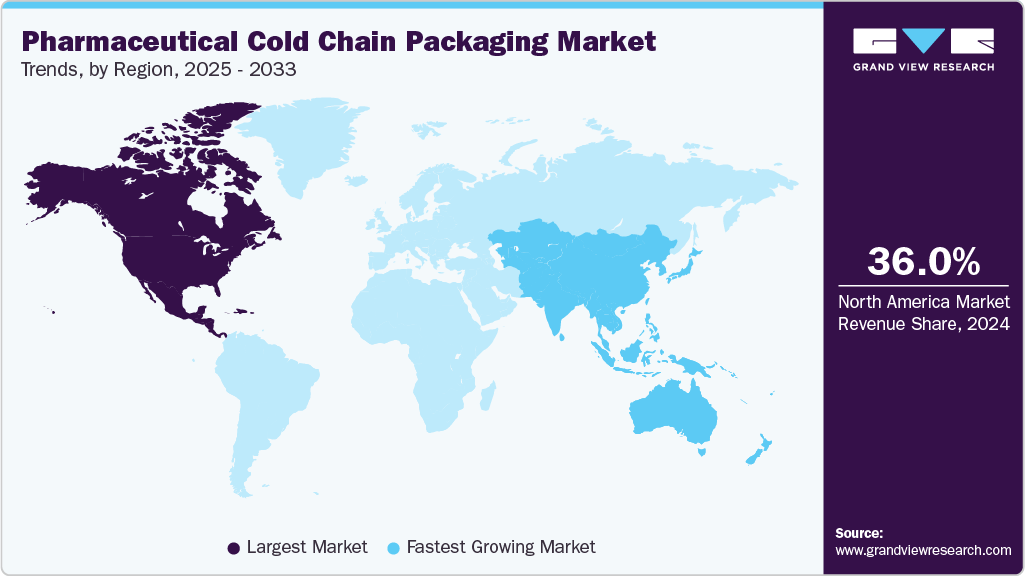
North America dominated the pharmaceutical cold chain packaging market with the largest revenue share of 35.9% in 2025. This positive outlook is due to its strong base of biopharmaceutical companies and advanced logistics infrastructure. The region has the largest share of biologics, cell & gene therapies, and specialty pharmaceuticals, which are all highly temperature sensitive. The U.S. and Canada also enforce strict regulatory frameworks (FDA, Health Canada) requiring validated cold chain packaging solutions, pushing companies to adopt high-performance insulated shippers, phase-change materials, and IoT-enabled tracking. The region’s high R&D investment in biotechnology and personalized medicine further adds to the demand for reliable cold chain packaging.
 To learn more about this report, Download Free Sample Report
 U.S. Pharmaceutical Cold Chain Packaging Market Trends
The pharmaceutical cold chain packaging market in U.S. held the largest share in the North America region in 2025. The U.S. is home to major pharmaceutical and biotech companies such as Pfizer, Moderna, Amgen, and Johnson & Johnson, all of which rely on robust cold chain solutions. The U.S. also has one of the world’s largest clinical trial ecosystems, requiring validated packaging solutions to transport investigational drugs nationwide. For example, the Pfizer-BioNTech and Moderna COVID-19 vaccines set new benchmarks in cold chain packaging with ultra-low temperature requirements. Logistics providers like UPS Healthcare and FedEx developed advanced insulated packaging with real-time tracking to ensure timely vaccine delivery.
Europe Pharmaceutical Cold Chain Packaging Market Trends
Europe’s growth in pharmaceutical cold chain packaging market is due to the presence of leading pharmaceutical and biotech companies, particularly in biologics and vaccines. The European Medicines Agency (EMA) enforces strict guidelines for maintaining pharmaceutical integrity, which fuels demand for innovative packaging solutions. Europe is also a hub for clinical trials, with countries such as Germany, Switzerland, and the UK conducting thousands of trials annually, requiring validated cold chain packaging to distribute investigational products across multiple trial sites. Additionally, Europe’s aging population and rising prevalence of chronic diseases create strong demand for specialty medicines that depend on cold chain packaging.
Germany drives the European cold chain packaging market as one of the continent’s largest pharmaceutical producers and exporters. It is home to industry giants such as BioNTech, Bayer, and Merck KGaA, which are deeply involved in biologics, vaccines, and specialty therapies. Germany is also a hub for clinical trials and R&D collaborations across Europe, requiring secure and validated packaging to transport investigational medicinal products. The country’s high regulatory standards, combined with strong government support for healthcare infrastructure, ensure widespread adoption of advanced cold chain packaging.
Asia Pacific Pharmaceutical Cold Chain Packaging Market Trends
Asia Pacific region is expected to grow at the fastest CAGR of 6.0% over the forecast period, owing to its rapidly expanding pharmaceutical manufacturing base and increasing healthcare demand. Countries such as China, India, South Korea, and Japan are major producers of generic drugs, vaccines, and biologics, all requiring robust cold chain systems. Rising incidences of chronic diseases and government vaccination campaigns have amplified the need for temperature-controlled packaging.
Key Pharmaceutical Cold Chain Packaging Market Company Insights
The competitive environment of the pharmaceutical cold chain packaging industry is characterized by the presence of both global leaders and specialized regional players, creating a moderately consolidated yet highly competitive market. Established companies such as Sonoco ThermoSafe, Pelican BioThermal, and Sofrigam dominate with strong portfolios in temperature-controlled packaging solutions, while niche players focus on innovative, sustainable, and cost-efficient products to capture market share.
Strategic collaborations with pharmaceutical companies, logistics providers, and healthcare institutions are common, as players aim to strengthen distribution networks and ensure compliance with stringent regulatory requirements from bodies such as the FDA and EMA. Additionally, sustainability trends are reshaping competition, with growing focus on recyclable, reusable, and eco-friendly cold chain packaging solutions.
-
In July 2025, Nordic Cold Chain Solutions launched the Nordic Express Pack, the first cold chain packaging designed for GLP-1 medications. Compact and space-saving, it improves freight efficiency, supports high-volume pharma distribution, and features irreversible temperature indicators for integrity assurance. ISTA-certified testing proves its reliability in extreme conditions, offering a fast, easy, and cost-effective solution for GLP-1 therapies.
-
In April 2025, Cold Chain Technologies launched the CCT Tower Elite, a 1600L reusable pallet shipper for pharma logistics. It offers 120+ hours of precise temperature control (-60°C to +20°C), fits Euro & US pallets, features IoT monitoring, and is supported by CCT’s global hub network, emphasizing efficiency and sustainability.
-
In January 2025, DS Smith launched TailorTemp, a fibre-based temperature-controlled packaging solution, at Pharmapack Europe 2025. This innovative product was designed to support the sustainability goals of pharmaceutical and biotech companies by maintaining controlled temperatures during the storage and transport of delicate medicinal products. TailorTemp is made from recyclable corrugated cardboard and can keep products cool for up to 36 hours.
Key Pharmaceutical Cold Chain Packaging Companies:
The following key companies have been profiled for this study on the pharmaceutical cold chain packaging market.
-
Sonoco Thermosafe
-
Sealed Air
-
Peli BioThermal Limited
-
CSafe
-
Intelsius
-
Cryoport Systems, LLC
-
Envirotainer
-
SkyCell AG
-
va-Q-tec AG
-
Inmark Global Holdings, LLC
-
Smurfit Westrock
-
Insulated Products Corporation
-
Chill-Pak
-
Practical Packaging Solutions, Inc.
-
TESSOL
-
The Wool Packaging Company Limited
-
Thermal Packaging Solutions Ltd.
-
Hanchett Paper Company
-
Topa Thermal
-
Sofrigam
Competitive Benchmarking
Category
Operating Strategies
Competitive Edge
Weakness
Established Players (Sonoco ThermoSafe, Sealed Air, Peli BioThermal Limited, CSafe, Intelsius, Cryoport Systems, LLC, Envirotainer, SkyCell AG, va-Q-tec AG, Inmark Global Holdings, LLC, Smurfit Westrock, and Sofrigam)
- Focus on expanding global cold chain logistics networks through strategic partnerships with pharmaceutical manufacturers, logistics providers, and airlines to strengthen worldwide distribution capabilities.
- Invest in advanced thermal technologies, reusable packaging systems, digital temperature monitoring, and regulatory-compliant solutions to support high-value biologics and cell & gene therapies.
- Strong global distribution networks, extensive product portfolios, and established relationships with leading pharmaceutical companies enable large-scale project execution.
- Significant investment capacity for R&D, validated packaging technologies, and compliance with international pharmaceutical regulations strengthens customer confidence and brand reputation.
- Large operational structures and extensive global supply chains may increase costs and reduce responsiveness to highly customized customer requirements.
- High dependence on regulatory compliance, continuous product validation, and capital-intensive innovation increases operational complexity and investment requirements.
Emerging Players (Insulated Products Corporation, Chill-Pak, Practical Packaging Solutions, Inc., TESSOL, The Wool Packaging Company Limited, Thermal Packaging Solutions Ltd., Hanchett Paper Company, and Topa Thermal)
- Concentrate on niche applications and customized temperature-controlled packaging solutions to address specific pharmaceutical shipping requirements.
- Expand regional presence through product innovation, sustainable packaging materials, and collaborations with local distributors to enhance market penetration.
- Greater operational flexibility enables rapid product customization and faster response to evolving customer requirements.
- Competitive pricing, specialized thermal packaging expertise, and focus on sustainable or innovative solutions help differentiate offerings in targeted market segments.
- Limited global presence, smaller production capacities, and lower financial resources restrict expansion into large multinational pharmaceutical projects.
- Lower brand recognition and relatively limited technological capabilities compared to established industry leaders can hinder customer acquisition and international market growth.
Pharmaceutical Cold Chain Packaging Market Report Scope
Report Attribute
Details
Market size in 2025
USD 20.3 billion
Estimated market size in 2026
USD 23.1 billion
Projected market size by 2033
USD 63.3 billion
Growth rate
CAGR of 15.5% from 2026 to 2033
Base year for estimation
2025
Historical data
2021 - 2024
Forecast period
2026 - 2033
Quantitative units
Revenue in USD million/billion, volume in kilotons and CAGR from 2026 to 2033
Report coverage
Revenue forecast, company ranking, competitive landscape, growth factors, and trends
Segments covered
Material, product, end-use, region
Regional scope
North America; Europe; Asia Pacific; Latin America; MEA
Country scope
U.S.; Canada; Mexico; Germany; UK; France; Italy; Spain; China; Japan; India; South Korea; Australia; Brazil; Argentina; Saudi Arabia; South Africa; UAE
Key companies profiled
Sonoco Thermosafe; Sealed Air; Peli BioThermal Limited; CSafe; Intelsius; Cryoport Systems, LLC; Envirotainer; SkyCell AG; va-Q-tec AG; Inmark Global Holdings, LLC; Smurfit Westrock; Insulated Products Corporation; Chill-Pak; Practical Packaging Solutions, Inc.; TESSOL; The Wool Packaging Company Limited; Thermal Packaging Solutions Ltd.; Hanchett Paper Company; Topa Thermal; Sofrigam
Customization scope
Free report customization (equivalent up to 8 analysts' working days) with purchase. Addition or alteration to country, regional & segment scope.
Pricing and purchase options
Avail customized purchase options to meet your exact research needs. Explore purchase options
Global Pharmaceutical Cold Chain Packaging Market Report Segmentation
This report forecasts revenue growth at a global, regional & country levels and provides an analysis of the latest industry trends in each of the sub-segments from 2021 to 2033. For this study, Grand View Research has segmented the global pharmaceutical cold chain packaging market report based on material, product, end use, and region:
 To learn more about this report, Download Free Sample Report
 -
Material Outlook (Revenue, USD Million; Volume, Kilotons; 2021 - 2033)
-
Plastic
-
Polyethylene (PE)
-
Polypropylene (PP)
-
Polyethylene Terephthalate (PET)
-
Expanded Polystyrene (EPS)
-
Polyurethane (PU)
-
Others
-
-
Paper
-
Metal
-
Others
-
-
Product Outlook (Revenue, USD Million; Volume, Kilotons; 2021 - 2033)
-
Small Boxes
-
Pallets
-
Large Sized Pallet Containers
-
Others
-
-
End Use Outlook (Revenue, USD Million; Volume, Kilotons; 2021 - 2033)
-
Biopharmaceutical Companies
-
Clinical Research Organizations
-
Hospitals
-
Research Institutes
-
Logistics and Distribution Companies
-
Others
-
-
Region Outlook (Revenue, USD Million; Volume, Kilotons; 2021 - 2033)
-
North America
-
U.S.
-
Canada
-
Mexico
-
-
Europe
-
Germany
-
France
-
UK
-
Italy
-
Spain
-
-
Asia Pacific
-
China
-
India
-
Japan
-
Australia
-
South Korea
-
-
Latin America
-
Brazil
-
Argentina
-
-
Middle East & Africa
-
South Africa
-
Saudi Arabia
-
UAE
-
-
Research Methodology
The pharmaceutical cold chain packaging market figures in this report are based on a proven research process that combines executive interviews with secondary research from proprietary databases, company filings, and recognized regulatory and institutional sources. Market size is built through value-chain sizing-reconciling supply-side and demand-side estimates-and triangulated with bottom-up and top-down approaches. Every estimate passes multiple levels of expert validation before publication, with each pharmaceutical cold chain packaging segment quantified using the revenue-capture definitions in the table below.
Segment Definition
Segment - Material
Revenue capture definition
Plastic
Revenue generated from the sale of plastic-based pharmaceutical cold chain packaging solutions, including insulated containers, coolers, and temperature-controlled components made from polyethylene (PE), polypropylene (PP), polyurethane (PU), and expanded polystyrene (EPS). This segment includes packaging used for biologics, vaccines, and other temperature-sensitive pharmaceutical products.
Paper
Revenue generated from the sale of paper- and paperboard-based cold chain packaging designed with insulated liners or thermal materials to protect temperature-sensitive pharmaceuticals. This segment includes recyclable and sustainable packaging solutions used for short-duration pharmaceutical shipments.
Metal
Revenue generated from the sale of metal-based cold chain packaging products, including aluminum and stainless-steel insulated containers used for transporting high-value pharmaceutical products requiring enhanced durability, thermal protection, and regulatory compliance.
Others
Revenue generated from the sale of cold chain packaging manufactured using alternative materials such as vacuum insulated panels (VIPs), phase change materials (PCMs), textiles, composites, and bio-based materials designed to improve thermal performance and shipment efficiency.
Segment - Product
Revenue capture definition
Small Boxes
Revenue generated from the sale of small insulated cold chain boxes designed for shipping limited quantities of temperature-sensitive pharmaceuticals, biologics, vaccines, clinical trial samples, and specialty medicines.
Pallets
Revenue generated from the sale of insulated pallet-based cold chain packaging systems used for transporting medium- to high-volume pharmaceutical shipments while maintaining required temperature ranges throughout transit.
Large Sized Pallet Containers
Revenue generated from the sale of large insulated pallet containers designed for bulk transportation of pharmaceutical products across domestic and international supply chains. This segment includes reusable and high-performance temperature-controlled containers for long-duration shipments.
Others
Revenue generated from the sale of other pharmaceutical cold chain packaging products, including insulated bags, shippers, thermal blankets, refrigerated containers, and customized temperature-controlled packaging solutions.
Segment - End Use
Revenue capture definition
Biopharmaceutical Companies
Revenue generated from the sale of pharmaceutical cold chain packaging solutions to biopharmaceutical manufacturers for the storage and transportation of biologics, biosimilars, vaccines, cell and gene therapies, and specialty pharmaceuticals.
Clinical Research Organizations
Revenue generated from the sale of cold chain packaging used by clinical research organizations (CROs) for transporting investigational drugs, biological samples, and clinical trial materials while maintaining validated temperature conditions.
Hospitals
Revenue generated from the sale of pharmaceutical cold chain packaging supplied to hospitals for receiving, storing, and distributing temperature-sensitive medicines, vaccines, blood products, and biologics.
Research Institutes
Revenue generated from the sale of cold chain packaging solutions used by research institutes and laboratories for transporting biological specimens, pharmaceutical compounds, vaccines, and research materials requiring temperature control.
Logistics and Distribution Companies
Revenue generated from the sale of cold chain packaging products to pharmaceutical logistics providers and distribution companies for domestic and international transportation of temperature-sensitive pharmaceutical products.
Others
Revenue generated from the sale of pharmaceutical cold chain packaging solutions to other end users, including government healthcare agencies, contract manufacturing organizations (CMOs), wholesalers, pharmacies, and public health organizations.
Estimation Model
Layer Name
Key Question
Description
Pharmaceutical Demand Base Layer
What forms the demand base?
Identify the global demand for temperature-sensitive pharmaceuticals, including biologics, biosimilars, vaccines, cell and gene therapies, blood products, and specialty drugs. This layer establishes the total addressable demand for pharmaceutical cold chain packaging based on production volumes, healthcare consumption, and international pharmaceutical trade.
Cold Chain Packaging Adoption Layer
Where is cold chain packaging utilized?
Estimate the penetration of cold chain packaging solutions across pharmaceutical manufacturers, clinical research organizations (CROs), hospitals, research institutes, wholesalers, and logistics providers. Assess the adoption of insulated shippers, pallet containers, temperature-controlled boxes, and reusable packaging across developed and emerging markets.
Cold Chain Logistics Intensity Layer
How much pharmaceutical volume requires temperature-controlled packaging?
Analyze the volume of pharmaceutical products transported under controlled temperature conditions based on shipment frequency, transportation mode, storage duration, distribution networks, and regulatory requirements. Distribution intensity is influenced by product sensitivity, global supply chains, export activities, and cold storage infrastructure.
Revenue Layer
How is market revenue generated?
Market revenue is quantified through the sale of pharmaceutical cold chain packaging products, including insulated boxes, pallet shippers, large pallet containers, thermal packaging systems, and reusable solutions. Revenue is generated from recurring demand across biopharmaceutical companies, healthcare providers, research organizations, and pharmaceutical logistics and distribution companies, supported by expanding biologics production and global cold chain transportation requirements.
Delivered Customizations
This report has been delivered with the following In-depth customizations
Client Request
Customization Delivered
Value Adds
Regional Segmentation Analysis
Detailed market assessment across North America, Europe, Asia Pacific, Central & South America, and Middle East & Africa, including regional demand patterns, cold chain infrastructure, regulatory landscape, healthcare investments, and adoption of pharmaceutical cold chain packaging solutions.
Enabled identification of high-growth regional markets, investment priorities, regulatory influences, and regional expansion opportunities.
Cross-Segmentation Analysis
Comprehensive cross-analysis of the market by Material (Plastic, Paper, Metal, Others), Product (Small Boxes, Pallets, Large Sized Pallet Containers, Others), and End Use (Biopharmaceutical Companies, Clinical Research Organizations, Hospitals, Research Institutes, Logistics and Distribution Companies, Others) across all major regions.
Delivered insights into high-growth material-product-end use combinations, regional demand variations, and niche market opportunities for strategic business planning.
Competitive Benchmarking
Comparative benchmarking of leading pharmaceutical cold chain packaging companies based on product portfolio, material expertise, packaging innovations, geographic presence, production capabilities, strategic partnerships, sustainability initiatives, and recent business developments.
Supported competitive positioning, identification of market leaders, benchmarking of best practices, and evaluation of strategic differentiation opportunities.
Frequently Asked Questions About This Report
The plastic segment led the market with the largest revenue share of 74.5% in 2025.
Small boxes segment led the market with the largest revenue share of 42.6% in 2025.
Key players in the pharmaceutical cold chain packaging market include Sonoco Thermosafe; Sealed Air; Peli BioThermal Limited; CSafe; Intelsius; Cryoport Systems, LLC; Envirotainer; SkyCell AG; va-Q-tec AG; Inmark Global Holdings, LLC; Smurfit Westrock; Insulated Products Corporation; Chill-Pak; Practical Packaging Solutions, Inc.; TESSOL; The Wool Packaging Company Limited; Thermal Packaging Solutions Ltd.; Hanchett Paper Company; Topa Thermal; Sofrigam.
North America market dominated, with a revenue share of 35.9% in 2025.
Asia Pacific is the fastest-growing region over the forecast period.
The global pharmaceutical cold chain packaging market size was valued at USD 20.3 billion in 2025 and is estimated at USD 23.1 billion for 2026.
The global pharmaceutical cold chain packaging market is expected to grow at a CAGR of 15.5% from 2026 to 2033, reaching USD 63.3 billion by 2033.
Key factors driving the pharmaceutical cold chain packaging market include rising demand for biologics and vaccines, expanding pharmaceutical production, stringent temperature-control regulations, growth in cold chain logistics, and advancements in insulated, reusable, and temperature-monitoring packaging solutions.
Biopharmaceutical companies segment led the market with the largest revenue share of 34.5% in 2025.
About the Author(s)
Next Generation Technologies Research Team
Technology · Next Generation TechnologiesThis report was authored by the next generation technologies research team at Grand View Research - comprising two research analysts, one senior research analyst, and one industry expert - with specialized expertise in the next generation technologies segment of the technology industry. All findings are based on proprietary technology databases, executive interviews, and regulatory analysis, subject to internal peer review prior to publication.
Last Updated:
Speak to Analyst

Customize this report to your needs - add regions, segments, or data points, with 20% free customization.
Or view our licence options:


ISO 9001:2015 & 27001:2022 Certified
We are GDPR and CCPA compliant! Your transaction & personal information is safe and secure. For more details, please read our privacy policy.


