
- Home
- »
- Pharmaceuticals
- »
-
Pharmaceutical Manufacturing Cold Storage Market Report 2033GVR Report cover

Pharmaceutical Manufacturing Cold Storage Market (2026 - 2033)
Size, Share & Trends Analysis Report By Storage Material (QC Samples, Stability Samples), By Product Class, By Storage Temperature, By Storage Model (In-house/Captive Storage), By End-user, By Region, And Segment Forecasts
Market Size, 2025
$4.1BMarket Estimate, 2026
$4.3BMarket Forecast, 2033
$6.9BCAGR, 2026–2033
6.9%Pharmaceutical Manufacturing Cold Storage Market Summary
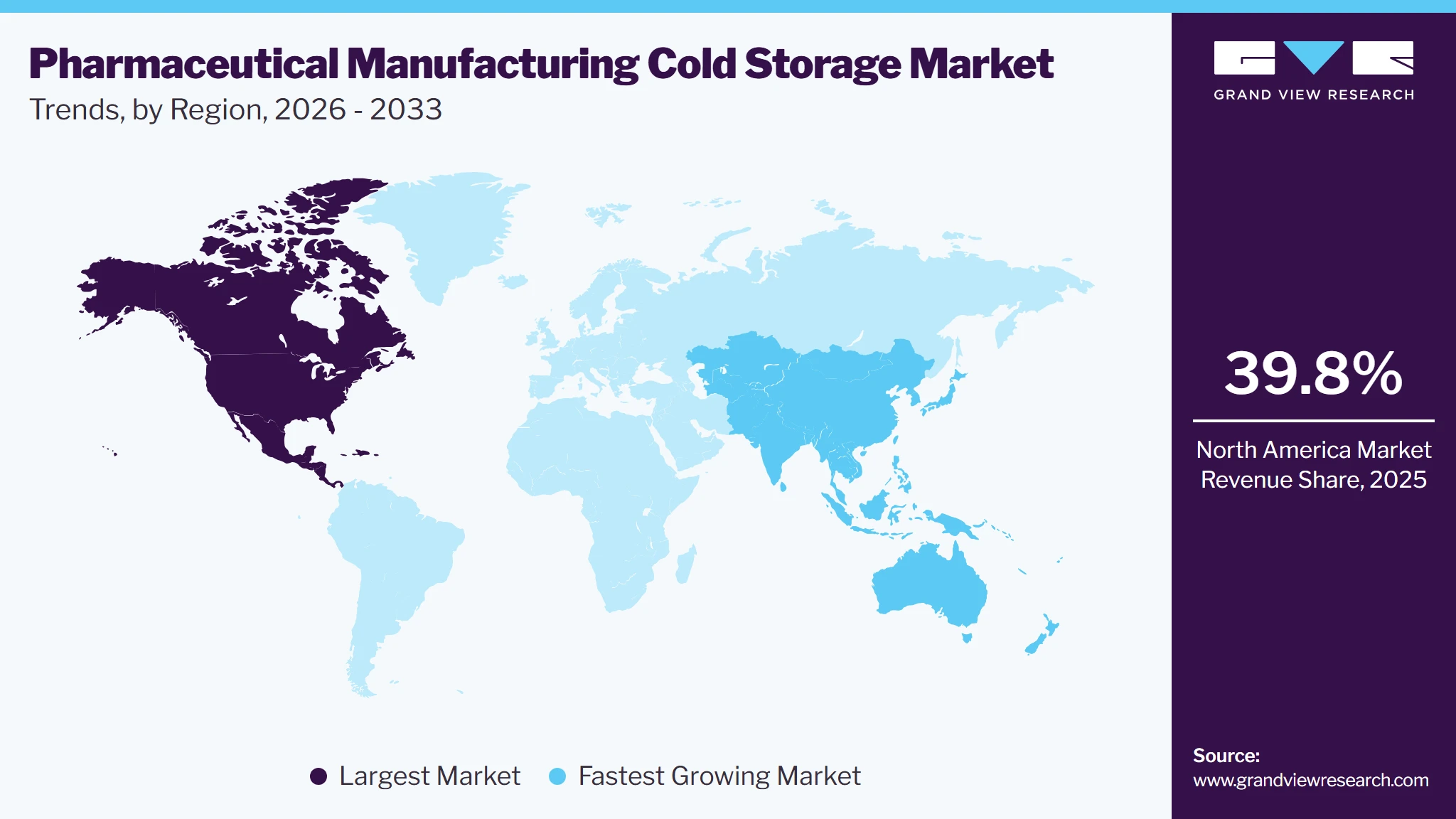
The global pharmaceutical manufacturing cold storage market size was valued at USD 4.1 billion in 2025 and is projected to grow from USD 4.3 billion in 2026 to USD 6.9 billion by 2033, at a CAGR of 6.9% from 2026 to 2033. North America dominated the market, accounting for a revenue share of 39.8% in 2025. The market is characterized by rising demand for temperature-controlled infrastructure within pharmaceutical and biopharmaceutical manufacturing operations.
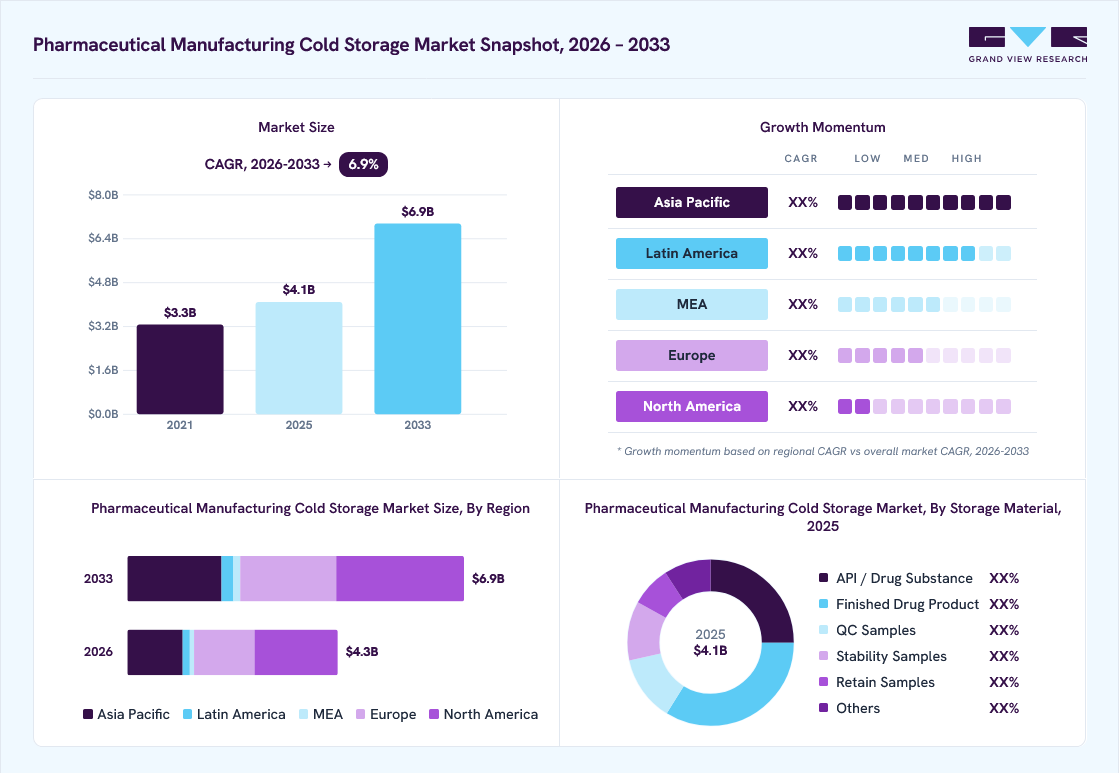 Source: Grand View Research, IR Documents, Primary Interviews, Paid DatabasesTo learn more about this report,
 Download Free Sample Report
Key Market Trends & Insights
- By storage material: Finished drug product segment held the largest market share of 33.7% in 2025.
- By product class: Small-molecule pharmaceuticals segment held the largest market share of 46.9% in 2025.
- By storage temperature: Refrigerated (2-8°C) segment held the largest market share of 51.4% in 2025.
- By storage model: In-house/captive storage segment held the largest market share of 61.9% in 2025.
- By end-user: Pharmaceutical manufacturers segment held the largest market share of 43.5% in 2025.
Regional Highlights
- Largest regional market: North America (39.8% revenue share, 2025)
- Fastest-growing regional market: Asia Pacific (highest CAGR, 2026-2033)
- By country: The U.S. held the largest market share in 2025.
Market Size & Forecast
- Market Size in 2025: USD 4.1 Billion
- Estimated Market Size in 2026: USD 4.3 Billion
- Projected Market Size by 2033: USD 6.9 Billion
- CAGR (2026-2033): 6.9%
Prism AI by Grand View Research Free to tryAsk a question about the pharmaceutical manufacturing cold storage marketTry asking✓Every figure cited from GVR research Prefer the report? Download free sample →
The need is driven by the growing production of biologics, vaccines, cell and gene therapies, and other temperature-sensitive products that require controlled storage during manufacturing, testing, and finished-product handling. Pharmaceutical manufacturers are investing in refrigerated storage, cold rooms, freezers, ultra-low-temperature systems, and digital temperature-monitoring solutions to maintain product quality and comply with storage requirements.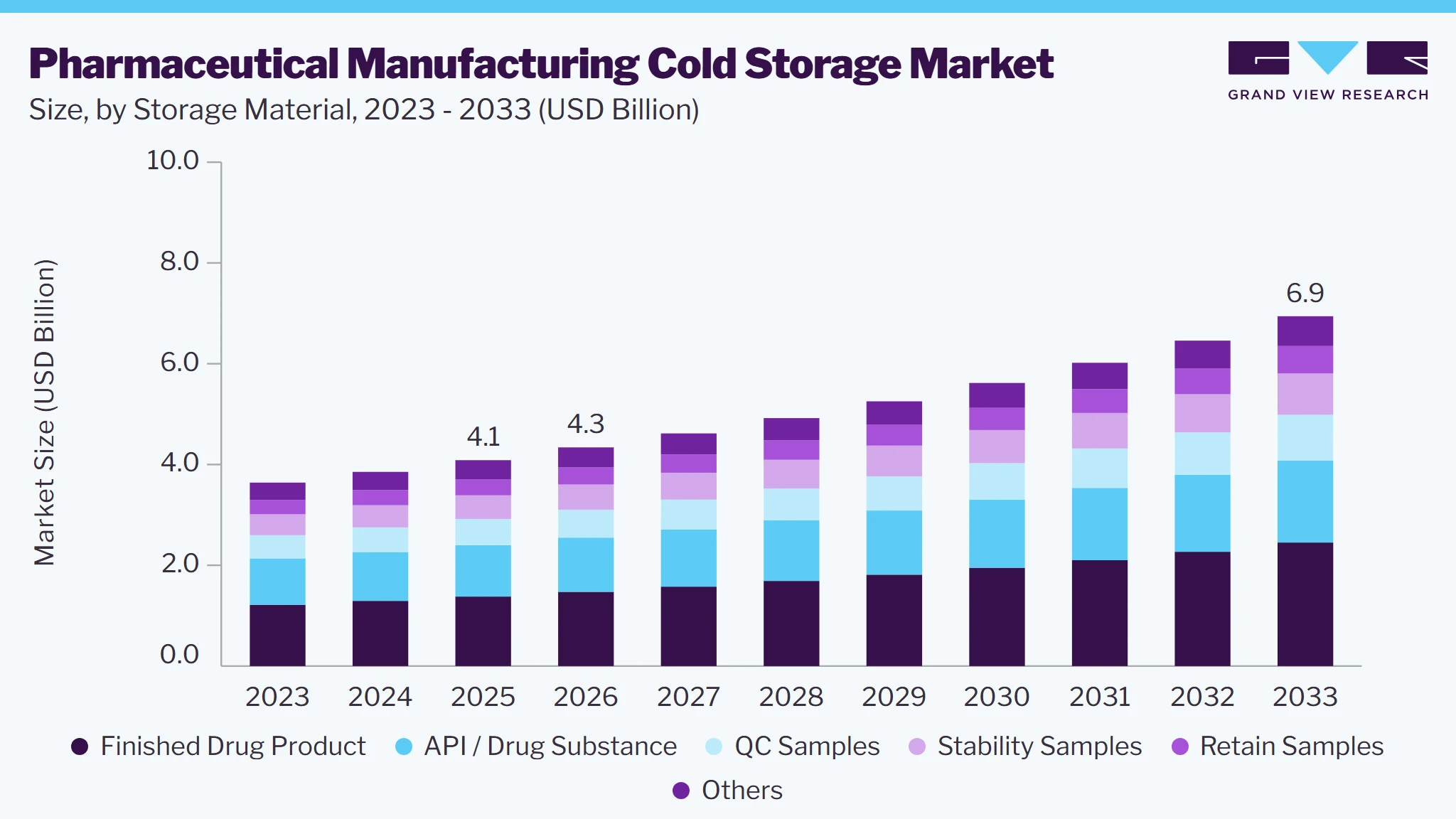 To learn more about this report, Download Free Sample Report
Cold storage is also becoming an important component of manufacturing facility design as companies expand production capacity and establish additional sites. Regulatory requirements for temperature control, qualification, monitoring, and documentation continue to shape equipment and facility specifications. However, high capital costs, energy consumption, equipment maintenance, space requirements, and the need for backup power and continuous monitoring remain key operational considerations.
Market Dynamics
The expansion of biologics and other temperature-sensitive pharmaceutical manufacturing is increasing the need for controlled cold-storage infrastructure within production facilities. Biologics, vaccines, injectable therapies, and other temperature-sensitive products require defined temperature conditions during manufacturing, intermediate handling, testing, and finished-product storage. This requirement supports demand for refrigerated storage, cold rooms, freezers, ultra-low-temperature systems, temperature monitoring, and backup power. The growth of contract development and manufacturing organizations (CDMOs) is also increasing cold-storage requirements, as these companies manufacture products for multiple pharmaceutical companies and handle products with varying temperature requirements. Pharmaceutical manufacturers are also expanding production facilities for biologics and injectable products, which require additional controlled storage areas within manufacturing sites. Cold storage supports the protection of raw materials, active pharmaceutical ingredients, intermediates, bulk products, and finished products during different stages of manufacturing. The increasing use of products requiring refrigerated and frozen conditions also requires manufacturers to maintain validated temperature ranges and continuous monitoring. This makes cold-storage infrastructure an important component of pharmaceutical manufacturing facilities. As manufacturers increase biologics production and diversify product portfolios, demand for storage systems that cover refrigerated, frozen, and ultra-low-temperature conditions is rising. This supports investment in cold rooms, specialized freezers, monitoring systems, and supporting infrastructure across pharmaceutical manufacturing sites.
High capital and operating costs remain a key restraint for the pharmaceutical manufacturing cold storage market. Pharmaceutical cold-storage infrastructure requires specialized refrigeration equipment, insulated rooms, freezers, monitoring systems, alarms, backup power, qualification, validation, and regular maintenance. These requirements increase the initial investment needed when manufacturers establish or expand temperature-controlled areas. Ultra-low-temperature storage adds further operating costs because equipment must maintain very low temperatures continuously and requires a reliable electricity supply and monitoring. Energy consumption also remains an important cost factor because refrigeration systems generally operate continuously, whereas temperature excursions can require additional investigation, product assessment, and corrective actions. Manufacturers also need adequate facility space for equipment, access areas, electrical systems, backup units, and monitoring infrastructure. Maintenance requirements increase operating expenditure through preventive servicing, component replacement, calibration, and system qualification. These costs become more significant when a facility needs multiple temperature zones for different pharmaceutical materials and products. Smaller manufacturers and companies establishing new production facilities, therefore, need to allocate capital to manufacturing equipment, cleanrooms, utilities, quality systems, and cold-storage infrastructure. The resulting investment burden can limit the speed at which manufacturers expand their internal cold-storage capacity, particularly where utilization levels are insufficient to justify dedicated infrastructure.
Investment in multi-temperature and ultra-low-temperature storage capacity is creating opportunities for cold-storage equipment providers, CDMOs, and pharmaceutical logistics companies. Pharmaceutical products increasingly require different storage conditions, ranging from refrigerated storage to frozen and cryogenic conditions. This creates demand for facilities capable of managing several temperature zones within the same network. Multi-temperature infrastructure allows pharmaceutical companies to store different product categories while reducing the need to use separate facilities for each temperature requirement. For instance, in January 2025, UPS completed the acquisition of Frigo-Trans and BPL, adding temperature-controlled warehousing covering 6 temperature zones, from cryopreservation at -196°C to ambient conditions of +15°C to +25°C, along with Pan-European cold-chain transportation capabilities. The acquisition demonstrates investment in infrastructure that covers a broad range of pharmaceutical storage requirements, including ultra-low-temperature conditions. Such capacity is particularly relevant for biologics, cell and gene therapy materials, clinical trial products, and other temperature-sensitive pharmaceuticals. The development of multi-temperature facilities also creates demand for refrigeration systems, monitoring technologies, alarm systems, temperature mapping, backup power, and facility management services. As pharmaceutical manufacturing and clinical supply networks expand, providers with multiple temperature capabilities can support storage requirements across different stages of pharmaceutical production and distribution.
Market Concentration & Characteristics
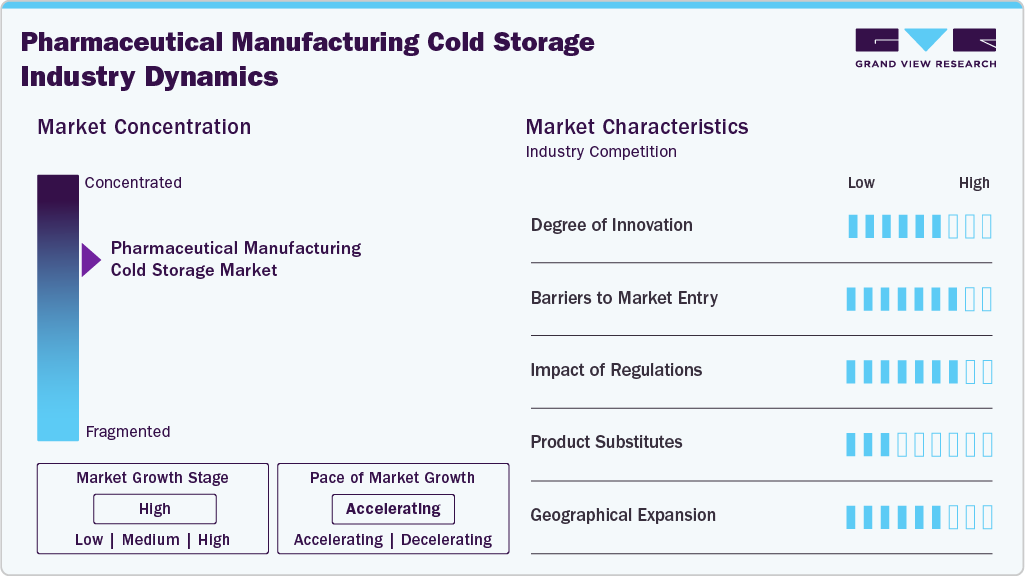
The degree of innovation is high because manufacturers are developing technologies focused on temperature stability, energy consumption, monitoring, automation, and equipment reliability. Pharmaceutical cold-storage systems increasingly incorporate digital temperature controls, remote monitoring, automated alarms, data logging, and connected monitoring platforms. Ultra-low-temperature freezers are also being developed with improved refrigeration performance and lower energy consumption for biological materials and other temperature-sensitive products. Temperature mapping and continuous monitoring support pharmaceutical quality requirements by providing documented storage conditions. Manufacturers are also improving insulation, compressor systems, temperature recovery, and storage capacity. Multi-temperature facilities are another area of development, allowing different pharmaceutical products to be stored at separate temperatures within a single facility. Innovation is therefore concentrated around refrigeration efficiency, temperature control, digital monitoring, equipment reliability, and integration with facility quality systems.
The barriers to market entry are high because pharmaceutical cold-storage suppliers must meet technical, quality, and regulatory requirements. Equipment used in pharmaceutical manufacturing requires reliable temperature control, monitoring, calibration, qualification, and documentation. Suppliers need technical capabilities in refrigeration, insulation, temperature control, alarm systems, and backup power. Ultra-low-temperature equipment requires additional engineering and testing capabilities. New suppliers also need installation, maintenance, calibration, spare parts, and technical support capabilities. Pharmaceutical manufacturers assess equipment suppliers based on product specifications, quality systems, documentation, reliability, and service capabilities. Large projects can require temperature mapping, qualification, validation, and integration with facility monitoring systems. These requirements increase development costs and lengthen customer approval processes. Established suppliers also benefit from technical expertise, service infrastructure, and existing relationships with pharmaceutical customers. As a result, companies entering the market need to invest in product development, quality systems, technical personnel, testing capabilities, and after-sales services.
 To learn more about this report, Download Free Sample Report
The impact of regulations is high because pharmaceutical cold storage is directly linked with product quality and manufacturing requirements. Regulations and quality guidelines cover temperature control, monitoring, documentation, equipment qualification, calibration, temperature mapping, and management of temperature excursions. Regulatory bodies such as the U.S. Food and Drug Administration (FDA), European Medicines Agency (EMA), and national health authorities influence pharmaceutical manufacturing and storage requirements. Manufacturers, therefore, need cold-storage equipment that maintains specified temperature ranges and provides documented monitoring records. Backup power and alarm systems are also important for facilities storing temperature-sensitive materials. Regulatory requirements influence equipment specifications, facility design, supplier qualification, operating procedures, and maintenance practices. Cold-storage equipment also requires periodic calibration and performance checks. These requirements increase the technical and operational requirements for manufacturers and equipment suppliers. Changes in pharmaceutical manufacturing processes can also create demand for additional refrigerated, frozen, or ultra-low-temperature infrastructure.
The availability of product substitutes is low because pharmaceutical products that require controlled temperatures generally cannot be stored at standard room temperature without compromising their specified storage requirements. Manufacturers can choose between cold rooms, pharmaceutical refrigerators, freezers, ultra-low-temperature freezers, and temperature-controlled warehouses, but these are different cold-storage configurations rather than direct substitutes for temperature control. Outsourcing storage to pharmaceutical logistics providers provides an alternative to owning infrastructure, but the underlying cold-storage requirement remains. Thermal packaging and phase-change materials can maintain temperatures during transportation for defined periods, but do not replace continuous storage infrastructure inside manufacturing facilities. Pharmaceutical manufacturers, therefore, continue to require dedicated temperature-controlled systems for products, APIs, intermediates, and materials with defined storage conditions. Competition occurs mainly between equipment types, capacity configurations, technology specifications, and internal versus outsourced storage. Since there are limited alternatives that eliminate the need for controlled-temperature storage, product substitutes are assessed as low.
The geographical expansion is moderate, supported by pharmaceutical manufacturing expansion across North America, Europe, and Asia Pacific. Pharmaceutical and biopharmaceutical companies are expanding production facilities in established manufacturing centers while developing additional regional production capacity. These facilities require cold-storage infrastructure based on the temperature requirements of raw materials, APIs, intermediates, biological materials, and finished products. Asia Pacific provides additional opportunities as pharmaceutical manufacturing expands across China, India, South Korea, and Singapore. North America and Europe continue to require cold-storage infrastructure because of their established pharmaceutical manufacturing bases and biologics production. Suppliers with international service networks can support manufacturers operating across multiple countries, while regional suppliers provide installation, maintenance, and technical support. However, differences in regulatory requirements, energy costs, infrastructure availability, and pharmaceutical production patterns affect equipment deployment across countries.
Analyst Perspective
Pharmaceutical manufacturing cold storage demand is supported by increasing production of temperature-sensitive medicines, biologics, vaccines, and advanced therapies. Refrigerated storage remains widely used across pharmaceutical manufacturing, while ultra-low-temperature and cryogenic storage are gaining use for biological materials. In-house storage remains widely adopted, while outsourced storage is expanding as manufacturers use third-party cold-chain capacity and specialized services.
Storage Material Insights
The finished drug product segment dominated the pharmaceutical manufacturing cold storage industry, accounting for a revenue share of 33.7% in 2025, as increasing production of biologics and injectable medicines, temperature-sensitive formulations, post-manufacturing storage requirements, longer product holding periods, manufacturing capacity expansion, and continuous temperature-monitoring requirements increased demand for controlled cold-storage infrastructure. Refrigerated and frozen finished products require dedicated refrigerators, freezers, cold rooms, alarms, and backup power to maintain defined storage conditions. Manufacturers also require documented temperature records and controlled access before products are released for distribution. These requirements make finished drug products a major storage material within pharmaceutical manufacturing facilities. For instance, in December 2025, Liebherr launched a new generation of undercounter refrigerators and freezers for laboratory and healthcare applications, designed to store temperature-sensitive substances and pharmaceutical products under controlled temperature conditions.
The stability sample segment is expected to grow at the fastest CAGR of 7.3% over the forecast period, as expanding pharmaceutical development programs, longer sample retention periods, higher stability testing volumes, growth in biologics development, increased testing requirements, and demand for controlled sample conditions increase the need for dedicated storage capacity. Stability samples require defined temperature conditions throughout testing periods to maintain sample integrity and support reliable analytical results. Pharmaceutical companies, therefore, require refrigerators, freezers, ultra-low-temperature systems, temperature monitoring, alarms, and documented storage records. Outsourced research and testing activities also increase demand for dedicated sample-storage capacity. Storage requirements can vary according to the product, study protocol, and testing period, creating demand for different temperature-controlled systems. These factors support continued investment in dedicated stability-sample storage infrastructure across pharmaceutical manufacturing and testing operations.
Product Class Insights
The small-molecule pharmaceuticals segment dominated the market in 2025, accounting for the largest share of 46.9%, due to large production volumes, established manufacturing networks, broad product portfolios, long-term storage requirements, standardized manufacturing processes, and use across multiple therapeutic areas. Small-molecule medicines are manufactured at high volumes, creating regular requirements for controlled storage of finished products and temperature-sensitive materials. Manufacturers also maintain refrigerated and frozen storage for products requiring defined conditions before quality release and distribution. These requirements support demand for pharmaceutical refrigerators, freezers, cold rooms, temperature-monitoring systems, and backup power. Established production networks further support storage demand across manufacturing facilities. Pharmaceutical companies also require documented temperature records and controlled access to maintain product quality during storage.
The cell & gene therapy products segment recorded the fastest growth, with a CAGR of 10.5%, driven by increasing clinical development, expansion of commercial therapy programs, specialized temperature requirements, greater use of cryogenic storage, and growth in manufacturing capacity. Cell and gene therapy products often require ultra-low-temperature or cryogenic conditions during storage and handling to maintain product quality. Their manufacturing process involves sensitive biological materials that require controlled environments and continuous temperature monitoring. Increasing movement from clinical development toward commercial production is creating additional requirements for dedicated storage capacity. Traceability, inventory control, temperature records, and secure handling further support specialized cold-storage systems. Demand therefore extends to ultra-low-temperature freezers, cryogenic storage equipment, monitoring technologies, and temperature-controlled logistics services across pharmaceutical manufacturing and supply operations.
Storage Temperature Insights
The refrigerated (2-8°C) segment dominated the market, accounting for a revenue share of 51.4% in 2025, as vaccines, biologics, injectable medicines, APIs, and finished pharmaceutical products commonly require refrigerated conditions, while established manufacturing processes, defined storage requirements, continuous temperature monitoring, and broad use across pharmaceutical facilities support demand. Refrigerated storage is used during manufacturing, quality testing, product holding, and preparation for distribution. Pharmaceutical manufacturers require refrigerators and cold rooms that maintain stable temperatures and provide monitoring and alarm systems. The established use of 2-8°C storage across pharmaceutical operations also supports demand for equipment, maintenance, and monitoring services. Growth in temperature-sensitive pharmaceutical production further adds storage requirements within manufacturing facilities. These factors support the dominant position of refrigerated storage in pharmaceutical manufacturing.
The cryogenic (below -80°C) segment is expected to grow at the fastest CAGR of 12.0% over the forecast period, as increasing cell and gene therapy development, cryopreservation requirements, biological sample storage, advanced therapy manufacturing, long-term preservation, and specialized cold-chain requirements increase demand for very-low-temperature infrastructure. Cryogenic storage requires dedicated freezers and storage systems that maintain temperatures below -80°C for sensitive biological materials. Growth in advanced therapies is creating requirements across manufacturing, clinical research, and product handling operations. These applications also require continuous temperature monitoring, alarms, backup systems, and controlled access. The increasing adoption of cryogenic storage in pharmaceutical and biotechnology operations is driving demand for ultra-low-temperature equipment and related monitoring solutions.
Storage Model Insights
The in-house / captive storage segment dominated the market, accounting for a revenue share of 61.9% in 2025, due to manufacturers’ need for direct control over storage conditions, continuous temperature monitoring, product security, immediate inventory access, quality management, and integration with manufacturing operations. Captive storage also allows manufacturers to align storage capacity with production schedules and product-specific temperature requirements. Internal facilities support the storage of raw materials, intermediates, finished products, and stability samples within the manufacturing network. Direct ownership provides control over equipment maintenance, temperature records, alarms, and backup systems. These factors support continued use of in-house cold-storage infrastructure across pharmaceutical manufacturing facilities.
The outsourced storage segment is expected to grow at the fastest CAGR of 8.4% over the forecast period, as pharmaceutical manufacturers increasingly use specialized logistics providers for temperature-controlled warehousing, flexible capacity, multi-temperature storage, geographic coverage, and access to established cold-chain infrastructure. Outsourcing also reduces the need for manufacturers to build and maintain dedicated storage facilities when storage requirements vary by product volume or location. Growth in biologics, clinical materials, specialty medicines, and temperature-sensitive products further supports outsourced storage demand. For instance, in March 2025, Kuehne+Nagel announced a partnership with Sanofi in Türkiye to manage an 11,000-square-meter facility equipped with 15-25°C temperature-controlled rooms and 2-8°C cold rooms for pharmaceutical products.
End-user Insights
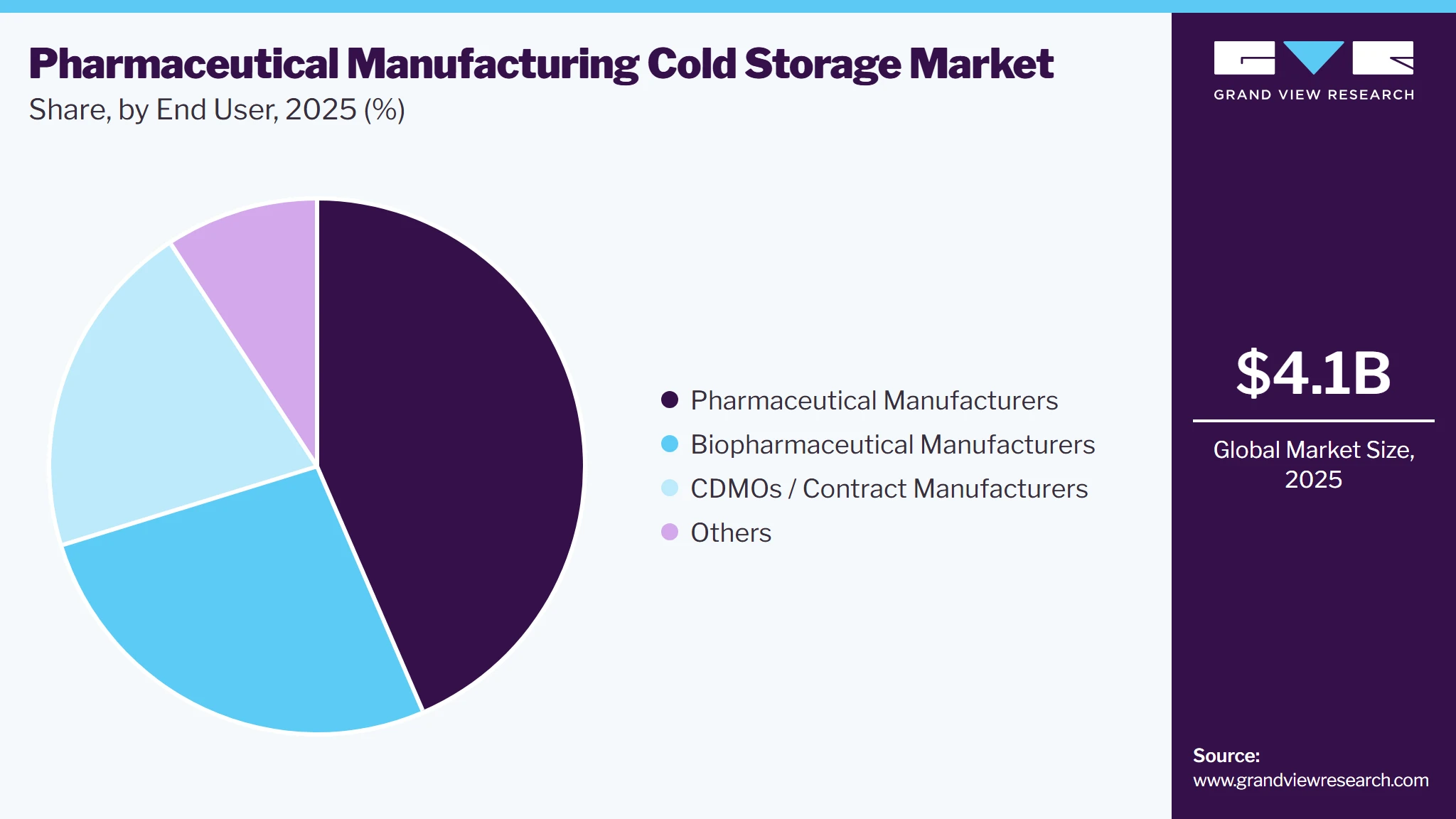
The pharmaceutical manufacturers segment dominated the market in 2025, accounting for 43.5% share, supported by the large volume of finished medicines, APIs, intermediates, and stability materials that require controlled-temperature storage. Demand is supported by strict product-quality requirements, regulatory temperature controls, inventory management, production integration, product security, and continuous temperature monitoring. Pharmaceutical manufacturers also maintain dedicated cold-storage capacity to coordinate production schedules, batch release, quality testing, and distribution requirements. Internal facilities support multiple temperature ranges across raw materials, intermediates, and finished products, requiring refrigerators, freezers, cold rooms, monitoring systems, and backup power. These requirements maintain the role of dedicated cold storage infrastructure across pharmaceutical manufacturing facilities.
 To learn more about this report, Download Free Sample Report
The biopharmaceutical manufacturers segment is expected to grow at the fastest CAGR of 8.1% during the forecast period, supported by increasing production of biologics, vaccines, cell and gene therapies, and other temperature-sensitive products requiring refrigerated, frozen, and ultra-low-temperature storage. Growth is supported by expansion of biomanufacturing capacity, increasing use of biological materials in drug development, growth in clinical trial activity, and greater requirements for specialized storage infrastructure. Biopharmaceutical manufacturing also requires multiple temperature zones, continuous monitoring, validated storage conditions, and specialized freezers to maintain product quality during manufacturing and inventory holding. Increasing production volumes and the storage requirements of sensitive biological materials further support demand for dedicated cold-storage infrastructure across biopharmaceutical manufacturing facilities.
Regional Insights
The North America pharmaceutical manufacturing cold storage market accounted for the largest global revenue share of 39.8% in 2025, supported by the region’s large pharmaceutical manufacturing base and established cold-chain infrastructure. The U.S. contributes substantially through the production of biologics, vaccines, specialty medicines, and temperature-sensitive therapies. High utilization of refrigerated and frozen storage supports the handling of APIs, intermediates, finished products, and clinical materials. Increasing manufacturing of biologics and cell and gene therapies is raising demand for ultra-low-temperature storage and continuous temperature monitoring. Pharmaceutical manufacturers also require validated storage facilities to maintain product quality during production and inventory holding. These factors support sustained demand for temperature-controlled pharmaceutical manufacturing facilities across North America.
 To learn more about this report, Download Free Sample Report
U.S. Pharmaceutical Manufacturing Cold Storage Market Trends
The U.S. pharmaceutical manufacturing cold storage industry is supported by its large pharmaceutical production base and extensive manufacturing of biologics, vaccines, specialty medicines, and injectable products. Growing biologics manufacturing requires refrigerated, frozen, and ultra-low-temperature storage across different production stages. Cell and gene therapy manufacturing adds demand for specialized freezers and controlled storage for biological materials. Pharmaceutical companies also require temperature monitoring, alarm systems, backup power, and validated storage conditions within manufacturing facilities. Expansion of domestic manufacturing capacity is increasing the need for additional cold rooms and temperature-controlled warehouses. Demand is further supported by the need to maintain product quality from material receipt through finished product storage.
Europe Pharmaceutical Manufacturing Cold Storage Market Trends
The Europe pharmaceutical manufacturing cold storage industry is supported by a broad pharmaceutical production base across Germany, France, Italy, Switzerland, and other manufacturing centers. Biologics, vaccines, injectables, and specialty medicines require controlled storage conditions during manufacturing and inventory management. The region also has substantial production of pharmaceutical ingredients and intermediates, creating demand across multiple temperature ranges. The increasing use of advanced biological therapies is raising the demand for frozen and ultra-low-temperature storage capacity. Pharmaceutical manufacturers are also strengthening temperature monitoring and storage validation within production facilities. Cross-border pharmaceutical manufacturing and distribution further increase the need for reliable cold-storage infrastructure connected to manufacturing operations.
The UK pharmaceutical manufacturing cold storage market is supported by established pharmaceutical production, clinical research activity, and the manufacturing of biologics and specialty medicines. Temperature-sensitive products require refrigerated storage for raw materials, intermediates, finished products, and stability samples. Growth in biological drug development is increasing the need for freezers and controlled-temperature rooms within manufacturing facilities. Pharmaceutical manufacturers also use automated monitoring systems to track temperature conditions and identify deviations during storage. Increasing requirements for specialized storage of clinical and biological materials are driving demand for flexible cold storage capacity. These factors support investment in pharmaceutical manufacturing cold rooms, refrigerators, freezers, and monitoring infrastructure across the UK.
The pharmaceutical manufacturing cold storage market in Germany benefits from the country’s strong pharmaceutical manufacturing base and production of vaccines, biologics, specialty medicines, and pharmaceutical ingredients. Manufacturers require temperature-controlled infrastructure across production, quality testing, and finished-product storage activities. The expansion of biologics manufacturing is increasing demand for refrigerated and frozen storage capacity. Production facilities also require temperature mapping, monitoring systems, alarms, and backup power to maintain specified storage conditions. Germany’s role in pharmaceutical manufacturing and European supply networks creates additional requirements for controlled storage before products enter distribution channels. Increasing production of temperature-sensitive medicines is therefore supporting demand for specialized cold-storage infrastructure within pharmaceutical facilities.
The France pharmaceutical manufacturing cold storage market is supported by domestic production of medicines, vaccines, biologics, and pharmaceutical ingredients. Temperature-sensitive products require dedicated refrigerators, cold rooms, and freezers during manufacturing and storage. Increasing production of biological medicines is raising requirements for controlled temperature and frozen storage capacity. Pharmaceutical manufacturers also require continuous monitoring systems to track temperature conditions across storage areas and protect product quality. Clinical development activity adds demand for controlled storage of investigational products and biological materials. The combination of pharmaceutical production, biologics manufacturing, and temperature-sensitive inventory supports continued demand for cold-storage infrastructure across French manufacturing facilities.
Asia Pacific Pharmaceutical Manufacturing Cold Storage Market Trends
The Asia Pacific pharmaceutical manufacturing cold storage industry is expected to grow at the fastest CAGR of 7.9% over the forecast period, driven by expanding pharmaceutical production, growing biologics manufacturing, and increasing investment in temperature-controlled manufacturing infrastructure. China, Japan, South Korea, India, and other regional markets are increasing production of vaccines, injectables, specialty medicines, and biological products. The expansion of contract manufacturing is also creating demand for storage capacity capable of handling different pharmaceutical temperature requirements. Cell and gene therapy development is increasing the need for frozen and ultra-low-temperature storage systems. Pharmaceutical manufacturers are adopting additional monitoring and backup systems to maintain controlled conditions across production facilities. These factors support the region’s higher rate of cold-storage capacity expansion compared with established pharmaceutical manufacturing markets.
The pharmaceutical manufacturing cold storage market in Japan is supported by established pharmaceutical production and increasing manufacturing of biologics, vaccines, and specialty medicines. Pharmaceutical facilities require refrigerated storage for temperature-sensitive ingredients and finished products throughout manufacturing operations. Biological drug production is increasing the demand for freezers and controlled-temperature rooms with continuous monitoring. Japan’s aging population also supports pharmaceutical production across therapies for chronic and age-related conditions, increasing the need for reliable storage capacity. Manufacturers are incorporating temperature monitoring, alarms, and backup systems into pharmaceutical storage areas to maintain specified conditions. Demand for specialized cold-storage infrastructure is therefore increasing across facilities handling temperature-sensitive pharmaceutical materials.
The China pharmaceutical manufacturing cold storage market is supported by the country’s expanding pharmaceutical manufacturing capacity and growing production of vaccines, biologics, injectable medicines, and pharmaceutical ingredients. Increasing domestic production of biological medicines is creating demand for refrigerated, frozen, and ultra-low-temperature storage. Contract pharmaceutical manufacturing also requires flexible storage capacity for materials and finished products across multiple temperature ranges. Pharmaceutical facilities are adopting monitoring systems and automated temperature controls to manage storage conditions across production areas. Growth in clinical development is increasing the requirements for controlled storage of investigational medicines and biological materials. These factors are supporting the expansion of cold rooms, pharmaceutical refrigerators, freezers, and temperature-controlled warehouses across Chinese manufacturing facilities.
Latin America Pharmaceutical Manufacturing Cold Storage Market Trends
The Latin America pharmaceutical manufacturing cold storage industry is supported by pharmaceutical production in Brazil, Mexico, Argentina, and other regional markets, with demand concentrated around temperature-sensitive medicines and biological products. Increasing local production of vaccines, injectables, and specialty pharmaceuticals is creating requirements for refrigerated storage within manufacturing facilities. Pharmaceutical companies also require controlled areas for APIs, intermediates, finished products, and stability samples. Growth in biologics is driving demand for frozen storage and temperature monitoring systems. Manufacturing facilities in the region are also expanding storage capacity to manage inventory requirements and reduce temperature-related product losses. These factors are supporting the gradual development of pharmaceutical cold-storage infrastructure across Latin American manufacturing centers.
The Brazil pharmaceutical manufacturing cold storage market is supported by a large domestic pharmaceutical industry producing generic medicines, branded products, vaccines, injectables, and biological therapies. Pharmaceutical manufacturers require refrigerated storage for temperature-sensitive materials throughout production and finished-product holding. Expansion of biological drug manufacturing is increasing demand for freezers and controlled-temperature rooms. Local production also requires storage capacity for APIs, intermediates, stability samples, and finished medicines across different temperature ranges. Pharmaceutical facilities are adopting temperature monitoring and alarm systems to maintain controlled conditions during storage. Increasing production complexity and demand for temperature-sensitive medicines are supporting the expansion of cold-storage infrastructure across Brazilian pharmaceutical manufacturing facilities.
Middle East & Africa Pharmaceutical Manufacturing Cold Storage Market Trends
The Middle East & Africa pharmaceutical manufacturing cold storage industry is supported by developing pharmaceutical production capacity and increasing handling of vaccines, biologics, injectables, and specialty medicines. Temperature-sensitive manufacturing materials require refrigerated and frozen storage during production and inventory holding. Pharmaceutical manufacturers are adding controlled-temperature infrastructure to manage different product requirements within manufacturing facilities. Growth in biological medicines is increasing demand for specialized freezers and monitoring systems. Clinical research activity also creates requirements for controlled storage of investigational pharmaceutical materials. Differences in manufacturing capacity across countries lead to varying demand for cold-storage infrastructure, with larger pharmaceutical production centers accounting for a greater share of regional requirements.
The Saudi Arabia pharmaceutical manufacturing cold storage market is supported by expanding local pharmaceutical production and increasing manufacturing of injectable medicines, vaccines, and temperature-sensitive products. Pharmaceutical manufacturers require refrigerated rooms, pharmaceutical refrigerators, and freezers for raw materials, intermediates, and finished products. Growth in biologics and specialty medicines is increasing demand for controlled and frozen storage capacity. Local manufacturing facilities also require continuous temperature monitoring, alarms, and backup power to maintain storage conditions. Increasing pharmaceutical production capacity is creating demand for cold-storage infrastructure integrated with manufacturing operations. These factors are supporting the development of temperature-controlled storage facilities across Saudi Arabia’s pharmaceutical manufacturing sector.
Key Pharmaceutical Manufacturing Cold Storage Company Insights
The pharmaceutical manufacturing cold storage market is characterized by the presence of established cold-storage equipment manufacturers and global healthcare logistics providers. Thermo Fisher Scientific; Azenta; PHC Holdings (PHCbi); Haier Biomedical; Eppendorf; Helmer Scientific; Arctiko; B Medical Systems; Stirling Ultracold; and Liebherr compete through pharmaceutical refrigerators, freezers, ultra-low-temperature systems, and temperature-controlled storage solutions. Logistics providers, including DHL, UPS Healthcare, Kuehne+Nagel, Cencora/World Courier, DSV, FedEx, CEVA Logistics, and GEODIS, support pharmaceutical manufacturers through temperature-controlled warehousing and distribution services. Competition varies across product specialization, storage capacity, temperature range, monitoring capabilities, geographic coverage, and service integration. The market remains moderately fragmented, with equipment manufacturers and logistics providers serving different parts of the value chain. Companies with broad product portfolios, validated storage capabilities, multi-temperature infrastructure, and established pharmaceutical customer networks maintain a strong competitive presence.
Key Pharmaceutical Manufacturing Cold Storage Companies:
The following key companies have been profiled for this study of the pharmaceutical manufacturing cold storage market.
-
Thermo Fisher Scientific
-
Azenta
-
PHC Holdings (PHCbi)
-
Haier Biomedical
-
Eppendorf
-
Helmer Scientific
-
Arctiko
-
B Medical Systems
-
Stirling Ultracold
-
Liebherr
-
DHL
-
UPS Healthcare
-
Kuehne+Nagel
-
Cencora / World Courier
-
DSV
-
FedEx
-
CEVA Logistics
-
GEODIS.
Competitive Benchmarking
Category
Operating Strategies
Competitive Edge
Weaknesses
Mature players (Thermo Fisher )
- Expand pharmaceutical cold-storage equipment and temperature-controlled warehousing capacity.
- Strengthen product portfolios through refrigeration, freezer, ultra-low-temperature, monitoring, and storage solutions.
- Expand geographic coverage through facilities, partnerships, acquisitions, and distribution networks.
- Established pharmaceutical customer relationships and broad geographic coverage.
- Wide range of temperature-controlled equipment and logistics services.
- Established technical expertise, manufacturing capacity, and cold-chain infrastructure.
- High operating costs for facilities, equipment maintenance, energy, and compliance.
- Large networks can increase operational complexity across different temperature requirements.
- Competition from specialized suppliers and focused cold-storage providers.
Emerging players(Helmer Scientific)
- Focus on specialized refrigeration, freezer, and ultra-low-temperature storage requirements.
- Expand product portfolios through temperature-control technologies and product development.
- Increase regional presence through distributors, partnerships, and targeted customer relationships.
- Focused product portfolios for specific pharmaceutical and life science storage requirements.
- Specialized expertise in refrigeration and ultra-low-temperature storage.
- Flexible product offerings for different facility sizes and temperature requirements.
- Smaller portfolios can limit coverage across multiple storage temperature requirements.
- More limited geographic distribution and service networks.
- Competition from larger suppliers with integrated equipment and service offerings.
Recent Developments
-
In April 2026, Stirling Ultracold introduced the Global Cooling family of brands, bringing Stirling Ultracold's ultra-low-temperature storage business together with GCI Life Sciences and Stirling UltraCARE. The initiative broadens the combined offering across cold-storage equipment, installation, preventive maintenance, repair, and extended warranty services for life-science applications.
-
In March 2026, Azenta completed the acquisition of UK Biocentre Limited, expanding its European sample-storage, automated-storage, and processing capabilities. UK Biocentre provides long-term cold storage and serves pharmaceutical and biotechnology customers.
-
In February 2026, DHL Group expanded its dedicated Airfreight Cold Chain Network for temperature-sensitive medicines, vaccines, pharmaceutical products, and cell and gene therapies. The expanded network connects more than 30 GDP-compliant aviation hubs and adds dedicated controlled capacity through a Boeing 777 freighter initially operating between Brussels and Cincinnati.
-
In January 2026, PHCbi launched the TwinGuard ECO 703VXH ultra-low-temperature freezer, designed for the storage of high-value biological materials, including vaccines, cell lines, and therapeutic samples. The freezer incorporates dual independent refrigeration, natural refrigerants, inverter-controlled compressors, and monitoring and access-control features supporting cGMP-related requirements.
-
In December 2025, Liebherr introduced a new generation of undercounter refrigerators and freezers for laboratory and healthcare applications. The appliances are designed for the controlled storage of temperature-sensitive substances, pharmaceutical products, and flammable materials, with temperature control and safety functions.
Pharmaceutical Manufacturing Cold Storage Market Report Scope
Report Attribute
Details
Market size in 2025
USD 4.1 billion
Estimated market size in 2026
USD 4.3 billion
Projected market size by 2033
USD 6.9 billion
Growth rate
CAGR of 6.9% from 2026 to 2033
Base year for estimation
2025
Historical data
2021 - 2024
Forecast period
2026 - 2033
Quantitative units
Revenue in USD Million and CAGR from 2026 to 2033
Report coverage
Revenue forecast, company ranking, competitive landscape, growth factors, trends
Segments covered
Storage material, product class, storage temperature, storage model. End-user, region
Regional scope
North America; Europe; Asia Pacific; Latin America; Middle East & Africa
Country scope
U.S.; Canada; Mexico; UK; Germany; France; Italy; Spain; Denmark; Sweden; Norway; Japan; China; India; Australia; South Korea; Thailand; Brazil; Argentina; South Africa; Saudi Arabia; UAE; Kuwait
Key company profiled
Thermo Fisher Scientific; Azenta; PHC Holdings (PHCbi); Haier Biomedical; Eppendorf; Helmer Scientific; Arctiko; B Medical Systems; Stirling Ultracold; Liebherr; DHL; UPS Healthcare; Kuehne+Nagel; Cencora / World Courier; DSV; FedEx; CEVA Logistics, GEODIS
Customization scope
Free report customization (equivalent up to 8 analysts working days) with purchase. Addition or alteration to country, regional & segment scope.
Pricing and purchase options
Avail customized purchase options to meet your exact research needs. Explore purchase options
Global Pharmaceutical Manufacturing Cold Storage Market Report Segmentation
This report forecasts revenue growth at the global, regional & country levels and provides an analysis of the latest industry trends in each of the sub-segments from 2021 to 2033. For this study, Grand View Research has segmented the global pharmaceutical manufacturing cold storage market report based on storage material, product class, storage temperature, storage model, end-user, and region:
-
Storage Material Outlook (Revenue, USD Million, 2021 - 2033)
-
API / Drug Substance
-
Finished Drug Product
-
QC Samples
-
Stability Samples
-
Retain Samples
-
Others
-
-
Product Class Outlook (Revenue, USD Million, 2021 - 2033)
-
Small-Molecule Pharmaceuticals
-
Large-Molecule / Biopharmaceuticals
-
Cell & Gene Therapy Products
-
Others
-
-
Storage Temperature Outlook (Revenue, USD Million, 2021 - 2033)
-
Refrigerated (2-8°C)
-
Frozen (-15 to -25°C)
-
Deep Frozen (-26 to -40°C)
-
Ultra-Low Temperature (-41 to -80°C)
-
Cryogenic (Below -80°C)
-
Others
-
-
Storage Model Outlook (Revenue, USD Million, 2021 - 2033)
-
In-house / Captive Storage
-
Outsourced Storage
-
-
End-user Outlook (Revenue, USD Million, 2021 - 2033)
-
Pharmaceutical Manufacturers
-
Biopharmaceutical Manufacturers
-
CDMOs / Contract Manufacturers
-
Others
-
-
Regional Outlook (Revenue, USD Million, 2021 - 2033)
-
North America
-
U.S.
-
Canada
-
Mexico
-
-
Europe
-
UK
-
Germany
-
France
-
Italy
-
Spain
-
Denmark
-
Sweden
-
Norway
-
-
Asia Pacific
-
Japan
-
China
-
India
-
Australia
-
South Korea
-
Thailand
-
-
Latin America
-
Brazil
-
Argentina
-
-
Middle East & Africa
-
South Africa
-
Saudi Arabia
-
UAE
-
Kuwait
-
-
Research Methodology
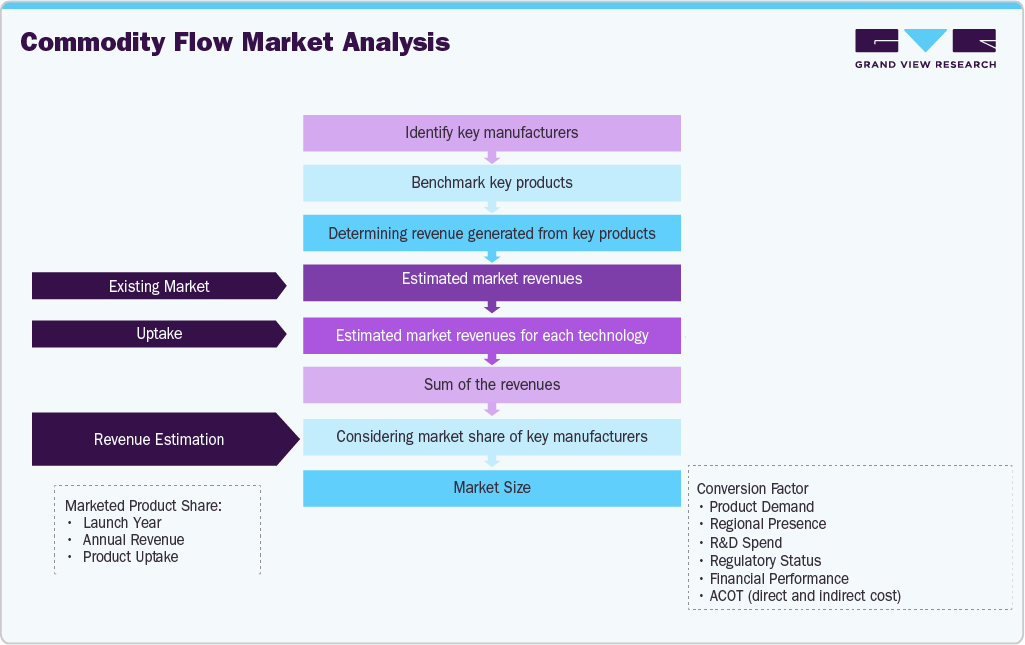
The pharmaceutical manufacturing cold storage market was estimated using a commodity flow and revenue modeling approach. The study began by identifying pharmaceutical cold-storage equipment manufacturers and temperature-controlled logistics providers across major countries and regions. Product and service portfolios were analyzed across pharmaceutical refrigerators, freezers, ultra-low-temperature freezers, cold rooms, temperature-controlled warehouses, and related monitoring systems. Key products and services were benchmarked by storage temperature, capacity, application, end user, geographic presence, and average selling price or service rate. Company annual reports, product information, investor presentations, facility announcements, regulatory documents, and industry publications were used to assess sales, installed capacity, storage facilities, and service activity. Pharmaceutical manufacturing output, manufacturing facility numbers, biologics production, temperature-sensitive product volumes, and cold-storage requirements were used for market validation. Country-level estimates were aggregated into regional and global markets and validated through primary interviews, secondary research, company-level analysis, and data triangulation.
Segment Definition
Segment - Storage Material
Revenue capture definition
API / Drug Substance
Temperature-controlled storage for active pharmaceutical ingredients or drug substances before formulation, including chemically synthesized or biologically derived substances used as the therapeutic component of a pharmaceutical product.
Finished Drug Product
Temperature-controlled storage for completed pharmaceutical products that have undergone manufacturing and packaging and are held for batch release, inventory management, distribution, or delivery.
QC Samples
Controlled-temperature storage for samples collected during pharmaceutical manufacturing and maintained for quality control testing, including physical, chemical, microbiological, and analytical evaluation.
Stability Samples
Controlled-temperature storage for pharmaceutical samples maintained under defined conditions to assess stability, shelf life, degradation, potency, and other quality characteristics during specified stability studies.
Retain Samples
Controlled-temperature storage for representative samples retained from manufactured pharmaceutical batches for future reference, quality investigation, product verification, complaint assessment, or regulatory requirements during the defined retention period.
Others
Temperature-controlled storage for pharmaceutical manufacturing materials outside API/drug substances, finished drug products, QC samples, stability samples, and retain samples, including other materials requiring defined storage conditions.
Segment - Product Class
Revenue capture definition
Small-Molecule Pharmaceuticals
Cold-storage requirements for chemically synthesized pharmaceutical products and related manufacturing materials, including temperature-sensitive APIs, intermediates, and finished dosage forms classified as small-molecule medicines.
Large-Molecule / Biopharmaceuticals
Temperature-controlled storage for biologic and other large-molecule pharmaceutical products, including proteins, monoclonal antibodies, vaccines, peptides, and related drug substances, intermediates, and finished products.
Cell & Gene Therapy Products
Specialized cold-storage requirements for cell-based and gene-based therapeutic products, including cellular materials, genetic materials, viral vectors, and associated manufacturing materials requiring frozen, ultra-low-temperature, or cryogenic storage.
Others
Cold-storage requirements for pharmaceutical products and manufacturing materials outside small-molecule pharmaceuticals, large-molecule/biopharmaceuticals, and cell and gene therapy products.
Segment - Storage Temperature
Revenue capture definition
Refrigerated (2-8°C)
Pharmaceutical cold-storage systems maintained at 2°C to 8°C for APIs, drug products, biological materials, samples, and other pharmaceutical manufacturing materials requiring refrigerated conditions.
Frozen (-15 to -25°C)
Pharmaceutical cold-storage systems maintained at -15°C to -25°C for pharmaceutical materials and products requiring frozen conditions within this temperature range during manufacturing, inventory holding, or quality-related storage.
Deep Frozen (-26 to -40°C)
Pharmaceutical cold-storage systems maintained at -26°C to -40°C for materials and products requiring temperatures below standard frozen conditions, including selected pharmaceutical and biological materials used during manufacturing and testing.
Ultra-Low Temperature (-41 to -80°C)
Pharmaceutical cold-storage systems maintained at -41°C to -80°C for temperature-sensitive pharmaceutical and biological materials requiring ultra-low-temperature preservation during manufacturing, processing, testing, or inventory storage.
Cryogenic (Below -80°C)
Pharmaceutical cold-storage systems operating below -80°C for materials requiring cryogenic preservation, including selected cell and gene therapy, biological, and other temperature-sensitive materials used in pharmaceutical manufacturing.
Others
Pharmaceutical cold-storage requirements maintained outside the defined 2-8°C, -15 to -25°C, -26 to -40°C, -41 to -80°C, and below -80°C ranges, including intermediate temperature requirements.
Segment - Storage Model
Revenue capture definition
In-house / Captive Storage
Pharmaceutical cold-storage capacity owned, leased, or directly operated by a pharmaceutical manufacturing company within its manufacturing or controlled storage network for temperature-sensitive materials and products.
Outsourced Storage
Pharmaceutical cold-storage capacity operated by an external third-party provider under a contractual arrangement for storing temperature-sensitive materials, samples, intermediates, or finished products on behalf of pharmaceutical manufacturers.
Segment - End User
Revenue capture definition
Pharmaceutical Manufacturers
Companies manufacturing small-molecule pharmaceutical products and requiring cold-storage infrastructure for APIs, intermediates, finished drug products, samples, and other temperature-sensitive materials used in pharmaceutical manufacturing.
Biopharmaceutical Manufacturers
Companies manufacturing biologic and large-molecule pharmaceutical products and requiring controlled-temperature storage for biological drug substances, intermediates, finished products, and other temperature-sensitive materials used in biopharmaceutical manufacturing.
CDMOs / Contract Manufacturers
Contract development and manufacturing organizations providing development, manufacturing, filling, packaging, or related production services to pharmaceutical and biopharmaceutical companies and requiring cold storage for client materials and manufactured products.
Others
Pharmaceutical manufacturing-related organizations requiring cold-storage infrastructure outside pharmaceutical manufacturers, biopharmaceutical manufacturers, and CDMOs/contract manufacturers.
Estimation Model
 To learn more about this report, Download Free Sample Report
Customization Table
Client Request
Customization Delivered
Value Adds
Pharmaceutical Manufacturing Cold Storage Market Assessment
Conducted a detailed assessment of pharmaceutical manufacturing cold-storage demand across major regions and countries. The study evaluated storage requirements by material, product class, temperature range, storage model, and end user. The analysis covered pharmaceutical refrigerators, freezers, ultra-low-temperature systems, cold rooms, temperature monitoring systems, and temperature-controlled warehousing. Market drivers, restraints, opportunities, pricing factors, regulatory requirements, and pharmaceutical supply-chain requirements were also assessed.
Helped the client understand demand patterns across pharmaceutical cold-storage categories, identify areas with higher storage requirements, and assess the role of temperature-sensitive products in storage demand. The analysis supported capacity planning, product portfolio decisions, regional expansion assessment, and evaluation of cold-storage requirements across pharmaceutical manufacturing facilities.
Pharmaceutical Cold Storage Competitive Benchmarking
Delivered a competitive benchmarking analysis covering pharmaceutical cold-storage equipment providers and temperature-controlled logistics providers. The study assessed product portfolios, temperature ranges, storage capacity, monitoring capabilities, geographic presence, manufacturing capabilities, logistics infrastructure, operating strategies, competitive positioning, and weaknesses. The analysis also categorized market participants into mature and emerging or specialized players based on their product coverage, geographic presence, infrastructure, and industry experience.
Enabled the client to assess competitive positioning across cold-storage equipment and outsourced storage providers, identify product and service gaps, and compare capabilities across temperature-controlled storage requirements. The analysis supported competitor profiling, partnership assessment, product portfolio planning, and regional expansion decisions in the pharmaceutical cold storage sector.
Emerging Market Pharmaceutical Cold Storage Infrastructure Assessment
Conducted a country-level assessment of pharmaceutical cold-storage infrastructure across North America, Europe, Asia Pacific, Latin America, and the Middle East & Africa. The study analyzed pharmaceutical manufacturing capacity, biologics production, temperature-sensitive product requirements, storage infrastructure, cold-chain facilities, temperature monitoring, storage models, and regional supply-chain conditions. Country-level analysis covered key markets across developed and emerging pharmaceutical manufacturing regions.
Supported the client in identifying regions with increasing pharmaceutical cold-storage requirements, assessing infrastructure gaps, and evaluating opportunities for equipment deployment and outsourced storage services. The study also supported regional resource allocation, facility planning, market entry assessment, and the identification of storage requirements for biologics, vaccines, and other temperature-sensitive pharmaceutical products.
Frequently Asked Questions About This Report
The finished drug product segment dominated the market with revenue share of 33.7% in 2025, while stability sample segment is the fastest-growing storage material.
North America dominated the market, accounting for a revenue share of 39.8% in 2025.
The expansion of biologics and other temperature-sensitive pharmaceutical manufacturing is increasing the need for controlled cold-storage infrastructure within production facilities.
The small-molecule pharmaceuticals segment dominated the market accounting for the largest share of 46.9% in 2025, while cell & gene therapy products is the fastest-growing segment.
The refrigerated (2–8°C) segment dominated the market with revenue share of 51.4% in 2025, while cryogenic (below −80°C) segment is the fastest-growing storage temperature.
Asia Pacific is the fastest-growing region over the forecast period.
The global pharmaceutical manufacturing cold storage market size was valued at USD 4.1 billion in 2025 and is estimated at USD 4.3 billion in 2026.
The global pharmaceutical manufacturing cold storage is expected to grow at a CAGR of 6.9% from 2026 to 2033, reaching USD 6.9 billion by 2033.
Key players include Thermo Fisher Scientific; Azenta; PHC Holdings (PHCbi); Haier Biomedical; Eppendorf; Helmer Scientific; Arctiko; B Medical Systems; Stirling Ultracold; Liebherr; DHL; UPS Healthcare; Kuehne+Nagel; Cencora / World Courier; DSV; FedEx; CEVA Logistics, GEODIS
About the Author(s)
Pharmaceuticals Research Team
Healthcare · PharmaceuticalsThis report was authored by the pharmaceuticals research team at Grand View Research - comprising two research analysts, one senior research analyst, and one industry expert - with specialized expertise in the pharmaceuticals segment of the healthcare industry. All findings are based on proprietary healthcare databases, executive interviews, and regulatory analysis, subject to internal peer review prior to publication.
Last Updated:
Speak to Analyst

Customize this report to your needs - add regions, segments, or data points, with 20% free customization.
Or view our licence options:


ISO 9001:2015 & 27001:2022 Certified
We are GDPR and CCPA compliant! Your transaction & personal information is safe and secure. For more details, please read our privacy policy.


