
- Home
- »
- Advanced Interior Materials
- »
-
Photocatalytic Building Materials Market Size Report, 2033GVR Report cover

Photocatalytic Building Materials Market (2026 - 2033)
Size, Share & Trends Analysis Report By Product (Cement & Concrete, Coatings & Paints, Tiles & Paving Materials), By End-use (Residential, Commercial, Industrial), By Application, By Region, And Segment Forecasts
Market Size, 2025
$2.2BMarket Estimate, 2026
$2.4BMarket Forecast, 2033
$4.3BCAGR, 2026–2033
8.6%Photocatalytic Building Materials Market Summary
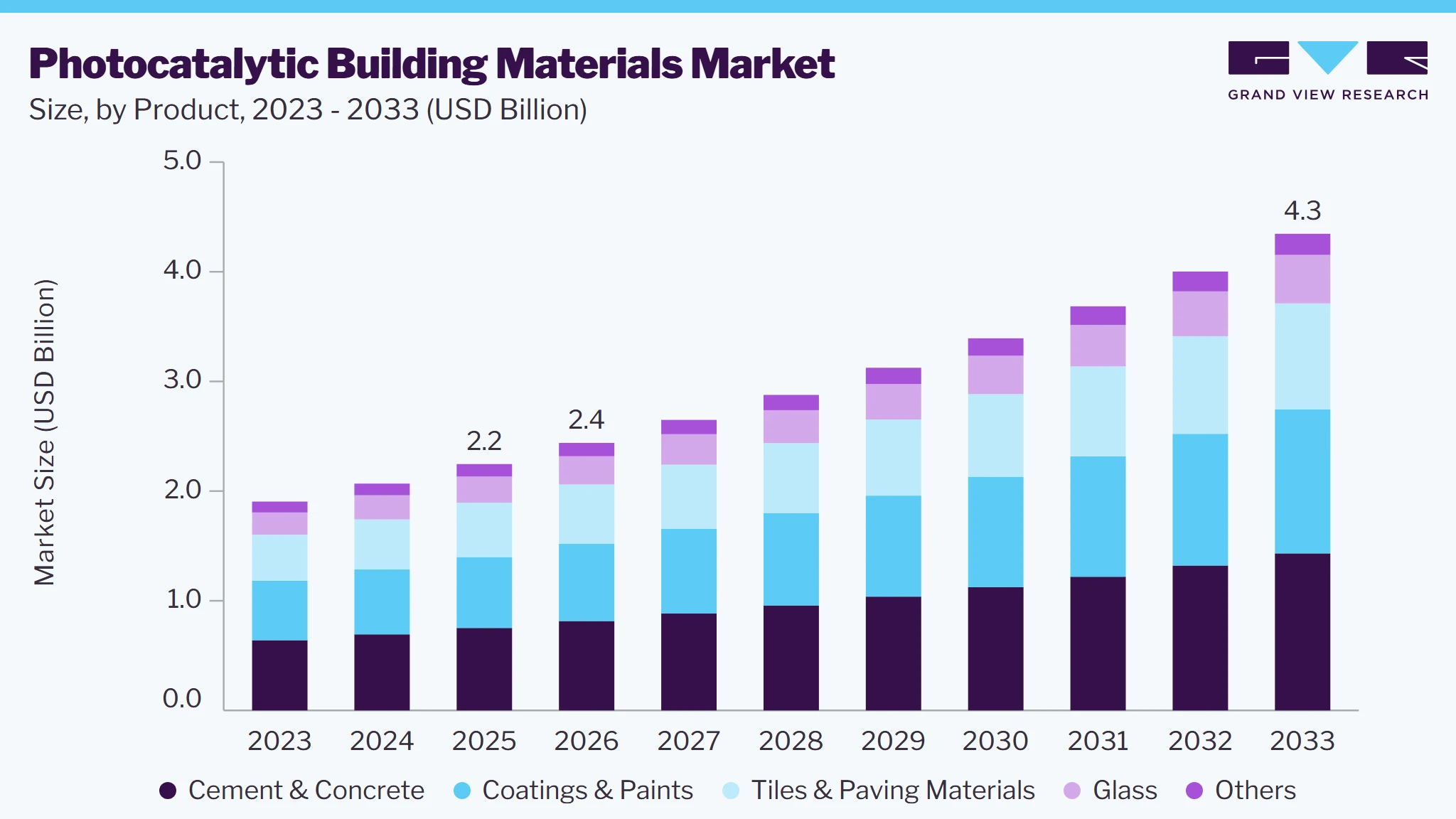
The global photocatalytic building materials market size was valued at USD 2.2 billion in 2025 and is projected to grow from USD 2.4 billion in 2026 to USD 4.3 billion by 2033, at a CAGR of 8.6% from 2026 to 2033. Europe dominated the market, accounting for a revenue share of 34.2% in 2025. The market is gaining attention as construction stakeholders seek materials that can provide functional benefits beyond structural and aesthetic performance.
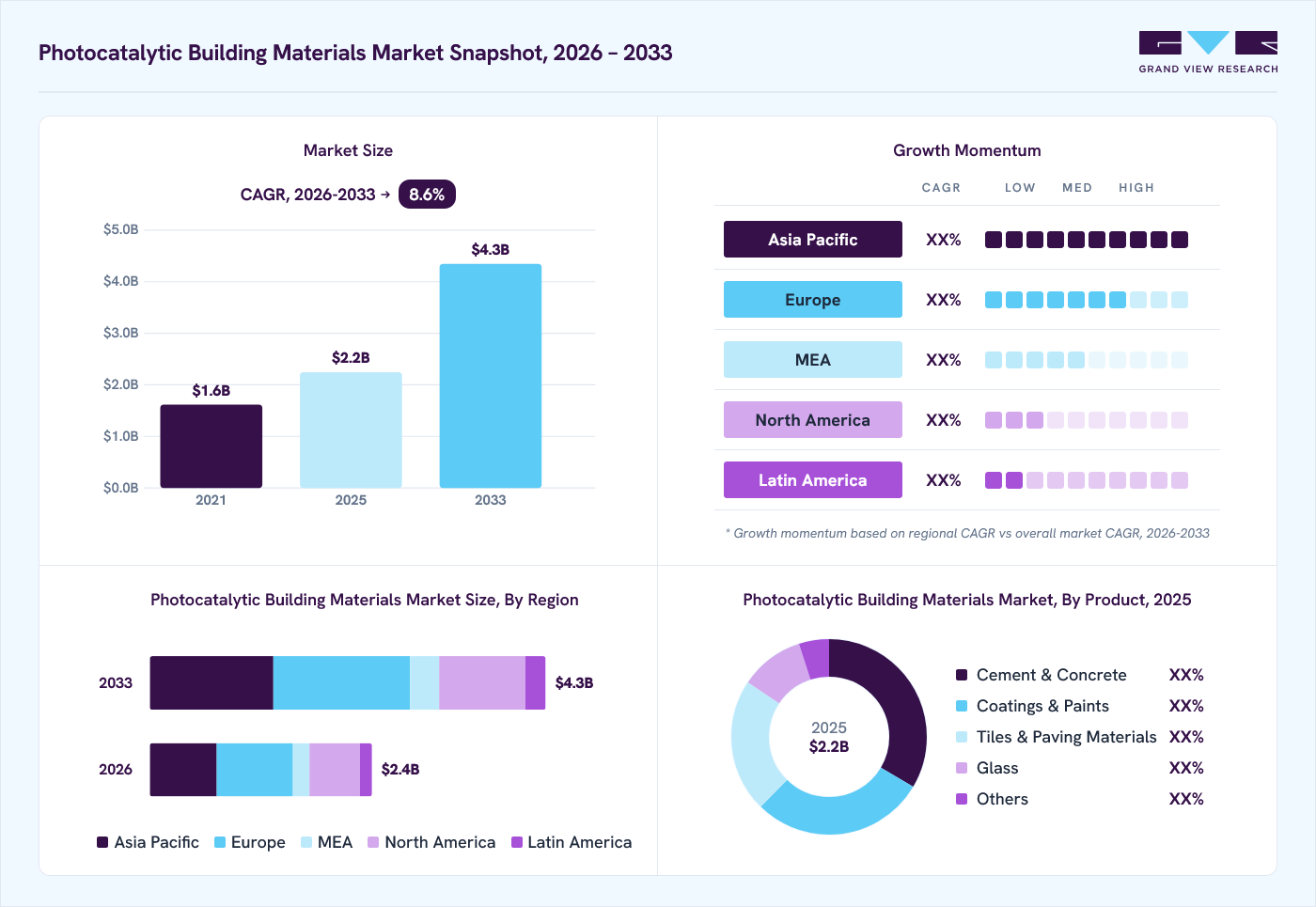 Source: Grand View Research, IR Documents, Primary Interviews, Paid DatabasesTo learn more about this report,
 Download Free Sample Report
 Key Market Trends & Insights
- By product: Cement & concrete segment held the highest revenue share of 33.5% in 2025.
- By application: Building facades & exterior walls segment dominated the market with a revenue share of 35.3% in 2025.
- By end-use: Infrastructure segment is projected to register a CAGR of 8.9% during the forecast period.
Regional Highlights
- Largest regional market: Europe (34.2% revenue share, 2025)
- Fastest-growing regional market: Asia Pacific (highest CAGR, 2026-2033)
- By country: Germany held the largest revenue share in 2025.
Market Size & Forecast
- Market Size in 2025: USD 2.2 Billion
- Estimated Market Size in 2026: USD 2.4 Billion
- Projected Market Size in 2033: USD 4.3 Billion
- CAGR (2026-2033): 8.6%
Three ways to get this report
Buy it, customize it, or ask a question.Ask an Analyst
A direct answer, usually in 1 working day
- AccessReport author, directly
- Reply timeWithin 1 working day
- No sales callDirect answer only
- FormatEmail reply
- CostFree, no cost
Get the Full Report
What the study covers
- FormatsPDF · Excel · Dashboard
- Timeline2026–2033 annual, 2025 base
- Coverage20+ countries, 5 regions
- Companies10+ key players profiled
Customize the Report
20% free customization
- IncludeCountries, segments, points
- TailorTo your product definition
- ExtendDeeper competitor detail
- OrA fully bespoke study
- Turnaround5–10 working days
Photocatalytic materials use light-activated compounds, particularly titanium dioxide, to trigger chemical reactions on or within building surfaces. These reactions can help break down selected air pollutants and organic contaminants, supporting cleaner exterior surfaces and improved environmental performance.The technology is being incorporated into products such as concrete, cement, coatings, tiles, glass, façade materials, paving products, and other construction surfaces. Increasing urbanization and the concentration of traffic and industrial activity in cities are supporting interest in technologies that can contribute to cleaner built environments. Photocatalytic building materials can be deployed across large surface areas, including roads, façades, pavements, roofs, and public infrastructure, allowing their environmental functionality to operate passively when exposed to suitable light. Growing emphasis on sustainable construction, low-maintenance infrastructure, green buildings, and improved urban air quality is encouraging material manufacturers and construction companies to evaluate photocatalytic solutions.
 To learn more about this report, Download Free Sample Report
 Material science developments are expanding the range of photocatalytic construction applications. Manufacturers are working on improved photocatalyst dispersion, surface durability, light utilization, compatibility with cementitious systems, and performance under different environmental conditions. Research into visible-light-responsive photocatalysts, self-cleaning surfaces, photocatalytic concrete, functional coatings, and hybrid materials is broadening the potential application base. Digital modeling and laboratory testing are also being used to evaluate photocatalytic performance under different light, pollution, humidity, and surface conditions.
Market Dynamics
The market is shaped by the growing requirement for sustainable and multifunctional construction materials, increasing urban air-quality concerns, advances in photocatalytic formulations, and the expansion of green-building practices. Adoption is also influenced by the cost difference compared with conventional materials, uncertainty regarding long-term performance under different environmental conditions, availability of suitable light exposure, and the need for reliable performance testing. As manufacturers improve material compatibility and demonstrate practical applications, photocatalytic functionality is being considered as an additional performance characteristic rather than a standalone construction technology.
The transition toward sustainable construction is increasing demand for building materials that provide multiple functional benefits during their service life. Photocatalytic materials can combine conventional construction functions with surface-cleaning or pollutant-reducing properties, creating additional value without requiring separate mechanical or chemical treatment systems. Concrete, tiles, coatings, glass, façade systems, and paving products can incorporate photocatalytic functionality while continuing to serve their primary structural or architectural purpose. This multifunctional characteristic supports adoption in projects where developers and infrastructure authorities are seeking environmental improvements through material selection.
Urban development is further supporting interest in passive technologies that can operate across large surface areas. Exposed construction surfaces can interact with naturally available light and atmospheric pollutants. Their integration into existing construction categories allows the technology to benefit from established material manufacturing and installation processes. As sustainability requirements become increasingly integrated into building design and infrastructure planning, photocatalytic functionality can serve as an additional criterion alongside durability, aesthetics, energy performance, maintenance requirements, and environmental impact.
The relatively higher cost of photocatalytic formulations compared with conventional construction materials can limit adoption, particularly in price-sensitive construction projects. Additional costs may arise from photocatalyst incorporation, specialized formulations, surface treatments, quality control, and performance validation. The effectiveness of photocatalytic systems can also vary according to light intensity, surface exposure, pollutant concentration, humidity, temperature, material composition, and surface contamination. These factors can create differences between laboratory results and real-world performance, making some project developers cautious about paying a premium where long-term benefits are difficult to quantify.
The expansion of smart-city and sustainable infrastructure programs creates opportunities for photocatalytic materials beyond conventional building applications. Roads, pedestrian areas, tunnels, parking structures, public plazas, bridges, transport infrastructure, and large façade surfaces provide extensive areas where photocatalytic products can potentially be deployed. Municipal projects can also combine photocatalytic surfaces with broader air-quality, sustainability, and urban-renewal initiatives. Development of durable formulations that maintain performance under outdoor conditions can therefore expand the addressable market and encourage larger-scale infrastructure applications.
Market Concentration & Characteristics
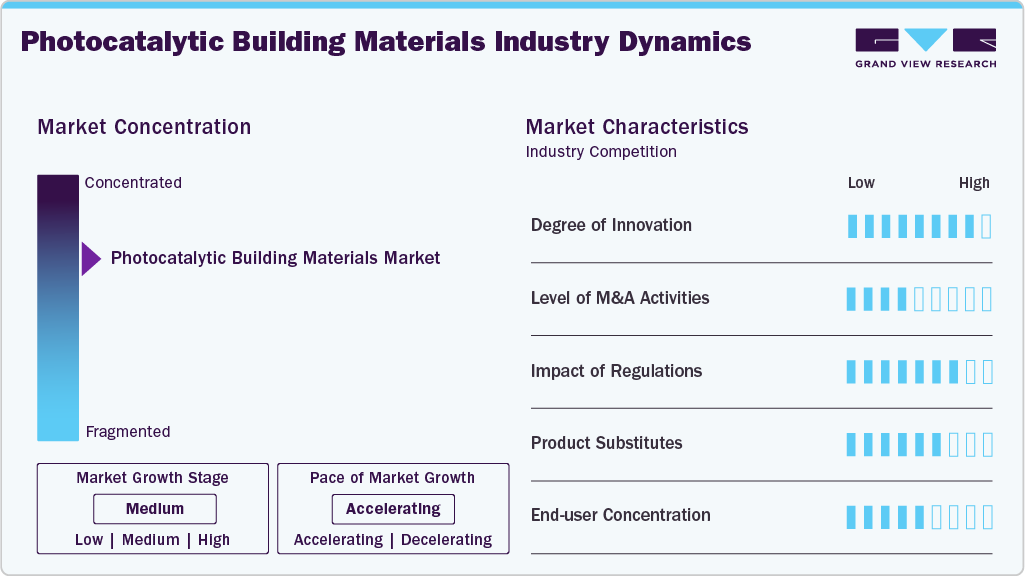
The industry has a specialized competitive structure involving construction-material manufacturers, chemical and specialty-material suppliers, coating producers, and technology developers. Competition varies across product categories because photocatalytic functionality can be incorporated into cementitious materials, coatings, glass, ceramics, concrete products, and other surfaces. Companies with established construction-material manufacturing, formulation expertise, distribution networks, and access to large infrastructure projects can integrate photocatalytic technology into existing product portfolios more efficiently.
 To learn more about this report, Download Free Sample Report
 Photocatalytic building materials are being replaced by conventional building materials, combined with separate air-purification, cleaning, pollution-control, or protective systems. Traditional materials remain widely available and generally have established specifications, installation practices, and cost structures. For air-quality applications, active filtration and purification systems can provide more controlled treatment within enclosed environments, while conventional cleaning and maintenance methods can address surface staining and contamination. However, these alternatives may require additional equipment, energy, chemicals, labor, or maintenance, whereas photocatalytic materials are designed to incorporate functionality directly into the construction surface.
Analyst Perspective
The market is positioned at the intersection of advanced construction materials, environmental technologies, and sustainable building solutions, with adoption driven by the growing integration of functional properties into conventional construction products. Market development depends on the ability of manufacturers to incorporate photocatalytic functionality without compromising durability, aesthetics, or construction performance. Demand is expected to remain closely linked to green-building practices, urban air-quality initiatives, infrastructure development, and the adoption of low-maintenance building solutions, while product cost, field performance, light availability, and technical validation remain important considerations for broader commercialization.
Product Insights
The cement & concrete segment held the highest revenue share of 33.5% in 2025, supported by the broad use of cementitious materials across public infrastructure. Photocatalysts can be incorporated into concrete and cement-based products to provide additional self-cleaning and pollutant-degrading functionality while maintaining their primary construction purpose. The availability of established manufacturing processes and the suitability of these materials for large exposed surfaces further support their market position.
The coatings & paints segment is expected to grow at a CAGR of 9.3% over the forecast period, as demand increases for functional surface treatments that combine protection, aesthetics, self-cleaning properties, and environmental functionality. Photocatalytic coatings can be applied to existing walls, concrete, glass, and other surfaces, providing a relatively flexible route for incorporating photocatalytic performance into new and renovation projects. Growing interest in low-maintenance buildings and air-quality improvement is expected to encourage adoption across commercial buildings and urban infrastructure.
End-use Insights
The commercial segment held the highest revenue share of 36.2% in 2025, supported by the extensive use of advanced construction materials in offices, retail facilities, hotels, shopping centers, institutional buildings, and other commercial properties. Commercial projects often place greater emphasis on appearance, cleanliness, maintenance requirements, and sustainability performance, creating suitable applications for photocatalytic materials. Large exterior surface areas and architectural features also provide opportunities for incorporating photocatalytic coatings, concrete, glass, tiles, and façade materials.
The infrastructure segment is expected to grow at a CAGR of 8.9% over the forecast period, as photocatalytic materials gain attention for roads, pavements, pedestrian areas, tunnels, bridges, public spaces, and transportation infrastructure. These applications provide large outdoor surfaces that can potentially utilize photocatalytic functionality for pollutant degradation and self-cleaning. Increasing investment in sustainable urban infrastructure and environmental improvement projects is supporting interest in materials that can provide additional functionality without requiring separate treatment systems.
Application Insights
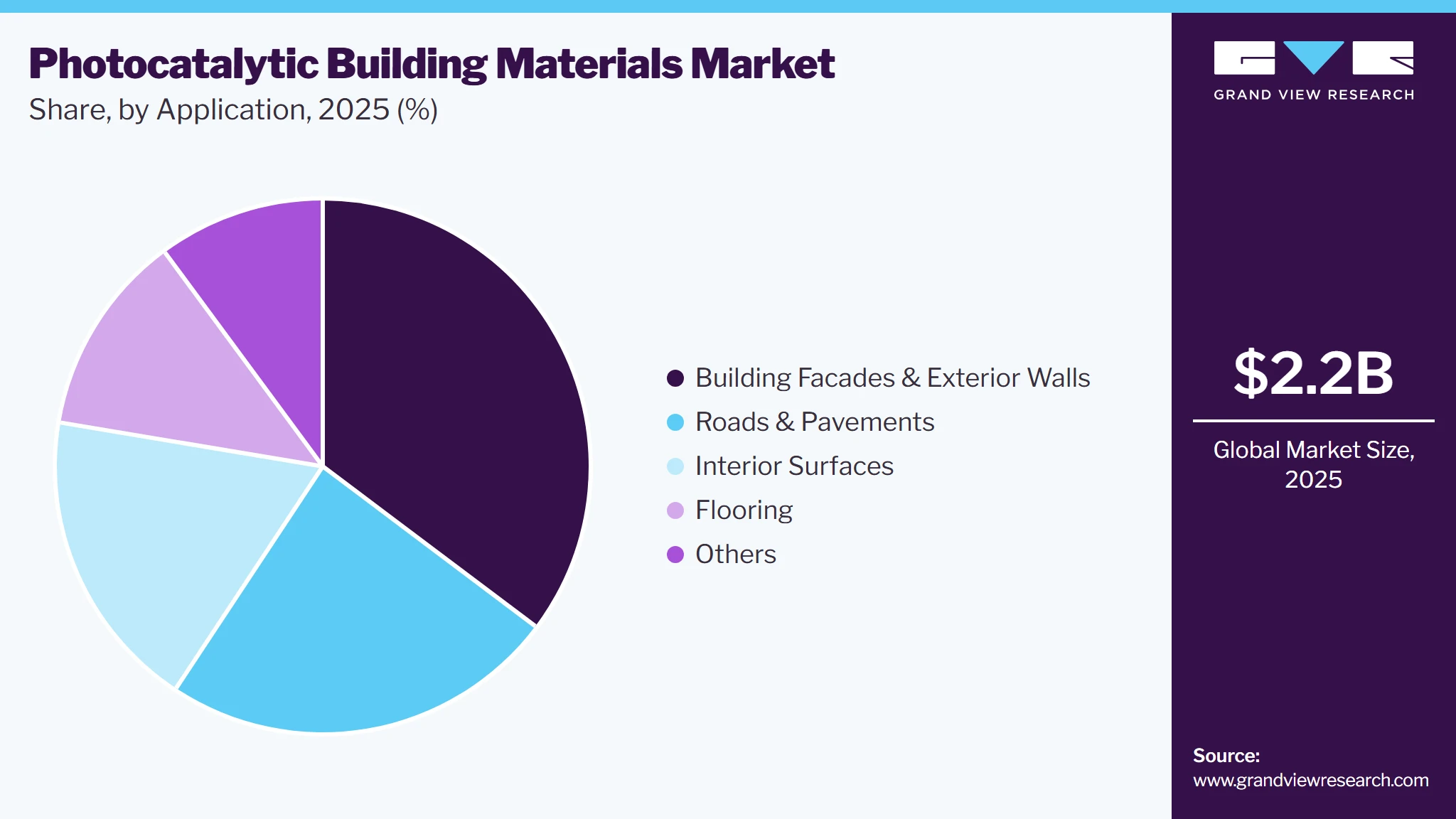
The building facades & exterior walls segment held the highest revenue share of 35.3% in 2025, driven by the large surface area available for photocatalytic treatment and the direct exposure of exterior surfaces to light and atmospheric pollutants. Photocatalytic materials can provide self-cleaning and pollutant-degrading functionality while supporting architectural requirements. Growing demand for attractive, durable, and low-maintenance building exteriors is further supporting the use of photocatalytic materials in this application.
 To learn more about this report, Download Free Sample Report
 The roads & pavements segment is expected to grow at a CAGR of 9.1% over the forecast period, as municipalities and infrastructure developers explore materials that can combine conventional pavement performance with environmental functionality. Photocatalytic concrete, paving blocks, tiles, and surface treatments can be incorporated into roads, sidewalks, parking areas, pedestrian zones, and public spaces. The extensive exposed surface area of transportation infrastructure creates opportunities for wider deployment, particularly in urban areas where air-quality improvement and sustainable infrastructure are important development priorities.
Regional Insights
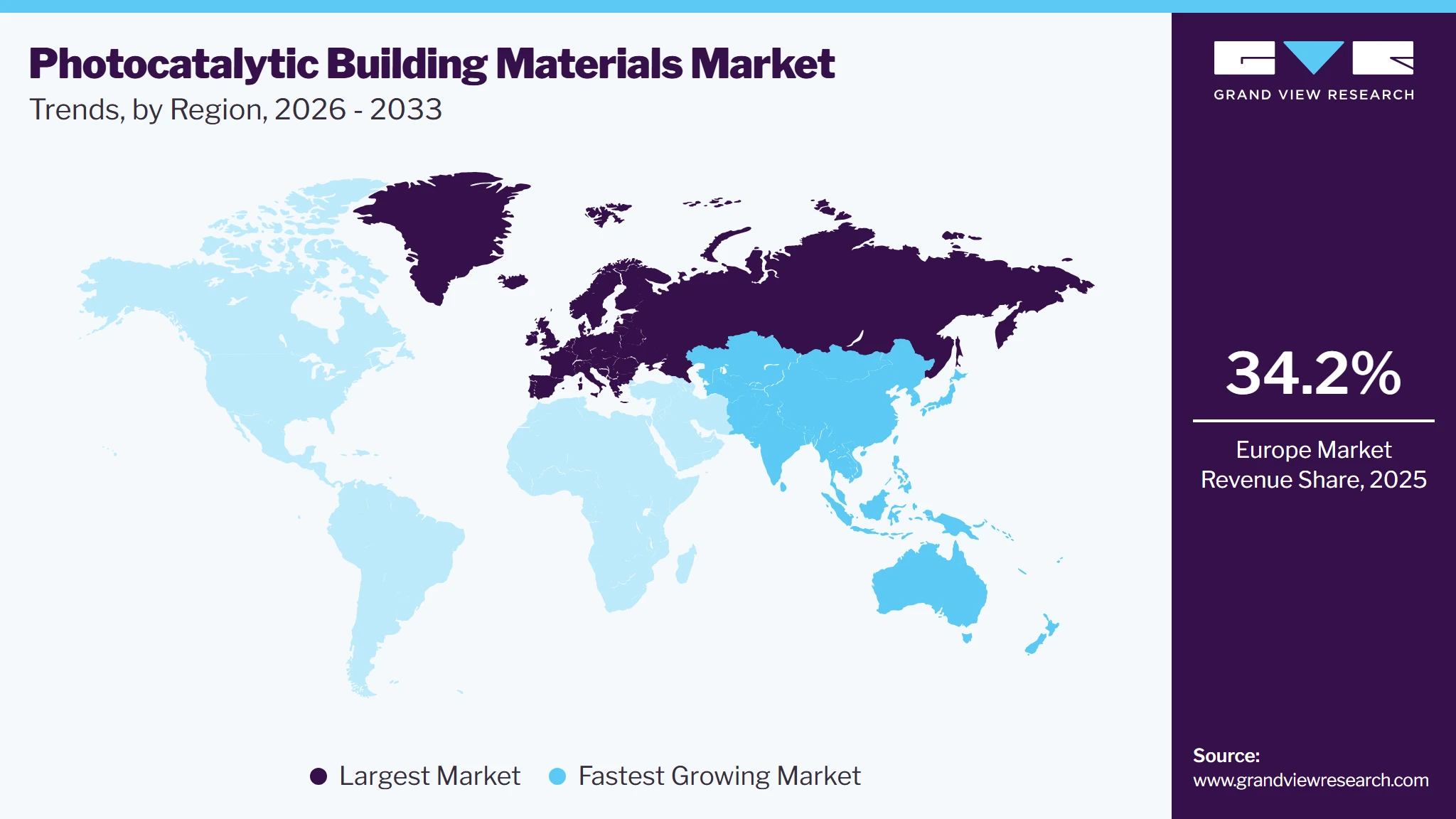
The Europe photocatalytic building materials market dominated and accounted for the largest revenue share of 34.2% in 2025, owing to a strong sustainability-oriented construction environment supported by environmental policies, green-building practices, and an increasing emphasis on reducing the environmental impact of the built environment. Photocatalytic materials are being explored for architectural applications as the region's focus on air-quality improvement and sustainable urban development provides a favorable application environment for technologies that can contribute to pollutant reduction or self-cleaning surfaces.
 To learn more about this report, Download Free Sample Report
 Germany Photocatalytic Building Materials Market Trends
The photocatalytic building materials market in Germany provides opportunities through its advanced construction sector, engineering capabilities, and emphasis on resource-efficient buildings. Major applications include concrete surfaces, coatings, roofing-related products, and urban infrastructure. The country's established building-material industry provides opportunities to integrate photocatalytic technology into existing product categories rather than relying exclusively on standalone products. Demand is also influenced by energy-efficient building practices, environmental standards, and increasing interest in materials that provide measurable lifecycle benefits.
Asia Pacific Photocatalytic Building Materials Market Trends
The photocatalytic building materials market in Asia Pacific is the fastest-growing regional market, representing a significant growth environment due to rapid urban development, expanding infrastructure investment, and increasing attention toward sustainable construction. Large-scale residential, commercial, transportation, and public infrastructure projects provide multiple potential applications for photocatalytic products. Countries with dense urban populations are also placing greater emphasis on air-quality management and pollution reduction. Construction-material manufacturers across the region are incorporating advanced functional materials into product development, supporting broader commercialization opportunities for photocatalytic technologies.
The China photocatalytic building materials market offers substantial application potential because of its extensive construction activity, large urban infrastructure base, and continuing focus on environmental improvement. The country's established cement, concrete, ceramic, glass, and specialty-material manufacturing industries provide a broad industrial base for technology integration. Continued development of sustainable urban infrastructure and advanced construction materials can support further adoption, particularly where environmental functionality is incorporated into large public projects.
North America Photocatalytic Building Materials Market Trends
The photocatalytic building materials market in North America is supported by growing interest in advanced building-material technologies. Demand is influenced by environmental performance requirements, urban air-quality concerns, and the development of high-performance building envelopes. Adoption remains dependent on project economics and the ability of suppliers to demonstrate durable field performance, particularly where photocatalytic functionality carries a premium over conventional materials.
The photocatalytic building materials market in the U.S. is supported by investments in sustainable infrastructure, commercial construction, public facilities, and advanced materials. Photocatalytic coatings and cementitious products can be incorporated into projects where environmental performance and surface maintenance are important considerations. Interest in low-maintenance infrastructure and environmentally responsive materials is encouraging evaluation of technologies that can provide additional functionality without major changes to conventional construction processes. Product certification, performance validation, project-specific requirements, and cost competitiveness remain important factors influencing commercial adoption.
Central and South America Photocatalytic Building Materials Market Trends
The photocatalytic building materials market in Central & South America is developing as urban infrastructure expands and construction markets incorporate sustainable material concepts. Photocatalytic products can be considered for commercial developments, transportation infrastructure, public spaces, and large urban projects. Adoption is currently influenced by product availability, project economics, technical awareness, and access to specialized materials. Increasing attention toward urban environmental conditions and sustainable infrastructure can create opportunities for suppliers capable of adapting photocatalytic products to local climate and construction requirements.
Middle East & Africa Photocatalytic Building Materials Market Trends
The photocatalytic building materials market in the Middle East & Africa presents opportunities through large-scale urban development, infrastructure investment, tourism projects, commercial construction, and sustainability-focused developments. Photocatalytic building materials can be relevant for all architectural applications where high solar exposure can support photocatalytic activity. The region's harsh outdoor conditions also create a strong requirement for durable formulations that can withstand heat, dust, and surface contamination.
Key Photocatalytic Building Materials Company Insights
Some of the key players operating in the photocatalytic building materials market include TOTO Ltd. and Saint-Gobain.
-
TOTO Ltd. is a Japan-based manufacturer of sanitary ware, bathroom fixtures, and related architectural products. The company has developed photocatalytic surface technologies, particularly for self-cleaning and environmental applications, supporting its presence in functional building-material solutions.
-
Saint-Gobain is a global building-materials company offering solutions across glass, construction products, insulation, façades, and specialty materials. Its broad construction-material portfolio and R&D capabilities support the development and integration of advanced surface and material technologies.
Green Millennium, Inc. and Nikki-Universal Co., Ltd. are some of the emerging market participants in the photocatalytic building materials market.
-
Green Millennium, Inc. is a technology-focused company involved in photocatalytic solutions designed for environmental and surface-treatment applications. Its activities include photocatalytic materials and coatings intended to support self-cleaning and pollutant-reduction functions.
-
Nikki-Universal Co., Ltd. is a Japan-based company associated with photocatalytic materials and related surface-treatment technologies. The company focuses on functional material solutions that can provide photocatalytic and environmental performance across specialized applications.
Key Photocatalytic Building Materials Companies
The following key companies have been profiled for this study on the photocatalytic building materials market.
-
TOTO Ltd.
-
Saint-Gobain
-
Heidelberg Materials
-
Nippon Sheet Glass Co., Ltd.
-
Sto SE & Co. KGaA
-
Evonik Industries
-
Nikki-Universal Co., Ltd.
-
Green Millennium, Inc.
-
PURETi Group LLC
-
TitanPE Technologies, Inc.
Competitive Benchmarking
Category
Operating Strategies
Competitive Edge
Weakness
Established Players: TOTO Ltd., Saint-Gobain, Heidelberg Materials, Nippon Sheet Glass Co., Ltd., Sto SE & Co. KGaA, Evonik Industries
- Invest in advanced photocatalytic materials, coatings, cementitious products, glass, and surface technologies to improve self-cleaning, pollutant-degrading, durability, and environmental performance.
- Expand product portfolios and manufacturing capabilities across construction materials, architectural surfaces, specialty chemicals, and building-envelope solutions to address demand from commercial, residential, and infrastructure projects.
- Strengthen partnerships with architects, contractors, developers, infrastructure companies, and construction-material distributors to increase adoption of photocatalytic solutions and support application-specific product development.
- Established manufacturing infrastructure and extensive expertise across construction materials, glass, coatings, cement, ceramics, and specialty chemicals support large-scale commercialization.
- Diversified product portfolios enable these companies to integrate photocatalytic functionality across multiple building-material categories and applications.
- Strong R&D capabilities, established customer relationships, technical expertise, quality systems, and global distribution networks support adoption in commercial and infrastructure projects.
- High capital requirements for specialized manufacturing, material development, R&D, testing, and integration of photocatalytic technologies into existing product lines.
- Complex construction-material qualification and project approval processes can extend product development and commercialization timelines.
- Exposure to raw material, energy, manufacturing, and construction-cycle fluctuations can affect production economics and the competitiveness of higher-cost photocatalytic products.
Emerging Players: Nikki-Universal Co., Ltd., Green Millennium, Inc., PURETi Group LLC, TitanPE Technologies, Inc.
- Focus on specialized photocatalytic coatings, surface treatments, advanced materials, and environmentally responsive building solutions targeting self-cleaning, air-purifying, and pollutant-degrading applications.
- Expand market presence through partnerships with construction companies, coating applicators, architects, building-material manufacturers, distributors, and infrastructure developers.
- Prioritize formulation development, surface-performance optimization, sustainability, and customized photocatalytic solutions for niche and application-specific construction requirements.
- Specialized product portfolios allow these companies to address targeted photocatalytic coating, surface-treatment, and advanced-material requirements.
- Focused technical capabilities support differentiation through photocatalytic activity, surface functionality, durability, application flexibility, and environmental performance.
- Greater specialization can provide flexibility in developing customized solutions and addressing emerging applications where conventional building materials offer limited functional performance.
- Relatively smaller scale and narrower product portfolios compared with diversified global construction-material manufacturers.
- Dependence on specialized photocatalytic applications can limit diversification and expansion across broader construction-material categories.
- Limited manufacturing scale, higher technology-development costs, and the need to demonstrate long-term field performance can constrain price competitiveness and large-scale project adoption.
Recent Developments
-
In June 2024, Saint-Gobain agreed to acquire FOSROC, a construction-chemicals company, for approximately €960 million. The transaction strengthened Saint-Gobain’s construction-chemicals portfolio and presence in high-growth markets including India and the Middle East.
-
In February 2024, Saint-Gobain announced a definitive agreement to acquire CSR Limited, expanding its building-products operations in Australia and New Zealand.
Photocatalytic Building Materials Market Report Scope
Report Attribute
Details
Market size in 2025
USD 2.2 billion
Estimated market size in 2026
USD 2.4 billion
Revenue forecast in 2033
USD 4.3 billion
Growth rate
CAGR of 8.6% from 2026 to 2033
Base year for estimation
2025
Actual estimates/historical data
2021 - 2024
Forecast period
2026 - 2033
Quantitative units
Revenue in USD billion and CAGR from 2026 to 2033
Report coverage
Revenue forecast, company ranking, competitive landscape, growth factors, and trends
Segments covered
Product, end-use, application, region
Regional scope
North America; Europe; Asia Pacific; Central and South America; Middle East and Africa
Country scope
U.S.; Canada; Mexico; Germany; UK; France; Italy; Spain; China; Japan; India; South Korea; Brazil; Saudi Arabia
Key companies profiled
TOTO Ltd.; Saint-Gobain; Heidelberg Materials; Nippon Sheet Glass Co., Ltd.; Sto SE & Co. KGaA; Evonik Industries; Nikki-Universal Co., Ltd.; Green Millennium, Inc.; PURETi Group LLC; TitanPE Technologies, Inc.
Customization scope
Free report customization (equivalent up to 8 analysts working days) with purchase. Addition or alteration to country, regional & segment scope.
Pricing and purchase options
Avail customized purchase options to meet your exact research needs. Explore purchase options
Global Photocatalytic Building Materials Market Report Segmentation
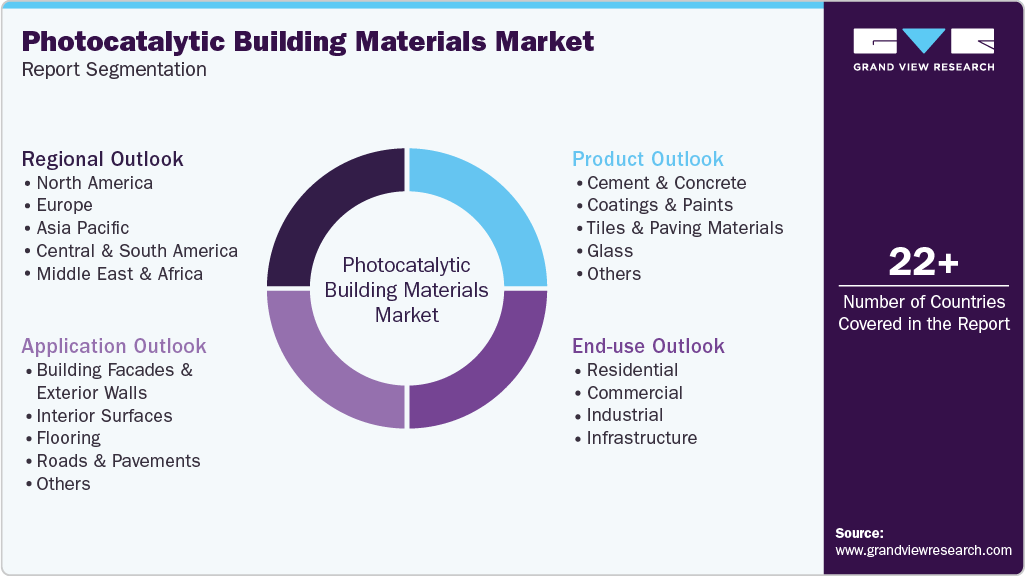
This report forecasts revenue growth at the global, regional & country levels and provides an analysis of the industry trends & opportunities in each of the sub-segments from 2021 to 2033. For this study, Grand View Research has segmented the global photocatalytic building materials market report based on product, end-use, application, and region:
 To learn more about this report, Download Free Sample Report
 -
Product Outlook (Revenue, USD Billion, 2021 - 2033)
-
Cement & Concrete
-
Coatings & Paints
-
Tiles & Paving Materials
-
Glass
-
Others
-
-
End-use Outlook (Revenue, USD Billion, 2021 - 2033)
-
Residential
-
Commercial
-
Industrial
-
Infrastructure
-
-
Application Outlook (Revenue, USD Billion, 2021 - 2033)
-
Building Facades & Exterior Walls
-
Interior Surfaces
-
Flooring
-
Roads & Pavements
-
Others
-
-
Regional Outlook (Revenue, USD Billion, 2021 - 2033)
-
North America
-
U.S.
-
Canada
-
Mexico
-
-
Europe
-
UK
-
Germany
-
France
-
Italy
-
Spain
-
-
Asia Pacific
-
China
-
Japan
-
India
-
South Korea
-
-
Central and South America
-
Brazil
-
-
Middle East and Africa
-
Saudi Arabia
-
-
Research Methodology
The photocatalytic building materials market figures in this report are based on a proven research process that combines executive interviews with secondary research from proprietary databases, company filings, and recognized regulatory and institutional sources. Market size is built through value-chain sizing - reconciling supply-side and demand-side estimates - and triangulated with bottom-up and top-down approaches. Every estimate passes multiple levels of expert validation before publication, with each photocatalytic building materials segment quantified using the revenue-capture definitions in the table below.
Segment Definition
Segment - Product
Revenue Capture Definition
Cement & Concrete
Revenue generated from the sale of photocatalytic cement and concrete products incorporating photocatalysts, primarily titanium dioxide, for building structures, façades, pavements, roads, and other construction applications requiring pollutant-reducing or self-cleaning properties.
Coatings & Paints
Revenue generated from the sale of photocatalytic coatings and paints applied to interior or exterior building surfaces, façades, walls, and infrastructure to provide self-cleaning, stain-resistant, or air-purifying functionality through light-activated photocatalytic reactions.
Tiles & Paving Materials
Revenue generated from the sale of photocatalytic tiles, paving blocks, slabs, and related surface materials used in buildings, walkways, plazas, roads, and public spaces requiring durable surfaces with self-cleaning or pollutant-degrading properties.
Glass
Revenue generated from the sale of photocatalytic glass products incorporating photocatalytic surface treatments or coatings for building windows, façades, doors, and architectural glazing applications requiring self-cleaning and environmental surface functionality.
Others
Revenue generated from the sale of other photocatalytic building materials, including photocatalytic roofing materials, façade panels, architectural surfaces, ceramics, sealants, and specialty construction products incorporating photocatalytic functionality.
Segment - End Use
Revenue Capture Definition
Residential
Revenue generated from the sale of photocatalytic building materials used in houses, apartments, residential complexes, and other housing projects for façades, walls, flooring, windows, coatings, and other residential construction applications.
Commercial
Revenue generated from the sale of photocatalytic building materials used in offices, retail buildings, hotels, restaurants, shopping centers, educational facilities, and other commercial properties for exterior, interior, flooring, glazing, and architectural applications.
Industrial
Revenue generated from the sale of photocatalytic building materials used in factories, warehouses, manufacturing facilities, logistics centers, and other industrial structures for façades, floors, walls, coatings, and specialized surfaces.
Infrastructure
Revenue generated from the sale of photocatalytic building materials used in roads, bridges, tunnels, sidewalks, public spaces, transportation facilities, airports, and other infrastructure projects requiring durable surfaces with self-cleaning or pollutant-reducing functionality.
Segment - Application
Revenue Capture Definition
Building Facades & Exterior Walls
Revenue generated from the sale of photocatalytic building materials used on exterior façades, cladding systems, exterior walls, and architectural surfaces to provide self-cleaning, stain-resistant, and pollutant-degrading properties under light exposure.
Interior Surfaces
Revenue generated from the sale of photocatalytic building materials used on interior walls, ceilings, partitions, and other indoor surfaces to support surface cleanliness, odor reduction, and degradation of selected indoor air contaminants.
Flooring
Revenue generated from the sale of photocatalytic flooring materials, tiles, concrete surfaces, and related products used in residential, commercial, industrial, and public spaces where self-cleaning and surface-maintenance properties are required.
Roads & Pavements
Revenue generated from the sale of photocatalytic concrete, paving materials, tiles, and surface treatments used on roads, sidewalks, pedestrian areas, parking areas, and other outdoor infrastructure to support pollutant degradation and surface cleanliness.
Others
Revenue generated from the sale of photocatalytic building materials used in other applications, including roofs, tunnels, bridges, parking structures, public spaces, transportation facilities, and specialized architectural surfaces.
Estimation Model
Layer Name
Key Question
Description
Parent Market Analysis
What is the overall size and growth outlook of the global construction materials, specialty chemicals, advanced coatings, cement & concrete, and architectural materials markets?
The estimation begins with the broader construction materials, cement & concrete, specialty coatings, architectural materials, glass, ceramics, and advanced building-materials markets. Construction activity, material production, infrastructure investment, building completions, renovation activity, and demand for sustainable construction products are assessed to establish the addressable market for photocatalytic building materials.
Photocatalytic Material Penetration Analysis
What proportion of the broader building-materials market is represented by photocatalytic materials across different product types and construction surfaces?
This layer estimates the penetration of photocatalytic technology across cement & concrete, coatings & paints, tiles & paving materials, glass, and other building materials, considering photocatalyst incorporation, product availability, technical performance, manufacturing capability, and adoption across construction applications. Penetration is further assessed across building façades & exterior walls, interior surfaces, flooring, roads & pavements, and other applications.
Regional & End-use Demand Assessment
Which regions, product types, applications, and end-use sectors contribute the highest demand for photocatalytic building materials?
Demand is assessed across major regions based on construction activity, infrastructure development, urbanization, green-building adoption, environmental regulations, air-quality concerns, and investment in sustainable buildings and infrastructure. Application-level demand is evaluated across building façades & exterior walls, interior surfaces, flooring, roads & pavements, and other applications, with further assessment across residential, commercial, industrial, and infrastructure end uses.
Company Revenue Validation & Market Forecasting
How is the final market size validated and forecast across product types, applications, regions, and end-use sectors?
Final estimates are validated using company revenues, production capacities, product portfolios, manufacturing facilities, photocatalytic product launches, investments, technology developments, capacity expansions, and project-level deployments. Bottom-up and top-down approaches are triangulated across company, Product, application, regional, and end-use data to generate market estimates and forecasts.
Delivered Customizations
We have successfully delivered the following deep-dive customizations
Client Request
Customization Delivered
Value Adds
Product Type & Material Performance Assessment
Evaluate cement & concrete, coatings & paints, tiles & paving materials, glass, and other photocatalytic building materials based on photocatalytic activity, durability, surface performance, weather resistance, self-cleaning capability, pollutant degradation, light responsiveness, and application suitability.
Helps identify the performance characteristics, positioning, and application potential of different photocatalytic building materials while highlighting opportunities for higher-performance formulations and specialty construction-material development.
Application & End-use Demand Assessment
Assess demand across building façades & exterior walls, interior surfaces, flooring, roads & pavements, and other applications based on construction activity, environmental requirements, material performance, adoption levels, maintenance requirements, and substitution potential. Demand is further evaluated across residential, commercial, industrial, and infrastructure end uses.
Provides visibility into high-demand and high-growth application areas and helps identify end-use sectors offering opportunities for market expansion, product development, and application-specific photocatalytic material innovation.
Competitive Landscape & Capacity Benchmarking
Benchmark key photocatalytic building-material manufacturers based on production capacity, product portfolio, manufacturing footprint, photocatalytic technology capabilities, application coverage, geographic presence, partnerships, investments, product launches, and capacity expansion plans.
Provides a clear view of competitive positioning, market concentration, production capabilities, leading participants, strategic strengths, technology differentiation, and potential gaps for new investments, partnerships, or market entry.
Frequently Asked Questions About This Report
The photocatalytic building materials market size was valued at USD 2.2 billion in 2025 and estimated USD 2.4 billion in 2026.
The photocatalytic building materials market is expected to grow at a CAGR of 8.6% from 2026 to 2033, reaching USD 4.3 billion by 2033.
Key factors driving the photocatalytic building materials market include growing demand for sustainable construction, increasing urban air-pollution concerns, adoption of self-cleaning building surfaces, green-building initiatives, and advancements in photocatalytic material technologies.
Some key players in the photocatalytic building materials market include TOTO Ltd., Saint-Gobain, Heidelberg Materials, Nippon Sheet Glass Co., Ltd., Sto SE & Co. KGaA, Evonik Industries, Nikki-Universal Co., Ltd., Green Millennium, Inc., TitanPE Technologies, Inc., and PURETi Group LLC
Asia Pacific is the fastest-growing region over the forecast period.
Europe dominated the market, accounting for a revenue share of 34.2% in 2025.
The commercial segment held the highest revenue share of 36.2% in 2025, while infrastructure segment is the fastest-growing end-use.
The building facades & exterior walls segment held the highest revenue share of 35.3% in 2025, while roads & pavements segment is the fastest-growing application.
The cement & concrete segment accounted for the largest revenue share of 33.5% in 2025, while coatings & paints segment is the fastest-growing product.
About the Author(s)
Advanced Interior Materials Research Team
Advanced Materials · Advanced Interior MaterialsThis report was authored by the advanced interior materials research team at Grand View Research - comprising two research analysts, one senior research analyst, and one industry expert - with specialized expertise in the advanced interior materials segment of the advanced materials industry. All findings are based on proprietary advanced materials databases, executive interviews, and regulatory analysis, subject to internal peer review prior to publication.
Last Updated:
Speak to Analyst

Customize this report to your needs - add regions, segments, or data points, with 20% free customization.
Or view our licence options:


ISO 9001:2015 & 27001:2022 Certified
We are GDPR and CCPA compliant! Your transaction & personal information is safe and secure. For more details, please read our privacy policy.


