
- Home
- »
- Advanced Interior Materials
- »
-
Piezoelectric Ceramics Market Size & Share Report, 2026-2033GVR Report cover

Piezoelectric Ceramics Market (2026 - 2033)
Size, Share & Trends Analysis Report By End-use (Consumer Electronics, Industrial & Manufacturing, Automotive), By Material (Lead Zirconate Titanate, Barium Titanate, Lead-free Ceramics), By Region, And Segment Forecasts
Market Size, 2025
$1,170.0MMarket Estimate, 2026
$1,227.0MMarket Forecast, 2033
$1,715.0MCAGR, 2026–2033
4.9%Piezoelectric Ceramics Market Summary
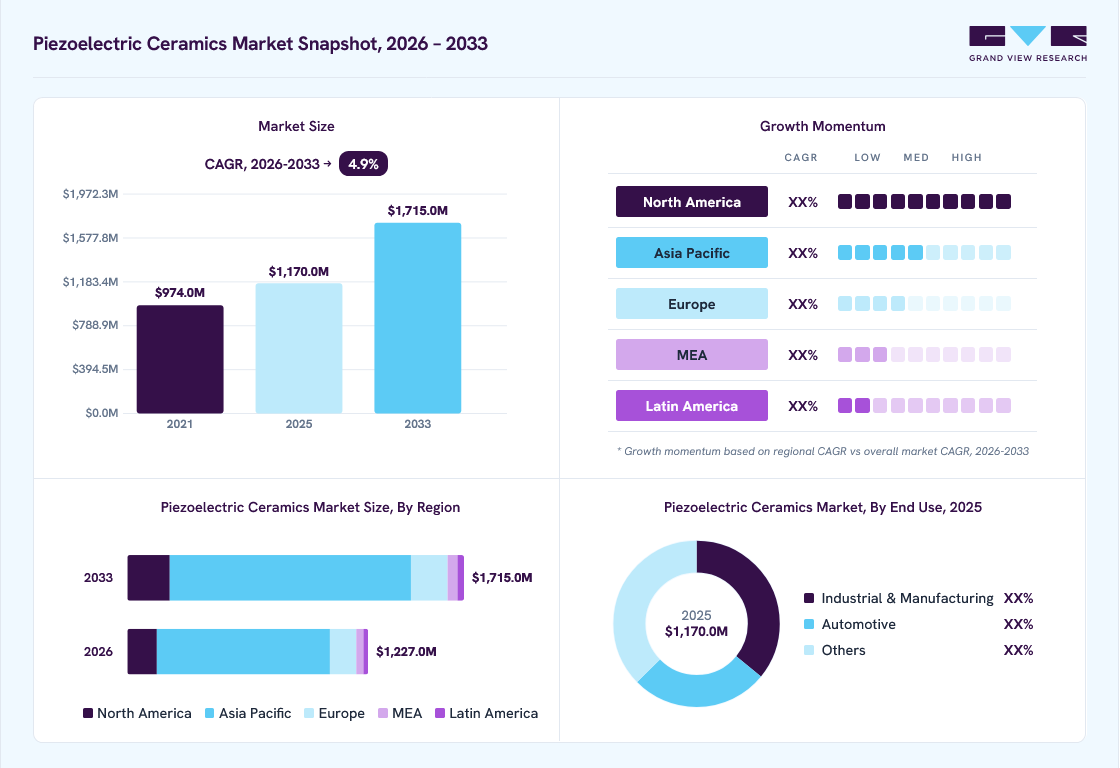
The global piezoelectric ceramics market size was valued at USD 1,170.0 million in 2025 and is projected to grow from USD 1,227.0 million in 2026 to USD 1,715.0 million by 2033, at a CAGR of 4.9% from 2026–2033. Asia Pacific dominated the market, accounting for the largest revenue share of 71.9% in 2025. Growth is being driven by increasing adoption of piezoelectric ceramics in sensors, actuators, transducers, ultrasonic devices, and precision electronic components across automotive, healthcare, industrial automation, aerospace, telecommunications, and consumer electronics.
 Source: Grand View Research, IR Documents, Primary Interviews, Paid DatabasesTo learn more about this report,
 Download Free Sample Report
Key Market Trends & Insights
- By end use: Consumer electronics segment accounted for the largest market revenue share of 33.3% in 2025.
- By material: Lead zirconate titanate (PZT) accounted for the largest share of 75.7% in 2025
Regional Highlights
- Largest regional market in 2025: Asia Pacific (71.9% revenue share, 2025)
- Fastest growing regional market: North America (highest CAGR, 2026-2033)
- By country: China held the largest market share in 2025.
Market Size & Forecast
- Market Size in 2025: USD 1,170.0 Million
- Estimated market size in 2026: USD 1,227.0 Million
- Projected Market Size by 2033: USD 1,715.0 million
- CAGR (2026-2033): 4.9%
Prism AI by Grand View Research Free to tryAsk a question about the piezoelectric ceramics market✓Every figure cited from GVR research Prefer the report? Download free sample →
Piezoelectric ceramics are advanced functional materials widely used in sensors, actuators, transducers, ultrasonic devices, and precision electronic components due to their ability to convert mechanical stress into electrical energy and vice versa.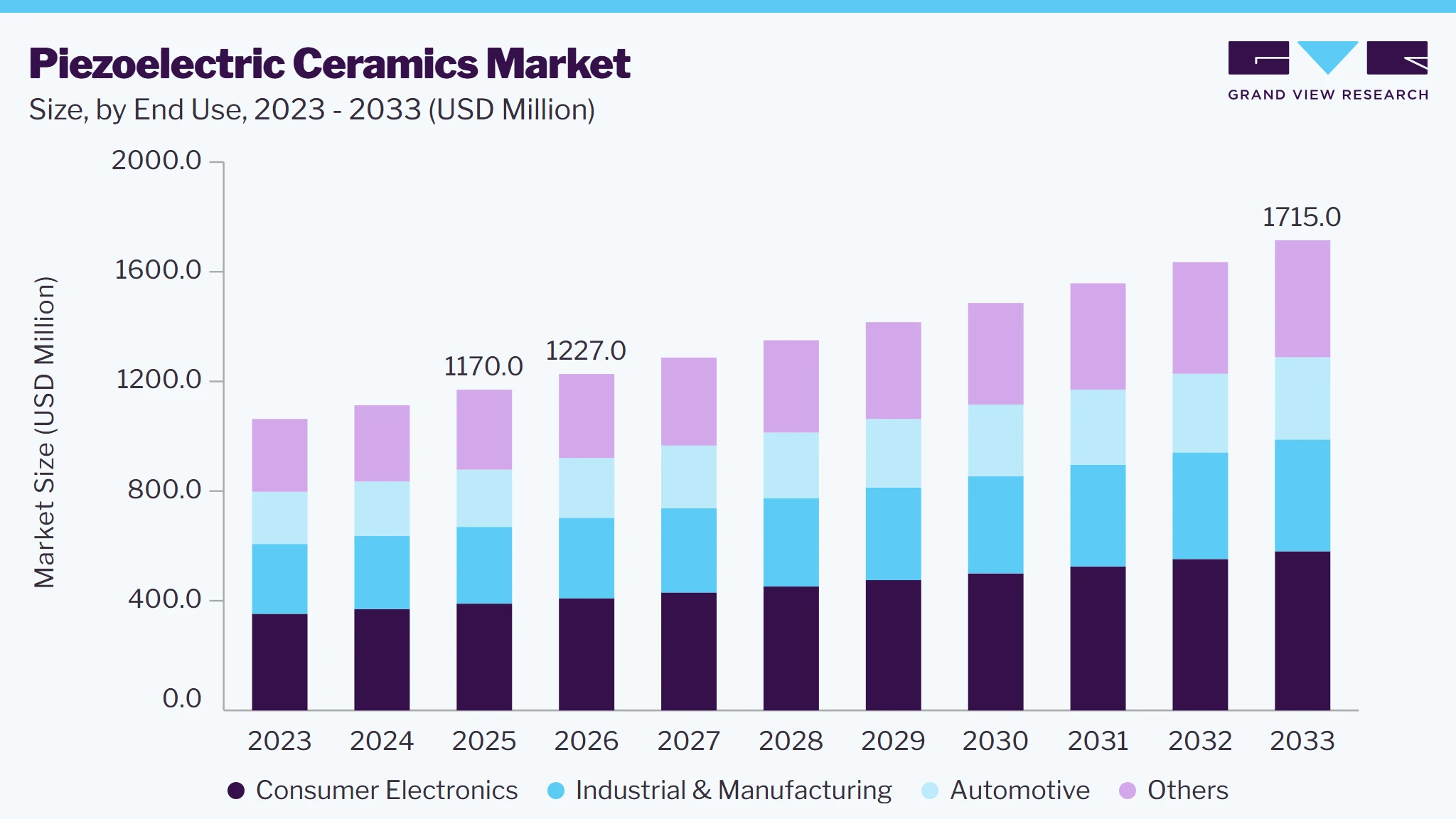 To learn more about this report,Their excellent electromechanical coupling, high sensitivity, thermal stability, and long-term reliability make them indispensable across automotive, medical, industrial automation, aerospace, telecommunications, and consumer electronics applications. As demand grows for miniaturized, energy-efficient, and high-performance electronic systems, manufacturers are increasingly adopting these materials to improve device accuracy, responsiveness, and operational efficiency. Download Free Sample Report
Market Dynamics:
Increasing deployment of sensors and actuators in automotive, industrial automation, healthcare, and consumer electronics is a major factor driving industry growth. These materials provide precise motion control, high-frequency operation, rapid response times, and exceptional durability, making them ideal for applications such as fuel injection systems, ultrasonic imaging equipment, precision positioning devices, vibration monitoring systems, and MEMS-based components. Growing adoption of electric vehicles, autonomous driving technologies, robotics, and smart manufacturing is further increasing demand for high-performance piezoelectric components.
Supportive government initiatives promoting domestic electronics manufacturing, semiconductor production, digital infrastructure, and advanced healthcare technologies are reinforcing this trend. Continuous innovation in AI-enabled devices, IoT ecosystems, wearable electronics, and next-generation communication networks is expected to create sustained opportunities for manufacturers over the forecast period.
Production requires high-purity raw materials, precise compositional control, advanced ceramic processing techniques, and stringent quality assurance, making manufacturing significantly more expensive than many conventional functional materials. Achieving consistent electrical performance, dimensional accuracy, and long-term reliability involves specialized sintering, polarization, machining, and inspection processes, all of which increase production costs and capital requirements.
In addition, machining brittle ceramic materials into intricate geometries without compromising performance remains technically challenging. The limited number of manufacturers capable of producing high-quality components at scale, coupled with stringent quality standards for automotive, medical, and aerospace applications, results in longer production lead times and higher procurement costs, creating barriers for smaller manufacturers and new market entrants.
The increasing focus on environmental sustainability and stricter regulations governing the use of hazardous substances are creating significant opportunities for lead-free piezoelectric ceramics. While lead zirconate titanate (PZT) remains the dominant material due to its superior piezoelectric performance, growing research and commercialization of alternatives such as barium titanate, potassium sodium niobate (KNN), and bismuth sodium titanate (BNT) are expanding the industry's growth potential. Rising demand from medical devices, consumer electronics, automotive electronics, wearable technologies, and industrial sensors is encouraging manufacturers to develop high-performance, eco-friendly materials that comply with global environmental standards.
Analyst Perspective
The piezoelectric ceramics industry is expected to witness steady growth over the forecast period. Rising demand for sensors, actuators, and ultrasonic devices is driving adoption across key industries. Increasing production of electric vehicles, consumer electronics, and medical devices is further supporting demand. Advancements in lead-free materials and precision ceramic manufacturing are improving performance and expanding application areas. These factors are expected to sustain long-term market growth.
End Use Insights
The consumer electronics segment held the largest market share of 33.3% in 2025 and is also expected to expand at the highest CAGR of 5.1% through 2033. Increasing production of smartphones, wearable devices, laptops, tablets, audio equipment, and smart home products continues to drive demand for piezoelectric components used in microphones, speakers, vibration motors, touch interfaces, and ultrasonic sensors. The ongoing trend toward miniaturization, energy-efficient electronics, and IoT-enabled devices is further supporting segment growth.
The automotive segment is expected to witness steady growth, driven by the rapid adoption of electric vehicles (EVs), advanced driver assistance systems (ADAS), autonomous driving technologies, and vehicle electrification. Piezoelectric ceramics are increasingly incorporated into fuel injection systems, knock sensors, pressure sensors, ultrasonic parking sensors, occupant detection systems, and battery management applications due to their high sensitivity, fast response, and long-term reliability. Growing investments in connected and intelligent mobility solutions are expected to strengthen demand from the automotive industry further.
Material Insights
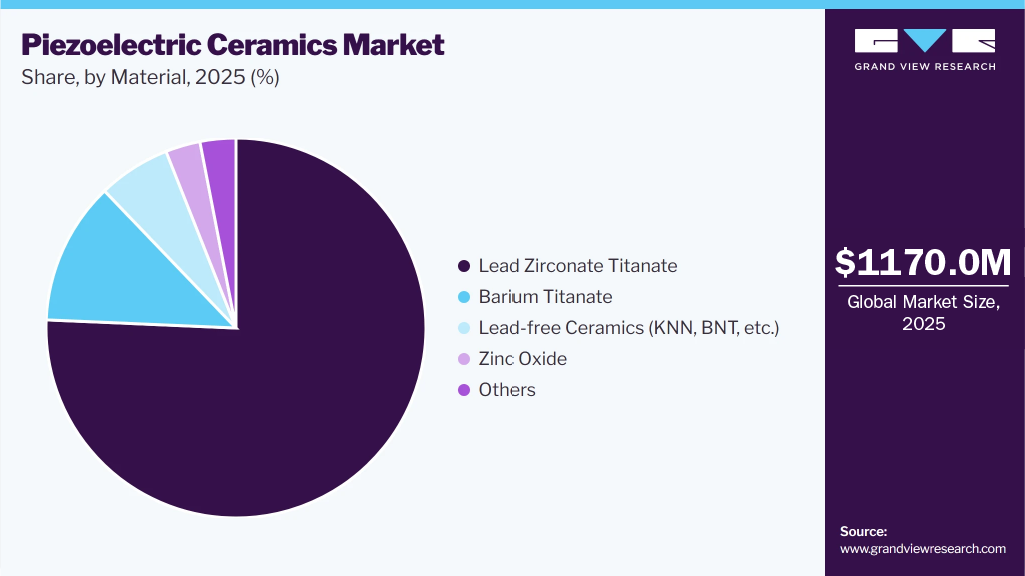
Lead zirconate titanate (PZT) accounted for the largest share of 75.7% in 2025 owing to its superior piezoelectric properties, high electromechanical coupling coefficient, excellent dielectric characteristics, and reliable performance across a broad range of applications. It is extensively used in ultrasonic transducers, actuators, sensors, fuel injectors, medical imaging equipment, and industrial automation systems, where high precision and durability are critical.
 To learn more about this report, Download Free Sample Report
Meanwhile, lead-free ceramics are projected to register the highest CAGR of 6.5% during the forecast period, supported by increasing environmental regulations restricting hazardous substances, growing investments in sustainable materials, and ongoing advancements in barium titanate, potassium sodium niobate (KNN), and bismuth sodium titanate (BNT) technologies.
Regional Insights
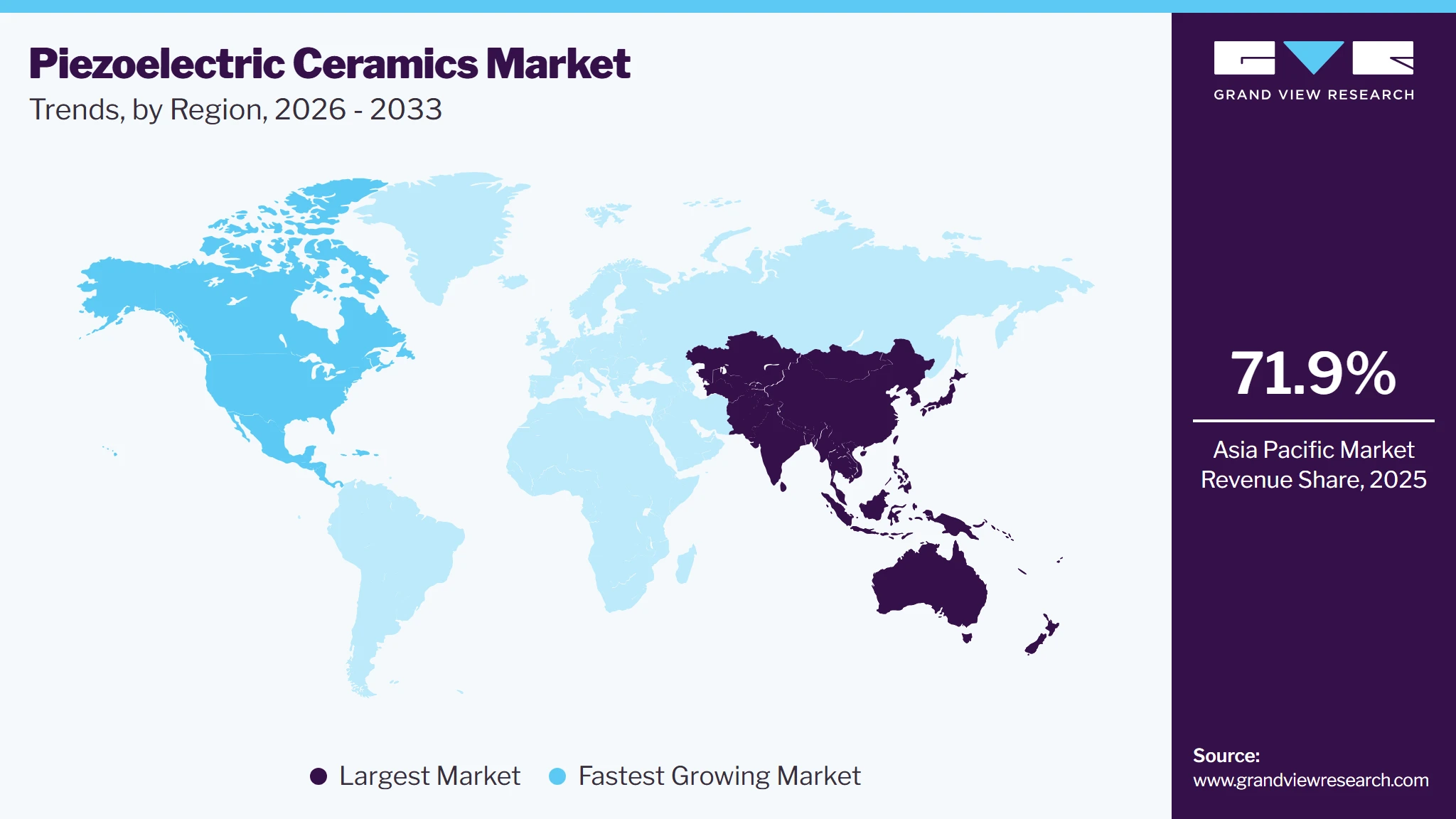
Asia Pacific piezoelectric ceramics industry held the largest global share in 2025, supported by its strong electronics manufacturing ecosystem and the presence of leading producers in China, Japan, South Korea, and Taiwan. The region benefits from robust demand for piezoelectric components across consumer electronics, automotive, industrial automation, telecommunications, and medical devices. Continued investments in semiconductor manufacturing, electric vehicles, and advanced manufacturing technologies, along with supportive government policies, are expected to sustain regional leadership throughout the forecast period.
 To learn more about this report, Download Free Sample Report
China Piezoelectric Ceramics Market Trends
China piezoelectric ceramics industry remains the largest contributor within the Asia Pacific owing to its extensive electronics manufacturing base and rapidly expanding production of electric vehicles, consumer electronics, and industrial equipment. Government initiatives promoting semiconductor self-sufficiency, intelligent manufacturing, and advanced materials are accelerating the adoption of high-performance piezoelectric components. Strong domestic demand, combined with the country's position as a major exporter of electronic products, continues to strengthen its market position.
Europe Piezoelectric Ceramics Market Trends
Europe piezoelectric ceramics industry is witnessing sustained growth, supported by its well-established automotive, industrial automation, aerospace, and healthcare sectors. Increasing adoption of electric mobility, Industry 4.0 technologies, and precision medical equipment is driving the use of advanced piezoelectric materials across the region. In addition, stringent environmental regulations and growing investments in lead-free ceramic technologies are encouraging innovation and expanding application opportunities.
North America Piezoelectric Ceramics Market Trends
North America piezoelectric ceramics industry is expected to register fastest growth, driven by increasing investments in semiconductor fabrication, medical technology, aerospace, defense, and industrial automation. Rising adoption of advanced sensing, ultrasonic imaging, and precision motion control technologies is supporting demand across multiple high-value industries. The region's emphasis on technological innovation and research in advanced materials is further contributing to long-term growth.
U.S. Piezoelectric Ceramics Market Trends
The U.S. piezoelectric ceramics industry accounted for the largest share of the North American market, supported by its leadership in semiconductor manufacturing, aerospace, defense, healthcare, and advanced industrial technologies. Increasing investments in domestic chip production, electric vehicles, robotics, and next-generation communication infrastructure are driving demand for high-performance sensors, actuators, and ultrasonic devices. Continuous innovation in smart electronics and advanced manufacturing is expected to strengthen industry growth further.
Latin America Piezoelectric Ceramics Market Trends
Latin America piezoelectric ceramics industry is anticipated to experience moderate growth, driven by expanding electronics manufacturing, automotive production, and healthcare infrastructure across key economies such as Brazil and Mexico. Increasing industrial automation, rising demand for consumer electronics, and growing investments in advanced manufacturing are contributing to higher adoption of piezoelectric components. Continued foreign direct investment and technological modernization are expected to support the region's long-term development.
Middle East & Africa Piezoelectric Ceramics Market Trends
The Middle East & Africa piezoelectric ceramics industry is emerging as a promising region, supported by increasing investments in industrial modernization, healthcare infrastructure, telecommunications, and smart city development. Governments across the region are actively promoting economic diversification and advanced manufacturing, creating opportunities for greater adoption of precision electronic components. The manufacturing base is still developing, and rising investments in high-value industries are expected to support steady growth.
Key Piezoelectric Ceramics Company Insights
Some of the key players operating in the market include PI Ceramic GmbH, CeramTec GmbH, and others.
-
PI Ceramic GmbH, established in 1992, is a Germany-based manufacturer specializing in piezoelectric ceramics, multilayer actuators, ultrasonic transducers, and precision motion components for industrial, medical, aerospace, and scientific applications. The company's offerings include lead zirconate titanate (PZT) ceramics, lead-free piezoceramics, piezo stacks, discs, rings, tubes, plates, custom ceramic elements, and multilayer actuators used in precision positioning systems, ultrasonic devices, sensors, and high-performance actuators.
-
CeramTec GmbH, established in 1903, is a global manufacturer of advanced technical ceramics serving the medical, electronics, automotive, energy, industrial, and semiconductor industries. The company's portfolio includes piezoelectric ceramic materials, PZT-based components, ultrasonic transducers, piezo discs, rings, cylinders, customized ceramic elements, and high-performance piezoceramic solutions designed for sensing, actuation, ultrasonic welding, flow measurement, and medical imaging applications.
-
APC International, Ltd., established in 1984, is a U.S.-based manufacturer specializing in piezoelectric ceramics and custom piezoelectric components for industrial, medical, aerospace, defense, and research applications. The company's offerings include lead zirconate titanate (PZT) ceramics, lead-free piezoelectric materials, piezo discs, plates, rings, cylinders, tubes, spheres, multilayer actuators, ultrasonic transducers, and custom-engineered piezoceramic components used in sensors, actuators, sonar systems, medical ultrasound, and precision instrumentation.
Key Piezoelectric Ceramics Companies
The following key companies have been profiled for this study on the piezoelectric ceramics market.
-
APC International, Ltd.
-
Audiowell Electronics (Guangdong) Co., Ltd.
-
CeramTec GmbH
-
CTS Corporation
-
Fuji Ceramics Corporation
-
Johnson Matthey Piezo Products GmbH
-
Morgan Advanced Materials plc
-
PI Ceramic GmbH
-
Physik Instrumente (PI) GmbH & Co. KG
Competitive Benchmarking
Category
Operating Strategies
Competitive Edge
Weakness
Established Players (e.g., CeramTec GmbH, CTS Corporation, Fuji Ceramics Corporation, Morgan Advanced Materials plc, PI Ceramic GmbH, Physik Instrumente (PI) GmbH & Co. KG, TDK Electronics AG)
-
Develop high-performance and lead-free piezoelectric materials for advanced sensing and actuation applications.
-
Invest in advanced manufacturing technologies and multilayer ceramic innovations.
-
Strengthening OEM partnerships through customized solutions and technical support.
-
Extensive R&D capabilities and proprietary material formulations enable superior electromechanical performance, reliability, and product consistency.
-
Strong global sales networks and diversified end-user portfolios reduce dependence on a single application sector.
-
Established customer relationships and proven quality certifications provide a competitive advantage in highly regulated industries such as healthcare, aerospace, and automotive.
-
High investment requirements for advanced ceramic processing, precision polarization, and quality assurance increase manufacturing costs.
-
Lengthy qualification cycles for medical, aerospace, and automotive applications delay the commercialization of new products.
-
Dependence on mature end-use industries may limit growth during periods of reduced industrial or electronics demand.
Emerging & Regional Players (e.g., APC International, Ltd., Audiowell Electronics (Guangdong) Co., Ltd., Sparkler Ceramics Pvt. Ltd.)
-
Focus on customized piezoelectric ceramic components for ultrasonic, sensing, medical, and energy harvesting applications.
-
Expand regional manufacturing capabilities with flexible production and rapid prototyping services.
-
Compete through cost-effective manufacturing, shorter development timelines, and responsive engineering support.
-
High manufacturing flexibility enables faster customization and shorter product development cycles.
-
Competitive pricing and localized technical support strengthen relationships with regional OEMs and system integrators.
-
Ability to address specialized applications with tailored ceramic compositions and custom geometries creates opportunities in niche markets.
-
Limited global manufacturing capacity and distribution networks constrain participation in large multinational supply programs.
-
Lower R&D budgets may slow the development of next-generation lead-free materials and advanced piezoelectric technologies.
-
Greater reliance on regional demand and a narrower customer base can increase exposure to fluctuations in local market conditions.
Recent Developments
-
In April 2026, Kyocera Corporation announced the development of a multilayer ceramic package technology for next-generation AI and high-performance computing semiconductors. The innovation is designed to improve thermal dissipation, signal integrity, and package reliability, supporting the increasing demand for advanced electronic components.
-
In October 2025, CeramTec GmbH introduced new piezoceramic solutions for ultrasonic sensing and industrial measurement applications. The expanded portfolio is intended to deliver higher precision, improved durability, and reliable performance in medical devices, industrial automation, and non-destructive testing systems.
-
In September 2025, PI Ceramic GmbH expanded its portfolio of lead-free piezoelectric ceramic materials to support customers seeking environmentally compliant alternatives to conventional PZT-based materials. The new solutions target precision positioning, medical technology, semiconductor equipment, and industrial sensing applications.
Piezoelectric Ceramics Market Report Scope
Report Attribute
Details
Market Definition
The market size represents the revenue generated from the sale of piezoelectric ceramics used across consumer electronics, industrial & manufacturing, automotives, and others end use applications globally.
Market size value in 2025
USD 1,170.0 million
Market size value in 2026
USD 1,227.0 million
Revenue forecast in 2033
USD 1,715.0 million
Growth rate
CAGR of 4.9% from 2026 to 2033
Base year for estimation
2025
Historical data
2021 - 2024
Forecast period
2026-2033
Quantitative Units
Revenue in USD million and CAGR from 2026 to 2033
Report coverage
Revenue forecast, competitive landscape, growth factors, and trends
Segments covered
End use, material, region
Regional scope
North America; Europe; Asia Pacific; Latin America; Middle East & Africa
Country scope
U.S.; Canada; Mexico; Germany; UK; France; Italy; China; South Korea; Japan; Taiwan; Brazil
Key companies profiled
APC International, Ltd.; Audiowell Electronics Co., Ltd.; CeramTec GmbH; CTS Corporation; Fuji Ceramics Corporation; Morgan Advanced Materials plc; PI Ceramic GmbH; Physik Instrumente (PI) GmbH & Co. KG; Sparkler Ceramics Pvt. Ltd.; TDK Electronics AG
Customization scope
Free report customization (equivalent up to 8 analysts working days) with purchase. Addition or alteration to country, regional & segment scope.
Pricing and purchase options
Avail customized purchase options to meet your exact research needs. Explore purchase options
Global Piezoelectric Ceramics Market Report Segmentation
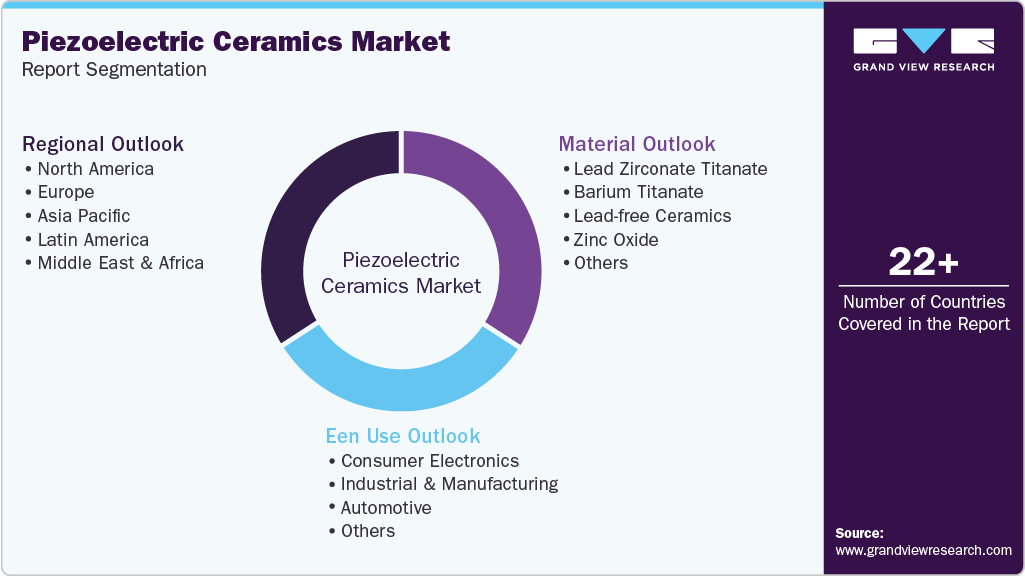
This report forecasts revenue growth at global, regional, and country levels and provides an analysis of the latest industry trends in each of the sub-segments from 2021 to 2033. For this study, Grand View Research has segmented the global piezoelectric ceramics market report based on end use, material, and region.
 To learn more about this report, Download Free Sample Report
-
End Use Outlook (Revenue, USD Million, 2021-2033)
-
Consumer Electronics
-
Industrial & Manufacturing
-
Automotive
-
Others
-
-
Material Outlook (Revenue, USD Million, 2021-2033)
-
Lead Zirconate Titanate
-
Barium Titanate
-
Lead-free Ceramics
-
Zinc Oxide
-
Others
-
-
Regional Outlook (Revenue, USD Million, 2021-2033)
-
North America
-
U.S.
-
Canada
-
Mexico
-
-
Europe
-
Germany
-
UK
-
France
-
Italy
-
-
Asia Pacific
-
China
-
South Korea
-
Japan
-
Taiwan
-
-
Latin America
-
Brazil
-
-
Middle East & Africa
-
Research Methodology
The piezoelectric ceramics market figures in this report are based on a proven research process that combines executive interviews with secondary research from proprietary databases, company filings, and recognized regulatory and institutional sources. Market size is built through value-chain sizing—reconciling supply-side and demand-side estimates—and triangulated with bottom-up and top-down approaches. Every estimate passes multiple levels of expert validation before publication, with each piezoelectric ceramics segment quantified using the revenue-capture definitions in the table below.
Segment Definition
End Use
Revenue Capture Definition
Consumer Electronics Revenue is generated from piezoelectric ceramics used in smartphones, wearables, tablets, laptops, audio devices, cameras, and smart home products. These materials are incorporated into buzzers, speakers, microphones, vibration motors, touch interfaces, and ultrasonic sensors to enhance device functionality and miniaturization. Industrial & Manufacturing Revenue is derived from piezoelectric ceramics used in industrial automation, robotics, precision positioning systems, ultrasonic welding, flow meters, non-destructive testing (NDT), and process monitoring equipment. Demand is driven by the adoption of Industry 4.0 technologies and smart manufacturing. Automotive Revenue is generated from piezoelectric ceramics used in fuel injection systems, knock sensors, pressure sensors, ultrasonic parking sensors, occupant detection systems, tire pressure monitoring systems (TPMS), and advanced driver assistance systems (ADAS). Increasing vehicle electrification and autonomous driving technologies continue to support demand. Others Includes revenue from piezoelectric ceramics used in medical ultrasound equipment, aerospace and defense systems, telecommunications, energy harvesting devices, sonar systems, scientific instruments, and research applications. Material
Revenue Capture Definition
Lead Zirconate Titanate Revenue is generated from lead zirconate titanate ceramics used in sensors, actuators, ultrasonic transducers, piezoelectric motors, fuel injectors, medical imaging equipment, and industrial automation systems due to their superior piezoelectric properties and high electromechanical coupling. Barium Titanate Revenue is derived from barium titanate ceramics used in multilayer ceramic devices, ultrasonic sensors, capacitors, actuators, and consumer electronic applications requiring a high dielectric constant and reliable piezoelectric performance. Lead-free Ceramics Revenue is generated from environmentally friendly piezoelectric ceramics, including potassium sodium niobate (KNN), bismuth sodium titanate (BNT), and other lead-free compositions used in medical devices, automotive electronics, industrial sensors, and consumer electronics to comply with global environmental regulations. Zinc Oxide Revenue is captured from zinc oxide-based piezoelectric materials used in thin-film sensors, MEMS devices, nanogenerators, flexible electronics, acoustic wave devices, and energy harvesting applications due to their semiconducting and piezoelectric characteristics. Others Includes revenue from aluminum nitride, lithium niobate, quartz, lithium tantalate, and other specialized piezoelectric materials used in RF filters, resonators, surface acoustic wave (SAW) devices, bulk acoustic wave (BAW) devices, optical modulators, and precision sensing applications. Estimation Model
Layer Name
Key Question
Description
End-Use Industry Demand Base Layer
What forms the demand base?
Identify global demand across major end-use industries, including consumer electronics, automotive, industrial & manufacturing, healthcare, aerospace & defense, and telecommunications. Assess production volumes of electronic devices, electric vehicles, medical equipment, industrial automation systems, and ultrasonic devices to establish the total addressable demand for piezoelectric ceramics. Application Penetration Layer
Where are piezoelectric ceramics utilized?
Estimate the penetration of piezoelectric ceramics across key applications, including sensors, actuators, ultrasonic transducers, buzzers, piezoelectric motors, vibration generators, energy harvesting devices, fuel injectors, and precision positioning systems. Analyze the adoption of lead zirconate titanate (PZT), barium titanate, lead-free ceramics, zinc oxide, lithium niobate, quartz, and other piezoelectric materials across end-use industries and regions. Consumption Intensity Layer
How much piezoelectric ceramics are consumed?
Evaluate consumption intensity based on the number of piezoelectric components used per product, material requirements, operating conditions, replacement rates, and product complexity. Consumption varies by application, device architecture, performance requirements, miniaturization trends, and technological advancements in sensors, actuators, and ultrasonic systems. Revenue Layer
How is market revenue generated?
Market revenue is generated through the sale of piezoelectric ceramic materials and finished components, including sensors, actuators, transducers, resonators, buzzers, and custom-engineered piezoceramic elements. Revenue growth is driven by increasing demand for smart electronics, electric vehicles, industrial automation, medical imaging systems, advanced sensing technologies, and the development of lead-free piezoelectric materials. Delivered Customizations
This report has been delivered with the following In-depth customization
Client Request
Customization Delivered
Value Adds
Manufacturing Cost Structure Analysis
Comprehensive assessment of the manufacturing cost structure for piezoelectric ceramics, including raw material costs (PZT, barium titanate, lead-free ceramics, zinc oxide), powder synthesis, forming, sintering, machining, electrode deposition, poling, quality inspection, labor, energy consumption, packaging, and logistics. The analysis also evaluates cost variations by material type, production scale, manufacturing process, and region. Identified major cost drivers and cost optimization opportunities across the value chain. Supported pricing strategy, investment planning, process optimization, and profitability improvement. Trade & Manufacturing Capacity Assessment
In-depth assessment of global manufacturing capacities, production footprints, import-export volumes, trade flows, and country-wise manufacturing capabilities for piezoelectric ceramics. The study includes key manufacturing hubs, capacity expansion projects, raw material sourcing, supply chain mapping, regional production versus consumption analysis, and trade dependencies across major markets. Identified supply-demand gaps, regional manufacturing opportunities, sourcing risks, and import dependencies. Enabled strategic sourcing, capacity planning, supply chain optimization, and international market expansion. Pricing Analysis
Comprehensive analysis of piezoelectric ceramic pricing by material type, product type, manufacturing process, and region. The study covers historical and forecast price trends, raw material cost fluctuations, processing and energy costs, demand-supply dynamics, technology advancements, and pricing variations across major end-use industries. Improved procurement and pricing strategies by identifying key cost drivers, regional price differences, and future pricing trends. Supported supplier evaluation, contract negotiations, cost optimization, and margin enhancement. Frequently Asked Questions About This Report
The global piezoelectric ceramics market size was estimated at USD 1,170.0 million in 2025 and is expected to reach USD 1,227.0 million in 2026.
The global piezoelectric ceramics market is expected to grow at a compound annual growth rate of 4.9% from 2026 to 2033 to reach USD 1,715.0 million by 2033.
By end use, consumer electronics accounted for the largest market revenue share of 33.3% in 2025
Asia Pacific dominated the piezoelectric ceramics market with the largest revenue share of 71.9% in 2025.
The key factor driving the growth of the global piezoelectric ceramics market is the increasing adoption of sensors, actuators, and ultrasonic devices across automotive, consumer electronics, healthcare, and industrial automation applications.
Some of the key players of the global piezoelectric ceramics market are APC International, Ltd., Audiowell Electronics (Guangdong) Co., Ltd., CeramTec GmbH, CTS Corporation, Fuji Ceramics Corporation, Morgan Advanced Materials plc, PI Ceramic GmbH, Physik Instrumente (PI) GmbH & Co. KG, Sparkler Ceramics Pvt. Ltd., TDK Electronics AG, and others.
The piezoelectric ceramics market in China held the largest share in the Asia Pacific region in 2025.
By material, the lead-free ceramics segment is anticipated to register the fastest CAGR of 5.6% from 2026 to 2033.
The consumer electronics segment is expected to register the highest growth rate during the forecast period, driven by increasing demand for smartphones, wearable devices, audio equipment, and miniaturized electronic components incorporating piezoelectric sensors and actuators.
About the Author(s)
Advanced Interior Materials Research Team
Advanced Materials · Advanced Interior MaterialsThis report was authored by the advanced interior materials research team at Grand View Research - comprising two research analysts, one senior research analyst, and one industry expert - with specialized expertise in the advanced interior materials segment of the advanced materials industry. All findings are based on proprietary advanced materials databases, executive interviews, and regulatory analysis, subject to internal peer review prior to publication.
Last Updated:
Speak to Analyst

Customize this report to your needs - add regions, segments, or data points, with 20% free customization.
Or view our licence options:


ISO 9001:2015 & 27001:2022 Certified
We are GDPR and CCPA compliant! Your transaction & personal information is safe and secure. For more details, please read our privacy policy.


