
- Home
- »
- Conventional Energy
- »
-
Pipeline Integrity Management Market Size Report, 2033GVR Report cover

Pipeline Integrity Management Market (2026 - 2033)
Size, Share & Trends Analysis Report By Location (Onshore, Offshore), By Service (Inspection Service, Cleaning Service, Repairs & Refurbishment), By Region (North America, Europe, Asia Pacific), And Segment Forecasts
Market Size, 2025
$9.0BMarket Estimate, 2026
$9.4BMarket Forecast, 2033
$14.7BCAGR, 2026–2033
6.6%Pipeline Integrity Management Market Summary
The global pipeline integrity management market size was valued at USD 9.0 billion in 2025 and is projected to grow from USD 9.4 billion in 2026 to USD 14.7 billion by 2033, at a CAGR of 6.6% from 2026 to 2033. North America dominated the market, accounting for a revenue share of 37.7% in 2025. Increasing demand for petroleum products such as LPG, LNG, petrol, and diesel is expected to fuel the need for pipeline integrity management services.
 Source: Grand View Research, IR Documents, Primary Interviews, Paid DatabasesTo learn more about this report,
 Download Free Sample Report
Key Market Trends & Insights
- By location: Onshore segment led the market with the largest revenue share of 87.5% in 2025.
- By service: Inspection service segment led the market with the largest revenue share of 49.8% in 2025.
Regional Highlights
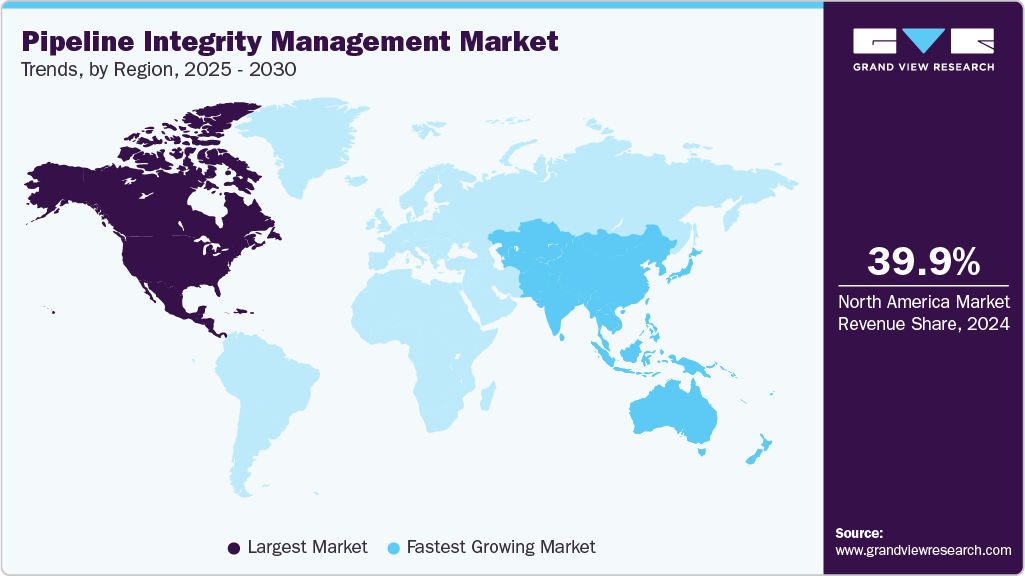
- Largest regional market: North America (37.7% revenue share, 2025)
- Fastest-growing regional market: Asia Pacific (highest CAGR, 2026-2033)
- By country: The U.S. held the largest share of North America in 2025.
Market Size & Forecast
- Market Size in 2025: USD 9.0 Billion
- Estimated Market Size in 2026: USD 9.4 Billion
- Projected Market Size by 2033: USD 14.7 Billion
- CAGR (2026-2033): 6.6%
Prism AI by Grand View Research Free to tryAsk a question about the pipeline integrity management marketTry asking✓Every figure cited from GVR research Prefer the report? Download free sample →
The rising expansion of the oil & gas industry has increased the need to maintain pipeline infrastructure's safety and reliability. This has boosted the demand for pipeline integrity management (PIM) solutions to ensure the optimal functioning of pipelines.In addition, integrating advanced technologies in PIM solutions, including artificial intelligence (AI) and the Internet of Things (IoT), offers enhanced monitoring and predictive analysis capabilities. This will enable the identification of potential issues to mitigate risks, thereby further improving the efficiency of the pipeline infrastructure.
 To learn more about this report, Download Free Sample Report
Technological advancements, smart pigging, and real-time monitoring systems are expected to improve integrity management solutions and services, making them more efficient and cost-effective. These advancements enable early detection of flaws and potential threats to pipeline safety, thereby preventing accidents and ensuring uninterrupted supply.
 To learn more about this report, Download Free Sample Report
The high initial cost and complexity of implementing advanced pipeline integrity management systems and services are expected to hinder market growth over the coming year. Small and mid-sized companies find investing in these expensive technologies challenging, which can impact market growth. However, large companies have high capital expenditures, and thus, it is easy for them to implement such advanced systems.
The increasing environmental protection and pipeline regulations and standards will likely provide new opportunities for market participants. There is a growing demand for services and solutions that can help pipeline operators comply with these regulations, opening new avenues for market expansion. In addition, technologies that can work in harsh environmental conditions are expected to provide new sales avenues for market players.
Market Dynamics
The pipeline integrity management market is growing due to increasing investments in aging pipeline infrastructure, stricter safety regulations, and the rising need to prevent leaks and environmental incidents. Pipeline operators are adopting advanced inspection technologies, real-time monitoring systems, and data analytics to improve asset reliability and reduce maintenance costs. The expansion of oil, gas, hydrogen, and carbon dioxide pipeline networks is further driving demand for integrity management solutions. In addition, digital technologies such as AI, IoT, and predictive maintenance are helping operators identify potential failures early and optimize pipeline performance.
Stringent pipeline safety regulations are driving the growth of the pipeline integrity management market by requiring operators to regularly inspect, monitor, and maintain pipeline networks. Agencies such as the U.S. Pipeline and Hazardous Materials Safety Administration (PHMSA) mandate integrity management programs to reduce the risk of leaks, failures, and environmental incidents. Compliance with these regulations encourages investments in advanced inspection tools, leak detection systems, and predictive maintenance technologies. As governments tighten safety standards, demand for pipeline integrity management solutions continues to increase.
In July 2026, PHMSA issued updated guidance for gas distribution operators to strengthen their Distribution Integrity Management Programs (DIMP). The guidance recommends improved risk assessment methods, enhanced leak management practices, and better use of data analytics to identify potential pipeline failures. These regulatory updates are prompting operators to upgrade integrity management systems and adopt advanced monitoring technologies to meet evolving compliance requirements.
The high upfront cost of pipeline integrity management systems is a major restraint for the market, particularly for small and mid-sized pipeline operators. Advanced in-line inspection (ILI) tools, smart pigging equipment, leak detection systems, and data analytics platforms require significant capital investment. In addition to equipment costs, operators must also invest in skilled personnel, software integration, and periodic inspections. These financial barriers can delay the adoption of comprehensive integrity management programs, especially in developing regions. A key example is the deployment of smart pigging technology, which requires specialized inspection tools, pipeline modifications, launch and receiving facilities, and temporary operational shutdowns during inspections.
The increasing adoption of predictive digital tools presents a significant growth opportunity for the pipeline integrity management market. Pipeline operators are shifting from reactive maintenance to predictive maintenance by using artificial intelligence, cloud-based analytics, digital twins, and IoT-enabled monitoring systems. These technologies enable continuous asset monitoring, early fault detection, and data-driven maintenance planning, helping reduce unplanned downtime and repair costs. According to DNV's Pipeline Insights 2025 report, 85% of pipeline professionals increased their focus on digitalization and 63% plan to raise digitalization investments, accelerating the adoption of AI, cloud analytics, and digital twin technologies for predictive pipeline integrity management.
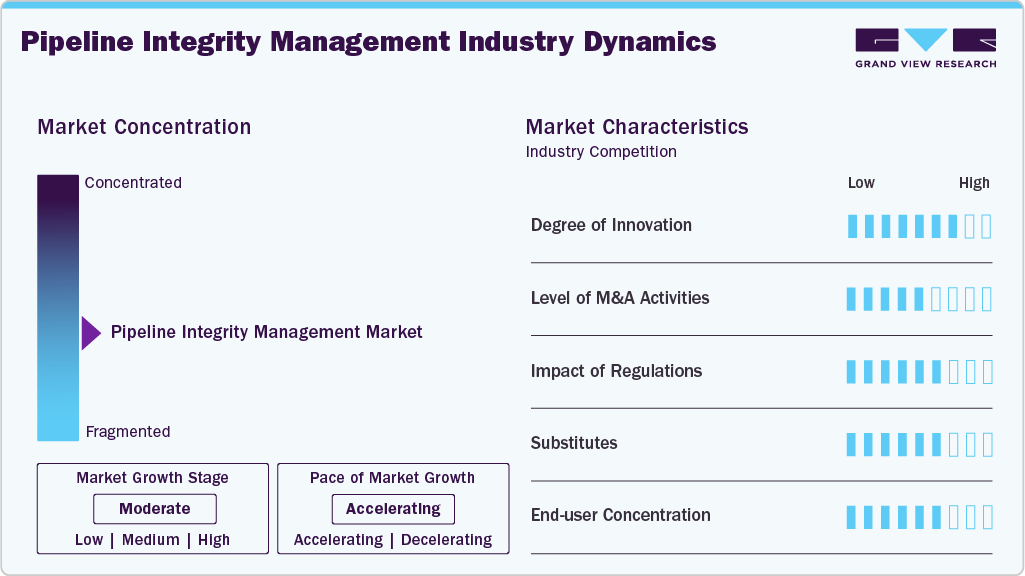
Market Concentration & Characteristics
The pipeline integrity management market is experiencing growth, driven by factors such as aging pipeline infrastructure, stricter regulatory requirements, heightened emphasis on safety and incident prevention, and the adoption of advanced data analytics and risk-based inspection methods. Cutting-edge innovations like digital twin technology, predictive maintenance, remote monitoring, and improved leak detection systems are becoming standard practices in the industry. In October 2024, Applus+ completed 904L Quick-Lock system installation for pipeline rehabilitation. It allows internal repairs without entry of human and is designed for demanding pipeline conditions.
Key technological advancements enhance real-time pipeline monitoring and support risk-based inspection approaches. Honeywell introduced its AI-based Gas Cloud Imaging system, which continuously monitors hazardous gas leaks, improving safety at oil, gas, and chemical facilities.
 To learn more about this report, Download Free Sample Report
Key companies in the pipeline integrity management market are engaged in moderate merger and acquisition (M&A) activity to enhance their technological capabilities and broaden their service offerings. In August 2022, Baker Hughes agreed to acquire a subsidiary of Team, Inc, Quest Integrity. The acquisition includes the latter’s Furnace Tube Inspection (FTIS) and Invista technology. This acquisition aligns with Baker Hughes’ existing asset integrity offerings and is expected to support clients by ensuring the asset infrastructure is reliable and safe.
Analyst Perspective
The pipeline integrity management market is expected to witness steady growth as aging pipeline infrastructure, stricter safety regulations, and rising investments in energy transportation networks increase the need for continuous asset monitoring. Operators are shifting from periodic inspections to predictive integrity management to reduce failures, maintenance costs, and unplanned downtime. The integration of AI, machine learning, and advanced inline inspection technologies is improving defect detection and enabling data-driven maintenance decisions. An emerging trend is the adoption of digital twin technology, which allows real-time simulation of pipeline conditions and supports proactive risk assessment throughout the asset lifecycle.
Location Insights
Based on location, the onshore segment led the market with the largest revenue share of 87.5% in 2025.. The onshore segment deals with pipelines trailing land to transport oil, gas, and other substances. This segment faces unique challenges, including environmental conditions, land usage conflicts, and the need for meticulous monitoring and maintenance to prevent leaks or ruptures that could have significant environmental and safety impacts. Pipeline integrity management services can address these challenges by employing a combination of inspections, corrosion control, and leak detection technologies.
The offshore segment is expected to grow at the fastest CAGR over the forecast period. The segment mainly deals with pipelines located in marine environments, often used to connect production platforms with onshore facilities. Offshore pipelines are subjected to harsher conditions, including deep water pressures, corrosive saltwater environments, and extreme weather, posing unique challenges for pipeline integrity management. In such conditions, robust materials, advanced corrosion protection systems, and sophisticated monitoring and inspection techniques adapted for the marine context are emphasized.
Service Insights
Based on service, the inspection service segment led the market with the largest revenue share of 49.8% in 2025. This segment includes identifying and assessing potential risks and damages to pipeline infrastructure. It has seen significant growth, driven by the need for regular inspections to ensure compliance with safety standards and extend the lifespan of pipeline assets.
 To learn more about this report, Download Free Sample Report
The cleaning services segment is expected to grow at the fastest CAGR over the forecast period. The segment is vital in maintaining pipeline efficiency and safety. Regular cleaning helps prevent blockages and buildup that can lead to corrosion or leaks. The increasing awareness about the importance of pipeline hygiene is expected to benefit the market growth.
Repairs & refurbishment is expected to grow significantly over the forecast period. The segment includes restoration and enhancement of existing pipeline systems to meet current operational standards and safety requirements. The services in this segment include minor repairs to address specific damages and refurbishments that might involve replacing large sections of a pipeline or upgrading its material and technology to extend its service life. The growing need to maintain the continuous and safe operation of pipelines is expected to benefit market growth over the coming years.
Regional Insights
North America dominated the pipeline integrity management market with the revenue share of 37.7% in 2025 and is expected to maintain its dominance during the forecast period. The North American market is characterized by its extensive network of oil and gas pipelines and a stringent regulatory environment. The region's focus on reducing environmental impact and preventing pipeline failures supports the continued adoption of pipeline integrity management (PIM) services. In addition, the rising crude oil production in the region is anticipated to fuel the PIM services.
 To learn more about this report, Download Free Sample Report
U.S. Pipeline Integrity Management Market Trends
The pipeline integrity management market in the U.S. held the largest share in the North America region in 2025. The country's large infrastructure of pipelines transporting oil, gas, and chemicals requires comprehensive integrity management solutions to meet safety and operational efficiency standards.
Europe Pipeline Integrity Management Market Trends
The European pipeline integrity management market is expected to grow significantly over the forecast period. This growth is driven by strict EU regulations on pipeline safety and the region's commitment to environmental sustainability. European countries are investing in advanced PIM technologies and services to upgrade their aging pipeline infrastructure and mitigate risks.
Asia Pacific Pipeline Integrity Management Market Trends
The China pipeline integrity management market held the largest revenue share in 2025. This growth is driven by rapid industrialization, expanding oil and gas pipeline infrastructure, and increasing investments in advanced inspection and monitoring technologies to ensure pipeline safety and reliability. Government initiatives in countries like India and China to increase natural gas usage and upgrade aging infrastructure further support this market expansion.
The China pipeline integrity management market held the largest revenue share in 2024. China’s expanding oil and gas pipeline networks, with ambitious renewable energy targets and stringent safety regulations, are accelerating the adoption of advanced pipeline integrity solutions. Investments in modernization of pipeline infrastructure and increased focus on environmental protection drive demand for technologies that enhance pipeline safety and operational efficiency.
Key Pipeline Integrity Management Company Insights
Some key companies operating in the market include Baker Hughes Company.; Rosen Group, Emerson Electric Co.; IKM Gruppen AS. Major market players have been focusing on innovation, novel product launches, and adoption of advanced technologies.
-
Baker Hughes, a GE company, is one of the world's leading oil field services companies. The company has a presence in over 120 countries and provides products and services for oil and gas exploration, production, and refining. The company also provides digital solutions that assist in enhancing efficiency and productivity for its customers.
-
Rosen is a leading provider of integrity and inspection services for a wide range of industries, including oil and gas, petrochemical, and other energy sectors. The company was founded in 1981 and has operations in more than 120 countries.
Key Pipeline Integrity Management Companies:
The following are the leading companies in the pipeline integrity management market.
- Applus+
- Baker Hughes Company
- Emerson Electric Co.
- IKM Gruppen AS
- Lin Scan
- NDT Global
- Rosen Group
- Schneider Electric Group
- SGS S.A.
- T. D. Williamson, Inc.
Competitive Benchmarking
Category
Operating Strategies
Competitive Edge
Weakness
Established Players (Applus, Baker Hughes Company., Emerson Electric Co., NDT Global, Rosen Group, Schneider Electric, SGS S.A., T. D. Williamson, Inc.)
- Provide integrated pipeline integrity management services covering inspection, monitoring, maintenance, data analytics, and asset lifecycle management through a single service platform.
- Invest significantly in advanced technologies such as AI, digital twins, robotics, intelligent pigging, and predictive analytics to improve inspection accuracy and reduce pipeline downtime.
- Expand market presence through mergers, acquisitions, strategic partnerships, and long-term contracts with oil & gas operators, pipeline owners, and utility companies.
- Strong global footprint and well-established customer relationships enable them to secure large, long-term pipeline integrity projects across both onshore and offshore assets.
- Broad portfolios of products and services allow customers to obtain inspection, monitoring, maintenance, and consulting solutions from a single provider.
- Significant financial resources support continuous investment in research and development, helping maintain technological leadership and regulatory compliance.
- High operating and administrative costs often make their services more expensive than those of smaller specialized competitors.
- Large organizational structures can slow decision-making, technology deployment, and responses to changing customer requirements.
- Integration of acquired businesses and technologies can create operational complexities and increase management challenges.
Emerging Players (IKM Operations, Lin Scan)
- Focus on specialized services such as intelligent pigging, non-destructive testing (NDT), corrosion monitoring, and advanced inspection technologies to build expertise in targeted market segments.
- Develop customized integrity management solutions tailored to specific pipeline conditions, customer requirements, and regional regulatory standards.
- Expand business through regional partnerships, technology collaborations, and selective entry into high-growth pipeline markets where specialized expertise is in demand.
- Specialized technical expertise enables them to deliver highly accurate inspection and diagnostic services for complex pipeline integrity challenges.
- Smaller organizational structures allow faster decision-making, quicker technology adoption, and greater responsiveness to customer requirements.
- Flexible business models enable them to provide customized and cost-effective solutions that are often better suited to mid-sized operators and regional pipeline networks.
- Limited financial resources can restrict investments in global expansion, large-scale R&D programs, and major infrastructure projects.
- Smaller geographic presence and lower brand recognition make it more challenging to compete for large international contracts against established multinational companies.
- Narrower service portfolios may require customers to engage multiple vendors for complete pipeline integrity management programs.
Recent Developments
-
In April 2025, Applus+ launched a project in El Salvador using its DTI Trekscan ultrasonic in-line inspection tool to detect corrosion and deformations in transmission and distribution pipelines.
-
In July 2024, South Sudan and Ethiopia announced an agreement to construct a new pipeline connecting the Nile state in South Sudan and the Gambella region of Ethiopia. This will enable improved pipeline infrastructure in both countries.
-
In July 2024, the U.S. Department of Justice (DOJ) proposed modifications in the Lakehead pipeline system by Enbridge Energy. Under this proposal, the company would be required to fix the previously identified cracks. Earlier, in 2016, DOJ and Enbridge reached a settlement agreement associated with the Kalamazoo River oil spill.
Pipeline Integrity Management Market Report Scope
Report Attribute
Details
Market Definition
The pipeline integrity management market comprises services that inspect, clean, maintain, and repair onshore and offshore pipelines to ensure safe and reliable operation. Market revenue represents earnings generated from inspection, cleaning, and repair & refurbishment services.
Market size in 2025
USD 9.0 billion
Estimated Market size in 2026
USD 9.4 billion
Projected Market size by 2033
USD 14.7 billion
Growth rate
CAGR of 6.6% from 2026 to 2033
Base year for estimation
2025
Historical data
2021 - 2024
Forecast period
2026 - 2033
Quantitative units
Revenue in USD Million and CAGR from 2026 to 2033
Report coverage
Revenue forecast, company ranking, competitive landscape, growth factors, and trends
Segments covered
Location, Service, Region
Regional scope
North America, Europe, Asia Pacific, Latin America, Middle East & Africa
Country scope
U.S., Canada, Mexico, Germany, UK, Russia, China, India, Japan, South Korea, Brazil, GCC, South Africa
Key companies profiled
Applus, Baker Hughes Company., Emerson Electric Co., IKM Operations, Lin Scan, NDT Global, Rosen Group, Schneider Electric, SGS S.A., T. D. Williamson, Inc.
Customization scope
Free report customization (equivalent up to 8 analysts' working days) with purchase. Addition or alteration to country, regional & segment scope.
Pricing and purchase options
Avail customized purchase options to meet your exact research needs. Explore purchase options
Global Pipeline Integrity Management Market Report Segmentation
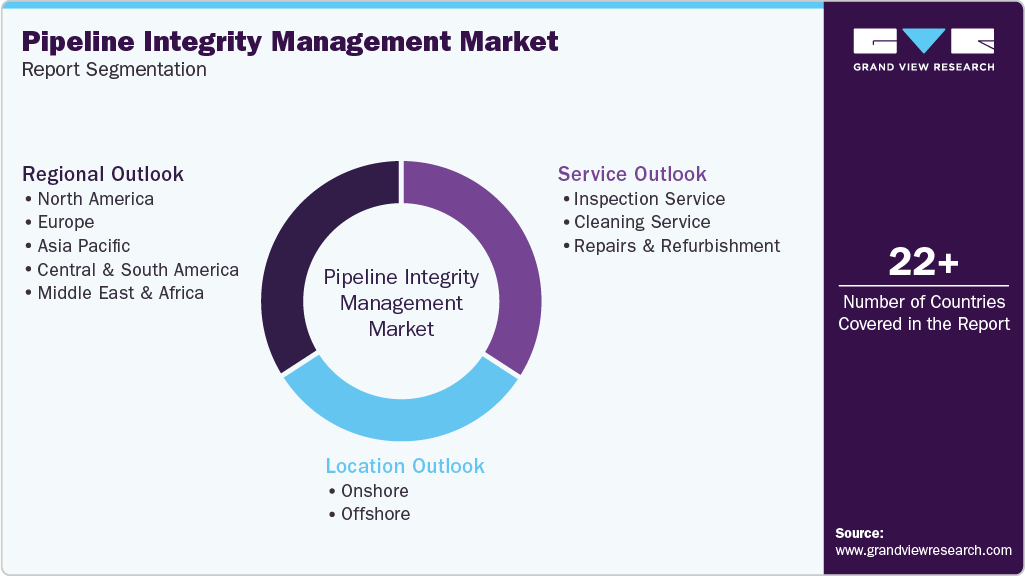
This report forecasts revenue growth at global, regional, and country levels as well as provides an analysis of the latest trends in each of the sub-segments from 2021 to 2033. For this study, Grand View Research has segmented the pipeline integrity management market report on the basis of location, service, and region:
 To learn more about this report, Download Free Sample Report
-
Location Outlook (Revenue, USD Billion, 2021 - 2033)
-
Onshore
-
Offshore
-
-
Service Outlook (Revenue, USD Billion, 2021 - 2033)
-
Inspection Service
-
Cleaning Service
-
Repairs & Refurbishment
-
-
Regional Outlook (Revenue, USD Billion, 2021 - 2033)
-
North America
-
U.S.
-
Canada
-
Mexico
-
-
Europe
-
UK
-
Germany
-
Russia
-
-
Asia Pacific
-
Japan
-
China
-
India
-
South Korea
-
-
Central & South America
-
Brazil
-
-
Middle East & Africa
-
GCC
-
South Africa
-
-
Research Methodology
The pipeline integrity management market figures in this report are based on a proven research process that combines executive interviews with secondary research from proprietary databases, company filings, and recognized regulatory and institutional sources. Market size is built through value-chain sizing - reconciling supply-side and demand-side estimates - and triangulated with bottom-up and top-down approaches. Every estimate passes multiple levels of expert validation before publication, with each pipeline integrity management megment quantified using the revenue-capture definitions in the table below.
Segment Definition
Location
Revenue capture definition
Onshore
Represents revenue generated from pipeline integrity management services provided for onshore pipeline networks, including inspection, cleaning, maintenance, and repair activities to ensure safe and reliable operation.
Offshore
Includes revenue from pipeline integrity management services delivered for offshore pipelines, covering integrity assessment, subsea inspection, cleaning, and repair solutions for marine oil and gas infrastructure.
Service
Revenue capture definition
Inspection Service
Represents revenue generated from pipeline inspection services, including in-line inspection (ILI), non-destructive testing (NDT), corrosion assessment, leak detection, and integrity evaluation.
Cleaning Service
Includes revenue from pipeline cleaning services such as pigging, debris removal, wax and scale cleaning, and other maintenance activities performed to improve pipeline performance and flow efficiency.
Repairs & Refurbishment
Comprises revenue generated from pipeline repair and refurbishment services, including defect repairs, corrosion mitigation, pipeline rehabilitation, component replacement, and life extension projects.
Estimation Model
Layer Name
Key Question
Description
Pipeline Integrity Management Demand Layer
What drives the demand for pipeline integrity management?
Identify the key demand drivers, including aging pipeline infrastructure, stringent safety regulations, expansion of oil, gas, hydrogen, and CO₂ pipeline networks, and increasing investments in asset integrity and preventive maintenance. Assess the impact of environmental compliance and digital monitoring on market growth.
Pipeline Integrity Management Location Layer
Which pipeline locations generate the highest demand?
Analyze market adoption across onshore and offshore pipeline networks. Assess demand based on pipeline length, operating environment, maintenance requirements, and integrity management needs in each location.
Pipeline Integrity Management Service Layer
Which services are most widely adopted?
Evaluate demand for inspection services, cleaning services, and repair & refurbishment. Assess adoption based on pipeline condition, regulatory inspection requirements, maintenance frequency, and asset life extension strategies.
Revenue Layer
How is market revenue generated?
Market revenue is quantified through the provision of inspection, cleaning, and repair & refurbishment services for onshore and offshore pipelines. The overall market value is determined by revenue generated from integrity management activities that help ensure pipeline safety, reliability, regulatory compliance, and operational efficiency.
Delivered Customizations
This report has been delivered with the following In-depth customizations
Client Request
Customization Delivered
Value Adds
Competitive Landscape & Market Share Analysis
A detailed assessment of leading pipeline integrity management providers based on service portfolio, regional presence, technology capabilities, strategic partnerships, mergers & acquisitions, and estimated market share.
Enables benchmarking of key competitors, identifies market leaders, and supports strategic planning and partnership decisions.
Regional Regulatory & Pipeline Safety Analysis
A comprehensive evaluation of pipeline integrity regulations, inspection standards, and compliance requirements across major regions, including North America, Europe, Asia Pacific, Latin America, and the Middle East & Africa.
Provides insights into regulatory drivers, compliance obligations, and regional opportunities, helping companies align their strategies with evolving pipeline safety requirements.
Service-wise Demand Analysis
A detailed assessment of demand across key pipeline integrity management services, including inspection, integrity assessment, corrosion management, leak detection, maintenance, repair, and monitoring. The analysis compares service adoption by pipeline type, asset age, operating environment, and end-use industry to identify high-demand service segments.
Helps identify the fastest-growing service categories, prioritize investment opportunities, and align service offerings with evolving customer requirements and maintenance strategies.
Frequently Asked Questions About This Report
Asia Pacific is anticipated to register the fastest CAGR of 7.0% over the forecast period.
Based on location, the onshore segment accounted for the largest revenue share of 87.5% in 2025.
Based on service, the inspection service segment accounted for the largest revenue share of 49.8% in 2025.
The key players operating in the pipeline integrity management market are Applus, Baker Hughes Company., Emerson Electric Co., NDT Global, Rosen Group, Schneider Electric, SGS S.A., T. D. Williamson, Inc., IKM Operations, Lin Scan, and others.
The key factors driving the pipeline integrity management market include aging pipeline infrastructure, stringent safety regulations, increasing oil & gas transportation, rising investments in pipeline monitoring technologies, and growing adoption of predictive maintenance solutions.
The global pipeline integrity management market size was estimated at USD 9.0 billion in 2025 and is expected to reach USD 9.4 billion in 2026.
The global pipeline integrity management market is expected to grow at a CAGR of 6.6% from 2026 to 2033 to reach USD 14.7 billion by 2033.
The North America region dominated the pipeline integrity management market with a revenue share of 37.7% in 2025.
U.S. dominated the North America region market with a revenue share of 83.6% in 2025.
About the Author(s)
Conventional Energy Research Team
Energy & Power · Conventional EnergyThis report was authored by the conventional energy research team at Grand View Research - comprising two research analysts, one senior research analyst, and one industry expert - with specialized expertise in the conventional energy segment of the energy & power industry. All findings are based on proprietary energy & power databases, executive interviews, and regulatory analysis, subject to internal peer review prior to publication.
Last Updated:
Speak to Analyst

Customize this report to your needs - add regions, segments, or data points, with 20% free customization.
Or view our licence options:


ISO 9001:2015 & 27001:2022 Certified
We are GDPR and CCPA compliant! Your transaction & personal information is safe and secure. For more details, please read our privacy policy.


