
- Home
- »
- Medical Devices
- »
-
Plasmid DNA CDMO Market Size And Share Report, 2033GVR Report cover
![Plasmid DNA CDMO Market (2026 - 2033)Report]()
Plasmid DNA CDMO Market (2026 - 2033)
Size, Share & Trends Analysis Report By Service, By Application (Cell & Gene Therapy, DNA Vaccines, Gene Editing), By Manufacturing Grade, By Manufacturing Scale, By End Use, By Region, And Segment Forecasts
Market Size, 2025
$753.2MMarket Estimate, 2026
$892.8MMarket Forecast, 2033
$3,094.4MCAGR, 2026–2033
19.4%Plasmid DNA CDMO Market Summary
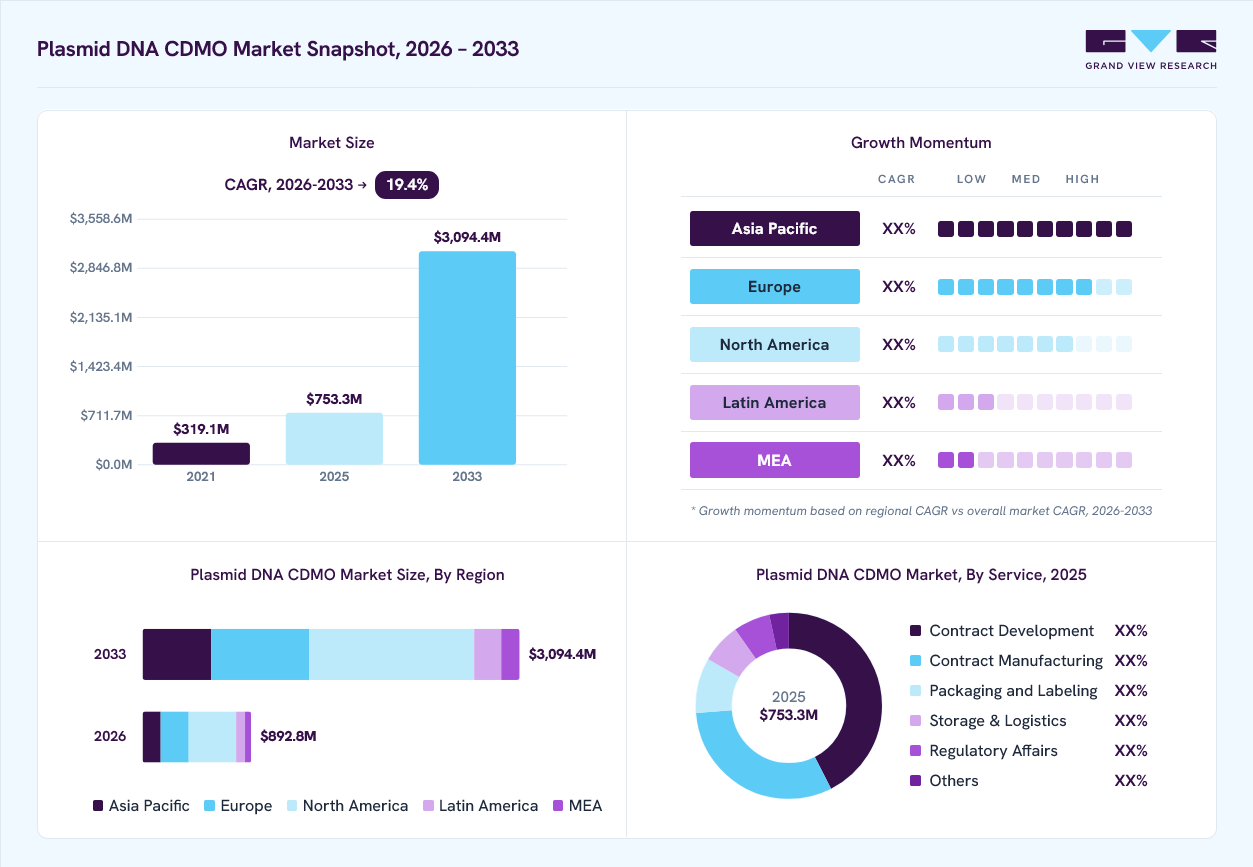
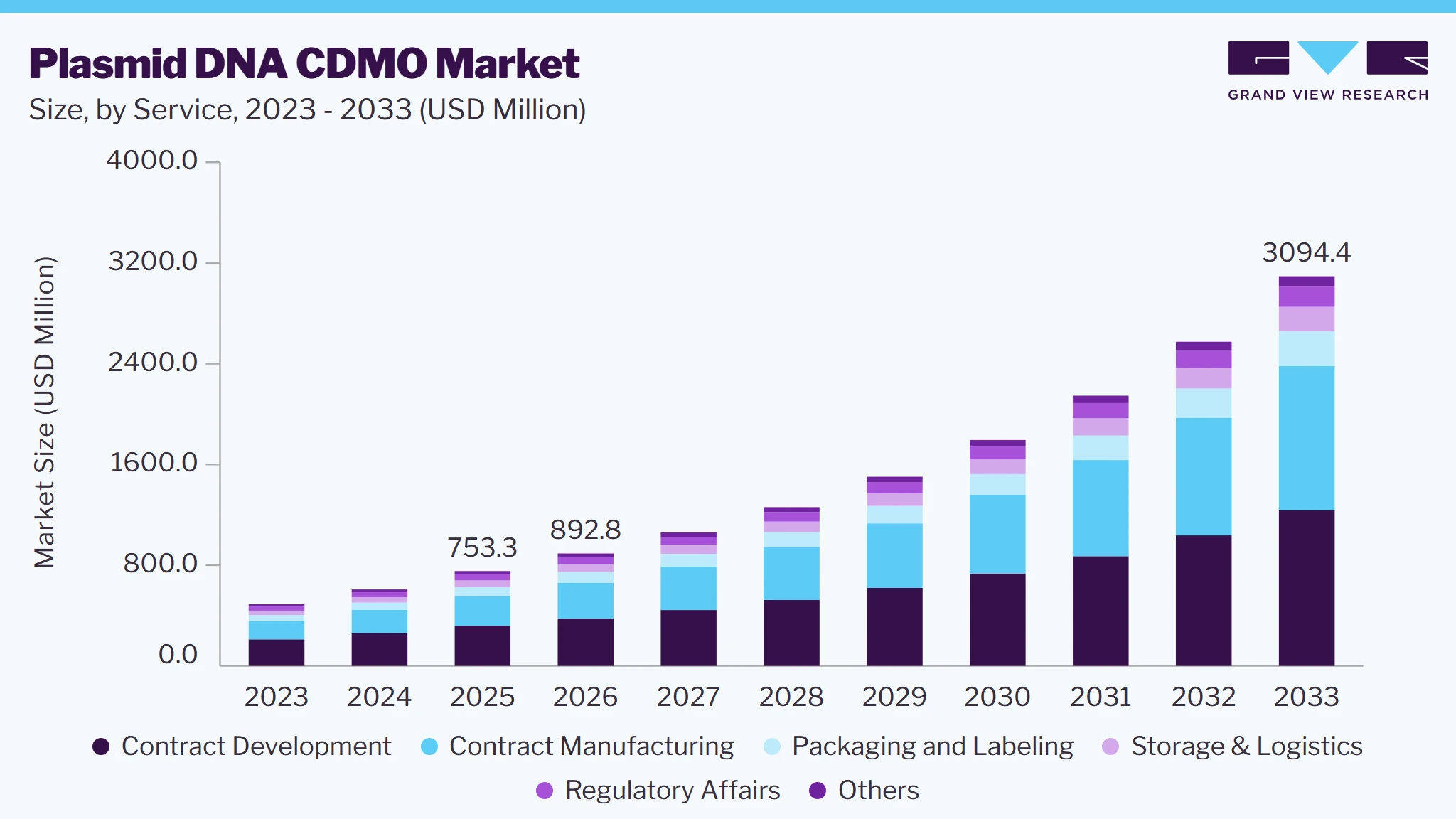
The global plasmid DNA CDMO market size was valued at USD 753.2 million in 2025 and is projected to grow from USD 892.8 million in 2026 to USD 3,094.4 million by 2033, at a CAGR of 19.4% from 2026 to 2033. North America dominated the market, accounting for the largest revenue share of 43.6% in 2025. Market growth is driven by increasing demand for plasmid DNA in gene therapy, cell therapy, DNA vaccines, and other advanced biopharmaceutical applications, alongside the expansion of development pipelines and growing outsourcing of plasmid DNA development and manufacturing activities.
Key Market Trends & Insights
- By service: Contract development held the largest market share of 42.5% in 2025
- By application: Cell & gene therapy held the largest market share of 47.3% in 2025
- By manufacturing grade: Clinical GMP grade held the largest market share of 57.5% in 2025
- By manufacturing scale: Small scale (<100 g) held the largest market share of 43.8% in 2025
- By end use: Biopharmaceutical companies held the largest market share of 43.2% in 2025
Regional Highlights
- Largest regional market: North America (43.6% revenue share 2025)
- Fastest-growing regional market: Asia Pacific (fastest CAGR, 2026-2033)
- By country: The U.S. is expected to grow significantly from 2026 to 2033
Market Size & Forecast
- Market Size in 2025: USD 753.2 million
- Estimated Market Size in 2026: USD 892.8 million
- Projected Market Size by 2033: USD 3,094.4 million
- CAGR (2026-2033): 19.4%
Moreover, the need for specialized capabilities in plasmid design, bacterial fermentation, downstream purification, formulation, and fill-finish services is increasing the demand for CDMO services. Technological advancements in microbial expression systems, fermentation optimization, purification processes, automation, and analytical testing are improving manufacturing efficiency, product quality, scalability, and batch consistency.Furthermore, the gene and cell therapy industry has witnessed continued growth in recent years, supported by increasing development activities and advances in plasmid DNA technologies. The growing number of plasmid DNA-based applications across gene therapy, cell therapy, DNA vaccines, and other advanced biopharmaceutical indications is increasing demand for specialized development and manufacturing capabilities. These products require controlled plasmid design, microbial fermentation, purification, formulation, analytical characterization, and GMP-compliant manufacturing processes. Thus, the expansion of plasmid DNA development pipelines is expected to increase demand for specialized CDMO services in the coming years.
In addition, several pharmaceutical and biotechnology companies are increasingly outsourcing plasmid DNA development and manufacturing activities to specialized CDMOs due to technical expertise, specialized infrastructure, and capital requirements associated with in-house production. CDMOs provide plasmid design, process development, fermentation optimization, scale-up, GMP manufacturing, purification, analytical testing, formulation, and fill-finish services. This approach enables developers to access specialized manufacturing capabilities while reducing the need to establish dedicated production facilities. The trend is particularly relevant among emerging biotechnology companies progressing advanced therapy candidates through clinical development and requiring flexible, scalable manufacturing capacity.
Market Dynamics
One of the major drivers of the plasmid DNA CDMO market is the expansion of gene and cell therapy pipelines and increasing outsourcing of development and manufacturing activities. Plasmid DNA is widely used as a critical starting material and manufacturing component in applications such as viral vector production, gene therapy, cell therapy, DNA vaccines, and other advanced biopharmaceutical products. Manufacturing requirements can vary depending on the plasmid construct, host strain, fermentation process, purification strategy, scale, and regulatory requirements. This increases the need for CDMOs with capabilities across plasmid design, process development, fermentation, purification, scale-up, GMP manufacturing, quality control, and regulatory documentation. Moreover, pharmaceutical and biotechnology companies are outsourcing selected activities to reduce the need for extensive internal manufacturing infrastructure and accelerate progression through development stages. Growing demand for high-quality, scalable plasmid DNA is expected to support CDMO utilization across clinical and commercial advanced therapy programs.
A key restraint in the plasmid DNA CDMO market is the technical complexity and cost associated with plasmid DNA development and manufacturing. Plasmid design, host strain selection, fermentation yield, plasmid integrity, purification efficiency, supercoiled content, and batch-to-batch consistency can require extensive process development and optimization. These activities can extend development timelines and increase manufacturing costs, particularly for companies with limited resources or for early-stage advanced therapy candidates. In addition, specialized facilities capable of producing GMP-grade plasmid DNA may have limited available capacity, creating scheduling constraints for sponsors requiring clinical or commercial batches. Technology transfer between developers and CDMOs can further increase project complexity because manufacturing processes, analytical methods, documentation, and quality requirements must be transferred and validated appropriately. These factors may increase project costs and extend timelines for plasmid DNA programs.
The increasing adoption of CCaaS solutions among small and medium-sized enterprises (SMEs) offers strong growth potential for the market. SMEs are increasingly recognizing the benefits of cloud-based contact centers, including lower upfront investment requirements, flexible pricing models, and simplified deployment processes. CCaaS platforms enable smaller organizations to access enterprise-grade customer engagement capabilities without extensive IT infrastructure investments.
Growing digitalization, e-commerce expansion, and customer service modernization initiatives are encouraging SMEs to adopt advanced communication solutions. Service providers are also introducing scalable and customizable offerings tailored to SME requirements. This expanding SME customer base is expected to contribute significantly to future market growth.
Market Concentration & Characteristics
The plasmid DNA CDMO market is at a medium growth stage, while the pace of market growth is accelerating. The market is characterized by increasing outsourcing of plasmid DNA development and manufacturing, service expansion, technological advancements, regulatory requirements, strategic collaborations, and regional capacity expansion.
The plasmid DNA CDMO industry is witnessing continuous innovation through advances in plasmid design, microbial fermentation, purification technologies, automation, and analytical characterization. High-throughput screening, automated bioprocessing, single-use technologies, process analytical technology, and advanced chromatography systems are improving production efficiency and process control. Developments in engineered microbial strains, fermentation optimization, and purification platforms are also supporting higher plasmid yields, improved product quality, and greater scalability.
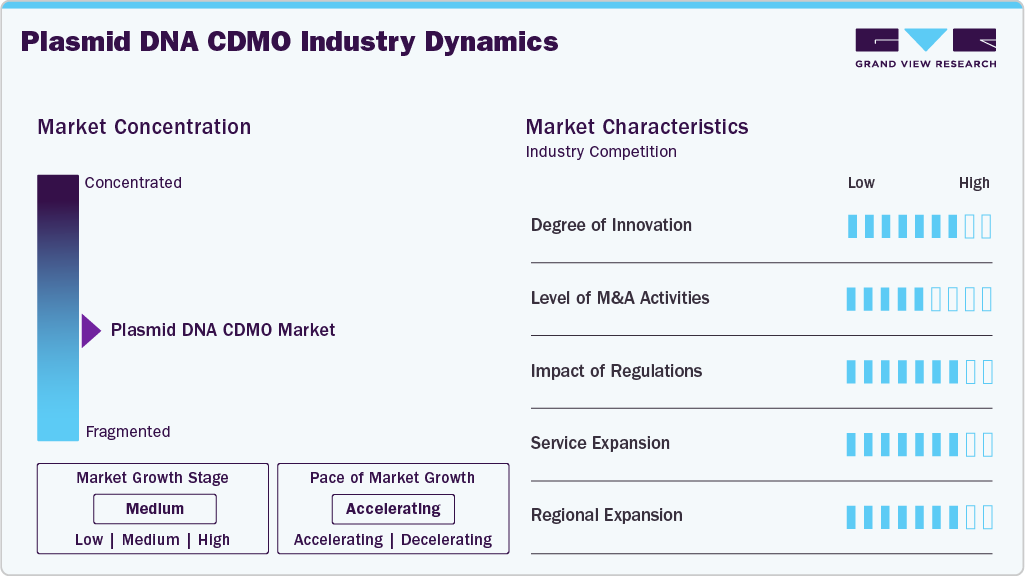
Regulatory requirements established by agencies such as the FDA, EMA, and other national regulatory authorities have a significant impact on plasmid DNA development and manufacturing. Requirements related to GMP production, process validation, quality control, plasmid identity, purity, supercoiled content, endotoxin levels, residual host-cell DNA, and consistency influence CDMO selection and service requirements. Furthermore, regulatory expectations for manufacturing process control and analytical characterization increase the need for CDMOs with validated facilities, robust quality systems, and regulatory expertise.
Mergers and acquisitions contribute to market development by enabling CDMOs to expand manufacturing capacity, technical capabilities, geographic presence, and service portfolios. Strategic acquisitions within the broader biologics, gene therapy, and advanced therapy manufacturing sector can provide access to specialized facilities, fermentation and purification technologies, analytical capabilities, and established client relationships. M&A activity is expected to remain relevant as CDMOs seek to strengthen integrated plasmid DNA development and manufacturing capabilities.
Increasing demand for plasmid DNA outsourcing is encouraging CDMOs to expand their service portfolios across the development and manufacturing lifecycle. Services include plasmid design, sequence optimization, strain development, fermentation, upstream and downstream process development, purification, analytical testing, technology transfer, GMP manufacturing, fill-finish, and stability studies. Moreover, CDMOs are developing integrated service models that support plasmid DNA programs from early development through clinical and commercial manufacturing, addressing the requirements of both emerging biotechnology companies and established pharmaceutical manufacturers.
The market is experiencing regional expansion across North America, Europe, and Asia Pacific. North America maintains a strong position due to its established biopharmaceutical and advanced therapy sector, advanced manufacturing infrastructure, and extensive regulatory framework. Europe also has a developed plasmid DNA manufacturing ecosystem supported by established pharmaceutical and biotechnology companies. Furthermore, Asia Pacific is expanding its plasmid DNA manufacturing capabilities due to increasing biopharmaceutical production, growing CDMO capacity, improving manufacturing infrastructure, and expanding participation of regional pharmaceutical and biotechnology companies.
Analyst Perspective
The plasmid DNA CDMO market is gaining strategic importance as cell and gene therapy candidates advance toward commercialization. The shifting demand toward integrated services encompassing plasmid design, process development, fermentation optimization, purification, analytical characterization, GMP manufacturing, and fill-finish. Biopharmaceutical companies increasingly rely on outsourcing to access specialized infrastructure, technical expertise, regulatory support, and scalable manufacturing capabilities while accelerating development timelines. Besides, the market growth is supported by expanding cell and gene therapy pipelines, the rising use of plasmid DNA as a critical manufacturing component, and increasing requirements for quality, purity, consistency, and process control. In addition, the developers are increasingly preferring CDMO partners capable of supporting programs from early-stage development through clinical and commercial manufacturing. Over the forecast period, competitive differentiation will be driven by technical expertise, manufacturing scalability, advanced analytical capabilities, automation, global regulatory readiness, efficient technology transfer, and the ability to support diverse and technically complex plasmid DNA applications.
Opportunity Analysis
The plasmid DNA CDMO market is expected to present opportunities through the expansion of gene and cell therapy development, increasing demand for scalable manufacturing capacity, and continued advancement of plasmid production and purification technologies. Furthermore, growing requirements for plasmid design, process development, fermentation optimization, analytical characterization, GMP manufacturing, and fill-finish services are creating opportunities for CDMOs to provide integrated solutions across multiple development stages. Pharmaceutical and biotechnology companies can use integrated CDMO services to coordinate technology transfer, process scale-up, manufacturing, quality testing, and regulatory documentation through a consolidated service model. In addition, advances in microbial fermentation, high-density cultivation, purification technologies, process automation, and analytical platforms can improve process efficiency, product quality, and manufacturing scalability.
Moreover, increasing advanced therapy manufacturing capacity in Asia Pacific and other emerging markets creates opportunities for CDMOs with regional production capabilities and regulatory expertise. Developers seeking access to clinical and commercial plasmid DNA manufacturing capacity may increasingly select service providers with established GMP facilities, scalable fermentation systems, analytical capabilities, and experience with complex plasmid products. Thus, CDMOs capable of integrating plasmid development, manufacturing, quality control, analytical testing, and fill-finish services are positioned to address the growing requirements of gene and cell therapy developers
Impact of U.S. Tariffs on the Plasmid DNA CDMO market
U.S. tariffs can indirectly impact the plasmid DNA CDMO industry by increasing costs throughout plasmid DNA development and manufacturing supply chains. Plasmid DNA CDMO operations may require imported laboratory equipment, single-use bioprocessing components, filtration systems, chromatography materials, fermentation equipment, specialized consumables, and other production inputs. Higher import costs for these materials can increase manufacturing and process development expenses, particularly for CDMOs with significant exposure to international suppliers. Service providers may respond by diversifying suppliers, optimizing inventory, sourcing alternatives, and adjusting procurement strategies.
Tariff-related cost increases may also influence the location of plasmid DNA development and manufacturing activities. Companies seeking to reduce exposure to import duties and supply disruptions may favor CDMOs with established U.S. manufacturing infrastructure or diversified regional supply networks. However, service providers with limited supplier options may face greater cost pressure and longer procurement cycles. Global CDMOs may therefore increase regional sourcing, qualify alternative suppliers, and expand localized manufacturing capabilities. Overall, tariff-related changes could contribute to greater supply chain diversification and regionalization in plasmid DNA development and manufacturing.
Technological Advancements
Technological advancements are reshaping the plasmid DNA CDMO industry by improving process efficiency, manufacturing consistency, scalability, and analytical control across plasmid DNA development and production. Automation and high-throughput process development platforms are streamlining plasmid design, fermentation, purification, formulation, and quality testing while reducing manual intervention. Advances in microbial expression systems, including engineered bacterial strains and optimized fermentation platforms, are improving plasmid yield and supporting process optimization. Moreover, chromatography systems, membrane-based purification, single-use technologies, and automated process control are enabling more efficient downstream processing and GMP manufacturing. Analytical technologies such as high-performance liquid chromatography, capillary electrophoresis, polymerase chain reaction, sequencing, and mass spectrometry also support the characterization of plasmid DNA, supercoiled content, process-related impurities, residual host-cell DNA, RNA, endotoxins, and other quality attributes.
Furthermore, artificial intelligence, machine learning, and digital process monitoring are being adopted to support process development, manufacturing data analysis, predictive maintenance, and quality control. Digitalization can facilitate real-time monitoring of critical process parameters and improve data management across development and manufacturing workflows. Advances in continuous processing, intensified fermentation, and process analytical technology are also creating opportunities to improve process control and production efficiency. As plasmid DNA applications in gene therapy, cell therapy, viral vector production, and DNA vaccines expand, these technologies are becoming increasingly important for developing scalable processes, maintaining product consistency, and meeting evolving GMP and regulatory requirements. Thus, technological advancements are expected to support market growth over the forecast period.
Pricing Model Analysis
In the plasmid DNA CDMO market, pricing models are important for managing differences in project complexity, development stage, manufacturing requirements, batch size, plasmid specifications, and client requirements. Milestone-based pricing links payments to defined project stages, such as plasmid design, process development, fermentation optimization, purification, technology transfer, GMP manufacturing, analytical testing, and clinical batch production. This model may be suitable for plasmid DNA programs that progress through multiple development phases and require payments based on completed deliverables.
Fixed-fee pricing can provide greater cost predictability for defined services, including plasmid design, analytical testing, formulation development, process characterization, and specific manufacturing activities with established scope and requirements. Furthermore, cost-plus pricing may be applied to projects involving variable manufacturing inputs, specialized raw materials, additional testing, or changes in production requirements. Time-and-materials pricing can support early-stage development activities where the scope may change as process optimization progresses. In addition, long-term contractual arrangements may be used by biotechnology and pharmaceutical companies requiring recurring plasmid DNA manufacturing, testing, or development services across multiple batches. These pricing approaches provide flexibility according to project scope and development stage while enabling CDMOs to manage variable technical and manufacturing requirements.
Service Insights
The contract development segment led the plasmid DNA CDMO market with the largest revenue share of 42.5% in 2025. The segment growth is driven by increasing demand for specialized plasmid DNA development capabilities and the growing outsourcing of early-stage development activities. Contract development services include process development and optimization, analytical testing and method validation, scale-up, and technology transfer, creating sustained demand among pharmaceutical and biotechnology companies. Moreover, the technical complexity of plasmid design, fermentation optimization, purification, and analytical characterization is prompting developers to leverage specialized CDMOs.
The contract manufacturing segment is expected to grow at the fastest CAGR over the forecast period. Segment growth is driven by increasing demand for GMP-grade plasmid DNA manufacturing across clinical and commercial applications. In addition, the expansion of gene and cell therapy pipelines is increasing the need for scalable manufacturing capacity and specialized production infrastructure. The capital-intensive nature of establishing dedicated plasmid DNA manufacturing facilities is also encouraging developers to outsource production activities to specialized CDMOs.
Application Insights
The cell & gene therapy segment led the plasmid DNA CDMO industry with the largest revenue share of 47.3% in 2025. Segment growth is driven by the growing development of gene and cell therapies and by the critical role of plasmid DNA in viral vector production, cell engineering, and other advanced therapy manufacturing processes. Plasmid DNA requires specialized capabilities in development, fermentation, purification, analytical characterization, and GMP manufacturing, creating sustained demand for CDMO services. Moreover, the expansion of clinical pipelines and increasing outsourcing of plasmid DNA production are supporting segment growth.
The gene editing segment is expected to grow at the second-fastest CAGR over the forecast period. Segment growth is driven by increased research and development activities in gene-editing technologies and the growing use of plasmid DNA in gene-editing workflows. In addition, advances in CRISPR-based technologies and other genetic engineering platforms are increasing demand for high-quality plasmid DNA with consistent purity and integrity. The specialized manufacturing requirements of gene-editing applications are also encouraging developers to outsource production to experienced CDMOs.
Manufacturing Grade Insights
The clinical GMP grade segment led the plasmid DNA CDMO market with the largest revenue share of 57.5% in 2025. Segment growth is driven by the increasing number of plasmid DNA candidates advancing through clinical development and by the need for GMP-compliant materials for clinical applications. Clinical-grade plasmid DNA requires controlled manufacturing processes, validated analytical methods, quality systems, and regulatory documentation, creating sustained demand for specialized CDMO services. Moreover, the expansion of early- and mid-stage gene and cell therapy pipelines is supporting demand for clinical GMP-grade plasmid DNA.
The commercial GMP grade segment is expected to grow at the fastest CAGR over the forecast period. Segment growth is driven by the increasing number of advanced therapy candidates progressing toward commercialization and the growing need for large-scale GMP manufacturing. In addition, commercial programs require consistent product quality, validated processes, reliable supply, and scalable production capabilities. The growing transition of successful clinical programs into commercial manufacturing is also encouraging developers to partner with CDMOs that offer established GMP infrastructure and commercial-scale plasmid DNA production capabilities.
Manufacturing Scale Insights
The small-scale (<100 g) segment led the plasmid DNA CDMO industry with the largest revenue share of 43.8% in 2025. Segment growth is driven by the high volume of early-stage research, process development, and clinical activities that require relatively small quantities of plasmid DNA. Small-scale production enables developers to conduct process optimization, analytical testing, and early clinical manufacturing while limiting material requirements and production costs. Moreover, the large number of early-stage gene and cell therapy programs is supporting sustained demand for small-scale plasmid DNA manufacturing services.
The large-scale (>1 kg) segment is expected to grow at the fastest CAGR over the forecast period. Segment growth is driven by the advancing progression of advanced therapy candidates toward late-stage clinical development and commercial manufacturing. In addition, commercial applications require larger quantities of high-quality plasmid DNA and reliable manufacturing capacity. The growing demand for scalable production, process intensification, and consistent GMP manufacturing is encouraging developers to utilize CDMOs with large-scale fermentation and purification capabilities.
End Use Insights
The biopharmaceutical companies segment led the plasmid DNA CDMO market with the largest revenue share of 43.2% in 2025. The segment growth is driven by the increasing adoption of plasmid DNA across gene therapy, cell therapy, viral vector production, DNA vaccines, and other advanced biopharmaceutical applications. Biopharmaceutical companies increasingly rely on specialized CDMOs to access plasmid development, manufacturing, analytical testing, and GMP capabilities without having to establish extensive internal infrastructure. Moreover, expanding development pipelines and increasing outsourcing activities are supporting demand from biopharmaceutical companies.
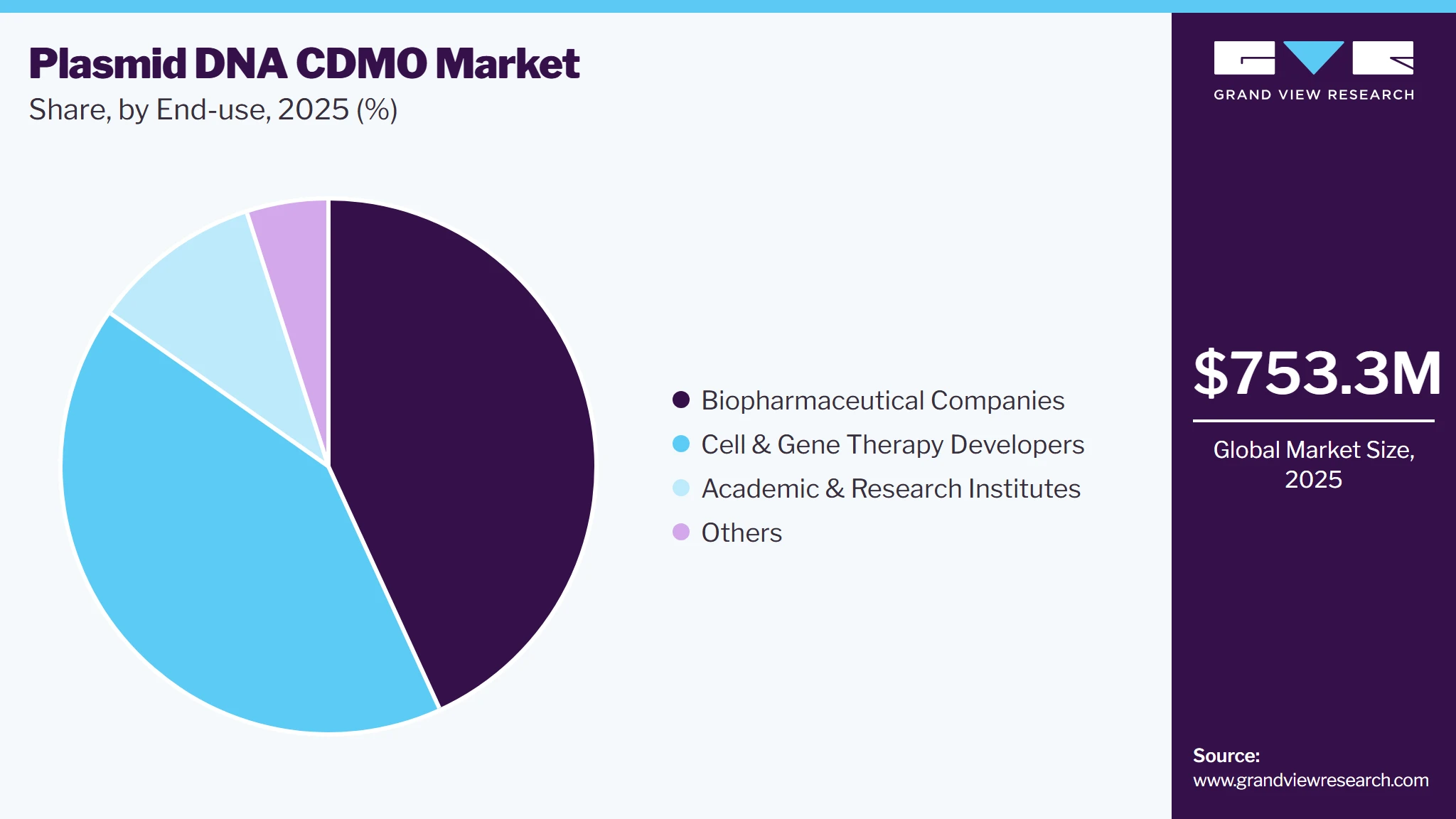
The cell & gene therapy developers segment is expected to grow at the fastest CAGR over the forecast period. Segment growth is driven by the increasing development of advanced therapies and the expanding use of plasmid DNA as a critical starting material and manufacturing component. In addition, the technical complexity of plasmid production and the need for high-quality, scalable GMP materials are encouraging therapy developers to outsource manufacturing activities. Growing clinical pipelines and rising demand for flexible production capacity are also expected to support CDMO demand among cell and gene therapy developers.
Regional Insights
The North America plasmid DNA CDMO market accounted for the largest global revenue share of 43.6% in 2025, supported by its established pharmaceutical and biotechnology industry, advanced biomanufacturing infrastructure, and strong gene and cell therapy development capabilities. The region’s concentration of major CDMOs, extensive clinical research activities, and established GMP manufacturing facilities is supporting demand for plasmid DNA development and production services. Moreover, increasing investment in advanced therapies and the expansion of plasmid DNA manufacturing capacity are strengthening the region’s position in the market.

U.S. Plasmid DNA CDMO Market Trends
The U.S. plasmid DNA CDMO industry’s growth is driven by its large pharmaceutical and biotechnology sector, advanced biomanufacturing infrastructure, and established regulatory framework. Moreover, increasing development of gene and cell therapy candidates and demand for flexible GMP manufacturing capacity are supporting outsourcing to specialized CDMOs. The presence of established plasmid DNA manufacturers, gene therapy developers, and contract manufacturing organizations is further contributing to market growth. In addition, increasing investment in advanced therapy manufacturing is supporting demand for scalable plasmid DNA production.
Europe Plasmid DNA CDMO Market Trends
The Europe plasmid DNA CDMO industry is experiencing growth due to its established pharmaceutical manufacturing industry, advanced biotechnology capabilities, and strong regulatory framework. Moreover, increasing demand for specialized plasmid DNA manufacturing and expansion of gene and cell therapy development are supporting CDMO services. The region’s focus on manufacturing quality, process validation, analytical characterization, and regulatory compliance is further increasing demand for specialized plasmid DNA development and manufacturing capabilities. Established biotechnology clusters are also supporting regional market expansion.
The plasmid DNA CDMO market in Germany is anticipated to grow significantly over the forecast period, driven by its strong pharmaceutical and biotechnology manufacturing base. The country’s advanced bioprocessing infrastructure focuses on research and development, and established quality systems support plasmid DNA manufacturing activities. Moreover, increasing demand for GMP-compliant production and specialized advanced therapy manufacturing services is contributing to market expansion. The growing development of gene and cell therapies is also supporting demand for high-quality plasmid DNA manufacturing and analytical services.
The UK plasmid DNA CDMO market held a significant share of Europe in 2025. The country’s market growth is supported by its established biotechnology sector, strong academic research base, and government support for life sciences development. Moreover, increasing gene and cell therapy research activities and the presence of specialized biomanufacturing facilities are creating demand for plasmid DNA development, analytical, and manufacturing services. The UK’s focus on advanced therapy innovation and regulatory development is further supporting market opportunities.
Asia Pacific Plasmid DNA CDMO Market Trends
The Asia Pacific plasmid DNA CDMO industry is projected to grow at the fastest CAGR over the forecast period. The growth is mainly due to increasing biopharmaceutical manufacturing, expanding gene and cell therapy development, improving biotechnology infrastructure, and government initiatives supporting domestic pharmaceutical production. Moreover, competitive manufacturing costs and increasing outsourcing by global pharmaceutical and biotechnology companies are supporting CDMO expansion across the region. Growing investments in advanced therapy manufacturing infrastructure are further creating opportunities for plasmid DNA service providers.
The plasmid DNA CDMO market in China is expected to grow over the forecast period. The growth is driven by the expansion of domestic biopharmaceutical manufacturing, increasing biotechnology research, and government initiatives supporting advanced therapy development. Moreover, efforts to strengthen domestic biopharmaceutical manufacturing capabilities and improve production infrastructure are increasing demand for plasmid DNA development and manufacturing services in the country. The increasing development of gene and cell therapy programs is further supporting demand for GMP-grade plasmid DNA.
The plasmid DNA CDMO market in Japan is witnessing significant growth over the forecast period. The growth is supported by the country’s established pharmaceutical industry, advanced biotechnology capabilities, and increasing research into innovative gene and cell therapies. Moreover, strong quality standards, advanced manufacturing infrastructure, and regulatory capabilities are supporting the development of specialized plasmid DNA CDMO services. The increasing adoption of advanced therapies and the demand for high-quality GMP manufacturing are further contributing to market expansion.
The India plasmid DNA CDMO market is witnessing considerable growth due to the country’s expanding pharmaceutical and contract manufacturing sector, growing biotechnology capabilities, and competitive biopharmaceutical manufacturing environment. Moreover, government initiatives supporting biotechnology research, advanced therapy development, and pharmaceutical manufacturing are increasing CDMO opportunities. Growing participation of biotechnology companies in gene and cell therapy development is further supporting demand for plasmid DNA development, analytical testing, and GMP manufacturing services.
Latin America Plasmid DNA CDMO Market Trends
Latin America’s plasmid DNA CDMO industry is gaining traction as pharmaceutical manufacturing, biotechnology research, advanced therapy development, and biopharmaceutical production activities expand across the region. Demand is increasing for specialized development, analytical, and manufacturing services as local manufacturers strengthen production capabilities and align with international GMP standards. Brazil, Mexico, and Argentina remain key contributors due to their established pharmaceutical industries and expanding biotechnology capabilities. Increasing interest in localized manufacturing is also creating opportunities for regional CDMO providers.
The Brazil plasmid DNA CDMO market is expected to grow over the forecast period. Brazil represents a leading opportunity within Latin America due to its established pharmaceutical manufacturing base, expanding biotechnology sector, and growing advanced therapy research activities. The country’s market is supported by increasing demand for local manufacturing capabilities and improvements in biopharmaceutical production infrastructure. Moreover, public-sector healthcare programs and pharmaceutical manufacturing initiatives are supporting demand for specialized biopharmaceutical development and manufacturing services. Increasing investment in biotechnology is further creating opportunities for plasmid DNA CDMOs.
Middle East & Africa Plasmid DNA CDMO Market Trends
The Middle East & Africa plasmid DNA CDMO industry is gradually expanding, driven by pharmaceutical localization, healthcare infrastructure development, advanced therapy research, and increasing interest in biotechnology manufacturing. Countries such as the UAE, Saudi Arabia, and South Africa are strengthening domestic pharmaceutical capabilities and regulatory frameworks. These developments are creating opportunities for GMP-compliant plasmid DNA development, manufacturing, analytical testing, and related services. Increasing efforts to diversify healthcare and biopharmaceutical manufacturing are expected to support regional market development.
The UAE plasmid DNA CDMO market is emerging as a strategic opportunity within the Middle East due to its focus on healthcare innovation, pharmaceutical localization, and life sciences infrastructure. The country’s position as a regional healthcare and logistics hub supports opportunities for biopharmaceutical manufacturing and outsourcing services. Moreover, government initiatives supporting biotechnology, healthcare diversification, and domestic pharmaceutical capabilities are creating opportunities for plasmid DNA CDMO services, although specialized manufacturing capacity remains in its early stages of development.
Key Plasmid DNA CDMO Companies Insights
Market players are undertaking various strategic initiatives, such as the launch of new manufacturing services, capacity expansions, collaborations, partnerships, and mergers & acquisitions, to strengthen their service offerings and provide a competitive advantage. For instance, in April 2025, ProBio launched its GMP plasmid DNA manufacturing service at its Hopewell, New Jersey facility, offering clinical-grade plasmid DNA production from cell bank to batch release within three months. The service expands the company’s plasmid DNA manufacturing capabilities and strengthens its integrated support for gene and cell therapy developers.
Key Plasmid DNA CDMO Companies
The following key companies have been profiled for this study of the plasmid DNA CDMO market.
-
Thermo Fisher Scientific
-
Aldevron (Danaher)
-
Charles River Laboratories
-
GenScript ProBio
-
Lonza
-
Catalent
-
AGC Biologics
-
WuXi AppTec
-
Kaneka Eurogentec
-
Richter-Helm BioLogics
Competitive Benchmarking
Category
Operating Strategies
Competitive Edge
Weakness
Established Players Thermo Fisher Scientific; Aldevron (Danaher); Charles River Laboratories; Lonza; Catalent; AGC Biologics; WuXi AppTec; Kaneka Eurogentec
- Established players are expanding end-to-end plasmid DNA capabilities across construct development, process optimization, GMP manufacturing, analytical testing, and clinical-to-commercial supply. Standardized platforms, scalable fermentation, dedicated facilities, and integrated project management are being used to shorten development timelines and improve manufacturing continuity.
- Established players benefit from GMP manufacturing infrastructure, extensive plasmid production experience, validated analytical capabilities, scalable production platforms, and established relationships with cell and gene therapy developers. Broad service portfolios also enable support across research, preclinical, clinical, and commercial development stages.
- Established players face high capital requirements for GMP facilities, quality systems, specialized equipment, and process validation. Complex plasmid constructs can increase development and manufacturing complexity, while capacity constraints and extended technology-transfer requirements can affect timelines for clinical and commercial programs.
Emerging Players GenScript ProBio; Richter-Helm BioLogics
- Emerging players are adopting focused plasmid DNA platforms, flexible manufacturing models, and shorter development timelines to attract biotechnology clients. Many are expanding GMP capabilities alongside viral vector, mRNA, and cell therapy services, while using specialized facilities and integrated workflows to address specific program requirements.
- Emerging players compete through faster project execution, flexible production scales, specialized plasmid capabilities, and customized client support. Some differentiate through fixed-cost offerings, high supercoiled DNA specifications, dedicated GMP facilities, and integrated development-to-manufacturing services designed for early-stage and clinical programs.
- Emerging players face limitations in manufacturing capacity, geographic coverage, regulatory track record, and commercial-scale experience compared with established CDMOs. Limited production history and smaller service portfolios can pose challenges in supporting complex plasmid programs that require large-scale GMP manufacturing, extensive analytical packages, and long-term supply commitments.
Recent Developments
-
In May 2026, Aldevron and Minaris renewed their licensing agreement, expanding access to Aldevron’s proprietary GMP-Source quality-grade off-the-shelf lentiviral plasmid system for gene-modified cell therapy applications. The agreement is intended to simplify plasmid supply chains and accelerate development programs.
-
In November 2025, Bharat Biotech launched Nucelion Therapeutics, a new CRDMO focused on cell and gene therapies. The company operates a 30,000-square-foot GMP facility in Genome Valley, Hyderabad, capable of developing and manufacturing plasmids, viral and non-viral vectors, and cell therapies, and providing aseptic fill-finish services.
-
In August 2025, Bionova Scientific opened a 10,000-square-foot plasmid DNA development and production facility in The Woodlands, Texas. The facility expands Bionova’s CDMO capabilities into plasmid DNA and was initially designed to support research-grade production, with clinical-to-commercial cGMP manufacturing targeted for Q4 2025.
-
In June 2025, ProBio opened its flagship U.S. plasmid DNA and viral vector manufacturing facility, a 128,000-square-foot GMP facility designed to manufacture plasmid DNA, AAV, and lentiviral vectors. The facility strengthens ProBio’s integrated manufacturing capabilities and supports developers from early-stage programs through clinical development.
Plasmid DNA CDMO Market Report Scope
Report Attribute
Details
Market size in 2025
USD 753.2 million
Estimated market size in 2026
USD 892.8 million
Projected market size by 2033
USD 3,094.4 million
Growth rate
CAGR of 19.4% from 2026 to 2033
Historical data
2021 - 2025
Forecast period
2026 - 2033
Quantitative units
Revenue in USD million and CAGR from 2026 to 2033
Report coverage
Revenue forecast, company ranking, competitive landscape, growth factors, and trends
Segments covered
Service, application, manufacturing grade, manufacturing scale, end use, region
Regional scope
North America; Europe; Asia Pacific; Latin America; MEA
Country Scope
U.S.; Canada; Mexico; UK; Germany; France; Italy; Spain; Denmark; Sweden; Norway; China; India; Japan; Australia; Thailand; South Korea; Brazil; Argentina; Saudi Arabia; UAE; South Africa; Kuwait; Oman; Qatar
Key companies profiled
Thermo Fisher Scientific; Aldevron (Danaher); Charles River Laboratories; GenScript ProBio; Lonza; Catalent; AGC Biologics; WuXi AppTec; Kaneka Eurogentec; Richter-Helm BioLogics
Customization scope
Free report customization (equivalent up to 8 analysts' working days) with purchase. Addition or alteration to country, regional & segment scope.
Pricing and purchase options
Avail customized purchase options to meet your exact research needs. Explore purchase options
Global Plasmid DNA CDMO Market Report Segmentation
This report forecasts revenue growth at the global, regional & country levels and provides an analysis of the latest industry trends in each of the sub-segments from 2021 to 2033. For this study, Grand View Research has segmented the global plasmid DNA CDMO market report based on service, application, manufacturing grade, manufacturing scale, end use, and region:
-
Service Outlook (Revenue, USD Million, 2021 - 2033)
-
Contract Development
-
Process Development & Optimization
-
Analytical Testing & Method Validation
-
Scale-up & Tech Transfer
-
-
Contract Manufacturing
-
Clinical
-
Commercial
-
-
Packaging and Labeling
-
Storage & Logistics
-
Regulatory Affairs
-
Others
-
-
Application Outlook (Revenue, USD Million, 2021 - 2033)
-
Cell & Gene Therapy
-
DNA Vaccines
-
Gene Editing
-
RNA / mRNA-related Applications
-
Others
-
-
Manufacturing Grade Outlook (Revenue, USD Million, 2021 - 2033)
-
Preclinical / Engineering Grade
-
Clinical GMP Grade
-
Commercial GMP Grade
-
-
Manufacturing Scale Outlook (Revenue, USD Million, 2021 - 2033)
-
Small Scale (<100 g)
-
Mid Scale (100 g - 1 kg)
-
Large Scale (>1 kg)
-
-
End Use Outlook (Revenue, USD Million, 2021 - 2033)
-
Biopharmaceutical Companies
-
Cell & Gene Therapy Developers
-
Academic & Research Institutes
-
Others
-
-
Regional Outlook (Revenue, USD Million, 2021 - 2033)
-
North America
-
U.S.
-
Canada
-
Mexico
-
-
Europe
-
UK
-
Germany
-
France
-
Italy
-
Spain
-
Sweden
-
Norway
-
Denmark
-
-
Asia Pacific
-
Japan
-
China
-
India
-
South Korea
-
Australia
-
Thailand
-
-
Latin America
-
Brazil
-
Argentina
-
-
Middle East & Africa
-
South Africa
-
Saudi Arabia
-
UAE
-
Kuwait
-
Oman
-
Qatar
-
-
Research Methodology
The plasmid DNA CDMO market figures in this report are based on a proven research process that combines executive interviews with secondary research from proprietary databases, company filings, and recognized regulatory and institutional sources. Market size is built through value-chain sizing-reconciling supply-side and demand-side estimates-and triangulated with bottom-up and top-down approaches. Every estimate passes multiple levels of expert validation before publication, with each plasmid DNA CDMO segment quantified using the revenue-capture definitions in the table below.
Segment Definition
Service
Definition
Contract Development
The segment captures revenue generated by providing contract development services for plasmid DNA to pharmaceutical, biotechnology, and cell and gene therapy companies, vaccine developers, and research organizations. The segment includes process development and optimization, analytical method development and validation, scale-up, technology transfer, plasmid construct-related development support, and preparation of manufacturing processes for clinical or commercial production.
Process Development & Optimization
The segment captures revenue generated by providing process development and optimization services for plasmid DNA to end users. The segment includes optimization of microbial fermentation, cell growth conditions, plasmid yield, harvest, cell lysis, clarification, purification, impurity removal, recovery, concentration, and process reproducibility.
Analytical Testing & Method Validation
The segment captures revenue generated by providing analytical testing and method development and validation services for plasmid DNA to end users. The segment includes identity, purity, potency, concentration, topology, supercoiled plasmid percentage, residual host-cell DNA, residual RNA, protein impurities, endotoxin, sterility, bioburden, and stability testing, as well as analytical method qualification, validation, and transfer.
Scale-up & Technology Transfer
The segment captures revenue generated by providing plasmid DNA process scale-up and technology-transfer services to end users. The segment includes laboratory-to-pilot and pilot-to-commercial scale-up, process characterization, engineering runs, manufacturing protocol transfer, analytical method transfer, equipment adaptation, comparability assessment, process documentation, and transfer of production processes between facilities.
Contract Manufacturing
The segment captures revenue generated by providing outsourced plasmid DNA manufacturing services to pharmaceutical, biotechnology, vaccine, and cell and gene therapy companies. The segment includes GMP and non-GMP production, upstream fermentation, downstream purification, formulation, filling, in-process testing, quality control, batch-release support, and manufacturing documentation for clinical and commercial requirements.
Clinical
The segment captures revenue generated by providing plasmid DNA manufacturing services for preclinical and clinical-stage programs to end users. The segment includes engineering, toxicology, and GMP batches for Phase I, Phase II, and Phase III studies, as well as small- and medium-scale fermentation, purification, formulation, filling, quality testing, batch documentation, and clinical supply support.
Commercial
The segment captures revenue generated by providing commercial-scale plasmid DNA manufacturing services for approved products to end users. The segment includes large-scale and recurring GMP production, validated fermentation and purification processes, formulation and filling, process performance qualification, routine quality control, batch release, ongoing stability testing, and supply under long-term commercial agreements.
Packaging & Labeling
The segment captures revenue generated by providing packaging and labeling services for plasmid DNA products to end users. The segment includes primary and secondary packaging, vial or container labeling, clinical trial labeling, serialization where applicable, tamper-evident packaging, kit assembly, country-specific labeling, packaging validation, and preparation of packaged products for storage or distribution.
Storage & Logistics
The segment captures revenue generated by providing controlled storage and logistics services for plasmid DNA products to end users. The segment includes temperature-controlled warehousing, stability-sample storage, inventory management, cold-chain distribution, shipment qualification, real-time temperature monitoring, customs documentation, chain-of-custody management, and delivery to clinical or commercial locations.
Regulatory Affairs
The segment captures revenue generated by providing regulatory support services related to plasmid DNA development and manufacturing to end users. The segment includes preparation and review of CMC documentation, IND/IMPD/BLA-related support, regulatory submission assistance, responses to regulatory queries, GMP compliance support, comparability documentation, change-control support, and regulatory strategy across development stages.
Others
The segment captures revenue generated by providing other specialized plasmid DNA CDMO services to end users that are not classified under development, manufacturing, packaging, logistics, or regulatory affairs. The segment includes plasmid construct design support, cell bank development and characterization, stability studies, consulting, raw material qualification, facility and process audits, project management, and customized technical support.
Application
Definition
Cell & Gene Therapy
The segment captures revenue generated by providing plasmid DNA CDMO services for cell and gene therapy applications to biotechnology companies, pharmaceutical companies, and therapy developers. The segment includes plasmid DNA used for viral-vector production, non-viral gene delivery, transient transfection, engineered cell therapies, gene replacement, and ex vivo cell modification. Gene-editing-specific plasmid applications reported under the gene editing segment are excluded to avoid overlap.
DNA Vaccines
The segment captures revenue generated by providing plasmid DNA CDMO services for DNA vaccine applications to pharmaceutical companies, biotechnology companies, vaccine developers, government agencies, and research institutions. The segment includes plasmid DNA development and manufacturing for prophylactic and therapeutic vaccines targeting infectious diseases, cancer, allergies, and other conditions, including clinical- and commercial-grade vaccine plasmids.
Gene Editing
The segment captures revenue generated by providing plasmid DNA CDMO services for gene-editing applications to biotechnology companies, pharmaceutical companies, and gene-editing therapy developers. The segment includes plasmids encoding CRISPR-associated nucleases, guide RNA components, donor DNA templates, base editors, prime editors, zinc-finger nucleases, and TALEN systems used in in vivo and ex vivo gene-editing workflows.
RNA/mRNA-related Applications
The segment captures revenue generated by providing plasmid DNA CDMO services for RNA- and mRNA-related applications to pharmaceutical companies, biotechnology companies, vaccine developers, and RNA-therapy developers. The segment includes plasmid DNA used as a template for in vitro transcription of mRNA, self-amplifying RNA, circular RNA, guide RNA, and other therapeutic or research RNA molecules. It covers plasmid template development, linearization, purification, testing, and GMP manufacturing.
Others
The segment captures revenue generated by providing plasmid DNA CDMO services for other applications to pharmaceutical companies, biotechnology companies, diagnostic developers, research institutions, and other end users. The segment includes plasmid DNA used in recombinant protein and antibody production, diagnostic assay development, cell-line engineering, biosensor development, preclinical research, and other molecular biology applications not classified under cell and gene therapy, DNA vaccines, gene editing, or RNA/mRNA-related applications.
Manufacturing Grade
Definition
Preclinical/Engineering Grade
The segment captures revenue generated by providing preclinical- and engineering-grade plasmid DNA CDMO services to pharmaceutical companies, biotechnology companies, research institutions, and therapy developers. The segment includes research-use, proof-of-concept, process-development, engineering-run, and toxicology-study plasmid DNA that is generally manufactured under controlled, non-GMP or GMP-like conditions. It covers fermentation, purification, characterization, analytical testing, and documentation appropriate for early-stage development.
Clinical GMP Grade
The segment captures revenue generated by providing clinical GMP-grade plasmid DNA CDMO services to pharmaceutical companies, biotechnology companies, vaccine developers, and cell and gene therapy developers. The segment includes plasmid DNA manufactured under current Good Manufacturing Practices for Phase I, Phase II, and Phase III clinical programs. It covers qualified raw materials, controlled fermentation and purification, validated or qualified analytical testing, batch documentation, quality assurance review, stability studies, and release of clinical-grade batches.
Commercial GMP Grade
The segment captures revenue generated by providing commercial GMP-grade plasmid DNA CDMO services to pharmaceutical companies, biotechnology companies, vaccine manufacturers, and developers of approved therapies. The segment includes plasmid DNA manufactured under validated cGMP processes for routine commercial supply. It covers process performance qualification, large-scale or recurring production, validated analytical methods, comprehensive quality control, batch release, ongoing stability programs, regulatory-compliant documentation, change control, and lifecycle management.
Manufacturing Scale
Definition
Small Scale (<100 g)
The segment captures revenue generated by providing plasmid DNA CDMO services at production volumes below 100 grams per manufacturing batch to pharmaceutical companies, biotechnology companies, research institutions, and therapy developers. The segment includes laboratory, pilot, preclinical, engineering, toxicology, and early clinical batches, covering fermentation, purification, formulation, analytical testing, quality documentation, and batch-release support.
Mid Scale (100 g-1 kg)
The segment captures revenue generated by providing plasmid DNA CDMO services at production volumes ranging from 100 grams to 1 kilogram per manufacturing batch to pharmaceutical companies, biotechnology companies, vaccine developers, and cell and gene therapy companies. The segment includes scale-up, late-stage clinical, process validation, launch preparation, and limited commercial batches, covering controlled fermentation, downstream purification, formulation, analytical testing, stability assessment, and batch release.
Large Scale (>1 kg)
The segment captures revenue generated by providing plasmid DNA CDMO services at production volumes exceeding 1 kilogram per manufacturing batch to pharmaceutical companies, biotechnology companies, vaccine manufacturers, and commercial therapy developers. The segment includes late-stage clinical, process performance qualification, commercial launch, and routine commercial batches, covering large-scale fermentation, high-throughput purification, formulation, quality control, validated batch release, stability programs, and recurring supply under commercial manufacturing agreements.
End Use
Definition
Biopharmaceutical Companies
The segment captures revenue generated by providing plasmid DNA CDMO services to pharmaceutical, biotechnology, and biopharmaceutical companies. The segment includes services supporting DNA vaccines, RNA/mRNA products, recombinant proteins, antibodies, viral vectors, gene therapies, and other plasmid-enabled products. Key services include plasmid development, process optimization, clinical and commercial manufacturing, analytical testing, packaging, storage, logistics, and regulatory support.
Cell & Gene Therapy Developers
The segment captures revenue generated by providing plasmid DNA CDMO services to companies primarily engaged in developing cell and gene therapies. The segment includes services for plasmids used in viral-vector production, non-viral gene delivery, gene editing, transient transfection, cell engineering, and ex vivo or in vivo therapeutic applications. It covers process development, GMP manufacturing, purification, analytical testing, batch release, stability studies, and regulatory documentation.
Academic & Research Institutes
The segment captures revenue generated by providing plasmid DNA CDMO services to universities, academic medical centers, government laboratories, nonprofit research organizations, and other research institutes. The segment includes services supporting basic research, proof-of-concept studies, translational research, investigator-initiated trials, preclinical development, molecular biology studies, and early-stage therapeutic development. Key services include plasmid design, small-scale production, purification, characterization, analytical testing, and research- or preclinical-grade supply.
Others
The segment captures revenue generated by providing plasmid DNA CDMO services to end users not classified as biopharmaceutical companies, cell and gene therapy developers, or academic and research institutes. The segment includes contract research organizations, government and public health agencies, diagnostic companies, veterinary medicine companies, synthetic biology companies, and other life science organizations. Services include customized plasmid development, manufacturing, testing, packaging, storage, logistics, and technical or regulatory support.
Delivered Customizations
This report has been delivered with the following In-depth customizations
Client Request
Customization Delivered
Value Adds
Extensive Segmentation & Cross-Segmentation Analysis
The study can be customized to include deeper segmentation and cross-analysis across service type, plasmid type, application, development stage, manufacturing scale, end use, and region. This may include plasmid design and construction, process development, fermentation, purification, analytical testing, GMP manufacturing, fill-finish, and stability studies across gene therapy, cell therapy, viral vectors, DNA vaccines, and mRNA applications.
The study can be customized to include deeper segmentation and cross-analysis across service type, plasmid type, application, development stage, manufacturing scale, end use, and region. This may include plasmid design and construction, process development, fermentation, purification, analytical testing, GMP manufacturing, fill-finish, and stability studies across gene therapy, cell therapy, viral vectors, DNA vaccines, and mRNA applications.
Regional Extension & Opportunity Mapping
The report can include country-level or sub-regional analysis across key markets in North America, Europe, Asia Pacific, Latin America, and the Middle East & Africa. This may cover regulatory requirements, gene and cell therapy development activity, plasmid manufacturing capacity, outsourcing penetration, biopharmaceutical R&D clusters, clinical trial activity, and GMP manufacturing infrastructure.
Supports geographic expansion planning, facility location assessment, regional demand mapping, and the identification of underserved markets with strong potential for plasmid DNA outsourcing.
Market Entry Strategy & Competitive Dynamics
The study can be expanded to assess entry opportunities for plasmid DNA CDMOs, CROs, testing laboratories, and analytical service providers by evaluating unmet demand, pricing models, regulatory requirements, service gaps, turnaround times, client concentration, and competitive intensity. It may also benchmark key players based on plasmid development capabilities, GMP manufacturing capacity, analytical services, geographic presence, quality systems, and strategic partnerships.
The study can be expanded to assess entry opportunities for plasmid DNA CDMOs, CROs, testing laboratories, and analytical service providers by evaluating unmet demand, pricing models, regulatory requirements, service gaps, turnaround times, client concentration, and competitive intensity. It may also benchmark key players based on plasmid development capabilities, GMP manufacturing capacity, analytical services, geographic presence, quality systems, and strategic partnerships.
Volume Analysis & Emerging Trend Assessment
The customization can include volume-based analysis, such as plasmid DNA production capacity, batch volumes, manufacturing scale, clinical batch requirements, commercial supply demand, and modality-wise plasmid utilization. Emerging trend coverage may include automation, high-throughput plasmid construction, advanced fermentation, continuous processing, digital quality systems, next-generation sequencing, and advanced analytical characterization.
The customization can include volume-based analysis, such as plasmid DNA production capacity, batch volumes, manufacturing scale, clinical batch requirements, commercial supply demand, and modality-wise plasmid utilization. Emerging trend coverage may include automation, high-throughput plasmid construction, advanced fermentation, continuous processing, digital quality systems, next-generation sequencing, and advanced analytical characterization.
Frequently Asked Questions About This Report
The global plasmid DNA CDMO market size was estimated at USD 753.2 million in 2025 and is expected to reach USD 892.8 million in 2026.
The global plasmid DNA CDMO market is expected to grow at a compound annual growth rate of 19.4% from 2026 to 2033 to reach USD 3,094.4 million by 2033.
Based on service, contract development segment held the largest market share of 42.5% in 2025.
North America plasmid DNA CDMO market held the largest share of 43.6% of the global market in 2025.
Key factors driving market growth include increasing demand for plasmid DNA in gene therapy, cell therapy, DNA vaccines, and other advanced biopharmaceutical applications, alongside the expansion of development pipelines and the growing outsourcing of plasmid DNA development and manufacturing activities.
Some of the key players operating in the plasmid DNA CDMO market include Thermo Fisher Scientific, Aldevron (Danaher), Charles River Laboratories, GenScript ProBio, Lonza, Catalent, AGC Biologics, WuXi AppTec, Kaneka Eurogentec, and Richter-Helm BioLogics among others.
Based on application, cell & gene therapy segment held the largest market share of 47.3% in 2025.
Based on manufacturing grade, clinical GMP grade segment held the largest market share of 57.5% in 2025.
Based on manufacturing scale, the small-scale (<100 g) segment held the largest market share of 43.8% in 2025.
Based on end use, biopharmaceutical companies segment held the largest market share of 43.2% in 2025.
About the Author(s)
Medical Devices Research Team
Healthcare · Medical DevicesThis report was authored by the medical devices research team at Grand View Research - comprising two research analysts, one senior research analyst, and one industry expert - with specialized expertise in the medical devices segment of the healthcare industry. All findings are based on proprietary healthcare databases, executive interviews, and regulatory analysis, subject to internal peer review prior to publication.
Last Updated:
Speak to Analyst


Customize this report to your needs — add regions, segments, or data points, with 20% free customization.
Or view our licence options:


ISO 9001:2015 & 27001:2022 Certified
We are GDPR and CCPA compliant! Your transaction & personal information is safe and secure. For more details, please read our privacy policy.


