
- Home
- »
- Medical Devices
- »
-
Polydeoxyribonucleotide Injectables Market Size Report, 2033GVR Report cover
![Polydeoxyribonucleotide Injectables Market Size, Share & Trends Report]()
Polydeoxyribonucleotide Injectables Market (2025 - 2033) Size, Share & Trends Analysis Report By Product (Single-Ingredient Injectables, Combination Injectables), By Material, By Application, By End Use, By Region, And Segment Forecasts
Market Size, 2024
$211.4MMarket Estimate, 2026
$241.4MMarket Forecast, 2033
$803.6MCAGR, 2025–2033
16.2%Polydeoxyribonucleotide Injectables Market Summary
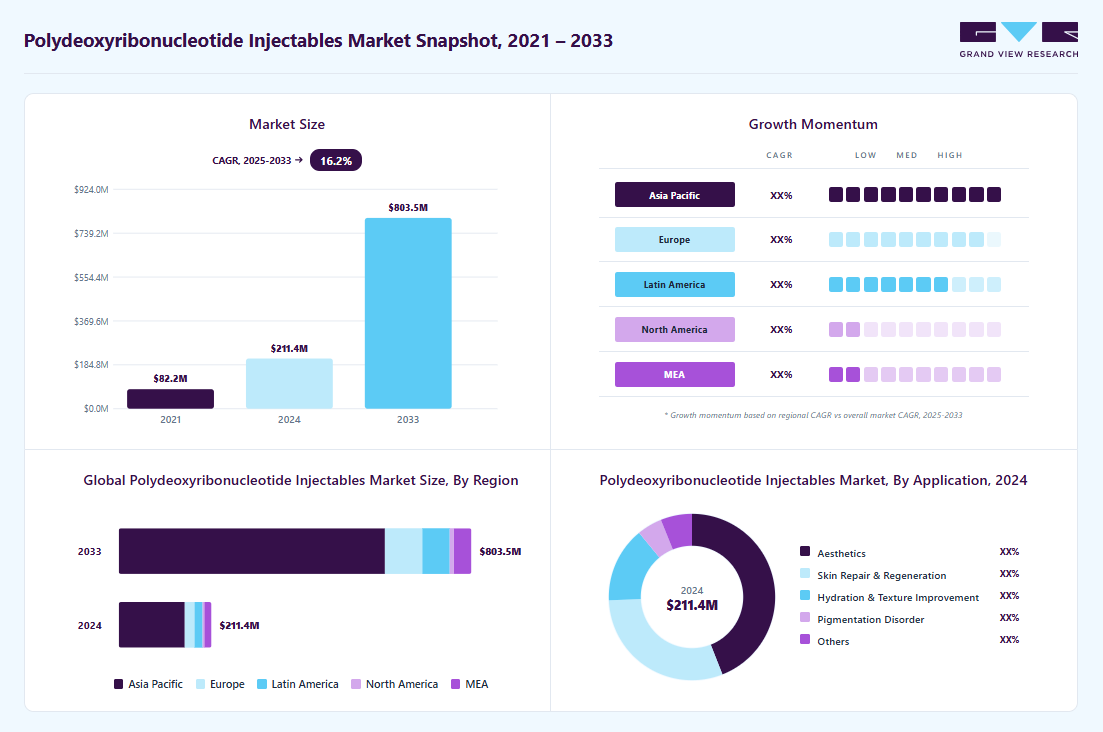
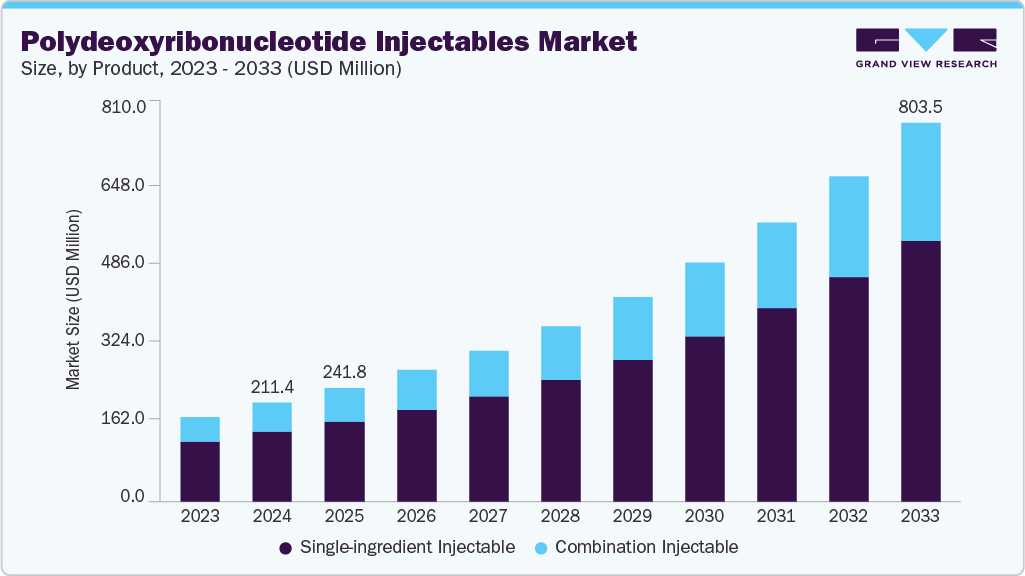
The global polydeoxyribonucleotide injectables market size was estimated at USD 211.37 million in 2024 and is projected to reach USD 803.55 million by 2033, growing at a CAGR of 16.2% from 2025 to 2033. This growth is driven by increasing awareness of aesthetic treatments, technological advancements, and a move towards minimally invasive therapies.
Key Market Trends & Insights
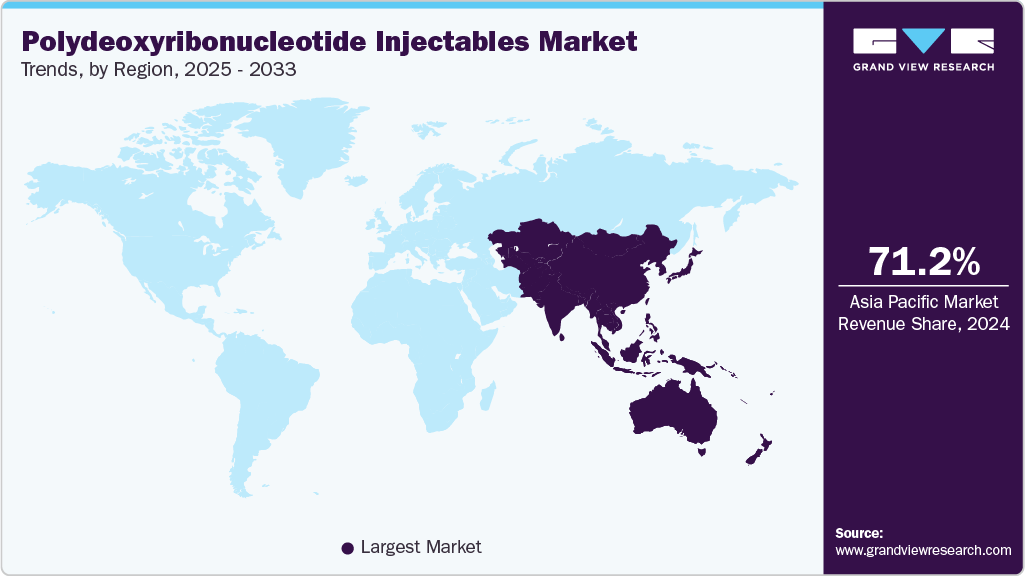
- Asia Pacific's polydeoxyribonucleotide (PDRN) injectables market held the largest share of 71.18% of the global market in 2024.
- The U.S.'s polydeoxyribonucleotide (PDRN) injectables industry is expected to grow significantly over the forecast period.
- By product, the single-ingredient injectable segment held the highest market share of 70.25% in 2024.
- By material, the salmon DNA-derived PDRN held a leading market share in 2024.
- By application, the aesthetics held a leading market share in 2024.
Market Size & Forecast
- 2024 Market Size: USD 211.37 Million
- 2033 Projected Market Size: USD 803.55 Million
- CAGR (2025-2033): 16.2%
- Asia Pacific: Largest market in 2024
Three ways to get this report
Buy it, customize it, or ask a question.Get the Full Report
What the study covers
- FormatsPDF · Excel · Dashboard
- Timeline2025–2033 annual, 2024 base
- Coverage20+ countries, 5 regions
- Companies10+ key players profiled
Customize the Report
20% free customization
- IncludeCountries, segments, points
- TailorTo your product definition
- ExtendDeeper competitor detail
- OrA fully bespoke study
- Turnaround5–10 working days
Ask Prism AI
A cited answer in seconds
- Corpus30K studies, 1.2M points
- ScopeAll markets, not just this
- CitationTraced to report & table
- HonestySays "not covered" if so
- SpeedSeconds, not days
Moreover, the introduction of innovative PDRN injectables, including advanced formulations that combine polydeoxyribonucleotides (PDRN) with hyaluronic acid (HA) and essential vitamins. These innovations improve the regenerative and rejuvenating properties of PDRN, addressing a wider range of skin issues and enhancing patient results.Combination PDRN injectables are quickly gaining widespread acceptance because they can single-handedly address multiple skin problems. To illustrate, the debut of VAMP by Prollenium represents a new milestone in skin revitalization. The product pairs PDRN with a nutrient cocktail of vitamins, amino acids, and minerals to deliver skin firmness, hydration, and quality at a whole new level. VAMP sets out to breathe new life into the skin tone, shrink pore sizes, and wrinkle-free, and give the already compromised skin a chance to rejuvenate; therefore, it is on the cutting edge of aesthetic dermatology as its name suggests. According to a research article published by Science Direct, hyaluronic acid-polydeoxyribonucleotide (HA-PDRN) cross-linked hydrogels are a very efficient means of skin regeneration. The hydrogels made by the covalent bonding of carboxyl groups of Hyaluronic Acid to amino groups of PDRN show enhanced biocompatibility and more collagen production than those made solely from Hyaluronic Acid. These studies indicate the immense possibilities of developing more stable and effective injectable treatments by combining PDRN and HA.
PDRN-related anti-aging advantages greatly boost the injectable market, particularly for those middle-aged to older individuals looking for non-surgical means of facial rejuvenation. PDRN is known to increase collagen levels, repair tissue, and improve skin elasticity, leading to decreased wrinkles, fine lines, and sagging skin in general. PDRN's great benefit of repairing damaged tissues to achieve a younger appearance is extraordinarily attractive for those looking for effective, long-term anti-aging solutions. As people become more familiar with these benefits, the injectable market will continue to grow in demand. Moreover, there is an increased interest in aesthetic treatments in regions with an aging population.
In addition, the scar-healing property of PDRN for acne is becoming a major factor in market growth. The regenerative aspects of PDRN injections are a perfect solution for the skin problems caused by acne. PDRN can reduce the concentration of acne scars and improve the skin surface by activating cell regeneration and tissue repair. As a result, treatments based on PDRN are getting increasingly popular with both young and mature patients who want to solve their skin problems in a safe, non-surgical way, thus being the main factor in the increasing installation of PDRN injections in aesthetic dermatology.
Market Concentration & Characteristics
The PDRN injectables market demonstrates a moderate level of industry concentration, with key players investing in innovative formulations and advanced technologies. Cosmetic PDRN injections, such as Rejuran, are widely adopted across South Korea and parts of Europe. For example, in countries like India, companies such as Dermat India and Cipla are emerging as notable manufacturers-Dermat India focusing on high-quality, compliant PDRN products through advanced R&D, and Cipla expanding its portfolio with regenerative therapeutic solutions. These developments highlight the market’s steady global expansion driven by innovation and rising demand for non-surgical aesthetic treatments.
The market is going through significant changes, new formulations, and manufacturing processes being the main reasons for this change. The manufacturers have already implemented leading-edge biotechnological procedures in India, such as using recombinant DNA technology to produce PDRN of high purity and quality without contamination. Such a formulation as polydeoxyribonucleotides combined with vitamins, amino acids, and minerals, like Prollenium's VAMP, makes skin rejuvenation progression more remarkable. All these technological breakthroughs signify a new period in aesthetic dermatology, where scientific accuracy and customer-specific delivery methods result in better regenerative and anti-aging effects.
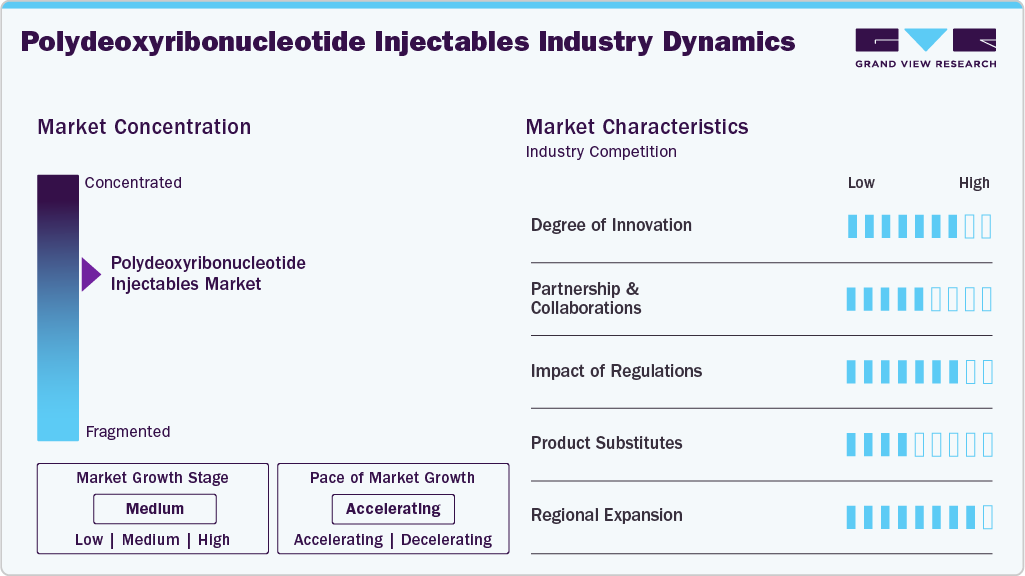
The PDRN injectables market has experienced increased partnerships and collaborations as companies seek to boost product innovation and broaden clinical applications. Many manufacturers are working with biotechnology firms, academic institutions, and dermatology specialists to create next-generation formulations that offer better efficacy and safety. These collaborations also aim to incorporate marine-derived bioactive ingredients and develop new delivery systems for regenerative and aesthetic purposes. For example, Wellbiotech teamed up with Sewon Life Science and Gunsan University College of Marine Science to develop PDRN-based regenerative medicines and cosmetics. This partnership uses marine-derived PDRN and PN to develop innovative skin rejuvenation products, including cosmetic and regenerative biopharmaceuticals, which are expected to be commercialized after regulatory approval.
Regulatory oversight is vital in the PDRN injectables market due to the clinical significance of these regenerative therapies. In countries like India, PDRN production is subject to strict quality standards and certification processes to guarantee safety and effectiveness. Manufacturers follow Good Manufacturing Practices (GMP) as the WHO recommends and often obtain ISO 13485 certification, indicating strong quality management. Rigorous testing protocols aligned with ICH guidelines further enhance product reliability. In addition, Indian PDRN producers seek approval from international regulators such as the FDA and EMA, which helps foster global trust. Although regulatory processes may delay market entry, they ensure high-quality products and offer a competitive edge for compliant manufacturers domestically and internationally.
While PDRN injectables offer regenerative and anti-aging benefits, they face partial competition from alternative treatments such as hyaluronic acid (HA) injectables and polynucleotide (PN)-based therapies. HA injectables are widely used for skin hydration, volume restoration, and wrinkle reduction, while PN formulations provide tissue repair and rejuvenation effects like PDRN. However, the substitute threat is limited as PDRN injectables provide unique molecular mechanisms for tissue regeneration and wound healing that are not fully replicated by these alternatives.
The PDRN injectables industry is witnessing significant regional expansion, particularly in countries such as South Korea, Italy, and other Asian markets, where demand for regenerative and aesthetic treatments is growing. Increasing regulatory approvals and clinical adoption are expected to drive further market penetration. Moreover, collaborations between local manufacturers and international partners enhance production capabilities and technology exchange. For instance, in India, domestic firms are leveraging the country’s strong pharmaceutical infrastructure, skilled workforce, and supportive regulatory environment to develop high-quality PDRN products. At the same time, joint initiatives with global entities accelerate innovation and manufacturing sophistication, broadening access to PDRN injectables across emerging and established markets.
Product Insights
The single-ingredient injectable segment held the largest market share of 70.25% in 2024, with a CAGR of 15.9%. The growth of PDRN is due to its effectiveness in skin treatment, such as acne scars, dullness, dryness, and sensitive areas like the under-eye region, which are the most common skin problems of the young. Single-ingredient PDRN injection products are the only ones capable of achieving the targeted tissue regeneration, collagen stimulation, and moisturizing improvement; thus, they are the most preferred by doctors and their patients. In the likes of Bio Aesthetic Laser Clinic and Dr. Rashmi Shetty’s practice, PDRN injections are touted to be very effective in anti-aging, skin elasticity enhancement, and achieving quick wound healing after skin care procedures.
The combination injectable segment market is witnessing significant growth at a CAGR of 16.8%, fueled by increasing demand for multifunctional, targeted skin treatments. These products combine PDRN with hyaluronic acid, vitamins, and amino acids to address multiple skin concerns simultaneously. Hyaluronic acid enhances hydration and elasticity, while vitamins and amino acids support brightening, collagen production, and skin repair, providing comprehensive skin rejuvenation. For example, Prollenium’s VAMP combines these ingredients to improve skin texture, radiance, and hydration, delivering an advanced solution for anti-aging and overall skin health.
By Material
The salmon DNA-derived polydeoxyribonucleotide (PDRN) segment accounted for the largest market share of 88% in 2024, at a CAGR of 16.0%, which is driven by its broad applicability and high efficacy in skin regeneration and rejuvenation. Salmon DNA-derived PDRN injections promote cell growth and tissue repair by activating fibroblasts, which produce collagen and elastin, essential for skin firmness and youthfulness. They also improve skin elasticity and hydration, making the skin appear tighter and suppler, while enhancing natural moisture retention-beneficial for dry, dull, or aging skin. Furthermore, PDRN reduces fine lines and wrinkles, soothes inflammation and redness, and brightens and evens skin tone, targeting key aesthetic concerns such as acne scars, sun damage, and uneven complexion. Combining these visible benefits and non-invasive administration drives the strong adoption of salmon DNA-derived PDRN injections among clinicians and younger consumers seeking effective anti-aging and skin-repair solutions.
The synthetic/recombinant PDRN segment is witnessing significant growth at a CAGR of 17.6% during the forecast period. Developments in recombinant DNA techniques have led to the generation of PDRN. This method permits more accurate production, customized molecular characteristics, and a reduced risk of contamination, meaning results are safer and more uniform. This technology allows PDRN formulation to be suited for specific therapeutic purposes, extending its applications in skin regeneration, anti-aging, and wound healing. With improved safety, efficacy, and versatility, clinician and patient use of recombinant DNA-generated PDRN-injected products provides reliable and quality skin rejuvenation options.
By Application
The aesthetic segment dominated the market in 2024, with a share of 44.05% and a CAGR of 16.2%. This is attributed to the non-invasive and effective way these injectables can address various common skin conditions. Benefits of PDRN injections include stimulation of collagen production, increased hydration, reduced fine lines and wrinkles, decreased acne scars, and brighter skin tone. According to clinics like Skination and Kosmoderma, these treatments are increasingly popular among younger adults and professionals looking for visible, natural-looking results and little downtime. PDRN injections are part of an initiative to rejuvenate, radiant skin, and improve aesthetic appearance.
The hydration & texture improvement segment, focusing on hydration and texture improvement, is projected to grow substantially, with a CAGR of 17.1% during the forecast period. This growth is driven by its capacity to deliver deep, long-lasting hydration and visibly improve skin texture. Unlike surface-level moisturizers, PDRN draws water into deeper skin layers, restoring moisture and adding a radiant glow. Clinics report that PDRN injections enhance skin elasticity, diminish fine lines, and smooth rough textures by boosting collagen synthesis and cellular turnover. This combination of profound hydration and skin rejuvenation makes PDRN popular for those seeking effective, non-invasive solutions for dry, dull, or aging skin.
End Use Insights
The Medspas segment is expected to have the largest market share, 47.43% in 2024. It is also the fastest-growing segment, at a CAGR of 17.0%, driven by its unique combination of medical expertise and a relaxing, spa-like environment. These clinics provide a safe, clinical setting for administering PDRN injections while ensuring client comfort and focusing on achieving aesthetic results. The blend of professional care with a comfortable experience makes medspas a preferred choice for consumers seeking skin rejuvenation treatments.
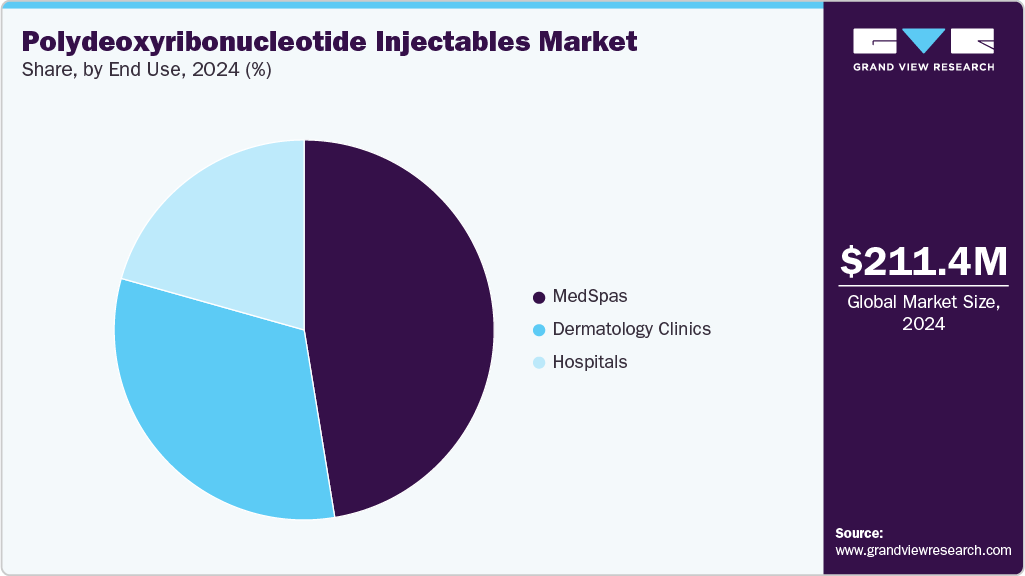
The dermatology clinics segment is expected to grow significantly, driven by increasing demand for professional skin rejuvenation and anti-aging treatments. These clinics provide specialized expertise and advanced resources for administering PDRN injectables, making them a desirable option for safe and effective aesthetic treatments for consumers. Their capabilities to offer customized treatment plans dedicated to specific skin types and aesthetic goals are particularly attractive to middle- and upper-income consumers seeking treatment options with reputable quality and trust in providers with clinical expertise. Lastly, dermatology clinics have led the adoption of newer injectable therapies, such as PDRN (polydeoxyribonucleotide) injectables, whenever they have demonstrated regenerative benefits and a favorable safety profile.
Regional Insights
The North America polydeoxyribonucleotide (PDRN) injectables market is growing, driven by rising consumer awareness of regenerative and anti-aging skin treatments. While these injectables are not yet approved for clinical use in the region, they are gaining attention among dermatologists and aesthetic practitioners due to promising data from international markets highlighting benefits in skin rejuvenation, wound healing, and tissue regeneration. The focus on minimally invasive, science-backed treatments continues to drive curiosity and demand, suggesting strong potential for adoption should regulatory approvals be granted.
U.S. Polydeoxyribonucleotide (PDRN) Injectables Market Trends
The polydeoxyribonucleotide (PDRN) injectables market in the U.S. is expected to grow, as the U.S. market is increasingly embracing Polydeoxyribonucleotide (PDRN) injectables, driven by regenerative properties and a minimally invasive nature. For instance, in February 2025, LaserAway partnered with Rejuran to introduce Rejuran’s salmon DNA-based skin boosters, Healing Essence and Tone-Up Booster, into the U.S. market. These treatments harness hydrolyzed salmon DNA (PDRN / PN technology) to support deeper skin rejuvenation and enhance recovery, especially when combined with LaserAway’s laser resurfacing and microneedling treatments.
Europe Polydeoxyribonucleotide (PDRN) Injectables Market Trends
The polydeoxyribonucleotide (PDRN) injectables market in Europe is witnessing significant growth driven by an aging population and a rising demand for minimally invasive treatments. For instance, in August 2025, a partnership between PharmaResearch and Laboratoires VIVACY. This collaboration aims to distribute Rejuran, a polynucleotide-based skin booster, across 22 European countries, including key markets such as the UK, Germany, France, Italy, and Spain.
The UK polydeoxyribonucleotide (PDRN) injectables market is growing steadily, supported by theincreasing demand for minimally invasive treatments and their anti-aging and regenerative benefits. Treatment offerings like “skin boosters,” under-eye renewal, and mesotherapy with salmon DNA formulations are now available in cities like London and Birmingham and in dermatology/aesthetics clinics across Hampshire and beyond.
The polydeoxyribonucleotide (PDRN) injectables market in Germany is experiencing significant growth, driven by increased aesthetic awareness and a rising preference for minimally invasive treatments. For instance, in 2024, Germany reported 1,303,528 aesthetic procedures, with 677,313 being non-invasive treatments. This surge in demand reflects a broader acceptance of advanced skincare solutions, including PDRN injectables, which are valued for their regenerative and anti-aging properties.
Asia Pacific Polydeoxyribonucleotide (PDRN) Injectables Market Trends
The polydeoxyribonucleotide (PDRN) injectables market in the Asia Pacific is the fastest-growing market.It is driven by increasing demand for minimally invasive treatments and rising medical tourism in countries like South Korea, Thailand, and Singapore, which are increasing the demand for the market as international patients seek affordable and effective PDRN treatments, with prices in South Korea starting at around 150 to 450 USD. Improving healthcare infrastructure is also a key driver in countries like South Korea, which offer advanced dermatology clinics with state-of-the-art technology, ensuring high-quality care for local and international patients. Meanwhile, India is emerging as a significant manufacturer of PDRN injectables, supported by a growing aesthetic industry and high-quality production capabilities. This combination of advanced medical infrastructure, rising aesthetic awareness, and strong regional manufacturing capabilities positions the Asia Pacific as a key growth hub.
China polydeoxyribonucleotide (PDRN) injectables market is driven by the regenerative properties of PDRN, the rising adoption of minimally invasive aesthetic treatments, and the growing demand for anti-aging solutions. Increasing consumer awareness and preference for non-surgical skin rejuvenation procedures fuel market growth. Domestic and international players are expanding their presence through marketing, distribution partnerships, and promotional events. For instance, PharmaResearch recently held a symposium in Urumqi to introduce its PDRN injectable product, Rejuran, across 17 regions in China, including major cities like Beijing, Shanghai, Zhejiang, and Jiangsu. This initiative highlights the rising recognition and adoption of advanced PDRN-based aesthetic treatments in the Chinese market.
The polydeoxyribonucleotide (PDRN) injectables market in India is rapidly evolving due to the regenerative and healing properties of the compound, increasing demand for minimally invasive aesthetic treatments, and rising awareness of anti-aging solutions. Prominent Indian manufacturers like Dermat India, Cipla, and Dr. Reddy’s Laboratories utilize advanced biotechnological techniques, strong R&D efforts, and strategic collaborations to develop high-quality PDRN products for medical and cosmetic uses. Production in India complies with strict international standards such as Good Manufacturing Practices (GMP), ISO 13485 certification, and ICH guidelines, ensuring safety, consistency, and effectiveness. Furthermore, Indian firms seek regulatory approvals from global agencies like the U.S. FDA and EMA, boosting the credibility of their PDRN products and establishing India as a key player in the international PDRN injectable market.
Latin America Polydeoxyribonucleotide (PDRN) Injectables Market Trends
The polydeoxyribonucleotide (PDRN) injectables market in Latin America is growing, driven by rising awareness of aesthetic treatments through social media and increasing demand for minimally invasive procedures. Consumers increasingly seek non-surgical options for skin rejuvenation and anti-aging, which has boosted the adoption of PDRN-based treatments. Countries such as Brazil, Mexico, and Argentina are emerging as key markets, supported by a growing network of dermatology and cosmetic clinics offering advanced regenerative solutions.
Brazil polydeoxyribonucleotide (PDRN) injectables market is expanding rapidly, driven by the country’s rising demand for aesthetic procedures and a strong cultural emphasis on beauty and skincare. For instance, according to the International Society of Aesthetic Plastic Surgery (ISAPS), Brazil ranks among the top global destinations for Aesthetic treatments, with consumers increasingly opting for minimally invasive options like PDRN injectables for skin rejuvenation and anti-aging.
Middle East and Africa Polydeoxyribonucleotide (PDRN) Injectables Market Trends
The polydeoxyribonucleotide (PDRN) injectables market in the Middle East and Africa (MEA) is witnessing growth, driven by rising aesthetic awareness, increasing demand for minimally invasive procedures, and the popularity of regenerative skin therapies. For instance, at Dubai Derma 2024, it showcased its Rejuran and ReNTox product lines and engaged regional medical professionals to highlight the safety and effectiveness of its offerings. This participation reflects the growing interest in PDRN skin boosters in the Middle Eastern market and positions Rejuran as a leading option for clinics seeking advanced, non-invasive aesthetic solutions.
Saudi Arabia polydeoxyribonucleotide (PDRN) injectables market is witnessing growth, driven by rising aesthetic awareness, demand for minimally invasive procedures, and PDRN's regenerative properties. For instance, clinics in Riyadh are increasingly offering Rejuran Healer, a salmon DNA-based skin booster that enhances collagen production, promotes skin regeneration, and improves hydration. This growing adoption reflects strong consumer interest in non-surgical, advanced aesthetic solutions, positioning PDRN injectables as a key option for skin rejuvenation in the Saudi market.
Key Polydeoxyribonucleotide Injectables Company Insights
The Polydeoxyribonucleotide (PDRN) Injectables market is highly competitive, with key players such as PharmaResearch Products Co. Ltd., ZK MEDIGROUP CO. LTD., and BioPlus Co., Ltd. holding significant positions. The major companies undertake various organic and inorganic strategies, such as product introduction, collaborations, and regional expansion, to serve their customers' unmet needs.
Key Polydeoxyribonucleotide Injectables Companies:
The following are the leading companies in the polydeoxyribonucleotide injectables market. These companies collectively hold the largest market share and dictate industry trends.
- ZK MEDIGROUP CO. LTD.
- BioPlus Co., Ltd.
- PharmaResearch Products Co. Ltd.
- K-PrivateLabel
- TY Cosmetic
- Dermax Co., Ltd.
- OTESALY
- Singderm
- Placentex
- Zerone Cellvane
Recent Developments
-
In May 2025, Forbes noted that PharmaResearch’s skin booster injection, Rejuran-which is derived from salmon sperm cells-caused the company’s shares to increase by about 230% in the past year. This dramatic rise in stock value made Jung Sang-soo, the founder and chairman of the company, South Korea’s latest billionaire. The growth underscores the rising global demand and popularity of PDRN-based aesthetic treatments.
-
In February 2025, Rejuran partnered with LaserAway, the top aesthetic dermatology provider in the U.S., to introduce South Korea's leading skin booster technology. This marks Rejuran's initial major entry into the U.S. market, expanding its innovative salmon DNA-based treatments nationwide.
-
In July 2024, idsMED Aesthetics Indonesia and PharmaResearch officially launched REJURAN HB (Hydro Booster) Plus: Radiance Reimagined at the Royal Glasshouse, Park Hyatt, Jakarta.
-
In March 2024, PharmaResearch launched the REJURAN Triple Radiance Ampoule, featuring DOT c-PDRN, a proprietary skin-specialized DNA ingredient designed to enhance skin whitening and radiance. The product, supported by 13 clinical trials, demonstrated improvements in pigmentation, skin transparency, melanin content, and overall facial tone within two weeks, highlighting the brand’s continued innovation in PDRN-based aesthetic treatments.
Polydeoxyribonucleotide Injectables Market Report Scope
Report Attribute
Details
Market size value in 2025
USD 241.37 million
Revenue forecast in 2033
USD 803.55 million
Growth rate
CAGR of 16.2% from 2025 to 2033
Actual period
2021 - 2023
Forecast period
2025 - 2033
Quantitative units
Revenue in USD million/billion and CAGR from 2025 to 2033
Report coverage
Revenue forecast, company ranking, competitive landscape, growth factors, and trends
Segments covered
Product, material, application, end use, region
Regional scope
North America; Europe; Asia Pacific; Latin America; MEA
Country scope
U.S.; Canada; Mexico; UK; Germany; France; Italy; Spain; Denmark; Sweden; Norway; Japan; China; India; Australia; Thailand; South Korea; Brazil; Argentina; South Africa; Saudi Arabia; UAE; Kuwait
Key companies profiled
ZK MEDIGROUP CO. LTD.; BioPlus Co., Ltd.; PharmaResearch Products Co., Ltd.; K-PrivateLabel; TY Cosmetic; Dermax Co., Ltd.; OTESALY; Singderm; Placentex; Zerone Cellvane
Customization scope
Free report customization (equivalent up to 8 analysts working days) with purchase. Addition or alteration to country, regional & segment scope.
Pricing and purchase options
Avail customized purchase options to meet your exact research needs. Explore purchase options
Global Polydeoxyribonucleotide Injectables Market Report Segmentation
This report forecasts revenue growth at country levels and provides an analysis of the latest industry trends and opportunities in each of the sub-segments from 2021 to 2033. For this study, Grand View Research has segmented the global polydeoxyribonucleotide injectables market report based on product, material, application, end use, and region:
-
Product Outlook (Revenue, USD Million, 2021 - 2033)
-
Single-Ingredient Injectable
-
Combination Injectable
-
-
Material Outlook (Revenue, USD Million, 2021 - 2033)
-
Salmon DNA-derived Polydeoxyribonucleotide (PDRN)
-
Synthetic/Recombinant Polydeoxyribonucleotide (PDRN)
-
-
Application Outlook (Revenue, USD Million, 2021 - 2033)
-
Aesthetics
-
Skin Repair & Regeneration
-
Hydration & Texture Improvement
-
Pigmentation Disorder
-
Others
-
-
by End Use Outlook (Revenue, USD Million, 2021 - 2033)
-
MedSpas
-
Dermatology Clinics
-
Hospitals
-
-
Region Outlook (Revenue, USD Million, 2021 - 2033)
-
North America
-
U.S.
-
Canada
-
Mexico
-
-
Europe
-
UK
-
Germany
-
France
-
Italy
-
Spain
-
Denmark
-
Sweden
-
Norway
-
-
Asia Pacific
-
Japan
-
China
-
India
-
Australia
-
South Korea
-
Thailand
-
-
Latin America
-
Brazil
-
Argentina
-
-
Middle East & Africa
-
South Africa
-
Saudi Arabia
-
UAE
-
Kuwait
-
-
About the Author(s)
Medical Devices Research Team
Healthcare · Medical DevicesThis report was authored by the medical devices research team at Grand View Research - comprising two research analysts, one senior research analyst, and one industry expert - with specialized expertise in the medical devices segment of the healthcare industry. All findings are based on proprietary healthcare databases, executive interviews, and regulatory analysis, subject to internal peer review prior to publication.
Last Updated:
Speak to Analyst


Customize this report to your needs - add regions, segments, or data points, with 20% free customization.
Or view our licence options:


ISO 9001:2015 & 27001:2022 Certified
We are GDPR and CCPA compliant! Your transaction & personal information is safe and secure. For more details, please read our privacy policy.


