
- Home
- »
- Next Generation Technologies
- »
-
Proactive Services Market Size & Share Report, 2026-2033GVR Report cover
![Proactive Services Market (2026 - 2033)Report]()
Proactive Services Market (2026 - 2033)
Size, Share & Trends Analysis Report By Service (Technical Support, Design & Consulting, Managed Services), By Technology (Analytics, AI), By End Use (BFSI, Healthcare, Manufacturing), By Enterprise Size, By Application, And Segment Forecasts
Market Size, 2025
$64.8BMarket Estimate, 2026
$70.6BMarket Forecast, 2033
$143.2BCAGR, 2026–2033
10.1%Proactive Services Market Summary
The global proactive services market size was valued at USD 64.8 billion in 2025 and is projected to grow from USD 70.6 billion in 2026 to USD 143.2 billion in 2033, at a CAGR of 10.1% from 2026 to 2033. North America dominated the market, accounting for a revenue share of 34.0% in 2025. The growing trend of understanding customer expectations & buying patterns, adoption of smartphones & tablets, and high usage of the internet, e-commerce websites & shopping applications are a few factors contributing to the growth of this market. As an aftereffect of pandemic, stronger digitalization initiatives across the globe were undertaken by the organizations. This helped the organizations to acknowledge the possibility disruption and adapt to proactive services to ensure business intelligence and process enhancement
Key Market Trends & Insights
- By service: The managed services segment held the largest market share of around 38.5% in 2025.
- By technology channel: The analytics segment held the largest market share of approximately 52.0% in 2025.
- By enterprise size: The large enterprise segment held the largest market share of over 58.0% in 2025.
- By application: The customer experience management segment held the largest market share of approximately 26.0% in 2025.
Regional Highlights
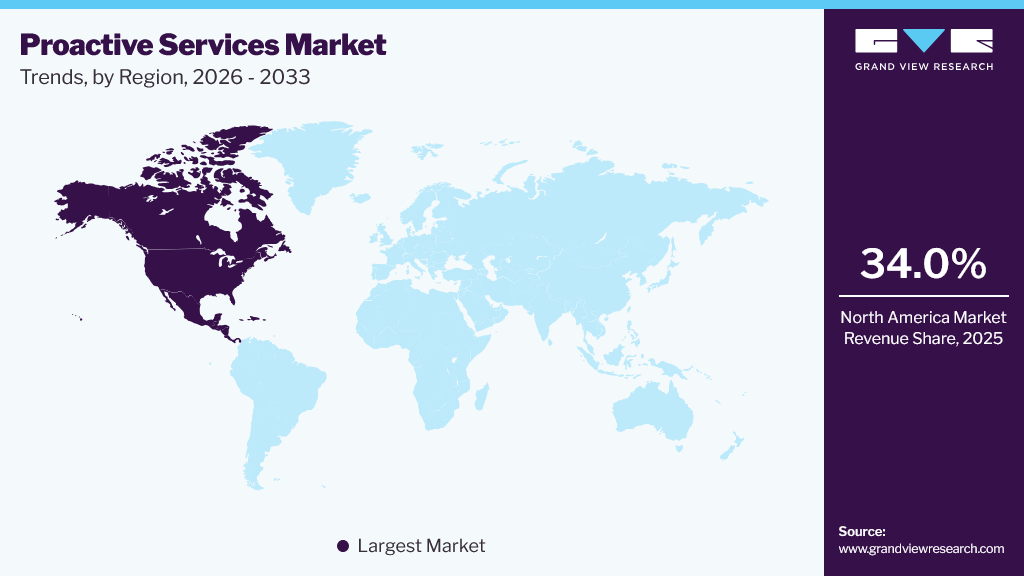
- Largest regional market: North America (34.0% revenue share, 2025)
- Fastest-growing regional market: Asia Pacific (highest CAGR, 2026-2033)
Market Size & Forecast
- Market size in 2025: USD 64.8 Billion
- Estimated market size in 2026: USD 70.6 Billion
- Projected market size by 2033: USD 143.2 Billion
- CAGR (2026-2033): 10.1%
There is a rise in the number of people opting for online shopping, permitting retailers and other business organizations to seize the valuable opportunity of adopting more sustainable practices by integrating the existing workflow with their digital presence. High usage of cell phones, tablets, and other electronic devices to access bank accounts for transactions is anticipated to increase and thus drive the market. Customers expect support and guidance, and acquiring new customers is not the only priority for organizations; retaining existing customers and ensuring they have all that they need is also important.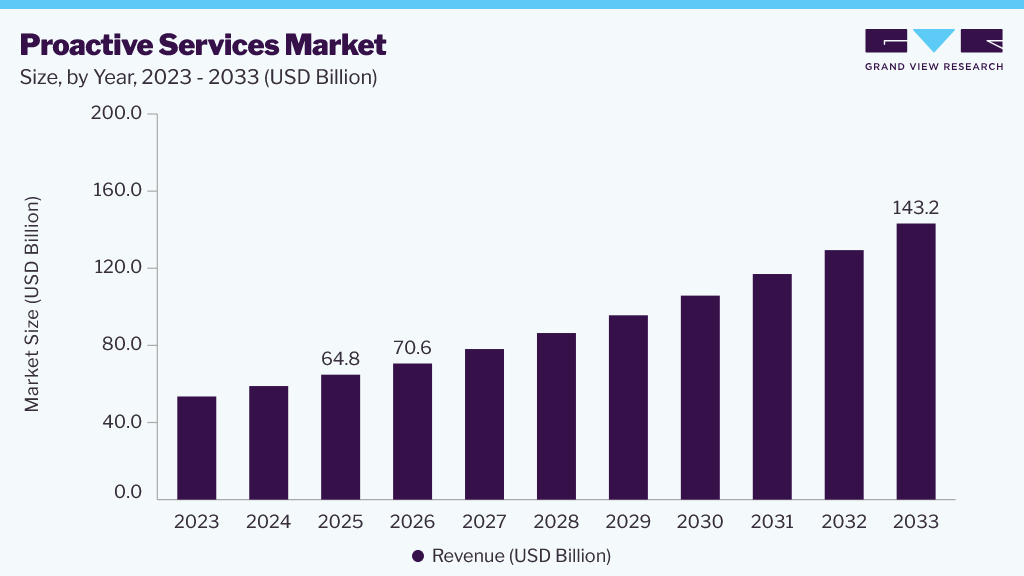
Proactive services allow marketers to identify the pain points of customers, not only understanding their current needs but also supporting their latent needs. The expanding interest and adoption rate of Machine Learning (ML), Artificial Intelligence (AI), and the Internet of Things (IoT) across various industries support data-rich solutions and are expected to fuel market growth. With the help of such technologies, organizations may well predict the future patterns of their customers and offer them services even before they realize their needs. Moreover, the expanding utilization of bots is affecting the market, as it would help examine the success rate of ads or content posted across various platforms.
To avoid challenges such as cost management and implementation while executing changes in the organization, it is important to improve performance across the entire IT infrastructure, which means the implementation of proactive services across all levels of the organization. While firms adopt new technologies, cost management is one of the most significant problems for the end-users of proactive services. To defeat these difficulties, organizations should concentrate on acquiring self-analytic devices, proactive & preventive support systems, omnichannel presence, and other upgraded management tools. In addition, organizations should acquire a strong IT security framework to prevent the loss of any data, as it could affect an organization’s brand reputation.
Analyst Perspective
The proactive services market is witnessing substantial growth as consumer behavior is shifting towards online shopping and the major factor would be practice of cell phones, tablets, and other electronic devices to access bank accounts for transactions is anticipated to increase. Organizations increasingly prioritize customer retention, operational efficiency, and personalized service delivery. The rising adoption of machine learning (ML), artificial intelligence (AI), predictive analytics, and Internet of Things (IoT) advance technologies, enabling the anticipation of customer needs. With the help of such technologies, organizations may well predict the future patterns of their customers and offer them services even before they realize their needs. Moreover, the expanding utilization of bots is affecting the market, as it would help examine the success rate of ads or content posted across various platforms. However, some constraints related to cost implementation, data security, and system integration continue to influence adoption strategies across organizations worldwide.
Service Insights
The managed services segment accounted for the largest market share of approximately 38.5% in 2025. Managed services allow the outsourcing of IT tasks for better work efficiency. Advantages offered by the implementation of managed services are low operational cost, enhanced functional effectiveness, and reduced workload on the in-house IT team. The need for ideal resource allocation, remote monitoring, and management of hardware, security services, and communication support will further boost this segment's growth. In addition, cloud computing and big data analytics are also expected to drive the growth. A few of the benefits offered by managed services include minimized downtime, scalability, data compliance, and faster response time.
The technical support segment is expected to grow the fastest CAGR of approximately 22.0% over the forecast period. The need for organizations to comply with the latest regulations and the increase in security threats compel organizations to disburden their daily IT operations and turn to service providers. In addition, technology is evolving at a considerable pace, and it demands continuous upgrades and maintenance, which is expected to support the growth of this segment. The technical support service includes reactive problem-solving, troubleshooting, customer support, predictive analysis, and self-service, among others.
Technology Insights
The analytics segment accounted for a market share of approximately 52.0% in 2025. The analytics solution can handle tremendous amounts of data, and it helps organizations achieve proactive customer care. Organizations can leverage advanced analytics to measure various variables, understand consumers’ purchasing patterns, analyze probabilities, and measure anomalies to find out the root causes. A higher amount of data collection results in better analytical capabilities; moreover, predictive analytics technology allows synchronous and real-time intervention, which is why organizations adopt analytics tools. Organizations that make heavy use of IoT devices contain heterogeneous streams of data that can be utilized by analytical tools to achieve consistency across the business.
The AI segment is expected to grow at the highest CAGR of approximately 22.0%. An increasing number of organizations are adopting AI due to its ability to accurately comprehend data and based on that, send customized product and service recommendations. In addition, it would help in cross-selling and upselling. Artificial intelligence saves customers’ time by assisting them in navigation through various web portals and applications. For instance, chatbots can help clients by addressing FAQs and other queries so that customers do not have to wait on long calls for assistance. Customers expect to stay updated about their order status, delivery time, or any changes in schedule; all these can be proactively conveyed to the customer with the help of AI, which will support the segment growth. For instance, The second largest telecom network in India, Bharti Airtel developed and deployed 6 AI agents that are helping customer with billing, payments, and other services.
Enterprise Size Insights
The large enterprise segment accounted for the largest share of more than 58.0% in 2025. Large enterprises are focusing on executing the seamless implementation of digital strategies, including preventive techniques across different levels of the organization, and they have sound financial backup to support the required on-premises infrastructure. Many banks and insurance companies are also seen to implement proactive services as it minimizes the risk associated with transactions. In addition, customers are often seen reaching out to contact centers to enquire about product delivery details or clarifications about prices, terms & conditions. To avoid such inbound calls, large enterprises actively focus on implementing proactive services, as it results in reduced operational costs.
The Small & Medium Enterprise (SME) segment is expected to witness the fastest growth at a CAGR of over 23.0%. Due to budget constraints, SMEs face multiple challenges, such as a lack of skilled workforce, a lack of domain-specific experts, scalability, and management control. However, with the help of cloud deployment, SMEs can bring more stability and control to their business process, and it would also help in the reduction of device costs. The rise in vendors offering the solution to SMEs is further pushing SMEs to rapidly adopt proactive services for enhanced network performance across all channels and better customer retention.
Application Insights
The customer experience management segment accounted for the largest share of approximately 26.0% in 2025. Customer experience helps organizations in many ways, such as spreading good word of mouth, retaining existing customers, acquiring new customers, improving customer satisfaction, higher customer lifetime value, and brand loyalty, among others. Organizations can strengthen their brand preference by serving differentiated experiences and lowering costs by reducing churn rates. In addition, factors such as lower marketing and acquisition costs, operational innovation, technological advancements, and heightened customer expectations will help boost the segment's growth.
The cloud management segment is expected to grow at the fastest CAGR of over 23.0% over the forecast period. Cloud management proactive service providers offer system monitoring, proactive patches for better security, capacity management, backup services, preventive maintenance, and service management. Cloud management provides a single platform to monitor the status of the entire IT infrastructure. It utilizes proactive threshold management across multiple elements to remediate the problem even before it occurs, thus maximizing the organization’s uptime and availability. Lower operational cost, ease of deployment, and customization as per the organization’s needs are a few other key factors driving the growth of this segment.
End Use Insights
The BFSI segment captured approximately 21.0% of the overall revenue share in 2025 and is expected to continue to dominate the market throughout the forecast period. The developing interest of banks and other financial institutions in enhancing customer engagement and interaction processes aimed at creating a lasting impact on customers is expected to support the growth of this segment. This further pushes banks to implement proactive services in the fast-growing marketplace. Banks and financial institutions contain sensitive financial data, due to which, customers often reach out to banks even for the smallest query.
This leads to large volumes of inbound calls, which can be expensive for organizations. With the help of proactive services, banks can proactively inform customers about any updates or changes relating to their accounts, which will not only enhance customer experience but also make them trust the bank more.
The healthcare segment is expected to grow at the fastest CAGR of over 23.0% over the forecast period. The healthcare segment is highly reactive, but a shift towards value-based care with better population health and lower cost is expected to support the segment's growth. With the use of sophisticated technology and algorithms to analyze various data streams, healthcare departments can predict future risks by utilizing pattern recognition with known outcomes. Proactive services help healthcare workers to address the issue before they advance, plus it helps patients to avoid the expense associated with high-risk conditions, such as the need for emergency surgery or the number of days spent in the ICU.
Regional Insights
North America dominated the global market in 2025 and accounted for approximately 34.0% revenue share. Proactive services demand active and flexible IT support, which can be found in most service vendors present in this region. In addition, a stabilized economy and heavy investments by government bodies into various technologies, such as AI, advanced data analytics, and ML, make North America one of the most advanced software and information technology service industries. Moreover, North America has a large retail industry that focuses on delivering proactive services, which is one of the key factors supporting regional market growth.
Asia Pacific Proactive Services Market Trends
Asia Pacific is anticipated to register the fastest growth rate of approximately 23.0% over the forecast period. This can be attributed to the rapidly expanding service sector and the rising number of startups in the region. Proactive services offer startups the support they need to enhance their visibility in the marketplace, which allows accurate customer segmentation and based on that, provides precise product suggestions. In addition, an increased number of mobile users and growing use of social media analytics & e-commerce will fuel the regional market growth.
Key Proactive Services Market Companies Insights
Industry players utilize a variety of inorganic growth tactics, such as partnerships, mergers, and acquisitions, to broaden their product offerings. For instance, AT&T helps their subscribers to avoid the phenomenon called ‘Bill Shock’, which occurs when the customer receives the bill for the first time, and it is difficult for them to understand. In such a scenario, customers are observed to make multiple inbound calls, hence, to avoid this, AT&T added a personalized video link with the first bill, which will walk them through the bill.
Key Proactive Services Companies
The following key companies have been profiled for this study on the proactive services market:
-
Amazon Web Services, Inc.
-
Avaya Inc.
-
Cisco Systems, Inc.
-
DXC Technology
-
Fortinet, Inc.
-
Genesys
-
Hewlett Packard Enterprise Company
-
Huawei Technologies Co., Ltd
-
International Business Machines Corporation
-
Juniper Network, Inc.
-
LivePerson, Inc.
-
Microsoft Corporation
-
NICE
-
Symantec Corporation
Recent Developments
- In January 2026, the Salesforce customer service landscape went into a massive, agentic shift. The company implemented AI and is expected to 50% of its services cases using AI by 2027 compared to the 30% in 2025. The company is utilizing the unified data and agentic AI to shift self-service from reactive problem-solving to concierge-style support that enhances customer experience.
- In May 2025, NICE Ltd. announced a strategic partnership with ServiceNow to deliver AI-powered customer service fulfillment across enterprise operations. The collaboration integrates customer engagement automation with workflow orchestration, enabling organizations to proactively identify, manage, and resolve customer issues while improving operational efficiency and customer experience.
Proactive Services Market Report Scope
Report Attribute
Details
Market size in 2025
USD 64.8 billion
Estimated market size in 2026
USD 70.6 billion
Projected market size by 2033
USD 143.2 billion
Growth rate
CAGR of 10.1% from 2026 to 2033
Base year for estimation
2025
Actual data
2021 – 2024
Forecast period
2026 – 2033
Quantitative units
Revenue in USD billion, and CAGR from 2026 to 2033
Report coverage
Revenue forecast, company ranking, competitive landscape, growth factors, and trends
Segments covered
Service, technology, enterprise size, application, end use, region
Regional scope
North America; Europe; Asia Pacific; Latin America; Middle East & Africa
Country scope
U.S.; Canada; Germany; UK; France; Italy; Spain; China; India; Japan; South Korea; Australia; Brazil; Mexico; Argentina; UAE; Saudi Arabia; South Africa
Key companies profiled
Amazon Web Services, Inc.; Avaya Inc.; Cisco Systems, Inc.; DXC Technology; Fortinet, Inc.; Genesys; Hewlett Packard Enterprise Company; Huawei Technologies Co., Ltd.; International Business Machines Corp.; Juniper Network, Inc.; LivePerson, Inc.; Microsoft Corp.; NICE, Symantec Corp.
Customization scope
Free report customization (equivalent up to 8 analysts working days) with purchase. Addition or alteration to country, regional & segment scope.
Pricing and purchase options
Avail of customized purchase options to meet your exact research needs. Explore purchase options
Global Proactive Services Market Report Segmentation
This report forecasts revenue growth and provides an analysis of the latest trends in each of the sub-segments from 2021 to 2033. For this report, Grand View Research has segmented the proactive services market based on service, technology, enterprise size, application, end use, and region:
- Service Outlook (Revenue, USD Billion, 2021 - 2033)
- Design & Consulting
- Managed Services
- Technical Support
- Technology Outlook (Revenue, USD Billion, 2021 - 2033)
- Analytics
- Artificial Intelligence
- Others
- Enterprise Size Outlook (Revenue, USD Billion, 2021 - 2033)
- Large Enterprise
- Small & Medium Enterprise
- Application Outlook (Revenue, USD Billion, 2021 - 2033)
- Cloud Management
- Customer Experience Management
- Data Center Management
- End-point Management
- Network Management
- Others
- End Use Outlook (Revenue, USD Billion, 2021 - 2033)
- BFSI
- Government
- Healthcare
- Manufacturing
- Media & Communications
- Retail
- Others
- Regional Outlook (Revenue, USD Billion, 2021 - 2033)
- North America
- U.S.
- Canada
- Europe
- UK
- Germany
- France
- Italy
- Spain
- Asia Pacific
- China
- India
- Japan
- Australia
- South Korea
- Latin America
- Brazil
- Mexico
- Argentina
- Middle East & Africa
- UAE
- Saudi Arabia
- South Africa
- North America
Frequently Asked Questions About This Report
The key players operating in the Enterprise Mobility Management market include Amazon Web Services, Inc., Avaya Inc., Cisco Systems, Inc., DXC Technology, Fortinet, Inc., Genesys, Hewlett Packard Enterprise Company, Huawei Technologies Co., Ltd. International Business Machines Corporation, Juniper Network, Inc., LivePerson, Inc., Microsoft Corporation, NICE , and Symantec Corporation
North America dominated with a 34.0% revenue share in 2025.
The global proactive services market is expected to grow at a compound annual growth rate of 10.1% from 2026 to 2033 to reach USD 143.2 billion by 2033.
Managed services dominated the proactive services market with a share of 38.5% in 2025, while technical support is the fastest-growing segment.
The global proactive services market size was estimated at USD 64.8 billion in 2025 and is expected to reach USD 70.6 billion in 2026.
About the Author(s)
Next Generation Technologies Research Team
Technology · Next Generation TechnologiesThis report was authored by the next generation technologies research team at Grand View Research - comprising two research analysts, one senior research analyst, and one industry expert - with specialized expertise in the next generation technologies segment of the technology industry. All findings are based on proprietary technology databases, executive interviews, and regulatory analysis, subject to internal peer review prior to publication.
Last Updated:
Speak to Analyst


Customize this report to your needs — add regions, segments, or data points, with 20% free customization.
Or view our licence options:


ISO 9001:2015 & 27001:2022 Certified
We are GDPR and CCPA compliant! Your transaction & personal information is safe and secure. For more details, please read our privacy policy.


