
- Home
- »
- Consumer F&B
- »
-
Global Probiotic Drink Market Size, Share, Report, 2020-2027GVR Report cover
![Probiotic Drink Market Size, Share & Trends Report]()
Probiotic Drink Market (2021 - 2027) Size, Share & Trends Analysis Report By Product (Dairy-based, Plant-based), By Distribution Channel (Offline, Online), By Region, And Segment Forecasts
Probiotic Drink Market Summary
The global probiotic drink market size was valued at USD 13.38 billion in 2020 and is projected to reach USD 21.95 billion by 2027, growing at a CAGR of 7.3% from 2021 to 2027. The growing demand for functional beverages worldwide to improve digestive health is supporting the growth of the market over the years. Consumers are increasingly getting aware of the product and understanding its importance for their gut wellness.
Key Market Trends & Insights
- The Asia Pacific accounted for the largest share of more than 40.0% in 2019.
- Central and South America is expected to expand at the fastest CAGR of 7.2% from 2020 to 2027.
- By distribution channel, the offline channel segment led the market and accounted for more than 85.0% of the global revenue in 2019.
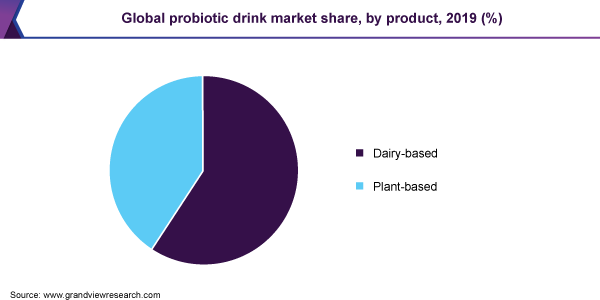
- By product, Dairy-based products held the largest revenue share of more than 55.0% in 2019.
Market Size & Forecast
- 2020 Market Size: USD 13.38 Billion
- 2027 Projected Market Size: USD 21.95 Billion
- CAGR (2021-2027): 7.3%
- Asia Pacific: Largest market in 2019
- Central and South America: Fastest growing market
Furthermore, the rising health awareness among the consumers, especially young consumers, has fueled the demand for the product across the globe. Moreover, the availability of ready-to-drink products for on-the-go consumption has prompted the growth of the market.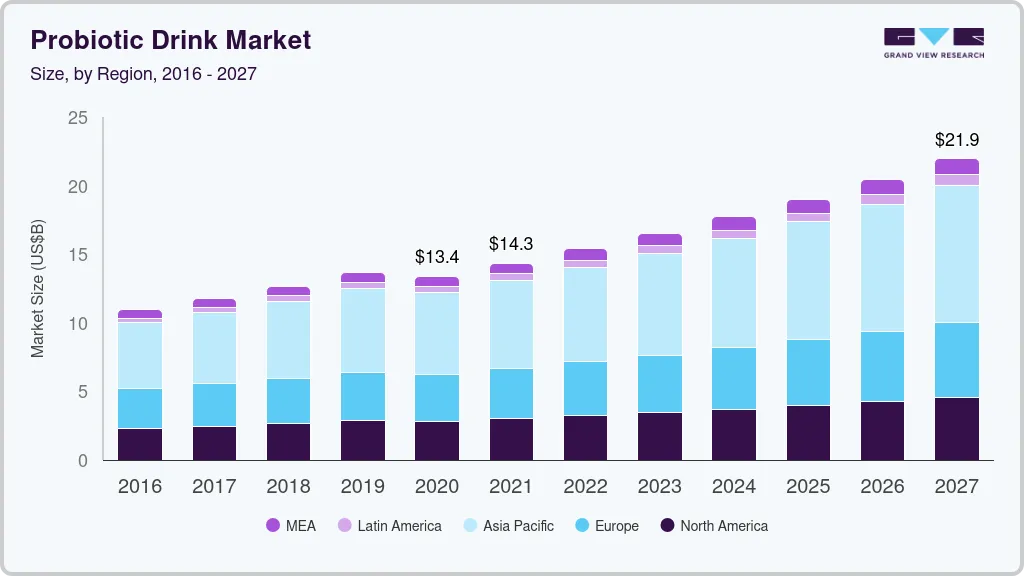
Probiotic drink help maintain a healthy balance of stomach bacteria, leading to several health benefits, including digestive health, weight loss, and immune function. Regular consumption of the drinks improves bowel movement and nutrient absorption. Furthermore, these drinks promote mental health as several studies have proven that mood and mental health are linked with gut health. Thus, the product helps reducing depression, anxiety, obsessive-compulsive disorder (OCD), and autism. In addition, the products may boost the immune system by promoting the production of natural antibodies in the human body.
The increasing awareness about the health benefits of the product has been fueling its adoption among the consumers. As per a survey conducted by Kerry Group, more than 75% of the consumers in the U.S. and over 50% of consumers worldwide are aware of the digestive health benefits associated with the product. Google searches for “microbiome” increased by 267% from 2014 to 2019. Thus, the demand for probiotic drink has been rising with the growing health consciousness among consumers.
The manufacturers of probiotic drinks have been introducing innovative products with different flavors and attractive packaging. However, choosing a substantial strain can be challenging for the manufacturers as performance levels vary with the other strains. Lactobacillus and Bifidobacterium are the most common strains used for the production of these products. Though, Bacillus is also gaining traction among the producers as it can be utilized in most extreme production processes.
Market Dynamics
The probiotic drinks market is experiencing significant growth driven by a fundamental shift in consumer behavior toward proactive health and wellness, as people increasingly seek out functional foods and beverages that offer benefits beyond basic nutrition. Probiotic drinks, which help maintain a healthy balance of gut bacteria, have gained widespread popularity due to their scientifically supported roles in improving digestive health, enhancing immune function, and even supporting mental well-being through the gut-brain axis. According to research from FMCG Gurus, 80% of global consumers have now heard of probiotics or cultures, demonstrating a substantial shift from niche awareness to mainstream recognition. The market has responded accordingly, with new beverage launches with gut health claims increased from just 1% in 2020 to 5% in 2025, representing the highest level ever recorded. This widespread and intensifying consumer focus on preventive healthcare, digestive health, and immunity is a primary force propelling the global expansion of the market.
The probiotic drinks market faces significant restraints due to non‑harmonized regulations across different jurisdictions, where probiotics are defined, classified, and regulated differently from one country to another, affecting both consumer protection and market access for manufacturers. According to an analysis of EFSA dossiers published between 2005 and 2013, 78% of all analyzed health claims were considered beneficial by the NDA Panel, yet most applications were turned down due to insufficient scientific substantiation. This regulatory non‑harmonization poses quality, safety, and validity risks for consumers, discourages food manufacturers from researching potential health benefits, and creates complicated approval procedures and market access barriers across various markets.
Distribution Channel Insights
The offline channel segment led the market and accounted for more than 85.0% of the global revenue in 2019. Supermarkets, hypermarkets, and convenience stores are the key offline distribution channels in the market. The increased shelf space in the physical stores, including supermarkets, convenience stores, grocery stores, health food stores, and pharmacies, has boosted the sales of these beverages over the world.
Online channel is expected to expand at the fastest CAGR of 6.7% from 2020 to 2027. The increasing number of online retailers who offer competitive pricing, easy payment options, and hassle-free delivery is fostering the segment growth. In addition, the growth can be attributed to the increasing experience and dependency of the younger generation on the internet and e-commerce. Furthermore, the high penetration of smartphones among the middle-class population across the globe is expected to boost the sales of these drinks via online platforms over the coming years.
Product Insights
Dairy-based products held the largest revenue share of more than 55.0% in 2019. Traditionally, probiotic drinks are associated with fermented dairy drinks or yogurt-based drinks as probiotics are very compatible with dairy products. Some of the traditional or regional dairy-based drinks are gaining popularity across the globe. For instance, Kefir, a fermented milk drink, traditionally consumed in Europe, is gaining popularity over the world. As reported by Food & Drink International in February 2020, Tesco plc, an international supermarket, has witnessed a demand growth of 400% for Kefir in the U.K. in the last 18 months. Key manufacturers including Yakult Honsha Co., Ltd., Danone S.A., and GCMMF (Amul) offer a range of milk-based products.
The plant-based product segment is expected to witness the fastest growth over the forecast period. Over the past few years, the demand for plant-based drinks, including probiotic fruit and vegetable juices, is increasing significantly. The increasing number of lactose-intolerant people and growing concerns over animal cruelty in the food and beverage industry have been driving the segment.
Companies such as KeVita (PepsiCo), Goodbelly (NextFoods), and Harmless Harvest offer exclusively plant-based probiotic drinks. Kombucha tea is one of the most trending beverages, which has been gaining traction among consumers. In April 2020, Neuro, a beverage company, introduced probiotic kombucha tea, Probucha. This product is a carbonated drink flavored with lemon and ginger and cultured with Bacillus subtilis bacteria.
Regional Insights
The Asia Pacific accounted for the largest share of more than 40.0% in 2019. China, Japan, and India are the key markets in the region. According to the International Probiotics Association (IPA), China is one of the most important markets for probiotics in the world. Producers and suppliers have been witnessing a significant increase in sales in the nation. Yogurt-based probiotic drinks are significantly prevalent in the region.
Central and South America is expected to expand at the fastest CAGR of 7.2% from 2020 to 2027. The functional beverage market is one of the fastest-growing markets in the region. As of 2019, Brazil contributed more than half of the sales in the region. Furthermore, increasing middle-class population, rising health concerns, and expanding availability of the probiotic drinks are expected to fuel the demand for the product in the region in the upcoming years.
Key Companies & Market Share Insights
The industry is characterized by intense competition on account of the presence of major market players. Manufacturers have been introducing new flavors, attractive packaging, and organic ingredients to gain a competitive advantage over others. In November 2017, AliveBiome, a U.K.-based food, and beverage specialist company, launched a new probiotic beverage that offers live bacteria, botanicals, and vitamins. This probiotic drink is available in citrus and raspberry flavors and packaged in 375ml bottles. Similarly, in July 2020, Chobani, LLC. launched a new plant-based organic beverage made with fermented fruit juice and oats. These beverages are available in vanilla, mixed berry vanilla, banana cream, and strawberry cream flavors. Some prominent players in the global probiotic drink market include:
-
Yakult Honsha Co., Ltd.
-
Danone S.A.
-
GCMMF (Amul)
-
PepsiCo
-
NextFoods
-
Harmless Harvest
-
Bio-K Plus International Inc.
-
Fonterra Co-operative Group
-
Lifeway Foods, Inc.
-
Nestle SA
-
Chobani, LLC
Probiotic Drink Market Report Scope
Report Attribute
Details
Market size value in 2021
USD 14.34 billion
Revenue forecast in 2027
USD 21.95 billion
Growth Rate
CAGR of 7.3% from 2021 to 2027
Base year for estimation
2020
Historical data
2016 - 2019
Forecast period
2021 - 2027
Quantitative units
Revenue in USD million and CAGR from 2021 to 2027
Report coverage
Revenue forecast, company ranking, competitive landscape, growth factors, and trends
Segments covered
Product, distribution channel, region
Regional scope
North America; Europe; Asia Pacific; Central & South America; Middle East & Africa
Country scope
U.S.; Germany; U.K.; China; Japan; Brazil; South Africa
Key companies profiled
Yakult Honsha Co., Ltd.; Danone S.A.; GCMMF (Amul); PepsiCo; NextFoods; Harmless Harvest; Bio-K Plus International Inc.; Fonterra Co-operative Group; Lifeway Foods, Inc.; Nestle SA; Chobani, LLC
Customization scope
Free report customization (equivalent up to 8 analysts working days) with purchase. Addition or alteration to country, regional & segment scope.
Pricing and purchase options
Avail customized purchase options to meet your exact research needs. Explore purchase options
Segments Covered in the ReportThis report forecasts revenue growth at the global, regional, and country levels and provides an analysis of the latest industry trends and opportunities in each of the sub-segments from 2016 to 2027. For the purpose of this study, Grand View Research has segmented the global probiotic drink market report on the basis of product, distribution channel, and region:
-
Product Outlook (Revenue, USD Million, 2016 - 2027)
-
Dairy-based
-
Plant-based
-
-
Distribution Channel Outlook (Revenue, USD Million, 2016 - 2027)
-
Offline
-
Online
-
-
Regional Outlook (Revenue, USD Million, 2016 - 2027)
-
North America
-
U.S.
-
-
Europe
-
Germany
-
U.K.
-
-
Asia Pacific
-
China
-
Japan
-
-
Central & South America
-
Brazil
-
-
Middle East & Africa
-
South Africa
-
-
Delivered Customizations
This report has been delivered with the following In-depth customizations
Client Request
Customization Delivered
Value Adds
Cross-Segmentation Analysis for Probiotic Drinks Across Channels
Detailed cross-segmentation analysis of probiotic drink categories, including dairy-based drinks (yogurt drinks, kefir), plant-based drinks, kombucha-based probiotic drinks, and water kefir across supermarkets/ hypermarkets, convenience stores, pharmacies, online retail, and specialty health food stores. Analysis of category performance by pricing tier (economy/mass-market, mid-range, premium), consumer demographics (health-conscious adults, wellness-oriented consumers, seniors, children), and consumption occasions (daily digestive health maintenance, post-exercise digestive recovery and hydration, on-the-go functional hydration). Regulatory bodies such as the FDA and EFSA play a crucial role in setting product standards, permissible strains, and labeling requirements, all of which impact product formulation and cross-border trade.
Identify the fastest-growing probiotic drink categories across individual distribution channels (online retail is the fastest-growing distribution channel; offline retail channels continue to account for the majority of revenue share). Evaluate channel-wise growth rates and revenue contribution by drink type to support targeted category expansion and channel prioritization strategies. Highlight whitespace opportunities for premium synbiotic drinks, botanical/plant-infused probiotic beverages, functional kombucha-based hydration drinks, and shelf-stable probiotic formulations.
Coffee Production & Competitive Manufacturing Analysis
Comprehensive assessment of competitor-wise estimated production capabilities, manufacturing footprint, strain stability protocols (with focus on encapsulation technologies for shelf stability), sourcing hubs for probiotic cultures (Lactobacillus, Bifidobacterium), and regional production facilities across key markets. Portfolio benchmarking across premium (specialized strains and clinically researched formulations), mainstream (flavored probiotic drinks), and value (mass-market/value segment) segments. Analysis of pricing positioning (dairy-based probiotic drinks: established mainstream pricing structure; plant-based and kombucha-based drinks: premium positioning; pricing varies based on strain potency, CFU stability requirements, and formulation complexity) and private-label manufacturing exposure (OEM/ODM services for custom strain blends and ambient-stable packaging). Asia-Pacific is emerging as the fastest-growing regional market for production expansion and consumption.
Identify benefits of vertical integration, including supply stability, margin optimization, and sourcing control through in-house strain development and advanced fermentation and encapsulation capabilities, enabling improved shelf stability and reduced cold-chain dependency. Benchmark competitor manufacturing efficiencies against metrics like CFU count stability, GMP/ISO 22000 compliance, strain viability under ambient conditions, and supply reliability metrics. Support strategic sourcing, production localization (reducing cold-chain dependency as a major industry focus), and capacity expansion decisions with strain-specific guidance.
Regulatory Compliance & Labeling Standards for Probiotic Drinks
Comprehensive assessment of region-specific regulatory frameworks governing probiotic drink labeling, health claims, and strain-specific approvals across North America (FDA GRAS notification), Europe (EFSA Article 13.5/Novel Food approval; strict limitations on the use of the term "probiotic" in product labeling without authorized health claims), Latin America (ANVISA registration), and MEA (varying local standards). Analysis of allowable claim categories, including "live cultures," "contains probiotics" (where permitted), digestive health support (where regulatory frameworks permit), immune support positioning, and wellness-focused positioning. Benchmarking of label compliance requirements, CFU declaration standards (per serving vs. per container), and finished-product stability testing protocols across jurisdictions.
Identify regulatory whitespace for shelf-stable ambient distribution claims, targeted health positioning (gut microbiome balance support, digestive regularity, immune support positioning), and synbiotic drink claim opportunities. Reduce market entry risks through early identification of documentation requirements, strain-specific dossier preparation, and third-party validation pathways. Support global scaling strategies with compliance-first category positioning across targeted geographies without reformulation penalties or localization delays.
Frequently Asked Questions About This Report
The global probiotic drink market size was estimated at USD 13.65 billion in 2019 and is expected to reach USD 13.38 billion in 2020.
The global probiotic drink market is expected to grow at a compound annual growth rate of 6.1% from 2020 to 2027 to reach USD 21.95 billion by 2027.
Asia Pacific dominated the probiotic drink market with a share of over 40% in 2019. This is attributable to rising health concerns coupled with the increasing middle-class population in the region.
Some key players operating in the probiotic drink market include Yakult Honsha Co., Ltd., Danone S.A., GCMMF (Amul), PepsiCo, NextFoods, Harmless Harvest, Bio-K Plus International Inc., Fonterra Co-operative Group, Lifeway Foods, Inc., and Nestle SA.
Key factors that are driving the probiotic drink market growth include growing demand for functional beverages, rising health awareness among the consumers, and the availability of ready-to-drink products across the world.
About the Author(s)
Consumer F&B Research Team
Consumer Goods · Consumer F&BThis report was authored by the consumer f&b research team at Grand View Research - comprising two research analysts, one senior research analyst, and one industry expert - with specialized expertise in the consumer f&b segment of the consumer goods industry. All findings are based on proprietary consumer goods databases, executive interviews, and regulatory analysis, subject to internal peer review prior to publication.
Last Updated:
Speak to Analyst


Customize this report to your needs — add regions, segments, or data points, with 20% free customization.
Or view our licence options:


ISO 9001:2015 & 27001:2022 Certified
We are GDPR and CCPA compliant! Your transaction & personal information is safe and secure. For more details, please read our privacy policy.


