
- Home
- »
- Advanced Interior Materials
- »
-
Pyrophyllite Market Size, Share & Trends Report, 2026-2033GVR Report cover
![Pyrophyllite Market (2026 - 2033)Report]()
Pyrophyllite Market (2026 - 2033)
Size, Share & Trends Analysis Report By Application (Ceramics, Refractories & Foundries, Fillers, Others), By Region (North America, Europe, Asia Pacific, Latin America, Middle East & Africa), And Segment Forecasts
Market Size, 2025
$77.0MMarket Estimate, 2026
$80.6MMarket Forecast, 2033
$116.9MCAGR, 2026–2033
8.1%Pyrophyllite Market Summary
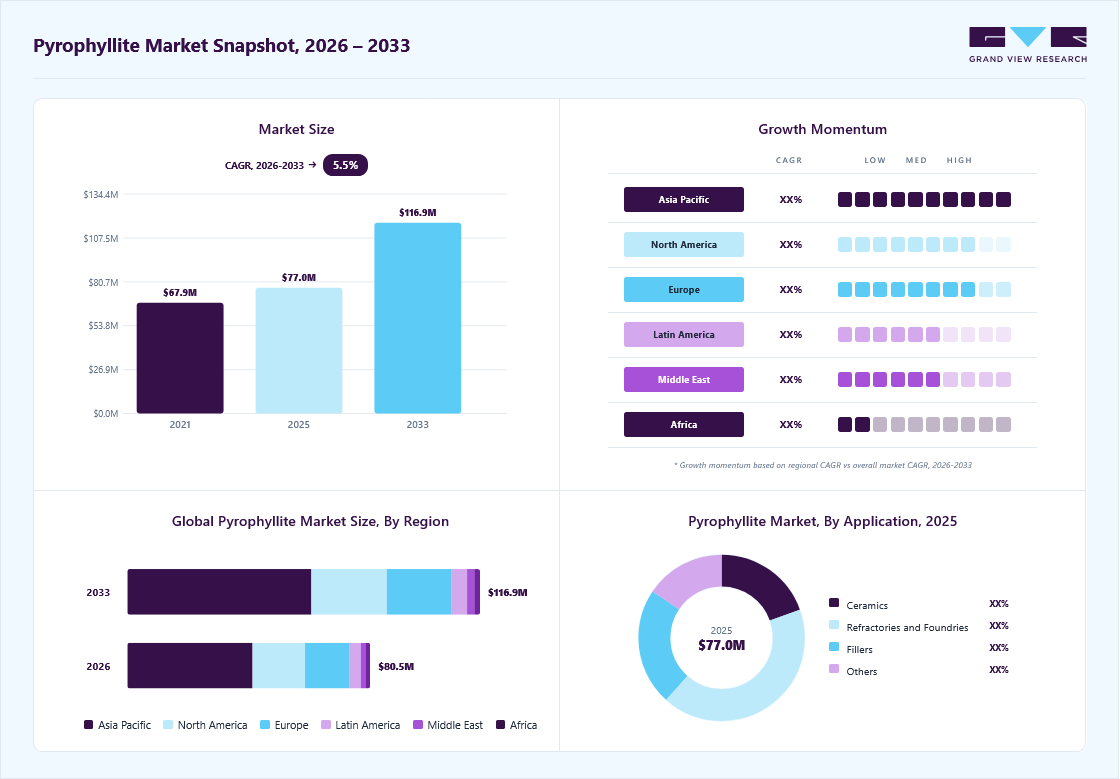
The global pyrophyllite market size was valued at USD 77.0 million in 2025 and is projected to grow from USD 80.6 million in 2026 to USD 116.9 million by 2033, at a CAGR of 8.1% from 2026 to 2033. The market in Asia Pacific dominated with a revenue share of 51.4% in 2025. This growth is driven by rising demand in ceramics, refractories, and specialty industrial applications, supported by urbanization, infrastructure expansion, and technological advancements in mineral processing.
Key Market Trends & Insights
- By application: Refractories and foundries segment held the largest market share of 42.1% in 2025.
Regional Highlights
- Largest regional market: Asia Pacific (51.4% revenue share, 2025)
- By country: The U.S. held the largest market share in 2025
Market Size & Forecast
- Market size in 2025: USD 77.0 Million
- Estimated market size in 2026: USD 80.6 Million
- Projected market size by 2033: USD 116.9 Million
- CAGR (2026-2033): 8.1%
The market benefits from the mineral’s natural abundance, non-toxic nature, and chemical inertness, making it an environmentally acceptable input across industrial applications. Its use in refractories and ceramics improves thermal efficiency and product durability, supporting reduced energy consumption and material wastage. Increasing emphasis on sustainable construction materials and compliance with environmental regulations is further reinforcing the adoption of pyrophyllite as a responsible alternative to certain synthetic and higher-impact raw materials.
Technological advancements in beneficiation, micronization, and particle size control are improving the quality and consistency of pyrophyllite products. These developments enable the tailoring of grades for refractories, ceramics, and polymer applications, thereby enhancing performance characteristics such as thermal stability, dispersion, and mechanical strength. Continued process optimization and formulation-driven research and development are expanding pyrophyllite’s role in high-performance and cost-efficient industrial applications.
Drivers, Opportunities & Restraints
Demand for pyrophyllite is primarily driven by the growth of the ceramics, refractories, and steel industries, where the mineral is utilized for its thermal stability and dimensional control. Rising construction activity and infrastructure investments are directly driving the production of ceramic tile and sanitaryware, particularly in Asia. For instance, in FY 2024, India experienced a notable increase in ceramic tile manufacturing capacity additions across Gujarat and Rajasthan, resulting in higher consumption of alumino-silicate minerals, such as pyrophyllite. Similarly, global crude steel output growth during 2024 supported demand for refractory materials, indirectly strengthening pyrophyllite consumption in furnace linings and kiln furniture.
Opportunities emerge through value-added processing and high-purity applications, especially in advanced ceramics, specialty refractories, and polymer fillers. Manufacturers are increasingly investing in beneficiation, micronization, and grade customization to cater to performance-driven end uses. A recent example includes capacity expansion and mineral processing upgrades announced by Indian industrial mineral producers in 2024, aimed at supplying refined pyrophyllite grades for high-temperature and specialty ceramic applications. In addition, the push toward energy-efficient kilns and durable refractory solutions is creating long-term demand for optimized pyrophyllite formulations.
The market is constrained by the limited availability of high-grade deposits and stricter mining and environmental regulations, which impact supply continuity and cost structures. Pyrophyllite reserves suitable for high-performance applications are geographically concentrated, making supply vulnerable to regulatory delays. In 2024, several Indian state governments tightened compliance norms related to mine rehabilitation, dust management, and water usage, resulting in longer approval timelines for minor mineral leases. These regulatory pressures, combined with rising logistics and labor costs, continue to pose challenges for consistent and scalable production of pyrophyllite.
Application Insights
By application, refractories and foundries dominated the market with a revenue share of 42.1% in 2025. Refractories and foundries represent the dominant application segment in the global market, driven by the mineral’s excellent thermal stability, low thermal expansion, and resistance to chemical attack. Pyrophyllite is widely used in refractory bricks, castables, kiln furniture, and foundry molds, where it enhances dimensional stability and reduces cracking under high-temperature operating conditions. Growth in steel production, non-ferrous metal processing, and glass manufacturing continues to support strong demand for refractory materials, particularly in the Asia Pacific. In addition, the shift toward energy-efficient furnaces and longer service life of refractory linings has increased the adoption of pyrophyllite as a cost-effective alumino-silicate input in high-temperature formulations.
The remaining applications, including ceramics, fillers, and others, collectively contribute a significant market share, supported by steady growth in construction and industrial manufacturing. In ceramics, pyrophyllite is used to improve firing behavior, whiteness, and surface finish in tiles, sanitaryware, and tableware. As a filler, it is increasingly incorporated into paints, coatings, rubber, and plastics to enhance barrier properties, smoothness, and dimensional control. Other applications, such as glass and specialty industrial uses, benefit from the mineral’s chemical inertness and fine particle characteristics, ensuring consistent demand across diversified end-use industries.
Regional Insights
The North America pyrophyllite market is primarily driven by steady demand from the ceramics, refractories, and industrial fillers sectors, with consumption closely tied to construction activity and industrial manufacturing. The region benefits from established downstream industries, particularly glass, ceramics, and specialty refractories used in energy, metals, and chemical processing. The increasing focus on durable, energy-efficient materials in building construction and industrial equipment continues to sustain demand, while the technological emphasis remains on consistent quality and performance rather than large-scale volume growth.

U.S. Pyrophyllite Market Trends
The pyrophyllite market in the U.S. is driven by refractory applications, technical ceramics, and niche industrial uses, supported by ongoing investments in steel production modernization and infrastructure upgrades. The push for longer-lasting refractory linings and improved kiln efficiency has led to the increased use of alumino-silicate minerals, such as pyrophyllite. In addition, the presence of advanced manufacturing and specialty ceramics producers encourages the use of refined and performance-optimized grades, positioning the U.S. market as value-oriented rather than volume-driven.
Asia Pacific Pyrophyllite Market Trends
Asia Pacific dominated the pyrophyllite market with a revenue share of 51.4% in 2025. The pyrophyllite market in the Asia Pacific represents the largest consumption base for pyrophyllite, led by China, India, and Southeast Asia, where rapid urbanization, expanding ceramic tile capacity, and growing steel production underpin demand. The region also serves as a major production hub due to the availability of mineral reserves and its cost-effective processing capabilities. Europe, in contrast, exhibits stable demand driven by high-end ceramics, refractories, and environmentally compliant industrial applications, with emphasis on quality consistency and sustainable sourcing. Together, Asia Pacific and Europe reflect a balance of volume-led growth and technology-driven consumption in the market.
Europe Pyrophyllite Market Trends
The pyrophyllite market in Europe is characterized by stable, application-specific demand driven by advanced ceramics, refractories, and specialty industrial fillers rather than large-volume consumption. Demand is closely linked to the region’s focus on high-performance, energy-efficient, and environmentally compliant materials, particularly in kiln furniture, technical ceramics, and refractory linings used in steel, glass, and chemical processing industries. Stringent environmental regulations and sustainability mandates across the EU are encouraging the use of naturally occurring, low-toxicity minerals, such as pyrophyllite, while also limiting the expansion of large-scale mining. As a result, the European market remains quality- and technology-driven, with greater reliance on consistent-grade supply and imports to meet specialized end-use requirements.
Key Pyrophyllite Company Insights
Some of the key players operating in the market include Ashapura Minechem Limited, Sibelco Group, and Golcha Minerals Pvt. Ltd., among others.
-
Ashapura Minechem Limited, established in 1960, is an India-based multinational industrial minerals company with integrated operations spanning mining, beneficiation, processing, and global distribution. The company has a strong presence in pyrophyllite and other industrial minerals used in ceramics, refractories, glass, and construction materials. Ashapura focuses on customized, application-specific grades, operational scale, and sustainable mining practices, serving customers across Asia, Europe, and North America through a well-developed export network.
-
Sibelco Group, founded in 1872, is a Belgium-headquartered global material solutions provider specializing in industrial minerals, including pyrophyllite for ceramics and refractory applications. The company operates a fully integrated model covering resource extraction, advanced processing, and technical support, with a strong emphasis on quality consistency and regulatory compliance. Sibelco serves a diversified customer base across construction materials, industrial manufacturing, and specialty ceramics, positioning itself as a technology- and application-driven supplier.
-
Golcha Minerals Pvt. Ltd., established in 1979, is a leading Indian producer of industrial minerals with a notable portfolio that includes pyrophyllite for ceramics, refractories, and filler applications. The company operates captive mines and in-house processing facilities, enabling tight control over purity, particle size, and product performance. Golcha Minerals emphasizes export-oriented growth, long-term customer partnerships, and continuous process optimization, supplying to major ceramic and industrial clusters in India and international markets.
Key Pyrophyllite Companies:
The following are the leading companies in the pyrophyllite market. These companies collectively hold the largest market share and dictate industry trends.
- Ashapura Minechem Limited
- BASF SE
- Golcha Minerals Pvt. Ltd.
- IMI Fabi S.p.A.
- LKAB Minerals AB
- Minerals Technologies Inc.
- Pyrophyllite Company Inc.
- Sibelco Group
- The R.T. Vanderbilt Company, Inc.
- Xinyang Mineral Group
Recent Developments
-
In July 2024, Ashapura Minechem Limited announced the commissioning of upgraded beneficiation and micronization lines at its Rajasthan minerals complex to enhance the output of high-purity pyrophyllite grades. The development is aimed at meeting rising demand from ceramic tiles and refractory manufacturers seeking consistent particle size distribution and improved thermal performance in kiln-fired applications.
-
In October 2024, several ceramic raw material processors in Gujarat, India, reported increased procurement of processed pyrophyllite following capacity expansions in the regional ceramic tile cluster. This development reflects a shift toward optimized alumino-silicate blends in tile bodies to improve firing stability and reduce energy consumption amid higher fuel costs.
-
In February 2025, European specialty ceramics manufacturers highlighted increased use of refined pyrophyllite in technical ceramic and kiln furniture formulations during industry forums, citing its role in enhancing dimensional stability and service life under high-temperature conditions. This trend highlights the increasing adoption of application-engineered pyrophyllite grades in performance-critical industrial ceramics.
Pyrophyllite Market Report Scope
Report Attribute
Details
Market definition
The apparent consumption/demand of pyrophyllite in ceramics, refractories & foundries, fillers, and others is considered for estimates & forecasts.
Market size in 2025
USD 77.0 million
Estimated market size in 2026
USD 80.6 million
Projected market size by 2033
USD 116.9 million
Growth rate
CAGR of 8.1% from 2026 to 2033
Base year for estimation
2025
Historical data
2021 - 2024
Forecast period
2026 - 2033
Quantitative Units
Volume in kilotons, revenue in USD million/billion, and CAGR from 2026 to 2033
Report coverage
Volume forecast, revenue forecast, competitive landscape, growth factors, and trends
Segments covered
Application, region
Regional scope
North America; Europe; Asia Pacific; Latin America; MEA
Country scope
U.S.; Canada; Mexico; Germany; UK; Russia; China; India; Japan; Brazil; Saudi Arabia; South Africa
Key companies profiled
Ashapura Minechem Limited; BASF SE; Golcha Minerals Pvt. Ltd.; IMI Fabi S.p.A.; LKAB Minerals AB; Minerals Technologies Inc.; Pyrophyllite Company Inc.; Sibelco Group; The R.T. Vanderbilt Company, Inc.; Xinyang Mineral Group
Customization scope
Free report customization (equivalent up to 8 analysts working days) with purchase. Addition or alteration to country, regional & segment scope.
Pricing and purchase options
Avail customized purchase options to meet your exact research needs. Explore purchase options
Global Pyrophyllite Market Report Segmentation
This report forecasts global, country, and regional revenue growth and analyzes the latest trends in each sub-segment from 2021 to 2033. For this study, Grand View Research has segmented the global pyrophyllite market report by application and region:

-
Application Outlook (Volume, Kilotons; Revenue, USD Million, 2021 - 2033)
-
Ceramics
-
Refractories & Foundries
-
Fillers
-
Others
-
-
Regional Outlook (Volume, Kilotons; Revenue, USD Million, 2021 - 2033)
-
North America
-
U.S.
-
Canada
-
Mexico
-
-
Europe
-
Germany
-
UK
-
Russia
-
-
Asia Pacific
-
China
-
India
-
Japan
-
-
Latin America
-
Brazil
-
-
Middle East & Africa
-
Saudi Arabia
-
South Africa
-
-
Frequently Asked Questions About This Report
The global pyrophyllite market size was valued at USD 77.0 million in 2025 and is estimated at USD 80.6 million for 2026.
The global pyrophyllite market is expected to grow at a CAGR of 8.1% from 2026 to 2033, reaching USD 116.9 million.
The refractories and foundries segment led with a 42.1% revenue share in 2025.
The key factor driving the growth of the global pyrophyllite market is the rising demand from the ceramics, refractories, and industrial filler industries, where pyrophyllite’s thermal stability, chemical inertness, and dimensional consistency make it a preferred raw material.
Asia Pacific dominated with a 51.4% revenue share in 2025.
Key players include Ashapura Minechem Limited, BASF SE, and Golcha Minerals Pvt. Ltd.; IMI Fabi S.p.A.; LKAB Minerals AB; Minerals Technologies Inc.; Pyrophyllite Company Inc.; Sibelco Group; The R.T. Vanderbilt Company, Inc.; Xinyang Mineral Group, and others.
About the Author(s)
Advanced Interior Materials Research Team
Advanced Materials · Advanced Interior MaterialsThis report was authored by the advanced interior materials research team at Grand View Research - comprising two research analysts, one senior research analyst, and one industry expert - with specialized expertise in the advanced interior materials segment of the advanced materials industry. All findings are based on proprietary advanced materials databases, executive interviews, and regulatory analysis, subject to internal peer review prior to publication.
Last Updated:
Speak to Analyst

Need a Tailored Report?
Customize this report to your needs — add regions, segments, or data points, with 20% free customization.
Or view our licence options:


ISO 9001:2015 & 27001:2022 Certified
We are GDPR and CCPA compliant! Your transaction & personal information is safe and secure. For more details, please read our privacy policy.












