
- Home
- »
- Plastics, Polymers & Resins
- »
-
Ready-To-Drink Packaging Market Size Report, 2026-2033GVR Report cover

Ready-To-Drink Packaging Market (2026 - 2033)
Size, Share & Trends Analysis Report By Material (Glass, Plastic, Paper & Paperboard, Metal), By Product (Cans, Cartons, Bottles, Pouches), By End Use, By Region, And Segment Forecasts
Market Size, 2025
$132.4BMarket Estimate, 2026
$140.3BMarket Forecast, 2033
$216.8BCAGR, 2026–2033
6.4%Ready-To-Drink Packaging Market Summary
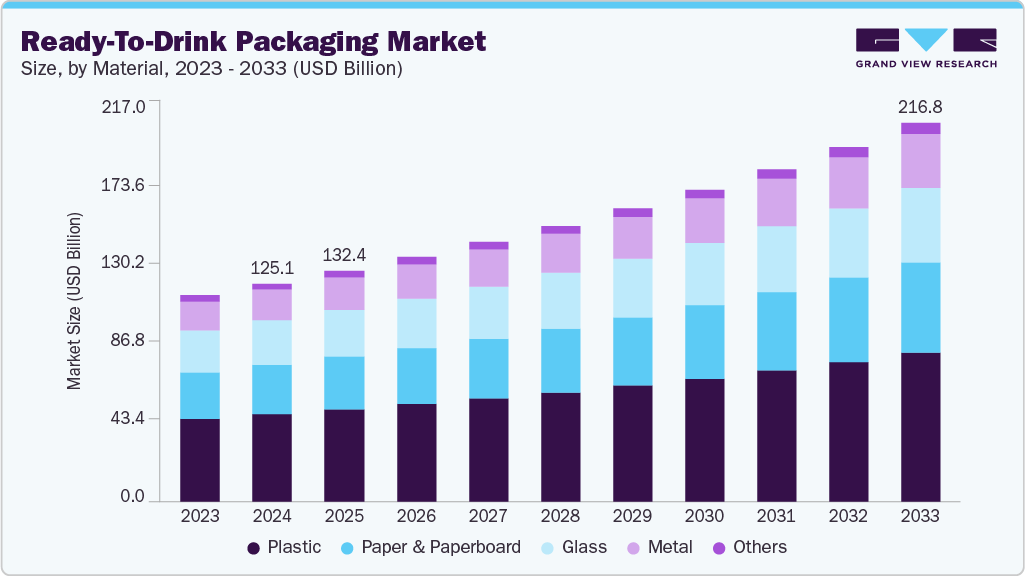
The global ready-to-drink packaging market size was valued at USD 132.4 billion in 2025 and is projected to grow from USD 140.3 billion in 2026 to USD 216.8 billion by 2033, at a CAGR of 6.4% from 2026 to 2033. The market in North America dominated with a revenue share of 38.7% in 2025. Rising consumer demand for convenience and on-the-go consumption is driving the global ready-to-drink packaging market.
 Source: Grand View Research, IR Documents, Primary Interviews, Paid DatabasesTo learn more about this report,
 Download Free Sample Report
 Key Market Trends & Insights
- By material: Plastic segment held the largest market share of 39.9% in 2025.
- By product: Bottles segment held the largest market share of 42.8% in 2025.
- By end use: Bottled water segment held the largest market share of 22.2% in 2025.
Regional Highlights
- Largest regional market: North America (38.7% revenue share, 2025)
- Fastest-growing regional market: Asia Pacific (highest CAGR, 2026-2033)
- By country: The U.S. held the largest market share in 2025
Market Size & Forecast
- Market size in 2025: USD 132.4 Billion
- Estimated market size in 2026: USD 140.3 Billion
- Projected market size by 2033: USD 216.8 Billion
- CAGR (2026-2033): 6.4%
Three ways to get this report
Buy it, customize it, or ask a question.Ask an Analyst
Analyst response in 1 business day
- AccessReport author, directly
- Reply timeWithin 1 working day
- No sales callDirect answer only
- FormatEmail reply
- CostFree, no cost
Get the Full Report
What the study covers
- FormatsPDF · Excel · Dashboard
- Timeline2026–2033 annual, 2025 base
- Coverage20+ countries, 5 regions
- Companies10+ key players profiled
Customize the Report
20% free customization
- IncludeCountries, segments, points
- TailorTo your product definition
- ExtendDeeper competitor detail
- OrA fully bespoke study
- Turnaround5–10 working days
Moreover, increased health awareness and the growing popularity of functional beverages are fueling market growth. Consumers across the globe are increasingly seeking healthier and functional beverage options that align with active lifestyles. This trend has significantly boosted demand for RTD products like protein shakes, cold brew coffees, functional teas, and vitamin-infused waters. Packaging that supports on-the-go consumption, such as PET bottles, cartons, and aluminum cans, is being prioritized by manufacturers to meet this demand. For example, Nestlé’s RTD protein shakes and PepsiCo’s LifeWTR emphasize not only functional benefits but also portability and aesthetic appeal, driving innovation in health-conscious, single-serve packaging formats.With urban populations growing and consumer lifestyles becoming busier, there's a growing preference for ready-to-consume beverages that require no preparation. This shift is particularly evident among millennials and Gen Z consumers in metropolitan areas, who value time-saving, portable beverage options. RTD packaging offers the necessary convenience by enabling easy storage, handling, and disposal, all while maintaining product shelf life. Brands such as Starbucks and The Coca-Cola Company are expanding their RTD coffee and tea offerings in compact formats (e.g., 250ml PET bottles or Tetra Paks) specifically designed for on-the-go consumption.
 To learn more about this report, Download Free Sample Report
 The growth of online grocery platforms and delivery apps has created new distribution channels for RTD beverages, which require robust, attractive, and protective packaging. RTD products sold online often face longer transit times and handling, demanding packaging that ensures durability without compromising aesthetics. Manufacturers are leveraging shelf-ready packaging (SRP), multi-pack cartons, and lightweight flexible pouches to appeal to digital consumers. For instance, La Colombe uses sleek aluminum RTD coffee cans with minimalistic branding, optimizing their appearance for online marketplaces such as Amazon and Walmart.
Environmental concerns and regulatory pressures have prompted RTD brands to adopt sustainable packaging practices, which in turn enhance brand reputation and consumer loyalty. The use of recyclable PET bottles, paper-based cartons and compostable pouches is growing steadily. Many beverage companies are adopting circular economy models, such as refillable or returnable packaging. For example, Coca-Cola’s 100% recycled PET bottles for some of its RTD drinks signal a broader industry shift. These sustainable packaging efforts resonate with environmentally conscious consumers, acting as both a competitive differentiator and a market driver.
Market Dynamics
The ready-to-drink packaging market is witnessing steady growth, driven by increasing demand for convenient, on-the-go beverages and changing consumer lifestyles. Rising preference for sustainable, lightweight, and recyclable packaging solutions, along with innovations in barrier technologies and smart packaging, is supporting market expansion. Growing consumption of functional beverages, energy drinks, ready-to-drink coffee, and tea further fuels demand. However, volatile raw material prices and stringent environmental regulations on single-use plastics remain key challenges. Despite these factors, advancements in sustainable packaging and expanding beverage consumption in emerging economies are expected to drive continued market growth.
The growing demand for convenient and on-the-go beverage consumption is the primary driver of the ready-to-drink packaging market. Rapid urbanization, busy lifestyles, and increasing preference for ready-to-consume products have significantly boosted the consumption of RTD beverages, including soft drinks, bottled water, ready-to-drink coffee and tea, energy drinks, sports drinks, and functional beverages. Consumers increasingly favor portable, lightweight, and resealable packaging formats that offer ease of handling, storage, and consumption, prompting beverage manufacturers to invest in innovative packaging solutions.
This shift in consumer behavior is encouraging packaging companies to develop durable, lightweight, and visually appealing formats such as PET bottles, aluminum cans, aseptic cartons, and flexible pouches. Packaging innovations that improve shelf life, product safety, convenience, and brand differentiation are becoming essential for beverage manufacturers competing in a highly dynamic market. As RTD beverage consumption continues to expand across both developed and emerging economies, demand for efficient, sustainable, and high-performance packaging solutions is expected to grow steadily, reinforcing the market's long-term growth trajectory.
Stringent environmental regulations on single-use plastics and growing pressure to reduce packaging waste are significant restraints for the ready-to-drink packaging market. Governments across various countries are implementing stricter recycling mandates, extended producer responsibility (EPR) policies, and plastic reduction targets, compelling packaging manufacturers to redesign products using more sustainable materials. While these initiatives support long-term environmental goals, they increase production costs, require substantial investments in new materials and recycling infrastructure, and create compliance challenges, limiting profitability and operational flexibility across the market.
The increasing adoption of sustainable and circular packaging solutions presents a significant opportunity for the ready-to-drink packaging market. Rising consumer preference for environmentally responsible products and stronger commitments from beverage brands to reduce carbon emissions are accelerating the use of recyclable, reusable, compostable, and bio-based packaging materials. Investments in lightweight packaging, high-recycled-content plastics, fiber-based cartons, and closed-loop recycling systems are creating new growth avenues for packaging manufacturers. As governments and brand owners continue to prioritize circular economy initiatives, the market is expected to benefit from expanding demand for innovative, sustainable, and regulatory-compliant packaging solutions.
Market Concentration & Characteristics
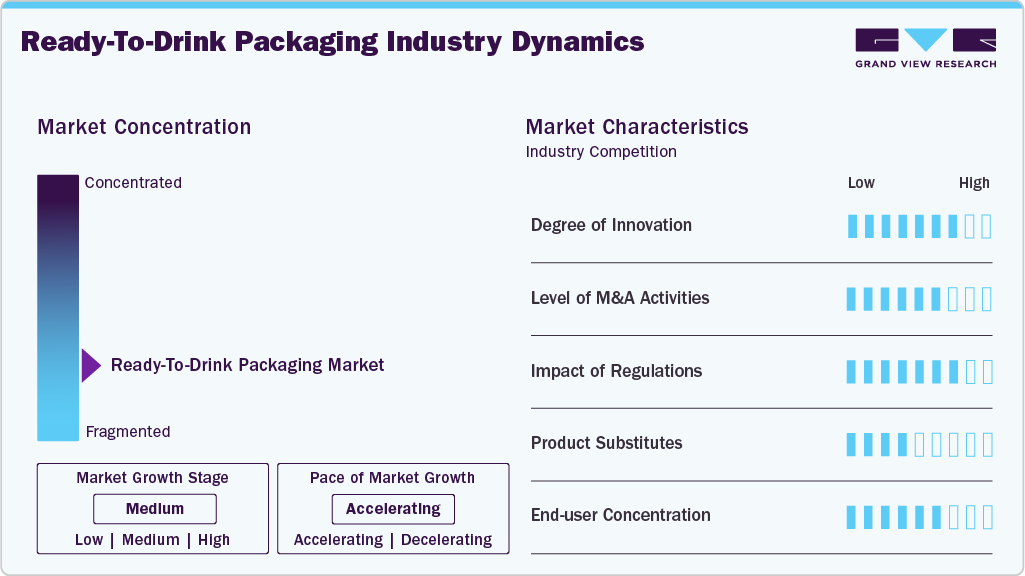
The RTD packaging market is characterized by high product differentiation. Beverage manufacturers invest heavily in branding and packaging to stand out in a crowded shelf space. Packaging serves not only functional purposes (protection, portability, shelf life) but also acts as a marketing tool. For instance, unique shapes, bold graphics, and limited-edition labels help drive impulse purchases. RTD alcoholic and functional drinks often use premium glass bottles or metallic finishes to signal quality and exclusivity.
 To learn more about this report, Download Free Sample Report
 Innovation is a core aspect of the industry, with continuous development in materials (bio-based plastics, paper-based bottles), features (resealable caps, tamper-evident seals), and formats (single-serve, multipacks). There’s a strong push toward eco-friendly packaging solutions, driven by consumer demand and environmental regulations. Lightweight, recyclable, and biodegradable materials are becoming the norm. For example, brands are shifting from multi-layer PET to mono-materials to enhance recyclability.
Analyst Perspective
The ready-to-drink packaging market is expected to grow steadily, driven by increasing consumption of ready-to-drink beverages and rising demand for convenient, portable packaging solutions. Advancements in lightweight materials, aseptic packaging, and sustainable packaging technologies are improving product protection and shelf life while supporting environmental goals. Growing adoption of recyclable packaging formats and continued innovation are expected to strengthen growth prospects for the market over the forecast period.
Material Insights
Based on material, the plastic segment led the market with the largest revenue share of 39.9% in 2025. Plastic, especially PET (Polyethylene Terephthalate), is widely used in the RTD segment due to its lightweight, durability, design flexibility, and low production costs. It is commonly used for water, carbonated soft drinks, iced teas, and flavored juices. PET bottles also support high-speed production and filling lines, making them a cost-effective choice for manufacturers. Plastic dominance is fueled by its affordability, convenience for on-the-go consumption, and adaptability across various RTD beverage types.
The paper & paperboard segment is expected to grow at the fastest CAGR of 7.0% during the forecast period. Paper & paperboard are primarily used in carton-based RTD packaging, especially for dairy beverages, juices, and plant-based drinks. These materials offer good barrier properties when combined with plastic or aluminum layers and are favored for their renewable source and ease of branding due to printable surfaces. The growing consumer demand for sustainable, biodegradable, and renewable packaging is driving the paper & paperboard segment. In addition, stringent regulations against single-use plastics, especially in Europe, are pushing beverage brands to switch to paper-based RTD packaging options such as Tetra Pak and SIG cartons.
Product Insights
Based on product, the bottles segment led the market with the largest revenue share of 42.8% in 2025. Bottles, particularly PET and glass bottles, are dominant in the RTD packaging market due to their versatility, reusability, and ability to protect product integrity. They are used for water, juices, dairy beverages, cold brews, and alcoholic RTDs. PET bottles remain popular due to their affordability, light weight, and suitability for high-speed filling lines. Rising consumption of bottled iced coffee, flavored water, and sports drinks is driving demand. Innovations in lightweighting and rPET usage (recycled PET) are supporting environmental goals and reducing carbon footprints.
The pouches segment is expected to grow at the fastest CAGR of 7.0% during the forecast period. Pouches, including stand-up and spouted types, offer flexible and portable packaging solutions for a variety of RTD beverages, especially those targeting kids and on-the-go consumers. They use significantly less material than rigid formats. Increasing preference for lightweight, resealable, and space-saving packaging is accelerating the demand for pouches. Their adaptability for single-serve formats, especially for smoothies and kids’ drinks, aligns with the rising convenience trend. Cost-effectiveness in production and transport further enhances their market growth.
End Use Insights
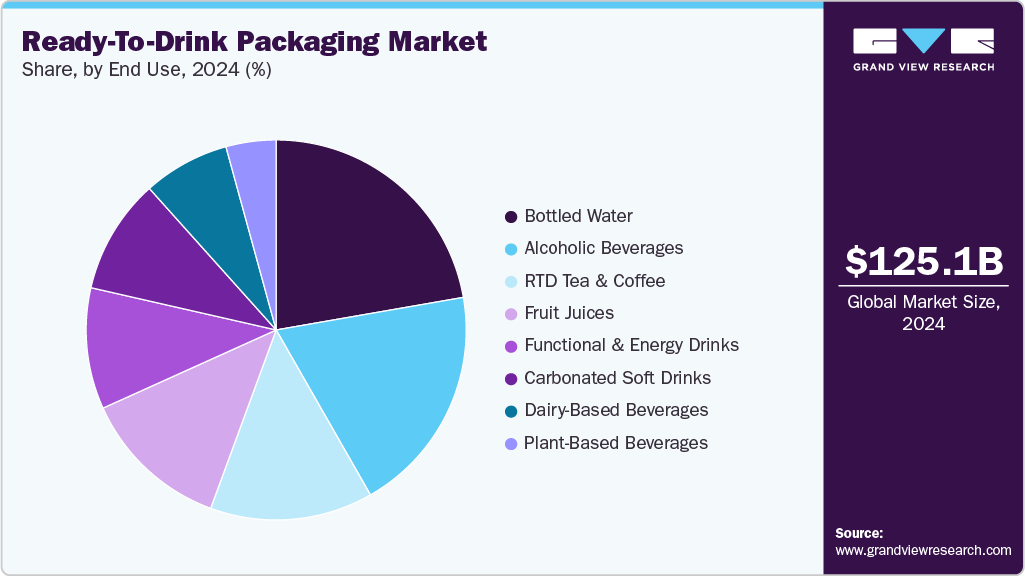
Based on end use, the bottled water segment led the market with the largest revenue share of 22.2% in 2025. RTD bottled water is packaged for instant consumption and includes still, sparkling, flavored, and mineral water. It remains one of the most consumed RTD beverages worldwide due to its health and hydration benefits. Rising health awareness, urbanization, and concerns over tap water safety in developing regions are key factors. Moreover, innovative eco-friendly packaging solutions (e.g., rPET bottles, paper-based bottles) and value-added variants such as vitamin-enriched water are gaining traction.
 To learn more about this report, Download Free Sample Report
 The plant-based beverages segment is projected to grow at the fastest CAGR of 8.0% during the forecast period. This segment includes soy, almond, oat, rice, and coconut milk-based drinks. Often used as dairy alternatives, they come in flavored and unflavored formats, catering to vegans and lactose-intolerant consumers. The growing vegan population, lactose intolerance, and environmental concerns are primary drivers. Product innovations in flavors and added nutritional benefits (e.g., calcium, B12) and eco-conscious packaging are strengthening this segment’s footprint in the RTD packaging market.
Region Insights
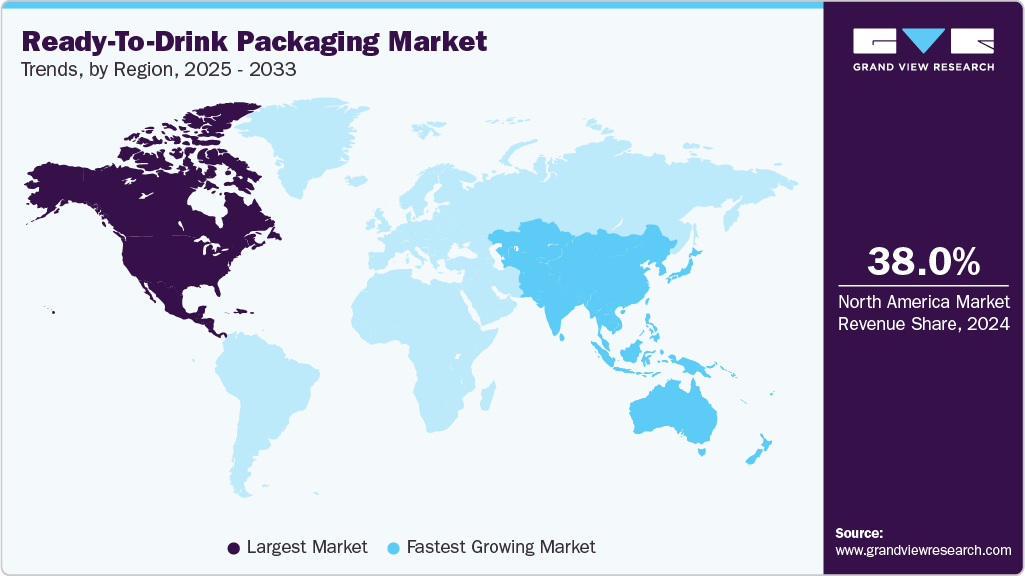
North America dominated the ready-to-drink packaging market with the largest revenue share of 38.7% in 2025. North America leads in RTD packaging innovation, driven by high consumer demand for health-focused and on-the-go beverages. The U.S. and Canada are seeing a rise in cold brew coffee, sparkling water, and CBD-infused drinks, requiring advanced packaging such as aluminum cans (popularized by brands such as LaCroix) and resealable PET bottles. The region’s strict food safety regulations also push manufacturers toward tamper-evident and BPA-free packaging. Furthermore, sustainability trends are boosting the use of biodegradable materials, as seen with Coca-Cola’s paper-based bottle trials and PepsiCo’s shift to 100% recycled plastic for its RTD products.
 To learn more about this report, Download Free Sample Report
 U.S. Ready-To-Drink Packaging Market Trends
The ready-to-drink packaging market in U.S. held the largest share in the North America region in 2025. The U.S. growth in the RTD packaging market is driven by trends in health-conscious and premium beverages. The success of brands such as Bang Energy (in cans) and Starbucks’ RTD coffee (in glass bottles) highlights the demand for varied packaging formats. The hard seltzer boom, led by White Claw, has popularized slim aluminum cans, while sustainability initiatives push companies such as Keurig Dr Pepper toward 100% recyclable materials. The convenience store culture also fuels demand for grab-and-go bottle designs with enhanced durability.
Europe Ready-To-Drink Packaging Market Trends
Europe’s RTD packaging market is shaped by stringent environmental regulations and a strong preference for sustainable solutions. The EU’s Single-Use Plastics Directive has accelerated the adoption of glass bottles, aluminum cans, and compostable materials for RTD beverages. Germany and UK are seeing growth in functional and organic drinks, with brands such as Innocent Drinks using recycled PET bottles. In addition, the popularity of carbonated soft drinks and hard seltzers in Scandinavia is driving demand for lightweight, recyclable cans, as seen with Norwegian brand Oskar Blues.
Asia Pacific Ready-To-Drink Packaging Market Trends
Asia Pacific is expected to grow at the fastest CAGR of 7.2% over the forecast period. This positive outlook is due to rapid urbanization, a growing middle class, and increasing demand for convenience beverages. Countries such as China, India, and Japan are witnessing a surge in RTD tea, coffee, and functional drinks, prompting innovations in lightweight, eco-friendly, and portable packaging. For example, Japan’s vending machine culture and China’s booming e-commerce sector have accelerated demand for durable, single-serve packaging solutions. In addition, sustainability concerns are pushing brands to adopt recyclable materials, such as Tetra Pak for plant-based beverages in Southeast Asia.
Key Ready-To-Drink Packaging Company Insights
The competitive environment of the ready-to-drink (RTD) packaging market is characterized by intense rivalry among both global and regional players striving to innovate in packaging formats, materials, and sustainability. Key players such as Amcor plc, Tetra Pak, Ball Corporation, ALPLA, and SIG are competing on the basis of lightweight packaging, extended shelf life, convenience, and recyclability. The market is highly influenced by consumer demand for eco-friendly, portable, and single-serve formats, prompting companies to invest in R&D and advanced manufacturing technologies. In addition, strategic partnerships, mergers & acquisitions, and geographic expansions are common as companies aim to enhance their market share and respond quickly to evolving consumer preferences and beverage trends.
-
In August 2024, ALPLA, a global company in plastic packaging, launched a new line of PET bottles that boast a premium, glass-like appearance, targeting the beverage sector with a sustainable and visually appealing alternative to traditional glass. These innovative bottles, already introduced for mineral water brands in Poland, are designed to closely mimic the look and feel of glass while offering significant advantages such as being lightweight, shatterproof, and fully recyclable.
-
In August 2024, Berry Global Inc. partnered with Norwegian brand Aquafigure to launch a new line of reusable 330ml water bottles designed to encourage water consumption among young people through customizable, interchangeable 3D artwork cards. Made from BPA-free Tritan, a recyclable and food-approved copolyester. Production is handled at Berry’s facilities in the Netherlands and England, with a focus on ensuring a secure yet child-friendly seal. The partnership aims to deliver a “bottle for life” solution, advancing both sustainability and consumer engagement as Aquafigure expands into new markets.
Key Ready-To-Drink Packaging Companies:
The following key companies have been profiled for this study on the ready-to-drink packaging market.
-
Amcor plc
-
Ball Corporation
-
Tetra Pak
-
Berry Global Inc.
-
ALPLA
-
Smurfit Westrock
-
Crown
-
SIG
-
Silgan Plastics
-
Ajanta Bottle
-
Graham Packaging
-
Toyo Seikan Group Holdings, Ltd.
Competitive Benchmarking
Category
Operating Strategies
Competitive Edge
Weakness
Established Players (Amcor plc, Ball Corporation, Tetra Pak, Berry Global Inc., ALPLA, Smurfit Westrock, Crown, SIG, and Toyo Seikan Group Holdings, Ltd.)
- Focus on expanding global manufacturing capacity and strengthening partnerships with leading beverage brands to ensure high-volume, consistent supply across regions.
- Invest significantly in sustainable packaging innovations, lightweight materials, recyclable solutions, and smart manufacturing technologies to meet evolving regulatory and consumer requirements.
- Extensive product portfolios covering metal cans, PET bottles, aseptic cartons, closures, and flexible packaging enable comprehensive packaging solutions for diverse RTD beverages.
- Strong global distribution networks, advanced R&D capabilities, and long-term customer relationships support technological leadership and high market penetration.
- Large-scale operations expose companies to fluctuations in raw material prices, energy costs, and complex global supply chain disruptions.
- High capital investment requirements and organizational complexity can slow production flexibility and responsiveness to rapidly changing niche market demands.
Emerging Players (Silgan Plastics, Graham Packaging, and Ajanta Bottle)
- Concentrate on regional market expansion through customized packaging solutions, flexible production capabilities, and competitive pricing strategies for beverage manufacturers.
- Strengthen customer relationships by offering short production runs, rapid product development, and specialized packaging formats tailored to local market requirements.
- Greater operational flexibility enables faster response to changing customer specifications and emerging beverage trends.
- Specialized expertise in selected packaging formats and personalized customer service helps build strong relationships with regional and mid-sized beverage producers.
- Limited geographic presence, production capacity, and financial resources restrict expansion into large multinational beverage contracts.
- Lower investment capability in advanced packaging technologies, sustainability initiatives, and global manufacturing infrastructure compared to established industry leaders.
Ready-To-Drink Packaging Market Report Scope
Report Attribute
Details
Market size in 2025
USD 132.4 billion
Estimated market size in 2026
USD 140.3 billion
Projected market size by 2033
USD 216.8 billion
Growth rate
CAGR of 6.4% from 2026 to 2033
Base year for estimation
2025
Historical data
2021 - 2024
Forecast period
2026 - 2033
Quantitative units
Revenue in USD million/billion and CAGR from 2026 to 2033
Report coverage
Revenue forecast, company ranking, competitive landscape, growth factors, and trends
Segments covered
Material, product, end use, region
Regional scope
North America; Europe; Asia Pacific; Latin America; MEA
Country scope
U.S.; Canada; Mexico; Germany; UK; France; Italy; Spain; China; Japan; India; South Korea; Australia; Brazil; Argentina; Saudi Arabia; South Africa; UAE
Key companies profiled
Amcor plc; Ball Corporation; Tetra Pak; Berry Global Inc.; ALPLA; Smurfit Westrock; Crown; SIG; Silgan Plastics; Ajanta Bottle; Graham Packaging; Toyo Seikan Group Holdings, Ltd.
Customization scope
Free report customization (equivalent up to 8 analysts' working days) with purchase. Addition or alteration to country, regional & segment scope.
Pricing and purchase options
Avail customized purchase options to meet your exact research needs. Explore purchase options
Global Ready-To-Drink Packaging Market Report Segmentation
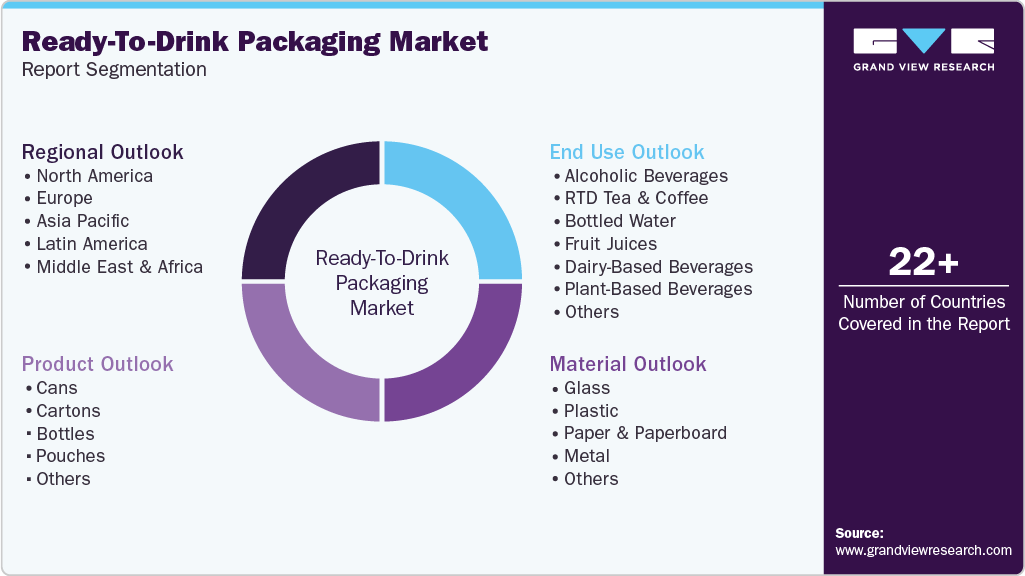
This report forecasts revenue growth at a global level and provides an analysis of the latest industry trends in each of the sub-segments from 2021 to 2033. For this study, Grand View Research has segmented the global ready-to-drink packaging market report based on material, product, end use, and region:
 To learn more about this report, Download Free Sample Report
 -
Material Outlook (Revenue, USD Million 2021 - 2033)
-
Glass
-
Plastic
-
Paper & Paperboard
-
Metal
-
Others
-
-
Product Outlook (Revenue, USD Million 2021 - 2033)
-
Cans
-
Cartons
-
Bottles
-
Pouches
-
Others
-
-
End Use Outlook (Revenue, USD Million 2021 - 2033)
-
Alcoholic Beverages
-
RTD Tea & Coffee
-
Bottled Water
-
Fruit Juices
-
Dairy-Based Beverages
-
Plant-Based Beverages
-
Carbonated Soft Drinks
-
Functional & Energy Drinks
-
-
Region Outlook (Revenue, USD Million 2021 - 2033)
-
North America
-
U.S.
-
Canada
-
Mexico
-
-
Europe
-
Germany
-
France
-
UK
-
Italy
-
Spain
-
-
Asia Pacific
-
China
-
India
-
Japan
-
Australia
-
South Korea
-
-
Latin America
-
Brazil
-
Argentina
-
-
Middle East & Africa
-
South Africa
-
Saudi Arabia
-
UAE
-
-
Research Methodology
The ready-to-drink packaging market figures in this report are based on a proven research process that combines executive interviews with secondary research from proprietary databases, company filings, and recognized regulatory and institutional sources. Market size is built through value-chain sizing - reconciling supply-side and demand-side estimates - and triangulated with bottom-up and top-down approaches. Every estimate passes multiple levels of expert validation before publication, with each ready-to-drink packaging segment quantified using the revenue-capture definitions in the table below.
Segment Definition
Segment - Material
Revenue capture definition
Glass
Revenue generated from the sale of glass packaging solutions used for ready-to-drink (RTD) beverages requiring superior barrier properties, product purity, and premium presentation. This segment includes glass bottles for alcoholic beverages, juices, dairy-based beverages, premium water, and specialty RTD drinks.
Plastic
Revenue generated from the sale of plastic packaging solutions designed for lightweight, durable, and cost-effective storage of ready-to-drink (RTD) beverages. This segment includes PET, HDPE, PP, and other plastic bottles, containers, and closures used across water, carbonated soft drinks, juices, dairy-based, and functional beverages.
Paper & Paperboard
Revenue generated from the sale of paper- and paperboard-based packaging for ready-to-drink (RTD) beverages, offering recyclable and renewable packaging solutions. This segment includes aseptic cartons and fiber-based beverage containers used for milk, juices, plant-based beverages, tea, and coffee.
Metal
Revenue generated from the sale of metal packaging solutions designed for ready-to-drink (RTD) beverages requiring excellent product protection, long shelf life, and high recyclability. This segment includes aluminum and steel cans used for carbonated soft drinks, alcoholic beverages, energy drinks, and ready-to-drink coffee.
Others
Revenue generated from the sale of alternative packaging materials used in the ready-to-drink (RTD) packaging market. This segment includes bio-based materials, compostable materials, multi-material composites, and other specialty packaging designed to improve sustainability or product performance.
Segment - Product
Revenue capture definition
Cans
Revenue generated from the sale of metal cans used for packaging ready-to-drink (RTD) beverages. This segment includes aluminum and steel cans widely used for carbonated soft drinks, beer, energy drinks, coffee, tea, and other beverages requiring extended shelf life.
Cartons
Revenue generated from the sale of carton packaging designed for ready-to-drink (RTD) beverages requiring aseptic or chilled storage. This segment includes paperboard-based cartons used for dairy beverages, fruit juices, plant-based drinks, tea, and coffee.
Bottles
Revenue generated from the sale of glass and plastic bottles used for packaging ready-to-drink (RTD) beverages. This segment includes bottles for bottled water, juices, dairy beverages, alcoholic beverages, carbonated soft drinks, and functional beverages.
Pouches
Revenue generated from the sale of flexible pouch packaging used for ready-to-drink (RTD) beverages requiring lightweight, portable, and convenient packaging. This segment includes stand-up pouches, spouted pouches, and other flexible beverage packaging formats.
Others
Revenue generated from the sale of other packaging formats used in the ready-to-drink (RTD) packaging market. This segment includes cups, bag-in-box systems, kegs, and other specialty beverage packaging solutions.
Segment - End Use
Revenue capture definition
Alcoholic Beverages
Revenue generated from packaging solutions supplied for ready-to-drink alcoholic beverages. This segment includes packaging for beer, wine, spirits, hard seltzers, cocktails, and other alcoholic RTD beverages.
RTD Tea & Coffee
Revenue generated from packaging solutions used for ready-to-drink tea and coffee beverages. This segment includes bottles, cans, cartons, and other packaging designed to preserve flavor, freshness, and product quality.
Bottled Water
Revenue generated from packaging solutions supplied for bottled drinking water, including still, sparkling, mineral, and flavored water products. This segment primarily includes plastic bottles, glass bottles, and cartons.
Fruit Juices
Revenue generated from packaging solutions used for fruit juice beverages. This segment includes cartons, bottles, cans, and pouches designed to maintain freshness, nutritional value, and extended shelf life.
Dairy-Based Beverages
Revenue generated from packaging solutions supplied for milk, flavored milk, yogurt drinks, and other dairy-based ready-to-drink (RTD) beverages. This segment includes aseptic cartons, bottles, and specialty dairy packaging formats.
Plant-Based Beverages
Revenue generated from packaging solutions used for plant-based ready-to-drink (RTD) beverages. This segment includes packaging for oat, soy, almond, coconut, rice, and other plant-based drinks requiring product protection and extended shelf life.
Carbonated Soft Drinks
Revenue generated from packaging solutions supplied for carbonated soft drinks. This segment includes cans, PET bottles, glass bottles, and other packaging formats designed to maintain carbonation and product integrity.
Functional & Energy Drinks
Revenue generated from packaging solutions used for functional beverages, sports drinks, nutritional beverages, and energy drinks. This segment includes cans, bottles, and other packaging formats designed for convenience, product stability, and brand differentiation.
Estimation Model
Layer Name
Key Question
Description
Ready-to-Drink Beverage Consumption Layer
What forms the demand base?
Identify global consumption volumes of ready-to-drink (RTD) beverages across major beverage categories, including bottled water, carbonated soft drinks, alcoholic beverages, RTD tea & coffee, fruit juices, dairy-based beverages, plant-based beverages, and functional & energy drinks. This layer establishes the total addressable packaging demand generated by RTD beverage production and consumption across developed and emerging markets.
Packaging Format Penetration Layer
Which packaging formats are utilized?
Estimate the penetration of different packaging formats, including bottles, cans, cartons, pouches, and other packaging solutions, across beverage categories and regions. Assess the adoption of packaging materials such as plastic, glass, metal, paper & paperboard, and other sustainable materials based on product requirements, consumer preferences, sustainability initiatives, and regulatory standards.
Packaging Volume Layer
How much packaging volume is consumed?
Analyze packaging consumption by evaluating beverage production volumes, units packaged, average pack sizes, refill frequency, packaging intensity, and material usage across end-use industries. Packaging demand is influenced by consumption trends, premiumization, convenience preferences, product shelf-life requirements, recycling targets, and regional manufacturing capacities.
Revenue Layer
How is market revenue generated?
Market revenue is quantified through the sale of ready-to-drink (RTD) packaging solutions across material types, product formats, and end-use beverage categories. Revenue is generated from the supply of primary beverage packaging, closures, labeling, decoration, and value-added packaging solutions such as lightweight designs, barrier technologies, aseptic packaging, smart packaging, and sustainable packaging innovations serving global beverage manufacturers.
Delivered Customizations
This report has been delivered with the following In-depth customizations
Client Request
Customization Delivered
Value Adds
Regional Segmentation Analysis
Provided a detailed regional analysis of the ready-to-drink packaging market across North America, Europe, Asia Pacific, Central & South America, and Middle East & Africa, covering regional consumption trends, packaging preferences, regulatory landscape, and growth drivers.
Enabled identification of high-growth regions, regional demand patterns, and market expansion opportunities across key geographies.
Cross-Segmentation Analysis
Delivered cross-segment analysis by mapping materials (Glass, Plastic, Paper & Paperboard, Metal, and Others) with product types (Cans, Cartons, Bottles, Pouches, and Others) across end-use categories including Alcoholic Beverages, RTD Tea & Coffee, Bottled Water, Fruit Juices, Dairy-Based Beverages, Plant-Based Beverages, Carbonated Soft Drinks, and Functional & Energy Drinks.
Provided deeper insights into segment-level demand trends, preferred packaging formats, material adoption patterns, and high-growth segment combinations.
Competitive Benchmarking
Conducted benchmarking of key ready-to-drink packaging market participants based on product portfolios, packaging material capabilities, product format offerings, sustainability initiatives, innovation strategies, geographic presence, and customer base across beverage categories.
Supported evaluation of competitive positioning, differentiation strategies, innovation capabilities, and market strengths of leading players.
Frequently Asked Questions About This Report
The key players in the ready-to-drink packaging market include Amcor plc; Ball Corporation; Tetra Pak; Berry Global Inc.; ALPLA; Smurfit Westrock; Crown; SIG; Silgan Plastics; Ajanta Bottle; Graham Packaging; and Toyo Seikan Group Holdings, Ltd.
North America dominated the ready-to-drink packaging market with a 38.7% revenue share in 2025.
Asia Pacific is the fastest-growing region in the ready-to-drink packaging market with a CAGR of 7.2% over the forecast period.
The plastic segment led the ready-to-drink packaging market with a 39.9% revenue share in 2025.
The bottled water segment led the ready-to-drink packaging market with a 22.2% revenue share in 2025.
Key factors driving the ready-to-drink packaging market include rising beverage consumption, demand for convenient and portable packaging, adoption of sustainable materials, advancements in packaging technologies, and growing demand for functional and premium beverages.
The global ready-to-drink packaging market size was valued at USD 132.4 billion in 2025 and is estimated at USD 140.3 billion for 2026.
The global ready-to-drink packaging market is expected to grow at a CAGR of 6.4% from 2026 to 2033, reaching USD 216.8 billion by 2033.
The bottles segment led the ready-to-drink packaging market with a 42.8% revenue share in 2025.
About the Author(s)
Plastics, Polymers & Resins Research Team
Bulk Chemicals · Plastics, Polymers & ResinsThis report was authored by the plastics, polymers & resins research team at Grand View Research - comprising two research analysts, one senior research analyst, and one industry expert - with specialized expertise in the plastics, polymers & resins segment of the bulk chemicals industry. All findings are based on proprietary bulk chemicals databases, executive interviews, and regulatory analysis, subject to internal peer review prior to publication.
Last Updated:
Speak to Analyst

Customize this report to your needs - add regions, segments, or data points, with 20% free customization.
Or view our licence options:


ISO 9001:2015 & 27001:2022 Certified
We are GDPR and CCPA compliant! Your transaction & personal information is safe and secure. For more details, please read our privacy policy.


