
- Home
- »
- Advanced Interior Materials
- »
-
Recycled Cotton Fiber Market Size And Share Report, 2033GVR Report cover

Recycled Cotton Fiber Market (2026 - 2033)
Size, Share & Trends Analysis Report By Recycling Technology (Mechanical Recycling, Chemical Recycling), By Source (Pre-consumer Textile Waste, Post-consumer Textile Waste), By Application, By Region, And Segment Forecasts
Market Size, 2025
$1.0BMarket Estimate, 2026
$1.1BMarket Forecast, 2033
$1.9BCAGR, 2026–2033
7.9%Recycled Cotton Fiber Market Summary
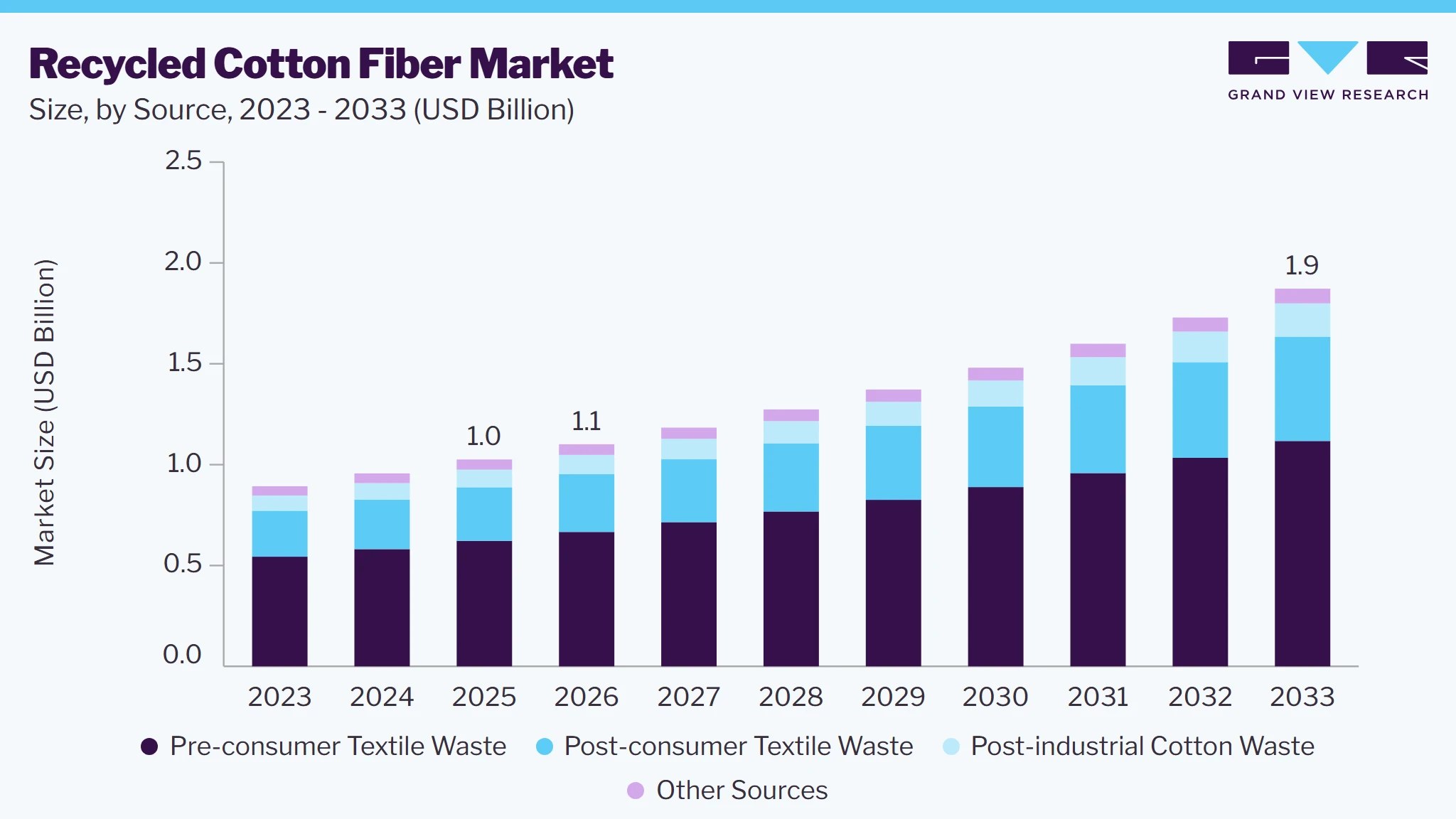
The global recycled cotton fiber market size was valued at USD 1.0 billion in 2025 and is projected to grow from USD 1.1 billion in 2026 to USD 1.9 billion by 2033, at a CAGR of 7.9% from 2026 to 2033. Asia Pacific dominated the market with a revenue share of 40.8% in 2025. The market is expanding as textile manufacturers, apparel brands, and consumers increasingly prioritize circular production, waste reduction, and lower dependence on virgin cotton.
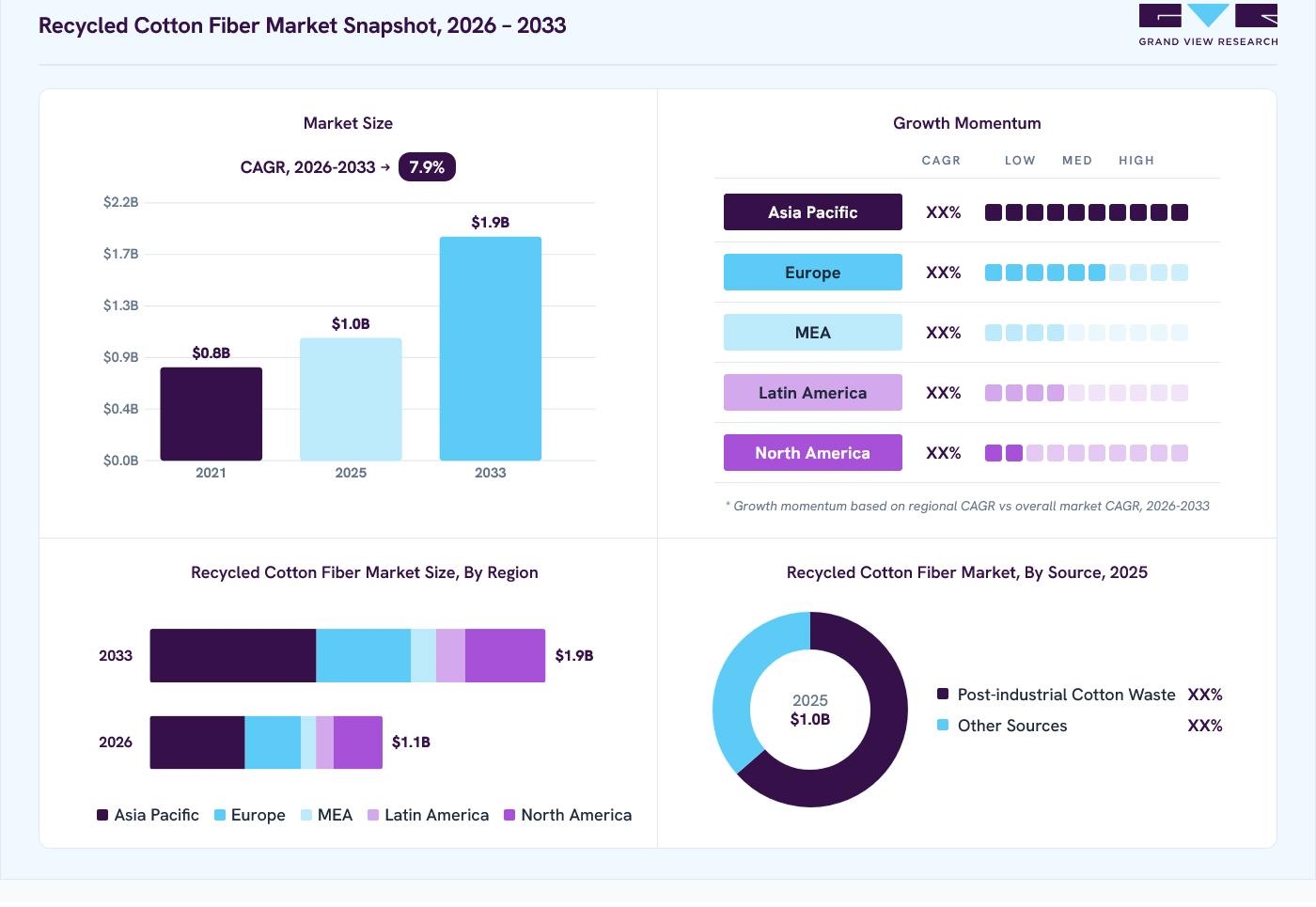 Source: Grand View Research, IR Documents, Primary Interviews, Paid DatabasesTo learn more about this report,
 Download Free Sample Report
 Key Market Trends & Insights
- By source: Post-consumer textile waste segment is expected to grow at a CAGR of 8.7% from 2026 to 2033.
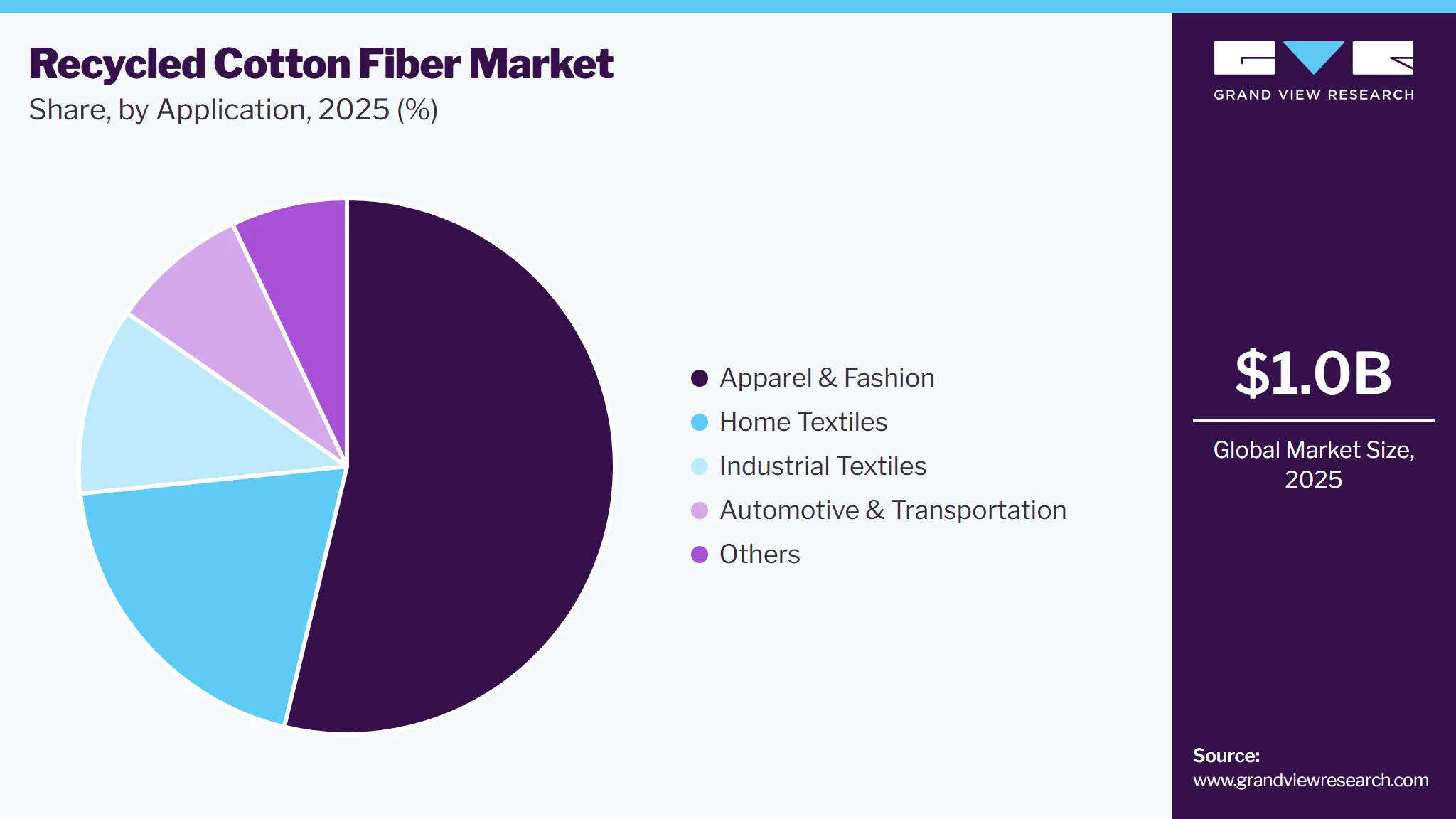
- By application: Apparel & fashion segment held the largest revenue share of 53.8% in 2025.
- By technology: Chemical recycling segment is projected to grow at a CAGR of 9.0% from 2026 to 2033.
Regional Highlights
- Largest regional market: Asia Pacific (40.8% revenue share, 2025)
- By country: China held the largest market share in 2025.
Market Size & Forecast
- Market Size in 2025: USD 1.0 Billion
- Estimated Market Size in 2026: USD 1.1 Billion
- Projected Market Size by 2033: USD 1.9 Billion
- CAGR (2026-2033): 7.9%
Three ways to get this report
Buy it, customize it, or ask a question.Ask an Analyst
A direct answer, usually in 1 working day
- AccessReport author, directly
- Reply timeWithin 1 working day
- No sales callDirect answer only
- FormatEmail reply
- CostFree, no cost
Get the Full Report
What the study covers
- FormatsPDF · Excel · Dashboard
- Timeline2026–2033 annual, 2025 base
- Coverage20+ countries, 5 regions
- Companies10+ key players profiled
Customize the Report
20% free customization
- IncludeCountries, segments, points
- TailorTo your product definition
- ExtendDeeper competitor detail
- OrA fully bespoke study
- Turnaround5–10 working days
Recycled cotton fibers are produced by recovering cotton textile waste from pre-consumer and post-consumer sources and mechanically or chemically processing it into usable fibers for yarns, fabrics, nonwovens, and other textile applications. Demand is supported by the large volume of cotton textile waste generated across global apparel and textile supply chains, as well as increasing sustainability commitments from brands and manufacturers.
 To learn more about this report, Download Free Sample Report
 The recycled cotton fiber industry is gaining commercial opportunities from the expansion of circular textile supply chains and investments in textile waste collection, sorting, shredding, fiber recovery, and yarn-spinning capabilities. Pre-consumer cotton waste remains particularly attractive because of its relatively consistent composition and easier processing compared with mixed post-consumer textile waste. Recycled cotton is also benefiting from established mechanical recycling infrastructure in major textile manufacturing clusters.
Technological developments focus on improving fiber quality, increasing the proportion of recycled cotton that can be incorporated into yarns, and addressing limitations in fiber length and strength. Mechanical recycling remains widely used due to its established processing infrastructure, while chemical and advanced recycling technologies are being developed to recover higher-quality cellulose fibers from textile waste. Brands and textile manufacturers are also increasing traceability, recycled-content verification, and circular-design initiatives.
Market Dynamics
The recycled cotton fiber market is shaped by increasing demand for sustainable textile materials, rising textile waste generation, advances in recycling technologies, and evolving regulations that support circular textile production. Market participants are focusing on improving the quality of recycled fiber, expanding access to textile waste feedstock, and developing efficient recycling processes to meet the requirements of apparel, home textile, denim, and industrial textile manufacturers. At the same time, limitations related to fiber strength, feedstock contamination, processing costs, and the availability of consistent textile waste influence market development.
The transition toward circular textile production is a major driver for the recycled cotton fiber market. Apparel brands, textile manufacturers, and retailers are increasingly incorporating recycled materials into product development to reduce dependence on virgin resources and improve the sustainability profile of their supply chains. Cotton recycling provides an opportunity to recover value from textile waste while reducing the need for new cotton cultivation and associated resource consumption. The growing emphasis on circularity is particularly relevant as the European Union targets a textile sector in which products are increasingly durable, recyclable, and made with recycled fibers.
Increasing textile waste generation is further strengthening the availability of raw material for recycling. Manufacturers are seeking to divert production waste from disposal while creating additional value from cutting scraps, yarn waste, defective fabrics, and discarded garments. In India, the Ministry of Textiles reported annual textile waste generation of 70.73 lakh tonnes in 2026 and highlighted opportunities to expand textile recycling and circular production. The introduction of initiatives supporting the development of recycled fiber is expected to encourage investment across the textile recycling value chain.
The quality limitations associated with recycled cotton fibers restrain market expansion, particularly for applications requiring high strength, softness, consistency, and durability. Mechanical recycling can shorten cotton fibers during repeated opening and processing, limiting the proportion of recycled cotton that can be incorporated into certain yarns without blending with virgin or other fibers. Post-consumer textile waste also creates additional challenges because garments may contain blends, dyes, finishes, trims, contaminants, and other materials that complicate sorting and processing. These factors increase processing requirements and can restrict the use of recycled cotton in higher-value textile applications.
Advancements in textile-to-textile recycling create significant opportunities for recycled cotton fiber manufacturers. Mechanical processing improvements, automated sorting, fiber-opening technologies, and chemical or dissolution-based recycling approaches can improve fiber recovery and expand the usable feedstock base. Advanced technologies can also help address the quality limitations associated with conventional recycling and enable greater utilization of post-consumer textile waste. Government support for recycling technologies and recycled fiber development, including India's Tex-Eco Initiative, is expected to encourage technology deployment, research collaborations, and commercialization of higher-value recycled textile materials.
Market Concentration & Characteristics
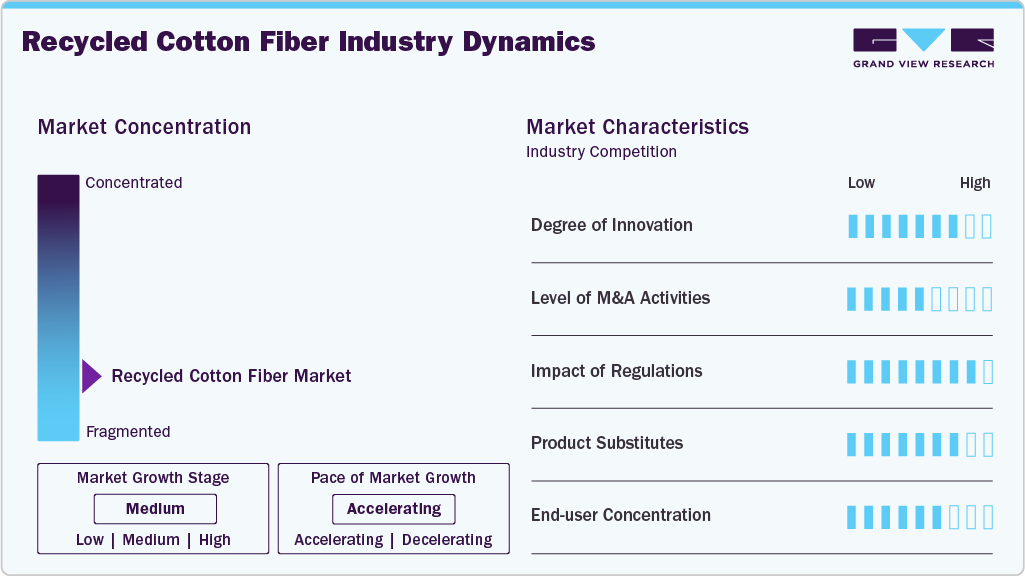
The recycled cotton fiber market is fragmented, with participation from specialized textile recyclers, recycled yarn manufacturers, vertically integrated textile companies, and emerging circular-material technology providers. The market remains characterized by regional recycling clusters and varying levels of integration across collection, sorting, fiber production, spinning, and finished textile manufacturing. Large textile manufacturers are increasingly developing in-house recycling capabilities or establishing partnerships with recyclers, while specialized companies continue to compete through fiber quality, feedstock access, technology, traceability, and customized recycled-content solutions. Increasing investments in recycling infrastructure are expected to gradually strengthen the position of larger integrated participants while maintaining opportunities for specialized regional recyclers.
 To learn more about this report, Download Free Sample Report
 Virgin cotton fibers represent the primary substitute for recycled cotton fibers because they provide consistent fiber length, strength, quality, and established processing characteristics. Recycled polyester, regenerated cellulose fibers, recycled wool, and other recycled textile fibers also compete with recycled cotton in applications where manufacturers prioritize recycled content rather than a specific fiber source. The selection between recycled cotton and substitute fibers depends on product performance, cost, availability, sustainability requirements, brand specifications, and compatibility with existing spinning and weaving processes. Increasing demand for natural-fiber-based recycled materials supports recycled cotton, while improvements in alternative recycled and regenerated fibers increase competitive pressure.
Analyst Perspective
The recycled cotton fiber market is transitioning from small-scale textile waste recovery to more structured circular fiber production, supported by increasing availability of textile waste, sustainability commitments, and advancements in recycling technologies. Mechanical recycling currently provides the primary pathway for converting cotton waste into usable fibers, while chemical and hybrid technologies are creating opportunities to improve fiber quality and expand the use of post-consumer feedstock. Market growth will depend on consistent waste collection, efficient sorting, improvements in fiber quality, competitive production costs, and broader adoption across apparel, home textiles, automotive, and industrial applications.
Recycling Technology Insights
The mechanical recycling segment held the largest revenue share of 89.8% in 2025, supported by its established commercial adoption, relatively straightforward processing requirements, and suitability for converting pre-consumer cotton textile waste into recycled fibers. Mechanical recycling enables textile manufacturers to recover cotton from cutting scraps, yarn waste, fabric remnants, and other cotton-rich materials while avoiding the use of chemical dissolution processes. Its scalability has established a processing infrastructure, and comparatively low processing complexity continues to support its widespread use in recycled yarn and textile production.
The chemical recycling segment is expected to grow at a CAGR of 9.0% over the forecast period, as textile manufacturers and fiber producers seek higher-quality recycled fibers with improved consistency, strength, and suitability for applications where mechanically recycled fibers face performance limitations. Chemical recycling can process cotton-rich textile waste by dissolving and regenerating cellulose, creating opportunities to utilize more challenging post-consumer waste streams and to produce fibers with properties closer to those of virgin materials. Increasing investments in next-generation textile recycling technologies and closed-loop production systems are expected to support the segment's expansion.
Source Insights
The pre-consumer textile waste segment dominated the recycled cotton fiber industry, accounting for a revenue share of 60.6% in 2025, primarily due to the relatively high availability, consistent composition, and easier collection and sorting of manufacturing waste such as cutting scraps, yarn waste, fabric remnants, and defective textiles. These waste streams generally contain fewer contaminants and mixed materials than post-consumer textiles, enabling more efficient recycling and better fiber consistency. Strong integration between textile manufacturers, recyclers, and yarn producers further supports the use of pre-consumer cotton waste as a key feedstock for recycled cotton fiber production.
The post-consumer textile waste segment is expected to grow at a CAGR of 8.7% over the forecast period, as increasing volumes of discarded clothing and household textiles create a larger feedstock base for textile-to-textile recycling. Growing emphasis on circular textile systems is encouraging recyclers and brands to develop collection, sorting, and processing infrastructure capable of recovering cotton from used garments. Advances in automated sorting, fiber separation, and chemical recycling are also improving the feasibility of processing complex post-consumer textile waste, supporting its increasing adoption in recycled cotton fiber production.
Application Insights
The apparel & fashion segment dominated the recycled cotton fiber market, accounting for a revenue share of 53.8% in 2025, driven by strong demand for sustainable fibers in clothing, denim, T-shirts, casualwear, sportswear, and other garment categories. Fashion brands and textile manufacturers are increasingly incorporating recycled cotton fibers into yarns and fabrics to reduce reliance on virgin cotton and improve the recycled content of finished products. The segment also benefits from growing consumer demand for sustainable apparel and increasing brand commitments toward circular and recycled-material sourcing.
 To learn more about this report, Download Free Sample Report
 The automotive & transportation segment is expected to grow at a CAGR of 8.7% over the forecast period, as vehicle manufacturers increasingly explore recycled textile materials for interior and non-structural applications. Recycled cotton fibers can be incorporated into acoustic insulation, interior fabrics, seat-related materials, door panels, headliners, and other textile-based components. Increasing requirements for lightweight, resource-efficient, and recycled-content materials, combined with automotive manufacturers' broader sustainability initiatives, are creating opportunities for greater adoption of recycled cotton fibers in transportation applications.
Regional Insights
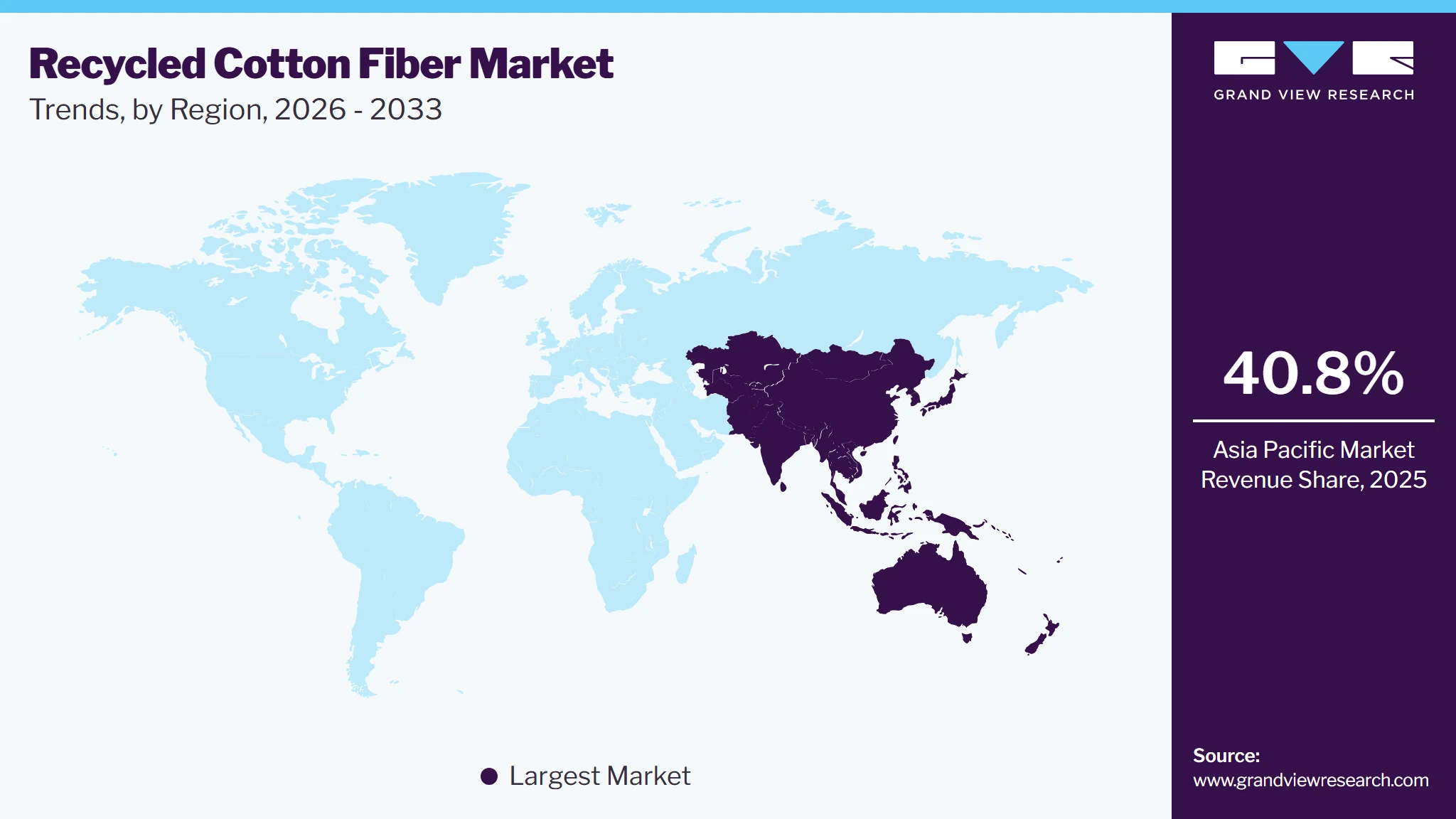
The Asia Pacific recycled cotton fiber market accounted for the largest global revenue share of 40.8% in 2025, and is expected to grow at the fastest CAGR over the forecast period, owing to its large textile and apparel manufacturing base, extensive cotton-processing infrastructure, and abundant availability of textile production waste. China, India, Bangladesh, Vietnam, Pakistan, and other regional manufacturing centers provide significant opportunities for recycled cotton fiber production and downstream yarn manufacturing. The region is also benefiting from the increasing adoption of sustainable materials by export-oriented textile manufacturers.
 To learn more about this report, Download Free Sample Report
 The China recycled cotton fiber market is a major participant in Asia Pacific, owing to its large textile production base, extensive spinning capacity, and substantial generation of cotton textile waste. Manufacturers are increasingly exploring textile recycling technologies to improve resource utilization and meet sustainability requirements from domestic and international customers. The country's integrated textile supply chain supports the collection, processing, spinning, and downstream utilization of recycled fibers. Growing demand from global apparel brands and export markets is expected to spur further development of recycled cotton processing capabilities.
North America Recycled Cotton Fiber Market Trends
North America is witnessing increasing demand for recycled cotton fibers as apparel brands, retailers, and textile manufacturers strengthen circularity initiatives and seek alternatives to virgin materials. Market opportunities are supported by sustainability commitments, recycled-content targets, textile take-back initiatives, and growing interest in domestic textile recycling infrastructure. The region also presents opportunities for technology providers developing automated sorting, fiber recovery, and textile-to-textile recycling solutions. Demand is particularly strong in apparel, home textiles, denim, and other applications where brands seek to increase recycled-material content.
U.S. Recycled Cotton Fiber Market Trends
The U.S. is a significant market for recycled cotton fibers, supported by the large apparel and home-textile industries and by increasing corporate emphasis on recycled materials. Brands and retailers are developing collection and recycling partnerships to improve textile circularity and reduce textile waste. Investments in domestic recycling infrastructure and advanced sorting and processing technologies are also creating opportunities for recycled cotton fiber producers. Demand from denim, apparel, home furnishings, and industrial textile applications is expected to support market development.
Europe Recycled Cotton Fiber Market Trends
Europe is an important market for recycled cotton fibers because regulatory initiatives are accelerating the transition toward circular textile production. The revised EU Waste Framework Directive, which entered into force in October 2025, introduced common extended producer responsibility requirements for textiles and footwear and strengthened the framework for textile collection, reuse, recycling, and waste management. These measures are increasing the importance of recycled materials and circular product design across the European textile value chain.
The Germany recycled cotton fiber market is significant in Europe, due to its developed textile industry, strong recycling infrastructure, and emphasis on resource efficiency and sustainable manufacturing. Textile manufacturers and brands are increasingly exploring recycled materials to comply with evolving sustainability requirements and respond to consumer demand for circular products. The country's industrial capabilities also support the development and adoption of advanced sorting, recycling, and material-processing technologies. Growing requirements for traceability and environmentally responsible sourcing are expected to support the adoption of recycled cotton.
Central and South America Recycled Cotton Fiber Market Trends
Central & South America is an emerging market for recycled cotton fibers, supported by textile and apparel production, increasing awareness of sustainable materials, and the availability of cotton-based textile waste. Brazil represents an important opportunity because of its sizeable cotton and textile industries, while other regional markets are gradually adopting circular production practices. Opportunities are concentrated in apparel, home textiles, and yarn manufacturing, although recycling infrastructure and organized textile collection remain less developed than in major markets in Asia Pacific, Europe, and North America.
Middle East & Africa Recycled Cotton Fiber Market Trends
The Middle East & Africa recycled cotton fiber industry is developing as textile manufacturers, apparel producers, and sustainability-focused brands increase interest in recycled materials. Growth opportunities are supported by investments in textile manufacturing, waste management infrastructure, and circular economy initiatives. Turkey, although geographically spanning Europe and Asia, is an important regional hub for textile production and recycling, serving international apparel supply chains, while countries in the Middle East are increasingly investing in sustainable manufacturing and resource-efficiency initiatives.
Key Recycled Cotton Fiber Company Insights
Some of the key players operating in the market include Recover Textile Systems, S.L. and Vardhman Textiles Ltd.
-
Recover Textile Systems, S.L. is a Spain-based textile recycling company specializing in the production of high-quality recycled cotton fibers from pre- and post-consumer textile waste. The company uses proprietary mechanical recycling technologies to produce recycled fibers for yarn and textile applications, supporting circularity and reducing dependence on virgin raw materials.
-
Vardhman Textiles Ltd. is an India-based integrated textile manufacturer with capabilities spanning spinning, weaving, processing, and textile recycling. Through its ReNova recycled cotton fiber portfolio, the company converts textile waste into recycled fibers and supports the integration of recycled materials into yarn and textile production.
Shanghai Vico and Evrnu are some of the emerging participants in the recycled cotton fiber market.
-
Shanghai Vico Industrial Co., Ltd. is a China-based textile materials manufacturer and supplier offering recycled cotton fiber and other recycled textile materials. The company focuses on processing textile waste into recycled fibers for applications across yarn manufacturing, textiles, and other fiber-based products.
-
Evrnu is a U.S.-based textile innovation company focused on transforming textile waste into next-generation circular fibers. Its Nucycl technology converts discarded cotton-rich textiles into engineered cellulosic fibers designed for use in apparel and other textile applications, providing an alternative source of raw material to conventional virgin fibers.
Key Recycled Cotton Fiber Companies
The following key companies have been profiled for this study of the recycled cotton fiber market.
-
Recover Textile Systems, S.L.
-
Vardhman Textiles Ltd.
-
Usha Yarns Ltd.
-
Marchi & Fildi Spa
-
APEX RECON
-
Ferre
-
Evrnu
-
Shanghai Vico
-
RE&UP Technologies
-
Circulose
Competitive Benchmarking
Category
Operating Strategies
Competitive Edge
Weakness
Established Players: Recover Textile Systems, S.L.; Vardhman Textiles Ltd.; Usha Yarns Ltd.; Marchi & Fildi S.p.A.; APEX RECON; Ferre; RE&UP Technologies
Invest in advanced textile recycling and fiber-processing technologies to convert pre-consumer and post-consumer cotton textile waste into recycled fibers and yarns.
Expand recycling and production capacity through partnerships with apparel brands, textile manufacturers, recyclers, and sustainability-focused organizations.
Increase recycled fiber content while improving fiber quality, traceability, consistency, and processing efficiency to support large-scale textile applications.
Strong expertise in recycled cotton processing, fiber recovery, yarn manufacturing, and circular textile production.
Established relationships with textile manufacturers, apparel brands, and downstream yarn producers support commercialization and market penetration.
Integrated recycling, fiber processing, spinning, and yarn capabilities provide greater control over product quality and supply.
High capital requirements for recycling equipment, fiber-processing infrastructure, and capacity expansion.
Variability in textile waste, including fiber blends, dyes, finishes, and contaminants, can affect recycling efficiency and product consistency.
Dependence on reliable textile-waste collection and consistent feedstock availability can constrain capacity utilization and scaling.
Emerging Players: Evrnu; Shanghai Vico; Circulose
Develop advanced textile-to-textile recycling technologies capable of converting cotton-rich and other textile waste into recycled or regenerated fiber materials.
Build partnerships with fashion brands, textile manufacturers, recyclers, and sustainability organizations to accelerate adoption of circular materials.
Focus on improving fiber quality, recycled content, traceability, process efficiency, and commercial scalability.
Strong specialization in next-generation textile recycling and circular material technologies.
Innovative recycling processes enable higher-value utilization of difficult textile waste and reduce reliance on virgin resources.
Strong sustainability positioning and collaboration with apparel and textile companies provide differentiation in the circular textile ecosystem.
Smaller production scale and market reach compared with established textile groups and vertically integrated recyclers.
Greater dependence on partnerships, financing, feedstock availability, and successful commercial scale-up.
Challenges remain around textile collection and sorting, processing economics, fiber consistency, scalability, and price competitiveness.
Recent Developments
-
In April 2025, Marchi & Fildi and RE&UP Technologies announced a strategic partnership to co-develop a new generation of premium recycled cotton yarns. The project combines RE&UP's textile-to-textile recycling technology with Marchi & Fildi's yarn-manufacturing expertise and aims to advance scalable, high-performance recycled yarn production.
-
In February 2026, Circulose announced the restart of commercial-scale production at its Ortviken plant in Sundsvall, Sweden. The company plans to resume production of CIRCULOSE, a recycled pulp made from discarded cotton textiles, in Q4 2026. The facility is planned to operate at approximately 60,000 tonnes per year, with potential for future expansion.
Recycled Cotton Fiber Market Report Scope
Attribute
Details
Market size in 2025
USD 1.0 billion
Estimated market size in 2026
USD 1.1 billion
Projected market size by 2033
USD 1.9 billion
Growth rate
CAGR of 7.9% from 2026 to 2033
Base year for estimation
2025
Actual estimates/Historical data
2021 - 2024
Forecast period
2026 - 2033
Quantitative units
Revenue in USD billion and CAGR from 2026 to 2033
Report coverage
Revenue forecast, company ranking, competitive landscape, growth factors, and trends
Segments covered
Recycling technology, source, application, and region
Regional scope
North America; Europe; Asia Pacific; Central & South America; Middle East & Africa
Country scope
U.S.; Canada; Mexico; UK; Germany; France; Italy; Spain; China; Japan; India; South Korea; Brazil; Saudi Arabia
Key companies profiled
Recover Textile Systems, S.L.; Vardhman Textiles Ltd.; Usha Yarns Ltd.; Marchi & Fildi Spa; APEX RECON; Ferre; Evrnu; Shanghai Vico; RE&UP Technologies; Circulose
Customization scope
Free report customization (equivalent up to 8 analysts working days) with purchase. Addition or alteration to country, regional & segment scope.
Pricing and purchase options
Avail customized purchase options to meet your exact research needs. Explore purchase options
Global Recycled Cotton Fiber Market Report Segmentation
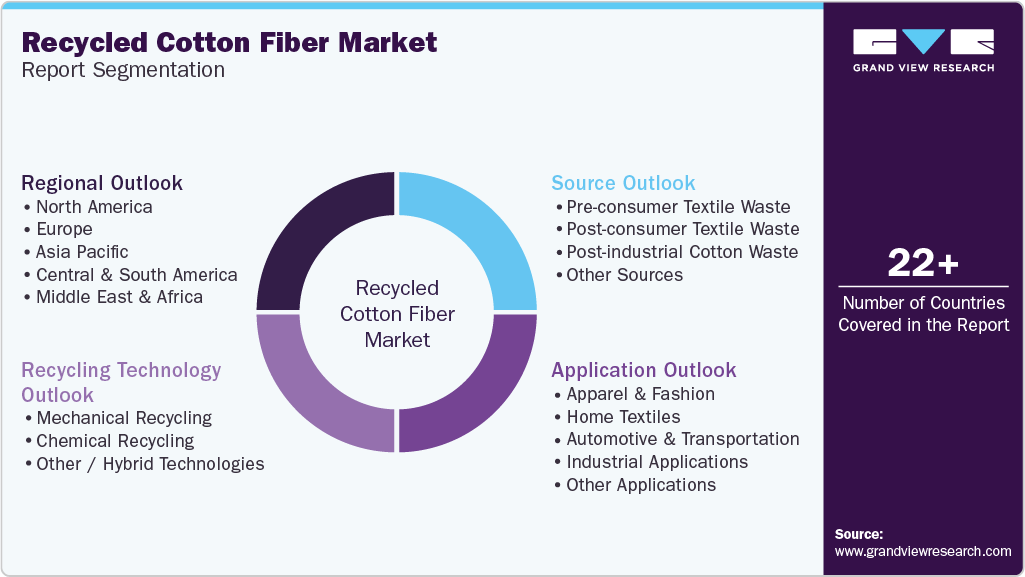
This report forecasts revenue growth at the global, regional & country levels and provides an analysis of the industry trends in each of the sub-segments from 2021 to 2033. For this study, Grand View Research has segmented the global recycled cotton fiber market report based on recycling technology, source, application, and region:
 To learn more about this report, Download Free Sample Report
 -
Recycling Technology Outlook (Revenue, USD Million/Billion, 2021 - 2033)
-
Mechanical Recycling
-
Chemical Recycling
-
Other / Hybrid Technologies
-
-
Source Outlook (Revenue, USD Million/Billion, 2021 - 2033)
-
Pre-consumer Textile Waste
-
Post-consumer Textile Waste
-
Post-industrial Cotton Waste
-
Other Sources
-
-
Application Outlook (Revenue, USD Million/Billion, 2021 - 2033)
-
Apparel & Fashion
-
Home Textiles
-
Automotive & Transportation
-
Industrial Applications
-
Other Applications
-
-
Regional Outlook (Revenue, USD Million/Billion, 2021 - 2033)
-
North America
-
U.S.
-
Canada
-
Mexico
-
-
Europe
-
UK
-
Germany
-
France
-
Italy
-
Spain
-
-
Asia Pacific
-
China
-
Japan
-
India
-
South Korea
-
-
Central and South America
-
Brazil
-
-
Middle East and Africa
-
Saudi Arabia
-
-
Research Methodology
The recycled cotton fiber market figures in this report are based on a proven research process that combines executive interviews with secondary research from proprietary databases, company filings, and recognized regulatory and institutional sources. Market size is built through value-chain sizing—reconciling supply-side and demand-side estimates—and triangulated with bottom-up and top-down approaches. Every estimate passes multiple levels of expert validation before publication, with each recycled cotton fiber segment quantified using the revenue-capture definitions in the table below.
Segment Definition
Recycling Technology
Revenue Capture Definition
Mechanical Recycling
Revenue generated from the sale of recycled cotton fibers produced through mechanical recycling processes, where pre-consumer or post-consumer cotton textile waste is collected, sorted, shredded, opened, and processed into recycled cotton fibers without chemically altering the cellulose structure.
Chemical Recycling
Revenue generated from the sale of recycled or regenerated cotton-derived fibers produced through chemical recycling processes, where cotton-rich textile waste is chemically processed to dissolve, purify, regenerate, or otherwise recover cellulose for conversion into new textile fibers.
Other / Hybrid Technologies
Revenue generated from the sale of recycled cotton fibers produced using combined, advanced, or alternative recycling technologies that integrate mechanical, chemical, enzymatic, thermal, or other processing methods to recover and convert cotton textile waste into reusable fiber materials.
Source
Revenue Capture Definition
Pre-consumer Textile Waste
Revenue generated from the sale of recycled cotton fibers produced from pre-consumer textile waste, including cutting scraps, yarn waste, fabric remnants, defective textiles, and other cotton-rich waste generated before reaching the end consumer.
Post-consumer Textile Waste
Revenue generated from the sale of recycled cotton fibers produced from discarded consumer textiles, including used cotton apparel, garments, household textiles, and other cotton-rich products collected after consumer use.
Post-industrial Cotton Waste
Revenue generated from the sale of recycled cotton fibers produced from cotton waste generated during industrial textile and cotton-processing operations, including spinning waste, weaving waste, knitting waste, and other manufacturing residues.
Other Sources
Revenue generated from the sale of recycled cotton fibers produced from other eligible cotton-containing waste sources, including mixed textile waste, recovered cotton materials, and specialized cotton waste streams not classified under pre-consumer, post-consumer, or post-industrial waste.
Application
Revenue Capture Definition
Apparel & Fashion
Revenue generated from the sale of recycled cotton fibers used in apparel and fashion products, including clothing, denim, T-shirts, sportswear, casualwear, underwear, and other garments.
Home Textiles
Revenue generated from the sale of recycled cotton fibers used in household textile products, including bed linens, towels, curtains, upholstery, blankets, carpets, rugs, and other home furnishing textiles.
Automotive & Transportation
Revenue generated from the sale of recycled cotton fibers used in automotive and transportation textile applications, including interior fabrics, seat materials, headliners, door panels, insulation, acoustic materials, and other vehicle textile components.
Industrial Textiles
Revenue generated from the sale of recycled cotton fibers used in industrial textile applications, including filtration materials, cleaning textiles, protective materials, wipes, insulation, geotextiles, and other technical or industrial textile products.
Other Applications
Revenue generated from the sale of recycled cotton fibers used in applications outside apparel and fashion, home textiles, automotive and transportation, and industrial textiles, including handicrafts, footwear, accessories, packaging textiles, and other specialty applications.
Estimation Model
Layer Name
Key Question
Description
Parent Market Analysis
What is the size and growth outlook of the global textile fibers, cotton fibers, recycled textile fibers, and sustainable textile materials market?
The analysis evaluates global fiber production, cotton demand, textile manufacturing, textile waste generation, recycling infrastructure, and investments in sustainable materials to establish the addressable market for recycled cotton fiber.
Recycled Cotton Fiber Penetration Analysis
What share of the recycled textile fiber market is represented by recycled cotton fiber?
Penetration is assessed across pre-consumer, post-consumer, and post-industrial cotton waste and across mechanical, chemical, and hybrid recycling technologies to determine recycled cotton fiber's market contribution.
Regional & Application Demand Assessment
Which regions and applications generate the highest demand for recycled cotton fiber?
Demand is assessed across major regions and applications based on textile production, cotton waste availability, recycling infrastructure, sustainability initiatives, and recycled-material adoption.
Company Revenue Validation & Market Forecasting
How is the market size validated and forecast?
Estimates are validated using company revenues, production capacities, product portfolios, recycling facilities, technologies, partnerships, and capacity expansions through bottom-up and top-down market triangulation.
Delivered Customizations
We have successfully delivered the following deep-dive customizations
Client Request
Customization Delivered
Value Adds
Cotton Textile Waste Feedstock & Recycling Potential Assessment
Analyze pre-consumer, post-consumer, and post-industrial cotton waste, collection channels, cotton content, sorting requirements, and feedstock suitability for recycled cotton fiber production.
Helps assess feedstock availability, recycling potential, and key raw-material constraints affecting production.
Recycled Cotton Fiber Quality & Application Suitability Analysis
Evaluate fiber length, strength, softness, color consistency, recycled content, blending requirements, and compatibility with spinning and textile production across major applications.
Helps identify suitable applications and opportunities to substitute virgin cotton and other conventional fibers.
Recycling Technology & Process Efficiency Assessment
Assess mechanical, chemical, and hybrid recycling technologies based on feedstock compatibility, fiber recovery, quality, processing efficiency, scalability, and production requirements.
Helps identify suitable technologies, improve process efficiency, and evaluate opportunities for higher-quality recycled cotton fiber production.
Frequently Asked Questions About This Report
The recycled cotton fiber market size was estimated at USD 1.0 billion in 2025 and is expected to reach USD 1.1 billion in 2026.
The recycled cotton fiber market is expected to grow at a compound annual growth rate of 7.9% from 2026 to 2033 to reach USD 1.9 billion by 2033.
The mechanical recycling segment accounted for the highest revenue share of 89.8% in 2025, driven by its established processes, cost efficiency, and suitability for recycling cotton waste.
Asia Pacific held the highest revenue market share of 40.8% in 2025, driven by its large textile manufacturing base, abundant cotton production, and growing adoption of sustainable recycling practices.
Rising textile waste generation, increasing demand for sustainable fibers, growing adoption of circular textile practices, and advancements in cotton recycling technologies are key factors driving the recycled cotton fiber market.
Some key players in the recycled cotton fiber market include Recover Textile Systems, S.L., Vardhman Textiles Ltd., Usha Yarns Ltd., Marchi & Fildi Spa, APEX RECON, Ferre, Evrnu, Shanghai Vico, Circulose, and RE&UP Technologies.
The post-consumer textile waste segment is the fastest-growing source in the recycled cotton fiber market.
The automotive & transportation segment is the fastest growing application in the recycled cotton fiber market.
The apparel & fashion segment accounted for the largest revenue share of 53.8% in 2025, driven by strong demand for sustainable denim and recycled fibers in clothing and textile manufacturing
About the Author(s)
Advanced Interior Materials Research Team
Advanced Materials · Advanced Interior MaterialsThis report was authored by the advanced interior materials research team at Grand View Research - comprising two research analysts, one senior research analyst, and one industry expert - with specialized expertise in the advanced interior materials segment of the advanced materials industry. All findings are based on proprietary advanced materials databases, executive interviews, and regulatory analysis, subject to internal peer review prior to publication.
Last Updated:
Speak to Analyst

Customize this report to your needs - add regions, segments, or data points, with 20% free customization.
Or view our licence options:


ISO 9001:2015 & 27001:2022 Certified
We are GDPR and CCPA compliant! Your transaction & personal information is safe and secure. For more details, please read our privacy policy.


