
- Home
- »
- Plastics, Polymers & Resins
- »
-
Recycled Plastic Additives Market Size & Share Report, 2033GVR Report cover

Recycled Plastic Additives Market (2026 - 2033)
Size, Share & Trends Analysis Report By Additive Type (Compatibilizers, Stabilizers and Antioxidants, Processing aids, Impact Modifiers, Chain Extenders), By End Use, By Region, And Segment Forecasts
Market Size, 2025
$866.8MMarket Estimate, 2026
$960.2MMarket Forecast, 2033
$2,009.6MCAGR, 2026–2033
11.1%Recycled Plastic Additives Market Summary
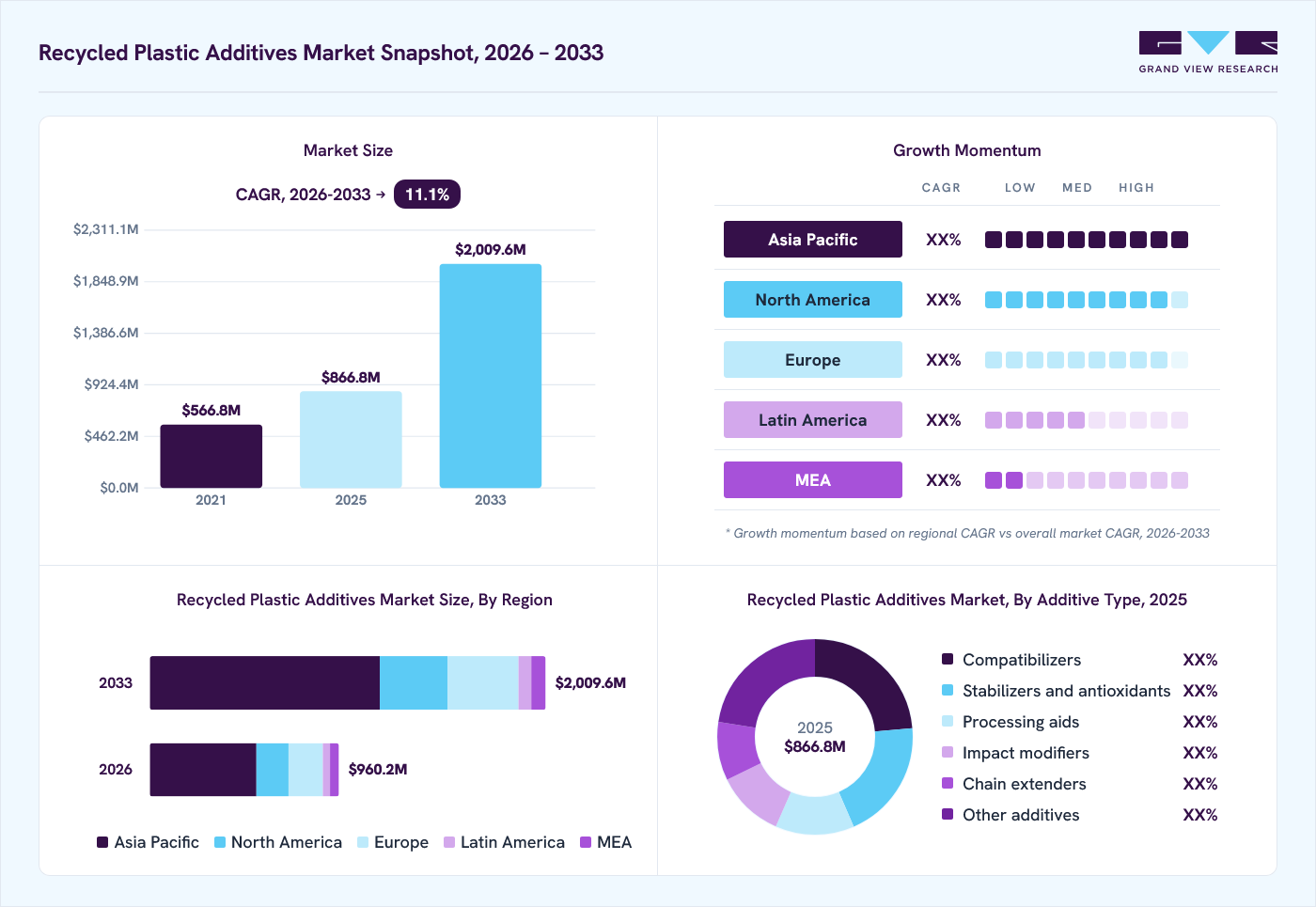
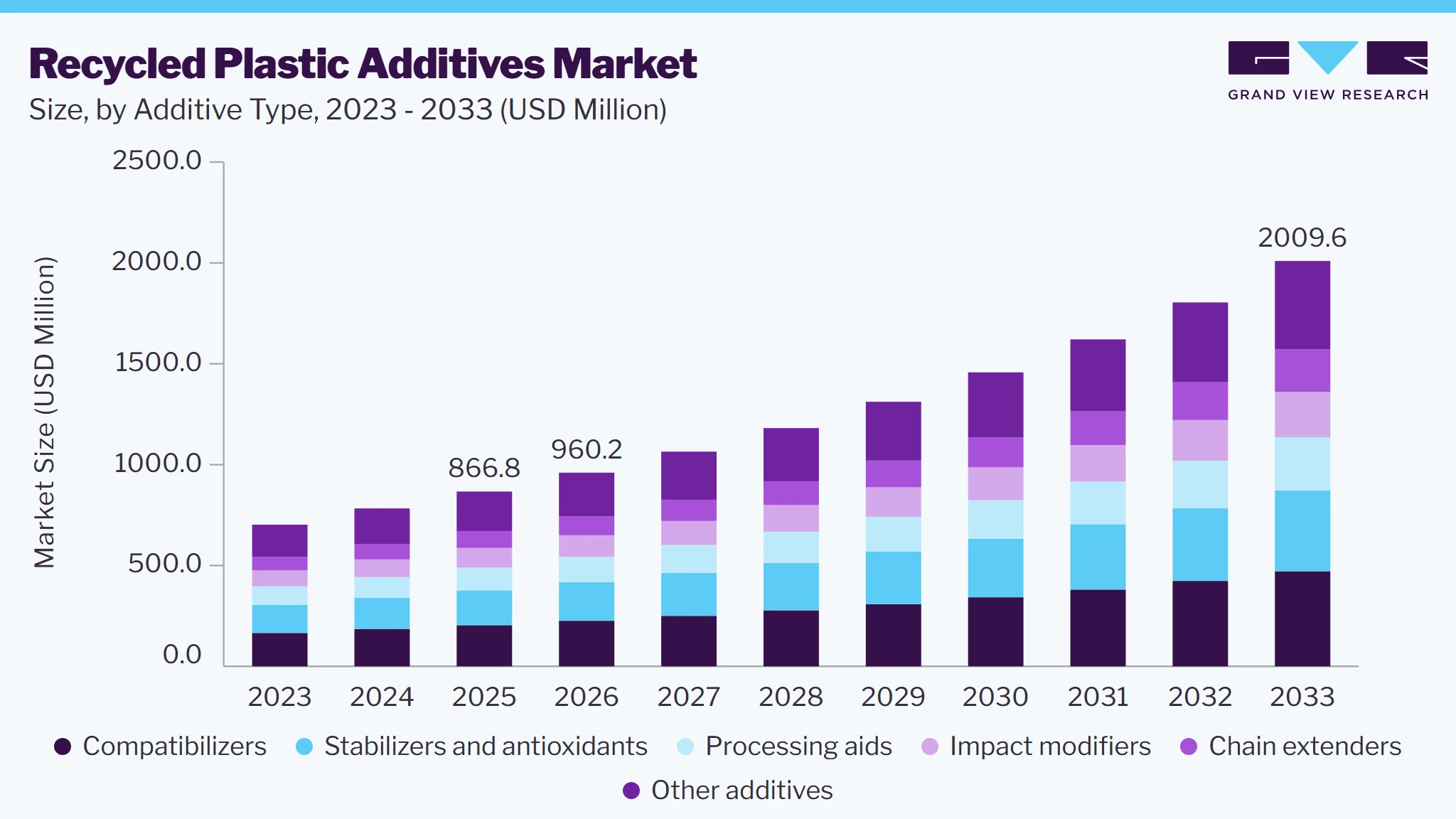
The global recycled plastic additives market size was valued at USD 866.8 million in 2025 and is projected to grow from USD 960.2 million in 2026 to USD 2,009.6 million by 2033, at a CAGR of 11.1% from 2026 to 2033. The market in Asia Pacific dominated with a revenue share of 56.1% in 2025. The recycled plastic additives market is driven by rising demand for high-quality recycled polymers, stricter plastic waste regulations, and corporate sustainability commitments.
 Source: Grand View Research, IR Documents, Primary Interviews, Paid DatabasesTo learn more about this report,
 Download Free Sample Report
Key Market Trends & Insights
- By additive type: Compatibilizers segment held the largest market share of 23.5% in 2025.
- By end use: Packaging segment held the largest market share of 30.0% in 2025.
Regional Highlights
- Largest regional market: Asia Pacific (56.1% revenue share, 2025)
- By country: India held the largest market share in 2025
Market Size & Forecast
- Market size in 2025: USD 866.8 Million
- Estimated market size in 2026: USD 960.2 Million
- Projected market size by 2033: USD 2,009.6 Million
- CAGR (2026-2033): 11.1%
Three ways to get this report
Buy it, customize it, or ask a question.Ask an Analyst
Analyst response in 1 business day
- AccessReport author, directly
- Reply timeWithin 1 working day
- No sales callDirect answer only
- FormatEmail reply
- CostFree, no cost
Get the Full Report
What the study covers
- FormatsPDF · Excel · Dashboard
- Timeline2026–2033 annual, 2025 base
- Coverage20+ countries, 5 regions
- Companies10+ key players profiled
Customize the Report
20% free customization
- IncludeCountries, segments, points
- TailorTo your product definition
- ExtendDeeper competitor detail
- OrA fully bespoke study
- Turnaround5–10 working days
Increasing use of recycled plastics in packaging, automotive, construction, and consumer goods is accelerating demand for compatibilizers, stabilizers, impact modifiers, and processing aids that improve material performance and manufacturing efficiency. The market is shifting toward application-specific additive formulations that improve the consistency of post-consumer recycled plastics.
 To learn more about this report, Download Free Sample Report
Compatibilizers, chain extenders, and antioxidants are increasingly important for managing polymer incompatibility, molecular weight loss, and thermal degradation during repeated processing. Formulators are also developing multifunctional additive systems that improve melt flow, mechanical strength, and processing stability simultaneously. This approach supports the use of recycled polymers in more demanding applications, where material consistency and predictable processing performance are essential.
Market Dynamics
Growing demand for recycled plastics in packaging, automotive components, construction materials, and consumer products is increasing the need for additives that improve the quality and performance of recycled polymers. Manufacturers are under pressure to incorporate more recycled content while maintaining product strength, durability, appearance, and processing efficiency. However, mechanical recycling can degrade polymer chains due to repeated heat exposure and processing. This may reduce molecular weight, impact resistance, thermal stability, and melt strength, limiting the use of recycled materials in applications that require consistent performance.
Recycled plastic additives help address these limitations and improve the suitability of recycled resins for different End Use applications. Compatibilizers improve bonding between incompatible polymers in mixed plastic waste, while stabilizers and antioxidants reduce degradation during processing. Chain extenders help restore molecular weight and melt strength, and impact modifiers improve toughness in selected applications. These additives enable manufacturers to use higher proportions of recycled plastics while meeting product quality and processing requirements. As demand for reliable recycled materials increases, the need for performance-enhancing additives is expected to grow across industries seeking to reduce virgin plastic consumption.
Variations in polymer composition, contamination, previous additive content, and degradation levels complicate additive selection and dosage optimization. A formulation effective for one recycled resin may deliver inconsistent results when applied to another waste stream. Certain additives can also introduce chemical safety concerns, migration risks, or compatibility problems in subsequent recycling cycles. Food-contact packaging faces additional qualification requirements. These factors increase testing, quality-control, and formulation costs, limiting adoption among smaller recyclers and price-sensitive processors.
The processing of mixed post-consumer plastics presents an opportunity for specialized additives that enable higher-value material recovery. Compatibilizers can improve the interfacial adhesion of incompatible polymers, while impact modifiers and reactive processing aids can improve selected mechanical properties. These technologies could expand the usability of mixed polyolefin waste in automotive parts, construction profiles, and industrial products. Further opportunities exist in customized additive masterbatches designed for variable feedstock quality. Commercial success will depend on achieving reliable performance improvements at additive costs that remain competitive with virgin and conventional recycled materials.
Market Concentration & Characteristics
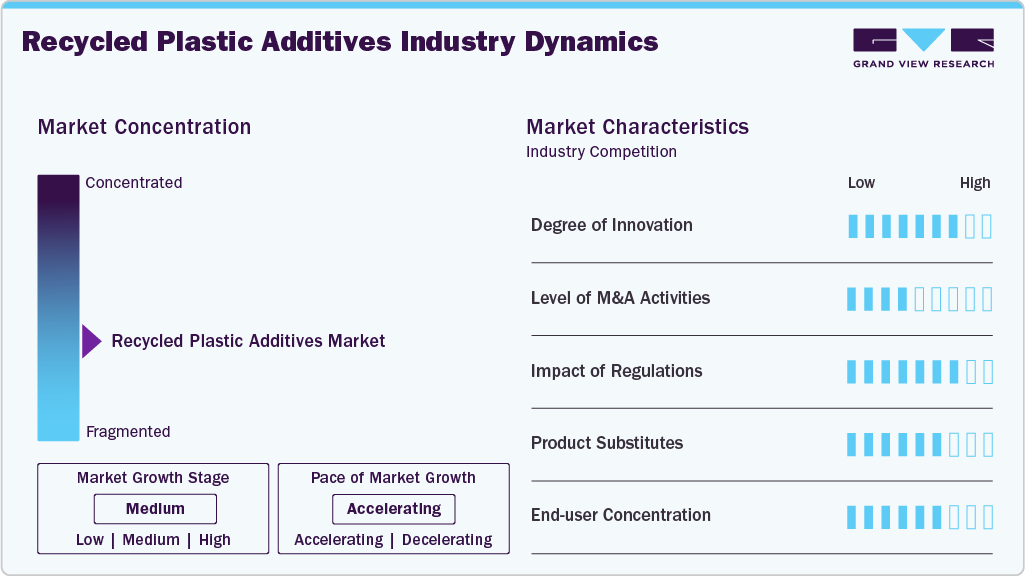
The market growth stage is medium, and growth is accelerating. The market exhibits fragmentation, with key players dominating the industry landscape. Major companies such as BASF, BYK (ALTANA), STRUKTOL, Nexam Chemical, Avient, Clariant, Baerlocher, SONGWON, Ampacet Corporation, Vin Group and others play a significant role in shaping the market dynamics. These leading players often drive innovation in the market by introducing new products, technologies, and materials to meet the industry's evolving demands.
Innovation in the recycled plastic additives market is increasingly focused on restoring polymer properties while accommodating variable waste composition. Developments include multifunctional stabilizer packages, reactive compatibilizers for mixed-polymer streams, and chain extenders tailored to degraded PET and other condensation polymers. These formulations help recyclers manage molecular degradation, inconsistent melt flow, odor, and mechanical performance without relying exclusively on virgin resin dilution. Research and industry training initiatives also emphasize application-specific additive selection and food-contact compliance. Commercial differentiation will depend on measurable property improvements, dosage efficiency, and compatibility with repeated recycling.
 To learn more about this report, Download Free Sample Report
Regulation is strengthening demand for additives that enable recycled plastics to meet material quality and application requirements. In India, Extended Producer Responsibility rules establish mandatory recycling obligations and recycled-content requirements for plastic packaging, supporting demand for performance-enhancing formulations. In the European Union, the Packaging and Packaging Waste Regulation entered into force in 2025, with general application from August 2026 and recyclability provisions applying on phased timelines. These frameworks increase the commercial value of compatibilizers, stabilizers, and processing aids, while food-contact and chemical-safety requirements constrain additive selection.
Analyst Perspective
The recycled plastic additives market is expected to transition from volume-led growth toward value-driven innovation over the next 5-10 years as recycled polymers gain wider acceptance in packaging, automotive and transportation, building and construction, consumer goods, and electrical and electronics. Stricter recycled-content requirements, extended producer responsibility policies, and corporate sustainability commitments will increase demand for additives that improve recyclate quality, processing stability, durability, and application suitability. Compatibilizers, chain extenders, advanced stabilizers, and multifunctional additive systems are likely to create significant opportunities by addressing polymer incompatibility, degradation, and inconsistent feedstock quality. Market leaders will differentiate through formulation expertise, application-specific product development, technical partnerships with recyclers and converters, global supply capabilities, and demonstrable improvements in recycled material performance.
Additive Type Insights
The compatibilizers dominated the market across additive type segmentation in terms of revenue, accounting for 23.5% market share in 2025, and is forecast to grow at an 11.1% CAGR from 2026 to 2033. The growing need to process mixed plastic waste is driving demand for compatibilizers, particularly in recycled polyethylene and polypropylene blends containing incompatible polymers. Variations in waste composition can weaken interfacial adhesion, reduce impact strength, and cause inconsistent mechanical performance. Compatibilizers help improve bonding between polymer phases, enabling recyclers to produce more consistent materials from complex waste streams. This capability supports the use of recycled resins in durable consumer products, construction components, and industrial applications where single-polymer feedstock availability is limited.
The chain extenders segment is expected to expand at the highest CAGR of 12.3% over the forecast period. Chain extenders are gaining importance as recyclers seek to recover the processing characteristics of degraded polymers, particularly polyethylene terephthalate (PET). Repeated thermal processing can reduce polymer chain length and intrinsic viscosity, limiting the suitability of recycled PET for demanding applications. Chain extenders react with functional groups in selected polymers to rebuild molecular weight and improve melt strength. These properties are important for sheet extrusion, thermoforming, and fiber production. Greater demand for higher-performance recycled polyester materials is strengthening the commercial relevance of chain-extending additives.
End Use Insights
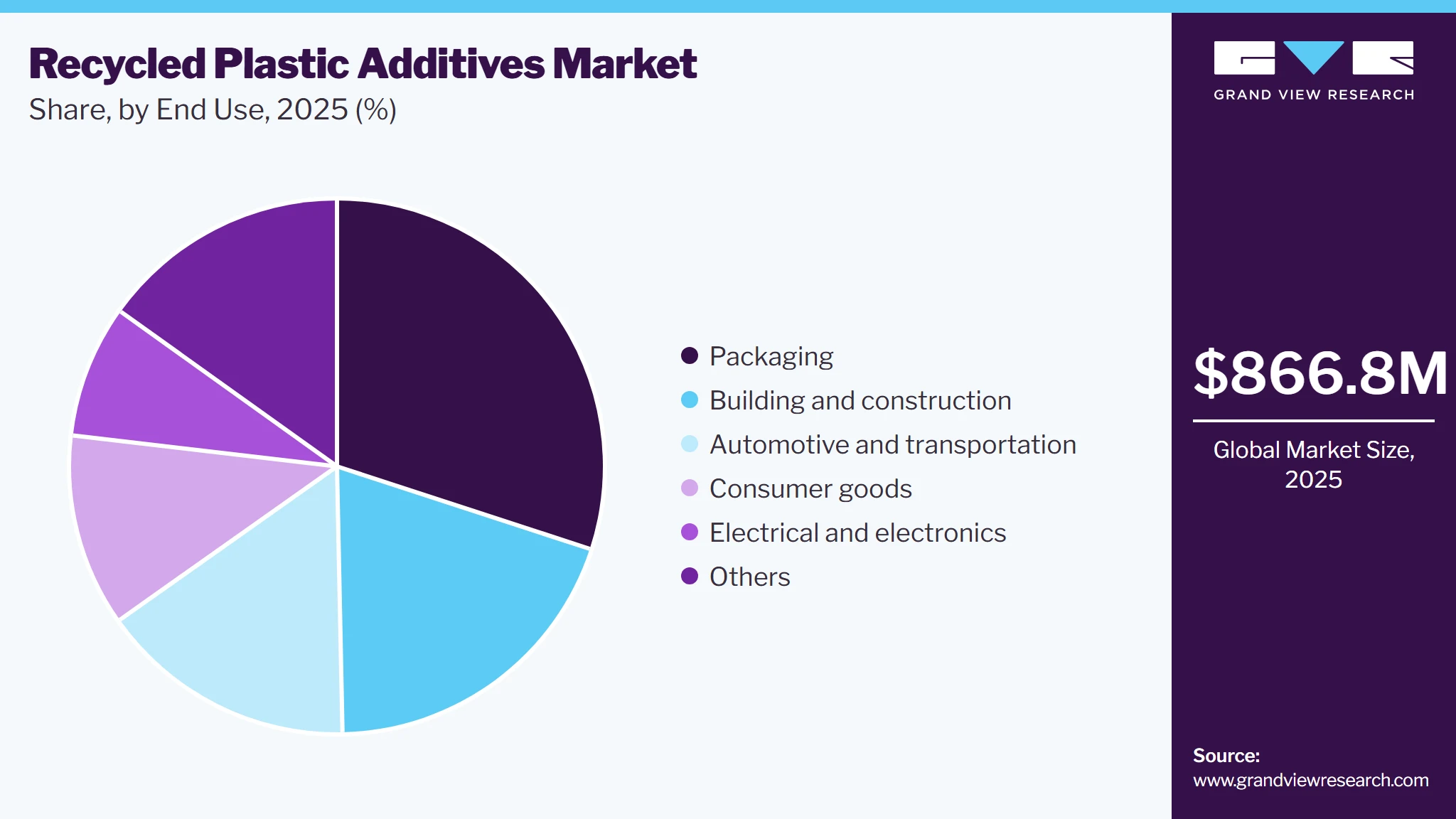
The packaging segment led the market by end use, accounting for 30.0% of revenue in 2025, and is projected to grow at a 11.0% CAGR from 2026 to 2033. Packaging demand is being reinforced by regulatory requirements that make recycled resin quality a commercial priority. Under the European Union's Packaging and Packaging Waste Regulation, minimum recycled-content requirements are scheduled from 2030, subject to the regulation's implementation provisions. Targets include 30% for single-use plastic beverage bottles and 35% for other plastic packaging, with specified exceptions. Meeting these requirements while maintaining packaging strength, processability, color consistency, and product protection is increasing the importance of stabilizers, compatibilizers, and processing aids in recycled packaging applications.
 To learn more about this report, Download Free Sample Report
The automotive and transportation segment is expected to grow at the fastest CAGR of 12.0% over the forecast period. Automotive manufacturers are facing stronger incentives to incorporate post-consumer recycled plastics while maintaining component durability, dimensional stability, and impact performance. The European Union's new end-of-life vehicle regulation entered into force on 13 August 2026, establishing a framework that includes recycled-plastic content targets of 15% from 2032 and 25% from 2036. These requirements are expected to increase demand for impact modifiers, heat stabilizers, compatibilizers, and processing aids that help recycled polymers meet automotive specifications for interior trim, underbody components, and other suitable applications.
Regional Insights
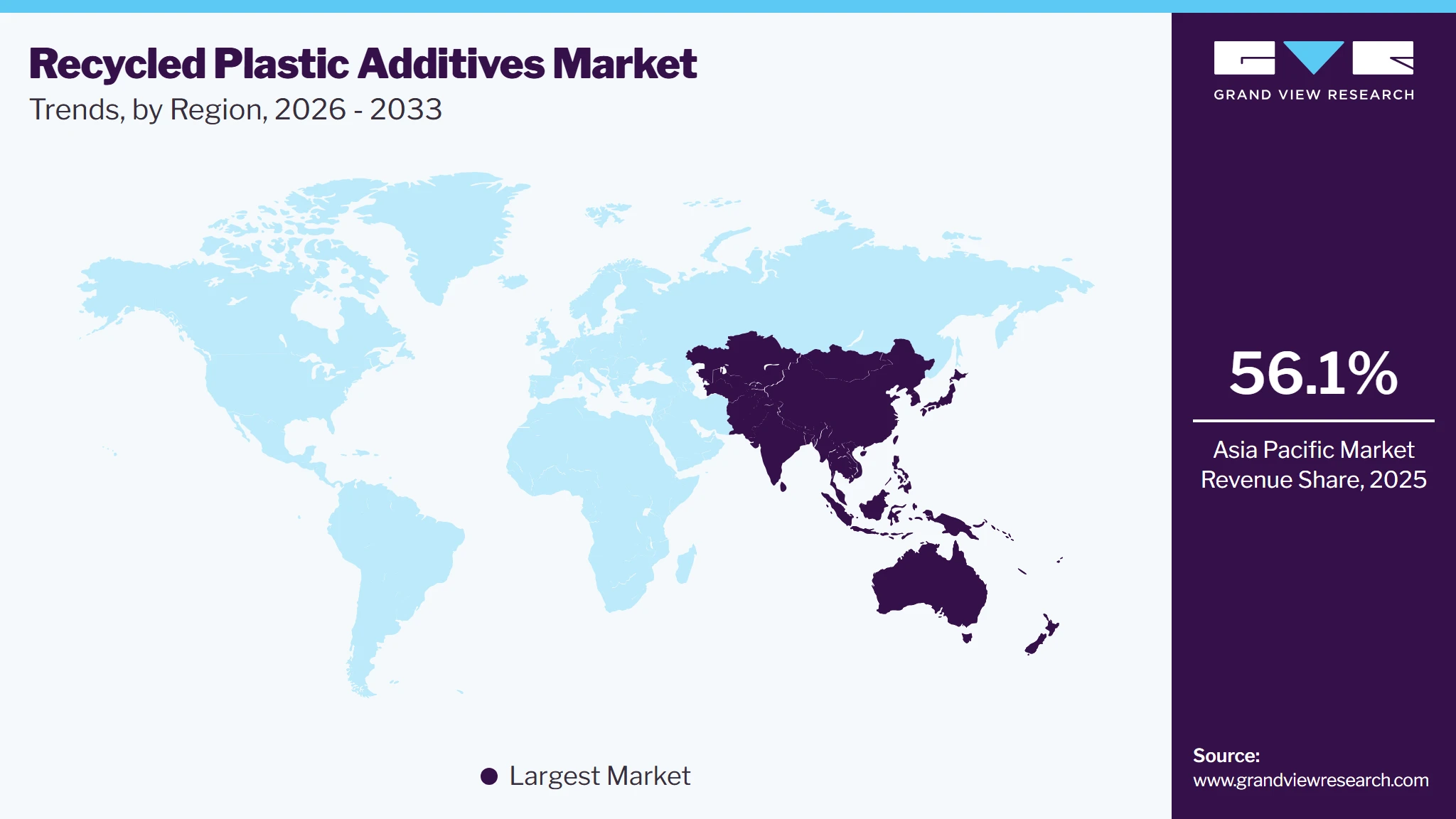
The Asia Pacific recycled plastic additives industry held the largest revenue share of 56.1% in 2025. The region is expected to grow at a CAGR of 11.6% over the forecast period. Asia Pacific benefits from its extensive plastics manufacturing base, large packaging industry, and expanding investment in recycling and circular-material systems. According to the OECD, several economies across Southeast and East Asia are introducing extended producer responsibility schemes, recycled-content initiatives, and measures to improve plastic waste collection. These developments increase the need for additives that improve recycled resin quality across diverse feedstocks. Compatibilizers, processing aids, and stabilizers are particularly relevant to converters seeking consistent performance from locally recovered plastics while controlling production costs.
 To learn more about this report, Download Free Sample Report
China Recycled Plastic Additives Market Trends
China's recycled plastic additives demand is supported by government initiatives to strengthen domestic waste collection, sorting, and resource recovery. The national plastic pollution control framework targets improvements across the entire plastics lifecycle, while urban waste-sorting systems support more organized recovery of recyclable materials. As domestic recycling systems process larger and more varied plastic waste streams, manufacturers require additives to improve recycled polymer consistency, thermal stability, and mechanical properties. China's large-scale plastics processing industry provides a substantial downstream base for these performance-enhancing materials.
North America Recycled Plastic Additives Market Trends
North America's demand for recycled plastic additives is supported by investment in recycling infrastructure, brand-owner recycled-content commitments, and the need to improve the consistency of secondary resins. According to the U.S. Environmental Protection Agency, expanding collection and sorting capacity is important for providing recyclers with sufficient, consistent plastic feedstock. This creates demand for compatibilizers, antioxidants, and processing aids that help manage contamination, polymer degradation, and variable melt properties. Adoption will depend on recycled resin economics and the performance requirements of downstream converters.
U.S. Recycled Plastic Additives Market Trends
In the U.S., demand is linked to efforts to expand domestic recycling capacity and increase the usability of recovered plastics in manufacturing. Federal procurement guidance identifies products with recommended recovered-material content, supporting established outlets for recycled materials in selected applications. As recyclers process more post-consumer packaging and mixed polyolefin waste, additive formulations that improve melt flow, impact resistance, odor control, and thermal stability become commercially relevant. Growth will vary by state because collection systems, recycled-content policies, and market incentives differ across jurisdictions.
Europe Recycled Plastic Additives Market Trends
Europe's market is being driven by regulatory requirements that connect packaging design, recyclability, and recycled-material utilization. The Packaging and Packaging Waste Regulation began applying on 12 August 2026 and establishes requirements that include recycled content in plastic packaging and recyclability by 2030. Compliance increases the importance of additives that preserve polymer performance during recycling and subsequent conversion. Stabilizers, compatibilizers, and chain extenders can help manufacturers achieve required material specifications. Demand will also depend on recycled resin availability, additive safety, and the economics of meeting application-specific quality standards.
Latin America Recycled Plastic Additives Market Trends
Latin America's recycled plastic additives market is supported by growing attention to packaging waste management, producer responsibility, and the development of domestic recycling value chains. Brazil and other major regional economies offer opportunities to improve the quality and commercial usability of recovered plastics used in packaging, construction products, and consumer goods. As recyclers work with variable post-consumer feedstocks, compatibilizers and stabilizers can help address inconsistent mechanical properties and processing behavior. Market expansion, however, depends on collection infrastructure, reliable recycled resin supply, investment in recycling technology, and the price competitiveness of recycled materials.
Middle East and Africa Recycled Plastic Additives Market Trends
The Middle East and Africa market is driven by efforts to diversify waste management systems and develop higher-value applications for recovered plastics. In the Middle East, investment in petrochemicals and plastics manufacturing creates opportunities to integrate recycling with established polymer processing capabilities. Across African markets, improvements in collection, sorting, and recycling infrastructure can increase the availability of locally recovered feedstock. These developments support potential demand for processing aids, antioxidants, and compatibilizers that improve material consistency. Adoption will depend on infrastructure investment, technical expertise, and the cost advantage of recycled resins over virgin polymers.
Key Recycled Plastic Additives Company Insights
Some of the key players operating in the market include BASF and BYK (ALTANA)
-
BASF strengthens its position in the recycled plastic additives market through its IrgaCycle solutions, which improve recyclate quality, processing stability, and mechanical performance. Its formulations address degradation, melt-flow fluctuations, and material defects in mechanically recycled plastics. Applications span packaging, automotive, and construction. Its established additives expertise and technical support capabilities help converters incorporate higher recycled content while maintaining product specifications.
-
BYK differentiates itself through specialized formulations for stabilizing and upgrading recycled thermoplastics. Its RECYCLOBYK range includes heat stabilizers, processing aids, antioxidant concentrates, and formulations that improve mechanical and rheological properties. Products address recycled polyolefins, engineering plastics, and mixed-polymer streams. This application-specific portfolio supports recyclers dealing with variable feedstock quality, including plastics recovered from automotive components, packaging, and multilayer films.
Nexam Chemical and Vin Group are some of the emerging participants in the recycled plastic additives market.
-
Nexam Chemical focuses on reactive additives that restore processing performance and material properties in recycled polymers. Its technologies include chain extenders, compatibilizers, crosslinkers, and impact modifiers for PET, polyethylene, and polypropylene. In August 2026, two additional recycling customers entered commercial production using its Reactive Recycling technology, indicating progress beyond industrial trials. This development strengthens its position in specialized polymer performance restoration.
-
Vin Group targets recycled plastic processing through moisture-management additives, coupling agents, and compatibilizers. Its VinBond range includes maleic anhydride-grafted polyolefins designed to improve interfacial adhesion, dispersion, and strength in recycled polymer alloys. The company also offers desiccant masterbatches for recycled and reclaimed plastics. Its portfolio addresses practical processing challenges, positioning it to serve plastic compounders and recyclers seeking cost-effective material improvement solutions.
Key Recycled Plastic Additives Companies:
The following key companies have been profiled for this study on the recycled plastic additives market.-
BASF
-
BYK (ALTANA)
-
STRUKTOL
-
Nexam Chemical
-
Avient
-
Clariant
-
Baerlocher
-
SONGWON
-
Ampacet Corporation
-
Vin Group
Competitive Benchmarking
Operating Strategies
Competitive Edge
Weakness
Mature Players: BASF, BYK (ALTANA), STRUKTOL, Avient, Clariant, Baerlocher, SONGWON, Ampacet Corporation
- Expand specialized additive portfolios covering compatibilizers, antioxidants, chain extenders, stabilizers, processing aids, and odor-control solutions for recycled PET and polyolefins.
- Strengthen technical collaboration with recyclers, compounders, and converters to develop formulations for variable post-consumer feedstocks and application-specific recycled resin requirements.
- Invest in multifunctional additive systems, processing optimization, and compatibility with mechanical recycling processes to improve recyclate quality and support higher recycled-content utilization.
- Established polymer chemistry expertise and extensive product portfolios enable manufacturers to address multiple degradation, compatibility, and processing challenges across recycled plastics.
- Global manufacturing facilities, technical service networks, and established customer relationships support product qualification and commercial adoption across packaging, automotive, construction, and consumer goods.
• Specialized formulations and application-development capabilities help differentiate products beyond price through measurable improvements in recycled resin quality and processing consistency.
- Premium additive formulations can increase recycling costs, particularly for low-margin applications and price-sensitive recyclers.
- Performance depends on polymer composition, contamination levels, degradation history, and processing conditions, requiring extensive testing and customized formulations.
- Competition from generic additives, integrated masterbatch suppliers, and alternative recycling technologies can constrain pricing power. Limited disclosure of recycling-specific revenue also complicates assessment of individual companies' market positions.
Emerging Players: Nexam Chemical and Vin Group
- Develop specialized reactive additives, chain extenders, compatibilizers, coupling agents, and moisture-management solutions for recycled PET, polyethylene, polypropylene, and mixed-polymer streams.
- Expand commercial adoption through partnerships with recyclers, compounders, and plastic processors, supported by application trials and customized formulation development.
- Prioritize additive solutions that restore molecular weight, improve interfacial adhesion, and address specific feedstock limitations without requiring major changes to existing recycling equipment.
- Focused product portfolios allow companies to address defined recycling challenges, including polymer degradation, poor compatibility, and inconsistent material properties.
- Reactive additive technologies and specialized coupling-agent formulations can offer targeted performance benefits in applications where conventional stabilizers alone are insufficient.
- Direct technical engagement with processors supports application-specific customization and creates opportunities to establish customer relationships in specialized recycling segments.
- Smaller financial resources and narrower product portfolios can limit research investment, manufacturing scale, and international market penetration relative to established competitors.
- Commercial qualification of new formulations can require extended testing to demonstrate consistent performance across different waste streams and processing conditions.
- Dependence on customer trials, adoption rates, and recycled resin economics may delay revenue expansion. Limited brand visibility and distribution reach can also restrict access to large multinational converters.
Recent Developments
-
In May 2026, Avient launched its Cesa Tough A4R additive for recycled high-density polyethylene (r-HDPE), targeting improved environmental stress-crack resistance while maintaining recyclability. Developed with Italian cable manufacturer Tratos, the technology aims to improve the performance of post-consumer recycled plastics
-
In August 2026, Nexam Chemical reported that two additional customers in North America and Europe had moved its Reactive Recycling additive technology from industrial trials to commercial production. Previous trials at a Canadian recycled PET food-packaging producer reduced defective products by more than 90%.
Recycled Plastic Additives Market Report Scope
Report Attribute
Details
Market size in 2025
USD 866.8 million
Estimated market size in 2026
USD 960.2 million
Projected market size by 2033
USD 2,009.6 million
Growth rate
CAGR of 11.1% from 2026 to 2033
Historical data
2021 - 2025
Forecast period
2026 - 2033
Quantitative units
Revenue in USD million/billion, volume in Kilotons, and CAGR from 2026 to 2033
Report coverage
Revenue & volume forecast, competitive landscape, growth factors, and trends
Segments covered
Additive type, end use, region
Regional scope
North America; Europe; Asia Pacific; Latin America; Middle East & Africa
Country Scope
U.S.; Canada; Mexico; Europe; Germany; UK; France; Italy; Spain; China; India; Japan; South Korea; Australia; Brazil; Argentina; Saudi Arabia; UAE; South Africa
Key companies profiled
BASF; BYK (ALTANA); STRUKTOL; Nexam Chemical; Avient; Clariant; Baerlocher; SONGWON; Ampacet Corporation; Vin Group
Customization scope
Free report customization (equivalent to up to 8 analyst working days) with purchase. Addition or alteration to country, regional & segment scope
Pricing and purchase options
Avail customized purchase options to meet your exact research needs. Explore purchase options
Global Recycled Plastic Additives Market Report Segmentation
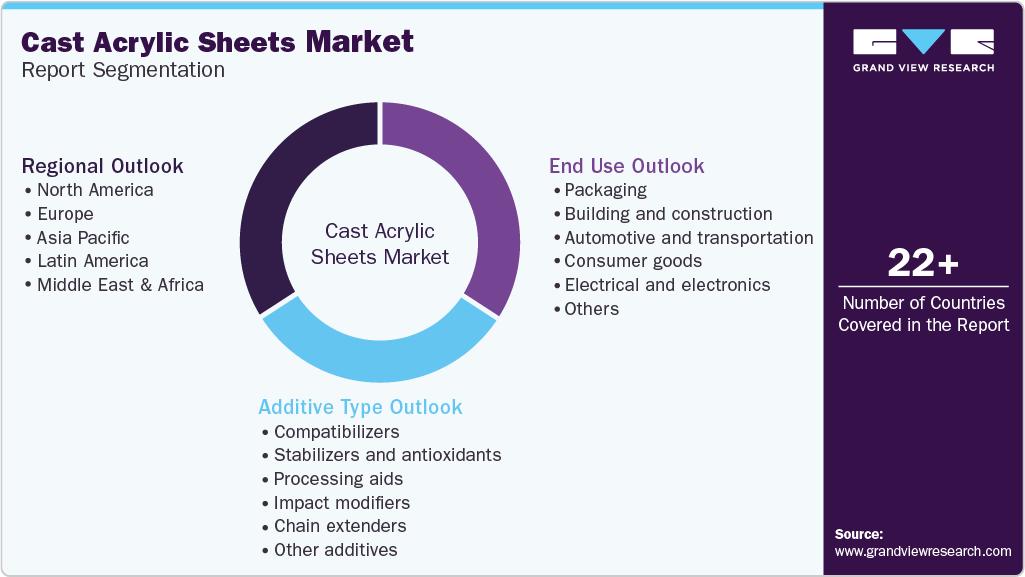
This report forecasts revenue growth at the global, regional, and country levels and provides an analysis of the latest industry trends across sub-segments from 2021 to 2033. For this study, Grand View Research has segmented the global recycled plastic additives market report based on additive type, end use, and region:
 To learn more about this report, Download Free Sample Report
-
Additive Type Outlook (Volume, Kilotons; Revenue, USD Million; 2021 - 2033)
-
Compatibilizers
-
Stabilizers and antioxidants
-
Processing aids
-
Impact modifiers
-
Chain extenders
-
Other additives
-
-
End Use Outlook (Volume, Kilotons; Revenue, USD Million; 2021 - 2033)
-
Packaging
-
Building and construction
-
Automotive and transportation
-
Consumer goods
-
Electrical and electronics
-
Others
-
-
Regional Outlook (Volume, Kilotons; Revenue, USD Million; 2021 - 2033)
-
North America
-
U.S.
-
Canada
-
Mexico
-
-
Europe
-
Germany
-
UK
-
France
-
Italy
-
Spain
-
-
Asia Pacific
-
China
-
India
-
Japan
-
South Korea
-
Australia
-
-
Latin America
-
Brazil
-
Argentina
-
-
Middle East & Africa
-
Saudi Arabia
-
UAE
-
South Africa
-
-
Research Methodology
The recycled plastic additives marketfigures in this report are based on a proven research process that combines executive interviews with secondary research from proprietary databases, company filings, and recognized regulatory and institutional sources. Market size is built through value-chain sizing—reconciling supply-side and demand-side estimates—and triangulated with bottom-up and top-down approaches. Every estimate passes multiple levels of expert validation before publication, with eachrecycled plastic additivessegment quantified using the revenue-capture definitions in the table below.
Segment Definition
Additive Type
Revenue capture definition
Compatibilizers
Revenue is captured through compatibilizers formulated to improve interfacial adhesion and compatibility between dissimilar polymers in recycled plastic blends. These additives are particularly relevant to mixed polyolefin waste, multilayer packaging, and recycled polymer compounds containing incompatible resin grades. Manufacturers evaluate compatibility, dispersion, mechanical strength, impact resistance, and processing stability. Reactive and non-reactive formulations support different polymer combinations and recycling processes. Demand is influenced by the increasing use of mixed post-consumer plastics and the need to produce consistent recyclates for applications that require predictable material performance.
Stabilizers and antioxidants
Revenue is generated through stabilizers and antioxidants that protect recycled polymers against further thermal, oxidative, and processing-related degradation. These additives are used during extrusion, compounding, injection molding, and other conversion processes that expose polymers to heat and mechanical stress. Manufacturers assess oxidation resistance, color retention, processing stability, additive compatibility, and long-term material durability. Formulations may be tailored to recycled polyethylene, polypropylene, PET, and other polymer types. Demand is supported by repeated thermal processing, variable waste quality, and the requirement to maintain consistent properties in recycled plastics used for packaging, automotive components, and construction products.
Processing aids
Revenue is captured through processing aids designed to improve melt flow, reduce processing defects, support material dispersion, and enhance production efficiency when converting recycled polymers. Products may address inconsistent rheology, surface imperfections, die buildup, and flow instability associated with degraded or contaminated feedstocks. Manufacturers evaluate lubrication, melt behavior, extrusion output, surface quality, and compatibility with the base polymer. These additives are relevant to film extrusion, injection molding, pipe production, and recycled compound manufacturing. Demand depends on the need to process variable recycled resin grades reliably while controlling production losses, equipment interruptions, and conversion costs.
Impact modifiers
Revenue is generated through impact modifiers that improve toughness and resistance to fracture in recycled plastics with reduced mechanical performance. These additives are particularly relevant where repeated processing, polymer degradation, or mixed feedstock composition weakens impact resistance. Manufacturers assess impact strength, tensile properties, flexibility, dispersion, and compatibility with the recycled resin. Applications include automotive components, construction profiles, consumer products, and durable packaging. Demand is influenced by manufacturers seeking to increase recycled content without compromising component durability. Adoption depends on achieving the required mechanical improvement at commercially viable dosage levels while preserving processability and other critical material properties.
Chain extenders
Revenue is captured through chain extenders that react with polymer functional groups to increase molecular weight, improve melt strength, or compensate for chain scission in selected recycled polymers. These additives are especially relevant to PET and other condensation polymers that experience molecular degradation during repeated processing. Manufacturers evaluate reaction efficiency, intrinsic viscosity, melt strength, processing stability, and compatibility with the target resin. Applications include recycled polyester fibers, sheets, films, and selected molded products. Demand is supported by efforts to upgrade lower-viscosity recyclates and expand their use in applications requiring improved molecular weight and processing performance.
Other additives
Revenue is generated through specialized additives that address additional quality limitations in recycled plastics, including odor, moisture, color variation, contamination effects, and selected functional requirements. Products include odor scavengers, desiccant masterbatches, color-correction additives, nucleating agents, and selected functional modifiers. Manufacturers assess odor reduction, moisture absorption, color consistency, additive dispersion, and compatibility with recycling and conversion processes. These solutions are relevant to post-consumer packaging, household products, construction materials, and recycled compounds. Demand depends on feedstock characteristics, end-product specifications, and the need to improve recyclate acceptability without introducing unnecessary processing complexity or excessive formulation costs.
End Use
Revenue capture definition
Packaging
Revenue is captured through recycled plastic additives used in the production of films, bottles, containers, trays, closures, and other packaging formats containing recycled polymers. Manufacturers prioritize material stability, melt flow, impact resistance, color consistency, and processability to maintain production efficiency and packaging performance. Compatibilizers support selected mixed-polymer streams, while antioxidants and processing aids help manage degradation and conversion defects. Chain extenders are relevant to selected recycled PET applications. Demand is influenced by recycled-content requirements, brand-owner sustainability commitments, packaging waste regulations, and the availability of recycled resins that meet application-specific performance and food-contact requirements.
Building and construction
Revenue is generated through additives incorporated into recycled plastics used in pipes, drainage systems, profiles, panels, decking, insulation components, and other construction products. These applications require dependable mechanical properties, dimensional stability, weathering resistance, and consistent processing performance. Stabilizers and antioxidants help protect polymers during processing and service, while impact modifiers and compatibilizers can improve toughness and performance in selected recycled formulations. Manufacturers also consider long service life, material consistency, and compliance with relevant product standards. Demand is supported by the use of recycled polyolefins in durable construction products and efforts to increase secondary material utilization without compromising functional requirements.
Automotive and transportation
Revenue is captured through additives used to upgrade recycled plastics incorporated into vehicle interiors, underbody components, wheel-arch liners, selected exterior parts, and transportation equipment. Manufacturers require controlled impact resistance, dimensional stability, thermal performance, odor characteristics, and processing consistency. Compatibilizers improve selected recycled polymer blends, while stabilizers and impact modifiers help address degradation and mechanical limitations. Chain extenders may support specialized recycled polyester applications. Demand is influenced by automotive recycled-content initiatives, lightweight material strategies, and efforts to increase the use of post-consumer and end-of-life vehicle plastics. Adoption depends on meeting application-specific durability, safety, and quality specifications.
Consumer goods
Revenue is generated through additives used in recycled plastics for household products, furniture components, storage containers, toys, personal accessories, and other durable or disposable consumer items. Manufacturers assess appearance, surface finish, impact resistance, odor, color consistency, and molding performance. Compatibilizers and impact modifiers help improve the usability of selected mixed or degraded resins, while processing aids support consistent manufacturing. Odor-control and color-correction additives can improve consumer acceptance of post-consumer recyclates. Demand is supported by product manufacturers seeking to incorporate recycled materials while maintaining acceptable aesthetics, functionality, durability, and production economics across different price categories.
Electrical and electronics
Revenue is captured through additives used in recycled plastic compounds for electrical housings, appliance components, cable-related products, electronic enclosures, and selected equipment parts. Material requirements can include dimensional stability, thermal resistance, mechanical integrity, and application-specific electrical properties. Stabilizers help manage processing degradation, while compatibilizers and impact modifiers improve selected recycled blends. Manufacturers must ensure that additive packages do not compromise flame-retardancy systems, insulation performance, or other required safety characteristics. Demand is influenced by electronic equipment production, appliance manufacturing, and the recovery of plastics from discarded electrical and electronic equipment, subject to restrictions on hazardous substances and End Use qualification requirements.
Others
Revenue is generated through additives used in recycled plastic applications outside the principal packaging, construction, automotive, consumer goods, and electrical and electronics categories. These applications may include agricultural products, industrial equipment, textiles, logistics products, and specialized molded components. Manufacturers select formulations according to polymer composition, contamination levels, mechanical requirements, exposure conditions, and conversion methods. Compatibilizers, antioxidants, processing aids, and chain extenders address different material limitations across these uses. Demand depends on the development of commercially viable outlets for recovered plastics, application-specific performance requirements, and the ability to produce consistent recycled compounds from diverse industrial and post-consumer waste streams.
Estimation Model
Layer Name
Key Question
Description
Top-Down Recycled Plastic Additives Demand Assessment Layer
What determines overall market demand?
Establishes global demand for recycled plastic additives by assessing recycled polymer consumption, plastic waste generation, mechanical recycling volumes, recycled resin production, and the adoption of recycled materials across packaging, building and construction, automotive and transportation, consumer goods, and electrical and electronics. The layer evaluates polymer degradation, feedstock variability, recycled content requirements, additive dosage, and the technical performance needed to convert recycled plastics into commercially viable materials.
End Use Demand Validation Layer
Where is demand concentrated?
Maps recycled plastic additives demand across major End Use industries and additive categories, including compatibilizers, stabilizers and antioxidants, processing aids, impact modifiers, chain extenders, and other functional additives. Demand is validated through recycled polymer processing volumes, application-specific performance requirements, product quality standards, recycling technology adoption, converter procurement patterns, and manufacturer specifications. The analysis also examines the need to address contamination, polymer incompatibility, odor, color variation, and reduced mechanical properties in recycled feedstocks.
Consumption-to-Revenue Conversion Layer
How is demand monetized?
Converts additive consumption into market revenue based on additive type, polymer compatibility, dosage rates, formulation complexity, grade specifications, average selling prices, and sales-channel margins. The analysis distinguishes standard formulations from specialized solutions such as reactive compatibilizers, high-performance antioxidants, chain extenders, and application-specific additive packages. Revenue assessment accounts for pricing premiums associated with customized formulations, technical support, regulatory compliance, and performance requirements across different recycled polymer grades and End Use applications.
Regional Demand Verification Layer
Where is demand validated geographically?
Validates demand across North America, Europe, Asia Pacific, Latin America, and the Middle East & Africa by examining plastic waste generation, recycling capacity, recycled resin output, packaging regulations, extended producer responsibility frameworks, and industrial demand for recycled materials. The analysis considers regional plastics manufacturing bases, recycling infrastructure, feedstock availability, technology adoption, import dependence, distribution networks, and investment in circular economy initiatives. It also evaluates differences in additive consumption and value realization based on local recycling capabilities and End Use quality requirements.
Delivered Customizations
This report has been delivered with the following In-depth customizations
Client Request
Customization Delivered
Value Adds
Regional Segmentation
Assessed market dynamics across North America, Europe, Asia Pacific, Latin America, and the Middle East & Africa, considering recycled plastic processing capacity, additive demand, regulatory frameworks, and key End Use industries.
Identified regional demand centers, market-entry opportunities, and geographic priorities for sales expansion and distribution planning.
Competitive Benchmarking
Compared major manufacturers based on product portfolios, recycling-specific additive technologies, revenue, geographical presence, manufacturing capabilities, and market positioning. Assessed established participants and emerging competitors to distinguish broad-based additive suppliers from specialized recycling solution providers.
Clarified competitive strengths, technology differentiation, portfolio gaps, and potential areas for product innovation and strategic partnerships.
Opportunity Assessment
Assessed opportunities arising from increasing recycled plastic utilization, demand for improved recyclate quality, mixed-polymer compatibility requirements, polymer degradation management, and recycled-content requirements in packaging, automotive, construction, and consumer products.
Prioritized promising additive categories and End Use applications, highlighted unmet technical requirements, and supported investment decisions, product development, and long-term market positioning.
About the Author(s)
Plastics, Polymers & Resins Research Team
Bulk Chemicals · Plastics, Polymers & ResinsThis report was authored by the plastics, polymers & resins research team at Grand View Research - comprising two research analysts, one senior research analyst, and one industry expert - with specialized expertise in the plastics, polymers & resins segment of the bulk chemicals industry. All findings are based on proprietary bulk chemicals databases, executive interviews, and regulatory analysis, subject to internal peer review prior to publication.
Last Updated:
Speak to Analyst

Customize this report to your needs - add regions, segments, or data points, with 20% free customization.
Or view our licence options:


ISO 9001:2015 & 27001:2022 Certified
We are GDPR and CCPA compliant! Your transaction & personal information is safe and secure. For more details, please read our privacy policy.


