
- Home
- »
- Advanced Interior Materials
- »
-
Resistance Spot Welding Machines Market Report, 2033GVR Report cover

Resistance Spot Welding Machines Market (2026 - 2033)
Size, Share & Trends Analysis Report By Technology (DC Inverter Spot Welding, Capacitor Discharge Spot Welding, Servo-Gun Spot Welding), By Operation Mode, By End Use, By Region, And Segment Forecasts
Market Size, 2025
$4.4BMarket Estimate, 2026
$4.6BMarket Forecast, 2033
$7.2BCAGR, 2026–2033
6.5%Resistance Spot Welding Machines Market Summary
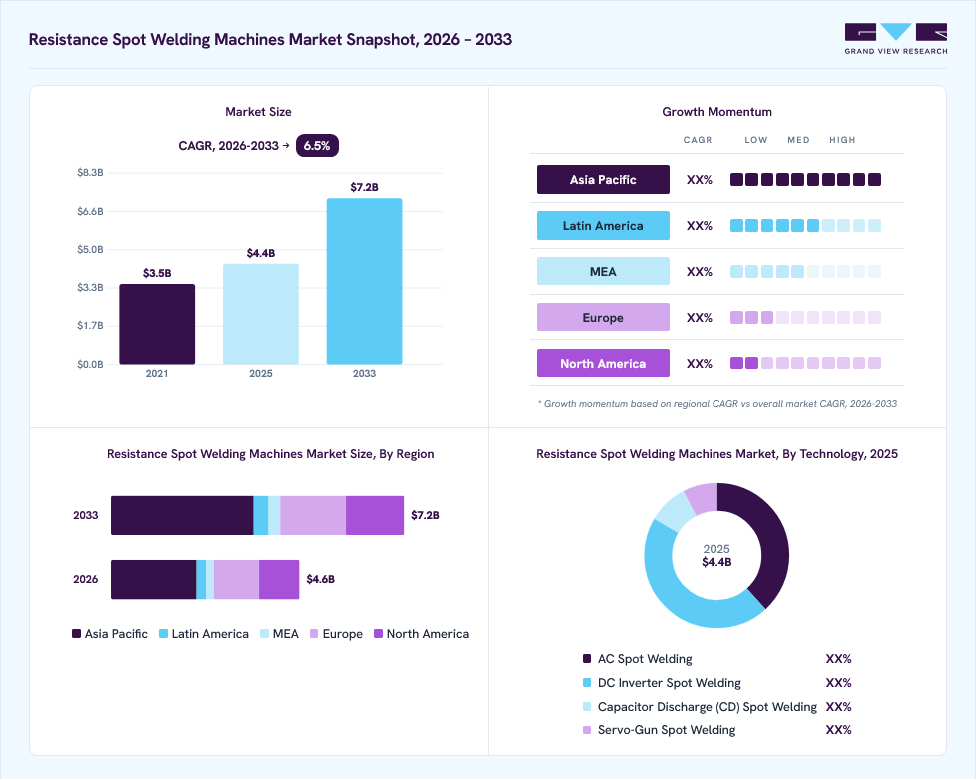
The global resistance spot welding machines market size was valued at USD 4.4 billion in 2025 and is projected to grow from USD 4.6 billion in 2026 to USD 7.2 billion by 2033, at a CAGR of 6.5% from 2026 to 2033. Asia Pacific dominated the market, accounting for a revenue share of 44.9% in 2025. The market is driven by the expansion of the automotive industry, where high-volume body and component assembly requires fast, repeatable joining processes.
 Source: Grand View Research, IR Documents, Primary Interviews, Paid DatabasesTo learn more about this report,
 Download Free Sample Report
 Key Market Trends & Insights
- Based on technology: DC inverter segment is projected to grow at the fastest CAGR of 6.7% during the forecast period.
- Based on operation mode: Automatic segment dominated the market in 2025, holding 43.9% revenue share.
- Based on end use: Automotive & transportation segment led the market in 2025, holding 42.7% revenue share.
Regional Highlights
- Largest regional market: Asia Pacific (44.9% revenue share, 2025)
- By country: China held the largest market share in 2025
Market Size & Forecast
- Market Size in 2025: USD 4.4 Billion
- Estimated Market Size in 2026: USD 4.6 Billion
- Projected Market Size by 2033: USD 7.2 Billion
- CAGR (2026-2033): 6.5%
Three ways to get this report
Buy it, customize it, or ask a question.Ask an Analyst
A direct answer, usually in 1 working day
- AccessReport author, directly
- Reply timeWithin 1 working day
- No sales callDirect answer only
- FormatEmail reply
- CostFree, no cost
Get the Full Report
What the study covers
- FormatsPDF · Excel · Dashboard
- Timeline2026–2033 annual, 2025 base
- Coverage20+ countries, 5 regions
- Companies10+ key players profiled
Customize the Report
20% free customization
- IncludeCountries, segments, points
- TailorTo your product definition
- ExtendDeeper competitor detail
- OrA fully bespoke study
- Turnaround5–10 working days
Increasing automation and robotic welding in manufacturing facilities is also driving the uptake of automatic and servo-controlled spot-welding equipment. In addition, manufacturers' focus on production efficiency, consistent weld quality, lower energy consumption, and real-time process monitoring is encouraging the replacement of conventional systems with advanced resistance spot-welding machines.
 To learn more about this report, Download Free Sample Report
 Market Dynamics
The market is shaped by production requirements of major end-use industries, technological advancements, material trends, and the level of manufacturing automation. Automotive and transportation production remains a major influence, while the growth of electric vehicles and battery manufacturing is increasing demand for precise and repeatable welding systems, particularly in inverter-based and automated systems. The shift toward inverter-based power supplies, servo-controlled guns, robotic cells, and real-time weld monitoring is influencing equipment specifications and purchasing decisions. At the same time, material changes such as increased use of high-strength steels and lightweight alloys require greater control over welding parameters. Capital investment requirements, availability of skilled technicians, energy efficiency, maintenance needs, and integration with existing production lines also influence adoption across different manufacturers and regions.
The expansion of electric vehicle (EV) and battery manufacturing is driving demand for resistance spot-welding machines, as the assembly of battery cells, modules, packs, busbars, and other electrical components requires precise and repeatable joining. Increasing EV production is also encouraging manufacturers to adopt inverter-based and automated resistance-welding systems capable of handling thin metals and conductive materials while maintaining consistent weld quality across high-volume production.
Resistance spot-welding machines require trained personnel to configure welding parameters, operate equipment, troubleshoot faults, and maintain consistent weld quality. Advanced systems with inverter power supplies, servo guns, robotic integration, and digital monitoring further increase the need for specialized technical skills. A shortage of qualified operators and maintenance personnel can therefore slow adoption, particularly among smaller manufacturers with limited in-house technical capabilities.
Integration of artificial intelligence (AI), internet of things (IoT) connectivity, sensors, and data analytics presents an opportunity to improve resistance spot-welding performance through real-time monitoring and predictive quality control. These technologies can enable manufacturers to detect weld abnormalities, optimize welding parameters, track equipment performance, and identify maintenance requirements, supporting greater process consistency and reducing unplanned downtime.
Market Concentration & Characteristics
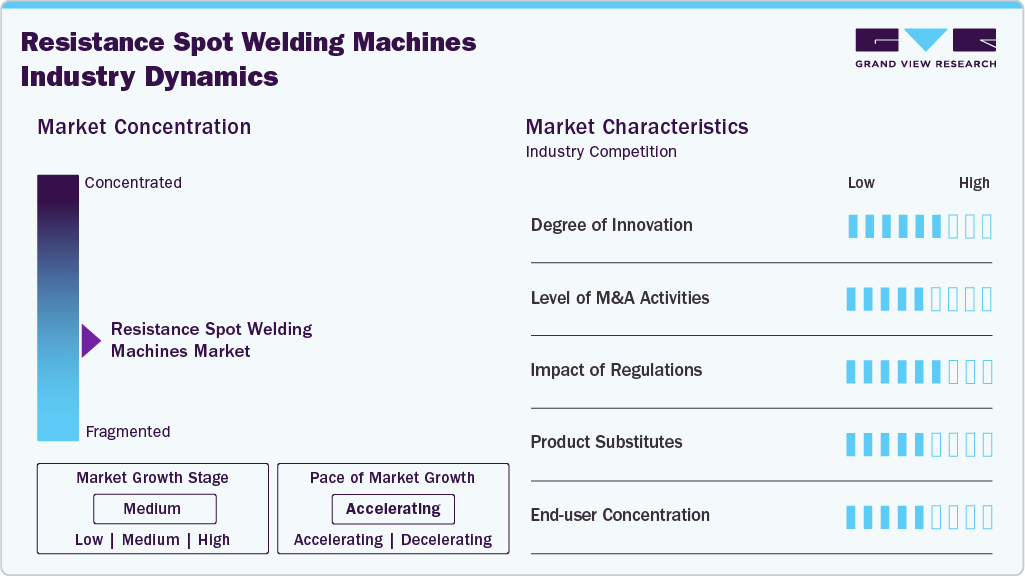
The market is moderately concentrated, with established players competing through specialized equipment, automation capabilities, and application support. The threat from alternatives is present but limited in high-volume metal assembly, where resistance spot welding offers short cycle times, repeatability, and no filler consumables. However, laser welding, arc welding, riveting, and clinching can substitute for resistance welding in applications involving dissimilar materials, complex geometries or specific joint requirements.
Safety, weld-quality, and manufacturing standards influence machine specifications, particularly in automotive and other safety-critical applications. Standards such as AWS D8.1 and D8.9 support requirements for weld quality and testing, encouraging manufacturers to incorporate process monitoring and control capabilities. Technological development is centered on medium-frequency direct current (MFDC), inverter power supplies, servo-driven guns, machine vision, artificial intelligence (AI), and real-time monitoring, enabling tighter control of current, electrode force, and welding time while supporting traceability and predictive quality control.
 To learn more about this report, Download Free Sample Report
 Market players are focusing on product differentiation, automation, digitalization, application-specific solutions and geographic expansion rather than competing solely on machine price. AMADA WELD TECH, for example, combines inverter-based resistance welding with process monitoring, statistical process control and servo systems, while NIMAK offers configurable resistance-welding machines with pneumatic and servo drives and multiple power technologies. Heron has pursued international distribution partnerships alongside investments in MFDC and capacitor-discharge technologies, while other players target automotive, electric vehicle and battery applications with integrated and automated welding solutions.
Analyst Perspective
Electrode wear, weld consistency, joining high-strength and dissimilar materials, skilled-labor requirements, and high automation costs are key challenges in the market. Technology development is focused on adaptive welding controls, real-time weld monitoring, robotics, Internet of Things (IoT) connectivity, and automated quality control. Safety requirements covering guarding, interlocks, grounding, emergency controls, and operator competency influence machine design, while standards such as OSHA 29 CFR 1910.255 and ISO 18595:2021 provide relevant safety and welding requirements. Companies are expected to focus on inverter-based systems, smart welding controls, robotic integration, energy efficiency, and application-specific solutions, while value-chain opportunities remain across welding guns, transformers, controls, electrodes, sensors, automation components, and aftermarket services.
Technology Insights
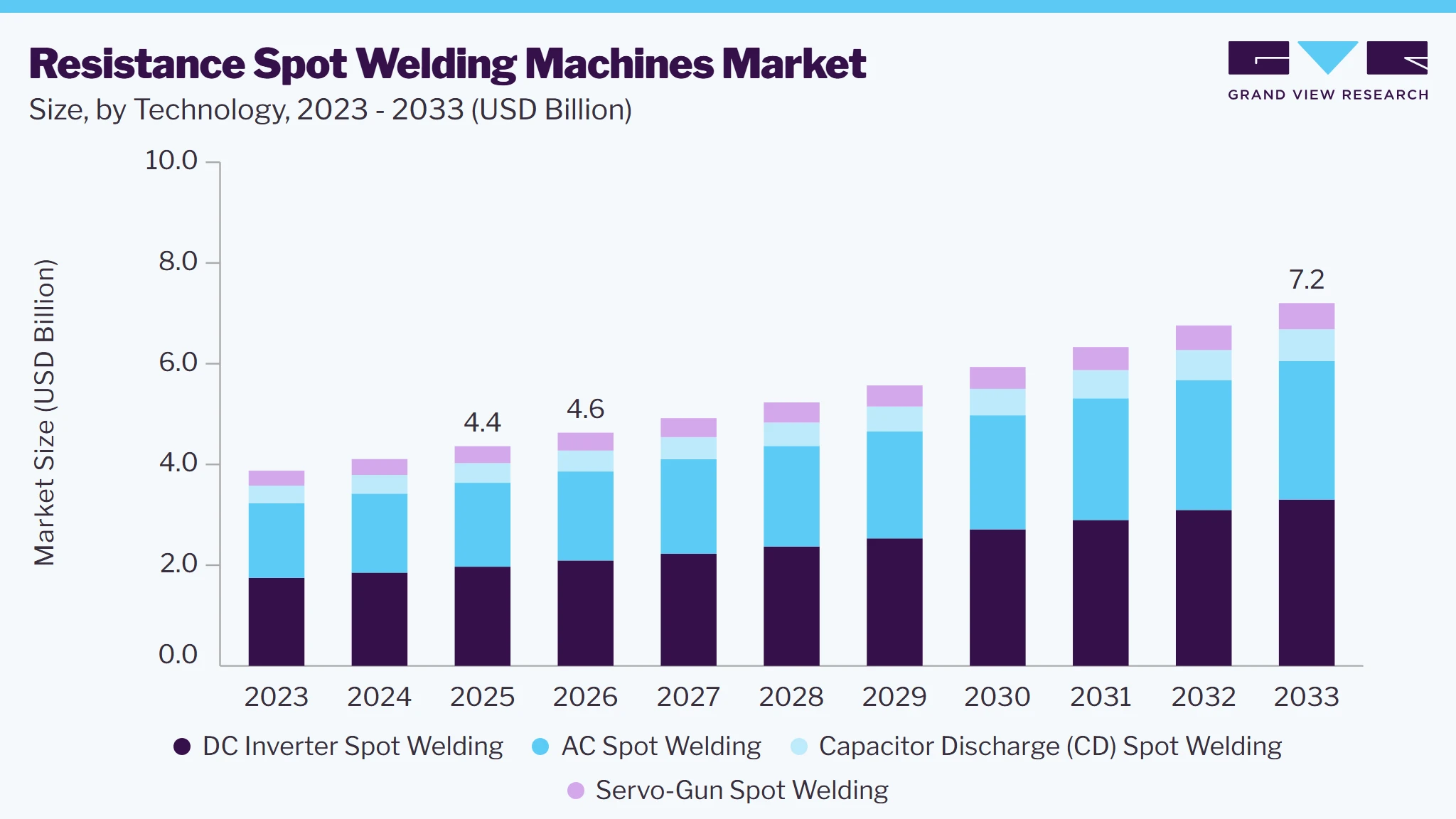
The DC inverter spot welding segment accounted for the majority revenue share of 45.1% in 2025. The segment is also projected to grow at the fastest CAGR of 6.7% during the forecast period. DC inverter spot welding is gaining importance due to its precise control of welding current, shorter weld times, lower energy consumption, and consistent weld quality. The technology is particularly suited to automated production environments and applications involving high-strength and thinner materials. Increasing use of inverter-based systems in automotive body manufacturing, electric vehicle (EV) production, and battery assembly is supporting segment demand.
The AC spot welding segment is projected to grow at a significant CAGR of 6.5% during the forecast period due to its relatively simple design, established technology, and lower equipment cost compared with advanced inverter-based systems. It is commonly deployed in general metal fabrication, appliances, automotive components, and other applications where extremely precise current control is less critical. The large installed base of conventional AC equipment and its suitability for routine, high-volume joining continues to support the segment.
End Use Insights
The automotive & transportation segment represented a major end-use segment in 2025, accounting for 42.7% of the market as vehicle bodies, structural components, exhaust systems, seats, and numerous sheet-metal assemblies require large numbers of repeatable spot welds. The expansion of electric vehicle manufacturing is creating additional demand for advanced resistance-welding equipment for battery-related components and lightweight vehicle structures. Increasing use of high-strength steels and aluminum alloys is also encouraging manufacturers to adopt equipment with tighter control over current, electrode force, and weld parameters.
The aerospace & defense segment is expected to be the fastest-growing end use segment from 2026 to 2033, with a projected CAGR of 7.8%. Aerospace & defense uses resistance spot welding for selected sheet-metal, structural, electrical, and component-assembly applications where controlled heat input, repeatability, and joint consistency are important. The segment generally places greater emphasis on process control, weld inspection, traceability, and specialized equipment than on very high production volumes. Increasing aircraft production, defense manufacturing, and development of lightweight structures can support demand for precision resistance-welding systems, particularly automated and digitally monitored equipment.
Operation Mode Insights
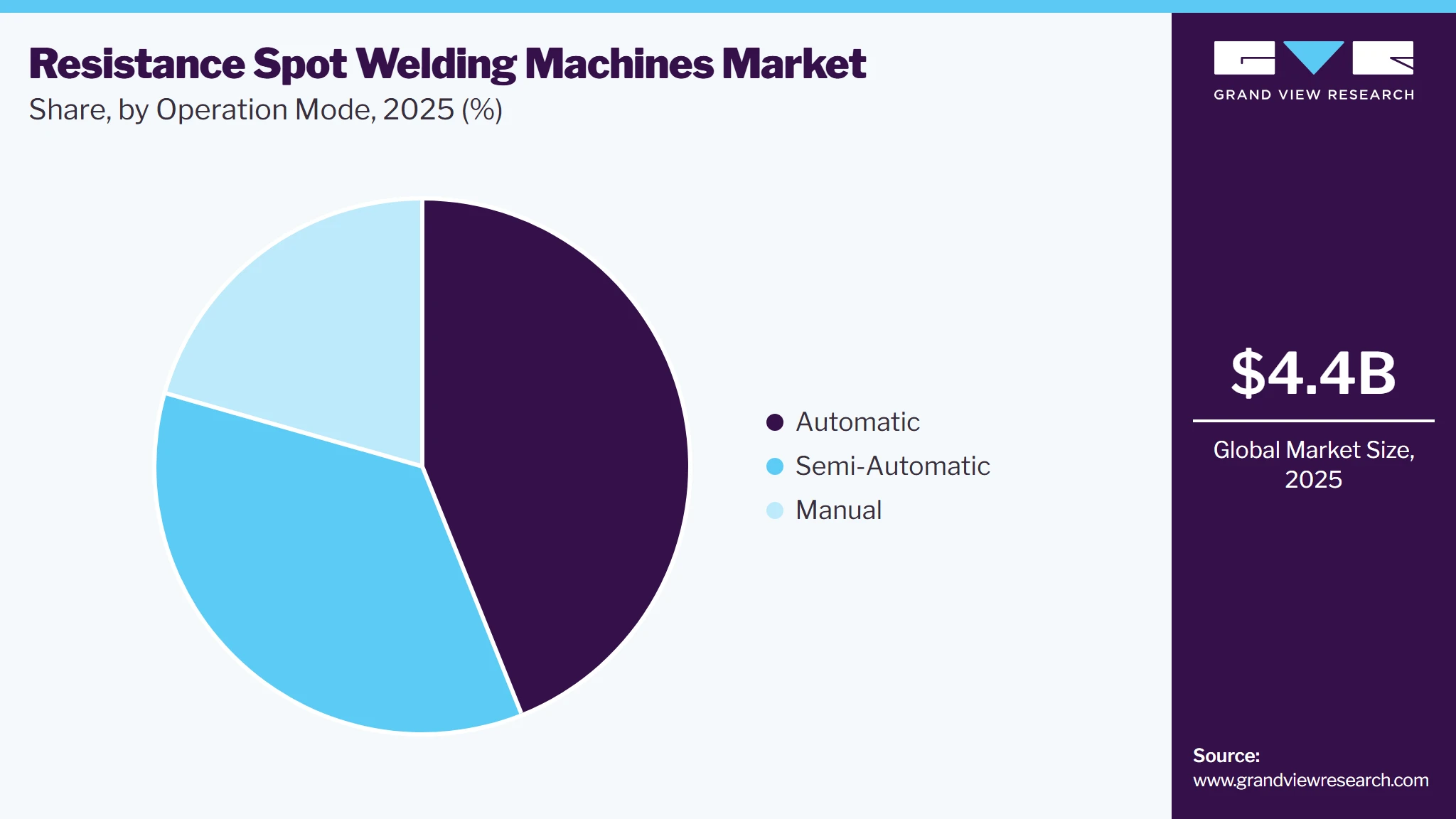
The automatic segment accounted for the largest share of 43.9% in 2025. Automatic resistance spot welding machines are being adopted in high-volume manufacturing because they provide consistent weld quality, faster cycle times, and reduced dependence on manual intervention. Integration with robotic arms, servo guns, automated fixtures, and weld-monitoring systems enables manufacturers to improve productivity and process repeatability. Automotive and electric vehicle manufacturing are particularly important applications, where large numbers of repeatable spot welds are required within highly automated production lines.
 To learn more about this report, Download Free Sample Report
 The semi-automatic segment is projected to grow at a significant CAGR of 6.3% during the forecast period. Semi-automatic resistance spot welding machines provide a balance between operator involvement and production automation, making them suitable for manufacturers that require improved productivity without fully automated production cells. These systems can incorporate automated electrode movement, programmable welding parameters, or automated material positioning while retaining operator control over loading, positioning, or other process steps. Demand is supported by small and medium-sized manufacturers and production environments with varied product configurations.
Regional Insights
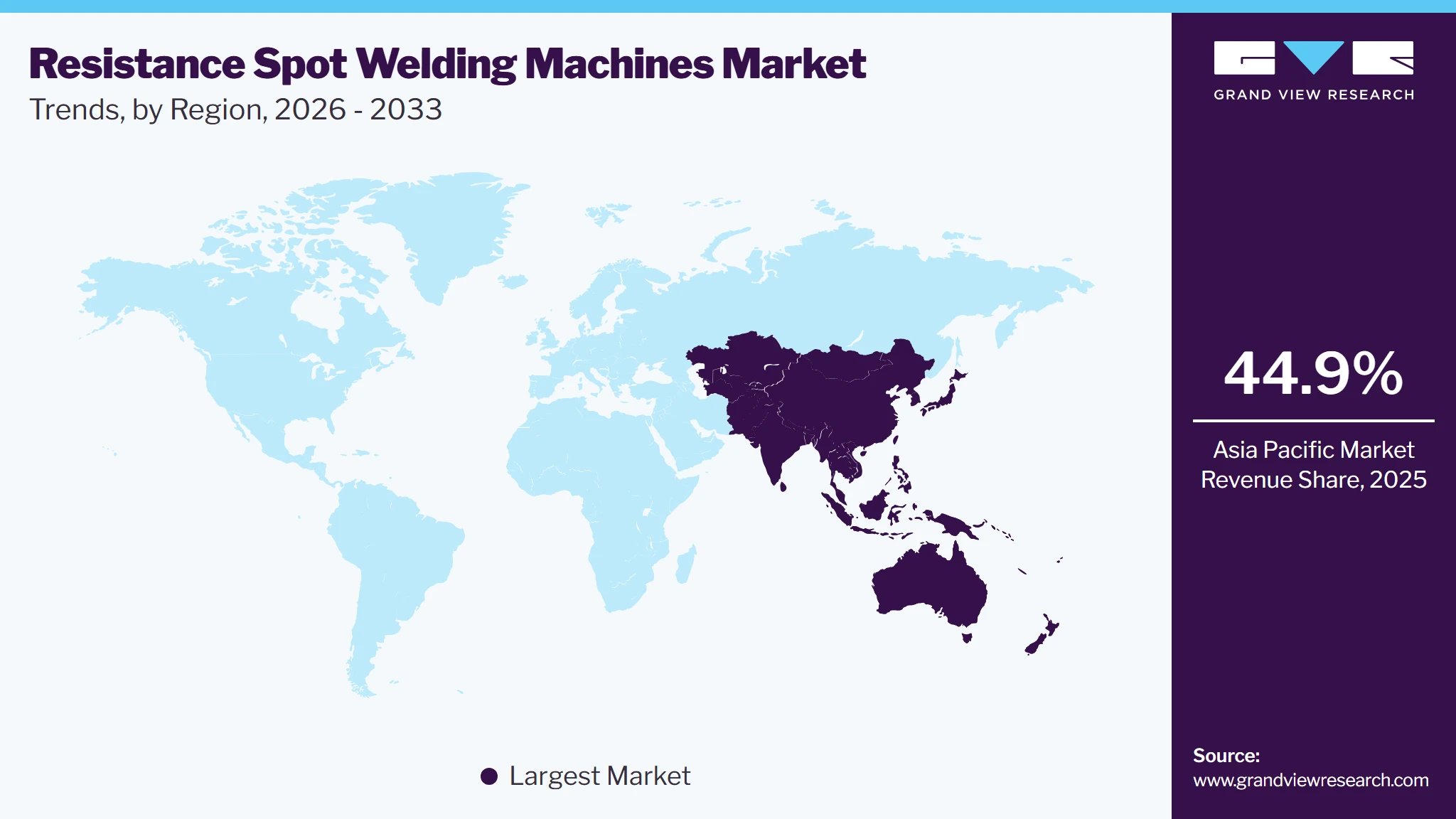
The Asia Pacific resistance spot welding machines market dominated, accounting for a revenue share of 44.9% in 2025, and is also expected to grow at the fastest CAGR from 2026 to 2033. Asia Pacific is shaped by its exceptionally large manufacturing base, with China, Japan, South Korea, and India supporting substantial demand from automotive, machinery, electronics, appliances, and metal fabrication. The region’s dominance in electric vehicle and battery manufacturing is creating particularly strong opportunities for high-speed and precision resistance welding, while the expansion of Chinese and other Asian manufacturers into overseas production locations is extending demand for automated welding lines. Rising manufacturing volumes, expanding industrial automation, and the need for consistent high-throughput production further reinforce adoption.
 To learn more about this report, Download Free Sample Report
 China Resistance Spot Welding Machines Market Trends
The resistance spot welding machines market in China is driven by the country’s largest manufacturing base across the globe. Its position is reinforced by its dominance in electric vehicle production. The country accounted for around 70% of global electric-car production in 2025 and more than 80% of global battery-cell production. Strong vehicle exports and continued expansion of electric vehicle and battery manufacturing are supporting demand for high-speed, automated, and inverter-based welding systems.
The India resistance spot welding machines market is expected to be a lucrative market over the forecast period, supported by automotive manufacturing, engineering, railways, construction equipment and general metal fabrication. The automotive industry recorded strong volumes in 2025, including approximately 5.38 million passenger vehicles and 11.1 million commercial vehicles produced, while the government's Production Linked Incentive (PLI) scheme for automobiles and components is supporting domestic manufacturing of advanced automotive technologies. Rising vehicle production, localization of components, and increasing automation are creating demand for both conventional and advanced spot-welding equipment. However, the market remains relatively price sensitive, with many small and medium-sized manufacturers continuing to favor manual or semi-automatic systems over higher-cost automated cells.
North America Resistance Spot Welding Machines Market Trends
The resistance spot welding machines market in North America is supported by the region’s large automotive, aerospace, and general manufacturing base, with automation used to address labor availability and productivity requirements. Reshoring and supply-chain localization are also encouraging manufacturers to invest in domestic production capacity and modern welding equipment. EV and battery manufacturing remains a source of demand, although the pace of investment varies with changing EV policies and vehicle-market conditions across the U.S. and Canada.
The resistance spot welding machines market in the U.S. remains a major market because of its large aerospace, defense, metal fabrication, and general manufacturing base. Automotive manufacturing continues to support demand for automated and robotic spot-welding systems, although the pace and composition of investment are being affected by changing electric vehicle policies, tariffs, and supply-chain considerations. U.S. automotive manufacturing investment rose substantially during 2019-2023 before declining in 2024, indicating a more cautious capital-investment environment. The market, therefore, combines a large installed base of conventional equipment with continuing demand for automated, inverter-based and digitally monitored systems. While skilled-labor shortages are encouraging manufacturers to automate welding operations in the country, the limited availability of technicians capable of programming, integrating, and maintaining advanced systems is increasing implementation costs and constraining adoption.
Europe Resistance Spot Welding Machines Market Trends
The resistance spot welding machines market in Europe is closely linked to its established automotive and industrial manufacturing ecosystem, particularly in Germany, Italy, France, and Central Europe. The transition toward electric vehicles is driving retooling and investment in vehicle and battery production, while stringent manufacturing-quality requirements and the region’s high level of industrial automation favor advanced inverter-based, robotic, and digitally monitored welding systems. Efforts to strengthen European manufacturing and supply-chain resilience are providing additional support for local production investments.
The Germany resistance spot welding machines market represents a significant market due to its strong automotive, metalworking, and industrial-equipment manufacturing base. The country produced approximately 4.15 million passenger vehicles in 2025, while its automotive industry generated EUR 527.6 billion in revenue and employed about 731,900 people. However, the broader industrial environment remains challenging. German industrial production declined 1.1% in 2025, with automotive production down 1.7% and machinery production down 2.6%. Such conditions tend to constrain near-term capital expenditure, while the country’s strong engineering base, high automation penetration and continued investment in electromobility and digitalization support demand for sophisticated resistance-welding systems.
The resistance spot welding machines market in Italy is supported by demand from small and medium-sized industrial manufacturers. However, automotive production remains a constraint. Total vehicle production fell 19.8% in 2025, while production of automotive components declined 4.8%. Consequently, demand is dependent on general fabrication, machinery, appliances and specialized manufacturing in addition to automotive applications. Italy's established industrial districts and large base of smaller manufacturers provide opportunities for manual and semi-automatic machines, while manufacturers seeking productivity improvements are gradually adopting automated and inverter-based systems.
Middle East & Africa Resistance Spot Welding Machines Market Trends
The resistance spot welding machines market in the Middle East & Africa is being shaped by new industrial capacity, localization programs, and manufacturing diversification. Saudi Arabia and the Gulf states are developing automotive, industrial equipment, fabricated-metal, energy, and infrastructure manufacturing capabilities, while Morocco and Egypt are strengthening automotive and industrial production ecosystems. These developments are creating opportunities for new automated welding lines and are expected to sustain demand over the forecast period. The market’s demand is more characterized by new purchases rather than broad-based equipment replacement due to the limited local manufacturing depth in many African and Middle Eastern countries at present.
The Saudi Arabia resistance spot welding machines market is developing rather than being a mature market, with demand linked to industrial diversification and localization under Vision 2030. The establishment of the King Salman Automotive Cluster in King Abdullah Economic City is intended to build local automotive manufacturing capacity and support supply chains. The Hyundai vehicle plant being developed in the cluster is planned for an annual production of 50,000 vehicles, providing a direct new source of demand for automotive production equipment. Beyond automotive, investment in construction, infrastructure, fabricated metals, industrial equipment and defense manufacturing creates additional applications. The principal limitation is the relatively smaller existing manufacturing base compared with the U.S., China, Germany and India, which means growth is likely to be more closely tied to new industrial projects and localization initiatives than to a large installed replacement market.
Latin America Resistance Spot Welding Machines Market Trends
The resistance spot welding machines market in Latin America is primarily anchored by automotive manufacturing in Brazil and Argentina, alongside other industrial activities. Expansion and modernization of vehicle production, increasing localization of automotive supply chains, and the gradual adoption of electric and hybrid vehicles are creating demand for resistance-welding equipment. However, equipment investment remains closely tied to industrial production cycles and the availability of capital for manufacturing modernization, making demand more project-and investment-dependent than in the larger manufacturing hubs of North America, Europe, and Asia Pacific.
The Brazil resistance spot welding machines market has a sizeable automotive manufacturing and metalworking base and is an important Latin American market. Automotive production increased 3.5% in 2025 to 2.64 million vehicles, while exports rose 32.1%, demonstrating continued utilization of the country's manufacturing base. The growing presence of electrified-vehicle manufacturing and increasing investment by automakers and suppliers should support demand for modern welding systems. However, relatively high interest rates and competition from imported vehicles and equipment can constrain capital investment. In 2026, domestic vehicle demand has remained strong, but rising imports are limiting the extent to which higher demand translates into additional domestic production.
Key Resistance Spot Welding Machines Company Insights
Some of the key players operating in the market include AMADA WELD TECH and ARO Welding Technologies SAS.
-
AMADA WELD TECH is a global manufacturer of precision welding and joining equipment, with resistance welding forming a core part of its portfolio. Its resistance-welding offering includes linear DC, high-frequency and mid-frequency inverters, capacitor-discharge, and AC systems, along with weld heads, process monitors, checkers, electrodes, and integrated semi-automated and fully automated systems. The company serves automotive and electric vehicle, battery, electronics, medical, aerospace, and general industrial applications and provides customized application engineering and process-development support.
-
ARO Welding Technologies is a specialist resistance-welding equipment manufacturer established in 1949 and headquartered in Château-du-Loir, France. Its portfolio covers robotic and manual weld guns, stationary welding machines, mobile welders, resistance-welding controls, transformers, servo motors, peripherals, and consumables, with particular strength in automotive manufacturing. ARO supports robotic, manual, and stationary spot-welding applications and serves automotive, aerospace, railway, white goods, and other general manufacturing applications through its international operations and sales/service network.
Key Resistance Spot Welding Machines Companies
The following key companies have been profiled for the study on the global resistance spot welding machines market.
-
ARO Welding Technologies SAS
-
Automation International, Inc
-
CenterLine (Windsor) Limited
-
Agera
-
Dengensha
-
Dahching Electric Industrial Co,. Ltd
-
CEA Costruzioni Elettromeccaniche Annettoni S.p.A.
-
HERON Intelligent Equipment Co., Ltd.
-
KUKA SE & Co. KGaA
-
AMADA WELD TECH
-
NIMAK GmbH
-
T. J. Snow
-
TECNA
-
Mechelonic Engineers Pvt. Ltd
Competitive Benchmarking
Category
Operating Strategies
Competitive Edge
Weakness
Established Players (e.g., AMADA WELD TECH, ARO Welding Technologies SAS)
Established players typically sell through direct sales teams, regional distributors, and OEM relationships to serve large automotive and industrial manufacturing accounts.
They maintain broad portfolios spanning AC, DC inverter, capacitor-discharge, and automated resistance spot-welding systems to address varied production requirements.
They expand geographically through local subsidiaries, distributors, system integrators, and strategic partnerships in automotive and industrial manufacturing hubs.
Strong established brands provide credibility when equipment is deployed in high-volume and quality-sensitive production environments.
Larger financial and engineering resources support sustained investment in automation, process monitoring, and welding-control technologies.
Established distributor and service networks provide greater access to multinational automotive and industrial customers
Larger organizational structures can make established players slower to customize equipment for highly specialized production requirements.
Broader product portfolios can result in greater organizational complexity and longer development cycles for niche applications.
Higher brand, service, and engineering overheads can make their equipment less competitive in price-sensitive applications.
Emerging & Regional Players (e.g., HERON Intelligent Equipment Co., Ltd, Automation International, Inc)
Specialist players typically target specific applications such as automotive components, battery manufacturing, precision joining, or customized resistance-welding cells.
They compete through application-specific machine configurations, customized automation, and faster adaptation to customer production requirements.
They increasingly use partnerships with distributors, robotic integrators, and local engineering firms to expand market access without establishing extensive direct-sales infrastructure.
Focused product portfolios allow specialist manufacturers to respond quickly to specific resistance-welding requirements and emerging applications.
Lower operating overhead can provide greater pricing flexibility in targeted applications
Smaller organizational structures can support faster customization, engineering changes, and customer-specific machine development.
Smaller geographic footprints can limit direct access to multinational automotive and industrial customers.
Narrower service networks can make installation, troubleshooting, spare-parts supply, and maintenance more difficult in overseas markets.
Lower financial resources can constrain large-scale R&D programs, production expansion, and international market development.
Recent Developments
-
In July 2026, Heron Intelligent Equipment and Germany-based GLAMAtronic announced a strategic brand partnership to jointly serve resistance-welding customers globally and launch AVENOR, a new range of resistance-welding equipment. The partnership combines GLAMAtronic’s engineering and capacitor-discharge welding expertise with Heron’s resistance-welding and intelligent-manufacturing capabilities, with AVENOR planned to offer resistance-welding equipment, installation and maintenance services, and customized process solutions. The brand is scheduled to make its global debut at EuroBLECH 2026 in Hannover, Germany.
-
In July 2026,T. J. Snow acquired Ewald Instruments, expanding its portfolio beyond resistance-welding machinery into wire-processing equipment, including wire stripping and cable-cutting machines. The acquisition strengthens T. J. Snow’s broader manufacturing offering while complementing its existing portfolio of resistance spot, projection, multi-gun, capacitor-discharge and automated welding systems.
Resistance Spot Welding Machines Market Report Scope
Report Attribute
Details
Market size in 2025
USD 4.4 billion
Estimated market size in 2026
USD 4.6 billion
Projected market size by 2033
USD 7.2 billion
Growth rate
CAGR of 6.5% from 2026 to 2033
Historical data
2021 - 2024
Forecast period
2026 - 2033
Quantitative units
Revenue in USD billion and CAGR from 2026 to 2033
Report coverage
Revenue forecast, company ranking, competitive landscape, growth factors, and trends
Segments covered
Technology, operation mode, end use, region
Regional scope
North America; Europe; Asia Pacific; Latin America; Middle East & Africa
Country scope
U.S.; Canada; Mexico; UK; Germany; France; Italy; Spain; China; Japan; India; Australia; South Korea; Brazil; Argentina; UAE; Saudi Arabia; South Africa
Key companies profiled
ARO Welding Technologies SAS; Automation International, Inc.; CenterLine (Windsor) Limited; Agera; Dengensha; Dahching Electric Industrial Co., Ltd.; CEA Costruzioni Elettromeccaniche Annettoni S.p.A.; HERON Intelligent Equipment Co., Ltd.; KUKA SE & Co. KGaA; AMADA WELD TECH; NIMAK GmbH; T. J. Snow; TECNA; Mechelonic Engineers Pvt. Ltd.
Customization scope
Free report customization (equivalent up to 8 analysts working days) with purchase. Addition or alteration to country, regional & segment scope.
Pricing and purchase options
Avail customized purchase options to meet your exact research needs. Explore purchase options
Global Resistance Spot Welding Machines Market Report Segmentation
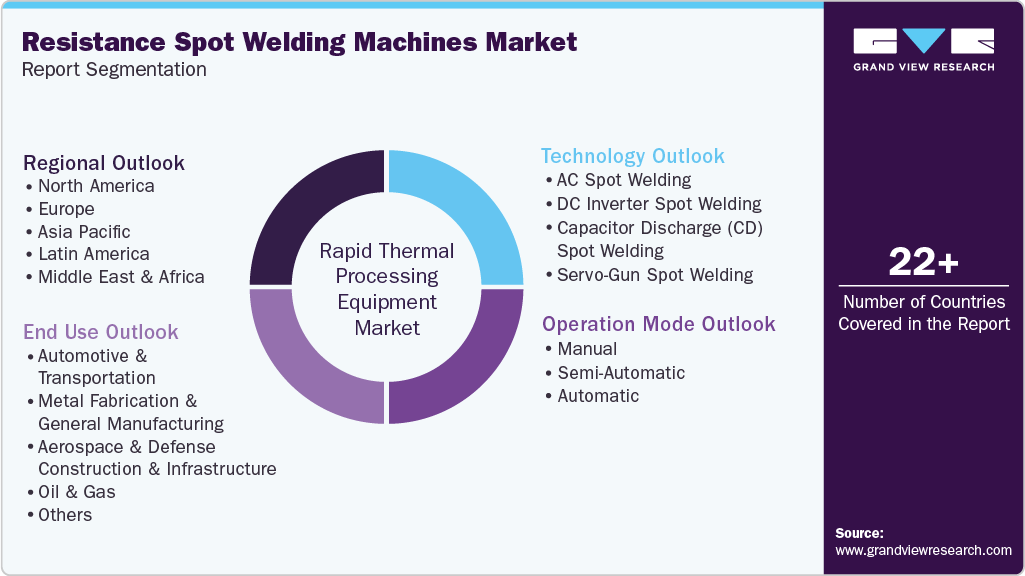
This report forecasts revenue growth at global, regional, and country levels and provides an analysis of the latest industry trends and opportunities in each of the sub-segments from 2021 to 2033. For this study, Grand View Research has segmented the global resistance spot welding machines market report based on technology, operation mode, end use, and region.
 To learn more about this report, Download Free Sample Report
 -
Technology Outlook (Revenue, USD Billion, 2021 - 2033)
-
AC Spot Welding
-
DC Inverter Spot Welding
-
Capacitor Discharge (CD) Spot Welding
-
Servo-Gun Spot Welding
-
-
Operation Mode Outlook (Revenue, USD Billion, 2021 - 2033)
-
Manual
-
Semi-Automatic
-
Automatic
-
-
End Use Outlook (Revenue, USD Billion, 2021 - 2033)
-
Automotive & Transportation
-
Metal Fabrication & General Manufacturing
-
Aerospace & Defense
-
Construction & Infrastructure
-
Oil & Gas
-
Others`
-
-
Regional Outlook (Revenue, USD Billion, 2021 - 2033)
-
North America
-
U.S.
-
Canada
-
Mexico
-
-
Europe
-
Germany
-
Spain
-
France
-
Italy
-
UK
-
-
Asia Pacific
-
China
-
India
-
Japan
-
Australia
-
South Korea
-
- Latin America
-
Brazil
-
Argentina
-
-
Middle East and Africa
-
Saudi Arabia
-
UAE
-
South Africa
-
-
Research Methodology
The resistance spot welding machines market figures in this report are based on a proven research process that combines executive interviews with secondary research from proprietary databases, company filings, and recognized regulatory and institutional sources. Market size is built through value-chain sizing-reconciling supply-side and demand-side estimates-and triangulated with bottom-up and top-down approaches. Every estimate passes multiple levels of expert validation before publication, with each resistance spot welding machines segment quantified using the revenue-capture definitions in the table below.
Segment Definition
Segment - Technology
Revenue Capture Definition
AC Spot Welding
AC spot welding machines use alternating current to generate localized heat between electrodes and form resistance welds at the contact points of metal components. The segment represents the revenue captured from the sale of AC resistance spot-welding machines.
DC Inverter Spot Welding
DC inverter spot welding machines use inverter-based power supplies to deliver controlled direct current for resistance spot welding of metal components. The segment represents the revenue captured from the sale of DC inverter resistance spot-welding machines.
Capacitor Discharge (CD) Spot Welding
Capacitor discharge spot welding machines store electrical energy in capacitors and release it rapidly through electrodes to create localized resistance welds. The segment represents the revenue captured from the sale of capacitor discharge resistance spot-welding machines,.
Servo-Gun Spot Welding
Servo-gun spot-welding machines use electrically driven servo mechanisms to control electrode movement and force during resistance spot welding. The segment represents the revenue captured from the sale of resistance spot-welding machines incorporating servo-driven welding guns.
Segment-Operation Mode
Revenue Capture Definition
Manual
Manual resistance spot-welding machines require an operator to position components and control or initiate the welding operation using the machine's operating controls. The segment represents the revenue captured from the sale of manually operated resistance spot-welding machines.
Semi-automatic
Semi-automatic resistance spot-welding machines combine automated welding functions with operator involvement for activities such as component loading, positioning, or process initiation. The segment represents the revenue captured from the sale of semi-automatic resistance spot-welding machines.
Automatic
Automatic resistance spot-welding machines perform defined welding operations with limited operator intervention, typically through automated positioning, sequencing, or integration with production systems. The segment represents the revenue captured from the sale of automatic resistance spot-welding machines.
Segment-End Use
Revenue Capture Definition
Automotive & Transportation
The segment represents the revenue captured from the sale of resistance spot-welding machines used by automotive and transportation manufacturers
Metal Fabrication & General Manufacturing
The segment represents the revenue captured from the sale of resistance spot-welding machines used in metal fabrication and general manufacturing
Aerospace & Defense
The segment represents the revenue captured from the sale of resistance spot-welding machines used in aerospace and defense manufacturing
Construction & Infrastructure
The segment represents the revenue captured from the sale of resistance spot-welding machines used in construction and infrastructure-related manufacturing
Oil & Gas
The segment represents the revenue captured from the sale of resistance spot-welding machines used in oil and gas-related manufacturing and fabrication
Others
The segment represents the revenue captured from the sale of resistance spot-welding machines used across end-use applications such as appliances & consumer durables, Furniture & Metal Fixtures, agricultural machinery and others that do not fall under key end uses.
Estimation Model
Layer Name
Key Question
Description
Industrial Demand Layer
What is the underlying demand for resistance spot welding machines across end-use industries?
Assess demand from automotive & transportation, metal fabrication & general manufacturing, aerospace & defense, construction & infrastructure, oil & gas, and other industries. Manufacturing output, vehicle production, industrial automation investments, metalworking activity, and capital expenditure trends are evaluated as part of the top-down. A bottom-up approach is also used to estimate machine demand based on production lines, welding stations, factory installations, replacement cycles, automation rates, and new manufacturing facility investments. Demand is further validated through equipment replacement requirements, installed base assessments, and industry-specific welding intensity.
Manufacturing & Equipment Demand Layer
How is demand distributed across technologies, operation modes, end-use industries, and regions?
Allocate total demand across AC Spot Welding, DC Inverter Spot Welding, Capacitor Discharge Spot Welding, and Servo-Gun Spot Welding, as well as Manual, Semi-Automatic, and Automatic systems. Demand is further distributed across end-use industries and key regions including North America, Europe, Asia Pacific, Latin America, and Middle East & Africa. A bottom-up assessment analyzes adoption rates by industry, production-line configurations, and equipment requirements, while a top-down assessment utilizes manufacturing output, industrial automation penetration, automotive production, aerospace activity, and regional industrial investment indicators to determine segment and regional shares.
Technology & Type Adoption Layer
What does the supply ecosystem indicate about market size and competitive positioning?
Evaluate manufacturers such as ARO Welding Technologies, Dengensha, AMADA WELD TECH, NIMAK, CenterLine, HERON, TECNA, T. J. Snow, Automation International, and other market participants. Assess production capabilities, manufacturing locations, product portfolios, technological specialization, regional presence, distributor networks, OEM relationships, direct sales channels, system integrators, and aftermarket support. Supply-side analysis incorporates company revenues, shipment volumes, manufacturing capacity, import/export flows, distributor activity, and channel inventories to estimate the available market supply and validate demand-side calculations.
Revenue Conversion Layer
What is the final market size and forecast after reconciling demand- and supply-side estimates?
Develop a final market estimate by triangulating top-down demand calculations, bottom-up demand estimates, and supply-side assessments. Validation inputs include manufacturer revenues, shipment and installation volumes, import/export statistics, capital equipment spending by end-use industries, replacement demand, pricing by machine type and automation level, product-mix assumptions, and regional manufacturing trends. Forecasts are refined using expected changes in automotive production, industrial automation adoption, aerospace manufacturing activity, battery and EV investments, and broader industrial capital expenditure patterns to ensure consistency across all market segments and regions.
Delivered Customizations
This report has been delivered with the following In-depth customizations
Client Request
Customization Delivered
Value Adds
Competitive Benchmarking
Benchmarked key resistance spot-welding manufacturers across product portfolios, AC/DC welding capabilities, target applications, financial strength, geographic presence, technology positioning, and strategic initiatives.
Helped the client identify competitive positioning gaps, assess market strengths, and refine product, partnership, and geographic expansion strategies.
Regional Segmentation
Assessed regional demand across North America, Europe, Asia Pacific, Latin America, and Middle East & Africa based on automotive production, manufacturing activity, industrial investment, automation levels, and end-use requirements.
Enabled the client to prioritize regional expansion opportunities and align resource allocation with market-specific demand conditions.
Opportunity Assessment
Assessed opportunities arising from electric vehicle and battery manufacturing, robotic welding, inverter-based systems, servo-controlled equipment, and digital weld monitoring.
Helped the client prioritize emerging applications and technology investments with potential to strengthen its resistance-welding portfolio and increase market competitiveness..
Frequently Asked Questions About This Report
The market is expected to grow at a CAGR of 6.5% from 2026 to 2033, reaching approximately USD 7.2 billion by 2033.
Key factors driving the resistance spot welding machines market include expansion of automotive and electric vehicle manufacturing, increasing industrial automation, and rising demand for high-speed, precise, and repeatable metal joining are driving the resistance spot welding machines market.
Asia Pacific dominated the global resistance spot welding machines market, accounting for the largest revenue share of 44.9% in 2025.
The DC inverter spot welding segment held the largest share of the total revenue in 2025 accounting for 45.1% of the market.
The automatic segment held the largest share of the total revenue in 2025 accounting for 43.9% of the market.
The automotive & transportation segment dominated the global market in 2025 holding 42.7% of the total revenue.
India is projected to register the fastest growth in the resistance spot welding machines market.
Key players include ARO Welding Technologies SAS, Automation International, Inc., CenterLine (Windsor) Limited, Agera, Dengensha, Dahching Electric Industrial Co., Ltd., CEA Costruzioni Elettromeccaniche Annettoni S.p.A., HERON Intelligent Equipment Co., Ltd., KUKA SE & Co. KGaA, AMADA WELD TECH, NIMAK GmbH, T. J. Snow, TECNA, and Mechelonic Engineers Pvt. Ltd.
The global resistance spot welding machines market size was valued at USD 4.4 billion in 2025 and is projected to reach USD 4.6 billion in 2026.
About the Author(s)
Advanced Interior Materials Research Team
Advanced Materials · Advanced Interior MaterialsThis report was authored by the advanced interior materials research team at Grand View Research - comprising two research analysts, one senior research analyst, and one industry expert - with specialized expertise in the advanced interior materials segment of the advanced materials industry. All findings are based on proprietary advanced materials databases, executive interviews, and regulatory analysis, subject to internal peer review prior to publication.
Last Updated:
Speak to Analyst

Customize this report to your needs - add regions, segments, or data points, with 20% free customization.
Or view our licence options:


ISO 9001:2015 & 27001:2022 Certified
We are GDPR and CCPA compliant! Your transaction & personal information is safe and secure. For more details, please read our privacy policy.


