
- Home
- »
- Next Generation Technologies
- »
-
RF Interconnectors And Waveguide Market Size Report 2033GVR Report cover

RF Interconnectors And Waveguide Market (2026 - 2033)
Size, Share & Trends Analysis Report By Product (RF Interconnectors, Waveguide), By Component (Couplers, Adapters, Filters), By Frequency (4–8 GHz, 8–18 GHz), By End-use (Aerospace & Defense, Medical), By Region, And Segment Forecasts
Market Size, 2025
$36.9BMarket Estimate, 2026
$39.5BMarket Forecast, 2033
$69.0BCAGR, 2026–2033
8.3%RF Interconnectors And Waveguide Market Summary
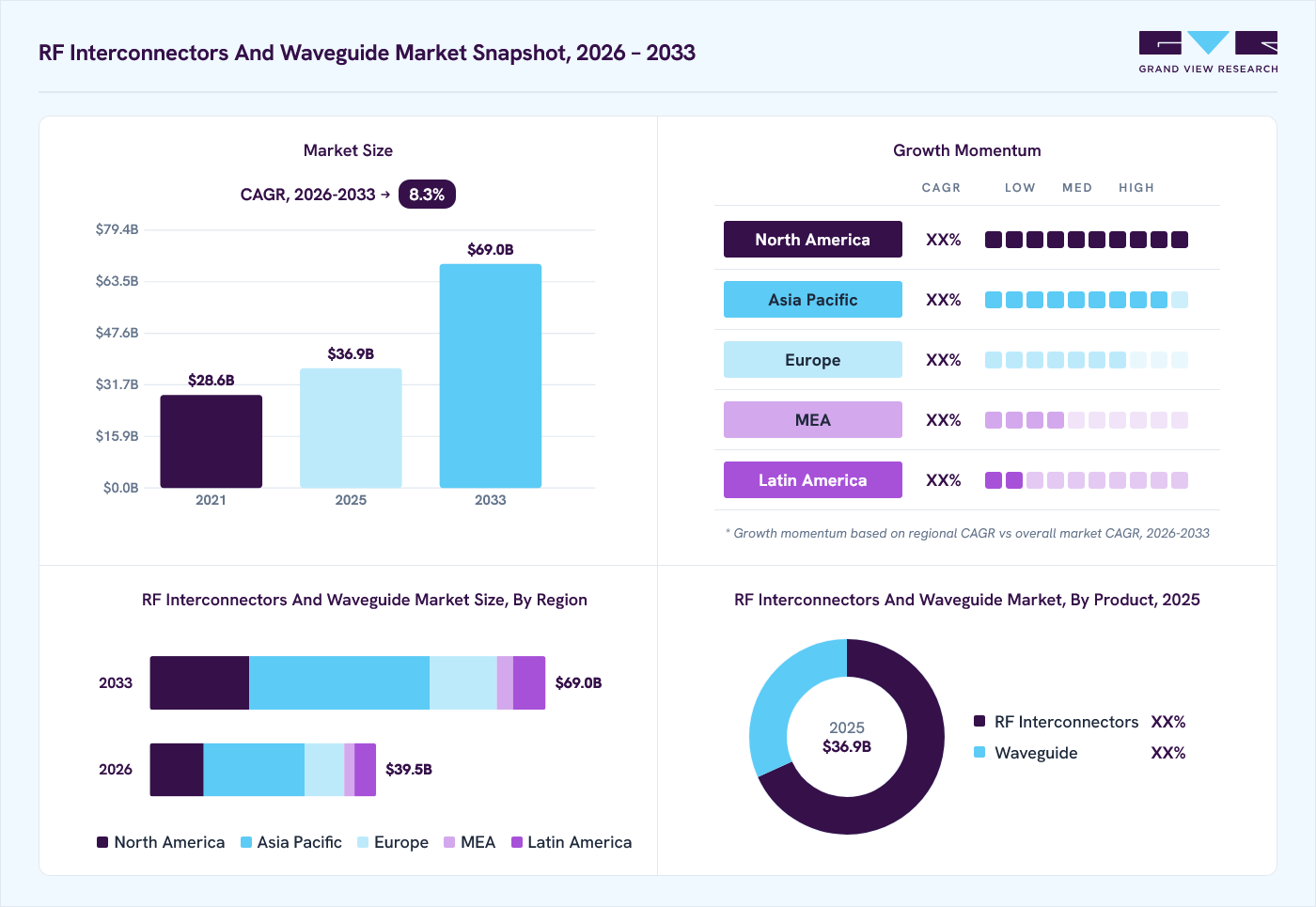
The global RF interconnectors and waveguide market size was valued at USD 36.9 billion in 2025 and is projected to grow from USD 39.5 billion in 2026 to USD 69.0 billion by 2033, at a CAGR of 8.3% from 2026 to 2033. Asia Pacific dominated the market, accounting for a revenue share of 44.6% in 2025. The market is driven by increasing deployment of 5G and high-frequency communication networks, rising aerospace and defense spending, expanding satellite communication infrastructure, growing adoption of radar and electronic warfare systems, increasing demand for high-frequency test and measurement equipment, and continued investments in advanced telecommunications and industrial RF systems.
 Source: Grand View Research, IR Documents, Primary Interviews, Paid DatabasesTo learn more about this report,
 Download Free Sample Report
 Key Market Trends & Insights
- By product: The RF interconnectors segment held the largest market share of around 68.0% in 2025.
- By component: Filters segment held the largest market revenue share over 27% in 2025.
- By frequency: Up to 4 GHz segment led the market with the largest revenue share over 34% in 2025.
- By end-use: Industrial segment held the largest market revenue share over 10% in 2025.
Regional Highlights
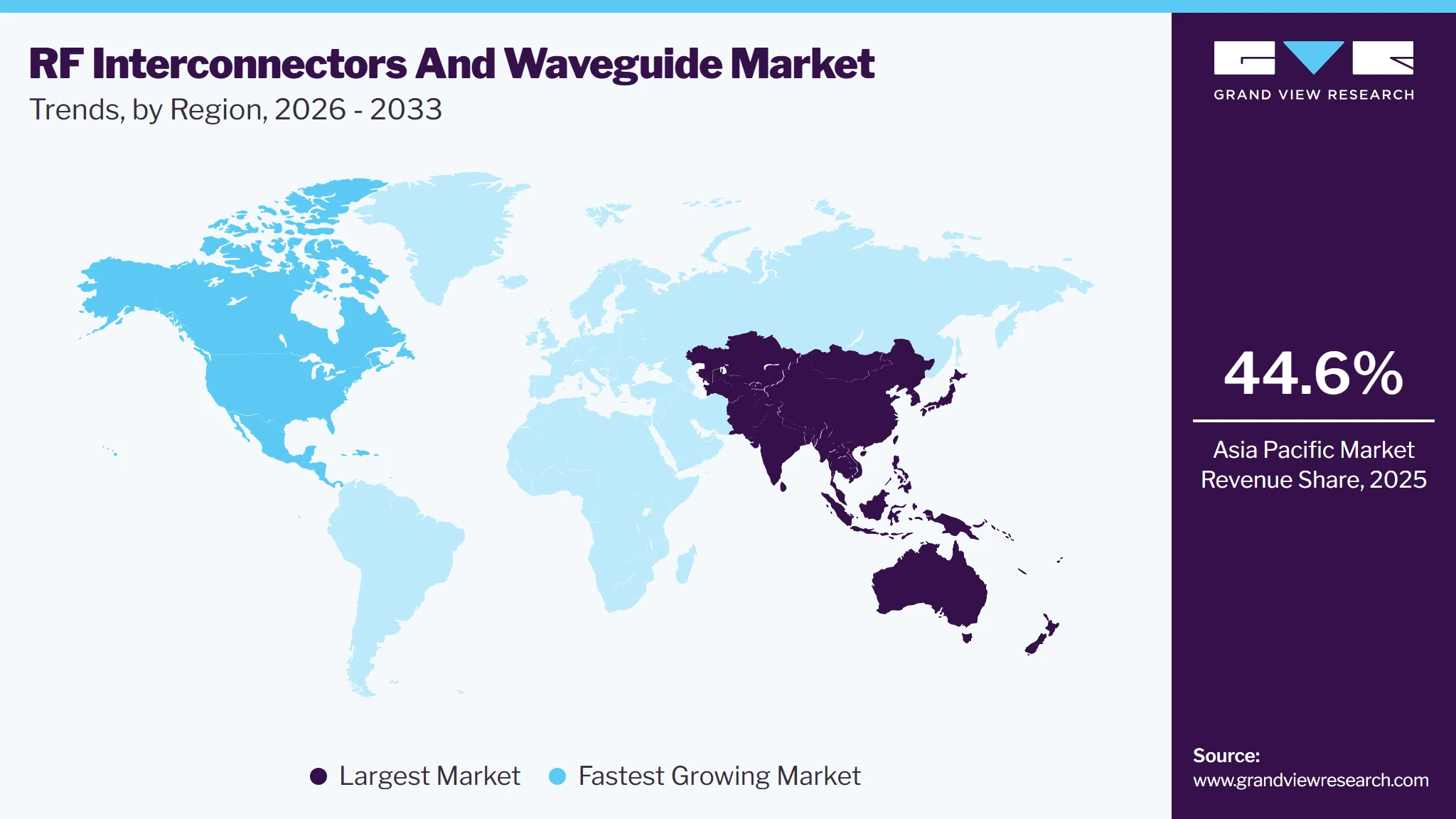
- Largest regional market: Asia Pacific (44.6% revenue share, 2025)
- Fastest-growing regional market: North America (highest CAGR, 2026-2033)
- Leading country: China held the largest share in 2025.
Market Size & Forecasts
- Market size in 2025: USD 36.9 Billion
- Estimated market size in 2026: USD 39.5 Billion
- Projected market size by 2033: USD 69.0 Billion
- CAGR (2026-2033): 8.3%
Three ways to get this report
Buy it, customize it, or ask a question.Ask an Analyst
A direct answer, usually in 1 working day
- AccessReport author, directly
- Reply timeWithin 1 working day
- No sales callDirect answer only
- FormatEmail reply
- CostFree, no cost
Get the Full Report
What the study covers
- FormatsPDF · Excel · Dashboard
- Timeline2026–2033 annual, 2025 base
- Coverage20+ countries, 5 regions
- Companies10+ key players profiled
Customize the Report
20% free customization
- IncludeCountries, segments, points
- TailorTo your product definition
- ExtendDeeper competitor detail
- OrA fully bespoke study
- Turnaround5–10 working days
Rising investments in radar, electronic warfare, surveillance, and defense communication systems are driving demand for high-performance microwave transmission components. Modern defense platforms increasingly require compact, reliable signal-routing architectures that support multiple frequency bands and high-power transmission. The expansion of phased-array radar and electronic sensing technologies is creating additional requirements for connectors, waveguides, couplers, filters, and other microwave components. Increasing integration of RF technologies across airborne, naval, and ground-based platforms is also supporting demand for components capable of operating under vibration, temperature, and electromagnetic stress. Ongoing defense modernization programs are consequently encouraging suppliers to develop application-specific solutions with improved reliability, frequency coverage, and power-handling capabilities.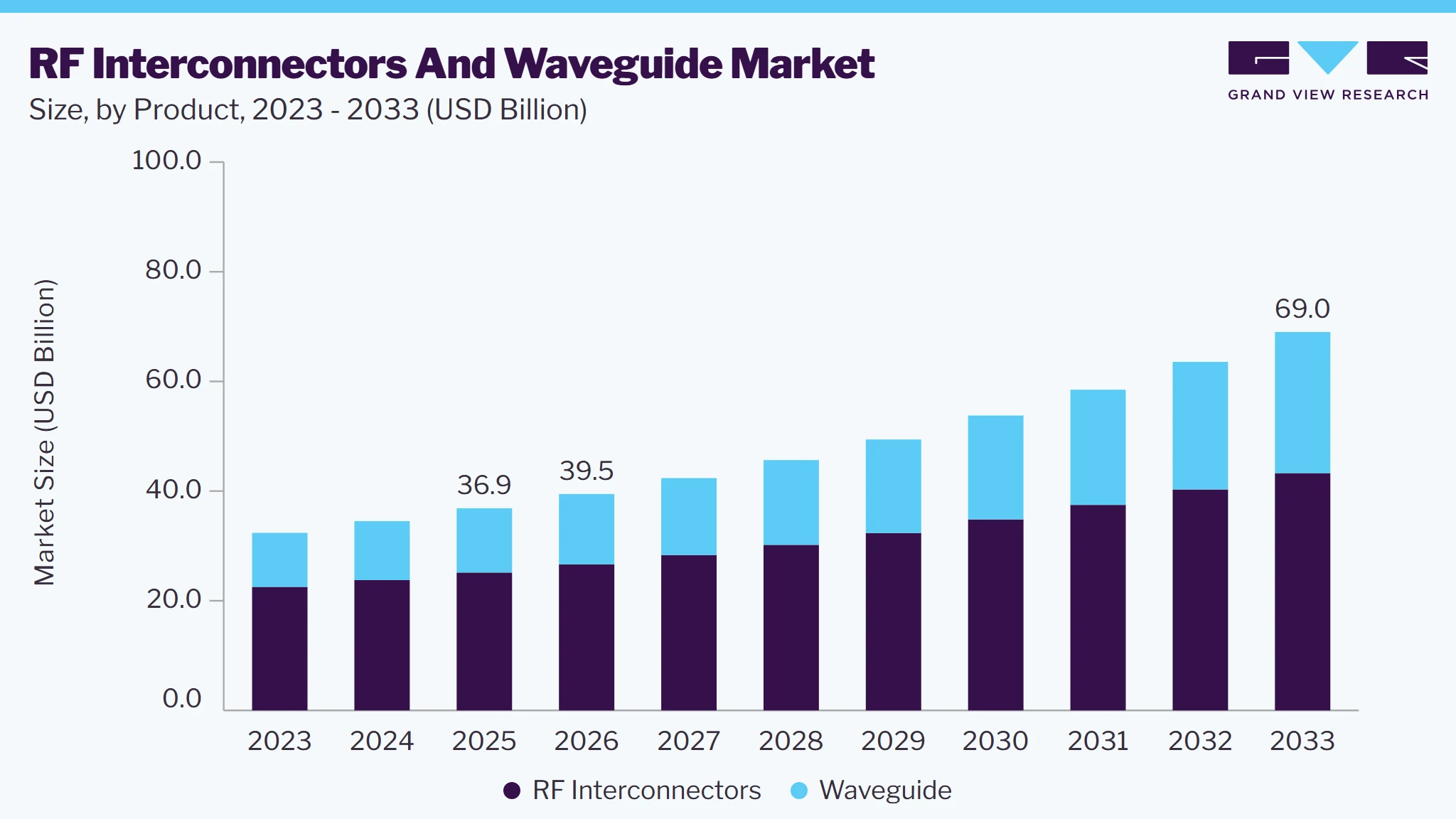 To learn more about this report, Download Free Sample Report
 Growing investments in satellite constellations, space-based communication, and spacecraft electronics are increasing demand for reliable RF transmission and interconnection solutions. The deployment of high-throughput satellites requires components capable of supporting higher bandwidths while maintaining signal integrity across complex communication architectures. Increasing satellite launches and the development of space-based sensing and navigation systems are further expanding the requirements for lightweight, high-reliability RF components. Waveguide assemblies, RF connectors, cable assemblies, filters, and couplers are increasingly incorporated into satellite payloads and ground-based communication equipment. Continued expansion of commercial and government space programs is therefore supporting demand for specialized components designed for harsh environmental and high-frequency applications.
The transition toward higher operating frequencies is driving demand for advanced RF interconnectors and waveguide components across communication, radar, sensing, and test applications. The increasing deployment of millimeter-wave systems is creating a need for components with lower transmission losses and tighter electrical tolerances. The growing use of frequencies above 40 GHz is also supporting the development of specialized connectors, cable assemblies, waveguide structures, and related microwave components. Semiconductor and electronics manufacturers are increasingly integrating high-frequency architectures to support faster data transmission and more precise signal processing. This shift is encouraging suppliers to expand frequency coverage and develop products that maintain stable performance under demanding operating conditions.
Market Dynamics
The RF interconnectors & waveguide industry is evolving alongside the expansion of high-frequency communication infrastructure, 5G networks, satellite communications, radar systems, and electronic warfare platforms. Increasing requirements for high signal integrity, low insertion loss, thermal stability, and reliable connectivity are supporting the adoption of advanced RF cables, cable assemblies, connectors, adapters, couplers, filters, and waveguide components across telecommunications, aerospace & defense, medical, and industrial applications. The transition toward higher-frequency systems is also increasing demand for precision-engineered microwave and millimeter-wave interconnect solutions, particularly for radar, satellite, sensing, and high-speed wireless applications. At the same time, manufacturers are focusing on miniaturization, lightweight designs, higher power-handling capabilities, and improved electromagnetic performance to address evolving system-level requirements. Competitive activity is increasingly centered on product customization, frequency coverage, material selection, manufacturing precision, and integration capabilities, while technological developments in RF interconnectors and waveguides continue to influence product specifications and application adoption.
The market is driven by the expanding deployment of 5G infrastructure and high-frequency communication networks, which require reliable RF cables, connectors, adapters, and waveguide components for signal transmission. Rising investments in aerospace and defense systems, including radar, electronic warfare, satellite communications, and surveillance platforms, are increasing demand for high-performance RF interconnectors and waveguides. The growing adoption of satellite communication and space-based connectivity is further supporting the use of high-frequency waveguide assemblies, RF connectors, and microwave components. Increasing demand for high-frequency test and measurement equipment across telecommunications, electronics, and defense applications is creating additional requirements for precision RF interconnect solutions. Furthermore, the expansion of industrial RF systems, wireless communication equipment, and advanced microwave technologies is supporting sustained demand for RF cables, cable assemblies, connectors, couplers, filters, and waveguide components.
The market faces constraints due to the high manufacturing costs of precision RF connectors, specialized cable assemblies, and waveguide components, particularly for high-frequency and customized applications. Complex design and manufacturing requirements for maintaining low insertion loss, high power handling, impedance matching, and signal integrity can increase product development and production costs. The availability of qualified suppliers and specialized manufacturing capabilities is also limited for advanced microwave components, high-frequency RF interconnectors, and precision waveguides, which can extend procurement lead times. Stringent quality, reliability, and certification requirements in aerospace & defense, satellite communications, and medical applications can further increase compliance costs and qualification timelines. In addition, technological shifts toward integrated RF modules, advanced packaging, and miniaturized wireless architectures can reduce demand for certain conventional RF interconnect products and discrete waveguide components in selected applications.
The market presents opportunities from the rapid expansion of millimeter-wave and high-frequency communication technologies, which are increasing requirements for low-loss RF interconnectors, high-frequency connectors, and advanced waveguide solutions. Growing investments in satellite constellations, space communications, and next-generation radar systems are creating demand for lightweight, high-reliability RF cable assemblies, waveguide components, and microwave interconnect solutions. The development of 6G networks and emerging high-frequency wireless technologies is expected to create new requirements for advanced RF connectors, couplers, filters, and waveguide architectures. Increasing adoption of automated test equipment and high-frequency electronic testing is also creating opportunities for precision RF interconnect solutions across telecommunications, semiconductor, aerospace, and electronics manufacturing. Moreover, rising demand for customized, miniaturized, and high-performance RF interconnectors and waveguide assemblies is creating opportunities for manufacturers to develop application-specific solutions for defense, satellite, industrial, medical, and communication systems.
Market Concentration & Characteristics
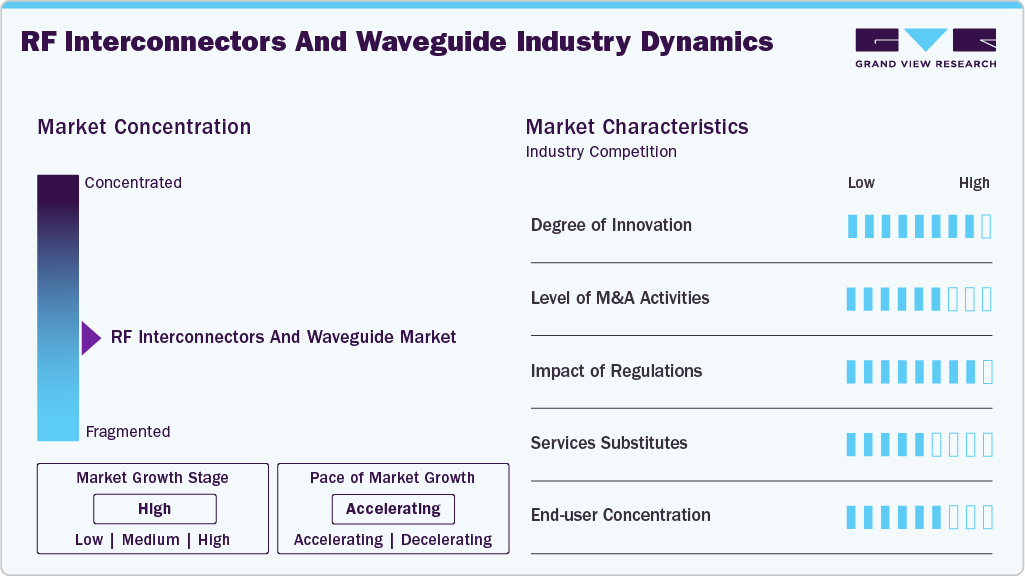
The RF interconnectors & waveguide industry is relatively fragmented, with competition distributed across established RF component manufacturers, specialized microwave suppliers, and companies serving specific aerospace, defense, telecommunications, medical, and industrial applications. Market participants compete through product breadth, frequency coverage, customization capabilities, manufacturing precision, and compliance with application-specific performance requirements. The market is characterized by a high degree of innovation, driven by increasing requirements for higher-frequency operation, lower signal loss, miniaturization, improved power handling, and enhanced reliability. The pace of market growth is accelerating, supported by expanding 5G infrastructure, satellite communications, radar systems, electronic warfare, and other high-frequency applications.
 To learn more about this report, Download Free Sample Report
 The industry also reflects a moderate-to-high level of M&A activity, as companies seek to expand RF and microwave product portfolios, strengthen technological capabilities, and access specialized customer segments. Regulatory impact is high, particularly in aerospace & defense and satellite-related applications, where certification, export controls, quality standards, and procurement requirements influence product development and supplier selection. Services substitutes have a moderate impact, as RF interconnectors and waveguide components generally require physical hardware, although integrated RF modules and advanced packaging can replace selected discrete components in certain applications. End user concentration is moderate, with demand distributed across aerospace & defense, telecommunications, medical, industrial, and other specialized applications, reducing dependence on a single end use sector.
Analyst Perspective
The market is being propelled by the increasing deployment of high-density transmission architectures across semiconductor equipment, instrumentation, wireless infrastructure, and precision electronics. Growing adoption of phased-array systems, mmWave sensing, autonomous platforms, and electronic warfare equipment is driving demand for compact configurations with stable transmission characteristics and consistent performance. The use of advanced materials, precision machining, miniaturized packaging, and application-specific engineering is further enabling components to meet demanding electrical and environmental conditions. Increasing system complexity is consequently driving demand for suppliers capable of delivering custom configurations, rapid prototyping, specialized fabrication, and consistent quality across complex transmission assemblies.
Product Insights
The RF interconnectors segment dominated the market, accounting for around 68% of global revenue in 2025, supported by broad deployment across telecommunications, aerospace & defense, industrial electronics, and test and measurement systems. Increasing requirements for reliable signal transmission across complex electronic architectures are driving demand for RF cables, cable assemblies, connectors, and related interconnection solutions. The expansion of high-speed wireless infrastructure and electronic systems is further increasing the demand for compact, low-loss, high-frequency connectivity products. Growing adoption of advanced radar, satellite communication, semiconductor testing, and wireless equipment is also support demand for specialized interconnection configurations. Continued system miniaturization and higher operating frequencies are expected to drive manufacturers toward higher-density, application-specific, and precision-engineered RF interconnectors.
The waveguide segment is projected to experience significant growth during the forecast period, driven by increasing adoption across radar, satellite communications, electronic warfare, and high-frequency sensing systems. Rising deployment of microwave and millimeter-wave technologies is driving demand for waveguide structures capable of supporting efficient transmission at higher frequencies. Growing requirements for low-loss signal propagation, high power handling, and electromagnetic performance are further supporting the adoption of rectangular, circular, and ridged waveguide configurations. Increasing investments in defense electronics, space infrastructure, and advanced communication systems are creating additional application opportunities for specialized waveguide components. Furthermore, the transition toward higher-frequency operating architectures is encouraging system manufacturers to adopt waveguide solutions for applications that require controlled, reliable microwave signal transmission.
Component Insights
The filters segment accounted for a significant revenue share of over 27% in 2025, driven by increasing requirements for frequency-selective signal management across communication, radar, satellite, and electronic systems. Growing deployment of multi-band and high-frequency equipment is increasing the need for filters that suppress unwanted signals, reduce interference, and maintain transmission quality within designated frequency ranges. The expansion of wireless infrastructure, aerospace & defense electronics, and microwave systems is further supporting demand for cavity, waveguide, and other specialized filtering solutions. Rising system density and increasing spectrum utilization are also encouraging the integration of advanced filtering components to improve electromagnetic compatibility and channel isolation. Furthermore, the development of higher-frequency platforms is driving demand for filters with tighter frequency selectivity, lower insertion loss, and improved power-handling capabilities.
The couplers segment is projected to witness significant growth over the forecast period, owing to increasing requirements for controlled signal distribution and power division across microwave and high-frequency electronic systems. Growing deployment of antenna arrays, radar equipment, satellite payloads, and wireless infrastructure is supporting demand for directional and hybrid couplers used in signal routing and monitoring applications. Increasing complexity of RF architectures is further driving the integration of couplers for signal sampling, power combining, isolation, and system-level measurement. The expansion of phased-array and multi-channel communication systems is creating additional requirements for compact couplers capable of maintaining consistent electrical performance across multiple operating frequencies. Furthermore, rising adoption of advanced microwave equipment is encouraging the development of wideband, low-loss, and high-power coupler designs for demanding transmission applications.
Frequency Insights
The Up to 4 GHz segment accounted for a significant market revenue share of over 34% in 2025, supported by widespread use across wireless communication, industrial electronics, test equipment, and defense systems. Increasing deployment of sub-4 GHz communication technologies is driving requirements for reliable transmission components across a broad range of network and electronic architectures. Growing adoption of IoT connectivity, private wireless networks, telemetry systems, and low-frequency radar applications is further supporting demand within this frequency range. The established installed base of equipment operating below 4 GHz is also sustaining replacement and expansion requirements for compatible RF transmission components. Furthermore, continued development of compact antennas, communication modules, and embedded wireless systems is creating additional demand for components designed to operate efficiently within lower-frequency bands.
The above 40 GHz segment is projected to experience substantial growth, owing to increasing adoption of millimeter-wave and sub-terahertz technologies across advanced communication, sensing, radar, and measurement applications. Growing requirements for higher bandwidth, faster data transmission, and greater frequency resolution are driving the integration of components capable of operating at extremely high frequencies. Expansion of high-resolution imaging, satellite payloads, automotive sensing, and defense electronics is further creating demand for specialized transmission solutions within this frequency range. Increasing investments in next-generation wireless technologies and advanced semiconductor devices are also supporting the development of high-frequency systems requiring precise signal routing and low-loss transmission. Furthermore, continued advancements in high-frequency testing, antenna systems, and electronic instrumentation are encouraging the adoption of specialized interconnect and waveguide components designed for operation above 40 GHz.
End-use Insights
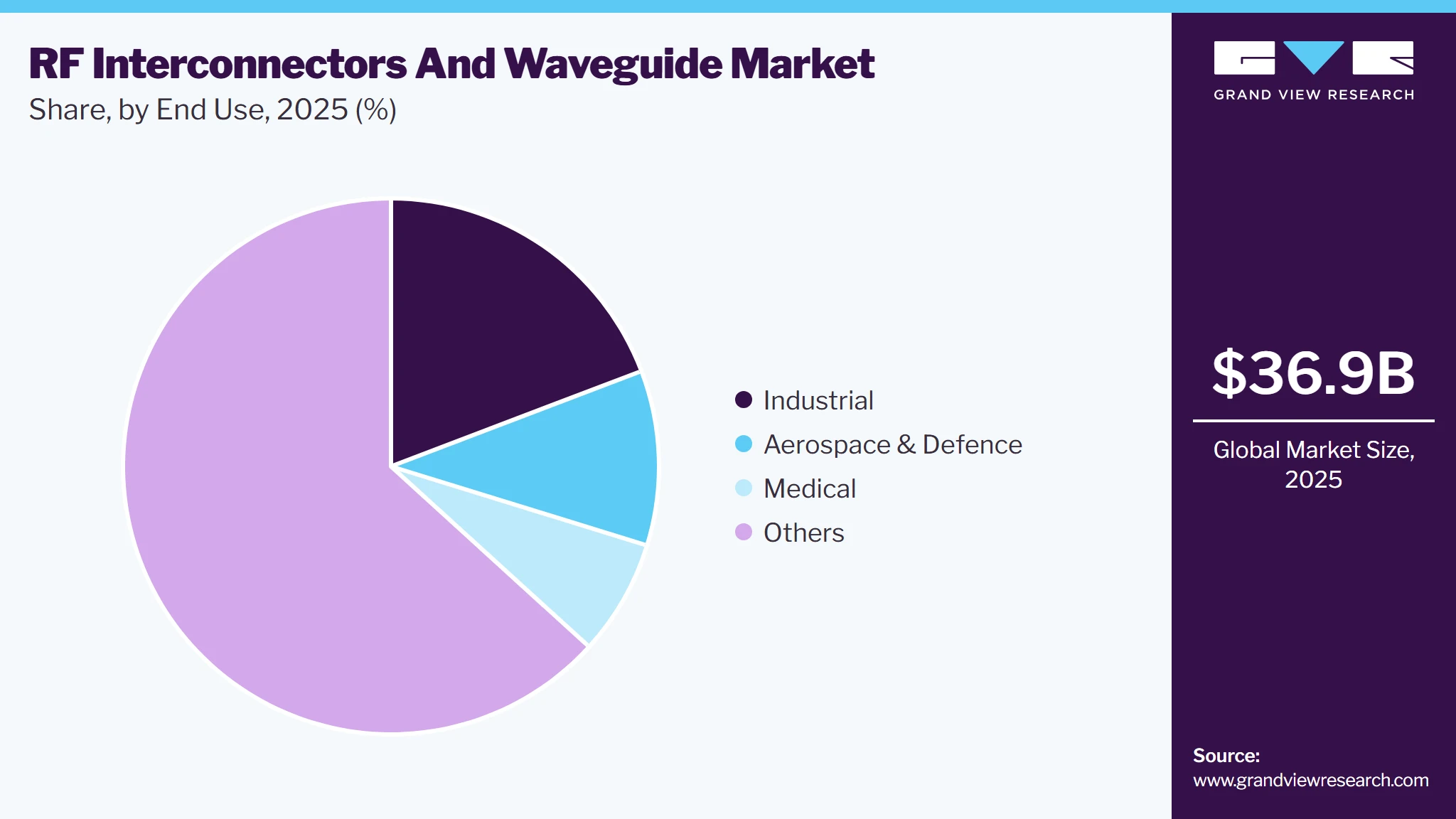
The aerospace & defense segment accounted for a significant market revenue share of over 10% in 2025, driven by increasing demand for radar systems, electronic warfare platforms, military communication networks, and satellite-based defense infrastructure. Rising investments in defense modernization programs are accelerating the adoption of high-performance transmission components capable of supporting mission-critical RF and microwave applications. Growing deployment of phased-array antennas, surveillance systems, avionics, missile guidance systems, and secure communication equipment is further strengthening demand for precision-engineered interconnection and transmission solutions. Increasing emphasis on high-frequency operation, low signal loss, electromagnetic shielding, and reliable performance under extreme operating conditions is supporting product adoption across airborne, naval, and ground-based defense platforms. Furthermore, the expansion of procurement for next-generation defense electronics and space-based security systems is creating sustained demand for advanced RF connectivity and microwave transmission technologies.
 To learn more about this report, Download Free Sample Report
 The industrial segment is expected to experience substantial growth during the forecast period, driven by increasing adoption of RF-based automation, sensing, process monitoring, and industrial communication systems. Growing deployment of industrial wireless networks, instrumentation equipment, semiconductor manufacturing systems, and non-destructive testing technologies is creating additional requirements for reliable high-frequency transmission components. Rising integration of connected equipment and advanced control systems is also supporting demand for components capable of maintaining signal quality in electrically and thermally demanding environments. Increasing use of microwave heating, material processing, laboratory equipment, and industrial radar is further expanding application areas for specialized transmission solutions. Moreover, investments in factory modernization and advanced electronic equipment are encouraging the adoption of compact, durable, and application-specific components across industrial operating environments.
Regional Insights
The Asia Pacific RF interconnectors and waveguide industry dominated the market with a revenue share of 44.6% in 2025. The region is growing rapidly, driven by expanding 5G infrastructure, electronics manufacturing, satellite communications, and defense technology development across major economies. Increasing investments in radar systems, telecommunications equipment, semiconductor production, and space programs are accelerating the deployment of high-frequency transmission technologies. Rapid industrialization and the expansion of wireless connectivity are further increasing demand for RF and microwave components across commercial and industrial applications.
 To learn more about this report, Download Free Sample Report
 China RF Interconnectors And Waveguide Market Trends
The China RF interconnectors & waveguide industry is expanding rapidly, driven by increasing investments in 5G infrastructure, satellite communications, radar systems, and domestic aerospace programs. Growing development of defense electronics, semiconductor manufacturing, and high-frequency communication equipment is accelerating demand for precision RF connectivity and microwave transmission components. Furthermore, the expansion of industrial automation, electronic testing, and advanced wireless technologies is driving adoption of high-frequency components across commercial and industrial applications.
North America RF Interconnectors And Waveguide Market Trends
The North America RF interconnectors & waveguide industry is projected to grow at the fastest CAGR of 9.1% over the forecast period, driven by sustained investments in defense electronics, satellite systems, radar infrastructure, and advanced communication networks. Growing deployment of sophisticated aerospace platforms and military technologies is increasing requirements for high-reliability microwave transmission and precision connectivity solutions. Expansion of semiconductor manufacturing, electronic testing, and high-frequency instrumentation is further supporting regional demand for specialized RF components.
The U.S. RF interconnectors and waveguide market is gaining momentum, driven by increasing expenditure on radar modernization, electronic warfare, military communications, and space-based systems. Growing investments in satellite constellations, aerospace platforms, and next-generation defense electronics are accelerating demand for advanced microwave transmission technologies. Expansion of semiconductor fabrication, wireless infrastructure, and high-frequency research is further creating requirements for specialized components across commercial and government applications.
Europe RF Interconnectors And Waveguide Market Trends
The RF interconnectors and waveguide industry in Europe is witnessing robust growth, supported by increasing investments in aerospace programs, defense modernization, satellite communications, and advanced wireless infrastructure. Growing development of radar, avionics, secure communication systems, and space technologies is driving demand for precision-engineered transmission components across regional industries. Rising investments in semiconductor technologies, industrial automation, and high-frequency measurement systems are further broadening application opportunities.
Key RF Interconnectors And Waveguide Company Insights
Key players operating in the market include Cobham Advanced Electronic Solutions (CAES); Ducommun Incorporated; ETL Systems Ltd; and among others.
-
Flann Microwave Ltd. is a UK-based manufacturer specializing in RF, microwave, and millimeter-wave components and assemblies for high-frequency applications. The company specializes in waveguide technology, including waveguide adapters, couplers, filters, loads, terminations, and assemblies used across aerospace & defense, telecommunications, space, and test and measurement applications. Its expertise is particularly focused on precision waveguide solutions and high-frequency transmission technologies, supporting applications that require controlled signal performance across demanding frequency ranges.
-
HUBER+SUHNER is a global connectivity solutions provider with a portfolio covering RF, fiber-optic, and low-frequency electrical connectivity technologies. In the RF interconnectors & waveguide industry, the company specializes in RF connectors, coaxial connectors, adapters, cable assemblies, and high-frequency interconnection solutions for telecommunications, aerospace & defense, industrial, and test applications. Its RF portfolio emphasizes high-frequency precision connectivity, signal integrity, and customized interconnection solutions for demanding electronic systems.
Key RF Interconnectors And Waveguide Companies:
The following key companies have been profiled for this study on the RF interconnectors & waveguide market.
-
Cobham Advanced Electronic Solutions (CAES)
-
Ducommun Incorporated
-
ETL Systems Ltd
-
Flann Microwave Ltd
-
Global Invacom
-
HUBER+SUHNER
-
Quantic Electronics
-
Radiall
-
Rosenberger
-
Samtec
-
Smiths Interconnect
-
SPINNER GmbH
Competitive Benchmarking
Operating Strategies
Competitive Edge
Weaknesses
Mature Players: HUBER+SUHNER, Rosenberger, Samtec, Smiths Interconnect, Ducommun Incorporated
·Mature players focus on expanding their RF and microwave product portfolios across RF connectors, cables, cable assemblies, waveguides, adapters, couplers, filters, and specialized high-frequency components to serve aerospace & defense, telecommunications, industrial, medical, and test and measurement applications.
Their competitive advantage lies in established customer relationships, broad product portfolios, advanced manufacturing capabilities, high-frequency engineering expertise, global distribution networks, and the ability to meet stringent performance, quality, and reliability requirements.
These companies face challenges related to relatively high manufacturing costs, complex qualification requirements, longer development cycles for customized products, exposure to specialized procurement requirements, and competition from niche microwave and waveguide manufacturers.
Emerging Players: Flann Microwave Ltd., ETL Systems Ltd., Global Invacom, Quantic Electronics, SPINNER GmbH, Cobham Advanced Electronic Solutions (CAES)
Emerging players focus on specialized RF, microwave, millimeter-wave, and waveguide solutions, including precision connectors, waveguide assemblies, filters, couplers, RF subsystems, and application-specific components for defense, space, telecommunications, and high-frequency testing.
Their strengths include specialized engineering expertise, focused product portfolios, flexible customization capabilities, application-specific solutions, faster product development, and the ability to address demanding high-frequency requirements.
Smaller scale compared with established global connectivity manufacturers, limited product breadth in some categories, narrower geographic coverage, dependence on specialized applications, and the need to meet stringent qualification requirements may constrain expansion across broader end-use markets.
Recent Developments
- In June 2026, FLANN Microwave showcased its WG32/WR3 waveguide solutions at IMS 2026, including programmable rotary and linear vane attenuators, high-power terminations, horn antennas, and waveguide switches. The products support operation up to 330 GHz, addressing demanding high-frequency applications. The demonstration strengthens FLANN’s portfolio of compact, high-performance waveguide components for millimeter-wave systems.
-
In June 2026, Amphenol RF introduced solderless 2.92 mm connectors for stripline and microstrip PCB applications, supporting frequencies up to 40 GHz. The design simplifies installation while maintaining high-frequency RF performance and is suited to precision PCB-based applications. This directly expands the company’s high-frequency RF interconnect portfolio for test, instrumentation and advanced electronics applications.
-
In May 2026, Amphenol RF expanded its FAKRA-to-AMC cable assembly portfolio with pre-configured solutions designed for space-constrained wireless and embedded applications. The assemblies combine ultra-miniature AMC and FAKRA interfaces with 0.81 mm and 1.13 mm micro-coaxial cables, supporting RF performance up to 6 GHz and selected higher-frequency applications. The solutions target IoT modules, wearables, and industrial sensors, with right-angle configurations, snap-on mating, and optional IP67 sealing for compact installation environments.
RF Interconnectors & Waveguide Market Report Scope
Report Attribute
Details
Market size in 2025
USD 36.9 billion
Estimated market size in 2026
USD 39.5 billion
Projected market size by 2033
USD 69.0 billion
Growth rate
CAGR of 8.3% from 2026 to 2033
Actual data
2021 - 2025
Forecast period
2026 - 2033
Quantitative units
Revenue in USD billion and CAGR from 2026 to 2033
Report coverage
Revenue forecast, company share, competitive landscape, growth factors, and trends
Segments covered
Product, component, frequency, end-use, region
Regional scope
North America; Europe; Asia Pacific; Latin America; Middle East and Africa
Country scope
U.S.; Canada; Mexico; UK; Germany; France; China; Japan; India; South Korea; Australia; Brazil; UAE; KSA; South Africa
Key companies profiled
Cobham Advanced Electronic Solutions (CAES); Ducommun Incorporated; ETL Systems Ltd; Flann Microwave Ltd; Global Invacom; HUBER+SUHNER; Quantic Electronics; Radiall; Rosenberger; Samtec; Smiths Interconnect; SPINNER GmbH
Customization scope
Free report customization (equivalent to up to 8 analyst working days) with purchase. Addition or alteration to country, regional & segment scope.
Pricing and purchase options
Avail customized purchase options to meet your exact research needs. Explore purchase options
Global RF Interconnectors And Waveguide Market Report Segmentation
This report forecasts revenue growth at global, regional, and country levels and provides an analysis of the latest industry trends in each of the sub-segments from 2021 to 2033. For this study, Grand View Research has segmented the global RF interconnectors and waveguide market report based on product, component, frequency, end-use, and region:
-
Product Outlook (Revenue, USD Billion, 2021 - 2033)
-
RF Interconnectors
-
RF Cable
-
RF Cable Assembly
-
RF Connector
-
Others
-
-
Waveguide
-
Rectangular Waveguide
-
Circular Waveguide
-
Single Ridged Waveguide
-
Double Ridged Waveguide
-
Elliptical Waveguide
-
-
-
Component Outlook (Revenue, USD Billion, 2021 - 2033)
-
Adapters
-
Couplers
-
Loads & Terminations
-
Filters
-
Isolators & Circulators
-
Power Combiners
-
Others
-
-
Frequency Outlook (Revenue, USD Billion, 2021 - 2033)
-
Up to 4 GHz
-
4–8 GHz
-
8–18 GHz
-
18–40 GHz
-
Above 40 GHz
-
-
End-use Outlook (Revenue, USD Billion, 2021 - 2033)
-
Aerospace & Defense
-
Medical
-
Industrial
-
Others
-
-
Regional Outlook (Revenue, USD Billion, 2021 - 2033)
-
North America
-
U.S.
-
Canada
-
Mexico
-
-
Europe
-
UK
-
Germany
-
France
-
-
Asia Pacific
-
China
-
Japan
-
India
-
South Korea
-
Australia
-
-
Latin America
-
Brazil
-
-
Middle East and Africa
-
UAE
-
KSA
-
South Africa
-
-
Research Methodology
The RF interconnectors and waveguide market figures in this report are based on a proven research process that combines executive interviews with secondary research from proprietary databases, company filings, and recognized regulatory and institutional sources. Market size is built through value-chain sizing-reconciling supply-side and demand-side estimates-and triangulated with bottom-up and top-down approaches. Every estimate passes multiple levels of expert validation before publication, with each RF interconnectors & waveguide segment quantified using the revenue-capture definitions in the table below.
Segment Definition
Product
Revenue Capture Definition
RF Interconnectors
RF interconnectors are components used to establish reliable electrical connections between RF and microwave devices for signal transmission. They include cables, cable assemblies, connectors, and other connection solutions designed for specific frequency and application requirements.
Waveguide
Waveguides are hollow metallic or dielectric transmission structures used to guide electromagnetic waves, particularly at microwave and millimeter-wave frequencies. They provide controlled signal propagation with low transmission loss and are widely used in radar, satellite, communication, and measurement systems.
Segment - Component
Revenue Capture Definition
Adapters
Adapters are used to connect RF, microwave, and waveguide components with different interface types, sizes, or configurations. They facilitate compatibility between transmission components while maintaining required electrical performance.
Couplers
Couplers are passive components used to sample, divide, or combine RF and microwave signals within transmission systems. They enable controlled signal distribution and monitoring across communication, radar, and test applications.
Loads & Terminations
Loads and terminations are used to absorb RF or microwave energy and prevent unwanted signal reflections within transmission systems. They support impedance matching and stable system operation across defined frequency and power ranges.
Filters
Filters selectively pass or reject specific frequency ranges to control the spectral content of RF and microwave signals. They are used to suppress unwanted frequencies, reduce interference, and improve signal separation.
Isolators & Circulators
Isolators and circulators control the direction of RF and microwave signal flow between connected components. They are used to protect sensitive equipment, manage signal routing, and reduce the effects of reflected power.
Power Combiners
Power combiners merge signals or power from multiple RF and microwave sources into a common transmission path. They are used in applications requiring efficient power distribution, signal combining, and multi-channel system integration.
Others
Others include specialized RF and microwave components that are not classified under the primary component categories. These may include application-specific components and customized transmission solutions designed for particular system requirements.
Segment - Frequency
Revenue Capture Definition
Up to 4 GHz
The Up to 4 GHz segment covers RF interconnectors and waveguide components designed to operate at frequencies below 4 GHz. These solutions are widely used in wireless communication, industrial electronics, defense systems, and test equipment.
4–8 GHz
The 4–8 GHz segment includes transmission components designed for mid-range microwave frequencies within the 4–8 GHz band. These products support applications such as wireless infrastructure, radar, satellite communication, and electronic instrumentation.
8–18 GHz
The 8–18 GHz segment comprises RF and microwave components engineered for higher-frequency transmission within this range. These solutions are used in radar, aerospace & defense, satellite systems, telecommunications, and measurement equipment.
18–40 GHz
The 18–40 GHz segment covers components designed for millimeter-wave and advanced microwave applications requiring higher-frequency signal transmission. Products within this range are used in radar, satellite communications, high-frequency testing, and specialized wireless systems.
Above 40 GHz
The Above 40 GHz segment includes RF interconnectors and waveguide components designed for very-high-frequency and millimeter-wave applications. These solutions support emerging applications such as advanced sensing, high-resolution radar, next-generation communications, and high-frequency research and testing.
Segment - End Use
Revenue Capture Definition
Aerospace & Defense
The Aerospace & Defence segment covers the use of RF interconnectors and waveguide components in aircraft, spacecraft, radar, electronic warfare, surveillance, and military communication systems. These products support high-frequency signal transmission where reliability, signal integrity, and resistance to demanding operating conditions are required.
Medical
The Medical segment includes RF and microwave transmission components used in medical imaging, diagnostic equipment, therapeutic systems, and laboratory devices. These solutions enable controlled signal transmission and connectivity within equipment operating at specific RF and microwave frequencies.
Industrial
The Industrial segment comprises applications across manufacturing equipment, automation systems, instrumentation, sensing, semiconductor equipment, and industrial communication systems. RF interconnectors and waveguide components support signal routing, measurement, monitoring, and high-frequency processing in industrial environments.
Others
The Others segment includes applications outside aerospace & defence, medical, and industrial sectors, such as telecommunications, satellite communications, research, test and measurement, and specialized electronics. Demand in this category is associated with diverse requirements for high-frequency connectivity and microwave signal transmission.
Estimation Model
Layer Name
Key Questions
Description
RF & Microwave System Demand Layer
Who creates demand for RF interconnectors and waveguide components?
Identify end-use industries and system manufacturers investing in telecommunications, aerospace & defense, satellite communications, radar, medical equipment, industrial electronics, and high-frequency systems. This layer assesses the underlying system deployments and technology requirements that generate demand for RF transmission components.
RF Component Investment Layer
Who invests in RF interconnection and waveguide components?
Assess spending on RF cables, cable assemblies, connectors, waveguides, adapters, couplers, filters, isolators, circulators, and power combiners. This layer determines the portion of system and equipment investments allocated to RF interconnection and microwave transmission components.
Product Adoption Layer
Which RF interconnectors and waveguide components are adopted?
Measure adoption across products, component categories, frequency ranges, end-use industries, equipment types, and application environments. This layer evaluates purchasing patterns, technical specifications, replacement requirements, customization, and deployment across different markets and regions.
RF Interconnectors & Waveguide Revenue Realization Layer
How much revenue is generated from RF interconnectors and waveguide products?
Estimate revenue captured by manufacturers and suppliers across RF interconnectors, waveguides, components, frequency bands, end-use sectors, and regions. This layer establishes the final market revenue pool and provides the basis for market sizing and forecasting.
Delivered Customizations
This report has been delivered with the following in-depth customizations
Client Request
Customization Delivered
Value Adds
RF Interconnectors & Waveguide Product Landscape Assessment
Analyzed RF interconnectors and waveguide products, including RF cables, cable assemblies, connectors, rectangular and ridged waveguides, and related product categories across key manufacturers.
Help identify key product categories, supplier capabilities, technology specialization, product gaps, and opportunities for portfolio expansion within the RF and microwave component market.
Component-Specific RF Demand Analysis
Assessed demand for adapters, couplers, loads & terminations, filters, isolators & circulators, and power combiners across relevant applications and frequency ranges.
Provides insights into component-level demand patterns, technical requirements, application adoption, and areas offering potential for product development and market expansion.
Frequency-Specific Market Assessment
Evaluated RF interconnector and waveguide demand across up to 4 GHz, 4–8 GHz, 8–18 GHz, 18–40 GHz, and above 40 GHz frequency bands.
Supports identification of high-growth frequency ranges, evolving technical requirements, application opportunities, and investment priorities for high-frequency transmission solutions.
End-Use & Application Demand Assessment
Evaluated adoption across Aerospace & Defense, Medical, Industrial, and Other end-use sectors, with analysis of application-specific requirements and purchasing considerations.
Enables identification of high-potential customer segments, sector-specific requirements, demand patterns, and opportunities for targeted market expansion.
Frequently Asked Questions About This Report
Asia Pacific dominated the market, accounting for a revenue share of 44.6% in 2025.
Key factors that are driving the market growth include driven by increasing deployment of 5G and high-frequency communication networks, growing adoption of radar and electronic warfare systems, and continued investments in advanced telecommunications and industrial RF systems.
North America is the fastest-growing region over the forecast period.
The global RF interconnectors and waveguide market size was valued at USD 36.9 billion in 2025 and is estimated at USD 39.5 billion in 2026.
The global RF interconnectors and waveguide market is expected to grow at a CAGR of 8.3% from 2026 to 2033, reaching USD 69.0 billion by 2033.
The RF interconnectors segment led with around 68.0% revenue share in 2025, while the waveguide segment is the fastest-growing segment.
Key players include Cobham Advanced Electronic Solutions (CAES); Ducommun Incorporated; ETL Systems Ltd; Flann Microwave Ltd; Global Invacom; HUBER+SUHNER, Quantic Electronics; Radiall; Rosenberger; Samtec; Smiths Interconnect; SPINNER GmbH.
The filters segment accounted for a significant revenue share of over 27% in 2025
The Up to 4 GHz segment led with over 34.0% revenue share in 2025, while the above 40 GHz segment is the fastest-growing segment.
About the Author(s)
Next Generation Technologies Research Team
Technology · Next Generation TechnologiesThis report was authored by the next generation technologies research team at Grand View Research - comprising two research analysts, one senior research analyst, and one industry expert - with specialized expertise in the next generation technologies segment of the technology industry. All findings are based on proprietary technology databases, executive interviews, and regulatory analysis, subject to internal peer review prior to publication.
Last Updated:
Speak to Analyst

Customize this report to your needs - add regions, segments, or data points, with 20% free customization.
Or view our licence options:


ISO 9001:2015 & 27001:2022 Certified
We are GDPR and CCPA compliant! Your transaction & personal information is safe and secure. For more details, please read our privacy policy.


