
- Home
- »
- Advanced Interior Materials
- »
-
Rice Husk Ash-Based Silica Market Size, Share Report, 2033GVR Report cover

Rice Husk Ash-Based Silica Market (2026 - 2033)
Size, Share & Trend Analysis Report By Application (Rubber & Tires, Personal Care & Oral Care, Paints & Coatings, Food & Feed, Electronics), By Product Type (Precipitated Silica, Sodium Silicate, Amorphous Silica), By Region, And Segment Forecasts
Market Size, 2025
$640.6MMarket Estimate, 2026
$698.2MMarket Forecast, 2033
$1,410.4MCAGR, 2026–2033
10.6%Rice Husk Ash-Based Silica Market Summary
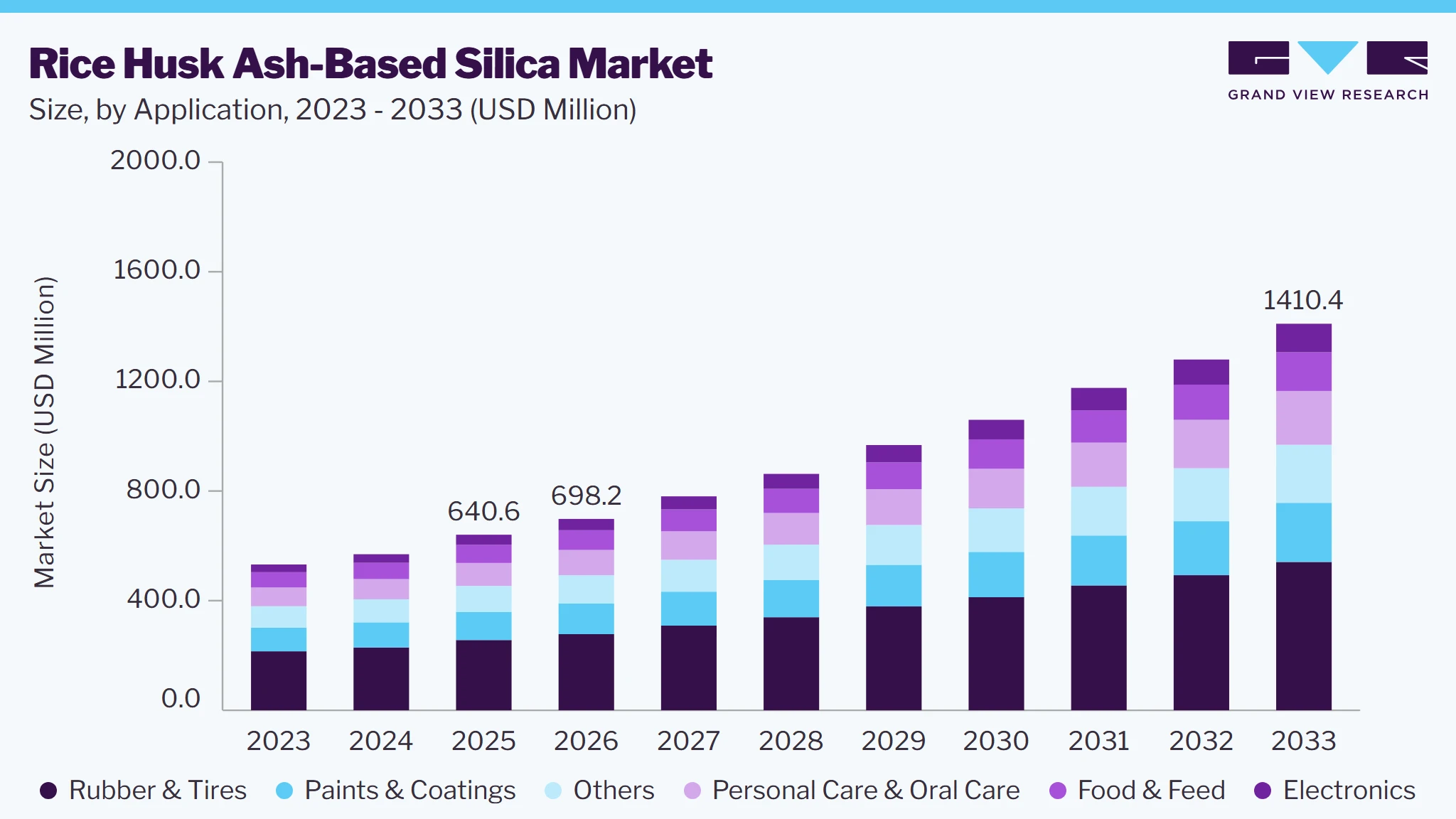
The global rice husk ash-based silica market size was valued at USD 640.6 million in 2025 and is projected to grow from USD 698.2 million in 2026 to USD 1,410.4 million by 2033, at a CAGR of 10.6% from 2026 to 2033. Asia Pacific dominated the market, accounting for the largest revenue share of 52.0% in 2025. Growth is supported by the increasing use of rice husk ash as a raw material for producing value-added silica products for use in rubber and tires, paints and coatings, construction, personal care, oral care, food, pharmaceuticals, and other applications.
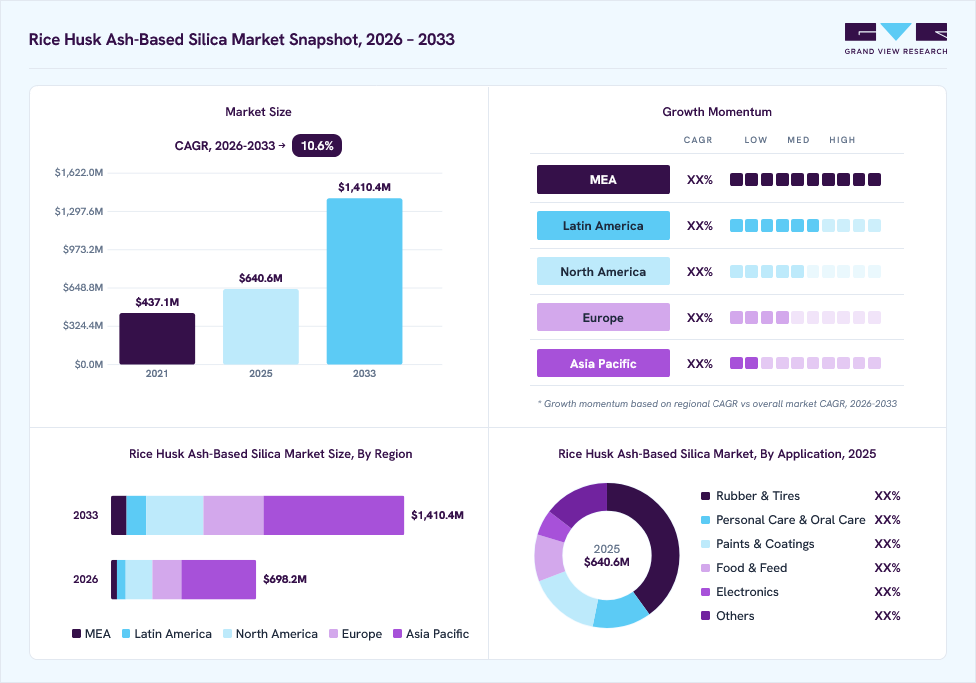 Source: Grand View Research, IR Documents, Primary Interviews, Paid DatabasesTo learn more about this report,
 Download Free Sample Report
 Key Market Trends & Insights
- By application: Rubber & tires accounted for the largest market revenue share of 40.0% in 2025.
- By product type: Colloidal silica segment is anticipated to register the fastest CAGR of 12.6% from 2026 to 2033.
Regional Highlights
- Largest regional market: Asia Pacific (52.0% revenue share, 2025)
- Fastest-growing regional market: Middle East & Africa (highest CAGR, 2026-2033)
Market Size & Forecast
- Market size in 2025: USD 640.6 Million
- Estimated market size in 2026: USD 698.2 Million
- Projected market size by 2033: USD 1,410.4 Million
- CAGR (2026-2033): 10.6%
Three ways to get this report
Buy it, customize it, or ask a question.Ask an Analyst
A direct answer, usually in 1 working day
- AccessReport author, directly
- Reply timeWithin 1 working day
- No sales callDirect answer only
- FormatEmail reply
- CostFree, no cost
Get the Full Report
What the study covers
- FormatsPDF · Excel · Dashboard
- Timeline2026–2033 annual, 2025 base
- Coverage20+ countries, 5 regions
- Companies10+ key players profiled
Customize the Report
20% free customization
- IncludeCountries, segments, points
- TailorTo your product definition
- ExtendDeeper competitor detail
- OrA fully bespoke study
- Turnaround5–10 working days
 To learn more about this report, Download Free Sample Report
 Manufacturers are investing in improved processing methods to increase production efficiency and maintain consistent product quality. Commercial facilities are being developed at different scales, ranging from pilot and small industrial units to larger production plants. Companies such as Brisil Technologies, Blue Ocean Biotech, EKASIL, BSB Nanotechnology, Oryzasil, and Green Silica Group are developing or supplying products derived from rice husk or rice husk ash. Expansion of production capacity is expected to improve product availability and support wider adoption across end-use industries.
Market Dynamics
Increasing efforts to convert agricultural waste into commercially useful products are creating growth opportunities for manufacturers. Rice husk is widely available in major rice-producing regions, providing an accessible feedstock for production. Converting this residue into value-added materials also supports resource utilization and reduces dependence on conventional raw material sources.
The availability of rice husk near processing facilities can support localized production and reduce the need for raw material transportation. Companies are therefore exploring technologies that enable efficient recovery of valuable components from rice husk ash. Growing interest in circular material utilization across industrial sectors is further supporting the development of rice husk-derived products.
Differences in rice husk composition, cultivation conditions, combustion methods, and ash-processing practices can result in variations in ash characteristics and active-component content. These differences may affect extraction efficiency, purity, particle properties, and consistency of the final product. Manufacturers need controlled processing conditions to maintain product specifications.
Quality-control requirements can increase production complexity and operating costs, particularly for smaller producers and new entrants. Consistent sourcing of suitable rice husk and standardized ash preparation are also important for maintaining stable production performance. These factors can limit scalability where reliable feedstock and processing infrastructure are not readily available.
Growing demand for specialty grades with defined purity, particle size, surface characteristics, and performance properties is creating opportunities for producers. Applications across rubber and tires, paints and coatings, personal care and oral care, and other industrial segments can provide opportunities for higher-value products. Manufacturers are increasingly focusing on processing technologies that improve the functional characteristics of rice husk-derived materials.
Product development targeted at specific end-use requirements can help expand the addressable application base. Improvements in purification, surface modification, and particle engineering can enable rice husk ash-based products to meet more demanding technical specifications. Greater acceptance among industrial users could support the development of specialty grades and strengthen revenue opportunities for producers.
Analyst Perspective
The industry is moving toward greater commercialization of silica produced from rice husk ash, supported by the availability of rice-processing residues and increasing interest in alternative raw materials. Producers are strengthening their positions by improving production capacity, developing application-specific grades, and establishing relationships with downstream manufacturers. Rubber and tire applications remain important areas of demand, while opportunities are emerging across personal care, oral care, paints and coatings, food, pharmaceuticals, and other industrial uses. The competitive environment remains fragmented, with specialized producers competing alongside established chemical and silica manufacturers.
Application Insights
Rubber & tires accounted for the largest share of the rice husk ash-based silica market in 2025, representing 40.0% of total revenue. Demand is driven by the use of this material as a reinforcing filler in tire and rubber compounds, where it enhances properties such as abrasion resistance, traction, and rolling resistance. The established use of silica-based fillers in rubber formulations provides a broad basis for the application of rice husk-derived products.
Electronics is projected to register the highest CAGR of 14.1% during the forecast period. The increasing demand for high-purity and functional materials in electronic components and related manufacturing processes is driving this growth. Improvements in purification and processing technologies may further expand the suitability of rice husk ash-derived products for specialized electronics applications.
Product Type Insights
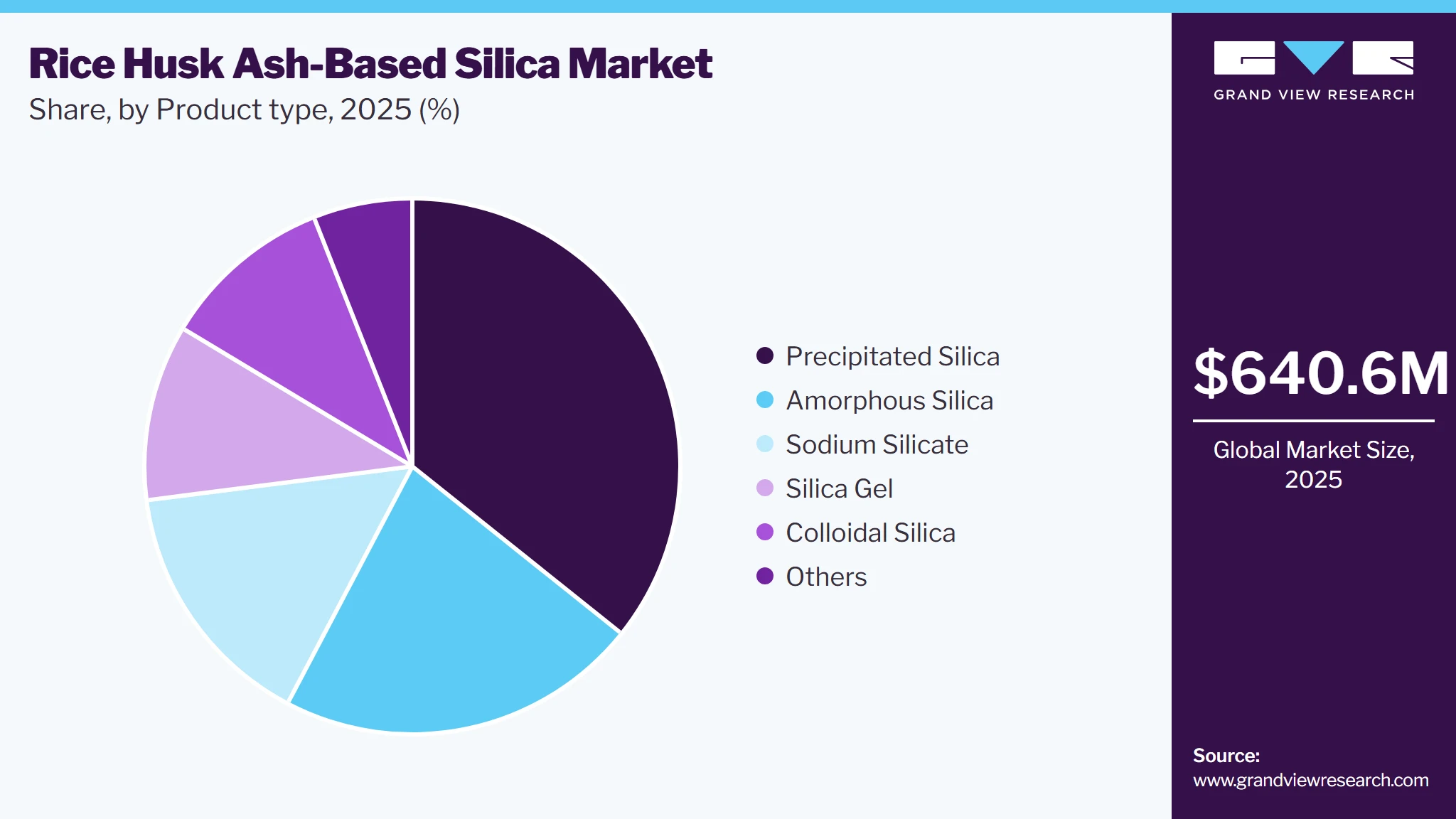
Precipitated silica held the largest share of the rice husk ash-based silica market in 2025, accounting for 35.7% of total revenue. Its established use across rubber and tires, coatings, personal care, and other industrial applications supports its leading position. Established precipitation-based processing routes also support commercial adoption among producers.
 To learn more about this report, Download Free Sample Report
 Colloidal silica is projected to record the highest CAGR of 12.6% during the forecast period. Growing use of this grade in applications requiring controlled particle characteristics, surface properties, and dispersion performance is supporting demand. Continued development of rice husk ash processing and purification technologies could create opportunities for producing application-specific grades.
Regional Insights
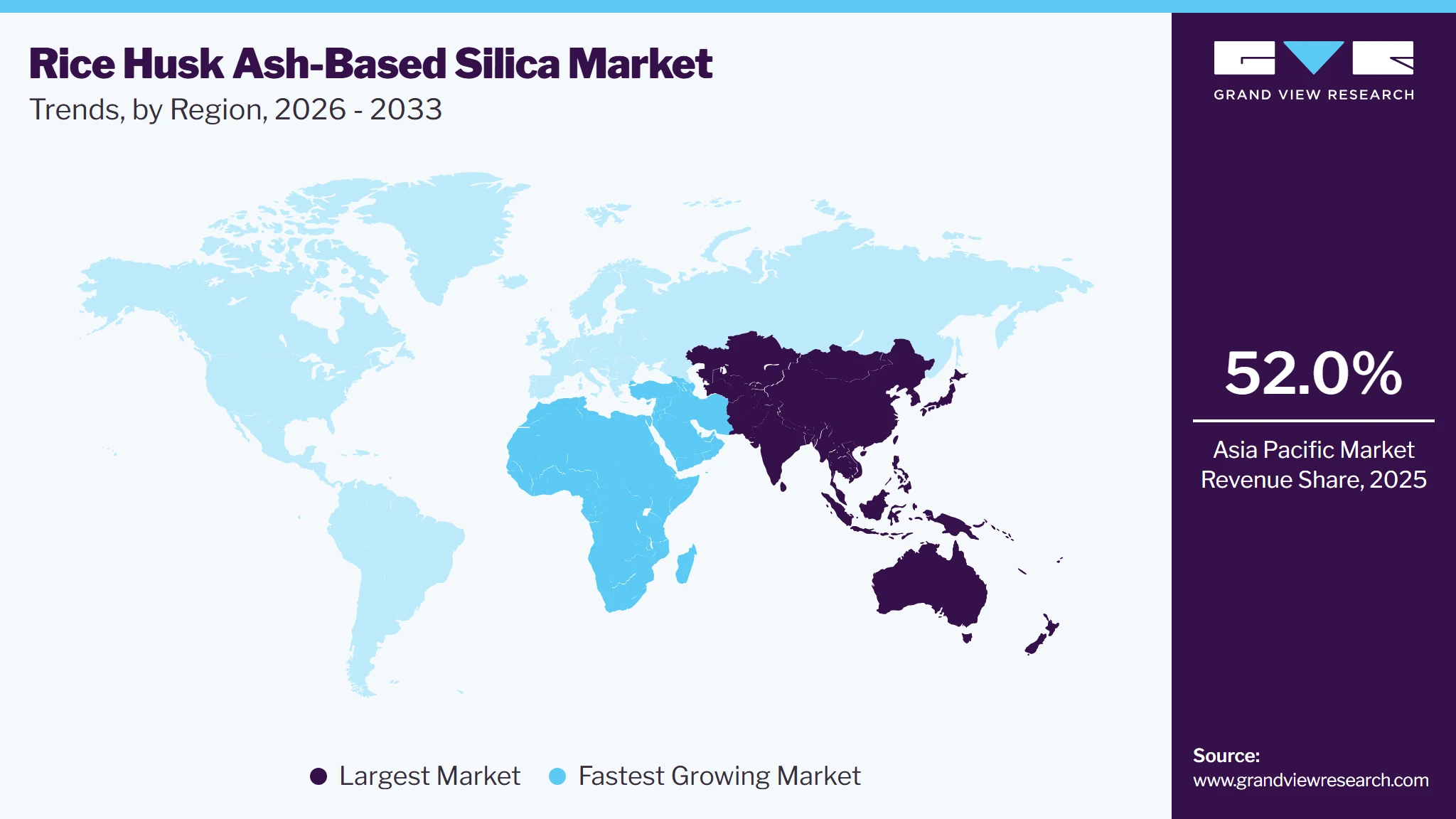
Asia Pacific dominated the rice husk ash-based silica market with the largest revenue share of 52.0% in 2025. The region is expected to remain a major market due to the presence of large rice-producing countries and a broad manufacturing base. China, India, Southeast Asia, and other regional economies generate substantial quantities of rice husk, providing a strong raw-material base for production. Expanding tire, rubber, construction, coatings, and consumer-product industries are supporting regional demand. The presence of local producers and technology developers is also strengthening the supply base.
 To learn more about this report, Download Free Sample Report
 China Rice Husk Ash-Based Silica Market Trends
China represents a significant market, supported by its large rice-processing industry and extensive manufacturing base. The availability of rice husk as an agricultural residue provides a potential feedstock for production, while growing interest in resource utilization and low-carbon materials supports adoption. Demand from rubber and tire manufacturing, paints and coatings, personal care, food and feed, and industrial applications is creating opportunities for rice husk ash-derived products. Continued development of extraction and processing technologies is also supporting commercialization.
North America Rice Husk Ash-Based Silica Market Trends
North America represents an established market for specialty products, supported by demand from rubber and tire manufacturing, coatings, personal care, and other industrial sectors. Adoption of rice husk-derived products remains dependent on product availability, customer qualification, pricing, and supply reliability. Increasing interest in sustainable raw materials is expected to create opportunities for suppliers entering the region.
U.S. Rice Husk Ash-Based Silica Market Trends
The U.S. is supported by demand from tire and rubber products, paints and coatings, construction materials, personal care, and industrial applications. Customers increasingly evaluate alternative raw materials based on cost, product consistency, and supply requirements. Commercial-scale availability and supplier qualification will remain important factors influencing adoption. Growing interest in converting agricultural residues into value-added materials is also supporting research and commercial development.
Europe Rice Husk Ash-Based Silica Market Trends
Europe is supported by strong interest in sustainable production, waste utilization, and alternative raw materials. Demand comes from rubber and tires, coatings, construction, personal care, and other industries. Environmental regulations and corporate sustainability targets are encouraging manufacturers to assess materials produced using agricultural by-products. Growth is expected to remain linked to product quality, regulatory compliance, and competitive pricing.
Latin America Rice Husk Ash-Based Silica Market Trends
Latin America offers growth opportunities due to its agricultural base and expanding industrial sectors. Brazil and other rice-producing countries provide access to rice husk as a potential raw material. Demand is supported by rubber products, construction, coatings, and other industrial applications. Development of local processing facilities and reliable supply networks will influence future adoption.
Middle East & Africa Rice Husk Ash-Based Silica Market Trends
The Middle East & Africa region represents an emerging opportunity, with demand supported mainly by construction, coatings, rubber products, and other industrial applications. Limited local production in several countries creates potential for imported products and regional supply partnerships. Adoption is expected to increase gradually as customers become more familiar with rice husk-derived materials and their available applications.
Key Rice Husk Ash-Based Silica Company Insights
Some of the key players operating in the market include Brisil Technologies Pvt. Ltd., Blue Ocean Biotech, and others.
-
Brisil Technologies Pvt. Ltd., established in 2016, is an India-based technology company focused on producing precipitated grades from rice husk ash. The company has developed technology for producing highly dispersible grades and other precipitated products using rice husk ash as a raw material. Its portfolio serves tires, rubber products, footwear, toothpaste, paints and coatings, pharmaceuticals, soaps, detergents, and food products. Brisil has established a commercial-scale production facility in Western India and focuses on expanding the use of rice husk-derived materials across industrial applications.
-
Blue Ocean Biotech, established in 2011, is an India-based sustainable manufacturing company with operations in agro-processing and specialty material production. The company offers Green Silica produced from rice husk ash for applications including tire and rubber manufacturing, food processing, pharmaceuticals, footwear, oral care, agrochemicals, and detergents. Its Green Silica facility has a reported production capacity of 10,000 metric tons per annum, with plans to expand capacity to 20,000 metric tons per annum. The company also offers different grades for rubber, tires, food, oral care, pharmaceuticals, agrochemicals, and detergent applications.
-
EKASIL, with its rice husk technology initiative established in 2016, is involved in developing and commercializing production technology based on rice husk. The company collaborated with technology developers and R&D institutes to develop its process, with its first industrial pilot project launched in 2016 at an initial capacity of 100 tons per month. Its portfolio serves applications including pharmaceuticals, skincare, tires, rubber, paints, and other industries. EKASIL also focuses on expanding its production technology in rice-producing countries and supporting commercial-scale adoption.
Key Rice Husk Ash-Based Silica Companies:
The following key companies have been profiled for this study on the rice husk ash-based market.
-
Bee Chems
-
Blue Ocean Biotech
-
Brisil Technologies Pvt. Ltd.
-
BSB Nanotech
-
EKASIL
-
Evonik Industries AG
-
Green Silica Group
-
ORYZASIL
-
Solvay S.A.
-
Yihai Kerry
Competitive Benchmarking
Category
Operating Strategies
Competitive Edge
Weakness
Established Players (Evonik Industries AG; Solvay S.A.; Yihai Kerry)
- Leverage existing silica, chemical, and agricultural-processing businesses to develop or supply products across multiple end-use industries.
- Use established distribution networks and customer relationships to access large industrial buyers and expand product reach.
- Focus on product development and application-specific grades to address requirements across rubber, tires, coatings, food, personal care, and other industries.
- Established industrial infrastructure and customer relationships provide access to large-volume buyers.
- Broader geographic presence can support regional sourcing, manufacturing, and distribution activities.
- Experience in related silica or agricultural-processing businesses can support product development and commercialization.
- Rice husk-derived products represent a relatively specialized part of broader business portfolios for some established companies.
- Large organizational structures may require longer commercial and technical qualification processes for new applications.
- Existing operations across conventional silica and other materials can create competing priorities for investment and capacity expansion.
Emerging & Regional Players (Bee Chems; Blue Ocean Biotech; Brisil Technologies Pvt. Ltd.; BSB Nanotech; EKASIL; Green Silica Group; ORYZASIL)
- Build businesses around rice husk-derived materials and target customers seeking alternative silica sources.
- Establish production facilities near rice-processing regions to improve access to raw materials and support localized supply.
- Expand into application-specific products and develop commercial partnerships with downstream manufacturers.
- Dedicated focus on rice husk-derived products allows greater attention to this specialized industry.
- Smaller operating structures can enable faster adaptation to customer requirements and emerging applications.
- Local presence in rice-producing regions can provide advantages in sourcing and relationships with rice-processing businesses.
- Smaller production footprints can limit their ability to serve customers requiring large and consistent volumes.
- Limited brand recognition may make customer qualification more challenging compared with established silica suppliers.
- Dependence on continued capacity expansion and customer adoption can increase exposure to commercialization risks.
Recent Development
-
In August 2026, Brisil Technologies raised a Pre-Series A funding round led by Peak Sustainability Ventures to scale commercial production of low-carbon precipitated silica derived from rice husk ash. The funding is intended to support production expansion, team development, and product development as the company increases supplies to customers in India and international markets. Brisil offers precipitated grades in powder and micro-pearl forms for applications including tires, rubber, footwear, toothpaste, paints, and coatings.
-
In January 2026, Brisil Technologies raised USD 0.31 million in pre-seed funding led by Momentum Capital, with participation from Fondation Botnar. The funding is intended to support the expansion of production capacity and operations for products derived from rice husk ash. Brisil operates a commercial production facility and serves applications including tires, footwear, paints, coatings, and other industrial products.
-
In January 2025, the Government of Tamil Nadu announced plans to explore silica production from rice husk as part of efforts to develop higher-value uses for rice-milling by-products. The state government indicated that it was considering a project to extract high-value materials from rice husk, highlighting opportunities to convert rice-processing residues into commercially useful products.
Rice Husk Ash-Based Silica Market Report Scope
Report Attribute
Details
Market Definition
The market size represents the revenue generated from the sale of rice husk ash-based silica across various regions in a given year.
Market size in 2025
USD 640.6 million
Estimated market size in 2026
USD 698.2 million
Projected market size by 2033
USD 1,410.4 million
Growth rate
CAGR of 10.6%from 2026 to 2033
Base year for estimation
2025
Historical data
2021 - 2024
Forecast period
2026 - 2033
Quantitative Units
Revenue in USD million, volume in tons, and CAGR from 2026 to 2033
Report coverage
Revenue forecast, volume forecast, competitive landscape, growth factors, and trends
Segments covered
Application, product type, region
Regional scope
North America; Europe; Asia Pacific; Latin America; Middle East & Africa
Country scope
U.S.; Canada; Mexico; Germany; UK; France; China; Japan; India; South Korea; Brazil
Key companies profiled
Bee Chems; Blue Ocean Biotech; Brisil Technologies Pvt. Ltd.; BSB Nanotech; EKASIL; Evonik Industries AG; Green Silica Group; ORYZASIL; Solvay S.A.; Yihai Kerry
Customization scope
Free report customization (equivalent up to 8 analysts working days) with purchase. Addition or alteration to country, regional & segment scope.
Pricing and purchase options
Avail customized purchase options to meet your exact research needs. Explore purchase options
Global Rice Husk Ash-Based Silica Market Report Segmentation
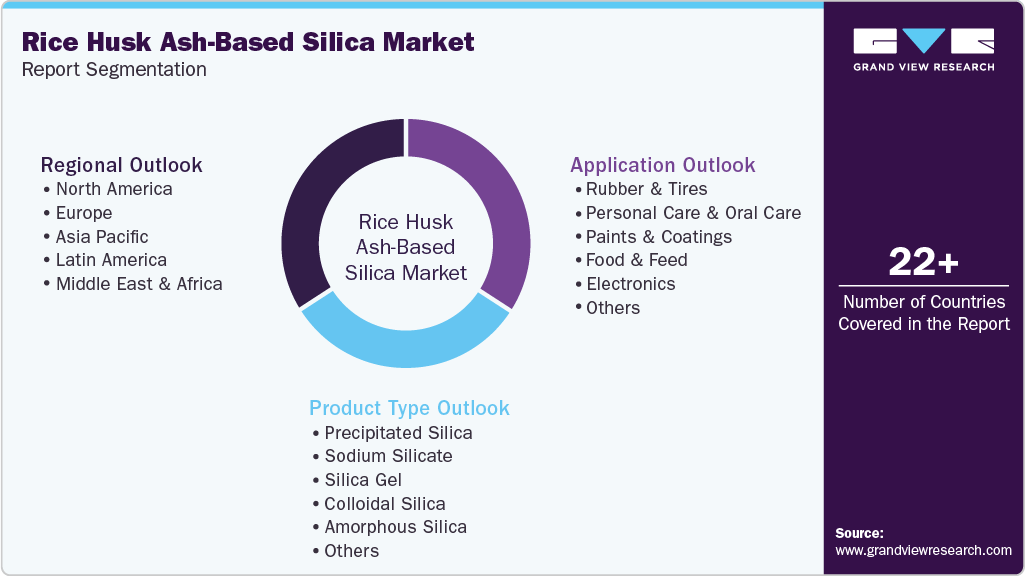
This report forecasts revenue and volume growth at global, regional, and country levels and provides an analysis of the latest industry trends in each of the sub-segments from 2021 to 2033. For the purpose of this study, Grand View Research has segmented the global rice husk ash-based silica market report on the basis of application, product type, and region.
 To learn more about this report, Download Free Sample Report
 -
Application Outlook (Volume, Tons; Revenue, USD Million; 2021 - 2033)
-
Rubber & Tires
-
Personal Care & Oral Care
-
Paints & Coatings
-
Food & Feed
-
Electronics
-
Others
-
-
Product Type Outlook (Volume, Tons; Revenue, USD Million; 2021 - 2033)
-
Precipitated Silica
-
Sodium Silicate
-
Silica Gel
-
Colloidal Silica
-
Amorphous Silica
-
Others
-
-
Regional Outlook (Volume, Tons; Revenue, USD Million; 2021 - 2033)
-
North America
-
U.S.
-
Canada
-
Mexico
-
-
Europe
-
Germany
-
UK
-
France
-
-
Asia Pacific
-
China
-
Japan
-
India
-
South Korea
-
-
Latin America
-
Brazil
-
-
Middle East & Africa
-
Research Methodology
The rice husk ash-based silica market figures in this report are based on a proven research process that combines executive interviews with secondary research from proprietary databases, company filings, and recognized regulatory and institutional sources. Market size is built through value-chain sizing—reconciling supply-side and demand-side estimates—and triangulated with bottom-up and top-down approaches. Every estimate passes multiple levels of expert validation before publication, with each rice husk ash-based silica segment quantified using the revenue-capture definitions in the table below.
Segment Definition
Application
Revenue Capture Definition
Rubber & Tires
Revenue from rice husk ash-based silica sold to tire manufacturers and rubber-product companies for use in tires, footwear, belts, hoses, seals, and other rubber goods.
Personal Care & Oral Care
Revenue from sales to manufacturers of toothpaste, skincare products, cosmetics, and other personal care products that incorporate rice husk ash-based silica into their formulations.
Paints & Coatings
Revenue from sales to manufacturers of architectural, industrial, protective, and specialty paints and coatings that use rice husk ash-based silica in their products.
Food & Feed
Revenue from sales of suitable grades to food and animal-feed manufacturers for incorporation into approved food, feed, and related formulations.
Electronics
Revenue from sales to electronics and electronic-material manufacturers using rice husk ash-based silica in the production of electronic components, materials, and related products.
Others
Revenue from sales to other end-use industries, including construction, pharmaceuticals, agrochemicals, detergents, and specialty industrial applications.
Product Type
Revenue Capture Definition
Precipitated Silica
Revenue from sales of precipitated silica produced from rice husk ash to manufacturers across tires, rubber, footwear, paints and coatings, personal care, and other end-use industries.
Sodium Silicate
Revenue from sales of sodium silicate produced rice husk-derived silica to chemical, detergent, construction, and other industrial manufacturers.
Silica Gel
Revenue from sales of rice husk-derived silica gel for packaging, moisture-control, adsorption, and other commercial applications.
Colloidal Silica
Revenue from sales of colloidal silica derived from rice husk-based raw materials to manufacturers serving construction, coatings, polishing, and other specialty applications.
Amorphous Silica
Revenue from sales of non-crystalline silica products derived from rice husk ash to manufacturers across rubber, coatings, construction, personal care, and other industries.
Others
Revenue from other rice husk-derived silica products that do not fall under the defined product categories, including specialty and application-specific grades.
Estimation Model
Layer No.
Layer Name
Key Question
Description
01
Rice Husk Availability Layer
How much rice husk is available for silica production?
Assess rice production and the resulting rice husk generation across major producing countries. Evaluate the portion of husk that can be collected and processed for silica production, considering availability of processing facilities, collection practices, competing uses, and geographic proximity to production units.
02
Ash & Silica Conversion Layer
How much silica can be produced from available rice husk ash?
Estimate the quantity of rice husk ash available for processing and determine the amount of silica that can be obtained from the usable ash. Account for processing yields, plant efficiency, product quality requirements, and losses during production to establish the potential output of commercial silica products.
03
Application & Consumption Layer
How much rice husk ash-based silica is consumed across end-use industries?
Assess consumption across rubber & tires, personal care & oral care, paints & coatings, food & feed, electronics, and other applications. Evaluate demand from individual industries, product requirements, adoption levels, and the use of rice husk-derived grades compared with conventional silica products.
04
Pricing & Revenue Layer
What is the monetary value of the installed glass demand?
Estimate revenue by multiplying the calculated consumption volume by the applicable average selling price. Pricing is assessed by product type, application, product grade, quality, purity, processing requirements, order volumes, and geographic market. Revenue is limited to sales of rice husk ash-based silica products and excludes revenue from raw rice husk, untreated rice husk ash, and unrelated silica products.
Delivered Customizations
This report has been delivered with the following In-depth customizations
Client Request
Customization Delivered
Value Adds
Production Capacity & Plant Analysis
Company-level assessment of production capacity, plant locations, expansion plans, commissioning timelines, and available production information for selected manufacturers.
Provides a clearer view of the competitive supply base and identifies capacity expansion that may affect future supply.
Import & Export Analysis
Assessment of trade flows, importing/exporting countries, major source markets, destination markets, and trade trends for relevant silica and precursor product categories, subject to available HS-code classification.
Help evaluate international supply patterns and identify potential export markets and sourcing opportunities.
Pricing & Cost Analysis
Analysis of pricing by product type, grade, application, geography, and order size, along with major cost components such as raw material, processing, energy, logistics, and packaging, where information is available.
Help with benchmark selling prices, understand cost differences, and assess potential pricing opportunities.
Frequently Asked Questions About This Report
The global rice husk ash-based silica market size was estimated at USD 640.6 million in 2025 and is expected to reach USD 698.2 million in 2026.
The global rice husk ash-based silica market is expected to grow at a compound annual growth rate of 10.6% from 2026 to 2033 to reach USD 1,410.4 million by 2033.
By application, rubber & tires accounted for the largest market revenue share of 40.0% in 2025.
Asia Pacific dominated the rice husk ash-based silica market with the largest revenue share of 52.0% in 2025.
The key factor driving the growth of the global rice husk ash-based silica market is the rising demand for sustainable, cost-effective silica alternatives across rubber, tire, construction, and industrial applications.
Some of the key players of the global rice husk ash-based silica market are Bee Chems, Blue Ocean Biotech, Brisil Technologies Pvt. Ltd., BSB Nanotech, EKASIL, Evonik Industries AG, Green Silica Group, ORYZASIL, Solvay S.A., Yihai Kerry, and others.
The rice husk ash-based silica market in China held the largest share in the Asia Pacific region in 2025.
By product type, the precipitated silica accounted for the largest market revenue share of 35.7% in 2025.
By product type, the colloidal silica segment is anticipated to register the fastest CAGR of 12.6% from 2026 to 2033.
About the Author(s)
Advanced Interior Materials Research Team
Advanced Materials · Advanced Interior MaterialsThis report was authored by the advanced interior materials research team at Grand View Research - comprising two research analysts, one senior research analyst, and one industry expert - with specialized expertise in the advanced interior materials segment of the advanced materials industry. All findings are based on proprietary advanced materials databases, executive interviews, and regulatory analysis, subject to internal peer review prior to publication.
Last Updated:
Speak to Analyst

Customize this report to your needs - add regions, segments, or data points, with 20% free customization.
Or view our licence options:


ISO 9001:2015 & 27001:2022 Certified
We are GDPR and CCPA compliant! Your transaction & personal information is safe and secure. For more details, please read our privacy policy.


