
- Home
- »
- Plastics, Polymers & Resins
- »
-
Rice Paper Packaging Market Size Report, 2026-2033GVR Report cover

Rice Paper Packaging Market (2026 - 2033)
Size, Share & Trends Analysis Report By Product (Sheets & Rolls, Pouches & Wraps, Labels & Stickers), By Application (Food & Beverage, Cosmetics & Personal Care, Retail & Gift Packaging), By Region, And Segment Forecasts
Market Size, 2025
$162.9MMarket Estimate, 2026
$174.0MMarket Forecast, 2033
$266.9MCAGR, 2026–2033
6.3%Rice Paper Packaging Market Summary
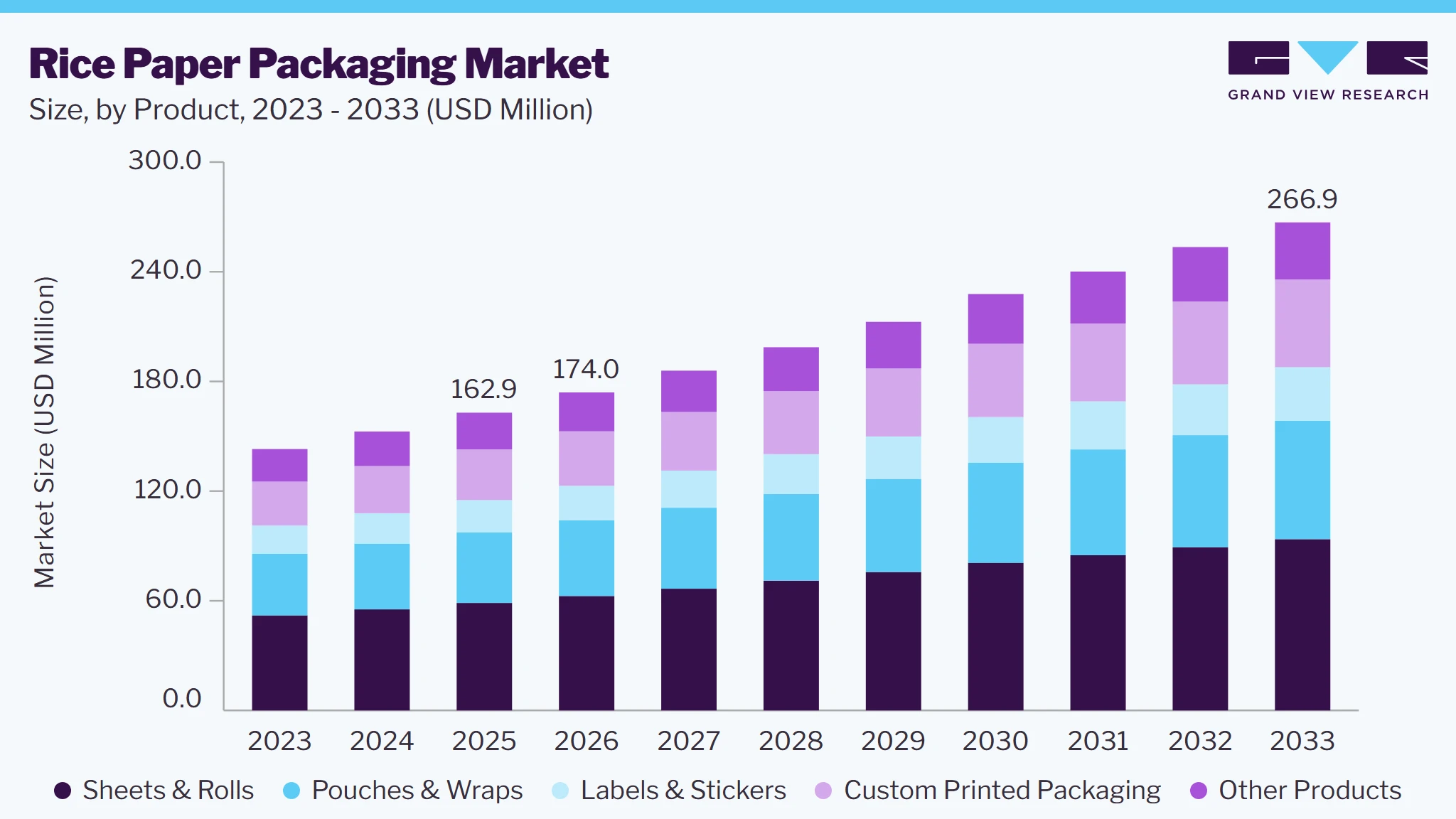
The global rice paper packaging market size was valued at USD 162.9 million in 2025 and is projected to grow from USD 174.0 million in 2026 to USD 266.9 million by 2033, at a CAGR of 6.3% from 2026 to 2033. North America dominated the market, accounting for a revenue share of 33.6% in 2025. The industry is driven by rising consumer demand for eco-friendly, biodegradable alternatives to plastic and increasing regulatory pressure to reduce single-use plastics.
 Source: Grand View Research, IR Documents, Primary Interviews, Paid DatabasesTo learn more about this report,
 Download Free Sample Report
Key Market Trends & Insights
- By product: Sheets & rolls segment led the market with the largest revenue share of 36.1% in 2025.
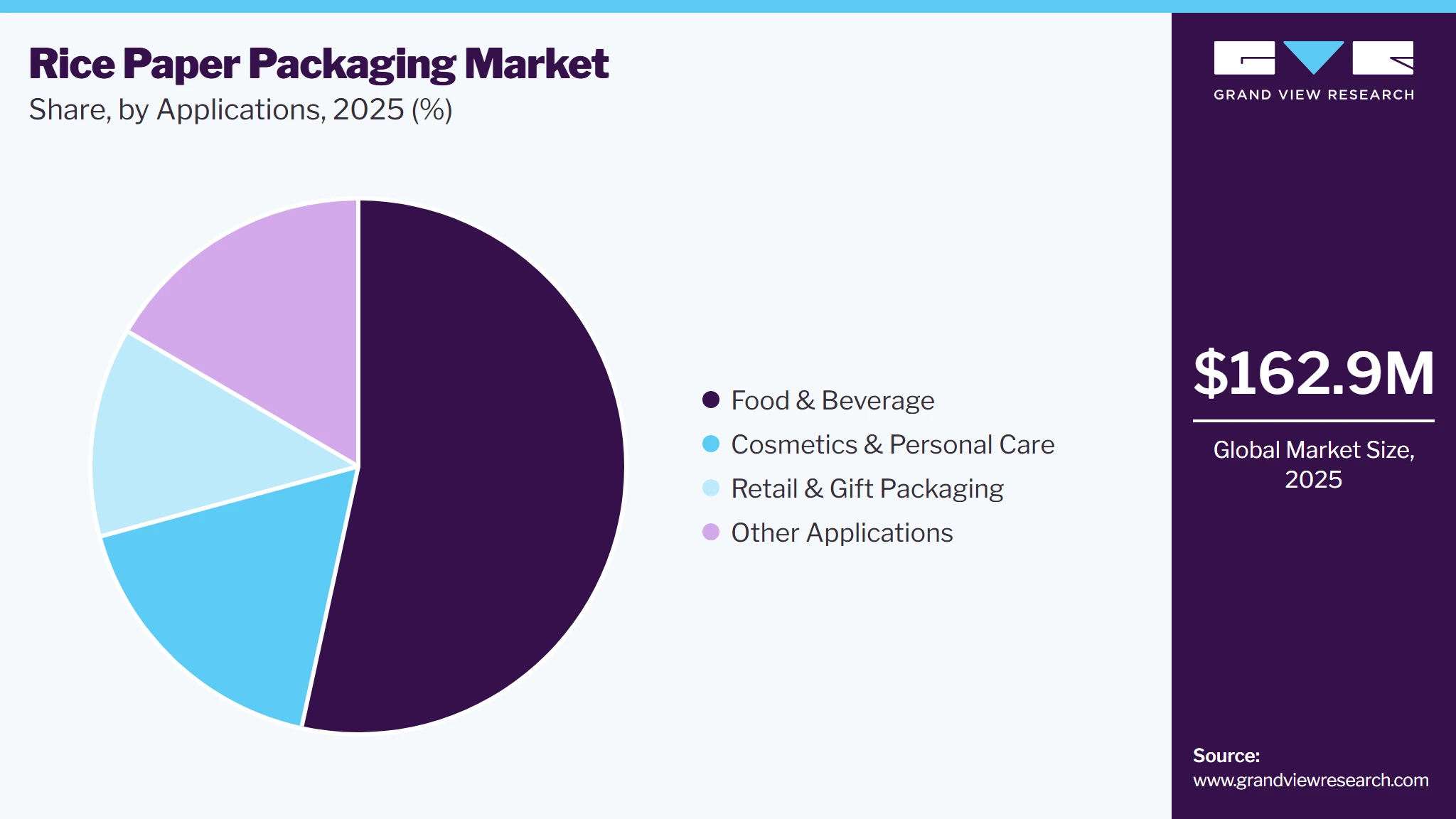
- By application: Food & beverage segment led the market with the largest revenue share of 53.4% in 2025.
Regional Highlights
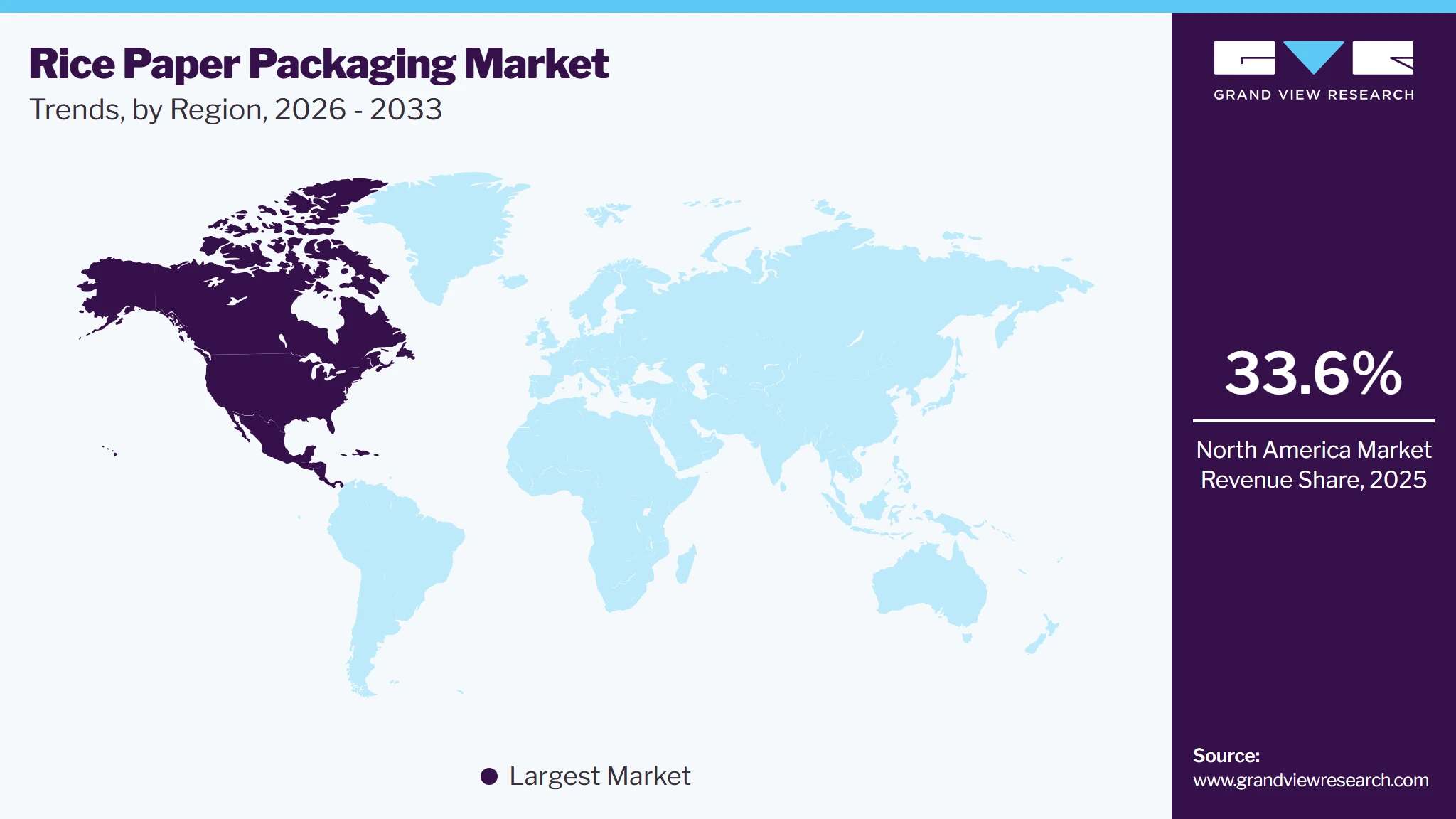
- Largest regional market: North America (33.6% revenue share, 2025)
- By country: The U.S. held the largest market share in 2025.
Market Size & Forecast
- Market size in 2025: USD 162.9 Million
- Estimated market size in 2026: USD 174.0 Million
- Projected market size by 2033: USD 266.9 Million
- CAGR (2026-2033): 6.3%
Prism AI by Grand View Research Free to tryAsk a question about the rice paper packaging marketTry asking✓Every figure cited from GVR research Prefer the report? Download free sample →
Additionally, its aesthetic appeal and suitability for food-safe applications boost its adoption in the food and retail sectors. As environmental concerns rise and awareness about plastic pollution spreads, rice paper, made from natural ingredients such as rice, tapioca, and water, offers a compostable and eco-friendly alternative to conventional plastic packaging. Governments and regulatory bodies across regions such as the EU, North America, and parts of Asia Pacific are implementing stringent regulations that push manufacturers to adopt biodegradable materials. For example, the EU's 2024 Packaging and Packaging Waste Regulation (PPWR) mandates ambitious recycled content targets for plastic packaging, which has triggered unprecedented research and development (R&D) investment across industries. PPWR requires all packaging to be recyclable or reusable by 2030, with specific minimum recycled content targets for plastic packaging increasing progressively through 2030 to 2040.Another key factor driving the industry is the surging demand for sustainable food packaging, especially in organic and health-conscious segments. Rice paper is already widely accepted in Asian cuisines and is now increasingly used to wrap snacks, candies, and even fresh produce in Western markets. Brands seeking a natural and artisanal aesthetic prefer rice paper for its transparent, minimalistic look that aligns well with clean-label products. For instance, organic food brands in the U.S. have started using rice paper wraps for chocolate and dry snacks to appeal to eco-conscious millennials and Gen Z consumers.
 To learn more about this report, Download Free Sample Report
The growth of e-commerce and eco-friendly gifting trends is also propelling the industry. E-commerce brands, particularly those offering handmade, vegan, or artisanal products, are leveraging rice paper for inner wrapping to enhance brand identity and reduce their carbon footprint. Rice paper is lightweight, reducing shipping costs and carbon emissions, making it suitable for sustainable logistics. In Japan and South Korea, rice paper is even being used in premium gift packaging and origami-style designs, enhancing product presentation while minimizing plastic use.
Moreover, supportive market dynamics in Asia-Pacific and emerging economies are creating significant growth opportunities. Countries such as Vietnam, Thailand, and Indonesia have abundant raw materials and traditional know-how related to rice paper production, enabling scalable and cost-effective manufacturing. With increasing global demand and supportive export policies, these nations are well-positioned as key supply hubs. Additionally, the rise in local consumption of eco-friendly products in these regions is fostering domestic adoption. As both local and international brands look to align with sustainable development goals (SDGs), rice paper packaging is expected to emerge as a viable and attractive option in the coming years.
Market Dynamics
The rice paper packaging market is witnessing steady growth due to the increasing preference for biodegradable and plastic-free packaging solutions across food, retail, and specialty consumer goods industries. Rising environmental awareness among consumers and stricter regulations on single-use plastics are encouraging manufacturers to adopt renewable, compostable materials. Rice paper packaging offers lightweight, recyclable, and aesthetically appealing properties, making it suitable for premium food wraps, gift packaging, and eco-friendly product presentation. Growing investments in sustainable packaging technologies and innovations in moisture-resistant rice paper are further supporting market expansion across developed and emerging economies.
Governments, retailers, and brand owners are increasingly replacing conventional plastic packaging with biodegradable alternatives to meet sustainability targets and reduce environmental impact. Rice paper packaging, produced from renewable plant-based materials, aligns well with circular economy initiatives and growing consumer demand for eco-conscious products. Food service providers, organic food brands, and premium retailers are increasingly adopting rice paper packaging to strengthen their environmental credentials while complying with evolving packaging regulations.
The expansion of sustainable food delivery, specialty retail, and premium gifting markets is further accelerating demand. Consumers are increasingly willing to pay for environmentally friendly packaging that enhances product presentation without compromising sustainability. Continuous improvements in barrier coatings, printing compatibility, and durability are also expanding the application scope of rice paper packaging across various end-use industries.
Despite its sustainability advantages, rice paper packaging faces challenges related to moisture sensitivity, lower mechanical strength, and relatively higher production costs compared to conventional plastic packaging. These limitations restrict its use in applications requiring high barrier performance or extended product shelf life. Manufacturers often need to incorporate additional coatings or processing techniques, increasing overall production expenses and limiting adoption in cost-sensitive markets.
Advancements in bio-based coatings, edible packaging technologies, and fiber reinforcement are creating significant opportunities for the rice paper packaging market. Manufacturers are developing moisture-resistant, grease-resistant, and heat-sealable rice paper solutions that improve performance while maintaining biodegradability. Growing investments in sustainable material research and partnerships between packaging companies and food brands are expected to expand commercial applications and open new opportunities in premium packaging, takeaway food packaging, cosmetics, and specialty retail products.
Market Concentration & Characteristics
The industry is still in the early stages of industrial adoption, categorized as a niche within the overall biodegradable and sustainable packaging sector. While demand is growing, especially among eco-conscious consumers and small to mid-sized organic brands, large-scale industrial adoption remains limited. The market is characterized by a relatively small number of specialized producers, mainly concentrated in regions with traditional expertise, such as China, Vietnam, Thailand, and Indonesia.
The industry heavily depends on agricultural raw materials such as rice starch, tapioca, and water, making it sensitive to crop yields and seasonal variations. Additionally, production is regionally concentrated, especially in Asia-Pacific, which has abundant raw materials and low-cost skilled labor for artisanal production. This geographic concentration offers cost advantages but also makes the industry susceptible to supply chain disruptions and trade policy changes.
 To learn more about this report, Download Free Sample Report
Moreover, the industry has low technological barriers to entry, especially for small-scale producers, which encourages the participation of craft-based or regional firms. However, scaling operations to meet industrial packaging standards, especially in terms of moisture resistance, tensile strength, and automated packaging line compatibility, poses a challenge. This limits the ability of the market to quickly transition into mass production for mainstream FMCG applications.
Analyst Perspective
The rice paper packaging market is gaining momentum as brands increasingly adopt biodegradable packaging to meet sustainability goals and reduce plastic usage. Demand is rising across food & beverage, cosmetics, and premium retail sectors, supported by growing consumer preference for eco-friendly packaging. Innovations in moisture-resistant coatings, printable surfaces, and customized packaging designs are enhancing product performance and expanding application areas. Although higher production costs remain a challenge, continued investments in sustainable materials and supportive environmental regulations are expected to drive long-term market growth.
Product Insights
Based on product, the sheets & rolls segment led the market with the largest revenue share of 36.1% in 2025. Sheets and rolls are widely used forms of rice paper packaging. They are typically supplied in flat or rolled formats and used for direct food wrapping, interleaving food items, or as liners in food containers. Their biodegradable and compostable properties make them highly favorable for sustainable packaging solutions in both foodservice and retail applications.
Custom printed packaging is projected to grow at the fastest CAGR of 7.7% during the forecast period. This segment includes rice paper materials that are customized with logos, patterns, or product information using eco-friendly printing techniques. Custom printed packaging is widely used for boutique brands, gift items, and premium organic products. It enhances brand identity while maintaining environmental credibility.
Application Insights
Based on application, the food & beverage segment led the market with the largest revenue share of 53.4% in 2025. Rice paper packaging is widely used in the food and beverage industry due to its edible nature, biodegradability, and aesthetic appeal. It is especially common for wrapping snacks, candies, specialty food items, and artisanal goods, particularly in eco-conscious or premium product lines. The material also offers moisture resistance and is perceived as a natural alternative to plastic.
 To learn more about this report, Download Free Sample Report
Cosmetics & personal care is projected to grow at the fastest CAGR of 7.5% during the forecast period. Rice paper packaging is used for wrapping soap bars, bath bombs, and eco-friendly product lines. Its smooth, translucent texture offers a natural and premium feel, appealing to brands emphasizing sustainability and aesthetics. Rising consumer awareness around sustainable beauty and wellness products is fueling the demand for biodegradable and zero-waste packaging.
Rice paper is also preferred in retail and gift packaging for its visual elegance, natural texture, and customizable surface. It is often used for wrapping specialty gifts, handmade crafts, luxury stationery, and eco-friendly product collections, lending a premium, artisanal look. Growing demand for customized, eco-conscious gift and retail packaging solutions is a major contributor to segment growth.
Regional Insights
North America dominated the rice paper packaging market with the largest revenue share of 33.6% in 2025. This dominance can be attributed to its stringent environmental regulations and consumer preference for sustainable products. The U.S. and Canada are witnessing a surge in demand for compostable and biodegradable packaging, particularly in the food and beverage sector. The rise of e-commerce has also fueled demand for eco-friendly shipping materials, with rice paper being used as an alternative to bubble wrap and plastic fillers. Corporate sustainability commitments, such as those by McDonald’s and Starbucks, further drive adoption, pushing manufacturers to invest in rice-based materials.
 To learn more about this report, Download Free Sample Report
U.S. Rice Paper Packaging Market Trends
The rice paper packaging market in U.S. held the largest share in the North America region in 2025. The rice paper packaging market in the U.S. is primarily driven by sustainability trends, corporate ESG commitments, and federal/state-level plastic restrictions. Major food brands and retailers are adopting rice paper for products such as snack wrappers, tea bags, and bakery packaging.
Europe Rice Paper Packaging Market Trends
The rice paper packaging market in Europe is primarily driven by strict EU regulations on single-use plastics and a strong circular economy framework. Countries such as Germany, France, and the UK are leading the shift toward biodegradable packaging, with rice paper being used for food wraps, tea bags, and disposable cutlery. For example, German companies such as Bio4Pack offer rice-based packaging for organic food brands, aligning with the EU’s Green Deal objectives. The region’s well-established food delivery sector is also adopting rice paper containers as a sustainable alternative to plastic. Additionally, European consumers’ high willingness to pay for eco-friendly products supports market expansion, with startups innovating in edible rice packaging for confectionery and gourmet foods.
Asia Pacific Rice Paper Packaging Market Trends
The rice paper packaging market in Asia Pacific is anticipated to grow at the fastest CAGR of 7.5% over the forecast period. This outlook is due to its strong agricultural base, increasing sustainability awareness, and government initiatives promoting eco-friendly alternatives. Countries such as China, India, and Japan are leading the adoption of rice-based packaging as a biodegradable solution to combat plastic pollution. For example, China’s ban on single-use plastics has accelerated demand for rice paper packaging in food service and retail industries. Startups in Southeast Asia are innovating with rice-based edible packaging for coffee and snacks, further boosting market growth.
Key Rice Paper Packaging Companies Insights
Key players operating in the rice paper packaging market are undertaking various initiatives to strengthen their presence and increase the reach of their products and services. Strategies such as expansion activities and partnerships are key in propelling the market growth.
Key Rice Paper Packaging Companies:
The following key companies have been profiled for this study on the rice paper packaging market.
-
TIPA LTD
-
Green Compostables
-
Guangdong BN Packaging Co., Ltd
-
IMPAK Corporation
-
TedPack Company Limited
-
VINPACK JOINT STOCK COMPANY
-
MST Packaging Co., Ltd.
-
Huizhou Yito Packaging Co., Ltd.
-
MTPak Coffee
-
Biopacktech Co., Ltd.
-
ClearBags
-
BioPack
-
GreenBiobag Co., Ltd.
Competitive Benchmarking
Category
Operating Strategies
Competitive Edge
Weakness
Established Players (TIPA LTD, Green Compostables, Guangdong BN Packaging Co., Ltd., IMPAK Corporation, TedPack Company Limited, VINPACK JOINT STOCK COMPANY, MST Packaging Co., Ltd.)
- Focus on expanding sustainable packaging portfolios through continuous product innovation, development of biodegradable and compostable rice paper packaging, and strategic partnerships with food, retail, and consumer goods brands.
- Invest in advanced printing technologies, customized packaging solutions, and manufacturing capacity expansion to address increasing demand for eco-friendly packaging across domestic and international markets.
- Strong manufacturing capabilities, established distribution networks, broad product portfolios, and long-term relationships with food processors, retailers, and packaging distributors enable large-scale supply.
- Significant investments in sustainable material development, customization capabilities, and international certifications strengthen brand reputation and competitive positioning.
- Higher production costs associated with sustainable raw materials and advanced manufacturing technologies may reduce price competitiveness in cost-sensitive markets.
- Dependence on evolving environmental regulations, raw material availability, and fluctuating demand for premium sustainable packaging increases operational complexity and investment requirements.
Emerging Players (Huizhou Yito Packaging Co., Ltd., MTPak Coffee, Biopacktech Co., Ltd., ClearBags, BioPack, GreenBiobag Co., Ltd.)
- Concentrate on niche applications, customized biodegradable packaging, and innovative rice paper solutions for specialty food, coffee, cosmetics, and retail packaging markets.
- Expand regional presence through sustainable product development, digital sales channels, and collaborations with local distributors, e-commerce platforms, and private-label brands to strengthen market penetration.
- Greater operational flexibility enables faster product customization, shorter production cycles, and quicker adaptation to changing customer preferences.
- Competitive pricing, specialized eco-friendly packaging solutions, and strong focus on biodegradable materials help these companies establish a presence in high-growth market segments.
- Limited production capacity, relatively smaller global distribution networks, and lower financial resources restrict participation in large-volume international packaging contracts.
- Lower brand recognition, fewer long-term customer relationships, and limited investment in advanced manufacturing technologies may slow expansion into highly competitive global markets.
Recent Developments
-
In February 2025, Bio4Pack and Argos Packaging formed a strategic partnership to introduce innovative, sustainable trays made from paddy straw, a by-product of rice plantations, exclusively in the Netherlands. This rice-based packaging solution offers significant environmental benefits by utilizing rice straw waste that would otherwise be burned, thereby reducing harmful emissions, lowering CO2 output, improving air quality, and protecting groundwater.
-
In November 2023, TIPA, a compostable packaging solutions provider, launched an innovative fully compostable and recyclable packaging tray made from rice waste, specifically paddy straw, an agricultural byproduct typically burned and causing air pollution. These trays offer a sustainable alternative to plastic and polystyrene takeaway containers, aligning with recent bans on such plastics in the UK and other regions.
Rice Paper Packaging Market Report Scope
Report Attribute
Details
Market size in 2025
USD 162.9 million
Estimated market size in 2026
USD 174.0 million
Projected market size by 2033
USD 266.9 million
Growth rate
CAGR of 6.3% from 2026 to 2033
Base year for estimation
2025
Historical data
2021 - 2024
Forecast period
2026 - 2033
Quantitative units
Revenue in USD million/billion, and CAGR from 2026 to 2033
Report coverage
Revenue forecast, company ranking, competitive landscape, growth factors, and trends
Segments covered
Product, application, region
Regional scope
North America; Europe; Asia Pacific; Latin America; MEA
Country scope
U.S.; Canada; Mexico; Germany; France; UK; Italy; Spain; China; India; Japan; South Korea; Australia; Brazil; Argentina; South Africa; Saudi Arabia; UAE
Key companies profiled
TIPA LTD; Green Compostables; Guangdong BN Packaging Co.,Ltd; IMPAK Corporation; TedPack Company Limited; VINPACK JOINT STOCK COMPANY; MST Packaging Co., Ltd.; Huizhou Yito Packaging Co., Ltd.; MTPak Coffee; Biopacktech Co.,Ltd.; ClearBags; BioPack; GreenBiobag Co.,Ltd.
Customization scope
Free report customization (equivalent up to 8 analysts' working days) with purchase. Addition or alteration to country, regional & segment scope.
Pricing and purchase options
Avail customized purchase options to meet your exact research needs. Explore purchase options
Global Rice Paper Packaging Market Report Segmentation
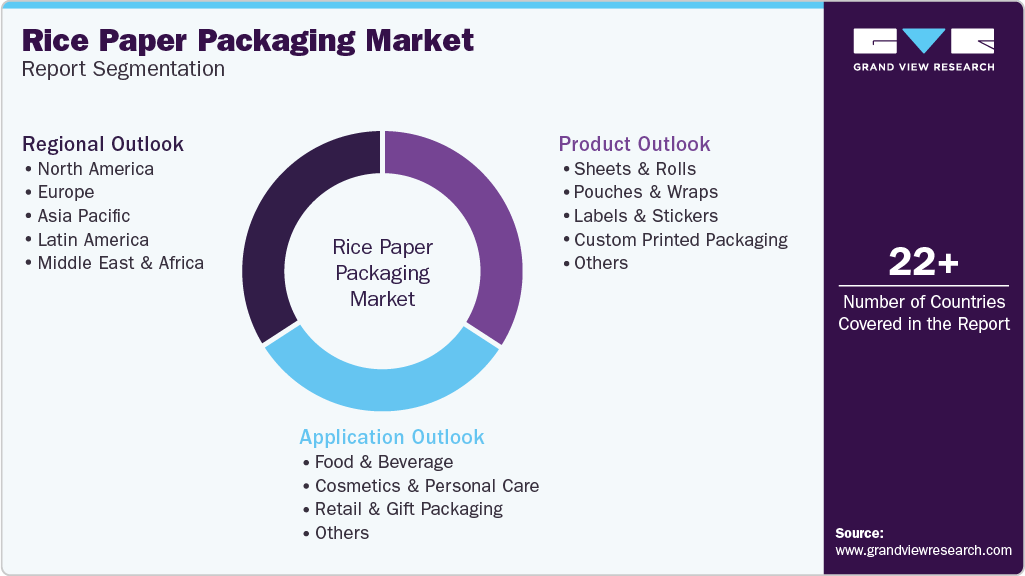
This report forecasts revenue growth at the global, regional and country levels and provides an analysis of the latest industry trends in each of the sub-segments from 2021 to 2033. For this study, Grand View Research has segmented the global rice paper packaging market report based on product, application, and region:
 To learn more about this report, Download Free Sample Report
-
Product Outlook (Revenue, USD Million, 2021 - 2033)
-
Sheets & Rolls
-
Pouches & Wraps
-
Labels & Stickers
-
Custom Printed Packaging
-
Others
-
-
Application Outlook (Revenue, USD Million, 2021 - 2033)
-
Food & Beverage
-
Cosmetics & Personal Care
-
Retail & Gift Packaging
-
Others
-
-
Regional Outlook (Revenue, USD Million, 2021 - 2033)
-
North America
-
U.S.
-
Canada
-
Mexico
-
-
Europe
-
Germany
-
France
-
UK
-
Italy
-
Spain
-
-
Asia Pacific
-
China
-
India
-
Japan
-
South Korea
-
Australia
-
-
Latin America
-
Brazil
-
Argentina
-
-
Middle East & Africa
-
South Africa
-
Saudi Arabia
-
UAE
-
-
Research Methodology
The rice paper packaging market figures in this report are based on a proven research process that combines executive interviews with secondary research from proprietary databases, company filings, and recognized regulatory and institutional sources. Market size is built through value-chain sizing - reconciling supply-side and demand-side estimates - and triangulated with bottom-up and top-down approaches. Every estimate passes multiple levels of expert validation before publication, with each rice paper packaging segment quantified using the revenue-capture definitions in the table below.
Segment Definition
Segment - Product
Revenue capture definition
Sheets & Rolls
Revenue generated from the sale of rice paper sheets and rolls used for wrapping, lining, separating, and protecting food products, gifts, handicrafts, and retail merchandise while providing an environmentally friendly packaging solution.
Pouches & Wraps
Revenue generated from the sale of rice paper pouches, sachets, bags, and wrapping materials used for packaging food products, cosmetics, personal care items, and specialty consumer goods requiring sustainable and lightweight packaging.
Labels & Stickers
Revenue generated from the sale of rice paper-based labels and stickers used for product branding, packaging identification, decorative labeling, ingredient information, and eco-friendly product presentation across multiple industries.
Custom Printed Packaging
Revenue generated from the sale of customized rice paper packaging featuring company logos, graphics, branding elements, product information, promotional designs, and personalized printing for commercial and retail packaging applications.
Other Products
Revenue generated from the sale of other rice paper packaging products, including envelopes, sleeves, inserts, liners, decorative packaging accessories, protective wraps, and specialty packaging formats designed for niche applications.
Segment - Application
Revenue capture definition
Food & Beverage
Revenue generated from the use of rice paper packaging for wrapping, serving, storing, transporting, and presenting bakery products, confectionery, fresh produce, takeaway meals, specialty foods, and premium food & beverage products.
Cosmetics & Personal Care
Revenue generated from the use of rice paper packaging for cosmetic, skincare, fragrance, beauty, and personal care products that require premium appearance, sustainable packaging, brand differentiation, and environmentally responsible product presentation.
Retail & Gift Packaging
Revenue generated from the use of rice paper packaging for retail merchandise, luxury goods, gift wrapping, promotional products, festive packaging, and premium product presentation to enhance customer experience and brand value.
Other Applications
Revenue generated from the use of rice paper packaging in other applications, including stationery, handicrafts, floral packaging, hospitality, event packaging, artisanal products, and various specialty industrial and commercial packaging requirements.
Estimation Model
Layer Name
Key Question
Description
Sustainable Packaging Demand Base Layer
What forms the demand base?
Identify the global demand for sustainable and biodegradable packaging across food & beverage, cosmetics, retail, gifting, and specialty consumer goods industries. This layer establishes the total addressable demand for rice paper packaging based on consumer preference for eco-friendly materials, packaging consumption volumes, sustainability initiatives, and regulations limiting conventional plastic packaging.
Rice Paper Packaging Adoption Layer
Where is rice paper packaging utilized?
Estimate the adoption of rice paper packaging across food manufacturers, restaurants, bakeries, confectionery producers, cosmetic brands, retailers, e-commerce companies, gift packaging providers, and artisanal businesses. Assess the penetration of rice paper sheets, rolls, pouches, wraps, labels, and customized packaging solutions across developed and emerging markets.
Packaging Consumption Intensity Layer
How much packaging volume utilizes rice paper solutions?
Analyze the volume of products packaged using rice paper based on production output, packaging frequency, product type, sustainability requirements, branding needs, retail sales, and consumer demand for environmentally responsible packaging. Packaging intensity is influenced by premium product positioning, regulatory compliance, eco-conscious purchasing behavior, and the expansion of biodegradable packaging applications.
Revenue Layer
How is market revenue generated?
Market revenue is quantified through the sale of rice paper packaging products, including sheets & rolls, pouches & wraps, labels & stickers, custom printed packaging, and other specialty packaging formats. Revenue is generated from recurring demand across food & beverage companies, cosmetics manufacturers, retailers, gift packaging businesses, and other commercial users, supported by the growing shift toward sustainable, biodegradable, and premium packaging solutions.
Delivered Customizations
This report has been delivered with the following In-depth customizations
Client Request
Customization Delivered
Value Adds
Regional Segmentation Analysis
Detailed assessment of market size, growth drivers, regulatory landscape, demand trends, and competitive dynamics across North America, Europe, Asia Pacific, Latin America, and the Middle East & Africa.
Enables identification of high-growth regions, investment opportunities, and region-specific market entry and expansion strategies.
Competitive Benchmarking
Comprehensive comparison of leading rice paper packaging manufacturers based on product portfolio, sustainability initiatives, manufacturing capabilities, pricing strategies, geographic presence, and recent strategic developments.
Helps stakeholders evaluate competitive positioning, identify market gaps, and formulate effective differentiation and growth strategies.
Supply Chain & Sustainability Analysis
In-depth evaluation of raw material sourcing, manufacturing processes, distribution networks, circular economy initiatives, compostability standards, and sustainability practices influencing the rice paper packaging value chain.
Provides actionable insights to optimize procurement, strengthen supply chain resilience, improve sustainability performance, and support compliance with evolving environmental regulations.
Frequently Asked Questions About This Report
Asia Pacific is the fastest-growing region in the rice paper packaging market with a CAGR of 6.8% over the forecast period.
The custom printed packaging segment is the fastest-growing product in the rice paper packaging market, with a CAGR of 7.0% over the forecast period.
The sheets & rolls segment led the rice paper packaging market with a 36.1% revenue share in 2025.
The food & beverage segment led the rice paper packaging market with a 53.4% revenue share in 2025.
The global rice paper packaging market size was valued at USD 162.9 million in 2025 and is estimated at USD 174.0 million for 2026.
The global rice paper packaging market is expected to grow at a CAGR of 6.3% from 2026 to 2033, reaching USD 266.9 million by 2033.
North America dominated the rice paper packaging market with a 33.6% revenue share in 2025.
The key players in the rice paper packaging market include TIPA LTD; Green Compostables; Guangdong BN Packaging Co.,Ltd; IMPAK Corporation; TedPack Company Limited; VINPACK JOINT STOCK COMPANY; MST Packaging Co., Ltd.; Huizhou Yito Packaging Co., Ltd.; MTPak Coffee; Biopacktech Co.,Ltd.; ClearBags; BioPack; and GreenBiobag Co.,Ltd.
Key factors driving the rice paper packaging market include rising demand for biodegradable packaging, growing restrictions on single-use plastics, and increasing consumer preference for sustainable and premium packaging solutions.
About the Author(s)
Plastics, Polymers & Resins Research Team
Bulk Chemicals · Plastics, Polymers & ResinsThis report was authored by the plastics, polymers & resins research team at Grand View Research - comprising two research analysts, one senior research analyst, and one industry expert - with specialized expertise in the plastics, polymers & resins segment of the bulk chemicals industry. All findings are based on proprietary bulk chemicals databases, executive interviews, and regulatory analysis, subject to internal peer review prior to publication.
Last Updated:
Speak to Analyst

Customize this report to your needs - add regions, segments, or data points, with 20% free customization.
Or view our licence options:


ISO 9001:2015 & 27001:2022 Certified
We are GDPR and CCPA compliant! Your transaction & personal information is safe and secure. For more details, please read our privacy policy.


