
- Home
- »
- Communication Services
- »
-
Satellite Surveillance Services Market Report, 2026-2033GVR Report cover

Satellite Surveillance Services Market (2026 - 2033)
Size, Share & Trends Analysis Report By Service (Imaging, Monitoring & Surveillance, Data Analytics, Mapping, Communication & Data Transmission), By Platform (LEO, MEO, GEO), By Application, By End-use, By Region, And Segment Forecasts
Market Size, 2025
$8.1BMarket Estimate, 2026
$8.8BMarket Forecast, 2033
$20.0BCAGR, 2026–2033
12.4%Satellite Surveillance Services Market Summary
The global satellite surveillance services market size was valued at USD 8.1 billion in 2025 and is projected to grow from USD 8.8 billion in 2026 to USD 20.0 billion by 2033, at a CAGR of 12.4% from 2026 to 2033. The North America held the largest share of 37.0% of the global market in 2025. The market expansion is driven by the increasing deployment of high-resolution Earth observation satellites, the integration of advanced geospatial analytics and AI-powered image processing technologies into surveillance platforms, and the growing demand for continuous real-time monitoring to support national security, environmental protection, and infrastructure management initiatives.
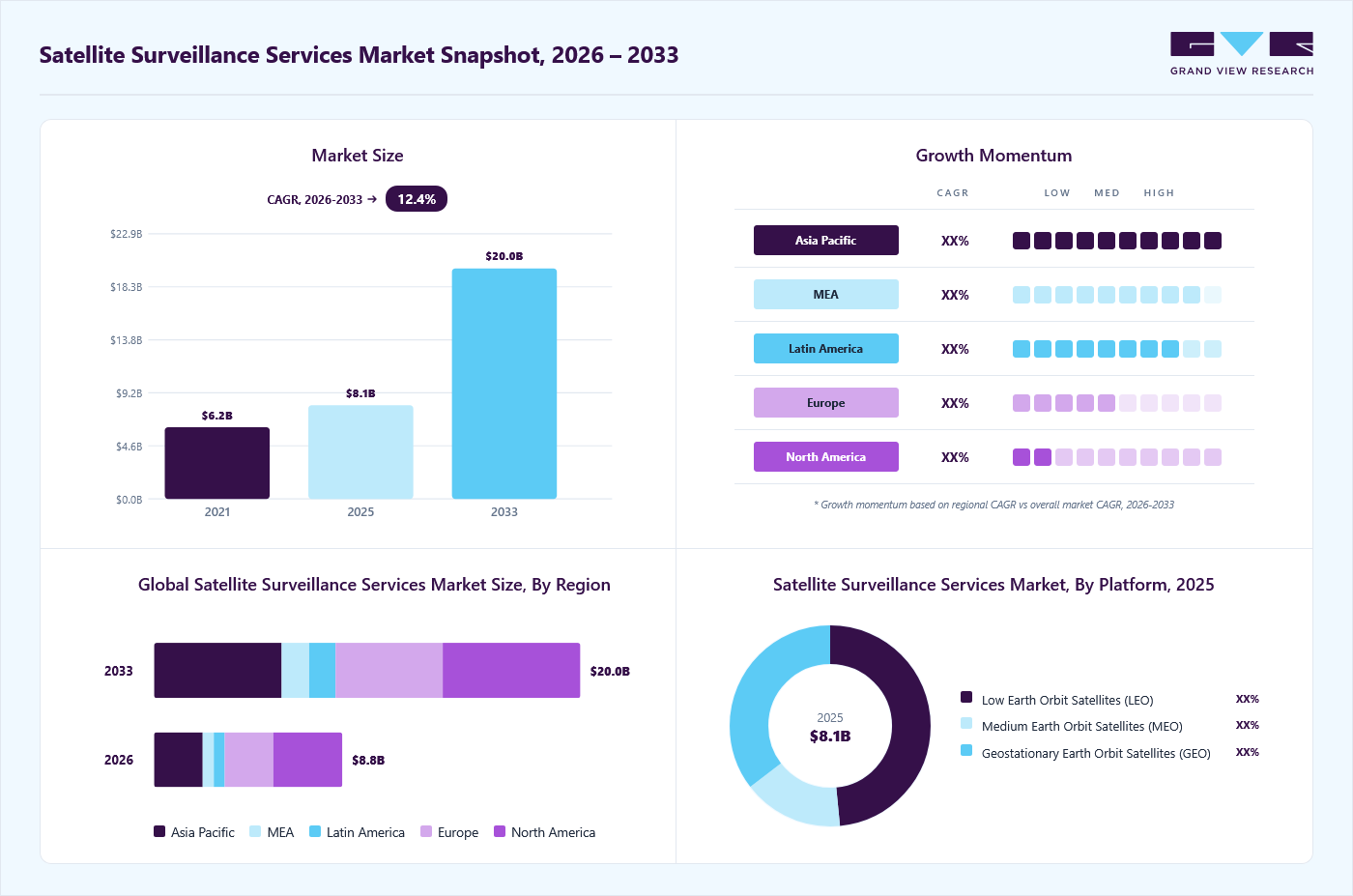 Source: Grand View Research, IR Documents, Primary Interviews, Paid DatabasesTo learn more about this report,
 Download Free Sample Report
Key Market Trends & Insights
- By service: Monitoring & surveillance segment held the largest market share of 31.0% in 2025.
- By application: Defense & intelligence segment held the largest market share in 2025.
- By end-use: Government agencies segment held the largest market share in 2025.
- By platform: Low earth orbit satellites segment held the largest market share in 2025.
Regional Highlights
- Largest regional market: North America (37.0% revenue share, 2025)
- Fastest-growing regional market: Asia Pacific (highest CAGR, 2026-2033)
- By country: The U.S. held the largest share in 2025
Market Size & Forecast
- Market size in 2025: USD 8.1 Billion
- Estimated market size in 2026: USD 8.8 Billion
- Projected market size by 2033: USD 20.0 Billion
- CAGR (2026-2033): 12.4%
Three ways to get this report
Buy it, customize it, or ask a question.Ask an Analyst
Analyst response in 1 business day
- AccessReport author, directly
- Reply timeWithin 1 working day
- No sales callDirect answer only
- FormatEmail reply
- CostFree, no cost
Get the Full Report
What the study covers
- FormatsPDF · Excel · Dashboard
- Timeline2026–2033 annual, 2025 base
- Coverage20+ countries, 5 regions
- Companies10+ key players profiled
Customize the Report
20% free customization
- IncludeCountries, segments, points
- TailorTo your product definition
- ExtendDeeper competitor detail
- OrA fully bespoke study
- Turnaround5–10 working days
The growth of the satellite surveillance services industry is driven by the rapid advancement of high-resolution imaging sensors, enhanced satellite communication bandwidth, and cost-efficient launch technologies. The adoption of satellite surveillance services is accelerating as governments, defense agencies, and commercial organizations seek reliable real-time monitoring solutions to strengthen border security, manage critical infrastructure, and improve disaster response coordination. The increasing integration of artificial intelligence, geospatial analytics, and cloud-based data processing technologies enhances situational awareness, predictive intelligence, and decision-making capabilities in the satellite surveillance services industry.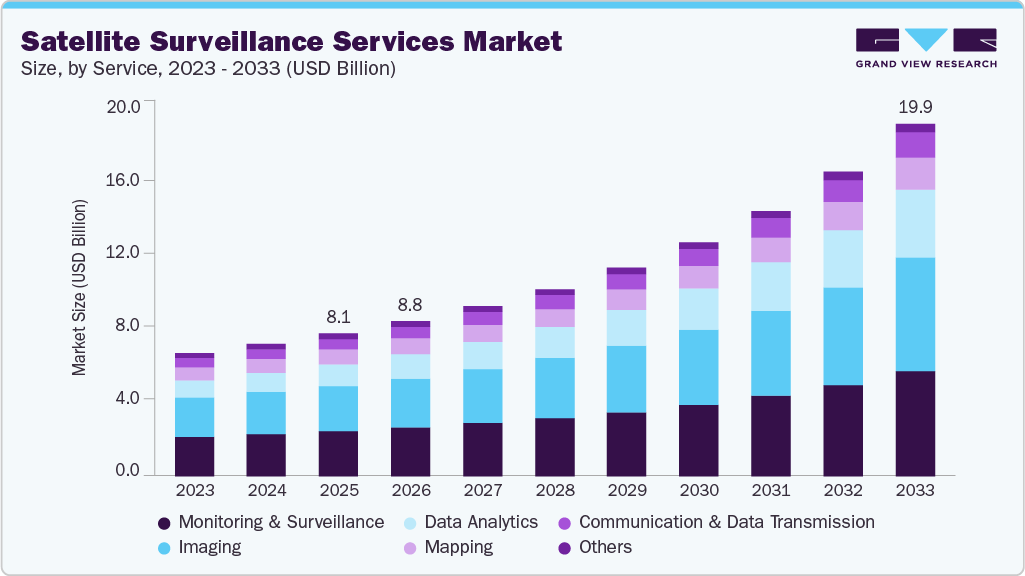 To learn more about this report, Download Free Sample Report
The rapid advancement of high-resolution Earth observation sensors, synthetic aperture radar (SAR) imaging technologies, and secure satellite communication systems is significantly transforming surveillance capabilities by enabling continuous, all-weather monitoring and precise geospatial intelligence collection. These innovations improve detection accuracy, revisit frequency, and data reliability, supporting mission-critical applications across defense, maritime security, and environmental monitoring. The integration of advanced payload miniaturization and reusable launch vehicle technologies further supports scalable deployment and cost optimization in the satellite surveillance services market.
In addition, the market is witnessing growing momentum toward the integration of satellite surveillance services into national security modernization programs and digital intelligence platforms designed to enhance situational awareness. Government agencies and defense organizations are increasingly incorporating satellite-based monitoring into border surveillance, counterterrorism operations, and disaster response frameworks to provide real-time intelligence, predictive risk analysis, and coordinated emergency management capabilities. This shift toward data-driven security infrastructure is enabling authorities to improve response times, strengthen threat detection, and enhance public safety resilience in the market.
Moreover, the expansion of commercial space activities, smart infrastructure development, and global supply chain monitoring initiatives are driving demand for persistent, wide-area surveillance and asset-tracking solutions. Enterprises are increasingly investing in satellite surveillance services to support fleet monitoring, pipeline inspection, and infrastructure integrity assessment, enabling faster decision-making and reduced operational disruptions. This growing emphasis on logistics visibility, resource management, and operational continuity is strengthening the role of satellite-enabled intelligence services across transportation, energy, and industrial sectors.
Furthermore, the rising adoption of advanced data analytics, artificial intelligence, and cloud-based geospatial processing platforms is reshaping application opportunities across the satellite surveillance services market. Organizations are leveraging automated image interpretation, anomaly detection algorithms, and real-time data integration tools to extract actionable insights from large volumes of satellite imagery. This transition toward intelligent surveillance ecosystems positions satellite surveillance service providers to meet the evolving demands for predictive monitoring, environmental risk assessment, and strategic planning.
Service Insights
The monitoring & surveillance segment accounted for the largest market share of over 31.0% in 2025, driven by the increasing demand for continuous, real-time situational awareness and persistent observation capabilities. The growing need for rapid threat detection, illegal activity tracking, and emergency response coordination is encouraging organizations to deploy advanced satellite-based monitoring solutions. The expansion of smart city initiatives, national security modernization programs, and cross-border surveillance collaborations is reinforcing the segment’s leading position in the satellite surveillance services market.
The data analytics segment is expected to witness the fastest CAGR of over 15.0% from 2026 to 2033. The segment growth is driven by the rapid advancement of artificial intelligence, machine learning algorithms, and cloud-based geospatial intelligence platforms. The rising demand for predictive analytics, anomaly detection, and decision-support systems is accelerating the adoption of advanced satellite data analytics services. The integration of edge computing infrastructure, advanced visualization tools, and scalable data processing architectures is expected to support strong expansion in the data analytics segment of the satellite surveillance services industry.
Application Insights
The defense & intelligence segment accounted for the largest market share in 2025, driven by the increasing demand for persistent satellite-based intelligence, surveillance, and reconnaissance (ISR) capabilities. Governments and defense organizations are prioritizing investments in high-resolution imaging satellites, synthetic aperture radar (SAR) systems, and secure communication networks to enhance threat detection and border surveillance effectiveness. The expansion of space defense modernization programs, rising geopolitical tensions, and the integration of advanced geospatial intelligence analytics platforms are encouraging organizations to deploy reliable satellite monitoring infrastructure, thereby driving segmental growth in the market.
The environmental monitoring segment is expected to witness the fastest CAGR from 2026 to 2033. This growth is attributed to the increasing global focus on climate change assessment, natural resource management, and disaster risk reduction initiatives. The growing emphasis on real-time monitoring of deforestation, air and water quality, and extreme weather events is encouraging government agencies and environmental organizations to adopt advanced satellite surveillance solutions. The continuous expansion of satellite constellations and the development of global sustainability and carbon monitoring frameworks are accelerating the deployment of satellite-based monitoring services in the market.
End-use Insights
The government agencies segment accounted for the largest market share in 2025, owing to the increasing deployment of satellite surveillance services to strengthen national security, border monitoring, and critical infrastructure protection initiatives. The growing demand for persistent Earth observation capabilities, real-time intelligence gathering, and coordinated disaster response systems is accelerating the adoption of satellite monitoring platforms. The rising emphasis on homeland security modernization, environmental compliance monitoring, and national space program investments is strengthening the growth potential of the segment in the satellite surveillance services industry.
The commercial enterprises segment is expected to witness the fastest CAGR from 2026 to 2033. This growth is driven by the rising demand for satellite-based asset tracking, supply chain visibility, and infrastructure monitoring solutions. The increasing focus on improving operational efficiency, reducing downtime, and enabling predictive maintenance strategies is encouraging the adoption of high-frequency satellite data services. Advancements in cloud-based geospatial analytics platforms and subscription-based satellite data delivery models are accelerating the deployment of commercial surveillance applications, thereby supporting expansion in the commercial enterprises segment of the satellite surveillance services market.
Platform Insights
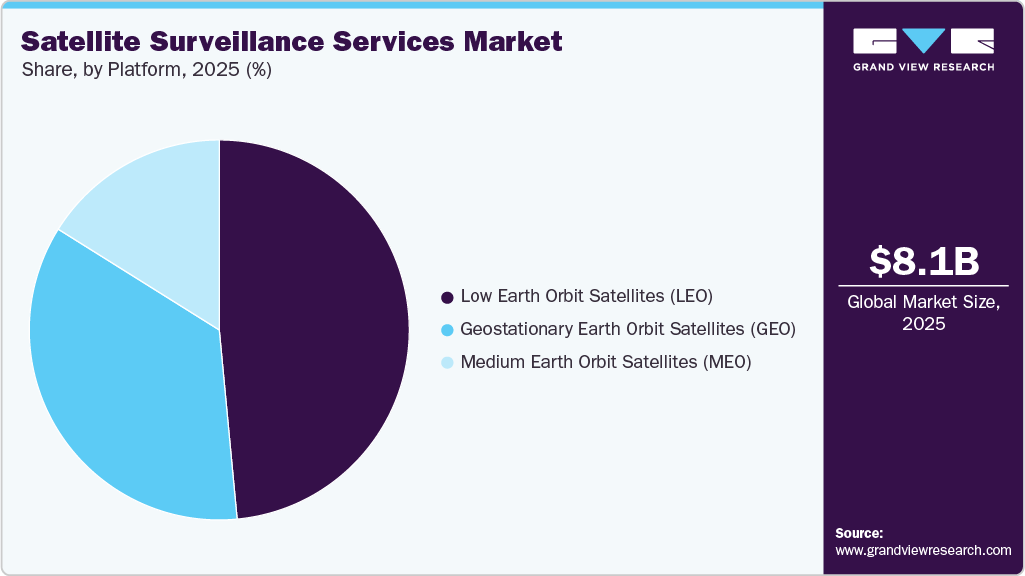
The Low Earth Orbit Satellites (LEO) segment accounted for the largest market share in 2025, propelled by its ability to deliver low-latency, high-resolution Earth observation and near-real-time data transmission. The rapid expansion of large-scale satellite constellations, increasing investments in reusable launch vehicles, and the growing demand for continuous global coverage are reinforcing the segment’s dominant position. The integration of advanced onboard sensors and artificial intelligence-enabled data processing is enabling faster data acquisition, thereby strengthening the growth trajectory of the LEO segment in the satellite surveillance services industry.
 To learn more about this report, Download Free Sample Report
The Medium Earth Orbit Satellites (MEO) segment is expected to witness a significant CAGR from 2026 to 2033, owing to its optimal balance between coverage area, orbital stability, and signal reliability for navigation and communication The rising demand for precise positioning, navigation, and timing (PNT) services in aviation, logistics, and defense operations is encouraging organizations to adopt MEO-based satellite surveillance infrastructure. The advancements in satellite payload miniaturization, improved orbital management technologies, and the expansion of next-generation navigation constellations are expected to accelerate adoption in the MEO segment.
Regional Insights
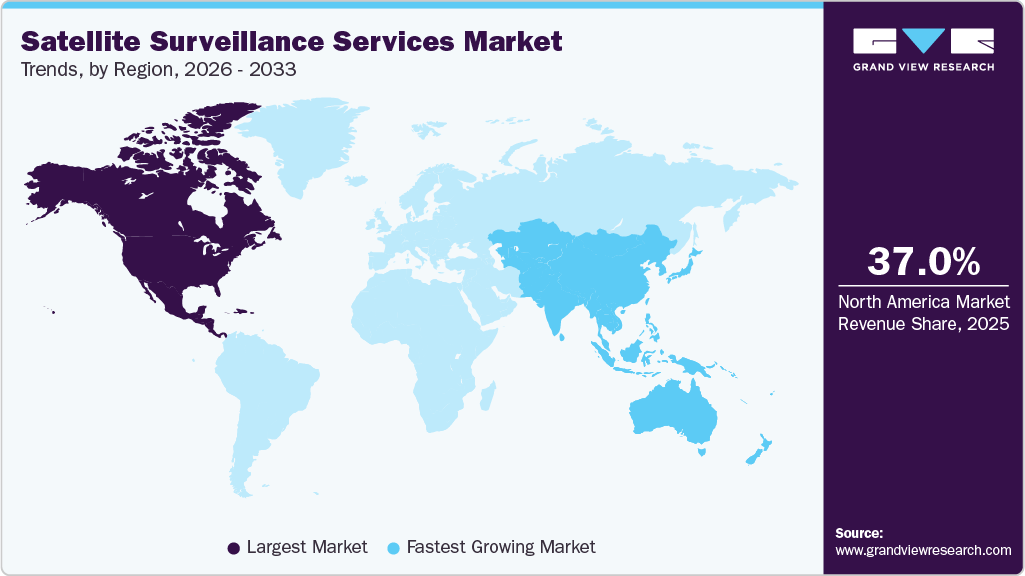
The North America satellite surveillance services market dominated with a share of over 37.0% in 2025, driven by the strong presence of advanced space infrastructure, well-established defense and intelligence agencies, and continuous investments in next-generation satellite constellations. The region is witnessing increasing demand for persistent surveillance capabilities to support border security, maritime domain awareness, and critical infrastructure monitoring across vast geographic territories. The growing collaboration between government agencies and defense contractors is accelerating the development of scalable satellite surveillance services for national security, disaster management, and environmental monitoring applications.
 To learn more about this report, Download Free Sample Report
U.S. Satellite Surveillance Services Market Trends
The satellite surveillance services industry in the U.S. dominated the market with a share of over 81.0% in 2025, fueled by strong government investments in space-based intelligence, surveillance, and reconnaissance (ISR) programs and the rapid deployment of commercial Earth observation satellite constellations. The growing demand for continuous monitoring of national borders and critical infrastructure is driving the adoption of advanced satellite surveillance services for real-time situational awareness. The presence of established aerospace and defense contractors, continuous innovation in satellite imaging technologies are contributing to sustained market growth in the country.
Europe Satellite Surveillance Services Market Trends
The satellite surveillance services industry in Europe is expected to grow at a CAGR of over 12.0% from 2026 to 2033. The market growth is driven by the increasing focus on regional security coordination, environmental monitoring initiatives, and cross-border data-sharing frameworks among European nations. The region is experiencing rising demand for satellite-based surveillance solutions that support disaster management, climate observation, and maritime safety operations across coastal and inland regions. The integration of advanced geospatial intelligence platforms and regulatory emphasis on sustainable resource management is supporting improved operational efficiency and technology adoption across the satellite surveillance services industry.
The UK satellite surveillance services industry is expected to grow significantly over the forecast period, driven by the expanding use of satellite-based monitoring systems for national defense readiness, maritime domain awareness, and infrastructure protection. Increasing collaboration between government space agencies, research institutions, and private satellite operators is fostering innovation in high-resolution imaging, data analytics, and secure satellite communication services. The growing focus on resilient national security infrastructure and rapid-response capabilities is boosting demand for the satellite surveillance services industry.
The satellite surveillance services industry in Germany is fueled by the increasing focus on industrial infrastructure protection, environmental compliance monitoring, and advanced transportation network management. The country is witnessing rising adoption of satellite-based remote sensing technologies to monitor energy pipelines, railway systems, and manufacturing facilities, thereby improving operational reliability and mitigating risk. A strong emphasis on engineering precision, industrial safety, and modernizing digital infrastructure is encouraging the development and deployment of highly reliable, performance-driven satellite surveillance technologies.
Asia Pacific Satellite Surveillance Services Market Trends
The satellite surveillance services industry in the Asia Pacific is expected to grow at the fastest CAGR of over 14.0% from 2026 to 2033, driven by the rapid expansion of national space programs, increasing investments in disaster risk management systems, and rising demand for border and maritime surveillance capabilities. The region is experiencing strong adoption of satellite monitoring technologies that support natural disaster response, agricultural resource management, and urban infrastructure planning across densely populated economies. The growing deployment of low satellite networks and expanding regional cooperation in space technology development are enhancing demand for advanced satellite surveillance services across the market.
The Japan satellite surveillance services industry is gaining traction owing to the increasing adoption of satellite-based monitoring systems for earthquake detection, coastal surveillance, and critical infrastructure resilience planning. The country is focusing on integrating advanced remote sensing technologies into disaster preparedness frameworks and environmental protection programs to improve national safety and operational continuity. The growing emphasis on technological innovation, disaster risk reduction, and high-precision monitoring capabilities is encouraging investments in reliable and high-performance satellite surveillance systems.
The China satellite surveillance services industry is rapidly expanding, driven by strong government investments in domestic satellite constellation development and strategic initiatives supporting national security and smart city management. The country is witnessing increasing adoption of satellite surveillance services for border monitoring, urban planning, and enforcement of environmental regulations. The expansion of local satellite manufacturing capabilities and the rising demand for high-frequency geospatial intelligence data are accelerating the large-scale deployment of satellite surveillance service technologies across the country.
Key Satellite Surveillance Services Company Insights
Some of the key players operating in the market are AIRBUS and Lockheed Martin Corporation.
-
AIRBUS is a global leader in satellite surveillance and Earth observation services, offering advanced optical and radar imaging solutions designed to support defense intelligence, border monitoring, and environmental surveillance applications worldwide. The company’s strong portfolio of high-resolution satellite systems, integrated geospatial analytics platforms, and long-standing partnerships with government and defense agencies have strengthened its position as one of the most dominant players in the global satellite surveillance services industry.
-
Lockheed Martin Corporation is a provider of space-based surveillance and intelligence solutions, delivering advanced satellite technologies and secure communication systems that support national security, missile warning, and global monitoring operations. The company’s extensive expertise in satellite engineering, continuous investment in next-generation space infrastructure, and leadership in defense modernization programs have reinforced its role in the satellite surveillance services industry.
ICEYE and BlackSky are some of the emerging market participants in the Satellite surveillance services market.
-
ICEYE is an emerging innovator in synthetic aperture radar (SAR) satellite surveillance services, offering high-frequency, all-weather imaging capabilities designed to support disaster response, maritime monitoring, and infrastructure risk assessment applications. The company’s rapid deployment of small satellite constellations, focus on near-real-time data delivery, and expansion into commercial and government markets are accelerating its growth and strengthening its presence in the global market.
-
BlackSky is a fast-growing provider of real-time satellite monitoring and analytics services, delivering dynamic Earth observation data and AI-driven intelligence platforms that support defense, logistics, and crisis management operations. The company’s scalable low Earth orbit satellite network, strong emphasis on rapid revisit rates, and increasing adoption of automated geospatial analytics solutions position it as a prominent emerging player in the satellite surveillance services industry.
Key Satellite Surveillance Services Companies:
The following key companies have been profiled for this study on the satellite surveillance services market.
- AIRBUS
- Northrop Grumman
- Lockheed Martin Corporation
- Thales Alenia Space
- Planet Labs PBC
- ICEYE
- L3Harris Technologies, Inc.
- BAE Systems
- General Dynamics Mission Systems, Inc.
- Leonardo S.p.A.
- BlackSky.
- Spire Global Inc.
Recent Developments
-
In March 2026, L3Harris Technologies collaborated with Mercury Systems to supply advanced solid-state data recorders for the U.S. Space Development Agency’s Tranche 3 Tracking Layer satellite constellation. The initiative supports the deployment of next-generation missile-tracking satellites designed to enhance persistent global surveillance and early threat detection capabilities. This partnership demonstrates the growing demand for high-performance onboard data processing technologies in satellite surveillance services supporting national security and space-based monitoring operations.
-
In February 2026, Thales Alenia Space signed a strategic cooperation agreement with Hellas Sat, Safran, and CNES to develop advanced optical communication payload technologies for the Hellas Sat-5 satellite system. The collaboration focuses on enabling secure, high-speed data transmission and resilient communication infrastructure to support real-time surveillance, environmental monitoring, and geospatial intelligence delivery services. This partnership underscores Thales Alenia Space’s strategy to expand next-generation satellite platforms that enhance data throughput and reliability in satellite surveillance.
-
In December 2025, ICEYE, in partnership with Rheinmetall, secured a major multi-year contract valued at approximately Euro 1.7 billion to provide satellite-based reconnaissance data services to the German armed forces through a dedicated surveillance satellite constellation. The agreement highlights increasing defense investments in persistent monitoring and space-based intelligence capabilities across Europe.
Satellite Surveillance Services Market Report Scope
Report Attribute
Details
Market size in 2025
USD 8.1 billion
Estimated market size in 2026
USD 8.8 billion
Projected market size by 2033
USD 20.0 billion
Growth rate
CAGR of 12.4% from 2026 to 2033
Base year for estimation
2025
Historical data
2021 - 2024
Forecast period
2026 - 2033
Quantitative units
Revenue in USD million/billion, and CAGR from 2026 to 2033
Report Product
Revenue forecast, company ranking, competitive landscape, growth factors, and trends
Segments covered
Service, platform, application, end-use, region
Region scope
North America; Europe; Asia Pacific; Latin America; Middle East & Africa
Country scope
U.S.; Canada; Mexico; UK; Germany; France; China; Japan; India; South Korea; Australia; Brazil; Saudi Arabia; UAE; South Africa
Key companies profiled
AIRBUS; Northrop Grumman; Lockheed Martin Corporation; Thales Alenia Space; Planet Labs PBC; ICEYE; L3Harris Technologies, Inc.; BAE Systems; General Dynamics Mission Systems, Inc.; Leonardo S.p.A.; BlackSky; Spire Global Inc.
Customization scope
Free report customization (equivalent to up to 8 analyst’s working days) with purchase. Addition or alteration to country, regional & segment scope.
Pricing and purchase options
Avail customized purchase options to meet you exact research needs. Explore purchase options
Global Satellite Surveillance Services Market Report Segmentation
This report forecasts revenue growth at global, regional, and country levels and provides an analysis of the latest technological trends in each of the sub-segments from 2021 to 2033. For this study, Grand View Research has segmented the global satellite surveillance services market report based on service, platform, application, end-use, and region:
-
Service Outlook (Revenue, USD Billion, 2021 - 2033)
-
Imaging
-
Monitoring & Surveillance
-
Data Analytics
-
Mapping
-
Communication & Data Transmission
-
Others
-
-
Platform Outlook (Revenue, USD Billion, 2021 - 2033)
-
Low Earth Orbit Satellites (LEO)
-
Medium Earth Orbit Satellites (MEO)
-
Geostationary Earth Orbit Satellites (GEO)
-
-
Application Outlook (Revenue, USD Billion, 2021 - 2033)
-
Defense & Intelligence
-
Environmental Monitoring
-
Agriculture
-
Disaster Management
-
Urban Planning
-
Maritime
-
Others
-
-
End-use Outlook (Revenue, USD Billion, 2021 - 2033)
-
Government Agencies
-
Military & Defense Organizations
-
Commercial Enterprises
-
Others
-
-
Regional Outlook (Revenue, USD Billion, 2021 - 2033)
-
North America
-
U.S.
-
Canada
-
Mexico
-
-
Europe
-
UK
-
Germany
-
France
-
-
Asia Pacific
-
China
-
Japan
-
India
-
South Korea
-
Australia
-
-
Latin America
-
Brazil
-
-
Middle East and Africa (MEA)
-
Saudi Arabia
-
UAE
-
South Africa
-
-
Frequently Asked Questions About This Report
North America dominated the market with a 37.0% revenue share in 2025.
The defense & intelligence segment held the largest revenue share in 2025, while the environmental monitoring segment is the fastest-growing.
The government agencies segment held the largest revenue share in 2025, while the commercial enterprises segment is the fastest-growing.
The low earth orbit satellites (LEO) segment held the largest revenue share in 2025, while the medium earth orbit satellites (MEO) segment is expected to witness a significant CAGR from 2026 to 2033.
The global satellite surveillance services market size was estimated at USD 8.1 billion in 2025 and is expected to reach USD 8.8 billion in 2026.
The global satellite surveillance services market is expected to grow at a compound annual growth rate (CAGR) of 12.4% from 2026 to 2033, reaching USD 20.0 billion by 2033.
The monitoring & surveillance segment accounted for the largest market share of over 31.0% in 2025, driven by the increasing demand for continuous, real-time situational awareness and persistent observation capabilities. The growing need for rapid threat detection, illegal activity tracking, and emergency response coordination is encouraging organizations to deploy advanced satellite-based monitoring solutions. The expansion of smart city initiatives, national security modernization programs, and cross-border surveillance collaborations is reinforcing the segment’s leading position in the satellite surveillance services market.
Some key players operating in the satellite surveillance services market include AIRBUS, Northrop Grumman, Lockheed Martin Corporation., Thales Alenia Space, Planet Labs PBC., ICEYE, L3Harris Technologies, Inc., BAE Systems, General Dynamics Mission Systems, Inc., Leonardo S.p.A., BlackSky., Spire Global Inc.
The market expansion is driven by the increasing deployment of high-resolution Earth observation satellites, the integration of advanced geospatial analytics and AI-powered image processing technologies into surveillance platforms.
About the Author(s)
Communication Services Research Team
Technology · Communication ServicesThis report was authored by the communication services research team at Grand View Research - comprising two research analysts, one senior research analyst, and one industry expert - with specialized expertise in the communication services segment of the technology industry. All findings are based on proprietary technology databases, executive interviews, and regulatory analysis, subject to internal peer review prior to publication.
Last Updated:
Speak to Analyst

Customize this report to your needs - add regions, segments, or data points, with 20% free customization.
Or view our licence options:


ISO 9001:2015 & 27001:2022 Certified
We are GDPR and CCPA compliant! Your transaction & personal information is safe and secure. For more details, please read our privacy policy.


