
- Home
- »
- Network Security
- »
-
Security As A Service Market Size Report, 2026-2033GVR Report cover

Security As A Service Market (2026 - 2033)
Size, Share & Trends Analysis Report By Component (Solutions, Services), By Deployment Mode (Public Cloud, Hybrid Cloud), By Organization Size, By Security Type, By End Use, By Region, And Segment Forecasts
Market Size, 2025
$19.1BMarket Estimate, 2026
$21.5BMarket Forecast, 2033
$55.7BCAGR, 2026–2033
14.6%Security As A Service Market Summary
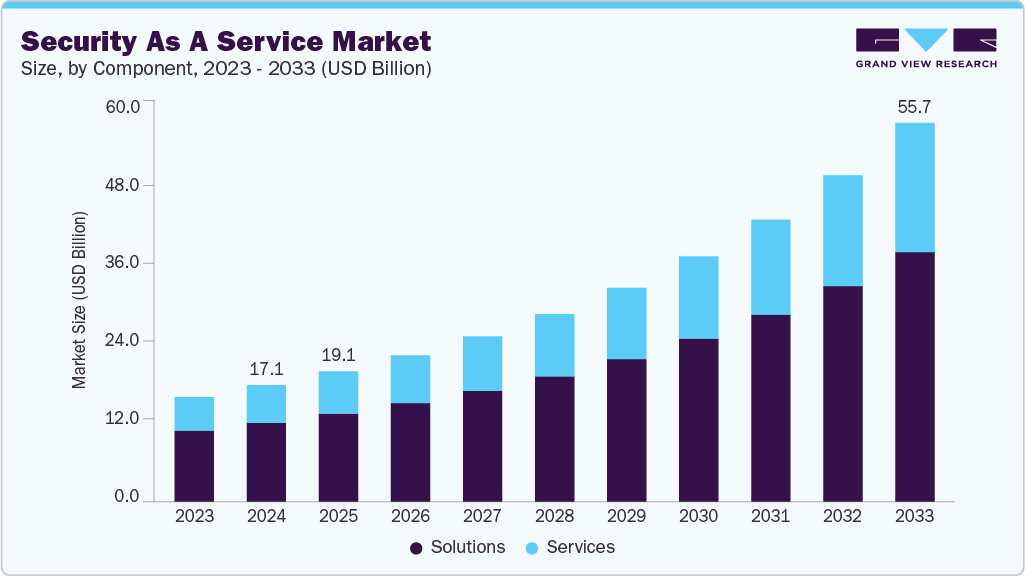
The global security as a service market size was valued at USD 19.1 billion in 2025 and is projected to grow from USD 21.5 billion in 2026 to USD 55.7 billion by 2033, at a CAGR of 14.6% from 2026 to 2033. The North America market dominated, with a revenue share of 36.8% in 2025. The market growth is being fueled by the rapid adoption of cloud-native security technologies, AI-powered threat intelligence, and zero-trust security frameworks.
 Source: Grand View Research, IR Documents, Primary Interviews, Paid DatabasesTo learn more about this report,
 Download Free Sample Report
 Key Market Trends & Insights
- By Component: The solutions segment dominated the market, with a revenue share of 67.5% in 2025
- By Deployment Mode: The public cloud segment dominated the market, with a revenue share of 57.5% in 2025
- By Organization Size: The large enterprises segment held the largest market share in 2025
- By Security Type: The network security segment held the largest market share in 2025
- By End Use: The BFSI segment held the largest market share in 2025
Regional Highlights
- Largest regional market: North America (36.8% revenue share, 2025)
- Fastest-growing regional market: Asia Pacific (highest CAGR, 2026-2033)
- By country: The U.S. held the largest market share in 2025
Market Size & Forecast
- Market size in 2025: USD 19.1 billion
- Estimated market size in 2026: USD 21.5 billion
- Projected market size by 2033: USD 55.7 billion
- CAGR (2026-2033): 14.6%
Three ways to get this report
Buy it, customize it, or ask a question.Ask an Analyst
A direct answer, usually in 1 working day
- AccessReport author, directly
- Reply timeWithin 1 working day
- No sales callDirect answer only
- FormatEmail reply
- CostFree, no cost
Get the Full Report
What the study covers
- FormatsPDF · Excel · Dashboard
- Timeline2026–2033 annual, 2025 base
- Coverage20+ countries, 5 regions
- Companies10+ key players profiled
Customize the Report
20% free customization
- IncludeCountries, segments, points
- TailorTo your product definition
- ExtendDeeper competitor detail
- OrA fully bespoke study
- Turnaround5–10 working days
Organizations are increasingly moving away from traditional on-premises cybersecurity solutions toward flexible, subscription-based Security as a Service (SECaaS) platforms that deliver advanced capabilities such as real-time threat monitoring, risk analytics, multi-factor authentication, and automated incident response. This shift toward cloud-centric security models is further accelerating as enterprises seek to address the growing complexity of cyber threats across hybrid work environments, multi-cloud ecosystems, and geographically distributed IT infrastructures.
Enterprises are increasingly shifting from traditional on-premises cybersecurity models to subscription-based, scalable SECaaS offerings that support real-time risk analytics, multi-factor authentication, and automated response capabilities. This cloud-first transition is accelerating as organizations face mounting cyber threats across hybrid work environments and distributed IT infrastructures. For instance, in April 2024, Microsoft expanded its Defender suite to offer integrated SIEM and XDR capabilities as-a-service, enabling customers to unify endpoint, email, and identity protection across multi-cloud ecosystems.
 To learn more about this report, Download Free Sample Report
 Additionally, key drivers include the growing sophistication of ransomware attacks, rising regulatory scrutiny around data protection (GDPR and HIPAA), and the need to secure expanding digital attack surfaces. Organizations across BFSI, healthcare, and retail are increasingly relying on SECaaS to manage security operations at scale while avoiding the capital expense of in-house infrastructure. Moreover, the integration of AI and machine learning is further optimizing threat detection accuracy and reducing incident response time. For instance, in May 2024, Palo Alto Networks launched an AI-based SECaaS platform that provides predictive threat modeling and autonomous remediation workflows, helping IT teams proactively mitigate vulnerabilities before they escalate.
Additionally, the proliferation of IoT, mobile devices, and remote access points is driving adoption of cloud-delivered security across SMEs and large enterprises alike. Vendors are enhancing their offerings with centralized policy management, real-time dashboards, and compliance reporting tools tailored for sector-specific requirements. For instance, in May 2022, Zscaler partnered with Siemens to deliver industrial-grade secure access services to critical infrastructure operators using edge-based micro segmentation. Consequently, as cyber threats continue to evolve, Security as a Service allows organizations to strengthen their resilience with enhanced agility and cost-efficiency, enhancing its role as a foundational pillar of modern cybersecurity strategies.
Market Dynamics
The Security as a Service (SECaaS) market is experiencing strong growth as organizations increasingly prioritize cybersecurity amid a rapidly evolving threat landscape. The rising frequency and sophistication of ransomware attacks, phishing campaigns, data breaches, and advanced persistent threats have compelled enterprises to strengthen their security posture through managed and cloud-based security solutions. Additionally, the widespread adoption of cloud computing, remote and hybrid work models, and digital transformation initiatives has expanded the attack surface, driving demand for scalable and continuously monitored security services. Organizations are increasingly leveraging SECaaS offerings to gain access to advanced threat detection, identity and access management, data protection, and security monitoring capabilities without the complexity and cost of maintaining extensive in-house security infrastructure.
Furthermore, technological advancements such as artificial intelligence, machine learning, automation, and zero-trust architectures are reshaping the SECaaS landscape by enabling faster threat identification, proactive risk mitigation, and automated incident response. Growing regulatory requirements related to data privacy, cybersecurity compliance, and critical infrastructure protection are also encouraging enterprises to adopt outsourced security services. Small and medium-sized enterprises, in particular, are increasingly turning to security as a service solution to address cybersecurity skill shortages and optimize operational costs. As businesses continue to migrate applications and workloads to cloud environments, demand for integrated, flexible, and subscription-based security platforms is expected to remain strong, supporting sustained market expansion over the forecast period.
The increasing volume and complexity of cyberattacks are among the primary factors driving the growth of the Security as a Service (SECaaS) market. Organizations across industries are facing a growing number of ransomware attacks, phishing campaigns, insider threats, distributed denial-of-service (DDoS) attacks, and advanced persistent threats (APTs). As cybercriminals leverage artificial intelligence and automation to launch more sophisticated attacks, businesses are under mounting pressure to strengthen their cybersecurity frameworks and improve threat visibility across increasingly complex IT environments.
Security as a Service solutions enable organizations to access advanced security capabilities such as threat intelligence, security monitoring, identity and access management, endpoint protection, and incident response through scalable, cloud-based delivery models. By leveraging SECaaS platforms, enterprises can enhance their security posture while reducing the operational burden associated with managing on-premises security infrastructure. The growing need for continuous threat detection, rapid response capabilities, and cost-effective cybersecurity solutions is expected to continue driving market growth over the forecast period.
Despite its advantages, the adoption of security as a service solutions is constrained by concerns surrounding data privacy, data sovereignty, and regulatory compliance. Many organizations, particularly those operating in highly regulated sectors such as banking, healthcare, government, and defense, remain cautious about storing sensitive information and security data on third-party cloud platforms. Concerns regarding unauthorized access, cross-border data transfers, and potential data breaches can create hesitation among organizations considering cloud-based security services.
In addition, compliance requirements vary significantly across regions and industries, making it challenging for service providers to address diverse regulatory obligations. Organizations must ensure that their security providers comply with regulations related to data protection, privacy management, and cybersecurity governance. Failure to meet these requirements may result in financial penalties, reputational damage, and operational disruptions, thereby slowing the adoption of security as a service solutions in certain markets and industry verticals.
The growing integration of artificial intelligence, machine learning, and zero-trust security frameworks presents a significant opportunity for the Security as a Service market. Organizations are increasingly seeking intelligent security platforms capable of detecting anomalies, identifying emerging threats, and automating incident response processes in real time. AI-powered security solutions enhance threat detection accuracy while reducing response times, enabling enterprises to proactively mitigate cyber risks in dynamic digital environments.
At the same time, the adoption of zero-trust architectures is gaining momentum as enterprises transition to hybrid work models, multi-cloud infrastructures, and distributed networks. Zero-trust principles require continuous verification of users, devices, and applications, creating substantial demand for cloud-delivered identity management, access control, and network security services. As organizations modernize their cybersecurity strategies, service providers offering integrated AI-driven and zero-trust-based SECaaS solutions are expected to benefit from significant growth opportunities in the coming years.
Analyst Perspective
The Security as a Service (SECaaS) market is undergoing a significant transformation as organizations increasingly prioritize cloud-based cybersecurity strategies to address the growing complexity of modern threat landscapes. The shift toward hybrid work environments, multi-cloud deployments, and digital-first business models has expanded the attack surface, prompting enterprises to adopt scalable and continuously managed security solutions. As a result, demand for services such as identity and access management, endpoint security, threat detection, managed security operations, and zero-trust security is expected to remain strong across both large enterprises and small and medium-sized businesses.
From an analyst’s perspective, the market is poised for sustained long-term growth, supported by increasing cybersecurity spending, regulatory compliance requirements, and advancements in artificial intelligence and automation. Vendors that offer integrated, cloud-native security platforms with capabilities such as AI-driven threat intelligence, extended detection and response (XDR), secure access service edge (SASE), and managed detection and response (MDR) are likely to gain a competitive advantage. Furthermore, the ongoing shortage of cybersecurity professionals is encouraging organizations to outsource security operations, creating substantial opportunities for SECaaS providers to expand their customer base and service offerings over the forecast period.
Component Insights
Based on the component, the solutions segment led the market with the largest revenue share of 67.5% in 2025, owing to the rising demand for integrated, cloud-native security tools that address complex threat landscapes. Enterprises prioritize modular solutions such as identity and access management (IAM), endpoint protection, SIEM, DLP, and secure email gateways to fortify security across distributed networks, hybrid cloud environments, and remote workforces.
Additionally, these solutions provide real-time threat detection, automated response, and centralized visibility capabilities that are critical as organizations face more frequent and sophisticated cyberattacks. Moreover, the growing adoption of zero-trust security models, regulatory compliance mandates, and the need for scalable protection across multi-cloud ecosystems have further reinforced demand for solution-based offerings. For instance, in May 2025, Microsoft announced the public preview of its unified security operations platform, combining Defender XDR and Sentinel SIEM into a single as-a-service solution, enabling users to streamline identity, endpoint, and email security across cloud platforms. Therefore, the growing demand to enhance solution performance with AI, behavioral analytics, and seamless integration features is contributing significantly to driving the growth of the solutions segment within the security as a service market.
The services segment is anticipated to be the fastest-growing segment during the forecast period, driven by rising enterprise demand for outsourced cybersecurity expertise. Managed and professional services are becoming essential as organizations adopt hybrid work models and multi-cloud infrastructures, requiring 24/7 threat monitoring, incident response, compliance support, and security architecture optimization.
Additionally, these services offer cost-effective access to expert teams and advanced tools without the need to maintain internal Security Operations Centers (SOCs). For instance, in July 2023, NTT DATA launched a global Security Management Outsourcing Service (MDR), offering end-to-end threat detection, incident response, and zero-trust-based remediation. Aimed at scaling from 100 to 500 security staff and generating ¥200 billion annual revenue by FY 2026, the initiative highlights the growing reliance on managed services for resilient and scalable cyber defense. Subsequently, the growing need to enhance service offerings with AI-driven threat analytics, automation, and sector-specific compliance solutions is contributing substantially to driving the demand for the services segment during the forecast period.
Deployment Mode Insights
Based on the deployment mode, the public cloud segment led the market with the largest revenue share of 57.5% in 2025 due to the growing enterprise preference for scalable, on-demand security solutions that align with cloud-first and digital transformation strategies. Additionally, public cloud deployments enable rapid provisioning, seamless integration with existing cloud workloads, and centralized threat management across global operations, ideal for businesses with distributed infrastructures. For instance, in November 2022, HCLTech launched its Cloud Security Service for AWS, a fully managed offering designed to help enterprises secure their AWS environments through real-time threat detection, vulnerability management, and compliance automation. By leveraging the flexibility and global reach of AWS’s public cloud infrastructure, HCLTech’s solution reflects the growing trend of vendors aligning SECaaS offerings with hyperscaler platforms to address evolving security and performance requirements. Therefore, the aforementioned factors are contributing notably to spurring the growth of the public cloud segment in the global security as a service market.
The hybrid cloud segment is projected to be the fastest-growing segment over the forecast period due to increasing enterprise demand for security platforms that bridge on‑premises, private, and public cloud environments, offering unified policy enforcement, consistent data protection, and regulatory compliance across diverse infrastructures. As organizations embark on digital transformation, they require flexible architectures that safeguard sensitive workloads in private clouds while leveraging public cloud agility for scalable applications.
For instance, in February 2025, AlgoSec launched its Horizon platform, an application-centric security management solution designed for hybrid environments, delivering AI-driven visibility, automated policy controls, and risk remediation. This development reflects the growing focus among SECaaS providers on supporting hybrid deployments with intelligent orchestration and comprehensive protection, making the hybrid cloud model the fastest-growing segment within the market.
By Organization Size
Based on the organization size, the large enterprises segment led the market with the largest revenue share of 67.5% in 2025 due to their expansive digital operations, stringent regulatory obligations, and heightened exposure to sophisticated cyber threats, which demand enterprise-grade SECaaS solutions. Additionally, these organizations operate across multiple regions, handling vast volumes of sensitive data, thus necessitating advanced offerings such as identity and access management, SIEM, endpoint protection, and zero-trust architectures.
For example, in March 2025, Bell Canada introduced a sovereign-cloud SECaaS platform designed specifically for large-scale enterprises and public sector organizations. Hosted entirely within Canadian data centers, the service ensures data residency, offers AI-powered SIEM-driven threat detection, and provides 24/7 monitoring by the Bell Business Enterprise Cyber Intelligence Centre. Therefore, the above-mentioned factors are contributing significantly in spurring the growth of the large enterprises segment in the global security as a service market.
 To learn more about this report, Download Free Sample Report
 The SME segment is expected to be the fastest-growing segment in the coming years as small and medium-sized businesses increasingly adopt accessible, cost-effective security platforms to combat escalating cyber threats amid resource constraints. SME face thousands of cyberattacks annually yet lack in-house expertise and infrastructure, making subscription-based SECaaS offerings particularly appealing. In October 2023, Arete introduced Cloud Security offering targeting SMBs, equipped with managed detection and response across email, cloud endpoints, mobile devices, and more, backed by a global Security Operations Center and proprietary threat intelligence data to reduce risk and business interruptions.
This allows SMEs to focus on core business operations while maintaining strong security postures, making security as a service a practical and strategic solution for their evolving needs. In conclusion, the increasing demand for security services in small and medium organizations with AI-driven analytics, MDR services, and sector-specific compliance features is projected to drive the market share during the forecast period.
Security Type Insights
Based on the security type, the network security segment led the market with the largest revenue share of 24.9% in 2025 because it serves as the frontline defense for distributed endpoints, cloud environments, and remote access. Additionally, the surge in hybrid work, multi-cloud deployments, and increasingly sophisticated cyber threats is driving rapid adoption of cloud-delivered firewalls, intrusion detection/prevention systems (IDS/IPS), Secure Access Service Edge (SASE), and secure network gateways.
Moreover, the growing trend towards the integration of AI-based analytics to streamline threat detection and reporting is further driving the growth of the network security segment. In November 2024, Zyxel Networks introduced SecuPilot, an AI-powered assistant within its SecuReporter Cloud Analytics Service. It allows IT teams to analyze and correlate network security data through natural-language queries and receive actionable insights in real time. Subsequently, the ability of network security to reduce analysis time and enable faster response is contributing notably to spurring market growth during the forecast period.
The cloud security segment is expected to register the fastest growth during the forecast period, driven by the expansion of multi-cloud and SaaS adoption, which exposes organizations to security risks, and the growing need for holistic and proactive protection of workloads and data in the cloud. These threats, including misconfigurations, runtime vulnerabilities, and API abuse, require continuous monitoring, automated response, and advanced analytics.
Additionally, the growing regulatory focus on data privacy and the increasing frequency of cloud-targeted attacks are further accelerating the adoption of cloud-native security platforms across industries. For instance, in June 2025, Tamnoon launched Managed Cloud Detection & Response (CDR) service alongside Tami. This AI-powered cloud SecOps agent contextualizes alerts and orchestrates runtime remediation across CNAPP platforms like Wiz, GuardDuty, CrowdStrike, and Orca. By combining machine learning with human validation, Tamnoon’s offering empowers organizations to reduce cloud security alert fatigue and speed up incident resolution. Consequently, the growing adoption of cloud security, owing to its benefits, is contributing notably to spurring the growth of the segment.
End Use Insights
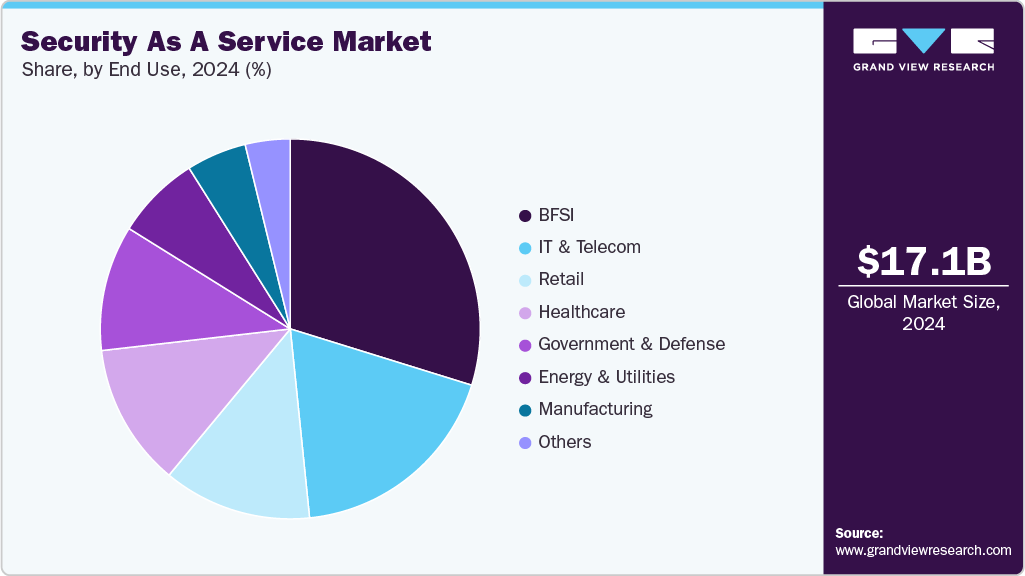
Based on the end use, the BFSI segment led the market with the largest revenue share of 29.6% in 2025 due to its high exposure to cyber threats, strict regulatory compliance requirements, and the critical importance of safeguarding sensitive financial and customer data. Financial institutions, including banks, insurers, and investment firms, are prime targets for cyberattacks such as phishing, ransomware, and advanced persistent threats, necessitating the adoption of robust, real-time security as a service solution.
Additionally, the industry's need for continuous monitoring, secure access management, data encryption, and regulatory reporting drives significant investment in cloud-native security platforms. Moreover, the rapid digital transformation of BFSI through mobile banking, online payments, and fintech integration further expands the threat surface, making security solutions essential for operational resilience and customer trust.
The healthcare segment is projected to register the fastest growth during the forecast period due to rising cybersecurity risks associated with digital health transformations, such as HIPAA compliance, telemedicine proliferation, and the digitization of patient records. Healthcare providers rely on cloud, IoT devices, and electronic health systems, making them vulnerable to ransomware, data breaches, and operational disruptions. This drives the demand for SECaaS offerings that ensure 24/7 protection, privacy, and regulatory compliance. For instance, in August 2022, Happiest Minds Technologies launched end-to-end security services for healthcare, tailored to the sector’s unique needs. The offering includes advanced threat detection, compliance support (HIPAA, HITRUST), secure EHR access, and real-time network monitoring. Therefore, the growing demand for security solutions in the healthcare sector, owing to the above-mentioned factors, is contributing notably in spurring the security as a service market size.
Regional Insights
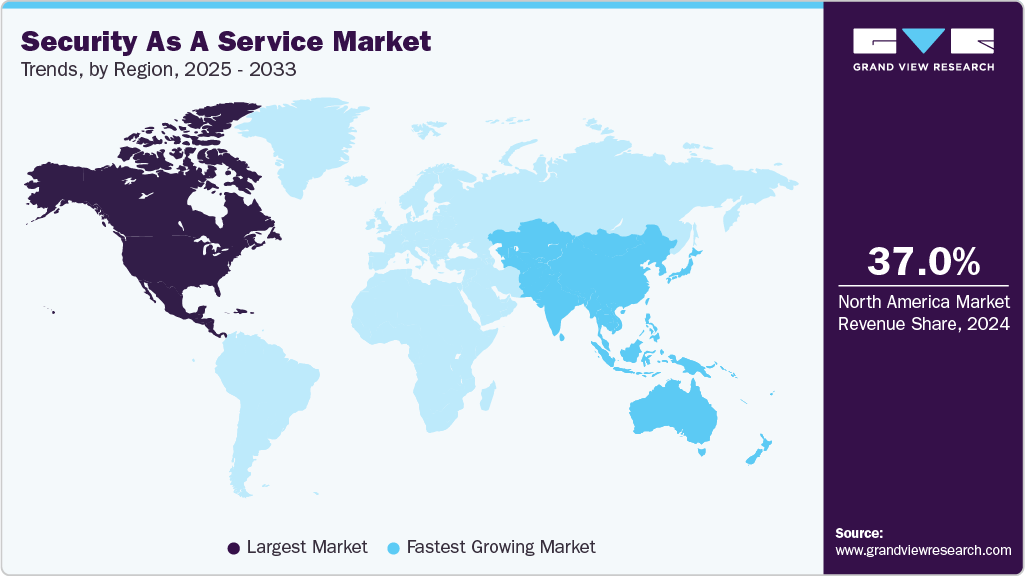
North America dominated the global security as a service market, with the largest revenue share of 36.8% in 2025, fueled by the region’s stringent data protection regulations such as HIPAA, GLBA, and CCPA, rapid cloud migration across industries, and the presence of major players offering advanced threat detection and zero-trust frameworks. The United States is witnessing a surge in high-profile ransomware and nation-state attacks targeting BFSI, healthcare, and government sectors, prompting organizations to adopt SECaaS solutions with integrated SIEM, MDR, and endpoint protection capabilities.
 To learn more about this report, Download Free Sample Report
 Additionally, the demand for sovereign cloud-based security offerings is growing amid rising concerns over data sovereignty and federal cybersecurity mandates. Moreover, North American enterprises are also leveraging AI-powered SECaaS tools for real-time analytics, insider threat detection, and compliance automation, reflecting a mature cybersecurity landscape that prioritizes both resilience and regulatory alignment.
U.S. Security As A Service Market Trends
The security as a service market in the U.S. held the largest share of the North American market in 2025. The U.S security as a service (SECaaS) market is experiencing rapid growth driven by a sharp rise in ransomware attacks, evolving regulatory mandates such as NIST 800-53, CMMC, and the Executive Order on Improving the Nation’s Cybersecurity, and widespread cloud adoption across sectors. Enterprises are increasingly transitioning to zero-trust architectures and integrating AI-powered threat analytics and identity management into their SECaaS frameworks to address sophisticated, multi-vector threats.
In addition, the growing emphasis on data sovereignty and secure federal cloud workloads is also accelerating demand for government-grade SECaaS platforms. For instance, Amazon Web Services announced the launch of its second “Secret” cloud region in the U.S., scheduled for 2025, to support classified federal workloads and reinforce national cybersecurity infrastructure. Additionally, domestic vendors such as Zscaler, Palo Alto Networks, and CrowdStrike continue to lead the market with tailored offerings that support real-time threat detection, endpoint protection, and compliance-driven cloud security, reinforcing the U.S. as the most advanced and security-conscious national market in this domain.
Europe Security As A Service Market Trends
The Europe security as a service market is anticipated to register considerable growth from 2025 to 2033, driven by strict regulatory frameworks like GDPR and the NIS2 Directive, which mandate rigorous data protection, breach reporting, and cybersecurity standards. Additionally, rising enforcement actions and recent rulings by the Court of Justice of the European Union, such as recognizing loss of control over personal data as compensable harm, have heightened compliance pressures, prompting widespread adoption of SECaaS solutions offering encryption, SIEM, and real-time risk visibility. Moreover, the region’s acute cybersecurity skills shortage, with over 290,000 unfilled roles, has further accelerated demand for managed detection and response (MDR) and SOC-as-a-Service platforms that deliver 24/7 monitoring and AI-driven threat mitigation without relying on internal teams.
The UK security as a service market is witnessing strong momentum, driven by a surge in cyberattacks targeting critical infrastructure, increased cloud adoption across public and private sectors, and evolving regulatory mandates under frameworks like the UK GDPR and the National Cyber Strategy 2022. Additionally, British enterprises are rapidly shifting toward SECaaS models to comply with data residency requirements, secure remote workforces, and protect sensitive assets against ransomware, phishing, and advanced persistent threats. Moreover, the UK government’s investment in enhancing national cyber resilience, such as funding for the National Cyber Security Centre (NCSC) and initiatives encouraging SME cybersecurity adoption, is further catalyzing demand for scalable, subscription-based security solutions.
Germany security as a service market is gaining traction owing to the increased demand across solutions like network security, endpoint protection, cloud security, and SIEM. Key growth drivers include Germany's rigorous implementation of GDPR, the national IT Security Act, and a robust regulatory posture that prioritizes data sovereignty and encryption, compelling businesses to adopt cloud-based security models compliant with local standards. Moreover, Germany’s critical infrastructure, including manufacturing, healthcare, and public institutions, is frequently targets by advanced cyber threats, pushing demand for managed detection and response (MDR) and SOC-as-a-service platforms, especially given a continuing shortage of cybersecurity professionals.
Asia Pacific Security As A Service Market Trends
The Asia Pacific security as a service market is expected to register the fastest CAGR of 15.3% from 2025 to 2033, driven by the region’s rapid digital transformation, rising cybercrime incidents, and expanding regulatory frameworks across key economies. Countries like India, Japan, and Australia are adopting a security-as-a-service solution to support secure cloud migration, remote work enablement, and the protection of critical infrastructure.
Additionally, the deployment of 5G and IoT technologies is increasing the complexity of threat landscapes, prompting enterprises to invest in AI-powered security platforms that offer continuous monitoring and automated threat response. Moreover, the shortage of skilled cybersecurity professionals across the region is pushing organizations, especially SMEs, to rely on managed detection and response (MDR) and SOC-as-a-Service solutions.
Japan security as a service market is experiencing strong growth, driven by a rising frequency of targeted cyberattacks, increased cloud adoption across both private and public sectors, and a shift toward outsourcing cybersecurity operations. With the expansion of remote work and digital services, Japanese enterprises are adopting security solutions to address vulnerabilities in endpoint protection, identity access management, and cloud workload security.
Moreover, the country’s aging population and workforce constraints have also contributed to a reliance on managed security solutions that offer round-the-clock protection and compliance support without requiring large internal teams. Additionally, Japan’s focus on critical infrastructure protection, coupled with government-led cybersecurity initiatives and industry-specific guidelines, is pushing sectors like BFSI, healthcare, and manufacturing to embrace scalable, regulation-aligned SECaaS platforms.
China security as a service marketheld a substantial revenue share in 2024, driven by strong government regulation and an expanding managed security ecosystem. The Chinese government’s Cybersecurity Law of 2017, alongside ongoing initiatives from MIIT, mandates data localization, stringent network security standards, and regular risk assessments for critical sectors, compelling enterprises to adopt SECaaS providers capable of ensuring regulatory compliance. Furthermore, a significant shortage of cybersecurity talent has prompted both large corporations and SMEs to rely heavily on outsourced cloud-based and managed security services, including SIEM, DDoS mitigation, and endpoint protection.
India security as a service market is gaining significant traction due to increasing cyber threats, accelerated cloud adoption, and a pronounced cybersecurity skills shortage, prompting organizations to outsource protection. For instance, in July 2024, Sysdig introduced a real‑time cloud security SaaS region based out of India, providing runtime threat detection for containers and cloud workloads hosted in local AWS data centers, an apt response to the country's expanding cloud ecosystem and real-time threat challenges.
Key Security As A Service Company Insights
Key players operating in the security as a service industry are IBM, Cisco Systems, Dell Technologies, Barracuda Networks, and others. Companies are focusing on various strategic initiatives, including new product development, partnerships & collaborations, and agreements to gain a competitive advantage over their rivals. The following are some instances of such initiatives.
-
In June 2025, Zscaler launched advanced AI-powered security innovations designed to enhance data protection, stop cyberattacks, and enable secure adoption of AI technologies at scale. Key features include AI-driven data security classification with granular sensitivity detection, enhanced generative AI protections to control and inspect AI prompts, AI-powered user-to-application segmentation to simplify security workflows, and AI-enabled network intelligence for improved reliability and threat detection.
-
In April 2025, Cisco and ServiceNow partnered to help enterprises securely adopt and scale AI-driven operations. The first integration, launched in H2 2025, combines Cisco AI Defense with ServiceNow SecOps to enable visibility into AI workloads, automated vulnerability assessment, real-time protection, incident response, and governance, all within a unified platform.
-
In November 2024, LTIMindtree partnered with Cisco by adopting Cisco Secure Access as its new Security Service Edge (SSE) solution to protect its 80,000 hybrid workforce with zero trust security and embedded AI. Together, they are delivering next-generation Secure Access Service Edge (SASE) solutions to LTIMindtree’s global clients, enabling seamless, secure hybrid work experiences with integrated cloud security and SD-WAN technologies.
Key Security As A Service Companies:
The following are the leading companies in the security as a service market. These companies collectively hold the largest market share and dictate industry trends.
- Barracuda Networks
- Check Point Software Technologies
- Cisco Systems
- CrowdStrike
- Dell Technologies
- Fortinet
- IBM
- McAfee
- Palo Alto Networks
- Proofpoint
- Qualys
- Sophos
- Symantec
- Trend Micro
- Zscaler
Competitive Benchmarking
Category
Operating Strategies
Competitive Edge
Weakness
Mature Players (IBM, Cisco Systems, Dell Technologies, Barracuda Networks, Proofpoint, Sophos, Trend Micro, McAfee, Symantec, Qualys, Fortinet, Palo Alto Networks, and Check Point Software Technologies)
- Offer comprehensive SECaaS solutions including cloud, network, endpoint, identity, and threat management services through integrated cybersecurity platforms.
- Strong brand presence, large customer base, extensive partner networks, broad product portfolios, and advanced threat intelligence capabilities.
- Higher costs, complex deployments, and slower implementation cycles compared to more agile providers.
Emerging Players (Zscaler and CrowdStrike)
- Focus on cloud-native security, zero-trust architecture, AI-driven threat detection, and automated security operations.
- Faster innovation, scalable platforms, simplified deployment, and strong capabilities in modern cybersecurity environments.
- Narrower product portfolios, lower market reach in some regions, and smaller service ecosystems compared to established vendors.
Security As A Service Market Report Scope
Report Attribute
Details
Market size in 2025
USD 19.1 billion
Estimated market size in 2026
USD 21.5 billion
Projected market size by 2033
USD 55.7 billion
Growth rate
CAGR of 14.6% from 2026 to 2033
Base year for estimation
2025
Historical data
2021 - 2024
Forecasts period
2026 - 2033
Quantitative units
Revenue in USD billion/billion and CAGR from 2026 to 2033
Report coverage
Revenue forecasts, company market share analysis, competitive landscape, growth factors, and trends
Segments covered
Component, Deployment Mode, Organization Size, Security Type, End Use, and Region
Regional scope
North America; Europe; Asia Pacific; Latin America; MEA
Country scope
U.S.; Canada; Mexico; Germany; UK; France; Italy; Spain; China; Japan; India; South Korea; Australia; Brazil; Saudi Arabia; South Africa; UAE
Key companies profiled
IBM; Cisco Systems; Dell Technologies; Barracuda Networks; Proofpoint; Sophos; Trend Micro; Zscaler; McAfee; Symantec; Qualys; Fortinet; Palo Alto Networks; Check Point Software Technologies; CrowdStrike
Customization scope
Free report customization (equivalent to up to 8 analysts' working days) with purchase. Addition or alteration to country, regional & segment scope.
Pricing and purchase options
Avail customized purchase options to meet your exact research needs. Explore purchase options
Global Security As A Service Market Report Segmentation
This report forecasts revenue growth at the global, regional, and country levels and provides an analysis of the latest industry trends in each of the sub-segments from 2021 to 2033. For this study, Grand View Research has segmented the global security as a service market report based on component, deployment mode, organization size, security type, end use, and region.
-
Component Outlook (Revenue, USD Billion, 2021 - 2033)
-
Solutions
-
Identity and Access Management (IAM)
-
Data Loss Prevention (DLP)
-
Endpoint Protection
-
Secure Email Gateway
-
Security Information and Event Management (SIEM)
-
Intrusion Detection and Prevention Systems (IDPS)
-
Encryption
-
Others
-
-
Services
-
Managed Services
-
Professional Services
-
-
-
Deployment Mode Outlook (Revenue, USD Billion, 2021 - 2033)
-
Public Cloud
-
Private Cloud
-
Hybrid Cloud
-
-
Organization Size Mode Outlook (Revenue, USD Billion, 2021 - 2033)
-
Large Enterprises
-
Small and Medium-sized Enterprises (SMEs)
-
-
Security Type Outlook (Revenue, USD Billion, 2021 - 2033)
-
Network Security
-
Endpoint Security
-
Email Security
-
Cloud Security
-
Web Security
-
Database Security
-
-
End Use Outlook (Revenue, USD Billion, 2021 - 2033)
-
BFSI
-
IT & Telecom
-
Healthcare
-
Retail
-
Government & Defense
-
Energy & Utilities
-
Manufacturing
-
Others
-
-
Regional Outlook (Revenue, USD Billion, 2021 - 2033)
-
North America
-
U.S.
-
Canada
-
Mexico
-
-
Europe
-
UK
-
Germany
-
France
-
-
Asia Pacific
-
China
-
India
-
Japan
-
South Korea
-
Australia
-
-
Latin America
-
Brazil
-
-
Middle East & Africa
-
UAE
-
Saudi Arabia
-
South Africa
-
-
Research Methodology
The security As A service market figures in this report are based on a proven research process that combines executive interviews with secondary research from proprietary databases, company filings, and recognized regulatory and institutional sources. Market size is built through value-chain sizing - reconciling supply-side and demand-side estimates - and triangulated with bottom-up and top-down approaches. Every estimate passes multiple levels of expert validation before publication, with each security As A service segment quantified using the revenue-capture definitions in the table below.
Segment Definition
Segment - Component
Revenue Capture Definition
Solutions
Revenue generated from Security as a Service platforms and software solutions designed to protect enterprise IT environments, applications, networks, endpoints, identities, and data from cyber threats. Includes network security, endpoint security, cloud security, email security, web security, database security, identity and access management (IAM), threat intelligence, security information and event management (SIEM), extended detection and response (XDR), and zero-trust security solutions delivered through service-based models.
Services
Revenue generated from managed and professional security services supporting SECaaS deployment, operation, and maintenance. Includes managed security services (MSS), managed detection and response (MDR), security consulting, implementation, monitoring, incident response, vulnerability assessments, compliance services, technical support, and security operations center (SOC) services.
Segment - Deployment Mode
Revenue Capture Definition
Public Cloud
Revenue generated from SECaaS solutions hosted on public cloud platforms and delivered through subscription-based or SaaS models. Includes cloud-native security platforms, threat monitoring services, cloud workload protection, identity security, and security solutions integrated with public cloud environments.
Private Cloud
Revenue generated from SECaaS solutions deployed within dedicated private cloud environments managed for individual organizations. Includes enterprise-controlled security platforms, customized security monitoring, data protection solutions, and compliance-focused cybersecurity services.
Hybrid Cloud
Revenue generated from SECaaS solutions designed to secure combined public and private cloud environments along with on-premise infrastructure. Includes hybrid security management platforms, unified threat monitoring, cloud access security broker (CASB), and integrated security solutions across distributed IT environments.
Segment - Organization Size
Revenue Capture Definition
Large Enterprises
Revenue generated from SECaaS solutions adopted by large organizations with complex IT infrastructures, multiple locations, extensive cloud environments, and advanced cybersecurity requirements. Includes enterprise-grade threat detection, managed security operations, zero-trust security, compliance management, and advanced security monitoring solutions.
Small and Medium-sized Enterprises (SMEs)
Revenue generated from SECaaS solutions adopted by SMEs seeking scalable and cost-effective cybersecurity protection. Includes subscription-based security platforms, managed security services, endpoint protection, cloud security, and outsourced security operations to address limited internal cybersecurity resources.
Segment - Security Type
Revenue Capture Definition
Network Security
Revenue generated from SECaaS solutions designed to protect enterprise networks from unauthorized access, malware, intrusion attempts, and network-based threats. Includes managed firewalls, intrusion prevention systems (IPS), secure access service edge (SASE), network monitoring, and threat detection services.
Endpoint Security
Revenue generated from SECaaS solutions protecting user devices, servers, and connected endpoints against malware, ransomware, unauthorized access, and advanced cyber threats. Includes endpoint detection and response (EDR), antivirus, device management, and behavioral threat monitoring solutions.
Email Security
Revenue generated from SECaaS solutions securing business email systems against phishing, business email compromise (BEC), spam, malicious attachments, and credential theft. Includes secure email gateways, email threat detection, anti-phishing solutions, and email data protection services.
Cloud Security
Revenue generated from SECaaS solutions designed to protect cloud applications, workloads, infrastructure, and data. Includes cloud security posture management (CSPM), cloud workload protection platforms (CWPP), cloud access security broker (CASB), and multi-cloud security management solutions.
Web Security
Revenue generated from SECaaS solutions protecting users and organizations from web-based threats such as malicious websites, unsafe downloads, data leakage, and online attacks. Includes secure web gateways, web application protection, URL filtering, and browser security solutions.
Database Security
Revenue generated from SECaaS solutions designed to secure enterprise databases and sensitive information from unauthorized access, breaches, and data loss. Includes database monitoring, encryption, access management, vulnerability assessment, and compliance-focused database protection services.
Segment - End Use
Revenue Capture Definition
BFSI
Revenue generated from SECaaS solutions adopted by banks, financial institutions, insurance providers, and fintech companies to protect financial data, customer information, digital banking platforms, and transaction systems from cyber threats.
IT & Telecom
Revenue generated from SECaaS solutions used by IT service providers, software companies, cloud providers, and telecom operators to secure networks, cloud environments, customer platforms, and enterprise digital services.
Healthcare
Revenue generated from SECaaS solutions deployed by hospitals, healthcare providers, and life sciences organizations to protect patient data, healthcare applications, medical systems, and connected devices from cyber risks.
Retail
Revenue generated from SECaaS solutions adopted by retailers, e-commerce companies, and consumer businesses to secure payment systems, customer data, digital platforms, and online transactions.
Government & Defense
Revenue generated from SECaaS solutions used by government agencies, defense organizations, and public sector entities to protect critical infrastructure, sensitive information, national security systems, and digital services.
Energy & Utilities
Revenue generated from SECaaS solutions deployed by energy companies, utility providers, and critical infrastructure operators to secure operational technology (OT), industrial networks, and essential services.
Manufacturing
Revenue generated from SECaaS solutions used by manufacturing organizations to protect industrial systems, connected devices, production environments, intellectual property, and supply chain networks.
Others
Revenue generated from SECaaS solutions adopted across industries such as education, transportation, logistics, hospitality, media, and professional services to strengthen cybersecurity protection and manage evolving digital threats.
Estimation Model
Layer
Question
Analysis
Digital Infrastructure & Cybersecurity Exposure Layer (TAM)
Who can potentially require security as a service solutions?
All organizations operating digital infrastructure, cloud environments, enterprise networks, applications, endpoints, and data assets that are exposed to cybersecurity risks. This includes enterprises, government agencies, educational institutions, healthcare providers, financial institutions, and small businesses relying on internet-connected systems.
Cloud Security Adoption Layer (SAM)
Who can technically adopt security as a service solutions?
Organizations utilizing cloud computing, hybrid IT environments, remote work infrastructure, SaaS applications, and internet-enabled business operations can adopt SECaaS solutions. These entities require services such as identity and access management, cloud security, endpoint protection, threat detection, data security, and security monitoring.
Active SECaaS Deployment Layer (SOM)
Who actively deploys Security as a service solutions today?
Organizations actively implementing managed security services, cloud security platforms, security information and event management (SIEM), identity and access management (IAM), endpoint security, threat intelligence, zero-trust security frameworks, managed detection and response (MDR), and security operations center (SOC) services.
Revenue Realization Layer
How is revenue generated?
Revenue is generated through subscription-based Security as a Service offerings, managed security services, cloud security platforms, identity and access management solutions, endpoint protection services, threat intelligence subscriptions, security monitoring services, consulting, implementation, support, and maintenance contracts.
Delivered Customizations
This report has been delivered with the following In-depth customizations
Client Request
Customization Delivered
Value Adds
Enterprise Security as a Service (SECaaS) architecture review
Evaluated SECaaS architectures across cloud environments, enterprise networks, endpoints, identity and access management systems, security operations centers (SOC), applications, and data protection frameworks deployed across cloud, hybrid, and on-premise environments.
Provides insights into security architecture effectiveness, identifies security gaps, strengthens cyber resilience, and supports optimization of enterprise-wide cybersecurity strategies.
AI-driven threat detection and security automation assessment
Analyzed the adoption of artificial intelligence, machine learning, behavioral analytics, security orchestration, automated incident response, threat intelligence, and extended detection and response (XDR) capabilities within SECaaS platforms.
Help organizations understand the impact of AI-powered security technologies, improve threat detection accuracy, accelerate incident response, and enhance overall security operations efficiency.
Industry-specific cybersecurity risk and adoption assessment
Evaluated cybersecurity threats, security priorities, SECaaS adoption patterns, compliance requirements, and protection needs across key industries including BFSI, healthcare, government, IT & telecom, retail, manufacturing, and critical infrastructure sectors.
Provides industry-specific insights into cyber risk exposure, supports cybersecurity investment planning, and enables the implementation of tailored security strategies aligned with sector-specific requirements.
Frequently Asked Questions About This Report
The global security as a service market size was estimated at USD 17.12 billion in 2024 and is expected to reach USD 19.15 billion in 2025.
The global security as a service market is expected to grow at a compound annual growth rate of 14.3% from 2025 to 2033 to reach USD 55.71 billion by 2033.
The solutions segment dominated the multi-cloud networking market with a market share of 67.69% in 2024. The growth is attributed to the rising demand for integrated, cloud-native security tools that address complex threat landscapes.
Some key players operating in the market include IBM, Cisco Systems, Dell Technologies, Barracuda Networks, Proofpoint, Sophos, Trend Micro, Zscaler, McAfee, Symantec, Qualys, Fortinet, Palo Alto Networks, Check Point Software Technologies, CrowdStrike and Others.
Factors such as the convergence of cloud-native technologies, AI-driven threat detection, and zero-trust architectures plays a key role in accelerating the Security as a Service market.
About the Author(s)
Network Security Research Team
Technology · Network SecurityThis report was authored by the network security research team at Grand View Research - comprising two research analysts, one senior research analyst, and one industry expert - with specialized expertise in the network security segment of the technology industry. All findings are based on proprietary technology databases, executive interviews, and regulatory analysis, subject to internal peer review prior to publication.
Last Updated:
Speak to Analyst

Customize this report to your needs - add regions, segments, or data points, with 20% free customization.
Or view our licence options:


ISO 9001:2015 & 27001:2022 Certified
We are GDPR and CCPA compliant! Your transaction & personal information is safe and secure. For more details, please read our privacy policy.


