
- Home
- »
- Plastics, Polymers & Resins
- »
-
Self-Healing Polymers Market Size, Share Report 2026-2033GVR Report cover
![Self-Healing Polymers Market (2026 - 2033)Report]()
Self-Healing Polymers Market (2026 - 2033)
Size, Share & Trends Analysis Report By Material (Polyurethane, Epoxy, Polylactide), By End Use (Medical, Automotive, Textile, Aerospace, Construction), By Region (North America, Europe, Asia Pacific), And Segment Forecasts
Market Size, 2025
$3.8BMarket Estimate, 2026
$4.6BMarket Forecast, 2033
$18.4BCAGR, 2026–2033
21.8%Self-Healing Polymers Market Summary
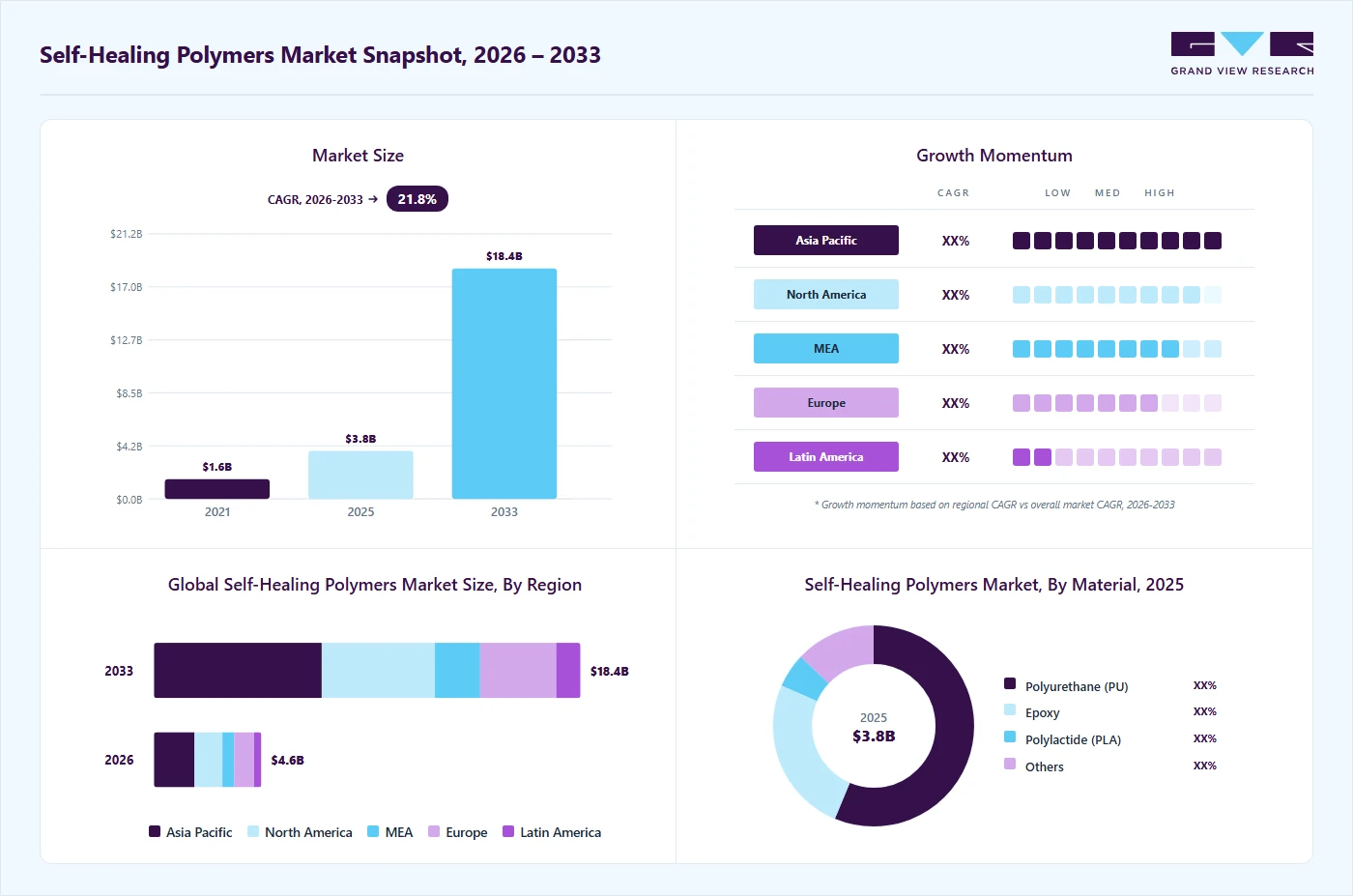
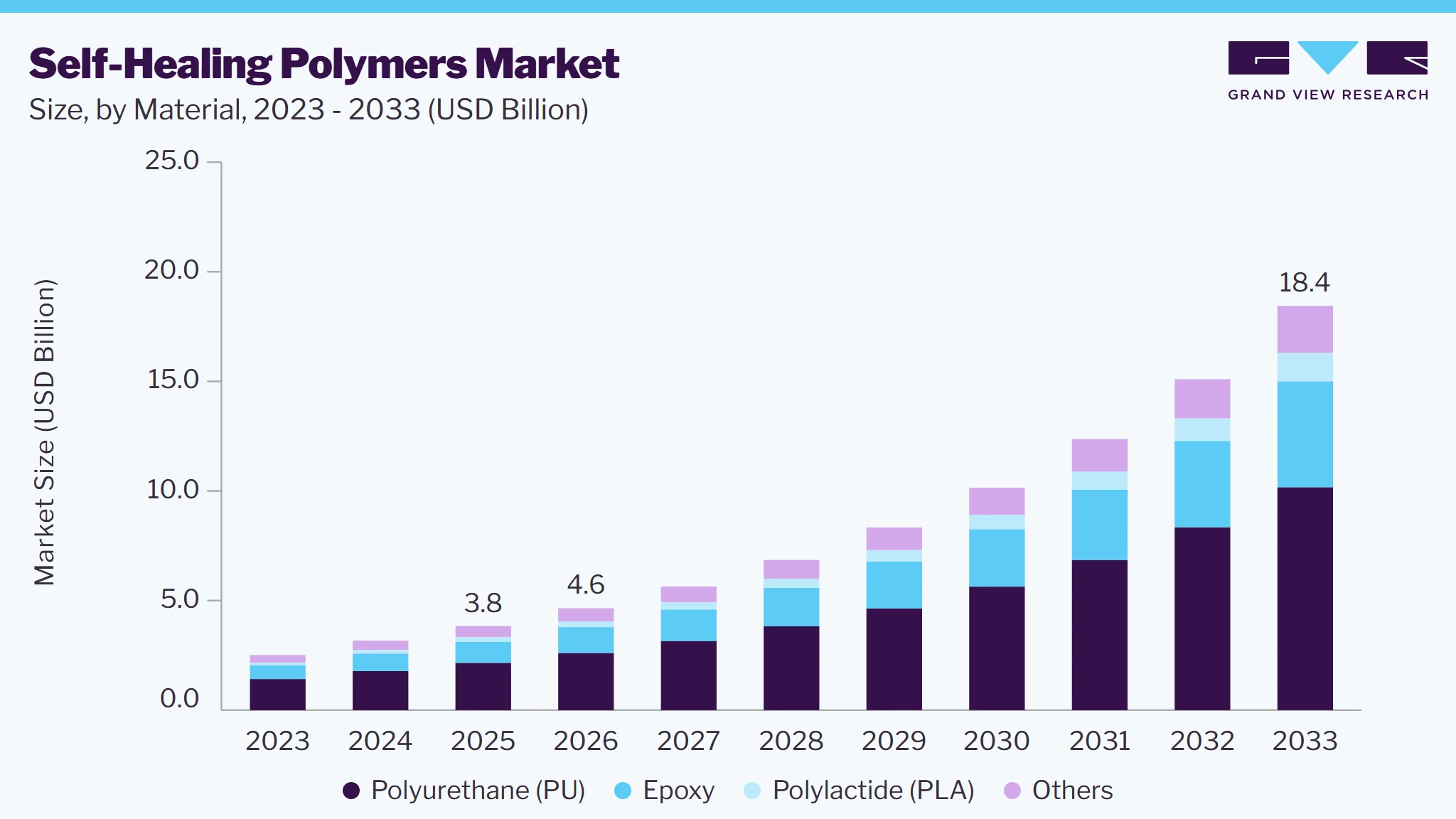
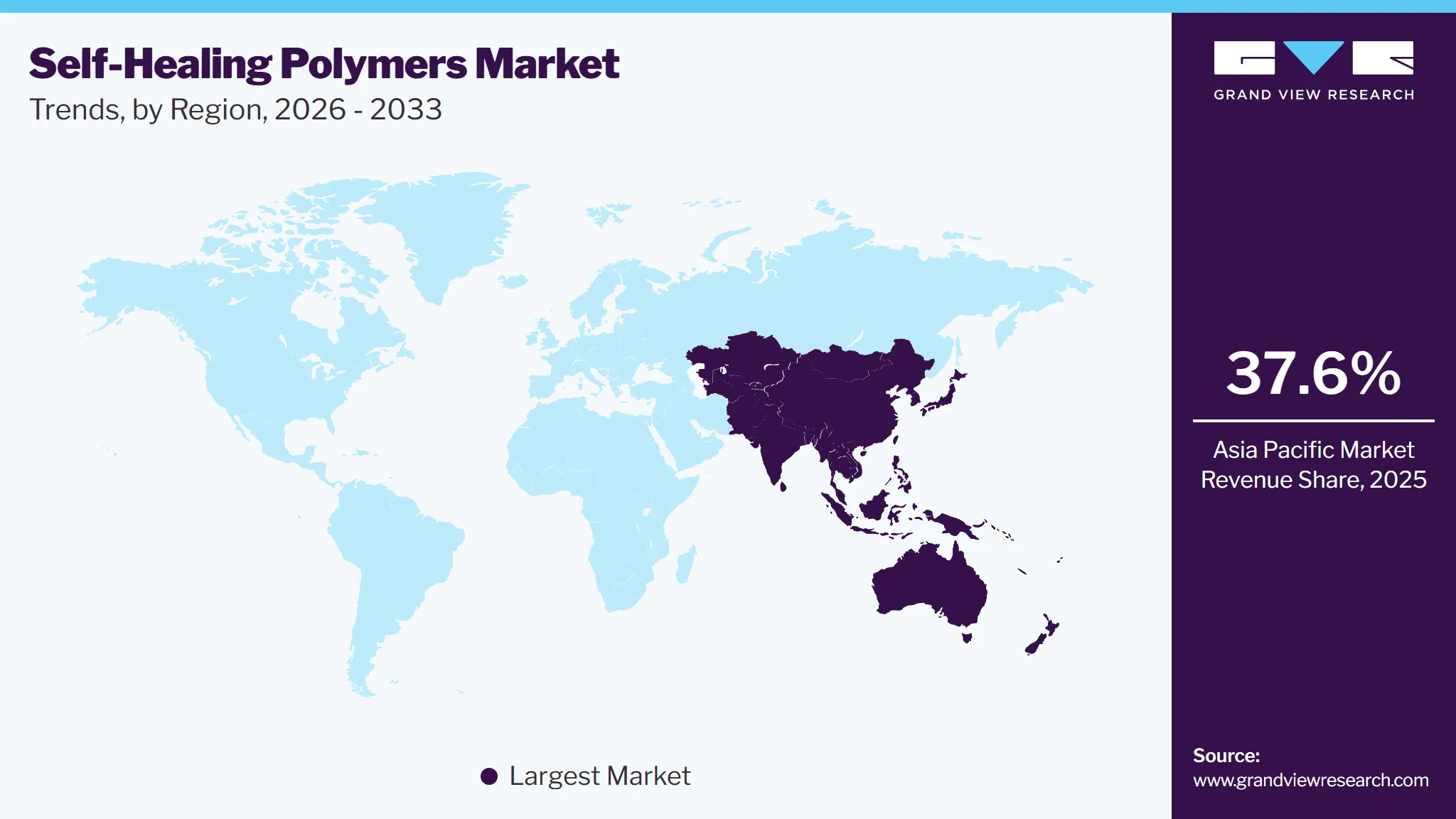
The global self-healing polymers market size was valued at USD 3.8 billion in 2025 and is projected to grow from USD 4.6 billion in 2026 to USD 18.4 billion by 2033, at a CAGR of 21.8% from 2026 to 2033. Asia Pacific dominated the market, accounting for a revenue share of 37.6% in 2025. The global self-healing polymers market is driven by the increasing demand for durable, low-maintenance, and high-performance materials across the automotive, electronics, medical, and infrastructure sectors.
Key Market Trends & Insights
- By material: Polyurethane (PU) segment dominated the market, with a revenue share of 56.2% in 2025.
- By end use: Automotive segment held the largest market share of 32.1% in 2025.
Regional Highlights
- Largest regional market: Asia Pacific (37.6% revenue share, 2025)
- By country: China held the largest market share in 2025.
Market Size & Forecast
- Market size in 2025: USD 3.8 Billion
- Estimated market size in 2026: USD 4.6 Billion
- Projected market size by 2033: USD 18.4 Billion
- CAGR (2026-2033): 21.8%
Three ways to get this report
Buy it, customize it, or ask a question.Ask an Analyst
A direct answer, usually in 1 working day
- AccessReport author, directly
- Reply timeWithin 1 working day
- No sales callDirect answer only
- FormatEmail reply
- CostFree, no cost
Get the Full Report
What the study covers
- FormatsPDF · Excel · Dashboard
- Timeline2026–2033 annual, 2025 base
- Coverage20+ countries, 5 regions
- Companies10+ key players profiled
Customize the Report
20% free customization
- IncludeCountries, segments, points
- TailorTo your product definition
- ExtendDeeper competitor detail
- OrA fully bespoke study
- Turnaround5–10 working days
Their ability to autonomously repair damage, extend product lifespan, and reduce maintenance requirements is accelerating adoption across these industries, while growing emphasis on sustainability, cost efficiency, and enhanced material performance continues to support market growth during the forecast period.
Rapid adoption of biopolymer-based packaging technologies is emerging as a key trend in the self-healing polymers market. Growing regulatory pressure to reduce plastic waste and improve packaging sustainability is accelerating the development of biodegradable self-healing polymer materials. Manufacturers are incorporating renewable feedstocks and dynamic functional groups that enable autonomous repair of microcracks and surface damage. These innovations help overcome the durability limitations of conventional bioplastics while extending product lifespan and reducing material waste. Demand is increasing across food packaging, consumer goods, and e-commerce end uses, where sustainability targets and circular economy objectives are influencing material selection and product design.
Integration of nanocomposite technologies is gaining significant traction in the self-healing polymers market as end users seek materials with enhanced multifunctional performance. Researchers and manufacturers are incorporating advanced nanomaterials, such as graphene and carbon-based additives, to enhance mechanical strength, thermal stability, and electrical conductivity. These developments are enabling the creation of multi-responsive self-healing systems for energy storage devices, flexible electronics, and advanced sensing end uses. Rising investments in smart materials, next-generation batteries, and connected technologies are supporting commercialization activities. The growing demand for durable, intelligent materials is accelerating innovation across the industrial, electronics, and high-performance engineering sectors.
Market Dynamics
The self-healing polymers market is witnessing strong growth, driven by rapid advancements in sustainable material technologies and the increasing demand for high-performance, durable polymers across diverse end-use industries. The growing adoption of biopolymer-based self-healing materials and nanocomposite technologies is enhancing mechanical strength, autonomous repair capabilities, thermal stability, and multifunctional performance, accelerating their use across packaging, electronics, energy storage, and industrial applications. Furthermore, continuous innovation in renewable feedstocks, dynamic polymer chemistries, and advanced nanomaterial integration is improving product performance, supporting sustainability goals, and strengthening the long-term growth prospects of the global self-healing polymers market.
The self-healing polymers market is experiencing steady growth, driven by the increasing deployment of next-generation sensor-embedded infrastructure across transportation, energy, and public utility sectors, where the demand for durable and intelligent construction materials continues to rise. Self-healing polymers are increasingly incorporated into bridges, tunnels, pipelines, rail networks, and other critical infrastructure owing to their ability to autonomously repair microcracks, extend service life, improve structural reliability, and support continuous structural health monitoring, accelerating their adoption across advanced infrastructure applications.
Market growth is further supported by rising investments in structural health monitoring systems, modernization of aging infrastructure, and the growing adoption of predictive maintenance strategies across global markets. The increasing integration of embedded sensors and smart monitoring technologies has significantly strengthened demand for polymer materials capable of maintaining structural integrity and long-term sensing performance. As governments and infrastructure operators continue to prioritize asset longevity, maintenance efficiency, and lifecycle cost reduction, self-healing polymers are expected to witness sustained demand across smart infrastructure applications during the forecast period.
High material and manufacturing costs remain a significant restraint for the self-healing polymers market. Producing self-healing polymers requires advanced polymer chemistries, specialized manufacturing processes, and high-value functional materials to achieve autonomous repair capabilities, durability, and long-term performance. These requirements substantially increase production costs and limit large-scale adoption, particularly in cost-sensitive industries. Additionally, the complexity of material formulations, processing techniques, and quality control necessitates considerable investment in manufacturing infrastructure and product development, which continues to restrict broader commercialization despite the performance and lifecycle benefits offered by self-healing polymers.
The increasing adoption of advanced lightweight materials in the aerospace and defense sector is creating significant growth opportunities for the self-healing polymers market. Rising demand for high-performance composites capable of autonomously repairing microcracks and maintaining structural integrity is accelerating their application in aircraft fuselages, turbine blades, and other critical components. Market growth is further supported by increasing investments in next-generation aerospace technologies, growing emphasis on operational reliability, and the need to reduce maintenance requirements and lifecycle costs. Additionally, continuous innovation in smart composite materials is expected to strengthen demand for self-healing polymers across aerospace and defense applications during the forecast period.
Market Concentration & Characteristics
The market growth stage is exponential, and the pace of growth is accelerating. The market exhibits slight fragmentation, with key players dominating the industry landscape. Major companies such as Huntsman International Corporation; BASF SE; Covestro AG; Dow Inc.; Wanhua Chemical Group Co., Ltd.; Autonomic Materials, Inc.; Arkema S.A.; NEI Corporation; CompPair Technologies SA; The Lubrizol Corporation; The Goodyear Tire & Rubber Company; Sika AG; and others play a significant role in shaping the market dynamics. These leading players often drive innovation in the market by introducing new products, technologies, and materials to meet the industry's evolving demands.
The degree of innovation in the self-healing polymers industry is high, as manufacturers are developing advanced chemistries that improve durability, repair speed, and lifecycle performance. Innovations such as dynamic covalent networks, microencapsulated healing agents, and reversible supramolecular systems are expanding the use of these materials across coatings, adhesives, electronics, and automotive parts. These advances are reducing maintenance needs and extending product life, which improves cost efficiency for end users. At the same time, innovation is helping suppliers differentiate their offerings and support wider commercial adoption in high-performance end uses.
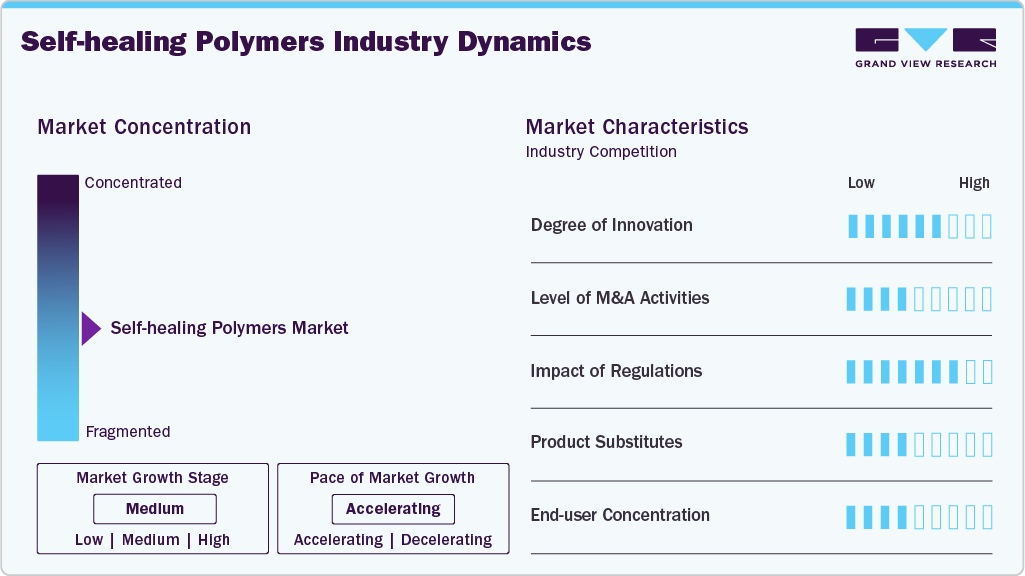
The self-healing polymers market is influenced by regulations related to chemical safety, environmental protection, and material sustainability. Frameworks such as the European Union’s REACH regulation and restrictions on hazardous substances require manufacturers to assess the safety of raw materials and additives used in polymer formulations. These regulations encourage the development of non-toxic, recyclable, and bio-based self-healing materials while reducing reliance on substances with environmental concerns. Although compliance increases testing, certification, and product development costs, it also drives innovation and supports wider adoption of sustainable self-healing technologies across automotive, construction, electronics, and healthcare end uses.
Analyst Perspective
The self-healing polymers market is expected to transition from an emerging innovation-driven market to a commercially scalable, value-led market over the next decade. Demand will be driven primarily by automotive, aerospace, construction, medical, electronics, and advanced infrastructure applications.
Autonomous damage repair enhances reliability, extends service life, and reduces maintenance requirements. Continued advances in reversible polymer chemistries, microencapsulation technologies, bio-based self-healing materials, and nanocomposite integration will expand commercial applications.
Multifunctional smart materials will further support the development of advanced self-healing polymer systems. Sustainability regulations and circular economy initiatives will encourage the development of recyclable and renewable self-healing polymer systems. Market leaders will differentiate themselves through strong research and development capabilities, proprietary technologies, intellectual property portfolios, and vertically integrated manufacturing. Strategic collaborations with OEMs and research institutions, along with expertise in application-specific material design, will strengthen competitive positioning. However, high production costs, complex manufacturing processes, raw material price volatility, and regulatory compliance requirements will remain key constraints. The challenge of scaling advanced technologies for mass commercialization will also limit market expansion. Companies that balance innovation, cost competitiveness, sustainable product development, and global commercialization capabilities will be best positioned to capture long-term value.Material Insights
Based on material, thepolyurethane (PU) segment led the market with the largest revenue share of 56.2% in 2025, and is forecast to grow at a 21.5% CAGR from 2026 to 2033 due to growing demand across building and construction, automotive, and transportation sectors. Increasing infrastructure development projects in emerging economies are supporting the adoption of self-healing materials in insulation systems, coatings, and structural components to improve durability and reduce maintenance costs. Infrastructure renovation programs in developed countries are further driving demand for advanced materials with extended service life. Rising residential construction activity, along with the growth of green buildings, smart offices, and data centers, is accelerating material adoption. In addition, increasing electric and hybrid vehicle production, supported by sustainability regulations, is boosting the use of self-healing polymers in interior components, protective coatings, lightweight parts, and battery-related end uses.
The polylactide (PLA) segment is expected to grow at a 25.6% CAGR over the forecast period.The growth is supported by increasing adoption in packaging end uses. Self-healing polymers are being incorporated into food packaging films, containers, and flexible packaging formats to improve durability and extend product shelf life. Demand is rising in food and beverage packaging segments that require food-contact-compliant materials with enhanced resistance to punctures and microcracks. The increasing consumption of pharmaceutical products is further driving the adoption of protective and sterile packaging solutions. The expanding market for energy drinks, ready-to-drink teas, fruit juices, yogurt beverages, sports drinks, and alcoholic beverages is creating sustained demand for advanced packaging materials that reduce product loss and maintain package integrity throughout distribution and storage.
End Use Insights
Based on end use, theautomotive segment led the market with the largest revenue share of 32.1% in 2025, and is projected to grow at a 22.5% CAGR from 2026 to 2033. The growth is due to the rising adoption of self-healing polymers in the automotive sector, supported by increasing electric and hybrid vehicle production driven by sustainability regulations and emission reduction targets. These materials help improve component durability, reduce maintenance requirements, and extend service life in vehicle interiors, coatings, and structural applications. In addition, growing automation in automotive manufacturing is increasing the use of advanced materials that enhance production efficiency and product reliability. Rapid industrialization and expanding commercial vehicle fleets for logistics and supply chain operations are further supporting demand, contributing to broader market growth and adoption of self-healing polymer technologies.
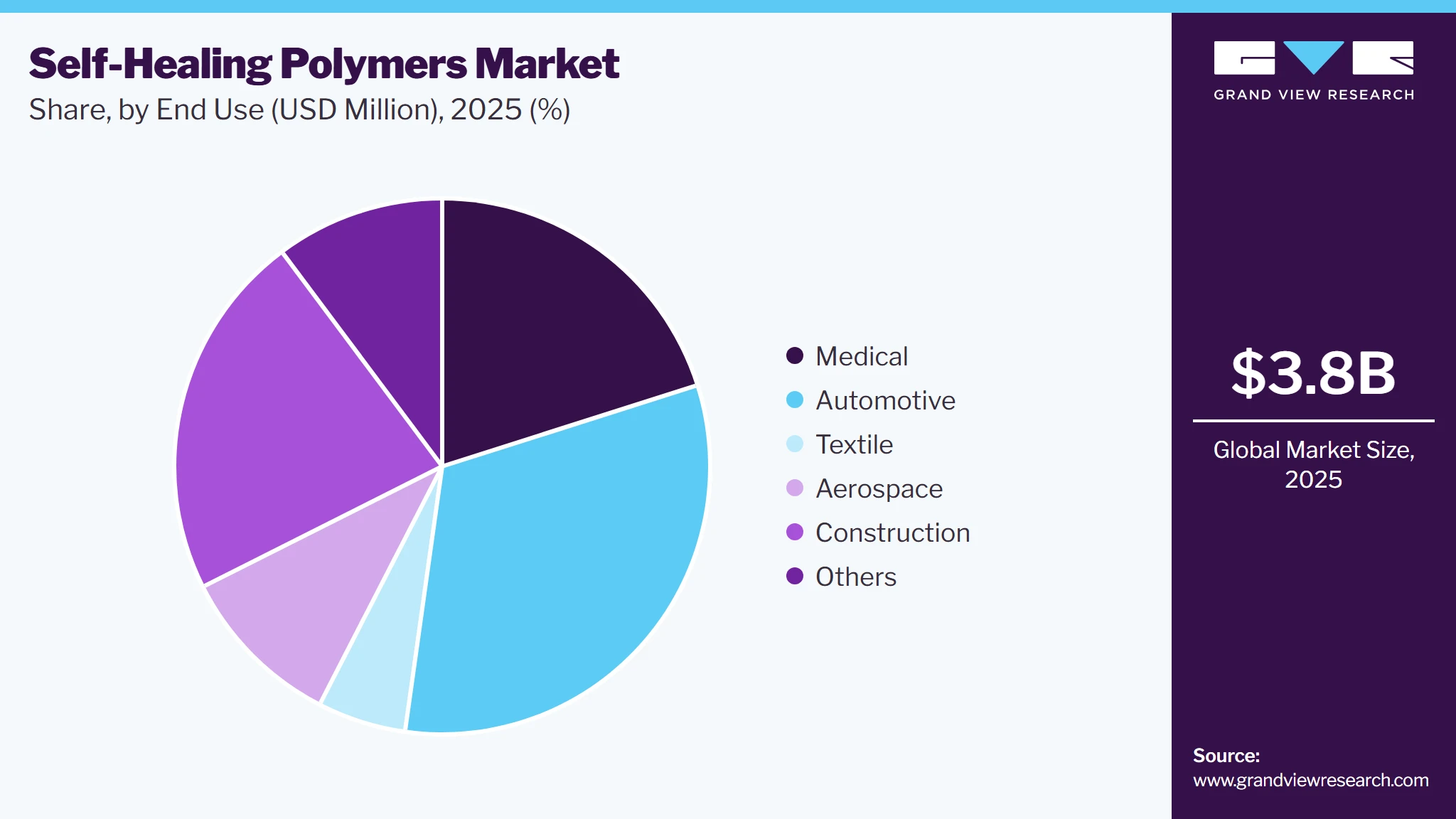
The medical segment is expected to grow at the fastest CAGR of 22.6% over the forecast period. The growth is driven by the increasing prevalence of lifestyle diseases associated with sedentary habits in the healthcare and medical sector. Rising incidences of diabetes, cardiovascular disorders, obesity, and chronic wound conditions are increasing the demand for advanced medical materials that offer longer service life and improved reliability. Self-healing polymers are gaining adoption in wearable health monitoring devices, implantable medical components, drug delivery systems, and wound care applications due to their ability to autonomously repair damage and maintain functional performance. This trend is supporting greater utilization of self-healing polymers across high-value healthcare and medical applications.
Regional Insights
Asia Pacific dominated the self-healing polymers market with the largest revenue share of 37.6% in 2025. The region is expected to grow at a CAGR of 22.5% over the forecast period due to growing adoption of electric vehicles across the Asia Pacific region, supported by large-scale vehicle manufacturing and export activities in China, Japan, South Korea, and India, is driving demand for advanced self-healing polymers. Increasing EV production volumes are encouraging automotive OEMs and tier suppliers to incorporate self-healing materials in coatings, seals, cable protection systems, and non-structural components. These materials help improve durability, reduce maintenance requirements, and extend component service life. Rising investments in battery manufacturing, electric mobility infrastructure, and automotive innovation programs continue to support market expansion. Key end users include automotive manufacturers, component suppliers, battery producers, and electric mobility system integrators.
China Self-Healing Polymers Market Trends
The self-healing polymers market in China accounted for the largest market revenue share in the Asia Pacific in 2025. China’s self-healing polymers market is expanding steadily, supported by the country’s position as a global manufacturing and export hub for electronics, automotive components, textiles, and consumer goods. Large-scale production capacity and integrated supply chains are encouraging material suppliers and manufacturers to commercialize self-healing polymer solutions for coatings, seals, and non-structural components. According to China’s General Administration of Customs, total goods imports and exports reached USD 6.17 trillion in 2024, reflecting a 5% year-on-year increase. Growing export volumes are increasing demand for durable, high-performance materials. As a result, self-healing polymers are being adopted in protective coatings, electronic encapsulants, and connector housings to repair microcracks, reduce moisture penetration, and improve product reliability.
North America Self-Healing Polymers Market Trends
North America's self-healing polymers industry is expected to witness strong growth, supported by increasing investments in aerospace, medical technologies, advanced manufacturing, and next-generation mobility platforms. The region benefits from a strong innovation ecosystem, extensive research capabilities, and the presence of leading aerospace, healthcare, and industrial equipment manufacturers. Growing aerospace and medical investments across the U.S., Canada, and Mexico are accelerating demand for advanced materials that enhance operational safety, reduce maintenance requirements, and improve lifecycle performance. Strong civil aviation activity and targeted government procurement programs are encouraging suppliers and OEMs to qualify self-healing polymer systems that deliver improved durability, structural reliability, and weight reduction across critical applications.
U.S. Self-Healing Polymers Market Trends
The U.S. self-healing polymers industry is expanding due to rising automotive production, fleet renewal activity, and increasing demand for advanced materials that enhance vehicle durability and reduce lifecycle costs. Higher vehicle output is encouraging OEMs and tier suppliers to accelerate qualification programs for next-generation polymer technologies. According to the U.S. Bureau of Economic Analysis, real motor vehicle output increased in late 2024, supporting stronger procurement of performance materials across the automotive value chain. Self-healing polymers are gaining adoption in exterior coatings, seals, and cable protection systems, where autonomous repair of microcracks helps reduce moisture penetration, improve component longevity, and lower maintenance and warranty expenses.
Europe Self-Healing Polymers Market Trends
The Europe self-healing polymers industry is expanding due to increasing infrastructure refurbishment projects, growing construction activity, and rising investments in tourism-related developments across the region. Demand is increasing for durable and low-maintenance materials in commercial buildings, transportation infrastructure, and hospitality facilities. Public and private spending on retrofits, modernization programs, and new hotel and transport capacity is encouraging the adoption of advanced self-healing polymer systems. Asset owners, contractors, and developers are prioritizing materials that extend service life, reduce maintenance frequency, and lower lifecycle costs. These factors continue to support market growth across Europe.
Latin America Self-Healing Polymers Market Trends
The Central & South America self-healing polymers industry is growing due to expanding manufacturing activity across major industrial economies such as Brazil and Argentina. Strong automotive, electrical and electronics, and textile production is creating demand for advanced materials that enhance product durability and operational performance. Manufacturers are increasingly adopting self-healing polymers to improve product quality, reduce maintenance requirements, and minimize warranty-related costs. Growing efforts by OEMs and component suppliers to strengthen competitiveness in domestic and export markets are supporting the use of self-healing coatings, seals, protective layers, and non-structural components across multiple industrial applications.
Middle East and Africa Self-Healing Polymers Market Trends
The Middle East & Africa market for self-healing polymers is growing due to increasing construction activity and public capital deployment across the Gulf countries and broader African economies. Demand is rising for durable, low-maintenance materials used in transport networks, commercial buildings, hospitality projects, and energy infrastructure. Harsh climatic conditions and high asset maintenance costs are encouraging the adoption of advanced self-healing polymer systems that enhance material longevity and structural resilience. Additionally, investments in urban regeneration, port expansion, logistics infrastructure, and large-scale housing developments are supporting long-term market growth by increasing the need for high-performance and lifecycle-efficient construction materials.
Key Self-Healing Polymers Company Insights
Some of the key players operating in the market include Huntsman International Corporation and BASF SE.
-
Huntsman International Corporation is a significant participant in the self-healing polymers market, supported by its strong capabilities in specialty polyurethane systems, performance materials, and advanced chemical technologies. The company focuses on high-value applications across coatings, adhesives, construction materials, automotive components, and industrial composites. Its expertise in polymer formulation, mechanical durability, and material performance supports the development of self-healing solutions designed to improve product lifespan and reduce maintenance requirements. Huntsman benefits from extensive research and development resources, a diversified product portfolio, and a broad global manufacturing network. These strengths support continuous innovation and enable the commercialization of advanced self-healing polymer technologies for demanding industrial and infrastructure applications.
-
BASF SE is a prominent participant in the self-healing polymers industry, supported by its extensive expertise in specialty chemicals, advanced polymer technologies, and material innovation. The company focuses on developing self-healing systems for coatings, automotive components, construction materials, electronics, and industrial applications. Its emphasis on functional polymers, microencapsulation technologies, and dynamic covalent chemistry strengthens its position in high-performance material solutions. BASF SE benefits from strong research and development capabilities, integrated manufacturing operations, and a broad global customer network. These strengths support continuous product advancement and enable the commercialization of self-healing materials that enhance durability, reduce maintenance requirements, and improve lifecycle performance across end-use industries.
Autonomic Materials, Inc. and NEI Corporation are some of the emerging participants in the self-healing polymers market.
-
Autonomic Materials, Inc. is strengthening its position in the market through its proprietary microcapsule-based self-healing coating technologies. The company focuses on corrosion protection systems that autonomously repair microcracks and coating damage in industrial and infrastructure environments. Its solutions are increasingly deployed in oil and gas, marine, defense, and transportation applications where asset longevity and maintenance cost reduction are critical. The growing demand for smart protective coatings is driving adoption. Continued R&D in encapsulated healing chemistries and scalable coating formulations enhances its competitiveness in high-performance self-healing polymer applications.
-
NEI Corporation is a specialized advanced materials participant in the self-healing polymers market, focusing on functional coatings, nanomaterials, and surface engineering for energy storage and industrial protection applications. The company leverages ceramic coatings, sol-gel chemistry, and nanostructured formulations to enable self-healing behavior, corrosion resistance, and microcrack suppression in demanding environments. Its platforms support applications in lithium-ion batteries, protective electronic coatings, and high-durability industrial surfaces requiring improved reliability and extended service life. NEI Corporation’s R&D-driven portfolio strengthens its position in advanced self-healing polymer and functional materials markets across energy and electronics sectors
Key Self-Healing Polymers Companies
The following key companies have been profiled for this study on the self-healing polymers market.
-
Huntsman International Corporation
-
BASF SE
-
Covestro AG
-
Dow Inc.
-
Wanhua Chemical Group Co., Ltd.
-
Autonomic Materials, Inc.
-
Arkema S.A.
-
NEI Corporation
-
CompPair Technologies SA
-
The Lubrizol Corporation
-
The Goodyear Tire & Rubber Company
-
Sika AG
Competitive Benchmarking
Category
Operating Strategies
Competitive Edge
Weakness
Established Players (BASF SE, Covestro AG, Dow Inc., Huntsman International LLC, Wanhua Chemical Group Co., Ltd., Arkema S.A., The Lubrizol Corporation, Sika AG, The Goodyear Tire & Rubber Company)
Focus on strengthening their position in the self-healing polymers market through the development and commercialization of advanced polymer systems, self-healing coatings, elastomers, adhesives, sealants, composites, and functional materials for automotive, construction, aerospace, medical, electronics, and industrial applications.
Strong emphasis is placed on expanding sustainable polymer portfolios, smart materials, bio-based chemistries, and high-performance formulations.
Continuous investments in material innovation, advanced manufacturing technologies, production capacity expansion, and strategic collaborations with OEMs, research institutions, and industrial partners support global market penetration and long-term commercial growth.
Extensive expertise in polymer chemistry, advanced material science, large-scale manufacturing, and global supply chain operations enables the commercialization of high-performance self-healing polymers offering superior durability, autonomous crack repair, mechanical strength, and extended service life.
Strong research and development capabilities, integrated production facilities, diversified product portfolios, established customer relationships, intellectual property portfolios, and global distribution networks provide sustainable competitive differentiation and recurring revenue opportunities across multiple end-use industries.
High capital investment requirements for advanced polymer synthesis, specialty material development, and manufacturing infrastructure increase operational complexity and production costs.
Market growth is influenced by fluctuations in raw material prices, evolving regulatory frameworks, and varying adoption rates across end-use industries.
Additionally, continuous investments in research and development, sustainability initiatives, bio-based material innovation, and manufacturing modernization may affect profitability and long-term market share.
Emerging Players (Autonomic Materials, Inc., NEI Corporation, CompPair Technologies SA)
Focus on expanding their presence in the self-healing polymers market through the development of application-specific self-healing coatings, composite materials, smart polymers, and functional formulations for aerospace, automotive, electronics, infrastructure, and industrial applications.
Emphasis is placed on advancing proprietary self-healing technologies, improving material performance, accelerating product commercialization, and expanding collaborative research with universities, OEMs, and technology partners.
Strategic partnerships and pilot-scale deployments support product innovation, commercial expansion, and entry into high-growth specialty materials markets.
Strong flexibility in technology development, specialized expertise in self-healing material design, agile innovation capabilities, and rapid product customization enable these companies to address evolving customer requirements effectively.
Their ability to commercialize niche technologies, develop application-specific solutions, shorten development cycles, and collaborate closely with research organizations strengthens adoption across emerging high-value applications.
Agile business models, focused intellectual property development, and strong technical specialization further enhance their competitive positioning in the global self-healing polymers market.
Limited manufacturing scale compared with multinational chemical companies, relatively lower financial resources, and smaller global distribution networks may restrict large-scale commercialization and competition in high-volume markets.
Dependence on strategic partnerships, external funding, and customer validation can constrain market expansion.
Additionally, significant investments in production scale-up, regulatory approvals, international market expansion, and commercialization infrastructure are required to compete effectively in the global self-healing polymers market.
Recent Developments
-
In September 2025, the Indian Institute of Technology (IIT), Bhilai, developed a self-healing polymer that can repair itself at room temperature without external heat or treatment. The impact-resistant polymer absorbs strong impacts and can heal small scratches within minutes. Even if cut, the pieces can be pressed together to regain almost their original strength. The material, created using a low-cost, scalable method, is thermally stable, highly adhesive, and reusable without losing its properties, making it suitable for industrial use. It functions as a smart shield, tough during normal use but softening to absorb shocks and prevent cracks. This innovation could enhance safety and durability in electric vehicles, aircraft, and protective gear, thereby reducing the need for repairs and replacements. This supports sustainability by lowering carbon emissions and minimizing material waste.
-
In March 2025, BASF SE expanded its manufacturing capabilities in the U.S. for Licity water-based anode binders to cater to the expanding lithium-ion battery market, establishing new plants in Pennsylvania and Tennessee to enhance existing operations in China, Germany, and Finland. These binders enhance battery capacity, improve cycle stability, and reduce charging times, offering customizable formulations suitable for electric vehicles and energy storage solutions. This focus on materials that minimize degradation and prolong functional lifespan reflects a broader trend toward self-healing polymer technologies, which aim to autonomously repair micro-damage in battery components, thereby further enhancing long-term performance.
Self-Healing Polymers Market Report Scope
Report Attribute
Details
Market size in 2025
USD 3.8 billion
Estimated market size in 2026
USD 4.6 billion
Projected market size by 2033
USD 18.4 billion
Growth rate
CAGR of 21.8% from 2026 to 2033
Base year for estimation
2025
Historical data
2021 - 2024
Forecast period
2026 - 2033
Quantitative units
Revenue in USD million/billion, volume in kilotons, and CAGR from 2026 to 2033
Report coverage
Revenue forecast, company ranking, competitive landscape, growth factors, and trends
Segments covered
Material, end use, region
Regional scope
North America; Europe; Asia Pacific; Latin America; Middle East & Africa
Country scope
U.S.; Canada; Mexico; Europe; Germany; UK; France; Italy; Spain; China; India; Japan; South Korea; Australia; Malaysia; Singapore; Thailand; Vietnam; Brazil; Argentina; Saudi Arabia; UAE; South Africa
Key companies profiled
Huntsman International Corporation; BASF SE; Covestro AG; Dow Inc.; Wanhua Chemical Group Co., Ltd.; Autonomic Materials, Inc.; Arkema S.A.; NEI Corporation; CompPair Technologies SA; The Lubrizol Corporation; The Goodyear Tire & Rubber Company; Sika AG
Customization scope
Free report customization (equivalent up to 8 analysts' working days) with purchase. Addition or alteration to country, regional & segment scope.
Pricing and purchase options
Avail customized purchase options to meet your exact research needs. Explore purchase options
Global Self-Healing Polymers Market Report Segmentation
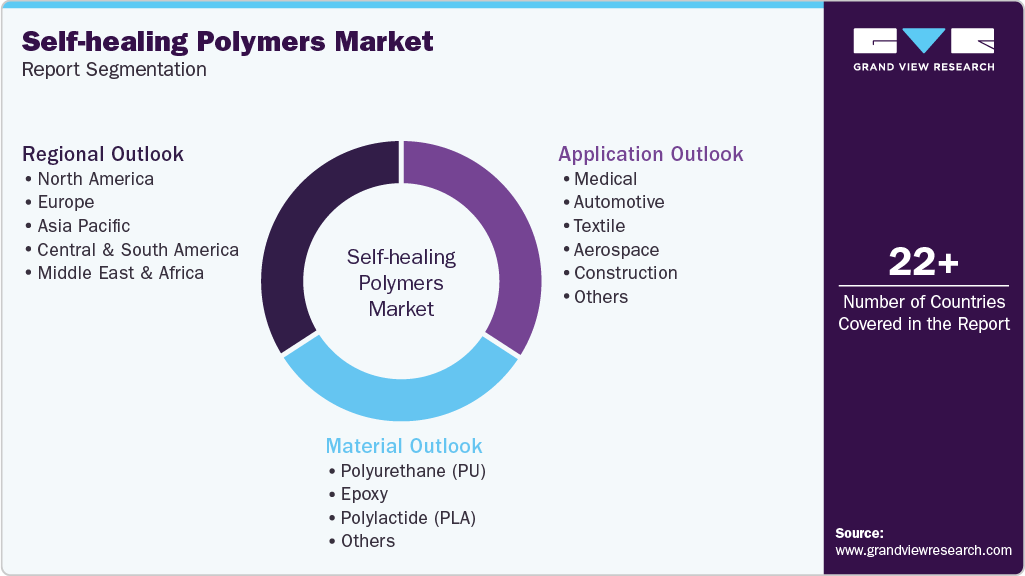
This report forecasts revenue growth at the global, regional, and country levels and provides an analysis of the latest industry trends across sub-segments from 2021 to 2033. For this study, Grand View Research has segmented the global self-healing polymers market report based on material, end use, and region:
-
Material Outlook (Volume, Kilotons; Revenue, USD Million/Billion, 2021 - 2033)
-
Polyurethane
-
Epoxy
-
Polylactide
-
Others
-
-
End Use Outlook (Volume, Kilotons; Revenue, USD Million/Billion, 2021 - 2033)
-
Medical
-
Automotive
-
Textile
-
Aerospace
-
Construction
-
Others
-
-
Regional Outlook (Volume, Kilotons; Revenue, USD Million/Billion, 2021 - 2033)
-
North America
-
U.S.
-
Canada
-
Mexico
-
-
Europe
-
Germany
-
UK
-
France
-
Italy
-
Spain
-
-
Asia Pacific
-
China
-
India
-
Japan
-
South Korea
-
Australia
-
Malaysia
-
Singapore
-
Thailand
-
Vietnam
-
-
Latin America
-
Brazil
-
Argentina
-
-
Middle East & Africa
-
Saudi Arabia
-
UAE
-
South Africa
-
-
Research Methodology
The self-healing polymers market figures in this report are based on a proven research process that combines executive interviews with secondary research from proprietary databases, company filings, and recognized regulatory and institutional sources. Market size is built through value-chain sizing - reconciling supply-side and demand-side estimates - and triangulated with bottom-up and top-down approaches. Every estimate passes multiple levels of expert validation before publication, with each self-healing polymers segment quantified using the revenue-capture definitions in the table below.
Segment Definition
Segment - Material
Revenue capture definition
Polyurethane (PU)
Revenue is captured through the production and sale of polyurethane-based self-healing polymers used in protective coatings, adhesives, sealants, elastomers, and flexible components. Demand is driven by excellent elasticity, abrasion resistance, impact durability, autonomous crack repair capabilities, and increasing adoption across automotive, construction, electronics, and industrial applications.
Epoxy
Revenue is captured through the commercialization of epoxy-based self-healing polymers used in structural composites, protective coatings, adhesives, and electronic encapsulation materials. Growth is supported by superior mechanical strength, chemical resistance, dimensional stability, crack-healing performance, and increasing demand across aerospace, automotive, electronics, and infrastructure applications.
Polylactide (PLA)
Revenue is captured through the production and sale of polylactide-based self-healing polymers used in sustainable packaging, biomedical devices, disposable products, and specialty consumer applications. Demand is driven by biodegradability, renewable feedstock utilization, improved sustainability, autonomous repair functionality, and increasing preference for environmentally friendly polymer materials across multiple industries.
Others
Revenue is captured through the commercialization of other self-healing polymer materials, including polycaprolactone, silicone, polyamide, and acrylic-based systems used in coatings, sensors, electronics, medical devices, and specialty engineering applications. Growth is supported by application-specific performance requirements, continuous material innovation, enhanced durability, and expanding adoption across high-value industrial sectors.
Segment - Application
Revenue capture definition
Medical
Revenue is captured through the production and sale of self-healing polymers used in medical devices, implants, wound dressings, drug delivery systems, and wearable healthcare technologies. Demand is driven by increasing requirements for biocompatibility, extended device lifespan, improved patient safety, autonomous damage repair, and growing investments in advanced healthcare materials.
Automotive
Revenue is captured through the commercialization of self-healing polymers used in automotive coatings, interior and exterior components, structural composites, adhesives, and protective films. Growth is supported by increasing demand for lightweight materials, enhanced durability, scratch resistance, reduced maintenance requirements, and expanding adoption of advanced materials in electric and conventional vehicles.
Textile
Revenue is captured through the production and sale of self-healing polymers used in smart textiles, protective clothing, performance fabrics, sportswear, and wearable electronics. Demand is driven by increasing consumer preference for durable fabrics, enhanced product longevity, improved functionality, autonomous repair capabilities, and growing adoption of intelligent textile technologies.
Aerospace
Revenue is captured through the commercialization of self-healing polymers used in aircraft structures, composite components, turbine blades, protective coatings, and aerospace adhesives. Growth is supported by increasing demand for lightweight materials, improved structural integrity, reduced maintenance costs, enhanced operational reliability, and rising investments in next-generation aerospace technologies.
Construction
Revenue is captured through the production and sale of self-healing polymers used in concrete additives, protective coatings, sealants, adhesives, waterproofing systems, and structural repair materials. Demand is driven by increasing investments in infrastructure modernization, enhanced structural durability, reduced maintenance requirements, crack repair capabilities, and growing adoption of smart construction materials.
Others
Revenue is captured through the commercialization of self-healing polymers used in electronics, energy storage systems, consumer goods, industrial equipment, marine applications, and specialty engineering products. Growth is supported by increasing demand for high-performance materials, improved product reliability, autonomous repair functionality, and expanding applications across advanced manufacturing and industrial sectors.
Estimation Model
Layer Name
Key Question
Description
Top-Down Self-Healing Polymers Demand Assessment Layer
What defines market boundaries?
This layer begins with global demand for self-healing polymers across automotive, aerospace & defense, construction, electronics, healthcare, coatings, adhesives, packaging, and other advanced material applications. Demand is filtered based on automotive production, aircraft manufacturing, infrastructure development, electronics production, healthcare investments, increasing adoption of smart materials, growing emphasis on sustainability, and rising preference for durable, lightweight, and low-maintenance materials across major end-use industries.
Application Validation Layer
Where is demand generated?
This layer evaluates demand distribution across automotive components, protective coatings, aerospace structures, construction materials, electronic devices, medical products, packaging, adhesives, and other specialty applications. Market revenue is aligned with critical performance requirements including autonomous crack repair, mechanical durability, abrasion resistance, corrosion protection, chemical stability, extended service life, lightweight construction, and reduced maintenance requirements across diverse end-use applications.
Product and Material Conversion Layer
Who captures market revenue?
This layer converts application-level demand into the self-healing polymers market revenue by applying product mix ratios across polyurethane (PU), epoxy, polyethylene (PE), polypropylene (PP), polycaprolactone (PCL), ionomers, and other specialty self-healing polymer materials. Revenue allocation considers healing mechanism, polymer chemistry, material performance, manufacturing technologies, product pricing, production efficiency, value-added material engineering, and supplier positioning across the global advanced materials value chain.
Regional Commercial Cross-Check Layer
How are assumptions validated?
This layer validates demand concentration by comparing Asia Pacific's leadership in automotive manufacturing, electronics production, and industrial development; North America's demand driven by aerospace innovation, healthcare technologies, automotive R&D, and advanced material commercialization; and Europe's growth supported by sustainable manufacturing, electric vehicle production, stringent environmental regulations, and high adoption of advanced polymer technologies. It also evaluates emerging opportunities across Latin America and the Middle East & Africa, supported by expanding industrialization, infrastructure investments, growing automotive production, increasing healthcare expenditure, and rising demand for durable, high-performance materials across key end-use industries.
Delivered Customizations
This report has been delivered with the following In-depth customizations
Client Request
Customization Delivered
Value Adds
Regional Segmentation
Market sizing and demand split across North America, Europe, Asia Pacific, Latin America, and Middle East & Africa, with country-level focus where relevant
Clarifies growth pockets, regional adoption patterns, and priority markets for commercial entry.
Competitive benchmarking
Comparative assessment of key players by product portfolio, technology depth, innovation focus, scale, and market positioning.
Highlights competitive gaps, relative strengths, and likely threat levels
Cross-Segmentation
Demand mapping by polymer type, healing mechanism, end-use industry, and application across the self-healing polymers value chain.
Identifies the highest-value segment combinations and improves strategic targeting.
Delivered Customizations
This report has been delivered with the following In-depth customizations
Client Request
Customization Delivered
Value Adds
Regional Segmentation
Delivered an in-depth regional analysis of the self-healing polymers market across North America, Europe, Asia Pacific, Latin America, and the Middle East & Africa, with country-level insights for key markets. The assessment included market size, growth outlook, demand drivers, regulatory landscape, end-use adoption trends, manufacturing footprint, and investment activity.
Enabled clients to identify high-growth regional markets, prioritize expansion strategies, optimize resource allocation, understand regional demand patterns, and develop market-entry and localization strategies.
Pricing Analysis
Delivered detailed pricing analysis covering raw material cost trends, production economics, value chain margins, regional pricing variations, pricing strategies by material type, and pricing comparison across key self-healing polymer technologies and end-use industries.
Supported pricing optimization, procurement planning, profitability analysis, contract negotiations, cost management, and long-term pricing strategy development.
Opportunity Assessment
Delivered a detailed opportunity assessment covering emerging application areas, high-growth end-use industries, technological advancements, sustainability-driven innovations, investment hotspots, white-space opportunities, and untapped regional markets across the self-healing polymers value chain.
Helped clients identify future revenue opportunities, prioritize strategic investments, accelerate innovation initiatives, expand into new markets, and build long-term growth roadmaps with reduced business risk.
Frequently Asked Questions About This Report
Some key players operating in the self-healing polymers market include Huntsman International Corporation, BASF SE, Covestro AG, Dow Inc., Wanhua Chemical Group Co., Ltd., Autonomic Materials, Inc., Arkema S.A., NEI Corporation, CompPair Technologies SA, The Lubrizol Corporation, The Goodyear Tire & Rubber Company, Sika AG.
Advancements in material science are enabling the development of more efficient self-healing polymers that can autonomously repair damage, making them ideal for applications in industries like automotive and aerospace, where material longevity is crucial.
The global self-healing polymers market size was valued at USD 3.8 billion in 2025 and is estimated at USD4.6 billion for 2026.
The global self-healing polymers market is expected to grow at a CAGR of 21.8% from 2026 to 2033,reaching USD 18.4 billion by 2033.
The Asia Pacific self-healing polymers market accounted for the largest share of 37.6% market size in 2025.
Automotive segment held the largest market share of 32.1% in 2025. Rising demand for durable, lightweight vehicle materials and increasing vehicle production are driving self-healing polymer adoption owing to their autonomous repair capability, durability, and reduced maintenance requirements.
The polyurethane led the self-healing polymers market in 2025 with a 56.2 % share. The growth is driven by increasing demand from building and construction, automotive and transportation, furniture and bedding, and electronics and appliances, which is accelerating the adoption of self-healing polymers.
About the Author(s)
Plastics, Polymers & Resins Research Team
Bulk Chemicals · Plastics, Polymers & ResinsThis report was authored by the plastics, polymers & resins research team at Grand View Research - comprising two research analysts, one senior research analyst, and one industry expert - with specialized expertise in the plastics, polymers & resins segment of the bulk chemicals industry. All findings are based on proprietary bulk chemicals databases, executive interviews, and regulatory analysis, subject to internal peer review prior to publication.
Last Updated:
Speak to Analyst


Customize this report to your needs - add regions, segments, or data points, with 20% free customization.
Or view our licence options:


ISO 9001:2015 & 27001:2022 Certified
We are GDPR and CCPA compliant! Your transaction & personal information is safe and secure. For more details, please read our privacy policy.


