
- Home
- »
- Advanced Interior Materials
- »
-
Semiconductor Manufacturing Equipment Market Report 2033GVR Report cover

Semiconductor Manufacturing Equipment Market (2026 - 2033) Size, Share & Trends Analysis Report By Process (Front-end, Back-end), By Dimension (2D, 2.5D, 3D), By Application (Semiconductor Electronics Manufacturing), By Region, And Segment Forecasts
Market Size, 2025
$118.9BMarket Estimate, 2026
$126.1BMarket Forecast, 2033
$224.9BCAGR, 2026–2033
8.4%Semiconductor Manufacturing Equipment Market Summary
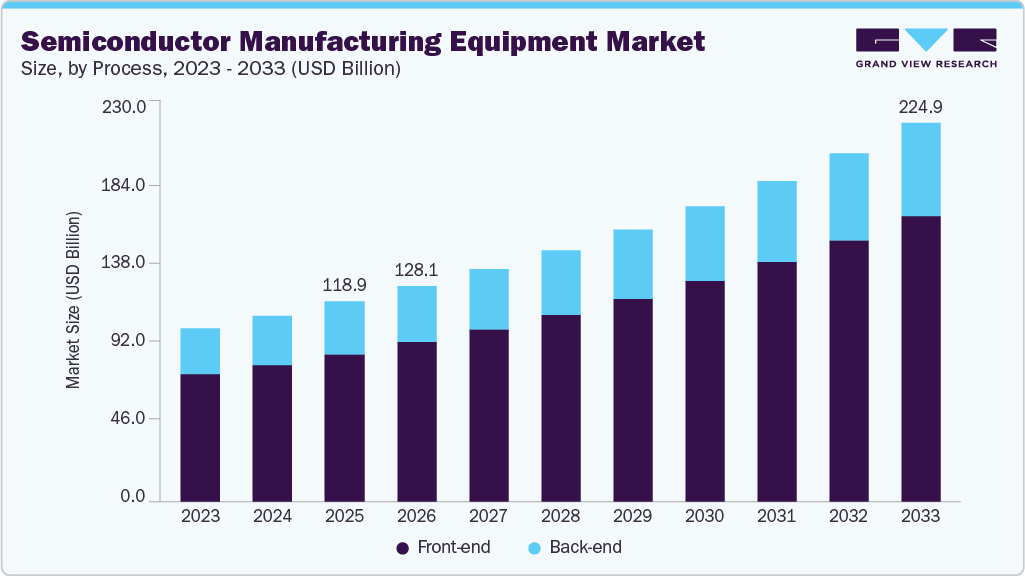
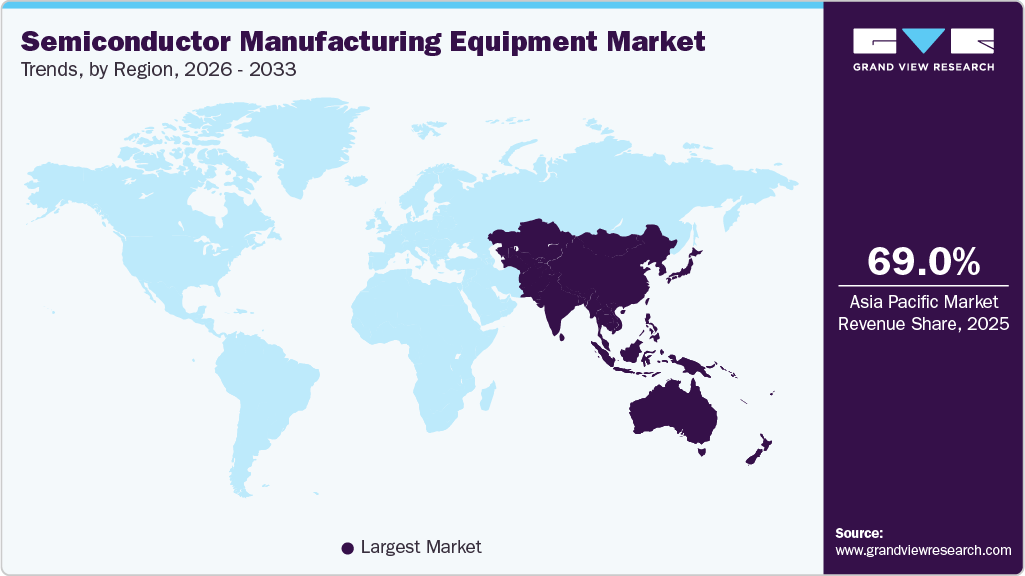
The global Semiconductor Manufacturing Equipment market size was valued at USD 118.9 billion in 2025 and is projected to grow from USD 128.1 billion in 2026 to USD 224.9 billion by 2033, at a CAGR of 8.4% from 2026 to 2033. The market in Asia Pacific dominated with a revenue share of 69.0% in 2025. Escalating adoption of electronic products as part of a daily lifestyle and for professional purposes is expected to increase the demand for semiconductors over the forecast period and support the growth of the semiconductor manufacturing equipment.
 Source: Grand View Research, IR Documents, Primary Interviews, Paid DatabasesTo learn more about this report,
 Download Free Sample Report
 Key Market Trends & Insights
- By process: The front-end segment is expected to grow at a considerable CAGR of 8.6% from 2026 to 2033 in terms of revenue.
- By dimension: The 3D segment is expected to grow at a considerable CAGR of 10.7% from 2026 to 2033 in terms of revenue.
- By application: The semiconductor fabrication plant/foundry segment is expected to grow at a considerable CAGR of 9.2% from 2026 to 2033 in terms of revenue.
Regional Highlights
- Largest regional market: Asia Pacific (69.0% revenue share, 2025)
- By country: The China held the largest market share in 2025.
Market Size & Forecast
- Market size in 2025: USD 118.9 Billion
- Estimated market size in 2026: USD 128.1 Billion
- Projected market size by 2033: USD 224.9 Billion
- CAGR (2026-2033): 8.4%
Three ways to get this report
Buy it, customize it, or ask a question.Ask an Analyst
Analyst response in 1 business day
- AccessReport author, directly
- Reply timeWithin 1 working day
- No sales callDirect answer only
- FormatEmail reply
- CostFree, no cost
Get the Full Report
What the study covers
- FormatsPDF · Excel · Dashboard
- Timeline2026–2033 annual, 2025 base
- Coverage20+ countries, 5 regions
- Companies10+ key players profiled
Customize the Report
20% free customization
- IncludeCountries, segments, points
- TailorTo your product definition
- ExtendDeeper competitor detail
- OrA fully bespoke study
- Turnaround5–10 working days
Moreover, growth of the semiconductor manufacturing equipment industry is supported by the evolution of cloud technology, development of 5G networks, and rising demand for connected vehicles. These advancements require increasingly complex and powerful semiconductor components, driving investment in cutting-edge fabrication technologies. In addition, the expansion of AI and IoT applications continues to fuel demand for high-performance chips, further boosting the need for advanced manufacturing equipment.
 To learn more about this report, Download Free Sample Report
 Market Dynamics
The demand for semiconductors is increasing progressively worldwide as the design of integrated circuits (ICs) is becoming increasingly complicated, resulting in the usage of many semiconductors for developing them. Semiconductors are utilized in the development of ICs as they help minimize production costs, reduce the time required for mass production, and enhance the value of final products in terms of operations. Furthermore, the rise in the demand for consumer electronics can be attributed to the increasing disposable income of the masses, coupled with the increasing demand for advanced electronic products. The surging adoption of electronic products in workplaces, daily routines, and entertainment is expected to increase the demand for semiconductors, thereby leading to a rise in the demand for semiconductor manufacturing equipment.
The high cost of semiconductor manufacturing equipment is a significant challenge for the industry. The cost of semiconductor manufacturing equipment can range between USD 700,000 and more than USD 4,000,000, with several pieces of equipment reaching as high as USD 130,000,000. The cost of constructing a semiconductor fabrication facility alone is projected to be between USD 15 billion and USD 20 billion. The high cost is due to the high initial costs and complexity of scaling anything as complicated as semiconductor manufacturing. The equipment used for manufacturing silicon wafers, in particular, is exceedingly expensive and needs to be custom-made.
Market Concentration & Characteristics
The global semiconductor manufacturing equipment industry is moderately to highly consolidated, dominated by a few major players which command a significant share of the global market. These companies operate alongside a network of specialized equipment providers and component suppliers, many of which serve niche roles in the broader semiconductor value chain. The market is characterized by high barriers to entry, driven by the complexity of technology, capital intensity, and the need for extensive R&D investment.
Innovation in semiconductor manufacturing equipment is rapid, driven by the push for smaller nodes, higher performance, and greater energy efficiency. Toolmakers invest heavily in R&D to introduce advanced lithography, precision metrology, and smarter process controls. This steady stream of breakthroughs keeps the competitive bar high. As a result, technology leadership remains a core differentiator in the market.
 To learn more about this report, Download Free Sample Report
 Regulatory pressures from organizations such as the EU, EPA, and local environmental authorities are significantly shaping the market, with a strong focus on monitoring harmful emissions, air quality, and compliance with safety standards. Companies must comply with these regulations to stay competitive, as governments around the world introduce stricter measures to mitigate pollution and protect public health. With industries becoming more conscious of their environmental impact, the demand for eco-friendly gas detection technologies that support regulatory compliance is increasing, particularly in sectors such as manufacturing, healthcare, and energy.
End user demand is concentrated among a small group of major foundries and IDMs that dominate global chip production. Their large-scale capital spending cycles often set the pace for equipment orders. As these players focus on advanced nodes and higher wafer output, tool suppliers must align closely with their roadmaps. This concentration makes customer relationships strategic and highly competitive.
Process Insights
The front-end process led the market and accounted for 73.8% of the semiconductor manufacturing equipment revenue share in 2025. This dominance is attributed to the increasing complexity and performance requirements of advanced semiconductors used in applications such as GPUs, CPUs, IoT devices, and high-performance computing (HPC). The front-end segment covers critical stages including wafer fabrication, lithography, etching, and deposition, where precision and technological advancement are paramount.
The back-end segment is expected to grow at a significant CAGR of 7.6% from 2026 to 2033 in terms of revenue. The back-end segment is projected to witness notable growth through 2033, driven by increasing demand for advanced packaging, 3D stacking, and heterogeneous integration. As chipmakers aims to improve yield, reduce costs, and shrink form factors, back-end processes such as assembly, test, and burn-in are evolving rapidly. Innovations in chiplet architecture, fan-out wafer-level packaging (FOWLP), and system-in-package (SiP) are prompting new investments in specialized back-end equipment.
Dimension Insights
The 2.5D segment dominated the market and accounted for 38.9% of overall revenue share in 2025 driven by its ability to enhance performance while maintaining a compact form factor. This technology enables high-bandwidth interconnects between multiple semiconductor dies on a single interposer, making it ideal for applications such as AI, high-performance computing, and data centers. As traditional 2D scaling reaches its limits, 2.5D packaging offers a cost-effective solution by supporting chiplet-based architectures that combine specialized chips into one package, boosting efficiency and reducing manufacturing complexity.
The 3D segment is projected to grow at a rapid CAGR of 10.7% from 2026 to 2033 in terms of revenue. The 3D segment is gaining significant traction in the market, driven by its ability to stack multiple layers of semiconductor dies, enabling higher performance, greater functionality, and reduced space requirements. This technology allows for faster data transfer and better power efficiency, making it ideal for applications in high-performance computing, AI, and data centers.
Application Insights
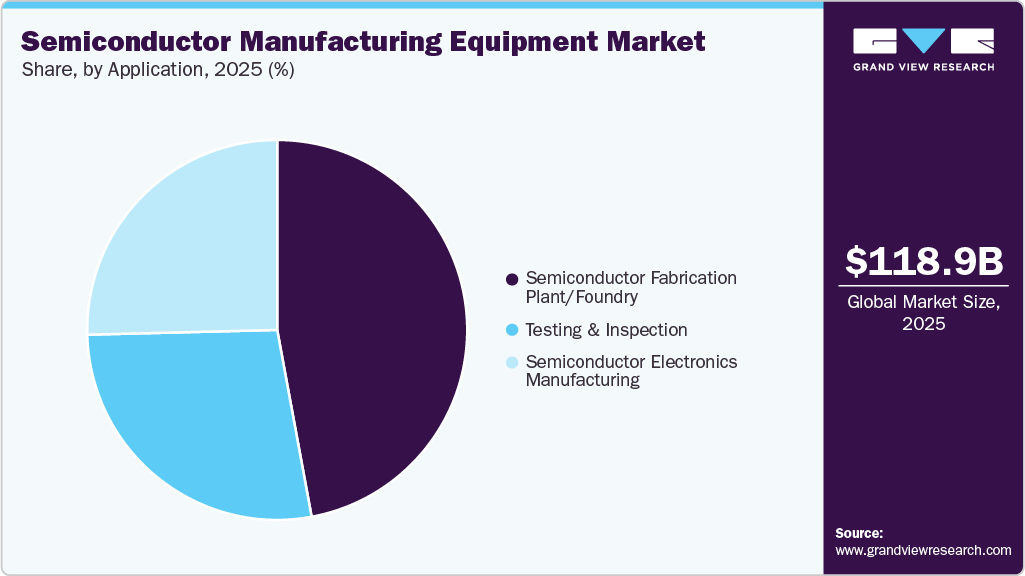
Based on application, the semiconductor fabrication plant/foundry segment led the market, accounting for a 47.1% revenue share in 2025. This growth is primarily driven by the expansion of industrial manufacturing throughout the forecast period. The increasing global population is driving higher demand for consumer electronics, including smartphones, laptops, wearables, and smart home products. As this demand rises, the need for advanced semiconductor manufacturing equipment is expected to grow significantly, further fueling the expansion of the semiconductor fabrication plant/foundry segment.
 To learn more about this report, Download Free Sample Report
 The semiconductor electronics manufacturing segment is projected to grow at a rapid CAGR of 7.8% from 2026 to 2033 in terms of revenue. The semiconductor electronics manufacturing sub-segment is projected to experience significant growth over the forecast period, driven by advancements in artificial intelligence (AI), high-bandwidth memory (HBM), and integrated circuit (IC) technologies. Investments in wafer fabrication equipment and advanced packaging technologies also support the segment’s persistent growth.
Regional Insights
The North America semiconductor manufacturing equipment industry is anticipated to grow at a CAGR of 6.6% over the forecast period, as large-scale fab construction and onshoring policies boost equipment demand. Incentives aimed at strengthening domestic chip manufacturing are driving investments in advanced logic fabs and R&D infrastructure. The presence of leading equipment suppliers also supports local ecosystem expansion. This combination is steadily lifting the region’s share of new tool installations.
U.S. Semiconductor Manufacturing Equipment Market Trends
The U.S. semiconductor manufacturing equipment industry dominated the North American region in 2025 due to major investments in advanced node fabs and strong federal incentives supporting domestic chip production. Leading foundries and IDMs are expanding capacity to reduce supply-chain risks and bring critical technologies onshore. The presence of top equipment suppliers further strengthens the country’s ecosystem. As a result, most regional tool demand is concentrated in the U.S.
Canada semiconductor manufacturing equipment industry is growing as it builds out its semiconductor value chain through research-driven initiatives and targeted incentives. The country is investing in compound semiconductors, photonics, and packaging technologies, which is gradually increasing its equipment needs. Collaboration between universities, startups, and global players is helping accelerate capability development. These efforts are positioning Canada as a rising participant in specialized segments of the market.
Asia Pacific Semiconductor Manufacturing Equipment Market Trends
Asia Pacific semiconductor manufacturing equipment industry led the global market and accounted for 69.0% share in 2025, due to its dense fabrication ecosystem, strong government incentives, and ongoing capacity expansion in countries such as Taiwan, South Korea, China, and Japan. Major foundries continue to invest in advanced nodes, which keeps demand for lithography, etch, and deposition tools high. The region also benefits from mature supply chains and skilled labor pools that support rapid scaling. Overall, it remains the core hub for both mature and cutting-edge semiconductor production.
 To learn more about this report, Download Free Sample Report
 China semiconductor manufacturing equipment dominated the Asia Pacific region in 2025 due to its aggressive fab expansion and strong government backing for domestic chip manufacturing. Large investments across memory, foundry, and mature-node production continue to drive sizeable equipment purchases. The rise of local toolmakers is also boosting procurement within the country. Altogether, these factors keep China at the center of regional equipment demand.
India semiconductor manufacturing equipment industry is growing as new semiconductor policies, incentives, and large-scale fabrication announcements propel the country into the global manufacturing landscape. Government programs are encouraging investments in fabs, ATMP units, and design-linked initiatives. Partnerships with global equipment suppliers are helping build early-stage technical capabilities. This momentum is steadily increasing India’s demand for both front-end and back-end equipment.
Europe Semiconductor Manufacturing Equipment Market Trends
Europe semiconductor manufacturing equipment industry is experiencing steady growth, with Germany leading the way due to its automotive industry’s increasing reliance on semiconductors. Investments in R&D and government efforts to boost semiconductor production within the region are expected to continue driving growth, although the pace may be slower compared to North America and Asia.
Germany semiconductor manufacturing equipment industry dominates the European market due to its strong industrial base, major investments in automotive and power semiconductor fabs, and supportive government funding. The country continues to attract leading chipmakers, expanding capacity for EVs and industrial applications. Its mature engineering ecosystem and supplier network also reinforces tool demand. As a result, Germany remains the key driver of equipment purchases in the region.
The semiconductor manufacturing equipment industry in the UK is growing as it strengthens its position in compound semiconductors, photonics, and advanced packaging technologies. Government-backed innovation programs and collaborations with research institutions are helping expand manufacturing capabilities. Rising interest from global players is further encouraging investments in niche, high-value segments. These developments are gradually increasing the UK’s need for specialized semiconductor equipment.
Latin America Semiconductor Manufacturing Equipment Market Trends
Latin America’s semiconductor manufacturing equipment industry is still in the early stages of growth but is showing promise due to increasing demand for consumer electronics and mobile devices. Countries like Brazil are focusing on developing local manufacturing capabilities, and while the region faces challenges like infrastructure and investment, growth is anticipated as the sector matures.
The semiconductor manufacturing equipment industry in Brazil is growing as it expands local electronics manufacturing and invests in strengthening its high-tech supply chain. Government incentives and public-private programs are encouraging companies to upgrade capabilities, including chip packaging and testing activities. Collaboration with global technology partners is also helping improve technical expertise. These efforts are slowly increasing Brazil’s demand for semiconductor manufacturing equipment.
Middle East & Africa Semiconductor Manufacturing Equipment Market Trends
The Middle East & Africa semiconductor manufacturing equipment industry is witnessing gradual growth, driven by technological advancements and rising demand for electronics in sectors like telecommunications and automotive. While the market is relatively small compared to other regions, investments in infrastructure and technology initiatives in countries like Israel and the UAE are fostering long-term growth prospects.
Israel semiconductor manufacturing equipment industry is growing owing to strong investment in advanced chip design, emerging fabrication projects, and expansion of local R&D capabilities. Government programs and global partnerships are encouraging companies to scale manufacturing-related activities. The country’s deep expertise in electronics and defense technologies supports greater adoption of specialized tools. These factors are steadily increasing Israel’s equipment demand within the region.
Key Semiconductor Manufacturing Equipment Company Insights
Some of the key players operating in the market include Applied Materials, Inc., and ASML, among others.
-
Applied Material, Inc. s is a prominent provider of semiconductor manufacturing equipment, specializing in materials and engineering solutions. The company offers a wide range of systems used in wafer fabrication, display, and solar industries. Applied Materials is known for its innovation in deposition, etching, and metrology technologies.
-
ASML is a key player in the semiconductor equipment manufacturing market, renowned for its advanced photolithography systems used in chip manufacturing. The company specializes in extreme ultraviolet (EUV) lithography, enabling the production of smaller and more powerful semiconductor devices. ASML is a critical supplier to leading semiconductor manufacturers worldwide.
Key Semiconductor Manufacturing Equipment Companies:
The following are the leading companies in the semiconductor manufacturing equipment market. These companies collectively hold the largest market share and dictate industry trends.
- Applied Materials Inc.
- Lam Research Corporation
- KLA Corporation
- ASML
- Tokyo Electron Limited
- Advantest Corporation
- SCREEN Semiconductor Solutions Co., Ltd.
- Cohu, Inc.
- ACM Research Inc.
- Nordson Corporation
- Tokyo Seimitsu Co., Ltd.
- EV Group (EVG)
- Modutek Corporation
- Dainippon Screen Group
- Ferrotec Holdings Corporation
Competitive Benchmarking
Operating Strategies
Competitive Edge
Weaknesses
Mature Players: Applied Materials, Inc.; LAM RESEARCH CORPORATION; KLA Corporation; ASML; Tokyo Electron Limited
- Majorly focus on global expansion through mergers & acquisitions.
- Launch new products and adapt to technological advancements.
- Vast geographic presence ensures easy product availability and accessibility.
- Established brand reputation.
- Better market experience.
- Wide product portfolio.
- As some of the companies operate on a global level, they are often exposed to political, economic, regulatory, and currency risks that may affect their business operations.
Emerging Players: ADVANTEST CORPORATION; SCREEN Semiconductor Solutions Co., Ltd.; COHU, INC.; ACM Research Inc.
- Adoption of an acquisition strategy to expand the business.
- Majorly cater to the local market.
- Can provide higher cost-effectiveness.
- Customized products based on specific requirements.
- Offer an extensive after-sales solution for semiconductor manufacturing equipment.
- More focus on manufacturing semiconductor manufacturing Equipment at a lower cost.
- These companies have a limited product portfolio.
- Intense competition faced by the key players with established brand reputations.
- Lower cash reserves may restrain the growth of these companies.
Recent Developments
-
In June 2024, ASML announced its roadmap for the next-generation Hyper-NA EUV lithography machine, targeting a numerical aperture (NA) of 0.75 around 2030, which would enable semiconductor patterning down to about 0.2 nm (2 angstroms) scale, far beyond the current High-NA EUV systems with 0.55 NA. This advancement promises much finer transistor features and higher chip density, potentially extending Moore’s Law for another decade.
-
In December 2024, KLA Corporation updated IC substrate product portfolio enhancing advanced semiconductor packaging, focusing on improving connectivity. Key innovations like the Corus direct imaging platform, Serena lithography system, and Lumina inspection system with AI-based defect detection are designed to optimize yield and manufacturing efficiency. These solutions align with the back-end process, particularly in packaging and testing, by offering integrated technologies to meet evolving packaging demands such as smaller feature sizes and new materials.
Semiconductor Manufacturing Equipment Market Report Scope
Report Attribute
Details
Market size in 2025
USD 118.9 billion
Estimated market size in 2026
USD 128.1 billion
Projected market size by 2033
USD 224.9 billion
Growth rate
CAGR of 8.4% from 2026 to 2033
Base year for estimation
2025
Historical data
2021 - 2024
Forecast period
2026 - 2033
Quantitative units
Revenue in USD billion and CAGR from 2026 to 2033
Report Coverage
Revenue forecast, company market position analysis, competitive landscape, growth factors, and trends
Segments Covered
Process, dimension, application, region
Regional scope
North America; Europe; Asia Pacific; Latin America; Middle East & Africa
Country Scope
U.S.; Canada; Mexico; Germany; France; Italy; UK; Spain; Netherlands; China; Japan; India; South Korea; Taiwan; Malaysia; Brazil; South Africa; Israel
Key companies profiled
Applied Materials Inc.; Lam Research Corporation; KLA Corporation; ASML; Tokyo Electron Limited; Advantest Corporation; SCREEN Semiconductor Solutions Co., Ltd.; Cohu, Inc.; ACM Research Inc.; Nordson Corporation; Tokyo Seimitsu Co., Ltd.; EV Group (EVG); Modutek Corporation; Dainippon Screen Group; Ferrotec Holdings Corporation
Customization scope
Free report customization (equivalent up to 8 analysts working days) with purchase. Addition or alteration to country, regional & segment scope.
Pricing and purchase options
Avail customized purchase options to meet your exact research needs. Explore purchase options
Global Semiconductor Manufacturing Equipment Market Report Segmentation
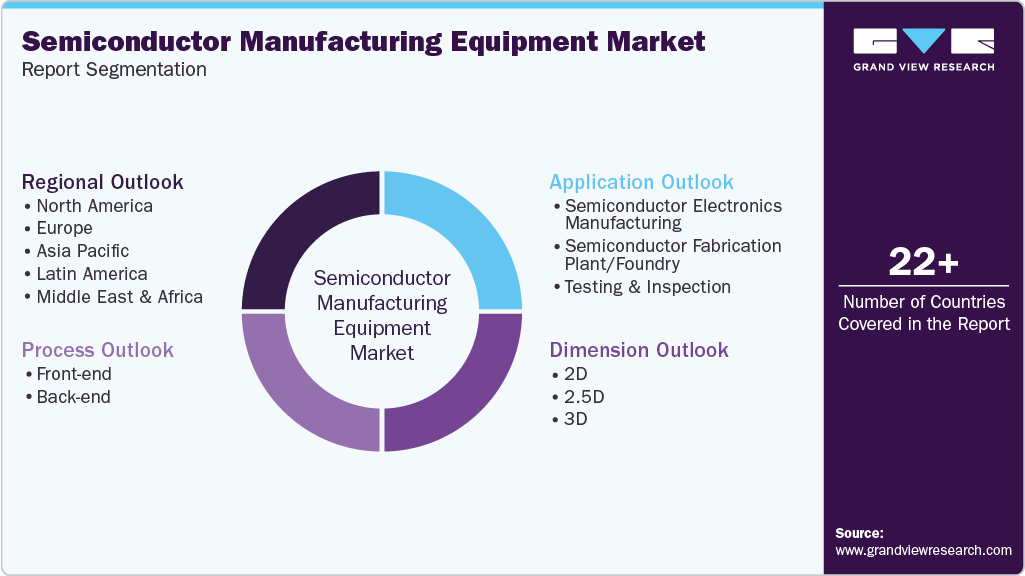
This report forecasts revenue growth at global, regional, and country levels and provides an analysis of the latest industry trends in each of the sub-segments from 2021 to 2033. For this study, Grand View Research, Inc has segmented the global semiconductor manufacturing equipment market report based on process, dimension, application, and region:
 To learn more about this report, Download Free Sample Report
 -
Process Outlook (Revenue, USD Billion, 2021 - 2033)
-
Front-end
-
Deposition
-
ALD (Atomic Layer Deposition)
-
CVD (Chemical Vapor Deposition)
-
Others
-
-
Lithography
-
DUV
-
EUV
-
-
Etch
-
Plasma Etch System
-
Gas Chemical Etch System
-
-
Cleaning
-
Single Wafer Cleaning System
-
Scrubber System
-
Single Wafer Cryokinetic Cleaning System
-
Batch Spray Cleaning System
-
Others
-
-
Testing
-
Multi-Cell Test System
-
Wafer/Dicing Frame Prober
-
Others
-
-
-
Back-end
-
Packaging
-
Testing
-
-
-
Dimension Outlook (Revenue, USD Billion, 2021 - 2033)
-
2D
-
2.5D
-
3D
-
-
Application Outlook (Revenue, USD Billion, 2021 - 2033)
-
Semiconductor Electronics Manufacturing
-
Semiconductor Fabrication Plant/Foundry
-
Testing & Inspection
-
-
Regional Outlook (Revenue, USD Billion, 2021 - 2033)
-
North America
-
U.S.
-
Canada
-
Mexico
-
-
Europe
-
Germany
-
France
-
Italy
-
UK
-
Spain
-
Netherlands
-
-
Asia Pacific
-
China
-
India
-
Japan
-
South Korea
-
Malaysia
-
Taiwan
-
-
Central & South America
-
Brazil
-
-
Middle East & Africa
-
Israel
-
South Africa
-
-
Delivered Customizations
This report has been delivered with the following In-depth customizations
Client Request
Customization Delivered
Value Adds
Regional Segmentation
Detailed breakdown of the semiconductor manufacturing equipment market across North America, Europe, Asia Pacific, Latin America, and the Middle East & Africa, including country-level analysis for Taiwan, China, South Korea, Japan, the U.S., Germany, and emerging semiconductor hubs. Assessment includes fab investments, government semiconductor initiatives, CHIPS Act impact, local manufacturing capacity, equipment demand trends, and technology node transitions.
Identify high-growth semiconductor manufacturing hubs and regional investment hotspots. Support regional expansion, localization, and distributor strategies. Enable prioritization of countries based on fab activity, government incentives, and long-term semiconductor ecosystem development.
Opportunity Assessment
Identification of high-growth opportunities driven by AI semiconductor demand, advanced packaging adoption, high-bandwidth memory (HBM) expansion, EV semiconductor requirements, data center investments, and government-backed semiconductor localization programs. Assessment of whitespace opportunities in mature nodes, specialty semiconductors, heterogeneous integration, and emerging regional fabs.
Prioritize the most attractive investment and expansion opportunities. Support long-term strategic planning and technology roadmap development. Enable early identification of emerging demand centers and future revenue streams across the semiconductor ecosystem.
Trade Assessment
Evaluation of global trade flows for semiconductor manufacturing equipment, including import-export analysis, tariff impacts, export restrictions, supply chain dependencies, and geopolitical risks.
Identify supply chain vulnerabilities and export-oriented growth opportunities. Support sourcing diversification and localization planning. Enable assessment of geopolitical risks, export controls, and trade policy impacts on long-term business strategy.
Frequently Asked Questions About This Report
Asia Pacific dominated the semiconductor manufacturing equipment market with a revenue share of 69.0% in 2025, on account of major electronic product manufacturing companies operating in the region.
Some of the key players operating in the semiconductor manufacturing equipment market include Applied Materials Inc., Lam Research Corporation, KLA Corporation, ASML, Tokyo Electron Limited, Advantest Corporation, SCREEN Semiconductor Solutions Co., Ltd., Cohu, Inc., ACM Research Inc., Nordson Corporation, Tokyo Seimitsu Co., Ltd., EV Group (EVG), Modutek Corporation, Dainippon Screen Group, and Ferrotec Holdings Corporation.scope
Key factors driving the semiconductor manufacturing equipment market include rising demand for advanced chips in AI, 5G, and automotive applications, along with increasing investments in semiconductor fabrication and packaging technologies. Additionally, government incentives and the push for domestic chip production are accelerating market growth.
Asia Pacific dominated with a 69.0% revenue share in 2025.
Front-end process held the largest revenue share in 2025.
2.5D held the largest share (over 38.9%) in 2025 and 3D segment is the fastest-growing segment.
Semiconductor fabrication plant/foundry held the largest revenue share in 2025, while semiconductor electronics manufacturing is the fastest-growing segment.
The global semiconductor manufacturing equipment market size was valued at USD 118.9 billion in 2025 and is estimated at USD 128.1 billion for 2026.
The global semiconductor manufacturing equipment market is expected to grow at a CAGR of 8.4% from 2026 to 2033, reaching USD 224.9 billion.
About the Author(s)
Advanced Interior Materials Research Team
Advanced Materials · Advanced Interior MaterialsThis report was authored by the advanced interior materials research team at Grand View Research - comprising two research analysts, one senior research analyst, and one industry expert - with specialized expertise in the advanced interior materials segment of the advanced materials industry. All findings are based on proprietary advanced materials databases, executive interviews, and regulatory analysis, subject to internal peer review prior to publication.
Last Updated:
Speak to Analyst

Customize this report to your needs - add regions, segments, or data points, with 20% free customization.
Or view our licence options:


ISO 9001:2015 & 27001:2022 Certified
We are GDPR and CCPA compliant! Your transaction & personal information is safe and secure. For more details, please read our privacy policy.


