
- Home
- »
- Conventional Energy
- »
-
Small-scale LNG Market Size And Share Report, 2026-2033GVR Report cover
![Small-scale LNG Market (2026 - 2033)Report]()
Small-scale LNG Market (2026 - 2033)
Size, Share & Trends Analysis Report By Mode Of Supply (Trucks, Trans-shipment & Bunkering), By Type (Liquefaction, Regasification), By Application (Transportation, Industrial Feedstock, Power Generation), By Region, And Segment Forecasts
Market Size, 2025
$68.0BMarket Estimate, 2026
$77.5BMarket Forecast, 2033
$197.9BCAGR, 2026–2033
14.3%Small-scale LNG Market Summary
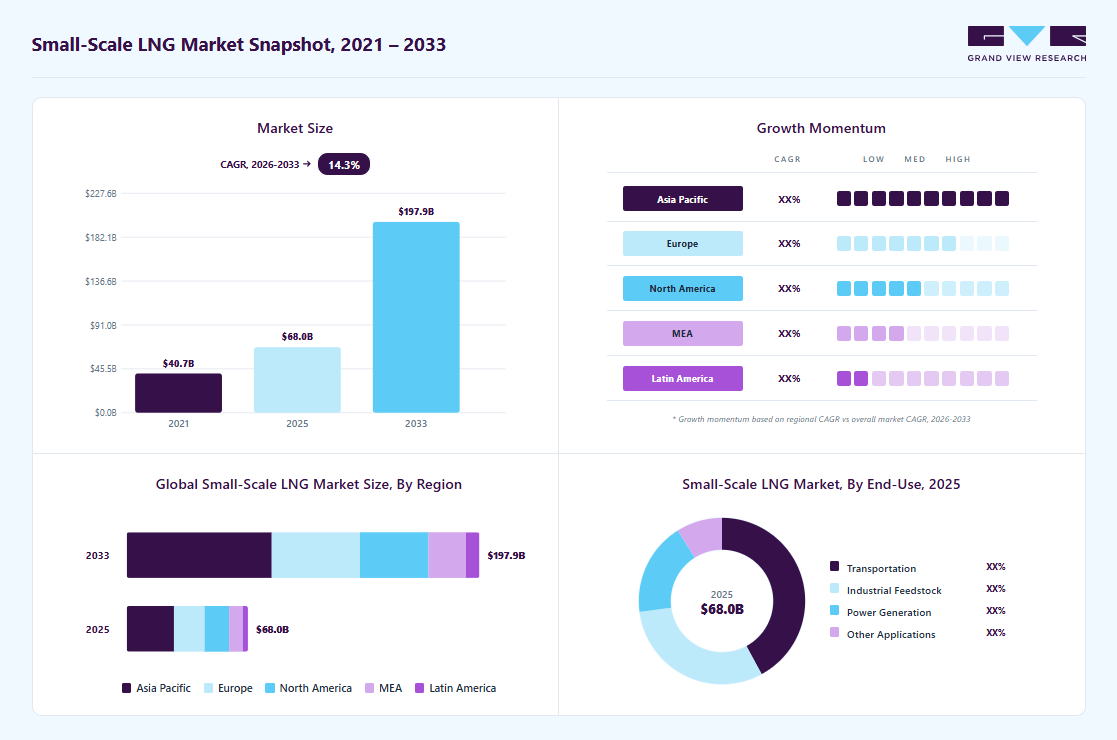
The global small-scale LNG market size was valued at USD 68.0 billion in 2025 and is projected to grow from USD 77.5 billion in 2026 to USD 197.9 billion by 2033, at a CAGR of 14.3% from 2026 to 2033. The Asia Pacific market held the largest share of 38.9% of the global market in 2025. The market is witnessing strong growth as governments, utilities, and private sector participants increasingly focus on cleaner fuel adoption and decentralized energy supply solutions.
Key Market Trends & Insights
- By mode of supply: The trucks segment accounted for the largest market share of 53.5% in 2025.
- By type: The liquefaction terminal segment accounted for the largest market revenue share of 61.0% in 2025.
- By application: The transportation segment accounted for the largest market share of 42.1% in 2025.
Regional Highlights
- Largest regional market: Asia Pacific (38.9% revenue share, 2025)
- By country: The China held the largest market share in 2025.
Market Size & Forecast
- Market size in 2025: USD 68.0 Billion
- Estimated market size in 2026: USD 77.5 Billion
- Projected market size by 2033: USD 197.9 Billion
- CAGR (2026-2033): 14.3%
The global small-scale LNG market is experiencing robust growth, driven by the increasing need for flexible, cleaner, and decentralized energy supply solutions in evolving energy dynamics. The rising energy demand in remote and off-grid regions, coupled with the lack of pipeline infrastructure and uneven distribution of natural gas resources, is accelerating the adoption of small-scale LNG for localized energy distribution and consumption. In addition, the development of modular liquefaction and regasification infrastructure is enabling operators to enhance supply efficiency while minimizing logistical constraints.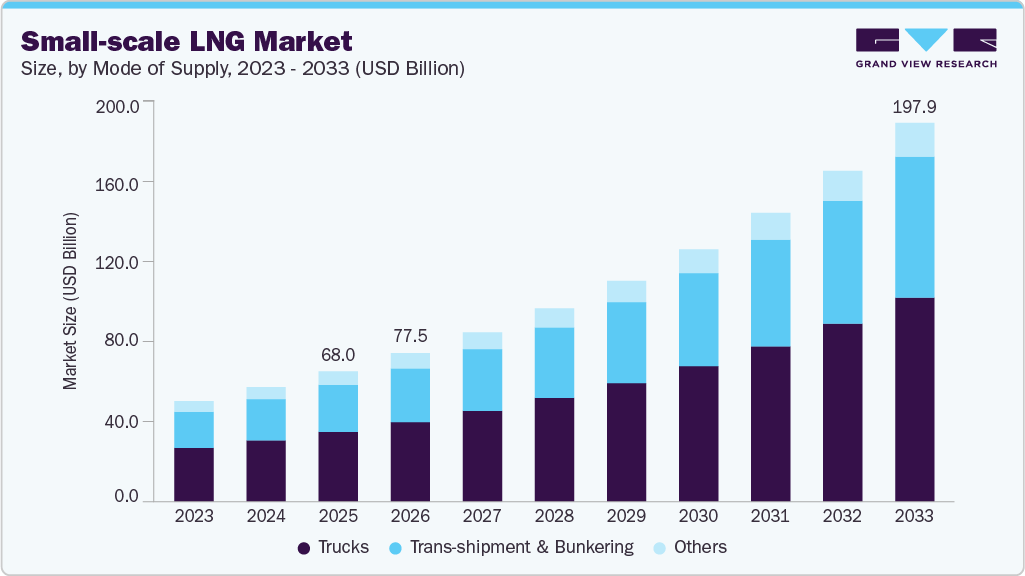
Furthermore, the rapid shift toward low-emission fuels across industries, including transportation, marine, and power generation, is significantly driving market expansion. Small-scale LNG systems play a critical role in facilitating reliable fuel supply to remote locations and ensuring seamless energy accessibility. Technological advancements, particularly in cryogenic storage, transportation, and regasification systems, are improving operational flexibility, safety, and scalability. Simultaneously, ongoing investments in energy infrastructure, along with increasing focus on cleaner fuel adoption and energy security, are reinforcing the strategic importance of small-scale LNG in supporting efficient, reliable, and lower-emission energy networks.
Drivers, Opportunities & Restraints
The primary driver of the small-scale LNG market is the growing need to adopt cleaner fuel alternatives across transportation and industrial sectors in response to stringent environmental regulations. Government policies and international mandates to reduce emissions, such as IMO 2020, are accelerating the shift from diesel and heavy fuel oil to LNG-based solutions. Small-scale LNG systems are increasingly favored for their flexibility, lower emissions, and suitability for decentralized energy distribution. The rising demand for energy in off-grid and remote locations, particularly in regions lacking pipeline infrastructure, is further strengthening the adoption of small-scale LNG solutions.
A significant opportunity lies in the expanding use of cleaner fuel alternatives across marine transportation and decentralized energy systems within the small-scale LNG ecosystem. The increasing adoption of LNG as a transition fuel in the maritime sector is enabling reduced emissions, improved fuel efficiency, and compliance with stringent environmental regulations, while growing pressure on shipping operators to decarbonize operations is accelerating the use of small-scale LNG for ferries, coastal vessels, and shipping carriers. Emerging economies across Asia Pacific, Latin America, and the Middle East & Africa are witnessing rising demand for reliable and cleaner energy solutions to support industrial and residential needs in remote regions, and the increasing focus on decentralized energy systems and off-grid power generation is creating new growth opportunities for small-scale LNG, as it provides a viable alternative to coal and oil for power, heating, and cooling applications in rural and island locations.
However, the market faces challenges related to price volatility and supply chain constraints. Fluctuations in natural gas prices, along with the cost differential between LNG and conventional fuels such as oil, impact the overall competitiveness of small-scale LNG solutions. The reason behind this uncertainty is the dynamic nature of global energy markets and regional pricing variations, which can affect project feasibility and long-term contracts. Additionally, supply chain disruptions pose a major challenge, as small-scale LNG relies heavily on truck and smaller vessel transportation, making it more susceptible to weather-related delays, port closures, and logistical inefficiencies. This often results in increased operational costs and extended delivery timelines, particularly in remote or infrastructure-limited regions.
The market faces several operational and infrastructure-related restraints that may hamper its growth trajectory. Small-scale LNG operations often incur higher per-unit costs due to the lack of economies of scale compared to large-scale LNG plants, making them less cost-efficient in certain applications. Additionally, infrastructure gaps, particularly in regions such as Africa and the Middle East, present significant challenges to widespread deployment, as the absence of adequate liquefaction, storage, and distribution networks limits market expansion. These factors collectively increase operational complexities, constrain investment decisions, and can hinder the overall pace of small-scale LNG infrastructure development.
Mode of Supply Insights
Based on mode of supply, the trucks segment accounted for the largest market share of 53.5% in 2025, driven by its flexibility, cost-effectiveness, and ease of deployment for last-mile LNG distribution. Truck-based transportation is widely used to deliver LNG to remote and off-grid locations where pipeline infrastructure is unavailable or economically unviable. These systems are particularly well-suited for small-scale, decentralized energy applications, enabling efficient and reliable fuel supply to industrial, commercial, and residential end users. Besides, increasing demand for cleaner fuel alternatives in transportation and off-grid power generation is further strengthening the adoption of truck-based small-scale LNG distribution networks.
The transshipment and bunkering segment is projected to register the fastest CAGR of 14.8% over the forecast period, driven by its increasing adoption in marine and shipping applications. LNG bunkering is gaining significant traction as the maritime industry shifts toward low-emission fuels to comply with stringent environmental regulations. Its ability to support fuel supply for ferries, coastal vessels, and large shipping carriers makes it particularly well-suited for port and coastal operations. Additionally, growing investments in LNG bunkering infrastructure, port facilities, and cleaner marine fuel initiatives are further accelerating segment growth.
Type Insights
Based on type, the liquefaction terminal segment accounted for the largest market revenue share of 61.0% in 2025, driven by the increasing need to convert natural gas into liquid form for efficient storage and transportation. Liquefaction terminals are critical components of small-scale LNG infrastructure, enabling volume reduction and facilitating distribution to remote and off-grid locations. They are currently the dominant market segment, commanding a significant share of installations, particularly in regions with limited pipeline connectivity and growing demand for cleaner fuel alternatives.
The regasification terminal segment is projected to register the fastest CAGR of 14.6% over the forecast period, supported by increasing demand for reliable energy access and flexible fuel supply across end-use sectors. Regasification systems play a vital role in converting LNG back into gaseous form for consumption, enabling seamless integration into power generation, industrial, and residential applications. The surge in investments in this segment is primarily driven by expanding decentralized energy systems, growing industrial demand, and the need to supply natural gas to remote regions. Furthermore, rising focus on energy security and infrastructure development is driving the deployment of regasification terminals, particularly in developing economies.
Application Insights
Based on application, the transportation segment accounted for the largest market share of 42.1% in 2025, driven by the increasing adoption of LNG as a cleaner alternative to conventional fuels such as diesel and heavy fuel oil. LNG is widely used across heavy-duty trucks, marine vessels, and rail applications, offering lower emissions and improved fuel efficiency. The segment is particularly favored in regions with stringent environmental regulations, enabling a transition toward low-emission mobility solutions. Additionally, the rising demand for sustainable transportation and the expansion of LNG fueling infrastructure are further strengthening the adoption of small-scale LNG in this segment.
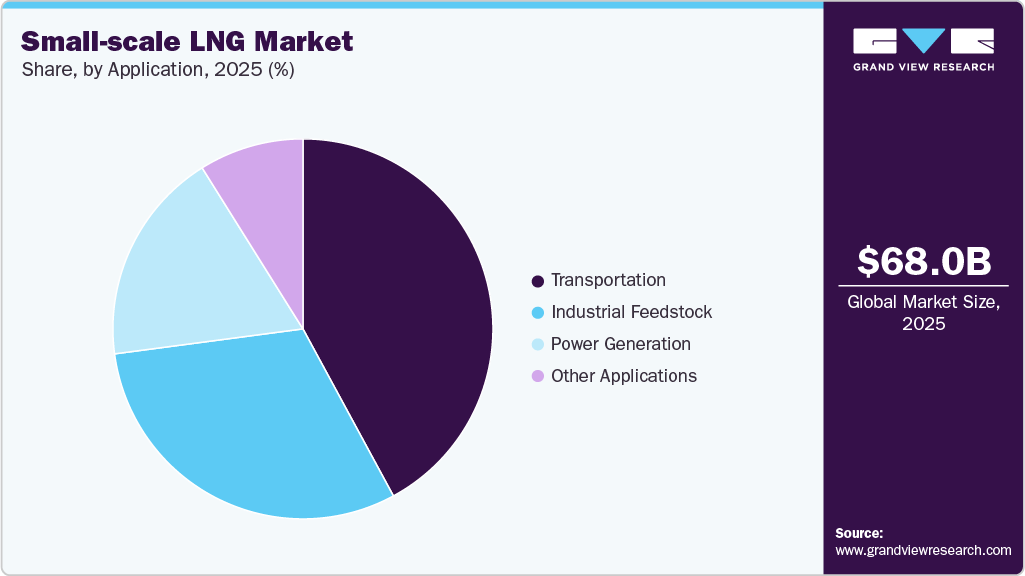
The transportation segment is also projected to register the fastest CAGR of 15.2% over the forecast period, driven by its growing adoption across road and maritime transport sectors. The growing shift toward cleaner fuels, driven by regulatory mandates and decarbonization goals, is accelerating LNG adoption in commercial fleets and shipping operations. Its ability to provide cost-effective and environmentally friendly fuel solutions makes it particularly well-suited for long-haul and high-consumption transport applications. Besides, ongoing investments in LNG refueling networks, port infrastructure, and advanced fuel technologies are further driving segment growth.
Regional Insights
The Asia Pacific small-scale LNG industry accounted for the largest revenue share of 38.9% in 2025, and it is expected to experience the fastest CAGR of 15.1% over the forecast period, driven by increasing demand for cleaner energy solutions, rapid industrialization, and expanding energy needs, particularly in countries such as China and India. The growing use of small-scale LNG across transportation, industrial, and power generation applications is driving strong demand for flexible, decentralized fuel-supply solutions. Additionally, the region is witnessing a significant transition toward cleaner fuels, supported by favorable government policies and rising investments in LNG infrastructure to improve energy accessibility and reduce emissions.
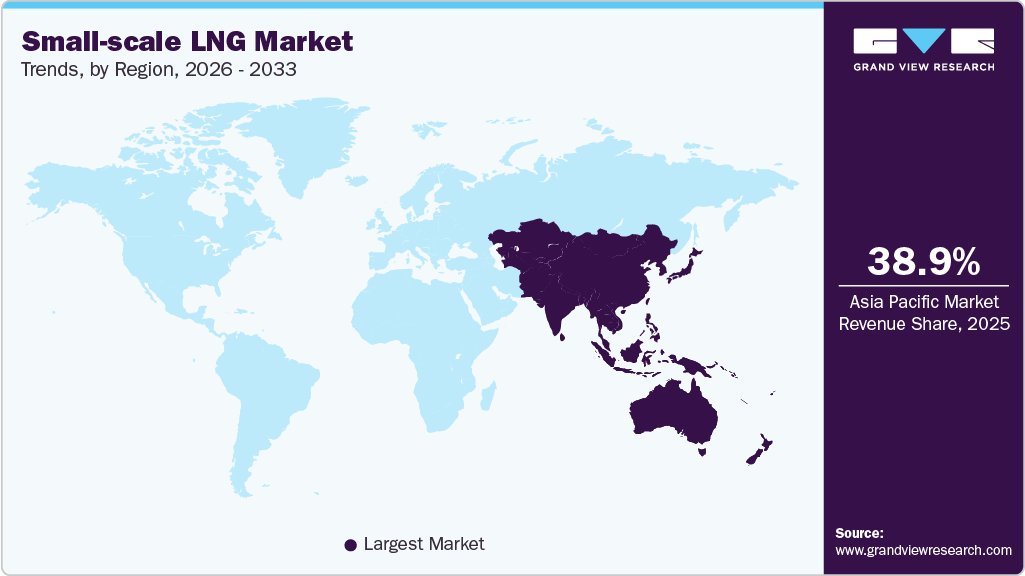
The growth of the market in the region is further supported by ongoing investments in liquefaction, storage, and distribution infrastructure that aim to enhance supply efficiency and reliability. The increasing adoption of LNG in marine transportation, off-grid power generation, and industrial applications, alongside the expansion of decentralized energy systems, is improving energy accessibility and flexibility. This positions the Asia Pacific region as a leading and rapidly developing market for small-scale LNG solutions.
China Small-scale LNG Market Trends
The small-scale LNG industry in China is a major contributor to the global market, supported by its extensive industrial base, large-scale infrastructure development, and strong government backing. The country leads in deploying small-scale LNG distribution networks, driven by the need to supply cleaner fuel to remote regions, industrial clusters, and the transportation sector. China’s rapidly growing energy demand, coupled with its commitment to reducing air pollution and carbon emissions, is accelerating investments in LNG adoption across trucking, marine, and off-grid power applications. Furthermore, continuous advancements in liquefaction, storage, and transportation technologies are strengthening the country’s position as a global leader in small-scale LNG infrastructure.
Europe Small-scale LNG Market Trends
The small-scale LNG industry in Europe is experiencing steady growth, driven by ambitious climate targets and strong regulatory support for cleaner fuel adoption and emission reduction across industries. Countries across the region are accelerating the transition away from conventional fuels by expanding the use of LNG in transportation, particularly in marine and heavy-duty trucking applications. Supportive policies and regulatory frameworks that promote low-emission fuels, infrastructure development, and energy security are driving the widespread deployment of small-scale LNG systems across decentralized energy and transportation networks.
North America Small-scale LNG Market Trends
The small-scale LNG industry in North America is witnessing steady growth, driven by abundant natural gas availability, increasing investments in LNG infrastructure, and ongoing technological advancements. The region benefits from a well-developed energy ecosystem, with growing emphasis on utilizing LNG as a cleaner alternative for transportation, industrial, and off-grid power applications as part of the transition toward lower-emission energy sources. Government incentives, favorable regulatory frameworks, and corporate sustainability initiatives are driving the adoption of small-scale LNG solutions across decentralized energy systems and transportation networks.
Latin America Small-scale LNG Market Trends
The small-scale LNG industry in Latin America is emerging as a steadily growing region over the forecast period. This growth is driven by increasing demand for cleaner fuel alternatives across transportation and power generation sectors. Growing reliance on LNG for marine transport and off-grid energy applications in the region is driving the demand for small-scale LNG infrastructure. Small-scale LNG systems are increasingly utilizing advanced liquefaction, storage, and distribution technologies to improve efficiency and reliability, alongside conventional fuel supply methods across key countries in the region.
Middle East & Africa Small-scale LNG Market Trends
The small-scale LNG industry in the Middle East & Africa is expanding steadily, driven by the rising need for cleaner and reliable energy solutions in regions with limited pipeline infrastructure. Governments are investing in LNG infrastructure to support energy diversification and improve fuel accessibility, with small-scale LNG systems playing a crucial role in ensuring efficient distribution and supply. Urbanization and industrial demand are also major factors driving market growth, as rising energy consumption in developing cities and new industrial zones requires flexible, low-emission fuel alternatives.
Key Small-scale LNG Company Insights
Some of the key participants in the global small-scale LNG market include Linde plc, Honeywell International Inc., Wärtsilä Corporation, Chart Industries, Inc., Air Products and Chemicals, Inc., Chiyoda Corporation, Black & Veatch Corporation, Technip Energies N.V., New Fortress Energy Inc., Excelerate Energy, Inc., Gasum Oy, Shell plc, TotalEnergies SE, ENGIE SA, and Eagle LNG Partners. These companies collectively hold the largest market share and dictate industry trends. They are increasingly focusing on developing efficient liquefaction, storage, and regasification systems, improving cost competitiveness, and ensuring long-term operational reliability. Additionally, strategic initiatives such as technological innovation, partnerships, and expansion into emerging markets are enabling them to reinforce their market leadership and influence industry trends.
Their operations typically encompass the design, manufacturing, and deployment of small-scale LNG systems, including liquefaction terminals, transportation solutions, regasification units, and integrated fuel supply infrastructure to enable efficient and reliable energy distribution. Industry leaders are increasingly emphasizing the adoption of advanced cryogenic technologies, modular LNG systems, and optimized logistics networks to enhance flexibility, scalability, and performance. Significant investments are being directed toward innovations in storage systems, transportation efficiency, and process optimization to improve overall system efficiency and reduce operational costs. The integration of digital solutions such as artificial intelligence, predictive maintenance, and advanced monitoring platforms is enabling real-time performance optimization, improved asset management, and enhanced supply chain efficiency.
As global demand for cleaner fuels intensifies and decarbonization targets become more stringent, companies operating in the small-scale LNG market are prioritizing capacity expansion, strengthening supply chain resilience, and diversifying their geographic footprint. Strategic collaborations, vertical integration across the value chain, and increased investments in emerging economies are key growth strategies adopted by industry participants. Furthermore, evolving energy dynamics, including the rise of decentralized energy systems, cleaner transportation fuels, and flexible fuel distribution networks, are reshaping the competitive landscape. Continuous advancements in liquefaction efficiency, storage technologies, and LNG logistics are expected to enhance market competitiveness and support the sustained growth of the global market.
Key Small-scale LNG Companies:
The following key companies have been profiled for this study on the small-scale LNG market.
- Linde plc
- Honeywell International Inc.
- Wärtsilä Corporation
- Chart Industries, Inc.
- Air Products and Chemicals, Inc.
- Chiyoda Corporation
- Black & Veatch Corporation
- Technip Energies N.V.
- New Fortress Energy Inc.
- Excelerate Energy, Inc.
- Gasum Oy
- Shell plc
- TotalEnergies SE
- ENGIE SA
- Eagle LNG Partners
Recent Developments
-
In April 2026, Technip Energies N.V. secured significant international contracts, including a contract for the Long Son Petrochemicals enhancement project in Vietnam and major authorizations for the Commonwealth LNG project in Louisiana. This initiative aligns with the company’s strategy to expand its global LNG footprint, strengthen project execution capabilities, and support the development of efficient and lower-emission energy infrastructure.
-
In March 2026, Shell plc strengthened its LNG supply presence in India by securing key fertilizer sector contracts following disruptions caused by Gulf geopolitical tensions. This move reflects the company’s focus on enhancing supply chain resilience, ensuring reliable fuel availability, and supporting growing demand for cleaner energy solutions in emerging markets.
Small-scale LNG Market Report Scope
Report Attribute
Details
Market Definition
The Small-Scale LNG market refers to the global revenue generated from the liquefaction, storage, transportation, and regasification of liquefied natural gas through small-scale infrastructure systems for distribution across industrial, commercial, transportation, and off-grid energy applications.
Market size in 2025
USD 68.0 Billion
Estimated market size in 2026
USD 77.5 billion
Projected market size by 2033
USD 197.9 billion
Growth rate
CAGR of 14.3% from 2026 to 2033
Base year for estimation
2025
Historical data
2021 - 2024
Forecast period
2026 - 2033
Quantitative Units
Revenue in USD million/billion and CAGR from 2026 to 2033
Report coverage
Revenue forecast, competitive landscape, growth factors, and trends
Segments covered
Mode of supply, type, application, region
Regional scope
North America; Europe; Asia Pacific; Latin America; Middle East & Africa
Country scope
U.S.; Canada; Mexico; Germany; UK; France; Italy; Spain; China; India; Australia; Japan; South Korea; Brazil; UAE
Key companies profiled
Linde plc; Honeywell International Inc.; Wärtsilä Corporation; Chart Industries, Inc.; Air Products and Chemicals, Inc.; Chiyoda Corporation; Black & Veatch Corporation; Technip Energies N.V.; New Fortress Energy Inc.; Excelerate Energy, Inc.; Gasum Oy; Shell plc; TotalEnergies SE; ENGIE SA; Eagle LNG Partners
Customization scope
Free report customization (equivalent up to 8 analysts working days) with purchase. Addition or alteration to country, regional & segment scope.
Pricing and purchase options
Avail customized purchase options to meet your exact research needs. Explore purchase options
Global Small-scale LNG Market Report Segmentation
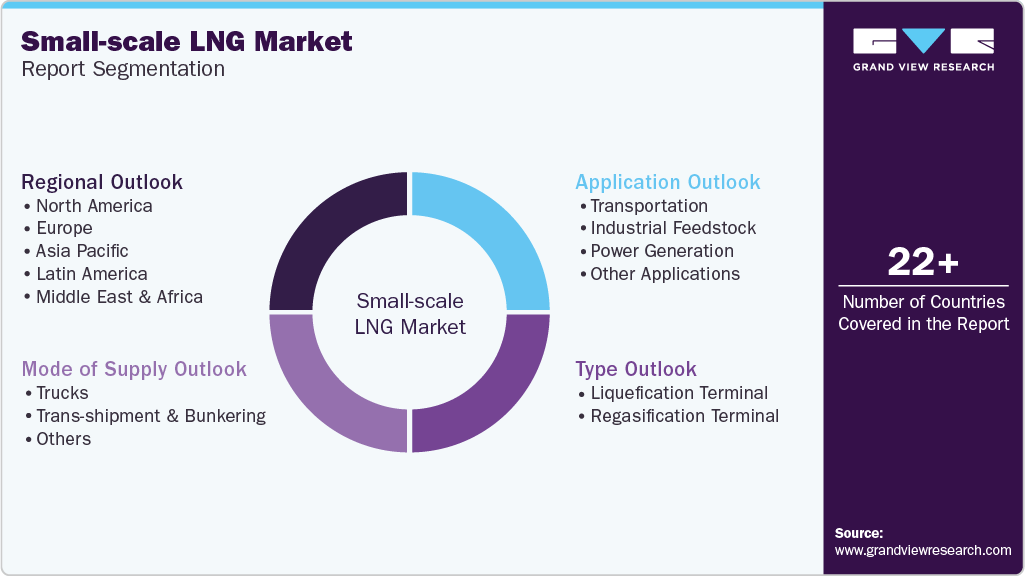
This report forecasts revenue growth at global, regional, and country levels and provides an analysis of the latest industry trends in each of the sub-segments from 2021 to 2033. For this study, Grand View Research has segmented the global small-scale LNG market report on the basis of mode of supply, type, application, and region:
-
Mode of Supply Outlook (Revenue, USD Billion, 2021 - 2033)
-
Trucks
-
Trans-shipment & Bunkering
-
Others
-
-
Type Outlook (Revenue, USD Billion, 2021 - 2033)
-
Liquefication Terminal
-
Regasification Terminal
-
-
Application Outlook (Revenue, USD Billion, 2021 - 2033)
-
Transportation
-
Industrial Feedstock
-
Power Generation
-
Other Applications
-
-
Regional Outlook (Revenue, USD Billion, 2021 - 2033)
-
North America
-
U.S.
-
Canada
-
Mexico
-
-
Europe
-
Germany
-
UK
-
France
-
Italy
-
Spain
-
-
Asia Pacific
-
China
-
India
-
Australia
-
Japan
-
South Korea
-
-
Latin America
-
Brazil
-
-
Middle East & Africa
-
UAE
-
-
Frequently Asked Questions About This Report
The trucks segment held the highest market share of 53.5% in 2025. while transshipment and bunkering is the fastest-growing segment.
The liquefaction terminal segment held the highest market share of 61.0% in 2025, while regasification terminal is the fastest-growing segment.
The transportation segment accounted for the largest share of 42.1% in 2025, while transportation and is the fastest-growing segment.
Asia Pacific dominated with a 38.9% revenue share in 2025.
Some of the key participants in the global small-scale LNG market include Linde plc, Honeywell International Inc., Wärtsilä Corporation, Chart Industries, Inc., Air Products and Chemicals, Inc., Chiyoda Corporation, Black & Veatch Corporation, Technip Energies N.V., New Fortress Energy Inc., Excelerate Energy, Inc., Gasum Oy, Shell plc, TotalEnergies SE, among others.
Key factors include the increasing demand for cleaner fuel alternatives driven by rapid urbanization and industrialization, along with the rising need for flexible and decentralized energy supply solutions. Growing energy demand in remote and off-grid areas, coupled with limited pipeline infrastructure, is further accelerating adoption.
The global small-scale LNG market was estimated at USD 68.0 billion in 2025 and is expected to reach USD 77.5 billion in 2026.
The global small-scale LNG market is expected to grow at a compound annual growth rate of 14.3% from 2026 to 2033 to reach USD 197.9 billion by 2033.
About the Author(s)
Conventional Energy Research Team
Energy & Power · Conventional EnergyThis report was authored by the conventional energy research team at Grand View Research - comprising two research analysts, one senior research analyst, and one industry expert - with specialized expertise in the conventional energy segment of the energy & power industry. All findings are based on proprietary energy & power databases, executive interviews, and regulatory analysis, subject to internal peer review prior to publication.
Last Updated:
Speak to Analyst


Customize this report to your needs — add regions, segments, or data points, with 20% free customization.
Or view our licence options:


ISO 9001:2015 & 27001:2022 Certified
We are GDPR and CCPA compliant! Your transaction & personal information is safe and secure. For more details, please read our privacy policy.


