
- Home
- »
- Next Generation Technologies
- »
-
Smart Greenhouse Market Size, Growth Report, 2026-2033GVR Report cover

Smart Greenhouse Market (2026 - 2033)
Size, Share, & Trends Analysis Report By Component (Hardware, Software, Services), By Type, By Farming Type, By Crop Type, By End Use, By Region And Segment Forecasts
Market Size, 2025
$5.8BMarket Estimate, 2026
$6.6BMarket Forecast, 2033
$18.0BCAGR, 2026–2033
15.4%Smart Greenhouse Market Summary
The global smart greenhouse market size was valued at USD 5.8 billion in 2025 and is projected to grow from USD 6.6 billion in 2026 to USD 18.0 billion by 2033, at a CAGR of 15.4% from 2026 to 2033. The market in North America dominated with a revenue share of 32.9% in 2025. The rising adoption of increasing demand for high-yield and quality crop production is driving the smart greenhouse market.
 Source: Grand View Research, IR Documents, Primary Interviews, Paid DatabasesTo learn more about this report,
 Download Free Sample Report
 Key Market Trends & Insights
- By component: Hardware segment held the largest market share of 57.4% in 2025.
- By type: Glass segment held the largest market share in 2025.
- By farming type: Soil-based cultivation segment held the largest market share in 2025.
- By crop type: Fruits & vegetables segment held the largest market share in 2025.
- By end use: Commercial growers segment held the largest market share in 2025.
Regional Highlights
- Largest regional market: North America (32.9% revenue share, 2025)
- Fastest-growing regional market: Asia Pacific (highest CAGR, 2026-2033)
Market Size & Forecast
- Market size in 2025: USD 5.8 Billion
- Estimated market size in 2026: USD 6.6 Billion
- Projected market size by 2033: USD 18.0 Billion
- CAGR (2026-2033): 15.4%
Three ways to get this report
Buy it, customize it, or ask a question.Ask an Analyst
Analyst response in 1 business day
- AccessReport author, directly
- Reply timeWithin 1 working day
- No sales callDirect answer only
- FormatEmail reply
- CostFree, no cost
Get the Full Report
What the study covers
- FormatsPDF · Excel · Dashboard
- Timeline2026–2033 annual, 2025 base
- Coverage20+ countries, 5 regions
- Companies10+ key players profiled
Customize the Report
20% free customization
- IncludeCountries, segments, points
- TailorTo your product definition
- ExtendDeeper competitor detail
- OrA fully bespoke study
- Turnaround5–10 working days
The increasing impact of climate change and extreme weather variability on traditional farming systems is driving market growth. Unpredictable rainfall, prolonged droughts, heat waves, and sudden frost events disrupt open-field agriculture and reduce yield reliability. Smart greenhouses offer a resilient alternative, providing controlled environments where key growth parameters are digitally managed and automatically adjusted. Advanced sensor networks continuously monitor environmental conditions and trigger corrective actions in real time. This reduces crop stress, improves survival rates, and ensures consistent quality regardless of external weather disturbances.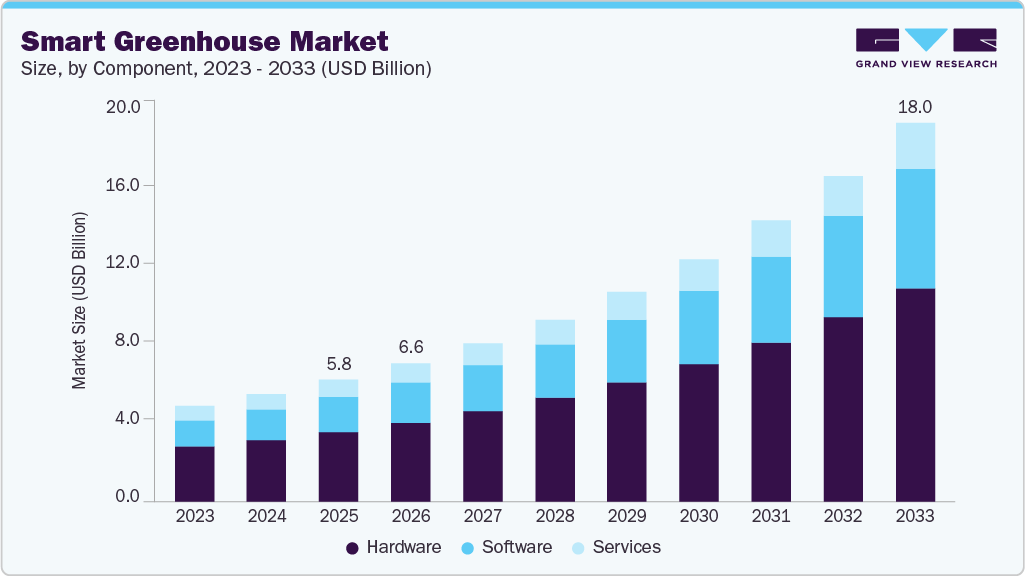 To learn more about this report, Download Free Sample Report
 The rapid adoption of precision agriculture technologies is also accelerating growth in the smart greenhouse market. Integration of IoT sensors, AI-driven analytics, and cloud-based management platforms allows growers to collect, analyze, and act on real-time crop and environmental data. Automated irrigation and fertigation systems precisely deliver water and nutrients based on plant requirements, minimizing waste and optimizing resource use. Data-driven decision-making enhances yield predictability and reduces operational inefficiencies. Remote monitoring capabilities enable operators to monitor multiple greenhouse facilities from a centralized control system. As digital transformation reshapes agriculture, smart greenhouses represent a natural evolution toward highly automated and intelligent cultivation models.
Increasing consumer demand for safe, high-quality, and traceable food products is another powerful market driver. Consumers are more conscious of food safety standards, pesticide usage, and environmental sustainability. Smart greenhouse systems provide controlled cultivation environments that reduce pest exposure and enable precise nutrient management, improving product safety and consistency. Digital monitoring systems record environmental conditions and input usage, enhancing traceability throughout the production cycle. Retailers and foodservice providers increasingly favor suppliers who can demonstrate standardized quality control and transparency. As consumer expectations evolve, growers are adopting smart greenhouse technologies to strengthen their competitive positioning and meet stringent quality requirements.
The expansion of urban agriculture and the trend toward vertical farming are other key drivers. As cities grow denser, local food production becomes increasingly important for reducing transportation costs and carbon emissions. Smart greenhouses, including rooftop and vertical farm installations, rely heavily on automation and digital monitoring to optimize limited space. Advanced lighting systems, hydroponic setups, and climate controls ensure efficient crop cycles within urban environments. Automated irrigation and nutrient management maximize output while conserving resources. The integration of smart technologies enables scalable and efficient urban food production models. As metropolitan areas prioritize sustainable food ecosystems, demand for smart greenhouse solutions continues to rise.
Market Dynamics
The integration of artificial intelligence (AI), Internet of Things (IoT), and data-driven automation is a major driver of growth in the smart greenhouse lighting market because it transforms lighting from a fixed input into an adaptive and intelligent cultivation tool. IoT sensors continuously monitor critical parameters such as solar radiation, temperature, humidity, CO₂ concentration, and plant growth conditions, while AI algorithms analyze this data to determine the optimal light intensity, spectrum, and photoperiod for each crop stage. Smart control systems can automatically dim or increase LED output based on real-time conditions, reducing energy consumption and ensuring that plants receive the precise amount of light needed for maximum photosynthesis and yield. This level of automation improves crop consistency, lowers labor requirements, and enhances return on investment, encouraging commercial greenhouse operators to adopt advanced lighting systems.
Cloud-based platforms allow operators to remotely monitor and manage multiple greenhouse sites, compare performance metrics, and implement predictive strategies that optimize both crop production and operating costs. For example, systems such as Signify’s Philips GrowWise Control use remote spectral steering and automated adjustments to improve efficiency and support energy trading opportunities. As greenhouse operators increasingly seek scalable and intelligent solutions that maximize productivity while minimizing resource use, the adoption of AI- and IoT-enabled lighting systems continues to accelerate, directly driving expansion of the smart greenhouse lighting market.
The dependence on reliable power and internet connectivity is a significant restraint for the smart greenhouse industry, as most advanced greenhouse systems rely on uninterrupted electricity and stable network connections to operate effectively. Climate control equipment, LED lighting, automated irrigation, sensors, and cloud-based monitoring platforms all require continuous power to maintain optimal growing conditions. In regions where electricity supply is unstable, frequent outages can disrupt temperature regulation, lighting schedules, and nutrient delivery, which may reduce crop yields and quality.
Similarly, poor internet connectivity can prevent real-time data transmission and remote control, limiting the effectiveness of IoT- and AI-enabled greenhouse systems. This infrastructure dependency is particularly challenging in rural and developing areas, where agricultural operations are often located but power grids and broadband networks may be unreliable. Growers in these regions may need to invest in backup generators, battery storage, or satellite communication systems, significantly increasing the overall cost of implementation.
The retrofit of conventional greenhouses represents a significant opportunity in the smart greenhouse industry because it allows growers to modernize existing facilities without investing in entirely new greenhouse structures. Many growers already operate traditional greenhouses equipped with basic heating, ventilation, and irrigation systems, but lack advanced technologies such as IoT sensors, automated climate controls, LED lighting, and data analytics platforms. By upgrading these facilities with smart components, growers can improve temperature and humidity control, optimize irrigation and fertigation, reduce energy consumption, and enhance crop productivity.
The retrofit market is particularly appealing because there is a large installed base of aging greenhouse infrastructure across Europe, North America, and Asia-Pacific. Technology providers can offer modular solutions that integrate with existing equipment, enabling growers to implement upgrades in phases according to budget and operational needs. Retrofitting also shortens implementation timelines and allows operators to realize measurable improvements in yield, product quality, and resource efficiency with lower upfront risk. As growers seek cost-effective ways to improve competitiveness and sustainability, the modernization of conventional greenhouses is expected to generate substantial demand for sensors, control systems, smart lighting, and software solutions, creating a strong long-term growth opportunity for market participants.
Market Concentration & Characteristics:
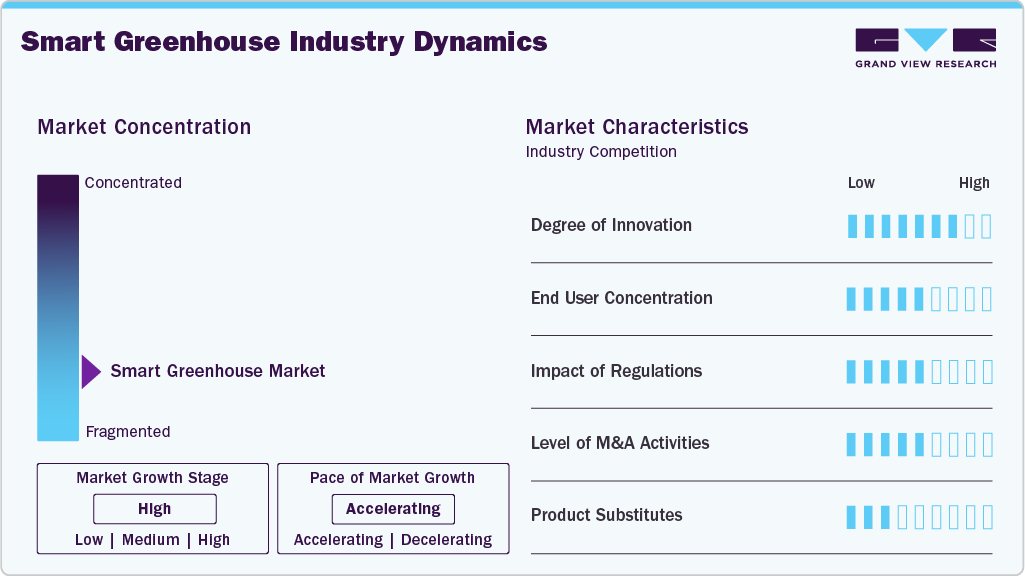
The market for smart greenhouse is concentrated, with competition spread across greenhouse automation specialists, sensor manufacturers, irrigation providers, LED lighting companies, and agricultural software developers. The market includes numerous regional and global participants, each offering specialized solutions for climate control, fertigation, crop monitoring, and analytics. Because customers often combine products from multiple vendors, market share is distributed across many companies rather than concentrated among a few dominant players. This diversified competitive landscape enables innovation and creates opportunities for both established companies and emerging agri-tech startups.
 To learn more about this report, Download Free Sample Report
 The degree of innovation in the smart greenhouse industry is very high. The industry is driven by continuous advancements in IoT sensors, artificial intelligence, machine learning, robotics, and cloud-based farm management platforms. These technologies enable automated control of temperature, humidity, lighting, irrigation, and nutrient delivery, significantly improving crop yields and resource efficiency. Innovations in dynamic LED lighting, predictive analytics, and autonomous greenhouse systems are transforming traditional cultivation into highly data-driven and self-optimizing operations, making innovation one of the most important competitive factors in the market.
Component Insights
The hardware segment dominated the smart greenhouse market with a market share of 57.4% in 2025. The increasing need for advanced environmental control infrastructure drives market adoption. Smart greenhouses rely heavily on physical components such as sensors, climate control systems, LED grow lights, irrigation controllers, and ventilation equipment to maintain precise growing conditions. As growers aim to optimize temperature, humidity, CO₂ concentration, and light intensity, investment in robust and high-performance hardware becomes essential. Unlike software platforms that manage data, hardware components directly execute environmental adjustments and maintain crop stability. The demand for durable, energy-efficient, and highly responsive hardware systems is rising as greenhouse operations scale in size and complexity. This direct dependency on physical automation and monitoring devices strongly drives growth within the hardware segment.
The software segment is projected to be the fastest-growing segment from 2026 to 2033. The increasing complexity of greenhouse operations also fuels demand for integrated management software. Commercial facilities often manage multiple greenhouse units, diverse crop types, and staggered production cycles simultaneously. Software platforms provide centralized visibility into all operational parameters, enabling coordinated scheduling, resource allocation, and workflow management. Integrated systems also facilitate fertigation planning, inventory tracking, and compliance reporting. This comprehensive management capability improves productivity while reducing administrative burden. As greenhouse enterprises expand in scale and sophistication, software solutions become indispensable for streamlined coordination and oversight.
Type Insights
The glass segment dominated the smart greenhouse market in 2025. The expansion of high-value horticulture and specialty crop cultivation fuels demand for glass greenhouse systems. Crops such as tomatoes, cucumbers, peppers, strawberries, and ornamental flowers require stable environmental conditions for consistent quality and appearance. Glass structures provide superior environmental stability, enabling precise management of humidity, temperature, and light exposure. This level of control is critical for crops destined for premium retail and export markets where uniformity and shelf life are essential. As growers invest in technology-intensive cultivation models to meet strict quality benchmarks, glass-based smart greenhouses become increasingly preferred.
The plastic segment is projected to be the fastest-growing segment from 2026 to 2033. Advancements in plastic material technology further fuel the segment’s expansion. Modern polyethylene films and polycarbonate sheets are engineered with UV stabilization, anti-drip coatings, and enhanced light diffusion properties. These improvements enhance durability, reduce condensation-related crop damage, and optimize light distribution within the greenhouse. Some plastic materials are designed to selectively filter specific wavelengths of light, improving photosynthetic efficiency and crop quality. Enhanced thermal insulation properties also help maintain stable internal temperatures, supporting energy-efficient climate control. Continuous innovation in plastic materials significantly improves performance, making them increasingly competitive within high-tech greenhouse applications.
Farming Type Insights
The soil-based cultivation segment dominated the smart greenhouse market in 2025. Consumer preference for naturally grown and soil-cultivated produce acts as a growth catalyst. In certain markets, customers perceive soil-grown crops as more authentic or flavorful compared to hydroponically grown alternatives. Retailers and organic certification bodies often align with soil-based cultivation standards, particularly for specific crop categories. Smart greenhouse systems allow soil growers to maintain environmental control while preserving natural growing conditions. This combination of technological precision and traditional cultivation appeals to both producers and consumers. As demand for premium and organic produce expands, soil-based smart greenhouses gain stronger market positioning.
The hydroponics segment is projected to be the fastest-growing segment from 2026 to 2033. The rising demand for high-quality, pesticide-free produce further drives the hydroponics segment. Controlled hydroponic systems reduce the need for chemical pesticides due to limited exposure to external pests. Smart greenhouse monitoring maintains stable humidity and airflow, helping prevent fungal outbreaks. Consistent nutrient delivery enhances crop uniformity, flavor, and shelf life. Retailers and consumers increasingly value produce grown in highly controlled and traceable environments. Hydroponic smart greenhouses meet these expectations by combining clean cultivation methods with digital oversight.
Crop Type Insights
The fruits & vegetables segment dominated the smart greenhouse market in 2025. The increasing integration of contract farming and retail partnerships is driving segment growth. Large supermarket chains and foodservice companies are entering into direct sourcing agreements with greenhouse operators to secure stable supplies of specific produce varieties. These contracts often require precise production planning, standardized quality metrics, and guaranteed delivery timelines. Smart greenhouse technologies enable growers to align cultivation schedules with contractual demand forecasts through data-driven crop planning tools. Automated monitoring systems ensure that environmental conditions remain within agreed specifications throughout the production cycle. The need to fulfill structured supply agreements with minimal deviation strongly accelerates the adoption of smart greenhouse solutions in fruit and vegetable cultivation.
The herbs & medicinal plants segment is projected to be the fastest-growing segment from 2026 to 2033. The increasing commercialization of essential oils and plant extracts contributes to market growth. Herbs cultivated for oil extraction require consistent biomass quality and high essential oil concentration. Smart greenhouse systems optimize environmental parameters to enhance oil yield and purity. Precise irrigation and nutrient management directly influence the development of aromatic compounds. Data analytics tools allow growers to track oil output performance across multiple harvest cycles. As essential oil markets expand across cosmetics, aromatherapy, and food applications, smart greenhouse adoption is strengthening.
End Use Insights
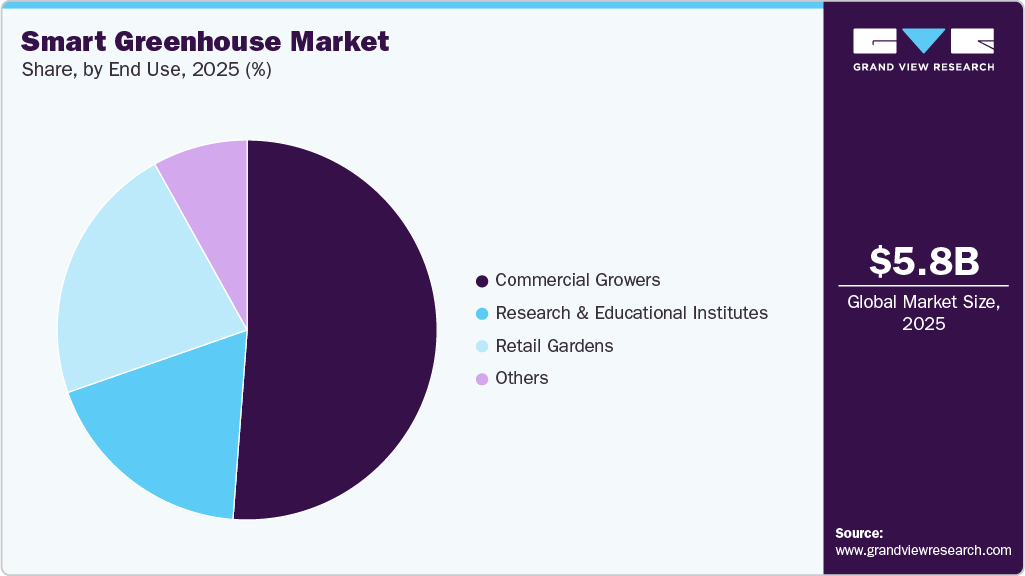
The commercial growers segment dominated the market in 2025. The demand for supply chain reliability and contractual fulfillment drives adoption within this segment. Commercial growers often supply large retailers, food processors, and exporters under long-term agreements. These contracts require consistent quality, uniform grading, and timely delivery schedules. Smart greenhouse systems allow growers to plan production cycles with high precision, aligning harvest timelines with contractual commitments. Automated monitoring reduces unexpected disruptions that could compromise supply agreements. By ensuring reliability and predictability, smart greenhouses strengthen the commercial grower’s position within structured supply chains.
 To learn more about this report, Download Free Sample Report
 The retail & garden centers segment is projected to be the fastest-growing segment from 2026 to 2033. The growing consumer interest in home gardening and do-it-yourself cultivation is driving segment growth. Urban households are increasingly engaging in balcony gardening, rooftop farming, and small-scale vegetable production as part of healthier lifestyle choices. Retail and garden centers are responding by offering technologically enhanced greenhouse kits and smart growing systems tailored for individual consumers. Smart greenhouse solutions allow garden centers to showcase automated irrigation, climate monitoring, and LED lighting systems that simplify plant care for beginners. These technologies reduce the learning curve associated with plant maintenance and improve customer success rates. As more consumers seek convenient, reliable gardening solutions, retail outlets are expanding their smart greenhouse offerings to capture this demand.
Regional Insights
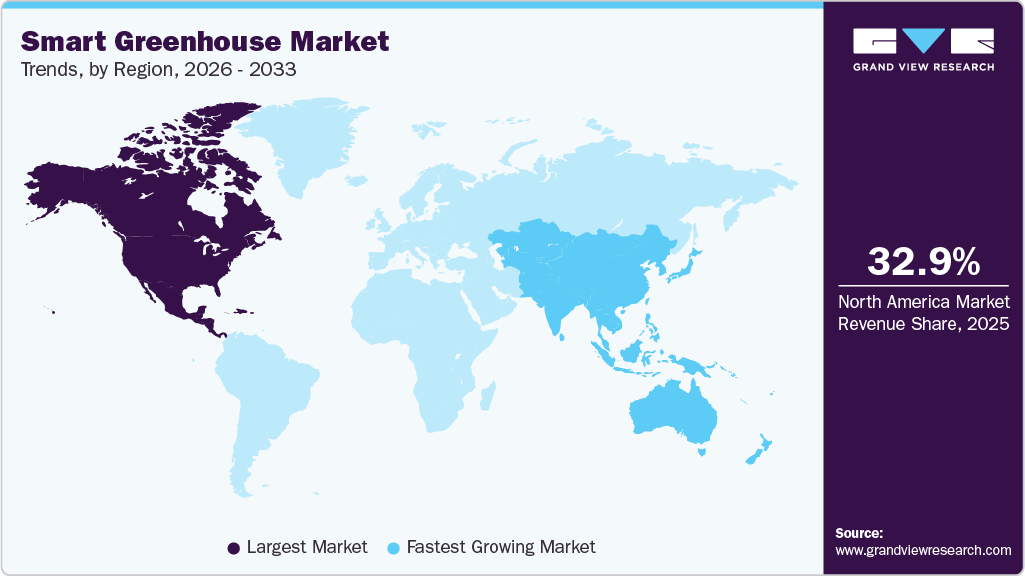
North America dominated the smart greenhouse market with a market share of 32.9% in 2025. The expanding role of urban agriculture and localized food systems within metropolitan regions is driving market growth. Cities such as New York, Los Angeles, Chicago, Toronto, and Vancouver have invested in vertical farms, rooftop greenhouses, and other controlled-environment agriculture initiatives to strengthen local food production. These urban cultivation models often rely on smart greenhouse technology to optimize limited space and maximize productivity. By reducing food miles and supplying fresh produce directly to urban consumers, smart greenhouses support municipal food security strategies and reduce carbon emissions associated with long-distance transportation. As urban populations swell and local food networks evolve, controlled-environment agriculture becomes an integral part of resilient, distributed food systems, further driving market growth.
 To learn more about this report, Download Free Sample Report
 U.S. Smart Greenhouse Market Trends
The U.S. smart greenhouse industry dominated the North America market in 2025. The expanding role of urban agriculture and localized food systems within metropolitan regions is driving market growth. Cities such as New York, Los Angeles, Chicago, Toronto, and Vancouver have invested in vertical farms, rooftop greenhouses, and other controlled-environment agriculture initiatives to strengthen local food production. These urban cultivation models often rely on smart greenhouse technology to optimize limited space and maximize productivity. By reducing food miles and supplying fresh produce directly to urban consumers, smart greenhouses support municipal food security strategies and reduce carbon emissions associated with long-distance transportation. As urban populations swell and local food networks evolve, controlled-environment agriculture becomes an integral part of resilient, distributed food systems, further driving market growth.
Asia Pacific Smart Greenhouse Market Trends
The Asia Pacific smart greenhouse industry is expected to be the fastest growing segment, with a CAGR of 11.7% over the forecast period. The demand for high-value horticultural and specialty crops is a major growth catalyst. In many Asia Pacific markets, rising middle-class incomes are driving greater consumption of premium fruit varieties, herbs, leafy greens, and organically grown produce. These high-value crops often require precise cultivation conditions to achieve desired quality and marketable attributes, such as extended shelf life, consistent flavor, and attractive appearance. Smart greenhouse systems support these requirements through controlled lighting, nutrient delivery, and environmental monitoring. Precision cultivation not only improves yield consistency but also enhances quality parameters crucial for premium pricing. As consumer preferences diversify and demand for specialty crops grows, smart greenhouses enable growers to produce these high-value crops more effectively and profitably.
The smart greenhouse industry in China is projected to grow during the forecast period. China’s rapid urbanization and the development of peri-urban agriculture further drive the adoption of smart greenhouses. As major cities like Shanghai, Beijing, and Guangzhou expand, local governments encourage the development of nearby controlled-environment agriculture to supply urban populations with fresh produce. Peri-urban greenhouse clusters reduce transportation time and costs while improving food freshness and safety. Smart greenhouse systems allow farms to operate efficiently in limited spaces, maximizing output per unit area. Remote monitoring capabilities also enable operators to manage multiple facilities from centralized urban hubs, reducing labor pressures. Urban and peri-urban policies increasingly prioritize technologies that support sustainable and efficient local food systems, making smart greenhouses integral to regional agricultural planning. This integration of urban development and technology adoption accelerates market growth.
Europe Smart Greenhouse Market Trends
Europe smart greenhouse industry is projected to grow during the forecast period. The expansion of export-oriented horticultural sectors in Europe drives the adoption of smart greenhouses. European growers participating in international markets must meet stringent quality, safety, and traceability standards imposed by importing countries, particularly in Asia and the Middle East. Smart greenhouse technology enables growers to document cultivation practices, precisely regulate environmental variables, and maintain the production consistency required by global buyers. Digital management systems provide detailed records that support compliance with international phytosanitary and quality protocols. Access to these export markets increases the commercial value of European produce and incentivizes growers to adopt technology that enhances competitiveness. As global demand for safe, high-quality horticultural products continues to expand, the smart greenhouse segment in Europe benefits from increased integration into international supply chains.
The smart greenhouse industry in UK is expected to grow during the forecast period. The accelerating adoption of digital and precision agriculture technologies in the UK is a major growth driver for the smart greenhouse market. Smart greenhouses integrate easily with digital monitoring platforms, IoT sensors, and data analytics tools that provide real-time insights into environmental conditions, crop health, and resource use. Growers can remotely adjust irrigation schedules, climate parameters, and lighting based on actionable data rather than manual observation. This digitization improves operational efficiency, enhances decision-making, and reduces the guesswork traditionally associated with horticultural management. The UK’s well-established technology infrastructure and high levels of digital literacy among producers further facilitate the adoption of these technologies. As precision agriculture technologies become more accessible and cost-effective, smart greenhouse systems increasingly appeal to growers seeking to modernize and optimize production.
Key Smart Greenhouse Company Insights
Some of the key companies operating in the market, include YANMAR HOLDINGS CO., LTD., and Netafim, among others are some of the leading participants in the smart greenhouse market.
-
YANMAR HOLDINGS CO., LTD. is a diversified Japanese industrial group. Its smart greenhouse approach integrates climate control systems, automated irrigation and fertigation units, sensor networks, and centralized management platforms to optimize plant growth conditions. By monitoring variables such as temperature, humidity, carbon dioxide levels, light intensity, and soil moisture, Yanmar’s systems enable data-driven decision-making that enhances crop consistency and productivity. These technologies allow greenhouse operators to maintain stable growing environments while reducing manual intervention and improving resource efficiency.
-
Netafim is a global agricultural technology company. Netafim delivers integrated solutions that combine precision irrigation, fertigation, climate monitoring, and digital control technologies to optimize controlled-environment agriculture. Its smart greenhouse approach is built on delivering precise water and nutrient dosing directly to the plant root zone through advanced drip and micro-irrigation systems, supported by automated controllers and sensor-based monitoring. These systems continuously collect data on soil moisture, temperature, humidity, and other environmental variables, enabling growers to make informed decisions and maintain optimal growth conditions.
Priva and Synnefa, Inc. are some of the emerging market participants in the smart greenhouse market.
-
Priva is a Netherlands-based technology company specializing in climate control, process automation, and data-driven solutions for horticulture, indoor farming, and building management. Priva delivers comprehensive automation and climate-control solutions to create optimal growing conditions in controlled environments. Its smart greenhouse offerings include advanced climate computers, irrigation and fertigation control systems, sensor networks, and centralized software platforms that monitor and regulate temperature, humidity, light levels, carbon dioxide concentration, and water distribution. Priva’s smart greenhouse solutions are highly integrated, combining hardware infrastructure with cloud-based analytics and remote management capabilities. Growers can monitor performance metrics in real time, access historical data, and implement predictive strategies to optimize energy use, water consumption, and nutrient delivery.
-
Synnefa, Inc. is an agricultural technology company focused on digital farming solutions and smart greenhouse management systems. Its solutions monitor critical environmental parameters, including temperature, humidity, soil moisture, light intensity, and carbon dioxide levels, enabling growers to maintain optimal conditions for plant growth. By collecting and analyzing real-time data, the system supports automated adjustments in irrigation, ventilation, shading, and fertigation processes. This precision-based approach enhances crop quality and yield consistency while reducing resource waste and operational inefficiencies.
Key Smart Greenhouse Companies:
The following key companies have been profiled for this study on the smart greenhouse market.
- Henan Yutuo Agricultural Technology Co.,Ltd.
- Intellias
- Koidra Inc.
- Netafim
- Novedades Agrícolas, S.A.
- Optimal Labs Limited
- Priva
- Softweb Solutions Inc.
- SPAGNOL srl
- Synnefa, Inc.
- Viemose DGS
- Wadsworth Controls
- YANMAR HOLDINGS CO., LTD.
Competitive Benchmarking
Operating Strategies
Competitive Edge
Weakness
Mature Players: Priva; Netafim; YANMAR HOLDINGS CO., LTD.; Wadsworth Controls; Novedades Agrícolas, S.A.
- Deliver integrated end-to-end greenhouse solutions combining climate control, irrigation, fertigation, energy management, and crop analytics.
- Focus on modular retrofit solutions, allowing growers to upgrade existing greenhouses without full replacement.
- strong brand recognition among commercial greenhouse operators worldwide.
- Comprehensive portfolios covering hardware, software, and services create high customer retention and recurring revenues.
- Higher upfront costs make solutions less accessible to small and mid-sized growers.
- Dependence on greenhouse capital expenditure cycles exposes revenues to agricultural commodity volatility.
Emerging Players: Koidra Inc.; Synnefa, Inc.; Optimal Labs Limited; Intellias; Softweb Solutions Inc.
- Use subscription-based SaaS models to lower upfront costs and create recurring revenue streams.
- Partner with research institutions and leading growers to validate yield improvements and energy savings.
- Faster innovation cycles and the ability to customize solutions to specific crops and grower needs.
- Lower capital commitment for growers supports faster adoption in cost-sensitive markets.
- Limited installed base and smaller service teams compared with established incumbents.
- Geographic reach and local technical support remain more limited than those of mature global competitors.
Recent Developments
-
In February 2026, Koidra partnered with Windset Farms on a smart greenhouse initiative backed by the B.C. Centre for Agritech Innovation. The collaboration centers on leveraging advanced data analytics and real-time monitoring systems to optimize greenhouse performance, particularly in climate regulation, nutrient management, and early identification of crop stress. As part of the project, Koidra provides its AI-driven autonomous greenhouse control platform to help maintain consistent growing conditions and enhance operational precision. Together, the partners aim to strengthen commercial greenhouse productivity through intelligent automation and advanced analytics.
-
IN October 2025, Ledgnd partnered with Viemose DGS to embed the MyLedgnd platform directly into Viemose’s Moving Gutter Systems. Through this collaboration, growers gain a unified, real-time overview of greenhouse conditions, enabling them to respond swiftly to changes in plant health and environmental parameters. The integrated solution enhances operational efficiency by optimizing the use of energy and water resources, while significantly reducing overall waste.
-
In June 2025, Sollum Technologies partnered with Optimal Labs Limited, combining Sollum’s fully dynamic LED lighting technology with Optimal’s AI-driven climate and irrigation control platform. This integration allows growers to accurately implement their preferred cultivation strategies, even amid rapidly fluctuating weather conditions.
Smart Greenhouse Market Report Scope
Report Attribute
Details
Market size in 2025
USD 5.8 billion
Estimated market size in 2026
USD 6.6 billion
Projected market size by 2033
USD 18.0 billion
Growth rate
CAGR of 15.4% from 2026 to 2033
Actual data
2021 - 2024
Forecast period
2026 - 2033
Quantitative units
Revenue in USD million/billion and CAGR from 2026 to 2033
Report coverage
Revenue forecast, company share, competitive landscape, growth factors, and trends
Segments covered
Component, type, farming type, crop type, end use, region
Regional scope
North America; Europe; Asia Pacific; Latin America; MEA
Country scope
U.S.; Canada; Mexico; UK; Germany; France; China; India; Japan; Australia; South Korea; Brazil; UAE; Saudi Arabia; South Africa
Key companies profiled
Henan Yutuo Agricultural Technology Co.,Ltd.; Intellias; Koidra Inc., Netafim; Novedades Agrícolas, S.A.; Priva, Softweb Solutions Inc.; SPAGNOL srl; Synnefa, Inc.; Wadsworth Controls; YANMAR HOLDINGS CO., LTD.; Optimal Labs Limited; Viemose DGS
Customization scope
Free report customization (equivalent to 8 analysts working days) with purchase. Addition or alteration to country, regional & segment scope.
Pricing and purchase options
Avail customized purchase options to meet your exact research needs. Explore purchase options
Global Smart Greenhouse Market Report Segmentation
This report forecasts revenue growth at global, regional, and country levels and provides an analysis of the latest industry trends in each of the sub-segments from 2021 to 2033. For this study, Grand View Research has segmented the smart greenhouse market report based on component, type, farming type, crop type, end use, and region.
-
Component Outlook (Revenue, USD Billion, 2021 - 2033)
-
Hardware
-
HVAC Systems
-
LED Grow Lights
-
Sensors
-
Irrigation Systems
-
Climate Control Systems
-
Others
-
-
Software
-
Cloud-Based
-
Web-Based
-
-
Services
-
-
Type Outlook (Revenue, USD Billion, 2021 - 2033)
-
Glass
-
Plastic
-
-
Farming Type Outlook (Revenue, USD Billion, 2021 - 2033)
-
Hydroponics
-
Aeroponics
-
Soil-Based Cultivation
-
Others
-
-
Crop Type Outlook (Revenue, USD Billion, 2021 - 2033)
-
Fruits & Vegetables
-
Flowers & Ornamentals
-
Nursery Crops
-
Herbs & Medicinal Plants
-
-
End Use Outlook (Revenue, USD Billion, 2021 - 2033)
-
Commercial Growers
-
Research & Educational Institutes
-
Retail & Garden Centers
-
Others
-
-
Regional Outlook (Revenue, USD Billion, 2021 - 2033)
-
North America
-
U.S.
-
Canada
-
Mexico
-
-
Europe
-
Germany
-
UK
-
France
-
-
Asia Pacific
-
China
-
India
-
Japan
-
South Korea
-
Australia
-
-
Latin America
-
Brazil
-
-
Middle East & Africa
-
UAE
-
Saudi Arabia
-
South Africa
-
-
Delivered Customizations
This report has been delivered with the following In-depth customizations
Client Request
Customization Delivered
Value Adds
Technology adoption and innovation trend analysis
- Analysis of integration trends involving IoT sensors, cloud-based analytics, and predictive controls.
- Review of commercialization readiness and adoption use cases.
- Identified innovation areas with strong commercial relevance.
- Supported long-term R&D and investment planning.
Regulatory and sustainability impact assessment
- Review of water-efficiency standards, energy regulations, food safety requirements, and sustainability initiatives affecting greenhouse operations.
- Analysis of how renewable energy integration and ESG priorities influence technology adoption.
- Regional comparison of policy support and agricultural modernization programs.
- Clarified compliance considerations and sustainability opportunities.
- Supported ESG-focused positioning and messaging.
- Identified policy-driven market expansion opportunities.
Customer needs and buying criteria assessment
- Evaluation of key decision factors such as ROI, interoperability, ease of use, local service support, and agronomic expertise.
- Mapping of common pain points and unmet needs across grower types.
- Supported customer-centric feature prioritization.
- Enhanced understanding of procurement and adoption barriers.
Frequently Asked Questions About This Report
Factors such as rising adoption of increasing demand for high-yield and quality crop production and increasing integration of IoT, sensors, and automation technologies are the key factors driving the market growth.
The hardware segment led with a 57.4% revenue share in 2025, while the software segment is the fastest-growing.
The glass segment held the largest revenue share in 2025, while the plastic segment is the fastest-growing.
The soil-based cultivation segment held the largest revenue share in 2025, while the hydroponics segment is the fastest-growing.
Fruits & vegetables segment held the largest share in 2025, while the herbs & medicinal plants segment is the fastest-growing.
North America dominated with a 32.9% revenue share in 2025.
Asia Pacific is the fastest-growing region over the forecast period.
Key players include Henan Yutuo Agricultural Technology Co.,Ltd.; Intellias; Koidra Inc., Netafim; Novedades Agrícolas, S.A.; Priva, Softweb Solutions Inc.; SPAGNOL srl; Synnefa, Inc.; Wadsworth Controls; YANMAR HOLDINGS CO., LTD.; Optimal Labs Limited; Viemose DGS
The global smart greenhouse market size was valued at USD 5.8 billion in 2025 and is estimated at USD 6.6 billion for 2026.
The global smart greenhouse market is expected to grow at a CAGR of 15.4% from 2026 to 2033, reaching USD 18.0 billion by 2033.
About the Author(s)
Next Generation Technologies Research Team
Technology · Next Generation TechnologiesThis report was authored by the next generation technologies research team at Grand View Research - comprising two research analysts, one senior research analyst, and one industry expert - with specialized expertise in the next generation technologies segment of the technology industry. All findings are based on proprietary technology databases, executive interviews, and regulatory analysis, subject to internal peer review prior to publication.
Last Updated:
Speak to Analyst

Customize this report to your needs - add regions, segments, or data points, with 20% free customization.
Or view our licence options:


ISO 9001:2015 & 27001:2022 Certified
We are GDPR and CCPA compliant! Your transaction & personal information is safe and secure. For more details, please read our privacy policy.


